
A complete issue · 36 pages · 1921
Judge — July 23, 1921
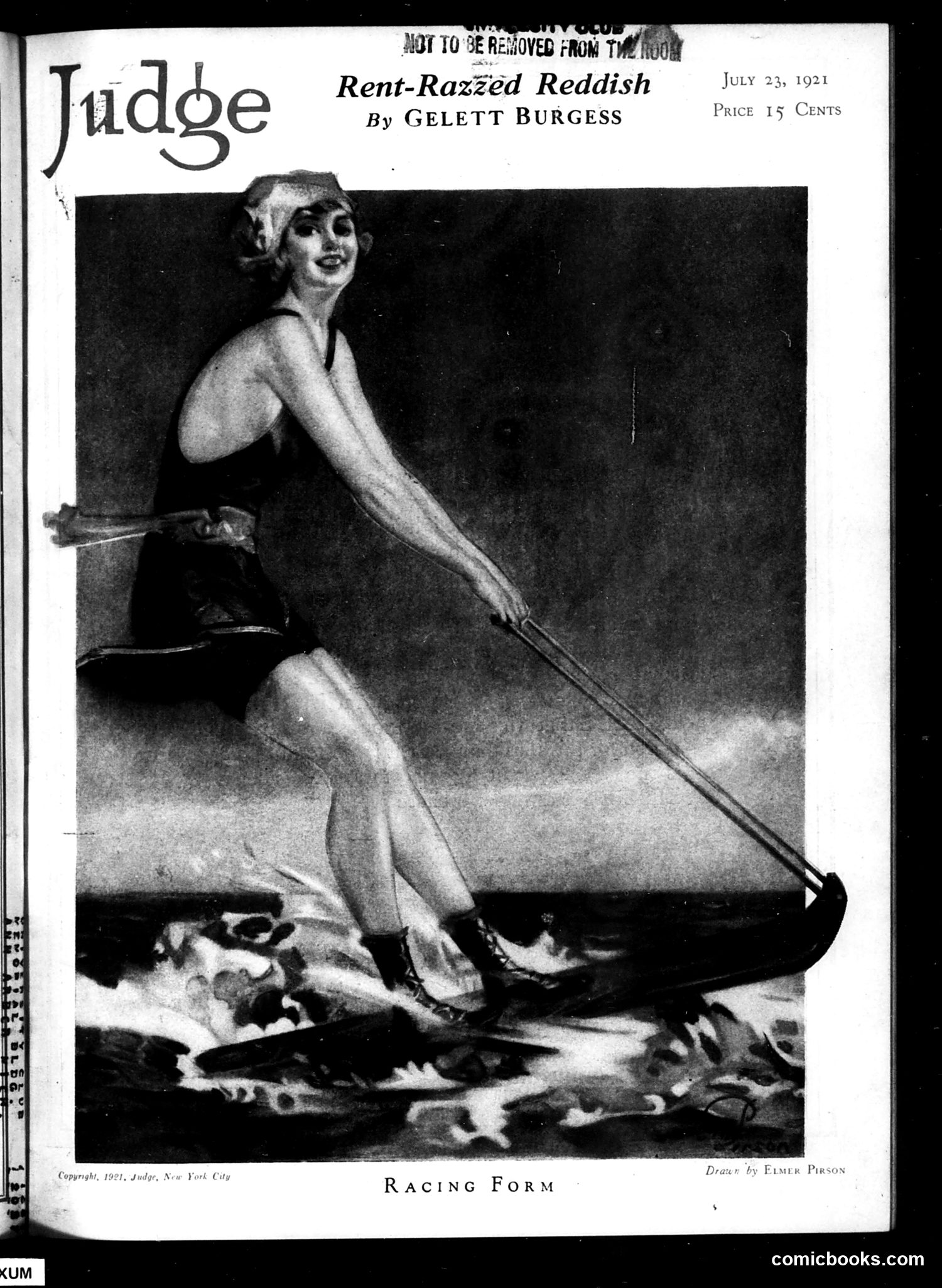
This page features an illustration titled "Rent-Razzed Reddish" by Gelett Burgess, drawn by Elsie Pierson. The image shows a woman in 1920s attire (short hair, minimal clothing) wielding what appears to be a sword or pole against large fish. The title "Rent-Razzed Reddish" suggests social commentary on housing costs ("rent-razzed") combined with what may be a political reference (the term "reddish" could allude to communist sympathies, a common 1920s concern). The "Racing Form" subtitle indicates this is likely satirizing financial speculation or betting culture. The woman's athletic pose and minimal dress reflect 1920s "New Woman" imagery—post-suffrage female independence—though Judge typically presented such modernity satirically.
This page is primarily **advertising copy**, not satire or political commentary. It's a promotional advertisement for *Leslie's* magazine (Leslie's Weekly), promoting the publication under new management. The ad emphasizes that *Leslie's* offers content that is "Informative, Instructive, Entertaining"—claiming the magazine features articles and pictures readers "like to see." The copy highlights the publication's "timeliness and refreshing attractiveness" as reasons for its appeal. The final line reads "It Is Interesting"—the ad's core pitch to potential readers. There are **no political cartoons or satirical figures** on this page. The decorative initial letter "A" is the only visual element besides the text layout itself. This is straightforward magazine promotion from what appears to be the early 20th century based on typography and advertising style.
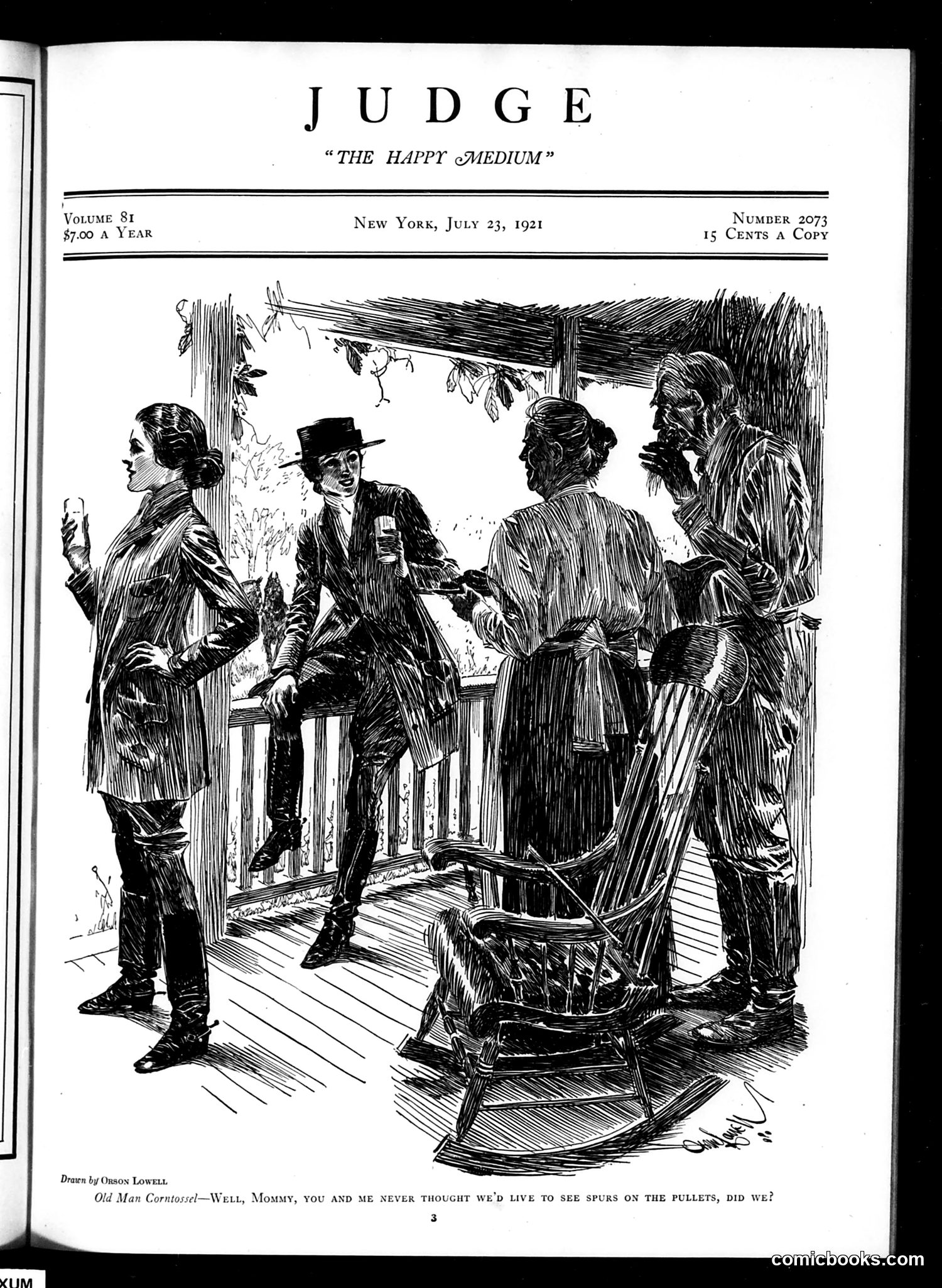
This illustration by Onslow Lowell depicts an "Old Man Cornered" encountering what appears to be military or uniformed figures on a porch or veranda. The caption reads: "Well, Mommy, you and me never thought we'd live to see spurs on the pullets, did we?" The satire appears to mock the appearance of women wearing military-style boots or spurs—traditionally masculine military attire. "Pullets" (young hens) is slang for young women. This likely comments on post-WWI social changes, particularly women's shifting roles and dress conventions following the war, when women's fashion and social freedoms were rapidly modernizing. The "old man" represents conservative attitudes being confronted with these contemporary changes, creating humor through the clash between traditional and modern values.
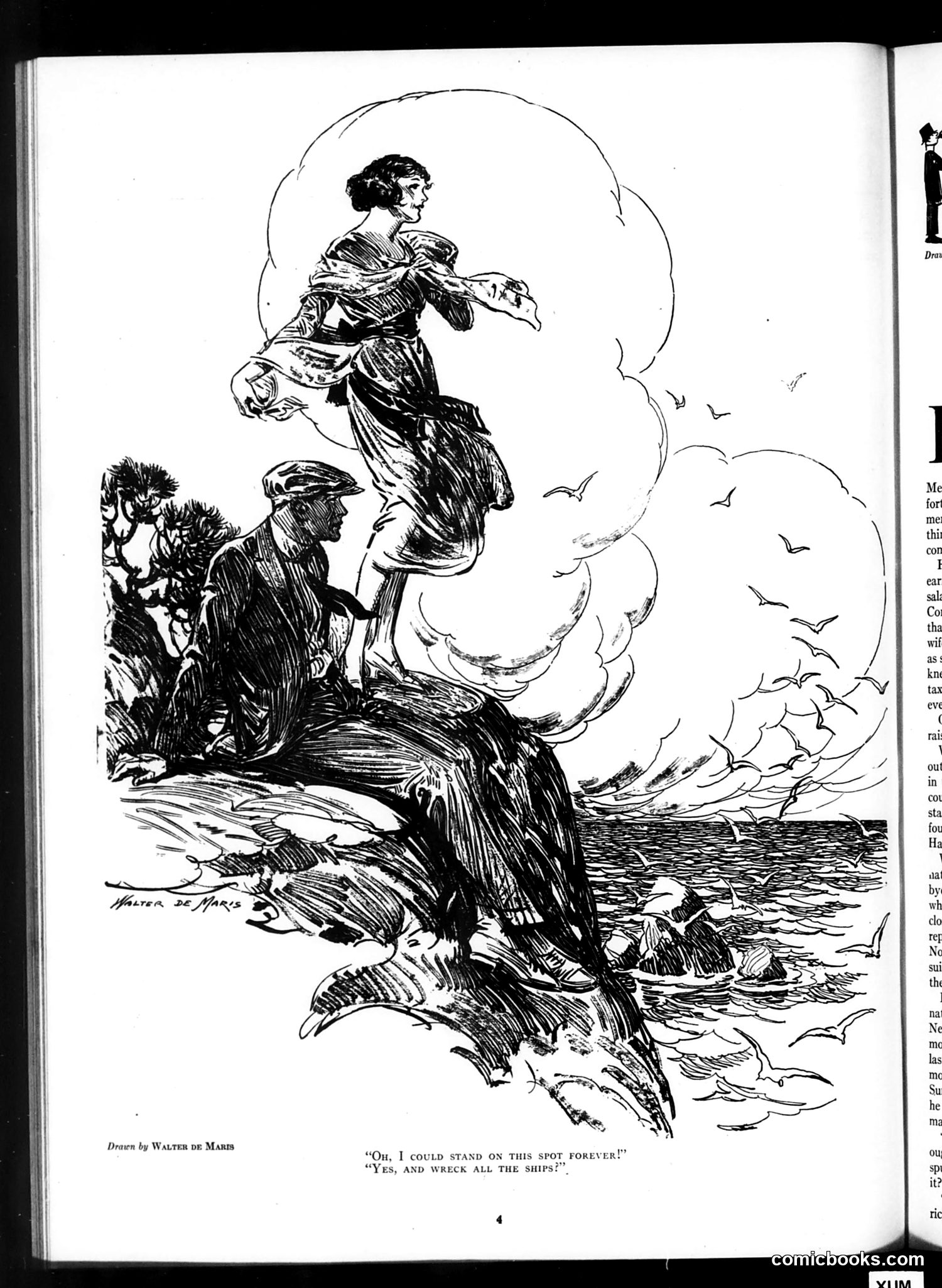
This page features an illustration by Walter de Maris titled "Oh, I could stand on this spot forever!" / "Yes, and wreck all the ships!" The cartoon depicts a woman standing on a rocky coastal outcrop, gesturing dramatically toward the sea where ships appear in the distance. A man beside her responds to her romantic declaration about the location. The satire appears to target female vanity or romantic sentimentality. The woman's poetic desire to remain in one beautiful spot is mocked through the man's retort suggesting her presence would cause maritime disaster—likely implying either that she's dangerously distracting to sailors or, less charitably, that her very existence poses a hazard. This reflects period attitudes combining romantic idealization of women with misogynistic humor about female foolishness or destructiveness.
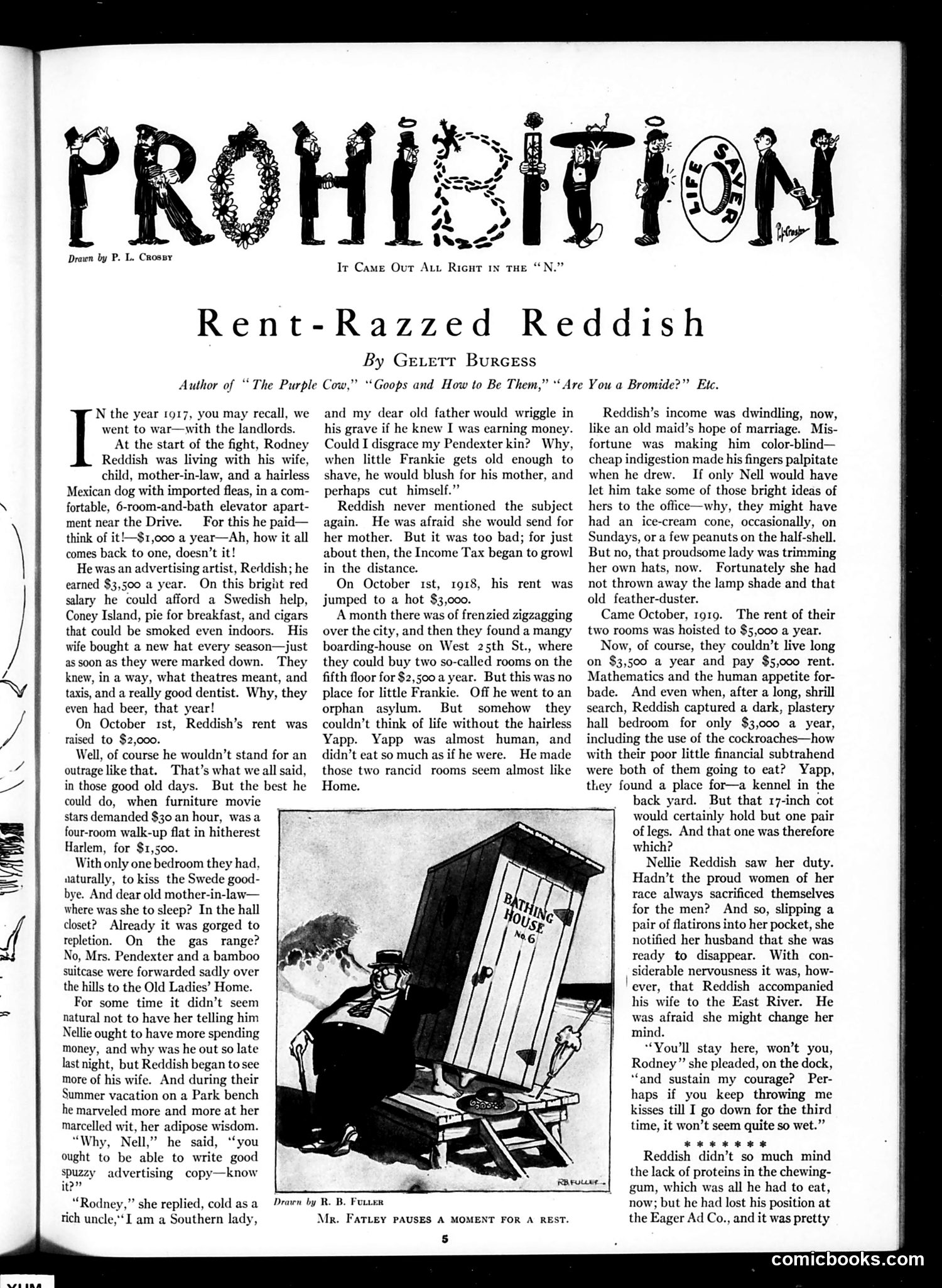
This is a satirical short story illustrated by P.L. Crosby, mocking the housing crisis of 1917 New York. The protagonist, Rodney Reddish, is an advertising artist struggling with skyrocketing rent—jumping from $1,000 to $3,000 yearly. The satire targets how landlords exploited tenants during WWI housing shortages. Reddish desperately seeks affordable housing, eventually finding a cheap two-room apartment, only to discover it's inadequate (barely fits furniture, includes a rooster-haunted space). The illustration shows him cramped in his tiny living situation. The story mocks both Reddish's delusions about middle-class stability and the predatory rental market that trapped working professionals. It's commentary on economic desperation dressed as comedy—a relatable complaint for Judge's urban, middle-class readership.
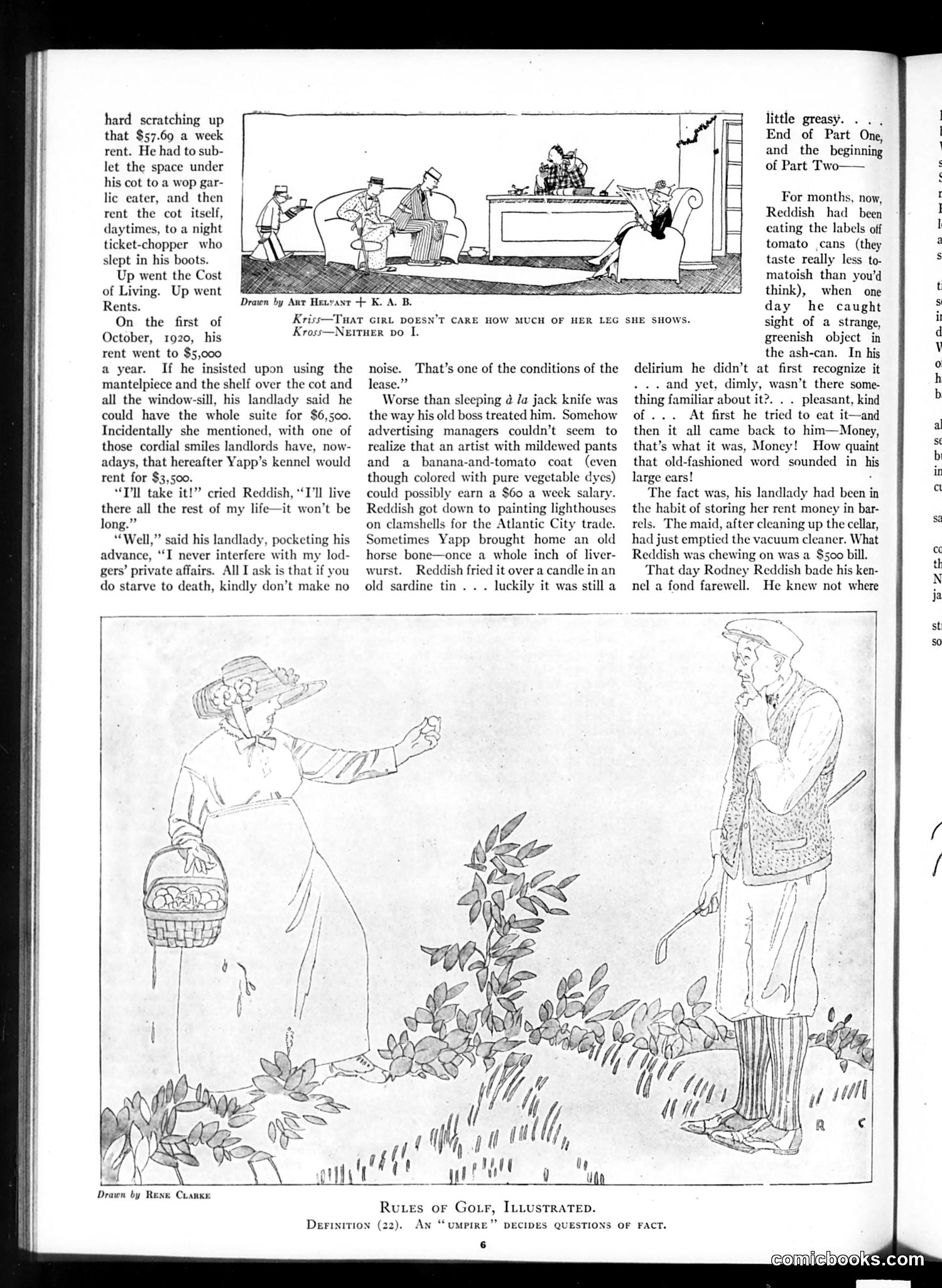
This page contains two unrelated pieces: **Top Section:** A narrative about "Reddish," a struggling artist in 1920s New York. The text describes his poverty—$5,000/year rent for a tiny space, eating tomato-can labels—and his landlord's threat to evict him. The accompanying illustration shows Reddish and his landlord in conflict over living conditions. This satirizes the housing crisis and economic hardship facing working artists and poor New Yorkers during this era. **Bottom Section:** A cartoon titled "Rules of Golf, Illustrated" showing a woman in a garden confronting a man, captioned as an "umpire" deciding factual questions. The joke appears to mock golf's complex rules and how disputes are resolved, though the specific reference is unclear without broader context.
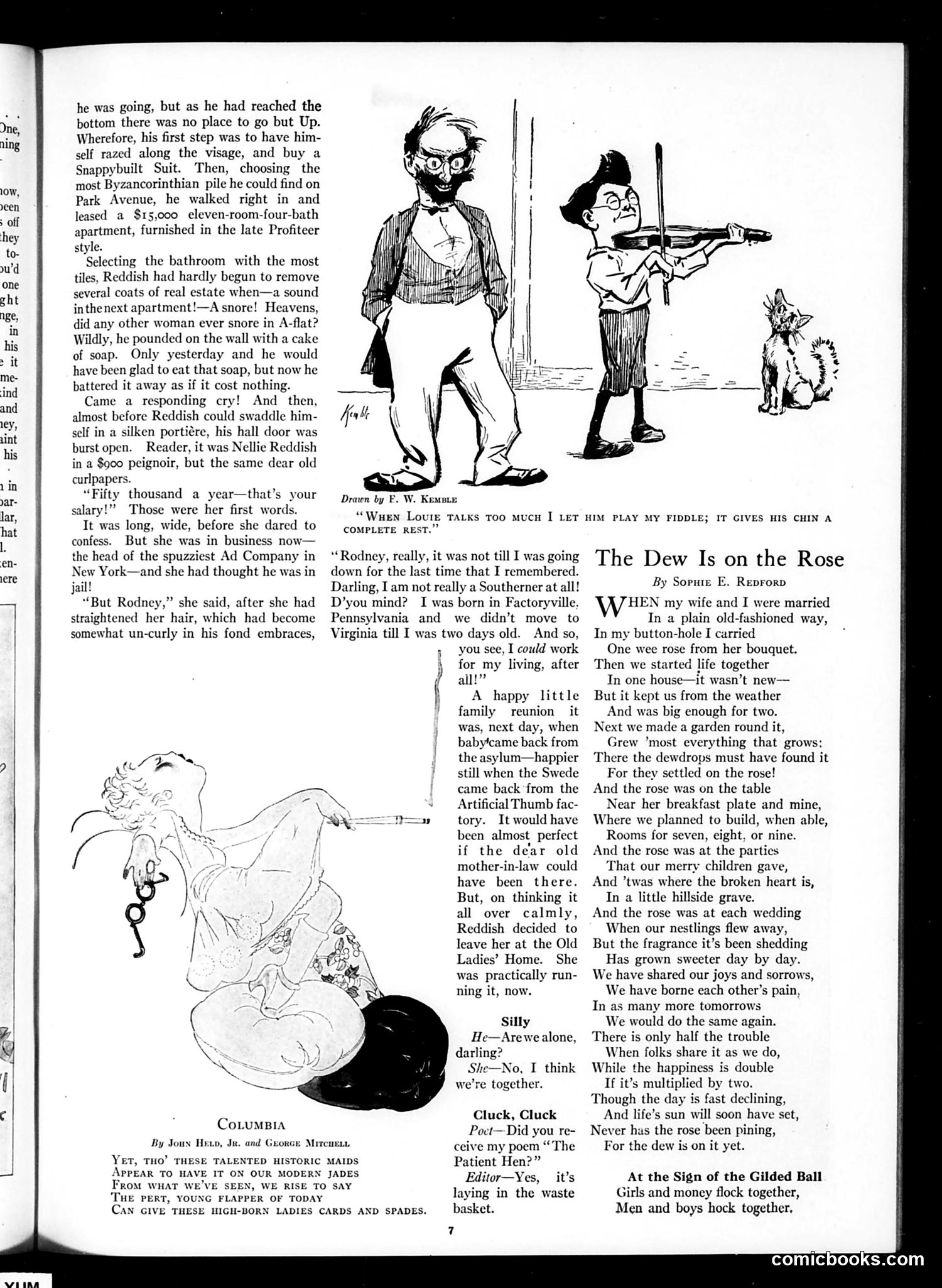
This page contains three distinct pieces from *Judge* magazine (likely early 20th century): **Main Story Cartoon** (top): A rags-to-riches narrative about "Reddish," a man who suddenly becomes wealthy and moves to a fancy Park Avenue apartment, only to discover his wife Nellie—whom he thought was in jail—has become a successful advertising executive. The satire mocks post-WWI "Profiteer" wealth (war profiteers), nouveau-riche excess, and changing gender roles (the wife as breadwinner surprised him). **"Columbia" Cartoon** (bottom left): A classical female allegorical figure (Columbia, representing America) illustrated by the credited artists. **Miscellaneous Humor Snippets** (center-right): Brief joke exchanges, including one about a poet's rejected manuscript. **Poetry** ("The Dew Is on the Rose"): Sentimental verse about married life and enduring love—likely filler content. The page primarily satirizes American wealth inequality and social mobility during the post-WWI era.
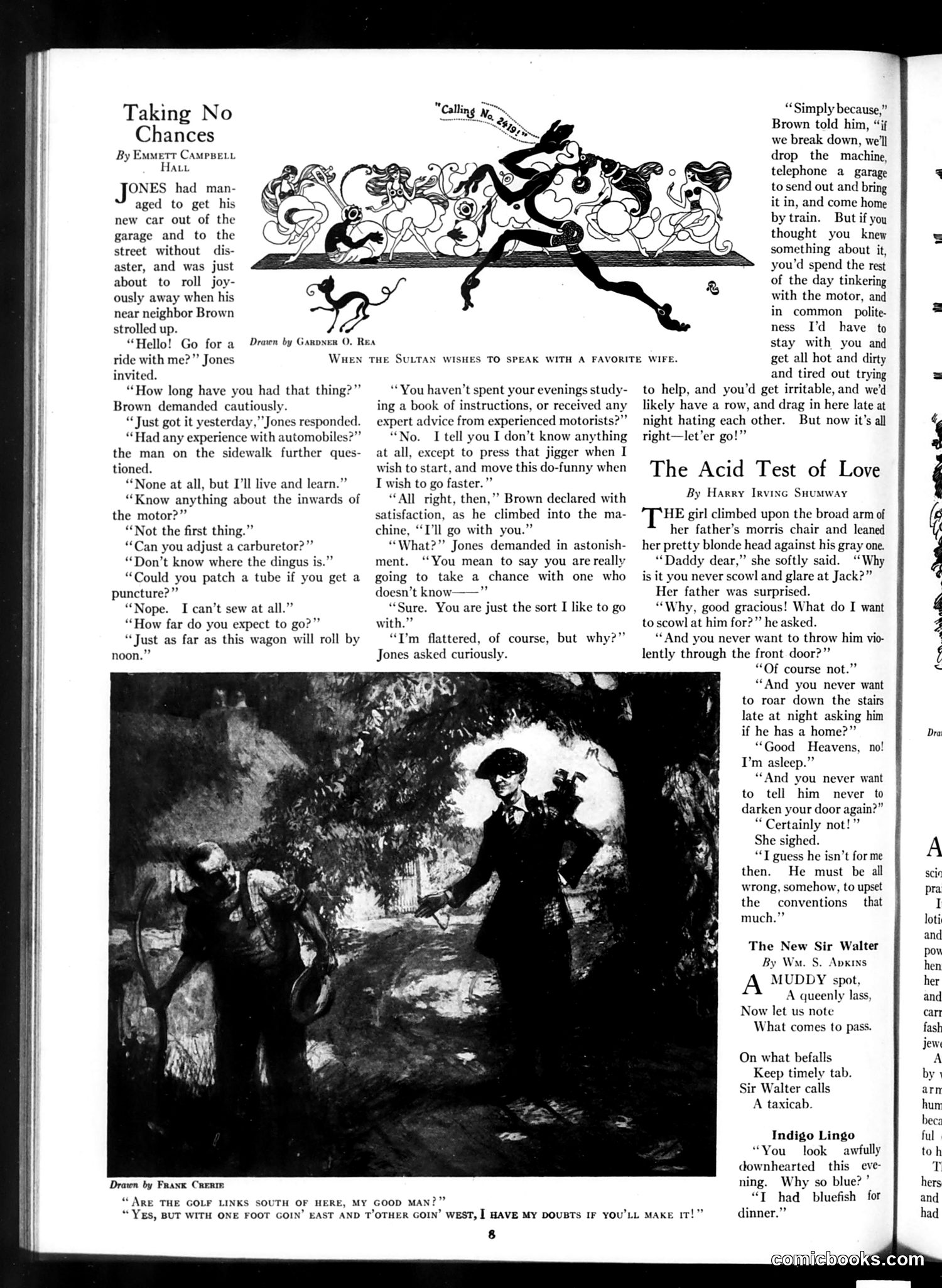
This comic story satirizes the early automobile era's uncertainty. Jones, a new car owner with zero mechanical knowledge, is about to drive when neighbor Brown—despite learning Jones can't adjust a carburetor, patch tires, or identify engine parts—eagerly joins him. Brown's reasoning reveals the joke's logic: an inexperienced driver means mechanical breakdown is inevitable, guaranteeing a quick phone call to a garage and train ride home. By contrast, if Jones *thought* he knew cars, he'd waste the entire day tinkering while Brown, out of politeness, would be trapped helping—resulting in frustration, quarreling, and a ruined afternoon. The satire targets both the era's newfangled automobile anxiety and human nature: sometimes admitting complete incompetence is more practical than pretending expertise. It's also a gentle jab at the social obligation to help a struggling friend, which could prove more exhausting than actual mechanical failure.
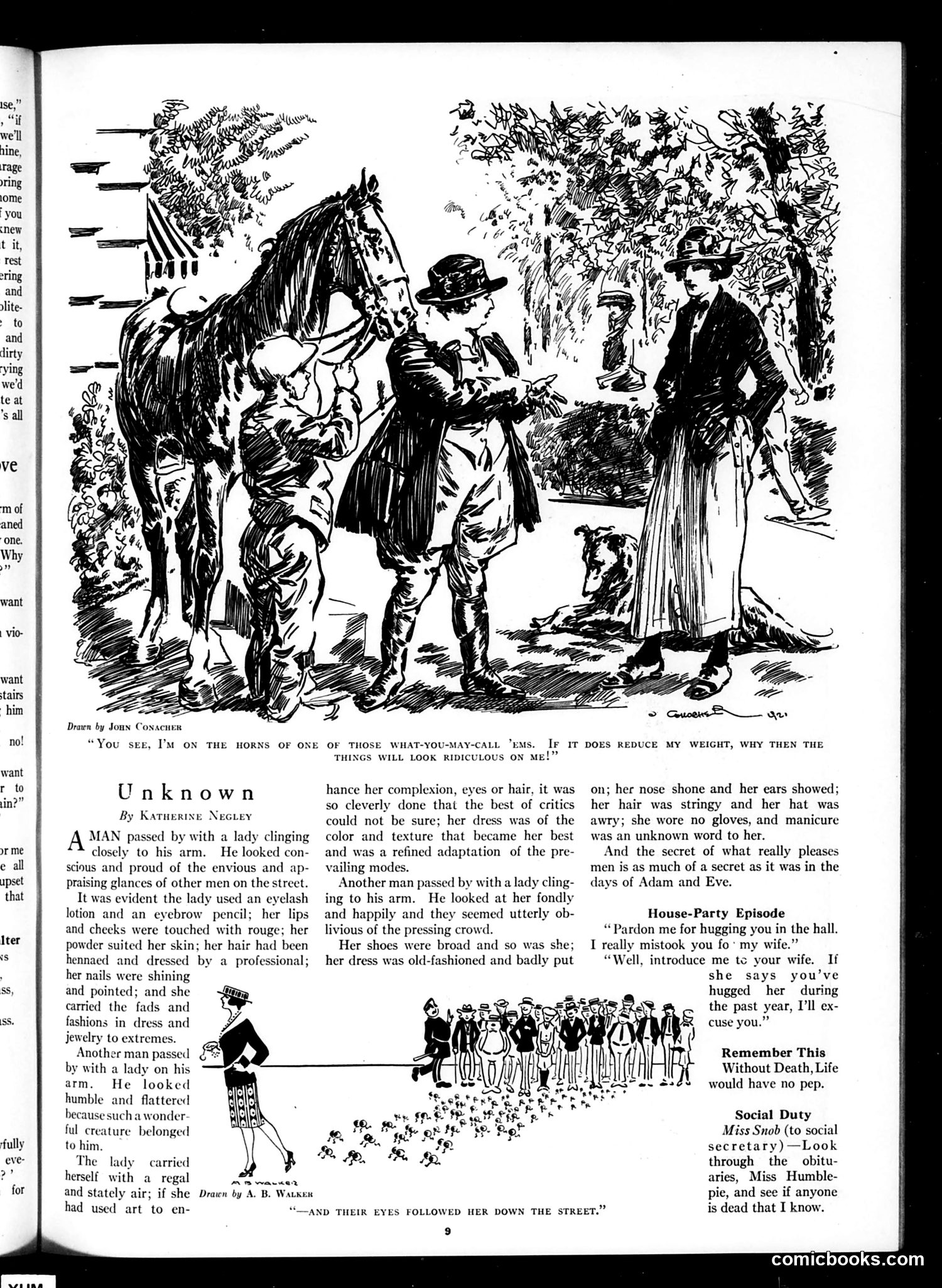
This story satirizes male superficiality and evolving standards of female beauty in the early 20th century. Negley presents three couples to expose what men *claim* to value versus what actually attracts them. The first man is proud to be seen with an elaborately made-up woman wearing fashionable jewelry and clothing—she's a status symbol. The second man appears humble with a naturally beautiful woman in refined, understated dress. The third man is genuinely happy with an unattractive, plainly dressed woman with no cosmetics or style. The concluding moral—that true attraction remains a mystery "as it was in the days of Adam and Eve"—suggests that despite all the artifice and fashion industry promises, authentic human connection defies explanation. The satire targets both the cosmetics industry's marketing and male pretense about their preferences. It's a commentary on how beauty standards and consumer culture were reshaping courtship and female self-presentation during this period.
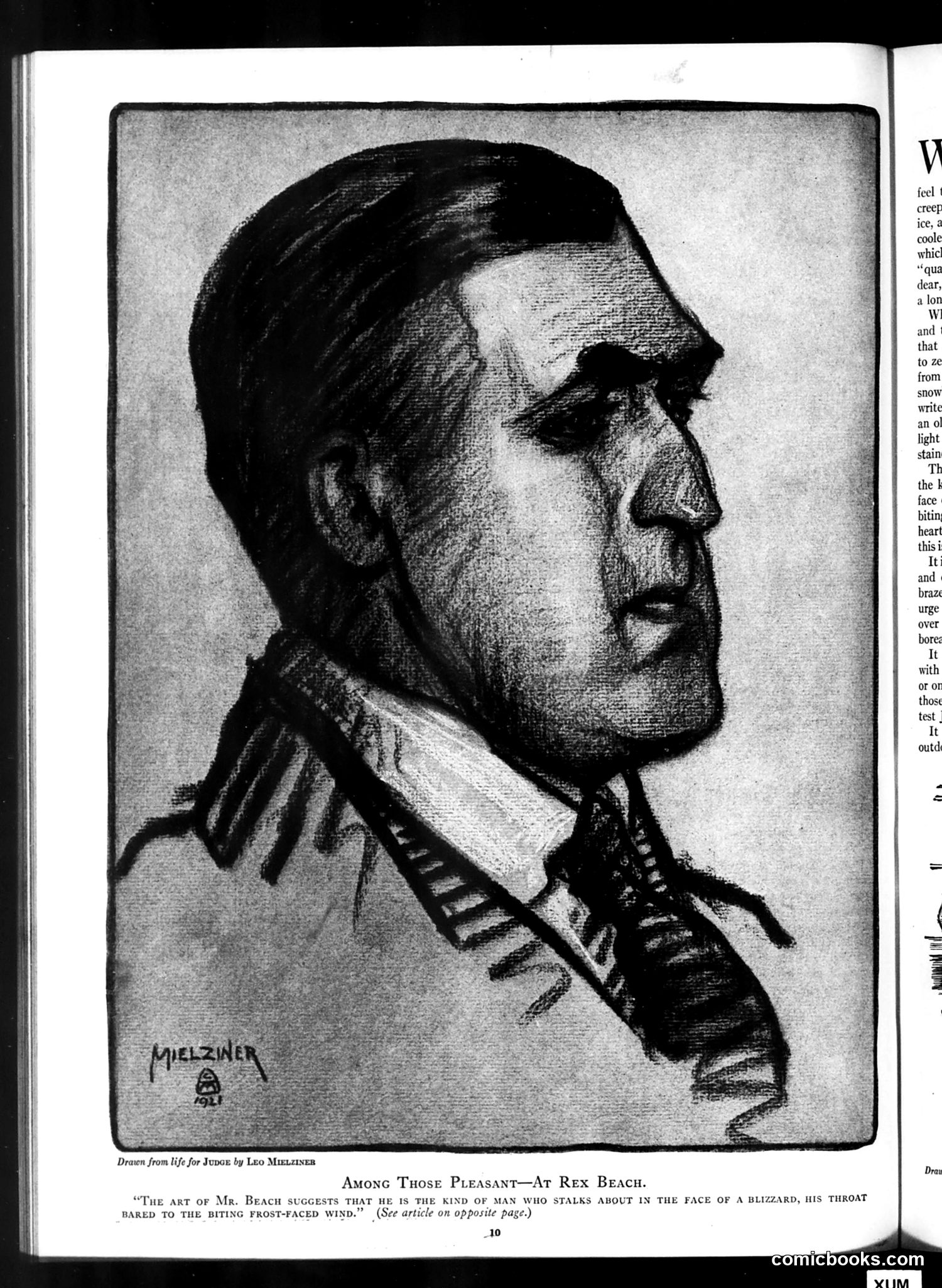
This is a portrait sketch titled "Among Those Pleasant—At Rex Beach," drawn by Leo Mielziner from life for *Judge* magazine. The caption describes a man (Mr. Beach) who defiantly exposes himself to harsh winter conditions—walking in blizzards with his throat bare to freezing wind. The satire appears to mock someone's affected toughness or stubborn disregard for comfort. The phrase "the art of Mr. Beach suggests" indicates this is satirizing a particular public figure's persona or reputation for hardy indifference to hardship. Without seeing the referenced article on the opposite page, the full context is unclear, but the cartoon ridicules what Judge considered an affectation of masculine toughness or defiant stoicism. The accompanying text (partially OCR'd and illegible here) likely provides additional satirical commentary on this characteristic.
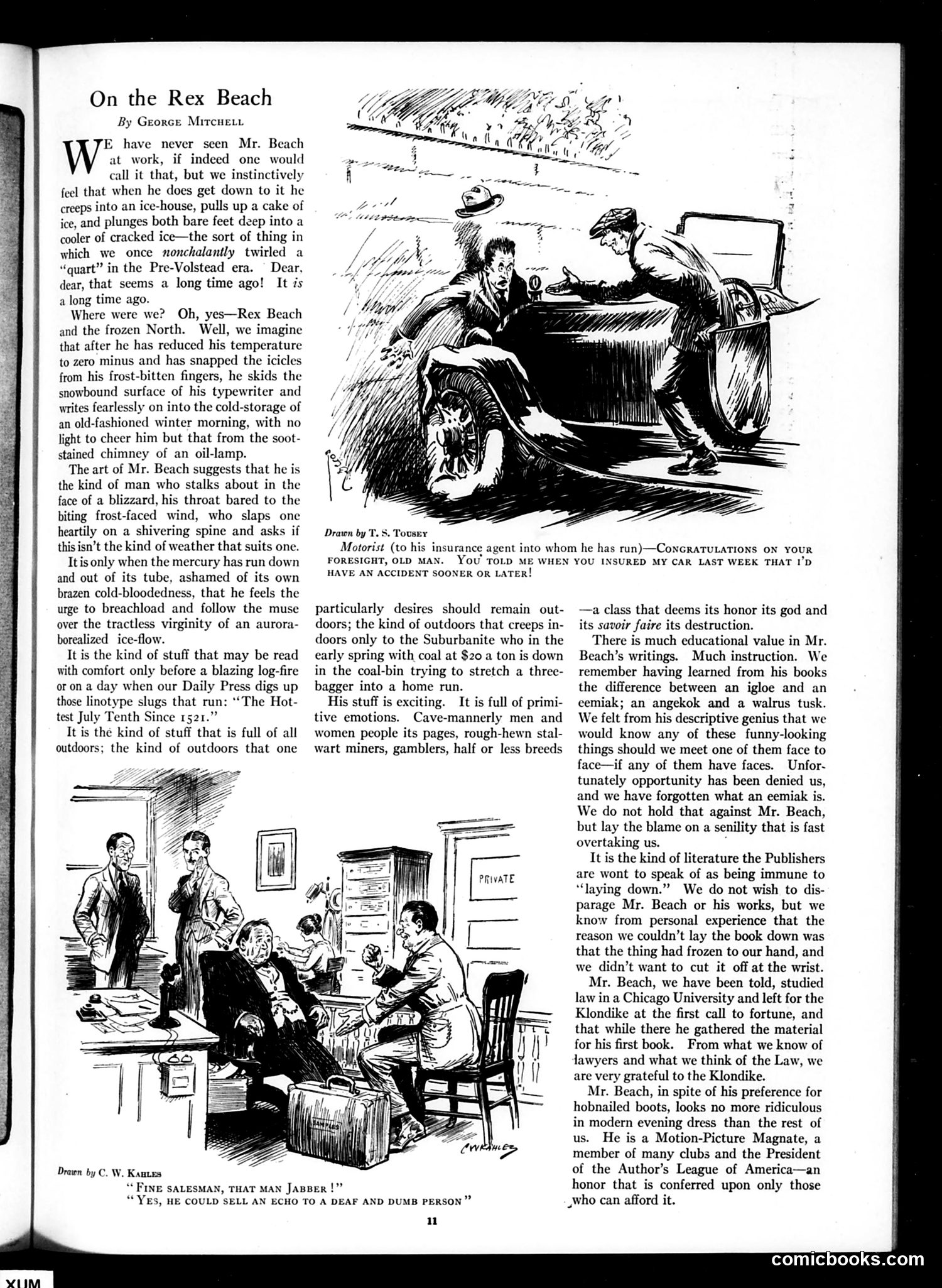
This article by George Mitchell humorously profiles **Rex Beach**, a popular adventure novelist known for stories set in the frozen North and Klondike. Mitchell satirizes Beach's writing by imagining him composing in extreme cold—literally freezing himself to achieve authenticity. The joke rests on Beach's reputation for vivid outdoor narratives filled with primitive emotions, miners, and Arctic terminology (igloos, eemiaks, angekoks). Mitchell gently mocks both Beach's intensity and the reading public's reaction, noting that one reader couldn't lay down his frozen book—a witty conflation of emotional engagement with literal ice. The accompanying cartoons are unrelated satirical sketches: one about aggressive salesmanship, another about an auto insurance claim. The piece celebrates Beach as a notable literary figure while poking fun at the overwrought earnestness of adventure fiction popular in the early 20th century.
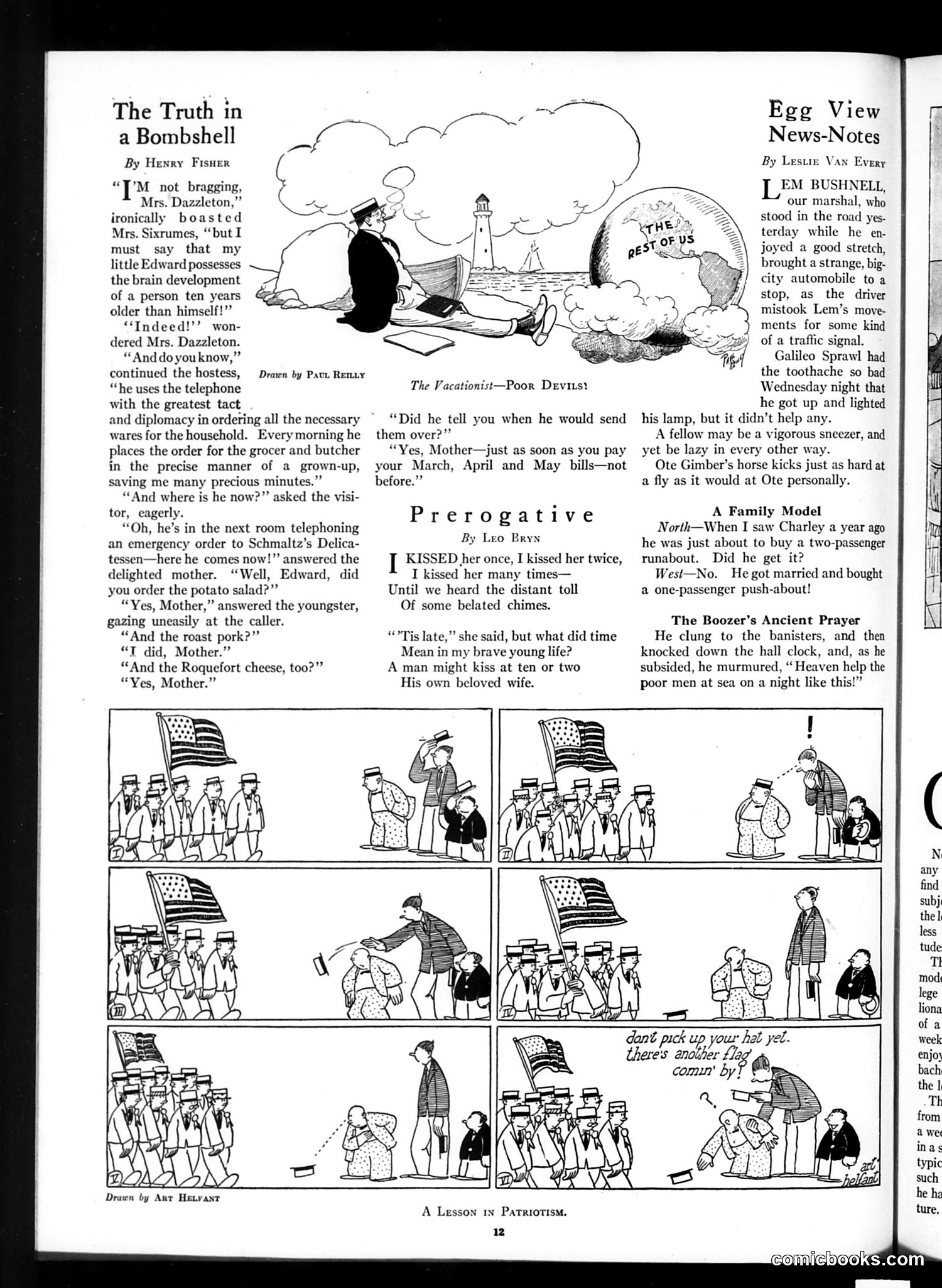
**"The Truth in a Bombshell"** satirizes parental boasting. Mrs. Sixrumes brags that her young son Edward demonstrates adult-level intelligence and diplomacy in telephoning orders to the delicatessen. The humor's "bombshell" arrives when Edward himself appears and reveals the truth: the grocer refuses delivery until the family pays overdue bills from March, April, and May. The child's blunt honesty exposes the mother's exaggeration—his "diplomacy" was merely relaying a creditor's demand. **"A Lesson in Patriotism"** (bottom comic strip) appears to depict American servicemen or soldiers with a flag, though the specific narrative is unclear from the image alone. The title suggests satire about patriotic conduct or military behavior. The remaining brief pieces ("Prerogative," "Egg View News-Notes," "A Family Model," "The Boozer's Ancient Prayer") are humorous anecdotes about small-town life, courtship, and domestic situations typical of Judge's satirical humor.
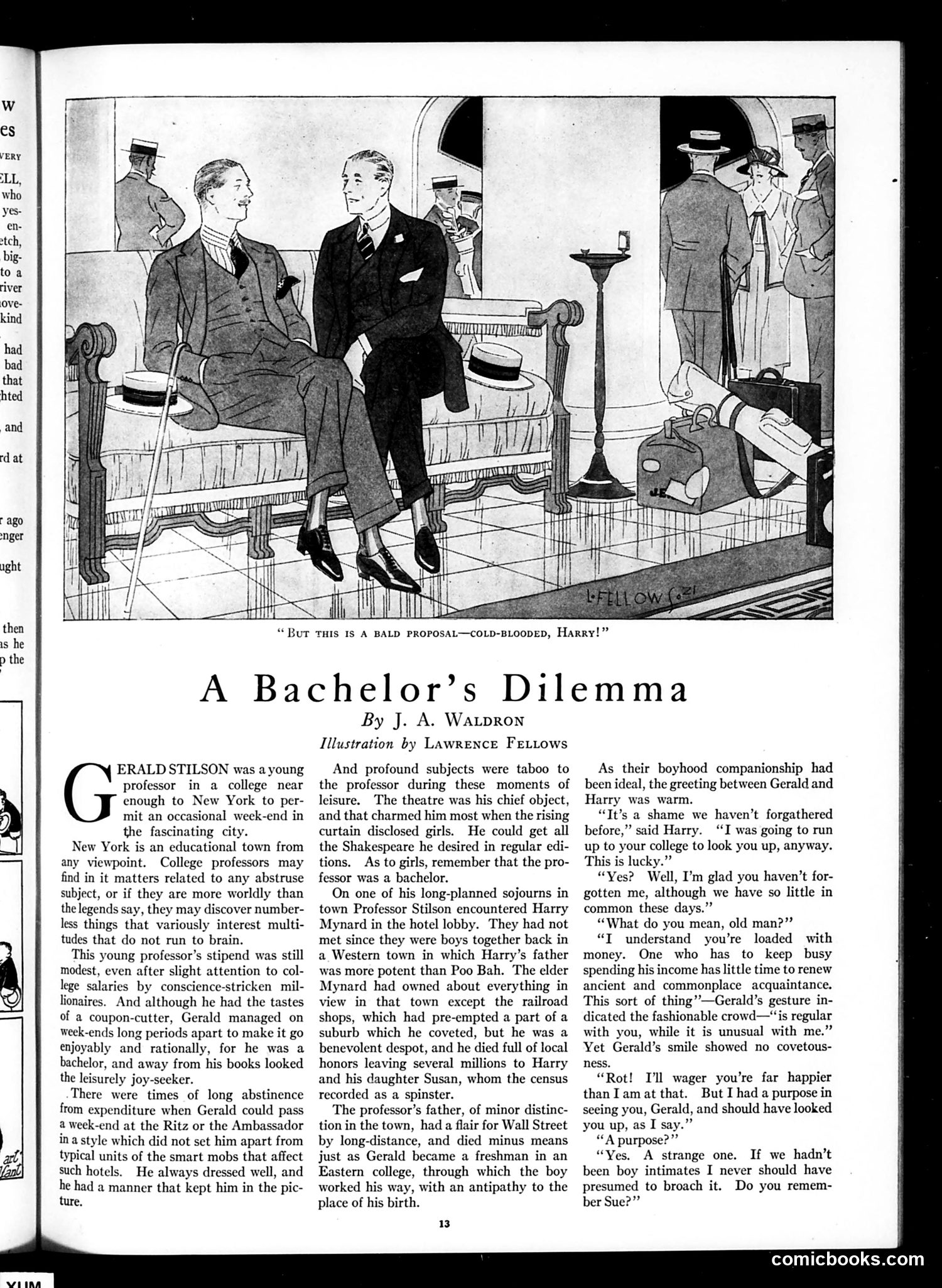
This is the opening of a serialized short story (not a political cartoon), illustrated in *Judge* magazine. The narrative establishes a class-conscious plot: Gerald Stilson, an underpaid college professor, encounters his wealthy childhood friend Harry Mynard in a New York hotel lobby. The satire targets turn-of-the-century social anxieties about money and masculinity. Gerald has "worked his way" through college and maintains intellectual dignity despite poverty, while Harry inherited millions. The story plays on period-specific tensions: professors' modest salaries, the nouveau riche lifestyle of Manhattan hotels (the Ritz, Ambassador), and the implicit awkwardness when former equals diverge economically. Harry's cryptic mention of "Sue" (his spinster sister) at the page's end suggests the "dilemma" involves a marriage proposal—likely Harry asking his poor friend to marry his sister, creating ethical conflict between love and financial security, a common theme in early 20th-century popular fiction.
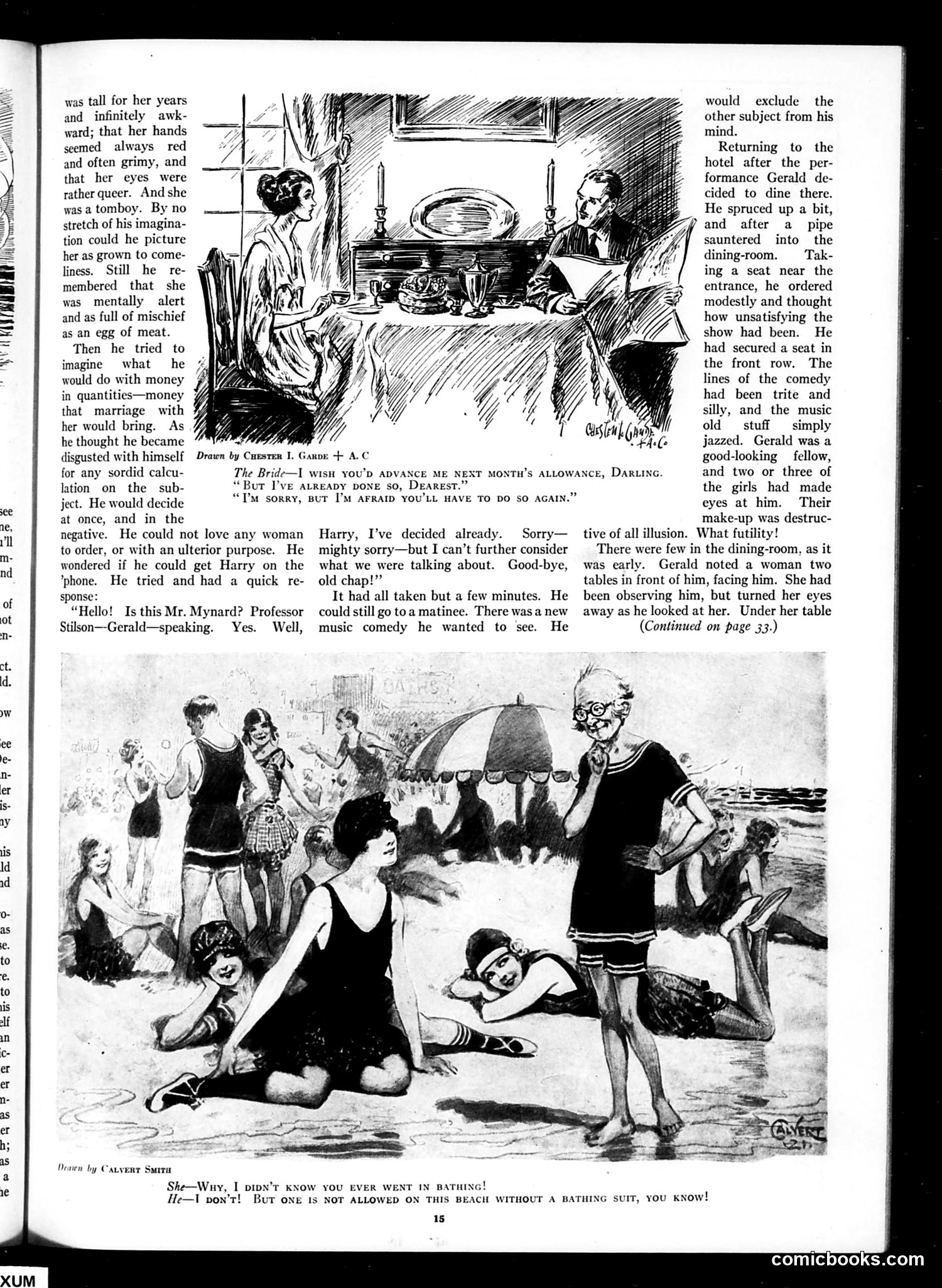
This page contains two distinct elements: **Upper section:** A serialized story (with illustration) about a man named Gerald weighing a marriage proposal. The narrative explores his conflicted thoughts—initially considering the financial benefits of marrying a wealthy but unattractive woman, then rejecting the idea as morally sordid. He decides to distract himself at a theater matinee instead. The dialogue shows him breaking off this consideration via telephone. **Lower section:** A beach-scene cartoon satirizing bathing suit conventions. A woman confronts a man about appearing in the water without proper attire, sarcastically noting he claims never to bathe. The humor targets rigid social rules about beachwear—likely mocking the era's strict dress codes that required full bathing suits even for men. The cartoon critiques the absurdity of enforcing such uncomfortable formality at leisure activities. Both pieces reflect early-20th-century social anxieties: matrimonial calculation and evolving standards around modesty and recreation.
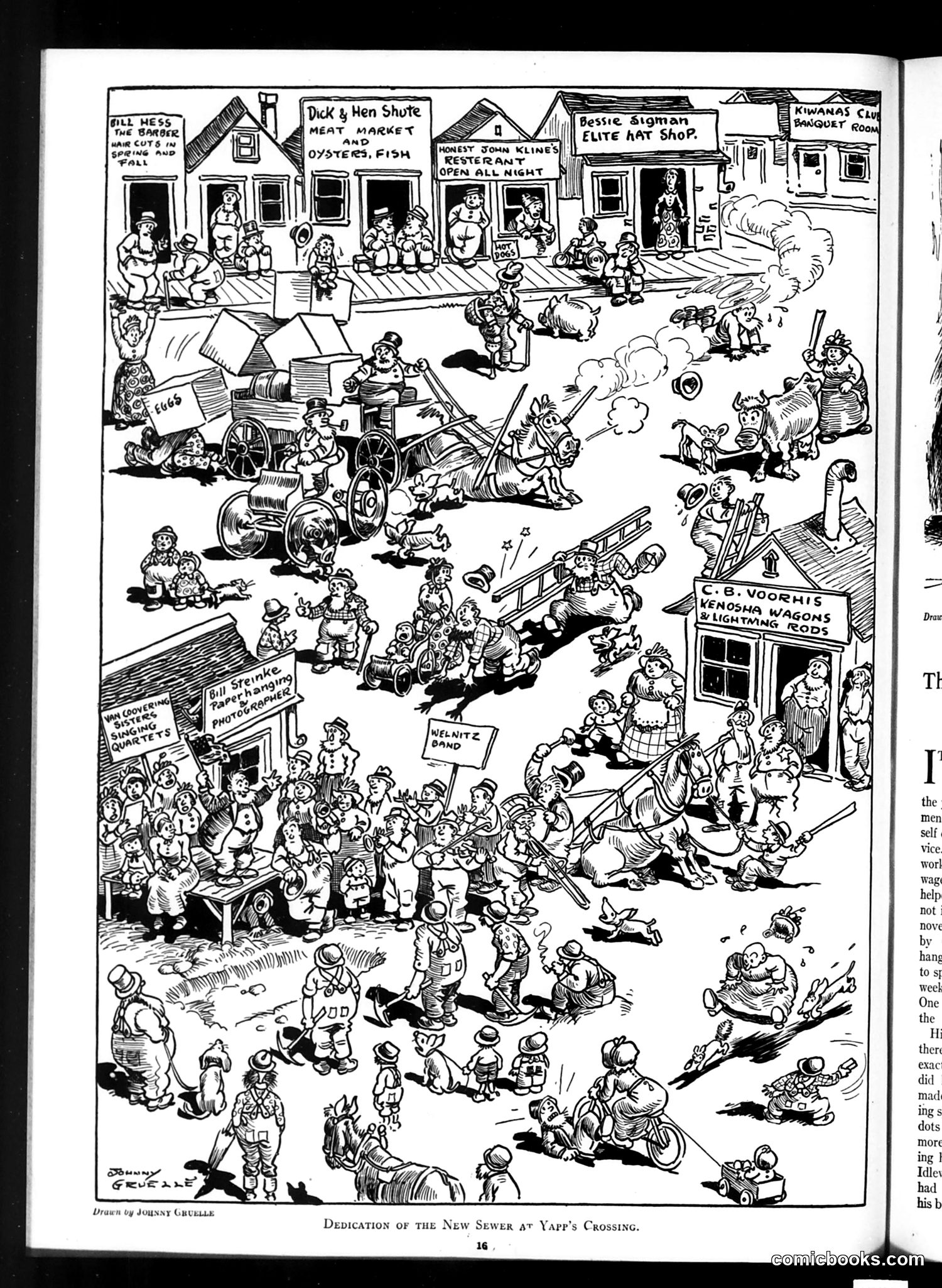
This is a satirical cartoon titled "Dedication of the New Sewer at Yaff's Crossing," drawn by Johnny Gruelle. It depicts a chaotic street celebration featuring numerous townspeople, animals, vehicles, and storefronts with exaggerated, humorous activity. Visible business signs include "Dick & Hen Shute Meat Market," "Bessie Sigman Elite Hat Shop," and others. The scene shows people parading, playing music (a "Welnite Band"), riding in carts and on animals, with general mayhem and celebration. The satire appears to mock small-town civic pride and the fanfare surrounding public works projects like sewer construction—presenting the dedication ceremony as an over-the-top, chaotic community spectacle where the actual infrastructure project becomes secondary to the carnival-like celebration itself.
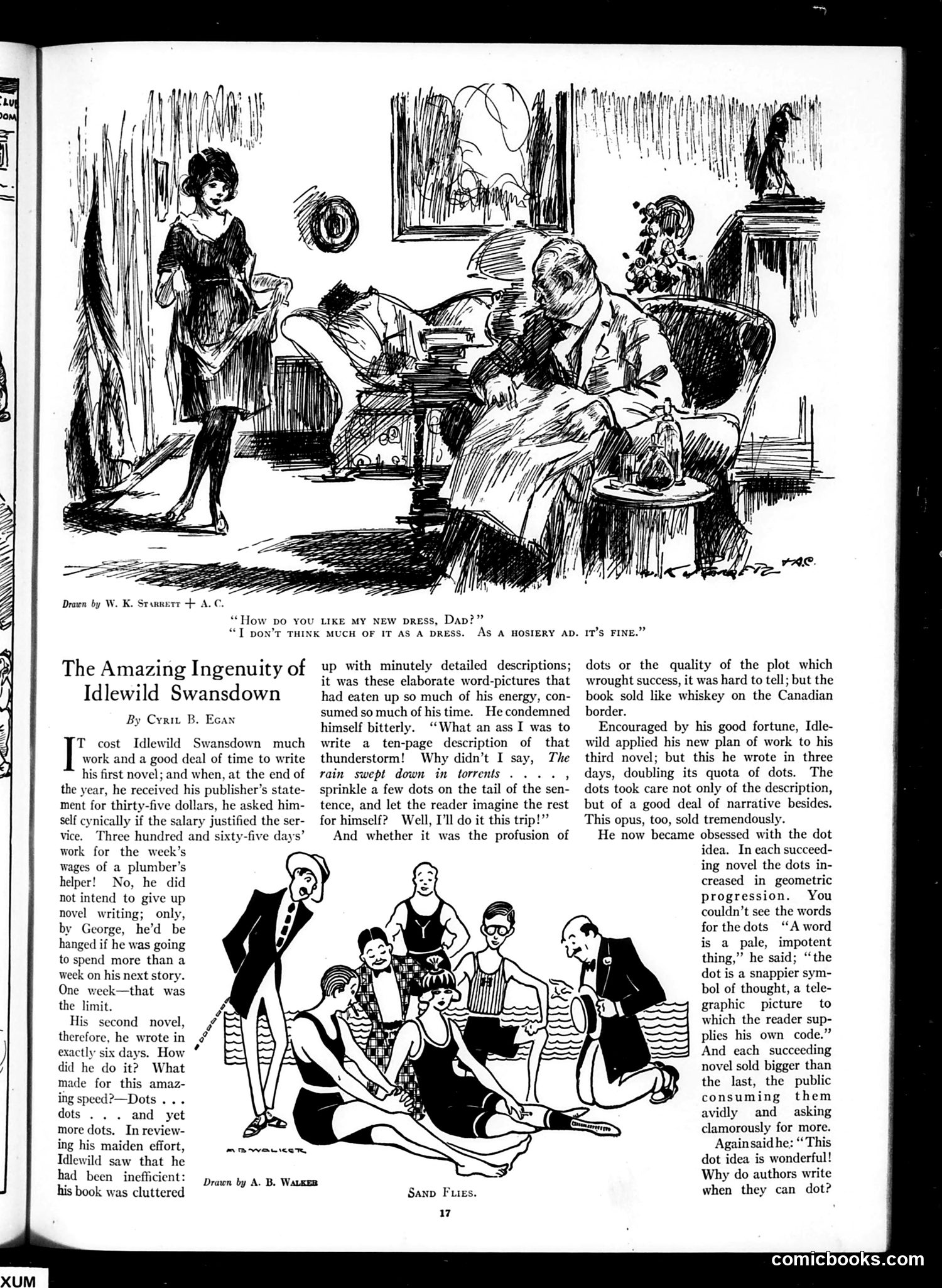
This article by Cyril B. Exas satirizes an author named Idlewild Swansdown who, desperate for income, wrote a novel in just one week. His publisher rejected it as inadequate, so Swansdown rewrote it using excessive "dots" (ellipses) to pad descriptions and reach the required length—a literary trick the author apparently found absurd. The top cartoon shows a woman asking her father about her new dress; he dismisses it as merely a "hosiery ad"—likely referencing how advertisements filled contemporary publications. The satire mocks both Swansdown's lazy writing shortcuts and the publishing industry's emphasis on word count over genuine content, a practice the writer views with cynical humor.
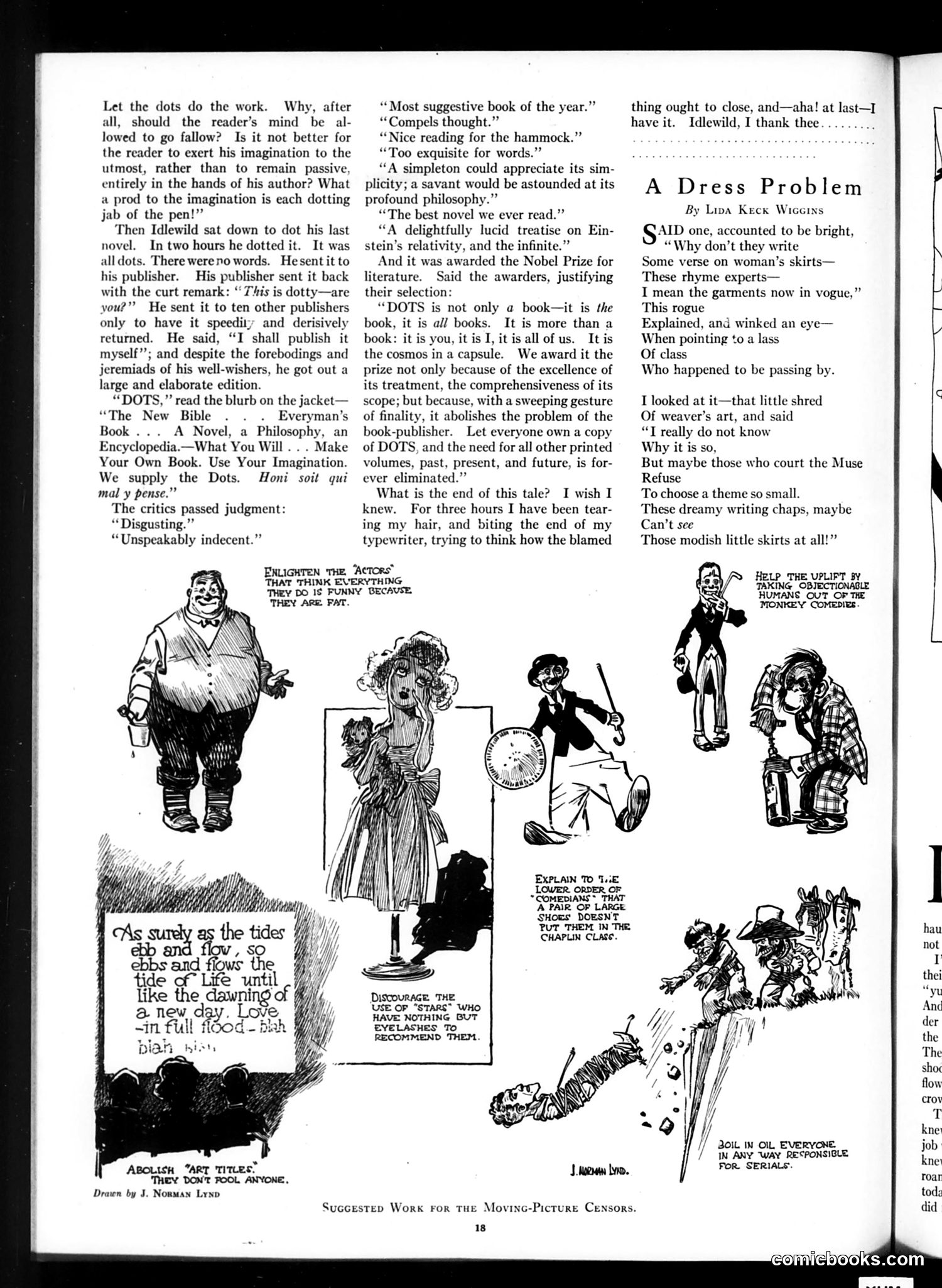
**"DOTS" Story**: This satirizes pretentious modernist literature and art criticism. An author named Idlewild publishes a novel consisting *entirely* of dots—nothing else. Despite initial rejections, it becomes celebrated by critics who praise its ambiguity, profundity, and philosophical depth. It wins the Nobel Prize. The satire mocks how critics and intellectuals can find deep meaning in meaningless work, and how avant-garde art banking on reader "imagination" can be intellectually empty yet culturally lauded. **"A Dress Problem"**: A lighthearted poem about women's fashionably short skirts (likely 1920s flapper era), joking that poets ignore this subject despite its prominence—perhaps suggesting either prudishness or that serious writers dismiss fashion as trivial. **Cartoon Panel**: Titled "Suggested Work for the Moving-Picture Censors," this satirizes film censorship by proposing ridiculous censorship "reforms"—targeting slapstick comedians, actors with only looks, and cheap serialization tactics—rather than genuine moral concerns. It mocks censors as missing actual problems while fixating on petty issues.
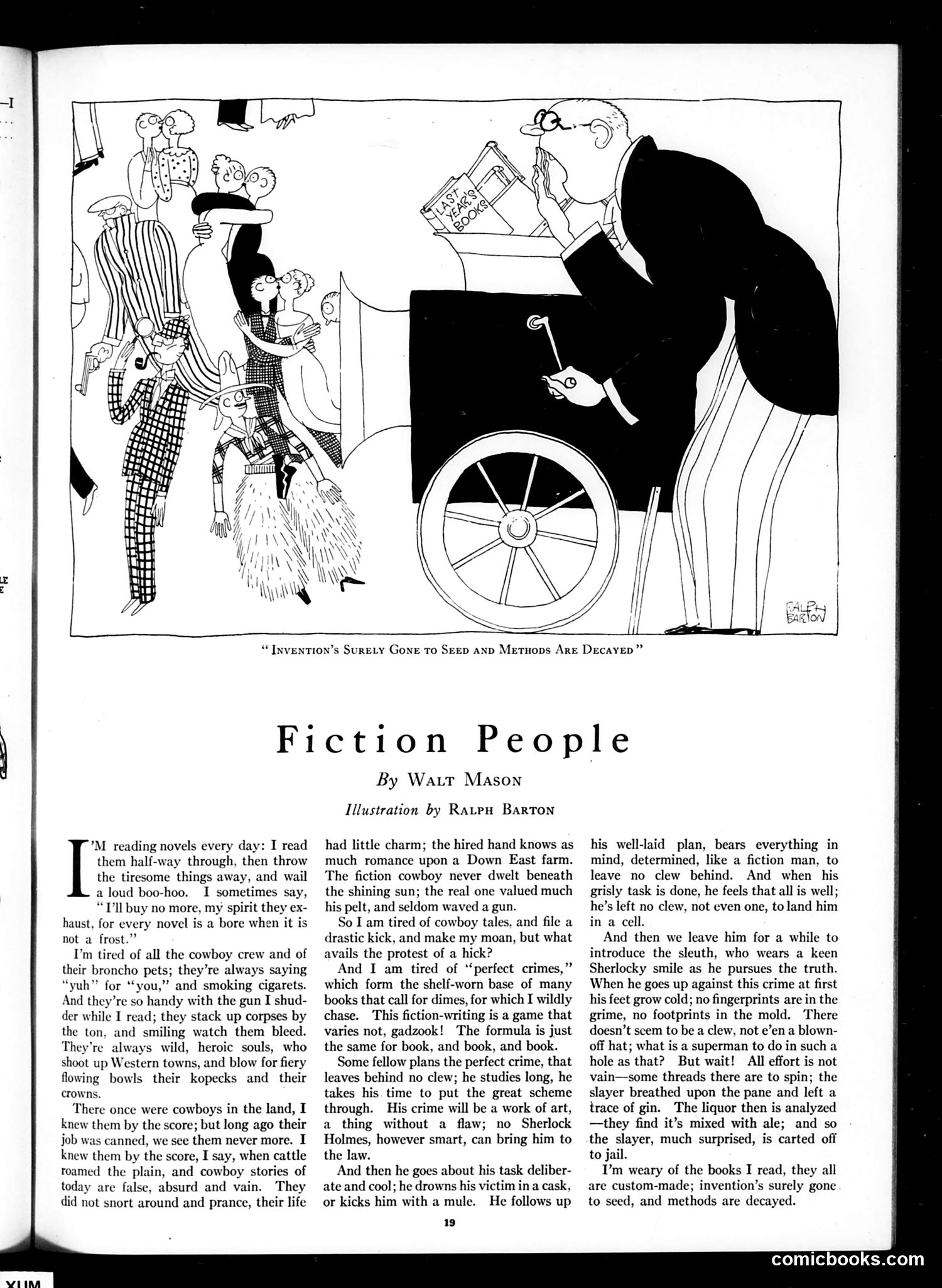
This page presents Walt Mason's essay criticizing the decline of American fiction, illustrated by Ralph Barton's cartoon at top. **The Cartoon:** Shows a well-dressed man in a carriage labeled "Invention's Surely Gone to Seed and Methods Are Decayed," pulled by figures representing tired literary tropes—a stereotypical cowboy and other stock characters—suggesting literature has become a mechanical, exhausted enterprise. **Mason's Complaint:** The essay attacks two dominant popular fiction genres of the era: 1. **Cowboy tales** - criticized as unrealistic and repetitive; real cowboys were unglamorous workers, not the trigger-happy, romantic heroes of pulp fiction 2. **Detective mysteries** - mocked for their predictable formula: a "perfect crime" with no clues, followed by a brilliant detective solving it through absurd, contrived evidence (a gin-stained fingerprint) **The Point:** Mason argues American popular fiction has become formulaic, mass-produced entertainment with no genuine imagination or originality—entertainment for "custom-made" consumption rather than art.
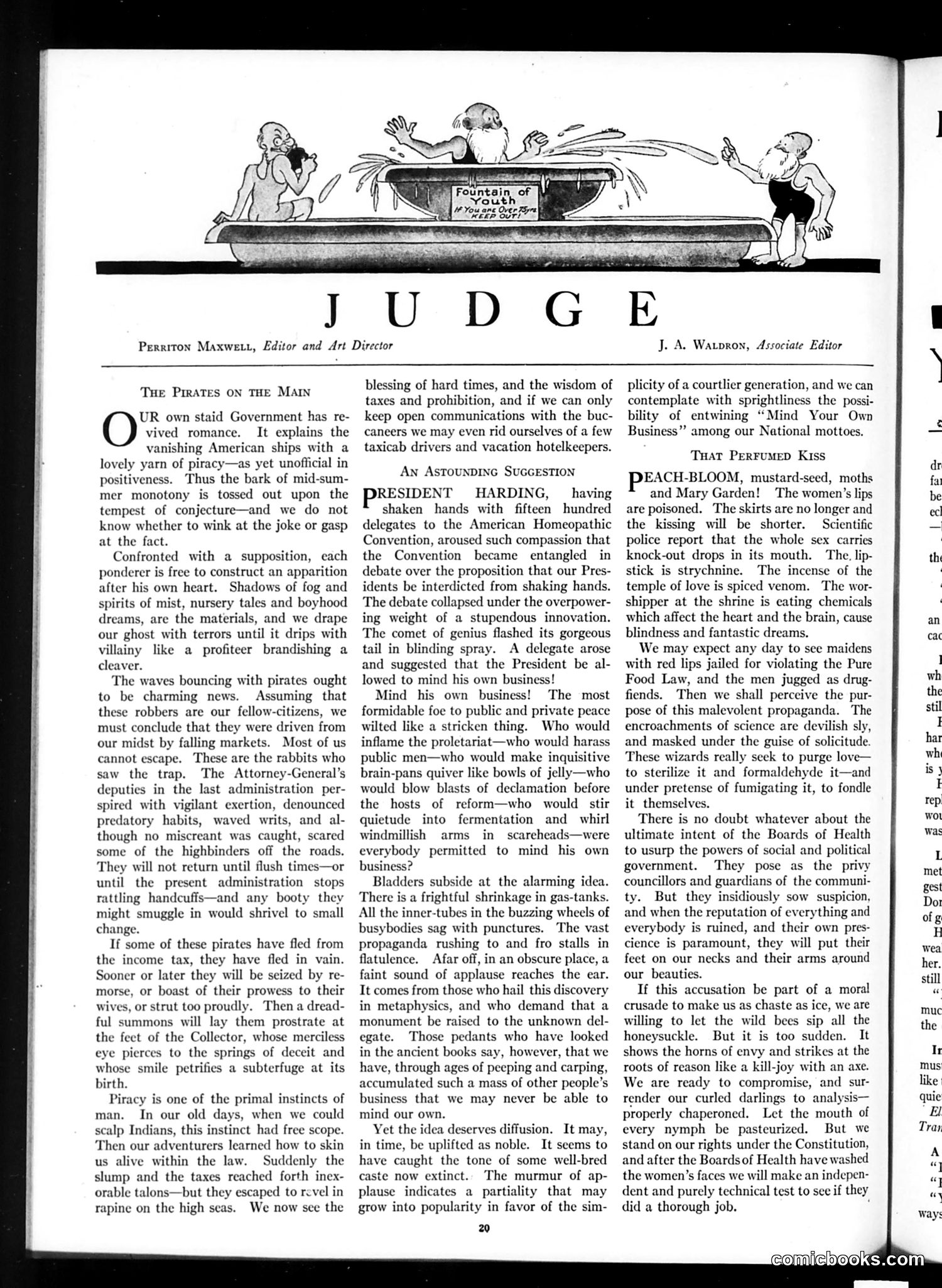
The masthead illustration depicts the "Fountain of Youth"—a classical fountain with cherubic figures splashing about—a visual pun introducing the magazine's satirical content. **"The Pirates on the Main"** sardonically addresses contemporary American ship disappearances. The article argues that government claims of piracy are actually romantic fiction masking economic reality: Americans driven to crime by failed markets and taxes during the post-war economic slump. The author suggests these "pirates" are ordinary citizens—even taxi drivers and hotel keepers—forced into lawlessness. The satire criticizes both the government's vague explanations and society's tendency to mythologize crime while ignoring its economic causes. **"An Astounding Suggestion"** mocks President Harding's exhausting handshake marathon with convention delegates, which sparked debate about presidential conduct. A delegate's radical proposal—that the President simply "mind his own business"—is presented as dangerously revolutionary to reformers, propagandists, and busybodies who thrive on interfering in public affairs. The satire targets activist culture and the perpetual machinery of political agitation.
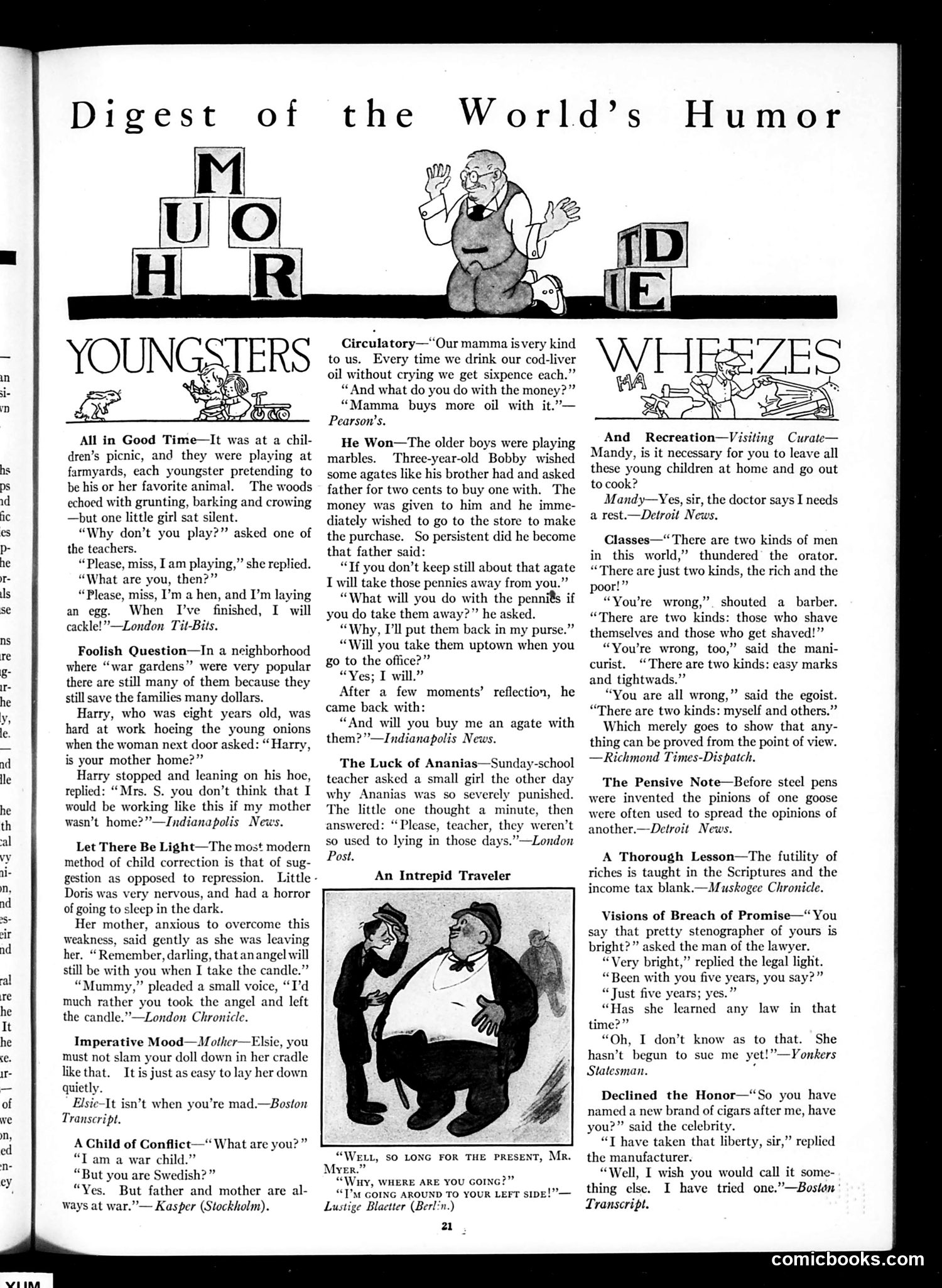
This page from *Judge* collects brief humorous anecdotes—typical of the magazine's "Digest of the World's Humor" format. The humor relies on children's innocent logic and adult social commentary: **Notable items:** - **"All in Good Time"**: A girl pretends to be a hen laying an egg—humor from literal-minded child play - **"Foolish Question"**: A boy's logical response to "is your mother home?" while doing chores - **"Let There Be Light"**: A nervous child's practical preference for a candle over an angel in the dark - **"Classes"**: An orator's claim that society has only rich and poor is challenged by a barber, manicurist, and others—satirizing oversimplified social divisions and each profession's cynical view (barbers see "easy marks and tightwads") **The cartoon** (bottom left) shows two men on a train; the caption's joke about going "around to your left side" is unclear without context, likely a visual gag about seating arrangements. The page reflects early-20th-century middle-class humor: children's honesty, domestic life, and gentle social satire about class and profession.
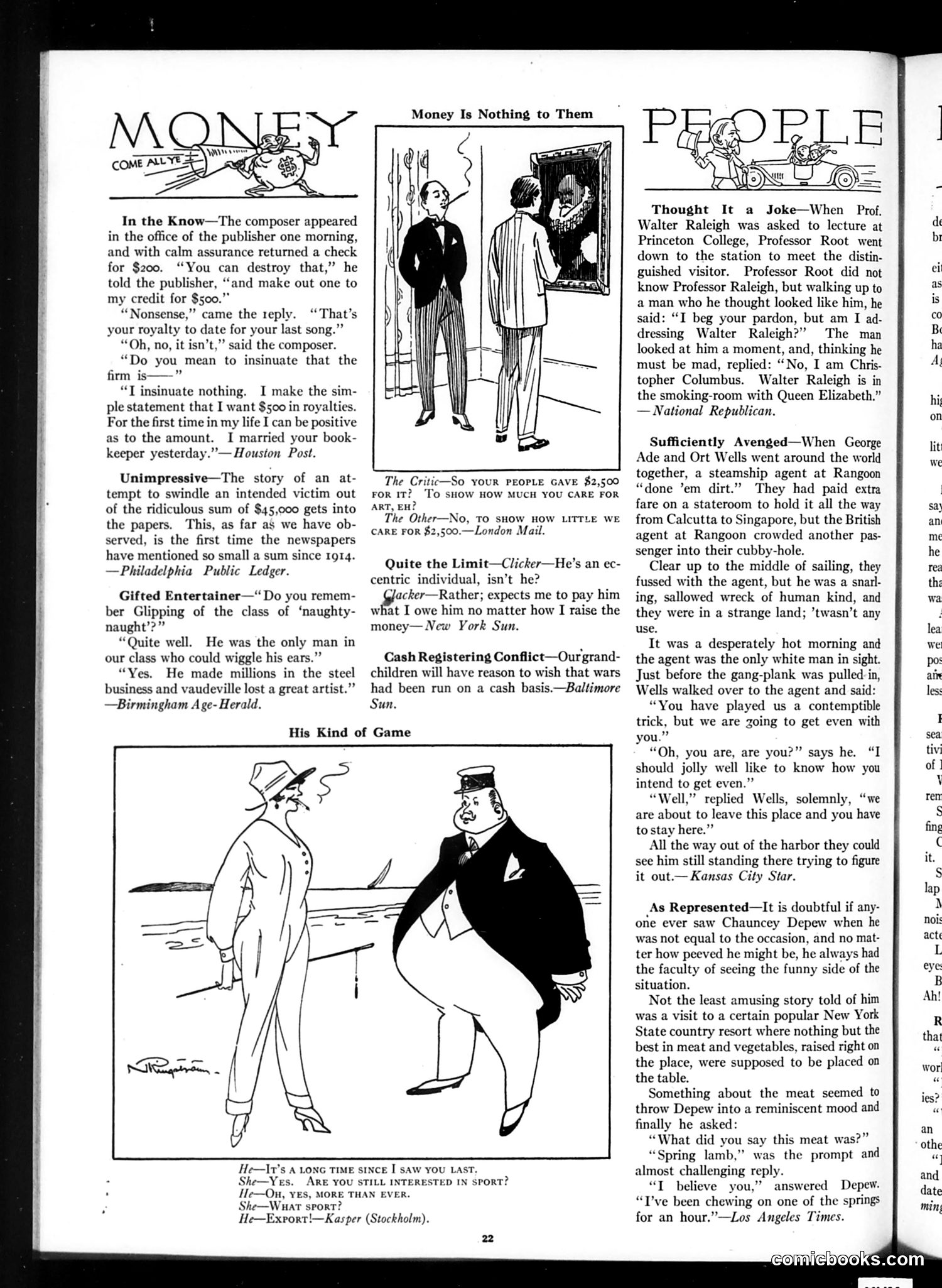
This page from Judge (a satirical weekly) contains brief humorous anecdotes rather than political cartoons. The content targets various social types and professions of the era. The main cartoon depicts two men in formal dress encountering each other—one appears to be a working-class or immigrant figure ("Export" from Stockholm), the other wealthy. Their exchange satirizes class differences: she asks if he's "still interested in sport," he replies with "export"—a pun suggesting economic disparity. The surrounding text anecdotes mock: - **Composers and publishers** (financial disputes over royalties) - **The wealthy** (spending $2,500 on art to show indifference to money) - **Eccentricity** (refusing to pay debts) - **Famous figures**: Walter Raleigh, Christopher Columbus, George Ade, Chauncey Depew (jokes suggesting these celebrities were mistaken for others or had amusing personal incidents) The humor relies on wordplay, class commentary, and references to recognizable public figures of the early 20th century. The overall tone reflects Judge's satirical approach to American society and notable personalities.
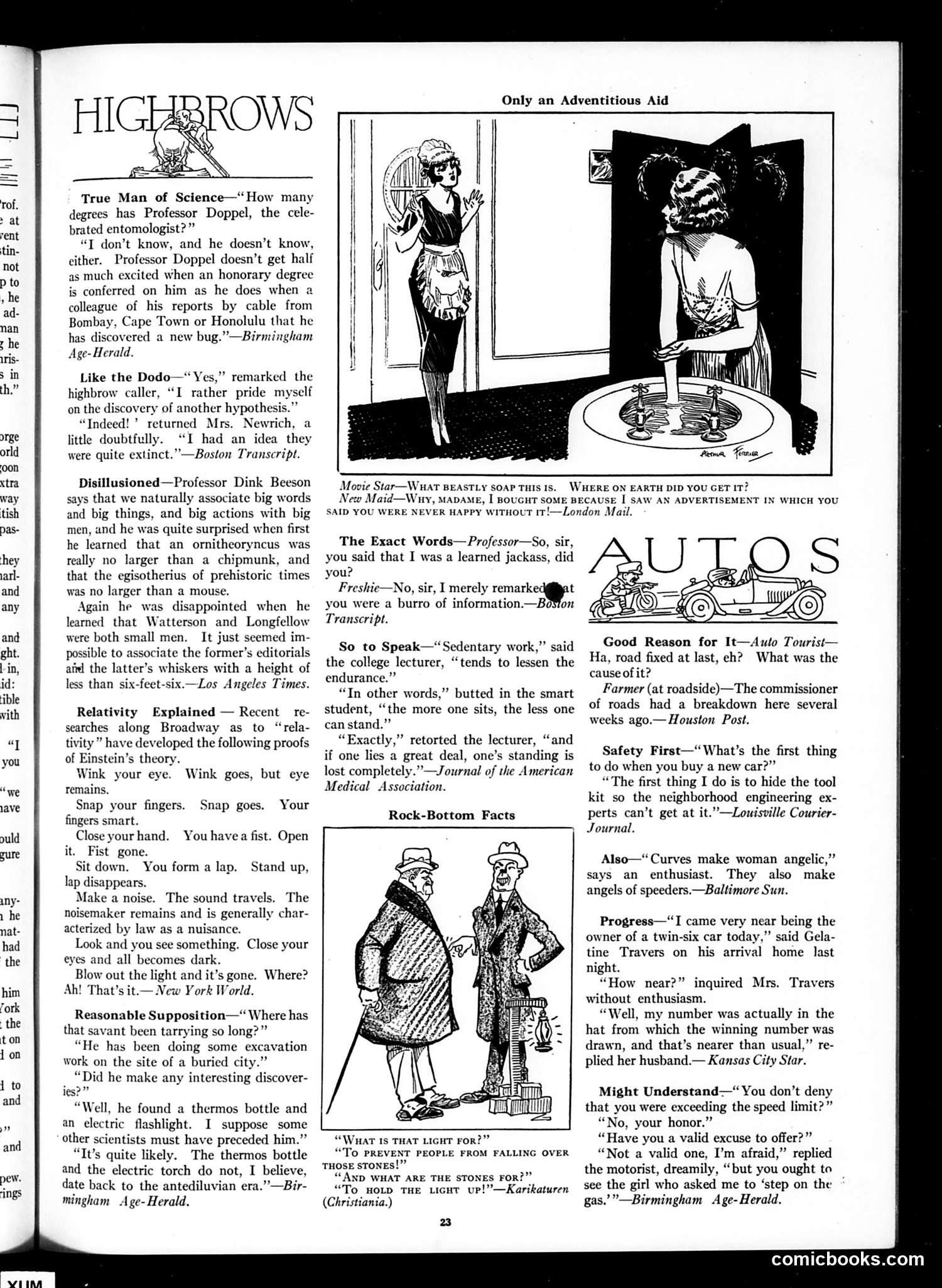
This page from *Judge* magazine contains multiple short humorous anecdotes satirizing early 20th-century society and intellectual pretension. **Key satirical targets:** - **"True Man of Science"**: Mocks academic priorities—a celebrated entomologist cares more about discovering new bugs than receiving honorary degrees, suggesting scientists value fieldwork over prestige. - **"Relativity Explained"**: Makes fun of Einstein's then-baffling theory of relativity by reducing it to obvious observations about everyday objects (winking, snapping fingers), mocking both the theory's complexity and public incomprehension. - **"Movie Star"** (cartoon): Satirizes celebrity vanity and advertising manipulation—a maid bought soap solely because the movie star endorsed it in an ad, despite the star herself complaining about the product's poor quality. - **"Rock-Bottom Facts"**: Absurdist humor about circular logic and bureaucratic incompetence—a light prevents people falling over stones, and stones hold up the light, creating pointless infrastructure. The humor relies on exposing intellectual pomposity, scientific mystification, and advertising's superficial influence on consumer behavior.
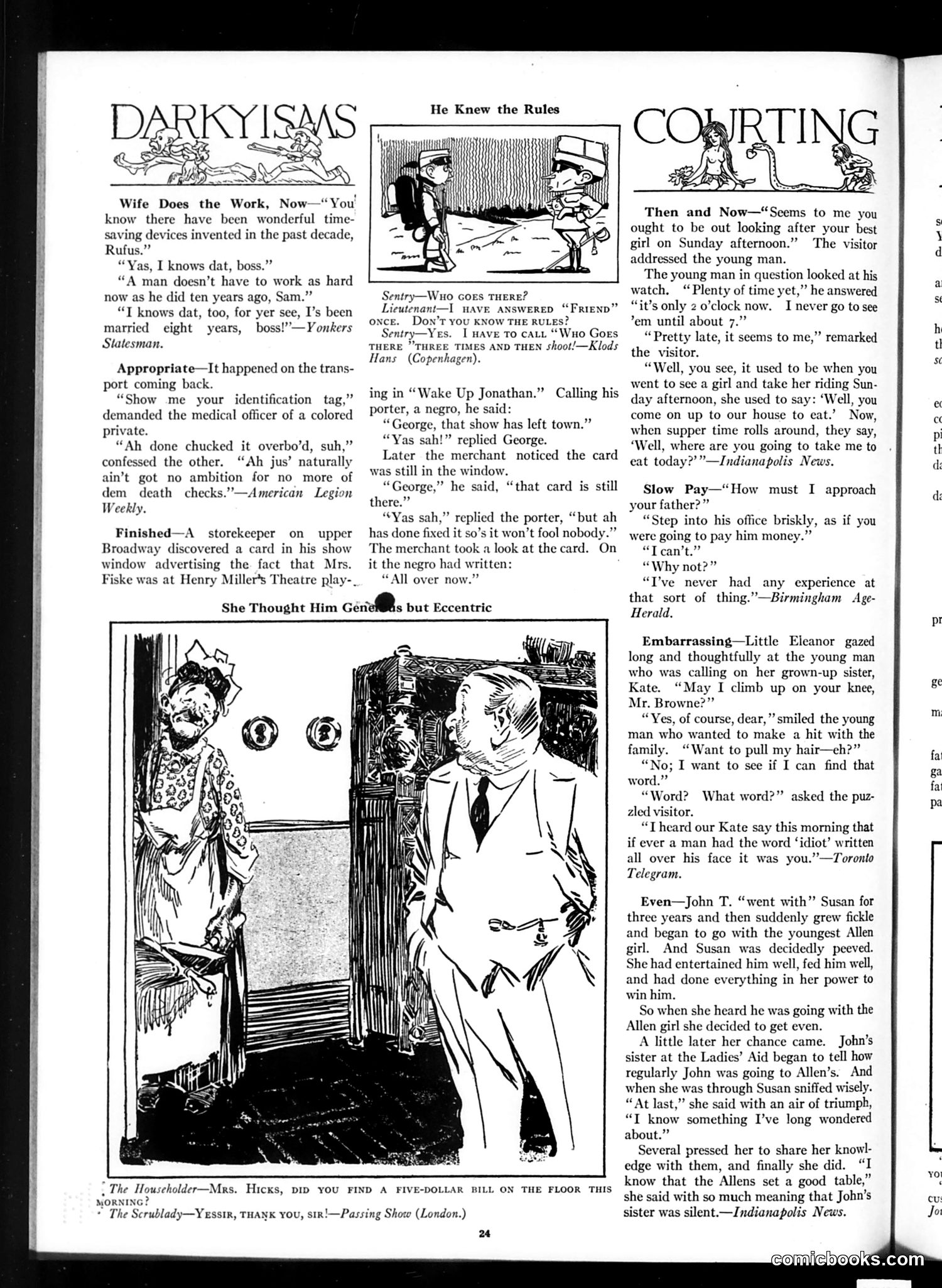
This page collects brief humorous anecdotes typical of early 20th-century American humor. Key content includes: **"He Knew the Rules"**: A military sentry joke about proper challenge protocol—the humor lies in the literal-minded soldier who has memorized procedures but misses context (shooting after three warnings regardless of response). **"Wife Does the Work, Now"**: A racial stereotype joke where a Black man (Sam) suggests marriage has made him work harder despite "labor-saving devices," inverting the premise that technology reduces toil. **"Slow Pay"**: A joke about a man afraid to approach his girlfriend's father for permission to marry, because the father is known for being difficult with money. **"Embarrassing"**: A child asks a suitor if he has the word "idiot" written on his face—referencing an earlier remark by the girl's sister. **"Even"**: A woman spurned by her boyfriend gains revenge by complimenting his new girlfriend's family's cooking to his sister, implying the new girl is only valued for domestic services. The humor reflects period attitudes toward class, gender dynamics, and racial stereotypes common to early 20th-century American magazines.
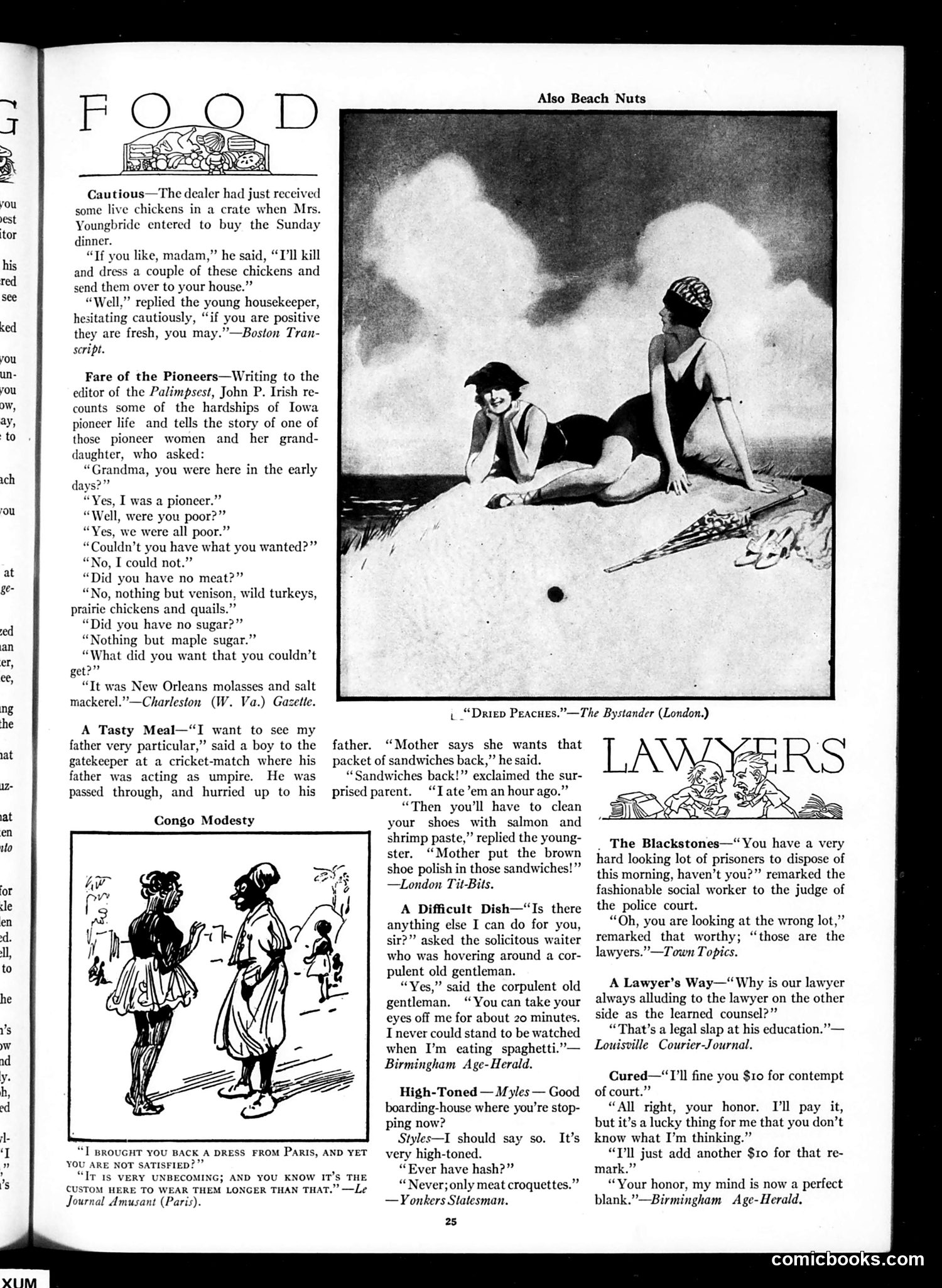
This page collects brief humorous anecdotes and jokes typical of early 20th-century American humor. The content reflects period concerns and social dynamics: **"Cautious"** satirizes a young housewife's anxiety about food freshness—reflecting the era's food safety concerns before modern refrigeration. **"Fare of the Pioneers"** contrasts pioneer hardship with modern abundance, with nostalgia for frontier life becoming a cultural touchstone. **"Congo Modesty"** (the cartoon) appears to mock fashion pretension, though the reference to "Congo" likely reflects problematic period racial attitudes common in satirical magazines. The remaining jokes target lawyers (portrayed as aggressive and calculating), social workers (depicted as naive), and domestic absurdities (mixing shoe polish into sandwiches, watching people eat). The overall tone treats working-class life, housekeeping anxieties, and legal/professional pomposity as fair targets for ridicule. The humor assumes readers share skepticism toward lawyers and fashionable pretension.
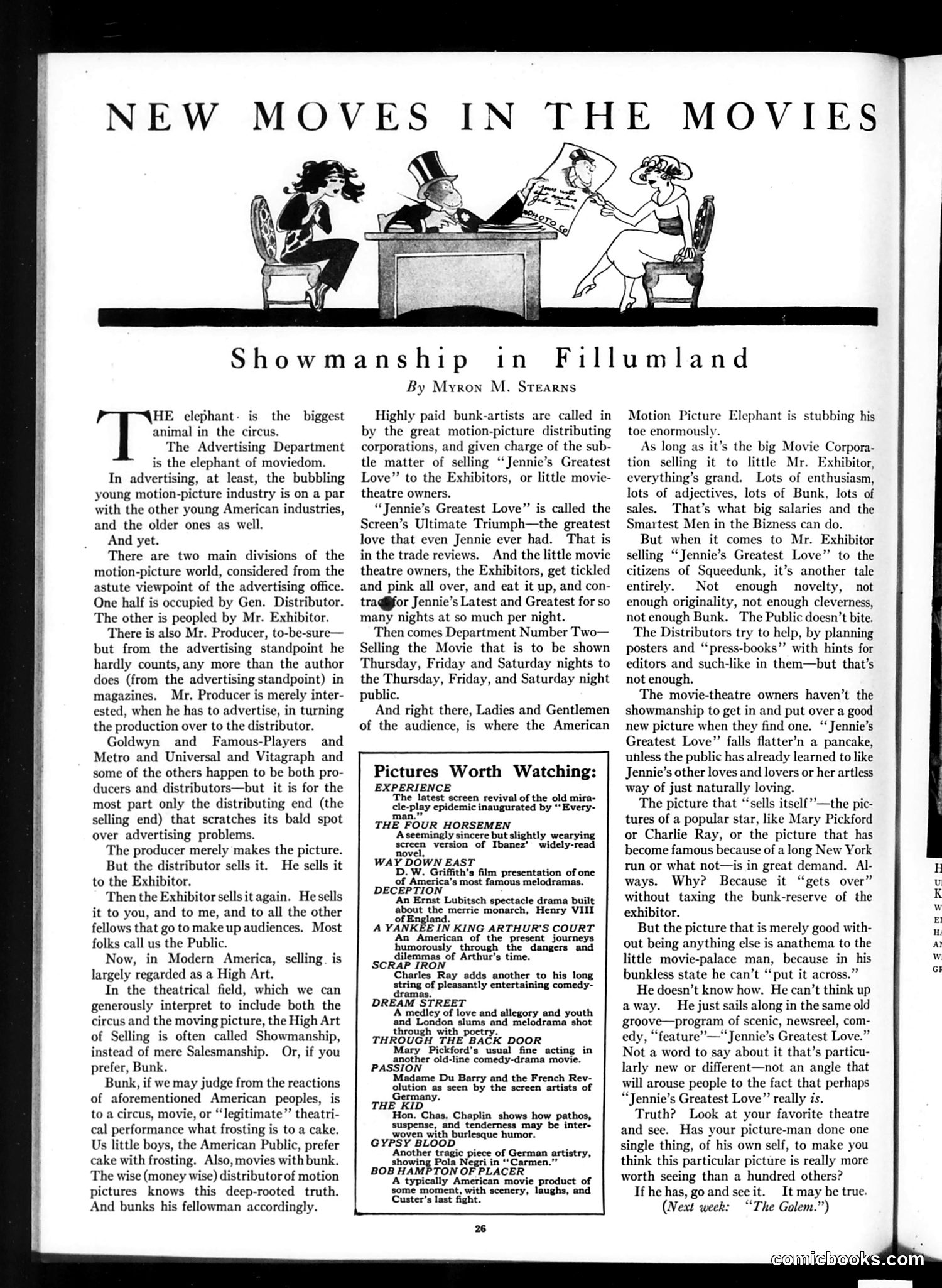
This article by Myron M. Stearns satirizes the motion picture industry's advertising and sales practices. The illustration shows three figures at a desk—likely representing the Producer, Distributor, and Exhibitor—engaged in the business of "selling" movies. Stearns argues that the film industry's real power lies not with filmmakers but with **distributors and exhibitors** who employ elaborate marketing tactics to sell films to theaters and audiences. He uses the term "**Bunk**"—meaning exaggerated promotional claims—to describe how the industry persuades the American public, comparing it to cake frosting: attractive but insubstantial. The satire targets how a mediocre film like "Jennie's Greatest Love" gets hyped as "the Screen's Ultimate Triumph," then resold through layers of middlemen using aggressive advertising. Stearns suggests Americans prefer entertainment *with* marketing hype, making dishonest salesmanship fundamental to filmdom's success.
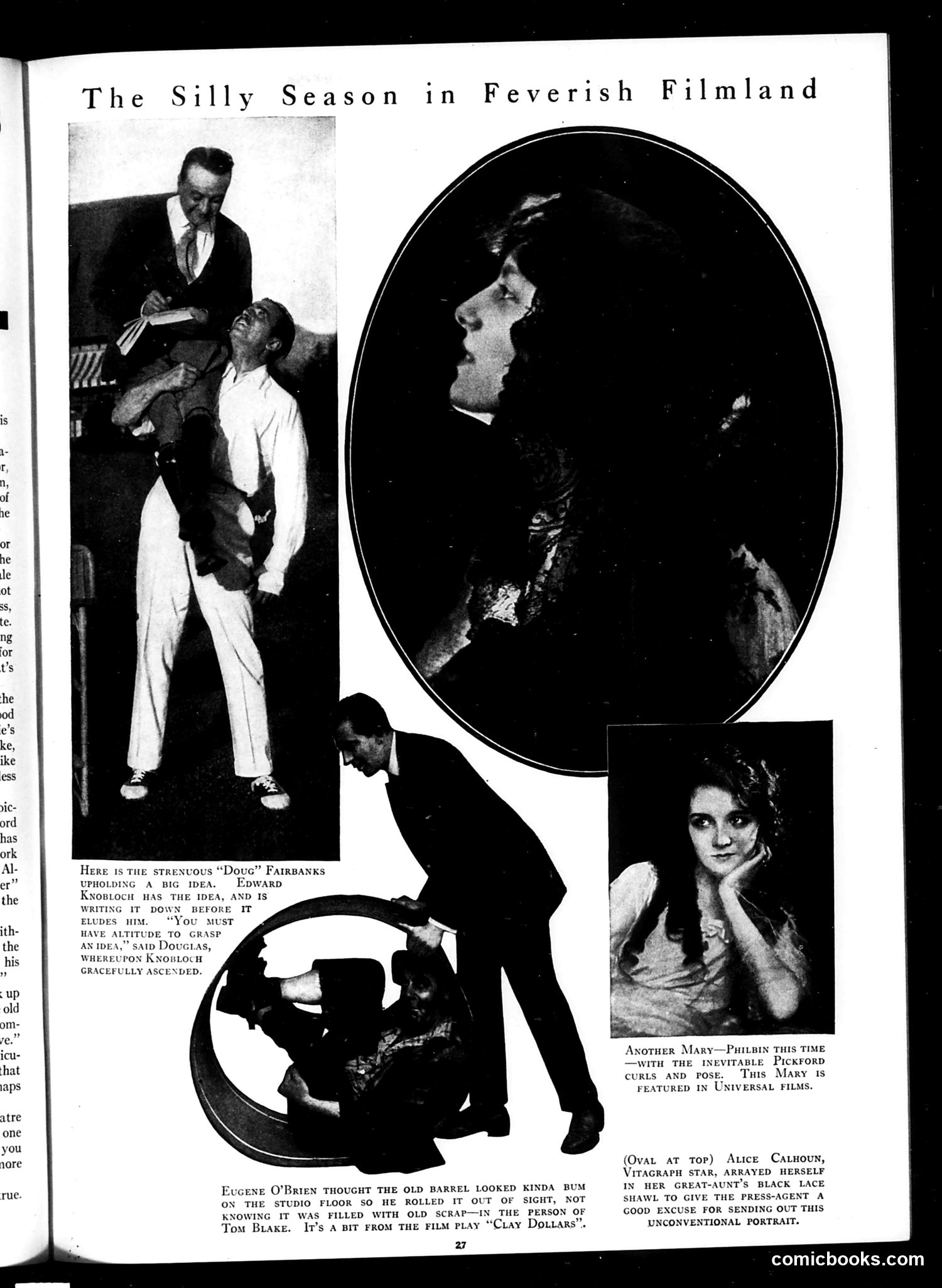
This page satirizes Hollywood's film industry during its early silent era. It showcases behind-the-scenes anecdotes mocking studio pretension and actress conventions. The captions ridicule: 1. **"Doug" Fairbanks** strenuously pitching ideas to writer Edward Knoblock—satirizing actors' self-importance in creative processes 2. **Mary Pickford imitations**—multiple actresses adopting Pickford's signature curls and poses, mocking the lack of originality and the industry's reliance on copying successful star images 3. **Alice Calhoun's portrait**—using a borrowed lace shawl as a theatrical prop, poking fun at studios manufacturing manufactured "artistry" for publicity 4. **A barrel mishap** from "Clay Dollars" film—slapstick absurdity where Eugene O'Brien unknowingly rolls away a barrel containing actor Tom Blake, exemplifying the chaotic, ridiculous nature of early film production The overall tone satirizes the pretension, imitation, and manufactured glamour of nascent Hollywood—suggesting the industry takes itself far too seriously despite its fundamental silliness.
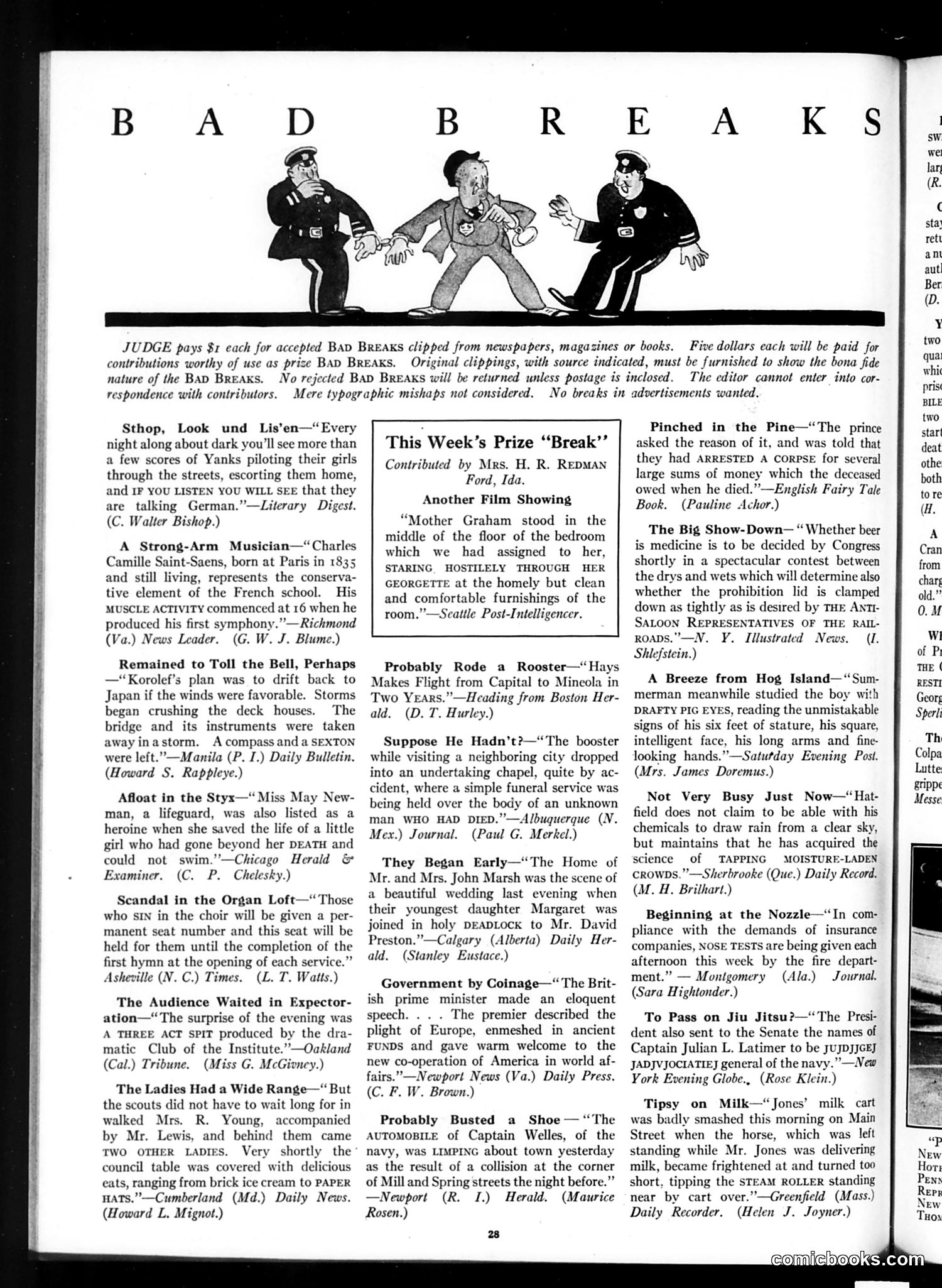
This page satirizes **newspaper typographical errors and editing mistakes**—a recurring Judge feature that rewarded readers $1 for submitting published "breaks" (humorous printing errors from American newspapers). The cartoon at the top shows three caricatured figures representing different ethnic/national types (appearing to reference Irish, German, and possibly Italian stereotypes common to 1910s-era American satire), illustrating the editorial chaos that produces such mistakes. The "breaks" themselves are highlighted words where accidental capitalization, word substitution, or phrasing created unintended comedy. Examples include: - "STARING HOSTILELY THROUGH HER GEORGETTE" (clothing/vision confusion) - "WHO HAD DIED" (redundant deadness) - "DEADLOCK" for "wedlock" (marriage as captivity joke) - "FUNDS" instead of "ancient" (government spending satire) The satire mocks sloppy newspaper production while inviting middle-class readers into complicit mockery of journalistic incompetence—a popular early-20th-century humor form.
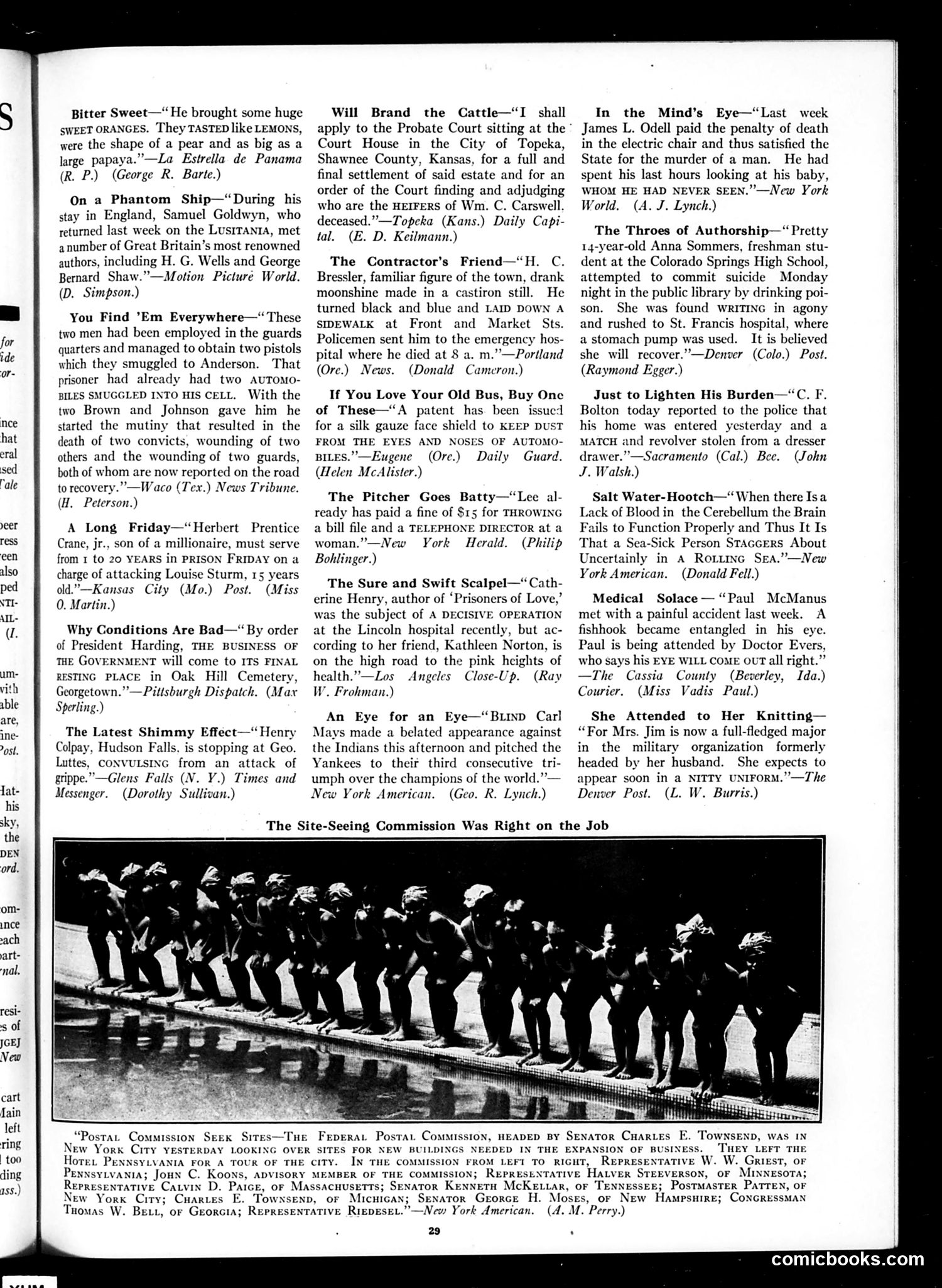
This page from Judge magazine consists primarily of **satirical newspaper clippings** rather than traditional political cartoons. The humor works by extracting absurd or contradictory phrases from actual newspaper articles, then highlighting them in capitals to expose unintentional comedy. Examples of the satire: - A man smuggling **two automobiles into a prison cell** (impossible logistics) - President Harding's business coming to its "final resting place" in a **cemetery** (darkly suggesting government death) - A dying man who **"had never seen"** his baby he spent hours looking at (logical contradiction) - A **silk gauze shield to keep dust from car noses** (anthropomorphizing vehicles) The bottom photograph shows a **Postal Commission touring New York City sites** for new federal buildings—captioned to suggest they're inspecting locations literally. The satire targets **sloppy newspaper writing** rather than specific political figures, mocking how careless phrasing creates unintentional absurdity. This was typical Judge humor of the early 1920s era.
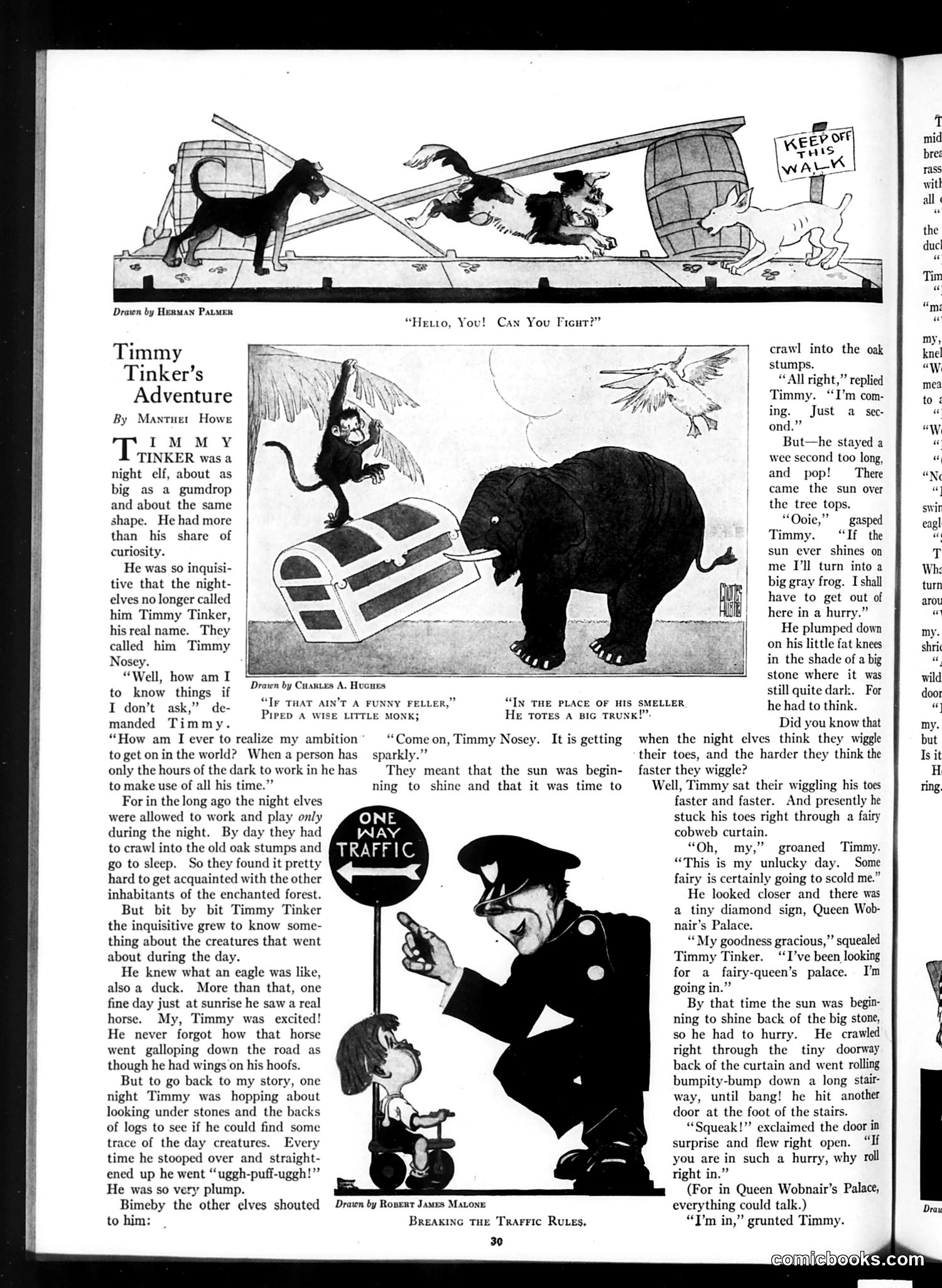
This page presents a children's fantasy story rather than political satire. "Timmy Tinker's Adventure" by Matthei Howe follows a curious night elf protagonist who must hide from daylight. The narrative combines whimsical worldbuilding (elves who transform into frogs in sunlight, talking objects in magical palaces) with gentle humor about Timmy's inquisitiveness and clumsiness. The accompanying illustrations by Herman Palmer, Charles A. Hughes, and Robert James Malone depict magical scenarios: Timmy encountering an elephant, traffic signs, and a palace entrance. A top-of-page cartoon shows dogs on a seesaw labeled "Keep Off This Walk." This appears to be *Judge* magazine's fiction feature rather than its satirical content—wholesome entertainment for younger readers rather than political commentary.
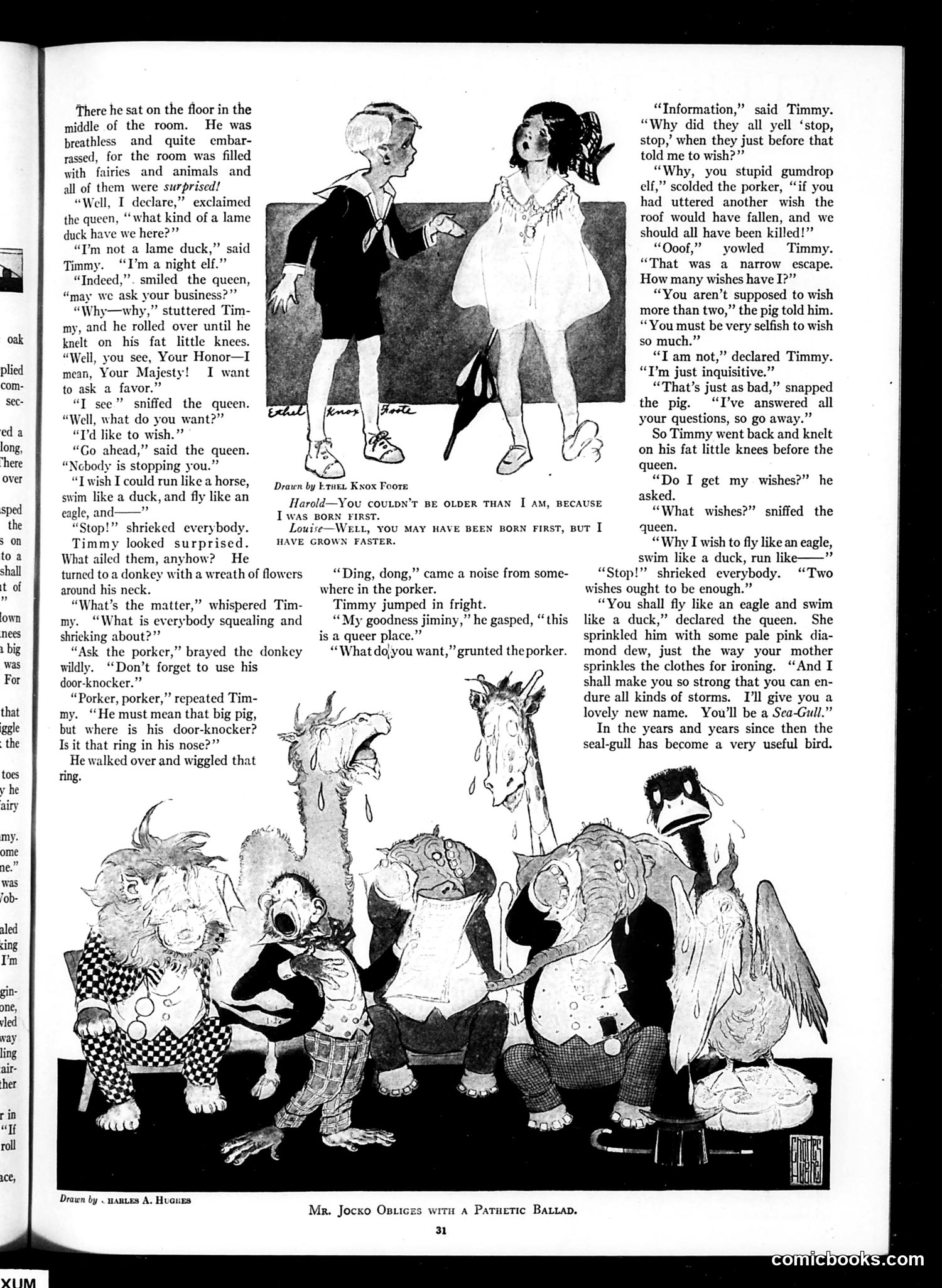
This page contains a children's fantasy story illustrated by L. Knox Foote about "Timmy," a night elf granted wishes by a fairy queen. The narrative teaches a moral lesson: greedy wish-making leads to consequences (the roof would collapse if he wished again), and selfishness is rebuked. The story concludes with Timmy transformed into a useful seagull after receiving only two wishes—flying and swimming—plus strength to endure storms. The separate cartoon at bottom, drawn by Harold A. Hughes, shows siblings debating who's older. Louise argues she's younger but has "grown faster," a gentle joke about competitive sibling dynamics. Both items reflect early 20th-century Judge magazine's mix of whimsical children's content and domestic humor. The "lame duck" reference appears literal rather than political. No specific historical figures or events are referenced—the page is primarily entertainment fiction rather than political satire.
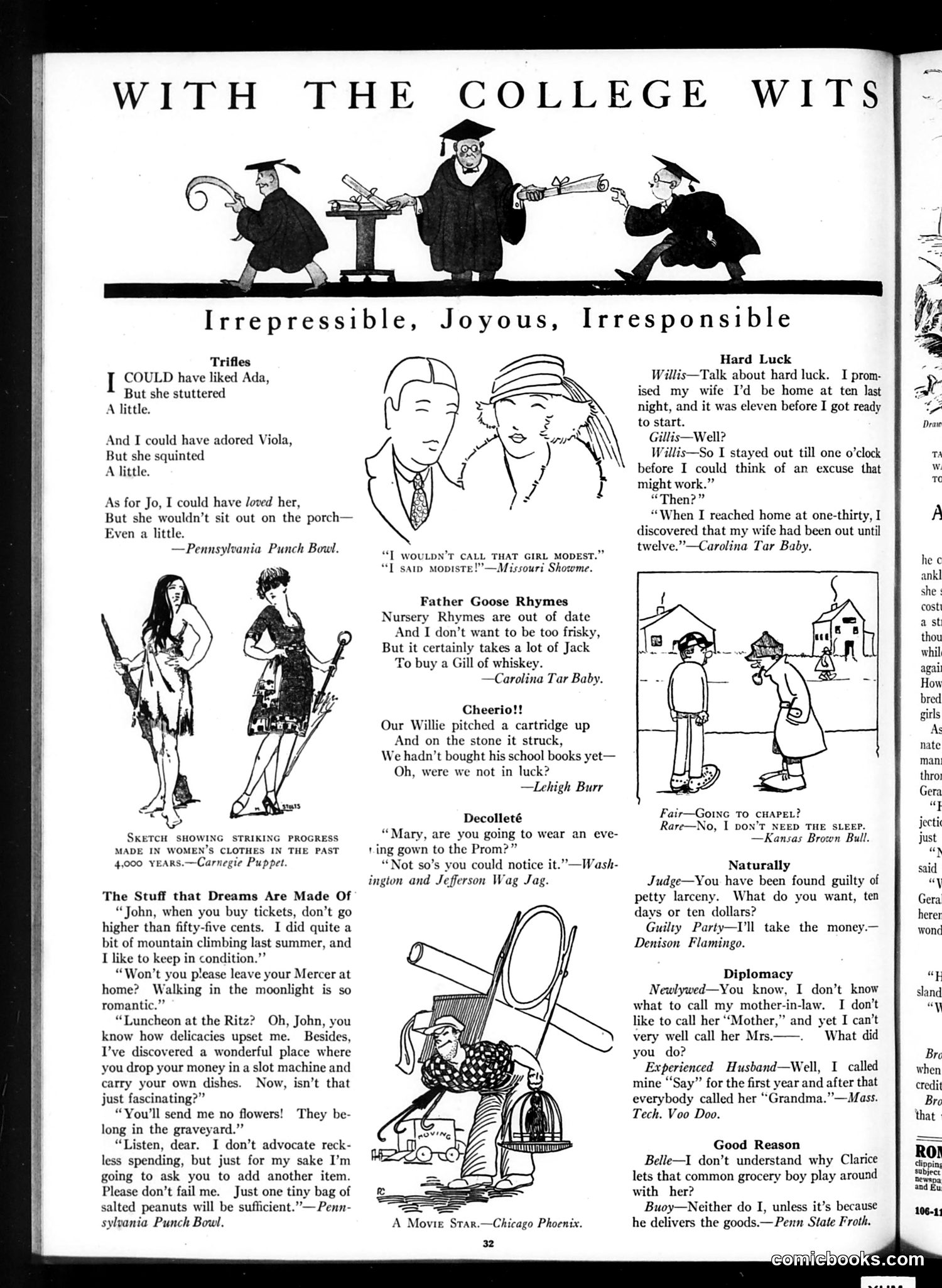
This page collects humorous short jokes and sketches targeting college students and young people of the era. The header illustration shows four graduates in academic robes engaged in various activities (observing instruments, gesturing dramatically), satirizing collegiate pretension. The content mocks predictable social behaviors: men making excuses to girlfriends about missed curfews, women's contradictory expectations of romance versus practicality, and the performative nature of courtship. One sketch contrasts women's clothing "progress" over 4,000 years—implying minimal actual change despite claims of advancement. Other jokes target Prohibition-era concerns (whiskey costs), parental anxiety (children finding ammunition instead of buying schoolbooks), and courtship etiquette. The final joke about the "grocery boy" relies on a class-based pun. The humor reflects 1920s college culture anxiety: generational independence, changing gender roles, and economic realities undermining romantic ideals. The satire is gentle rather than biting—poking fun at universal relationship follies rather than attacking specific targets.
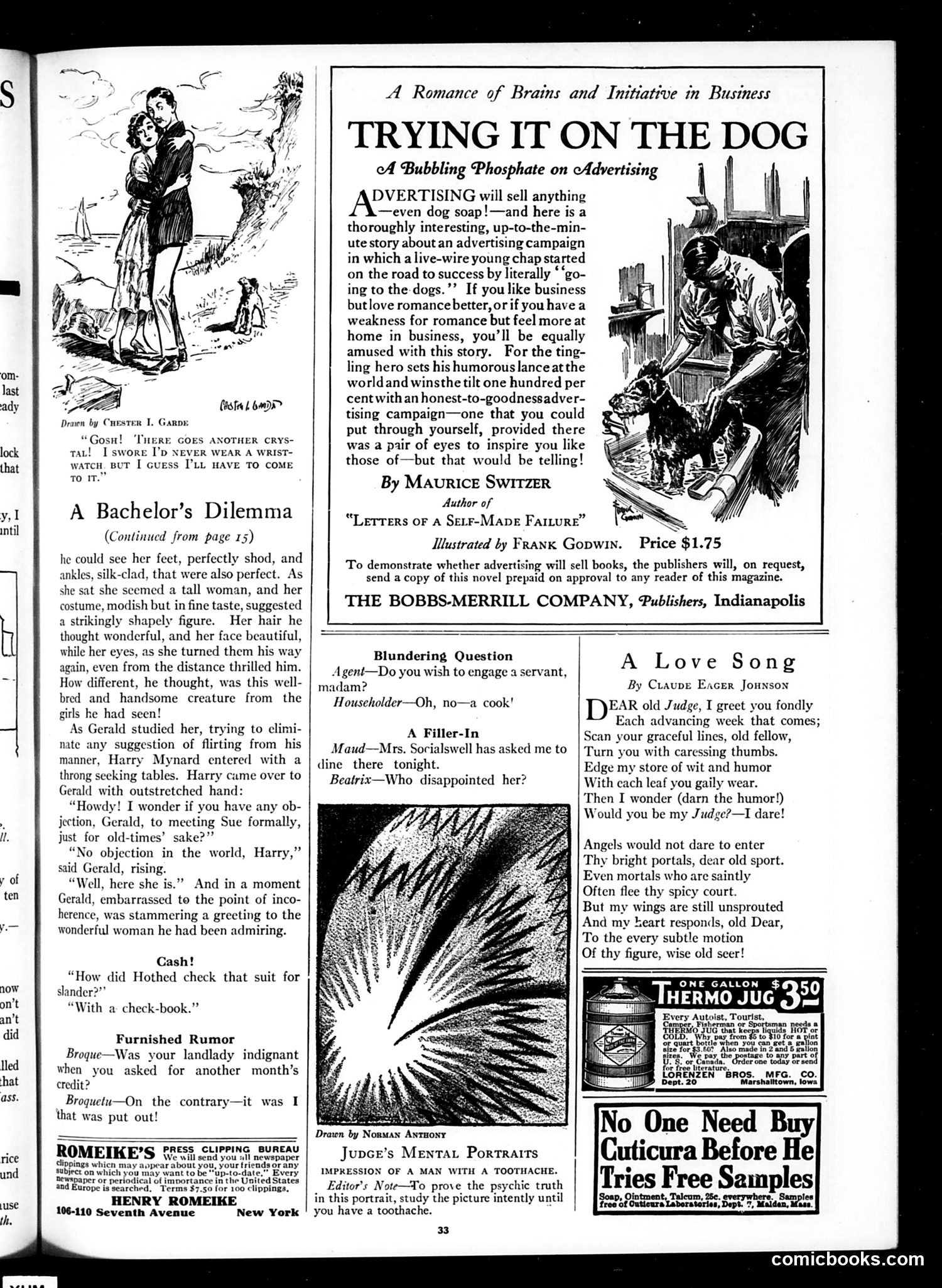
This page from *Judge* magazine contains several satirical pieces typical of early 20th-century humor: **"A Bachelor's Dilemma"** (top left): A serialized romantic story about a man encountering an elegant woman. The accompanying cartoon shows a bachelor lamenting he must finally buy a wristwatch—a social convention he'd resisted. The satire targets bachelors who resist modern fashions and romantic obligations. **"Trying It On the Dog"** (center): An advertisement for a novel about an ambitious young salesman who succeeds through an advertising campaign, even using unconventional methods ("going to the dogs"). This playfully mocks advertising's ability to sell anything, even dog soap. **Minor jokes** include workplace humor ("Cash!"), servant-hiring mishaps, and a visual gag about toothache expressions. The page is primarily **advertising and light entertainment** rather than political satire, reflecting *Judge*'s focus on business culture, romance, and social conventions of the era. The humor assumes readers understand turn-of-the-century middle-class anxieties about courtship, employment, and modern commercialism.
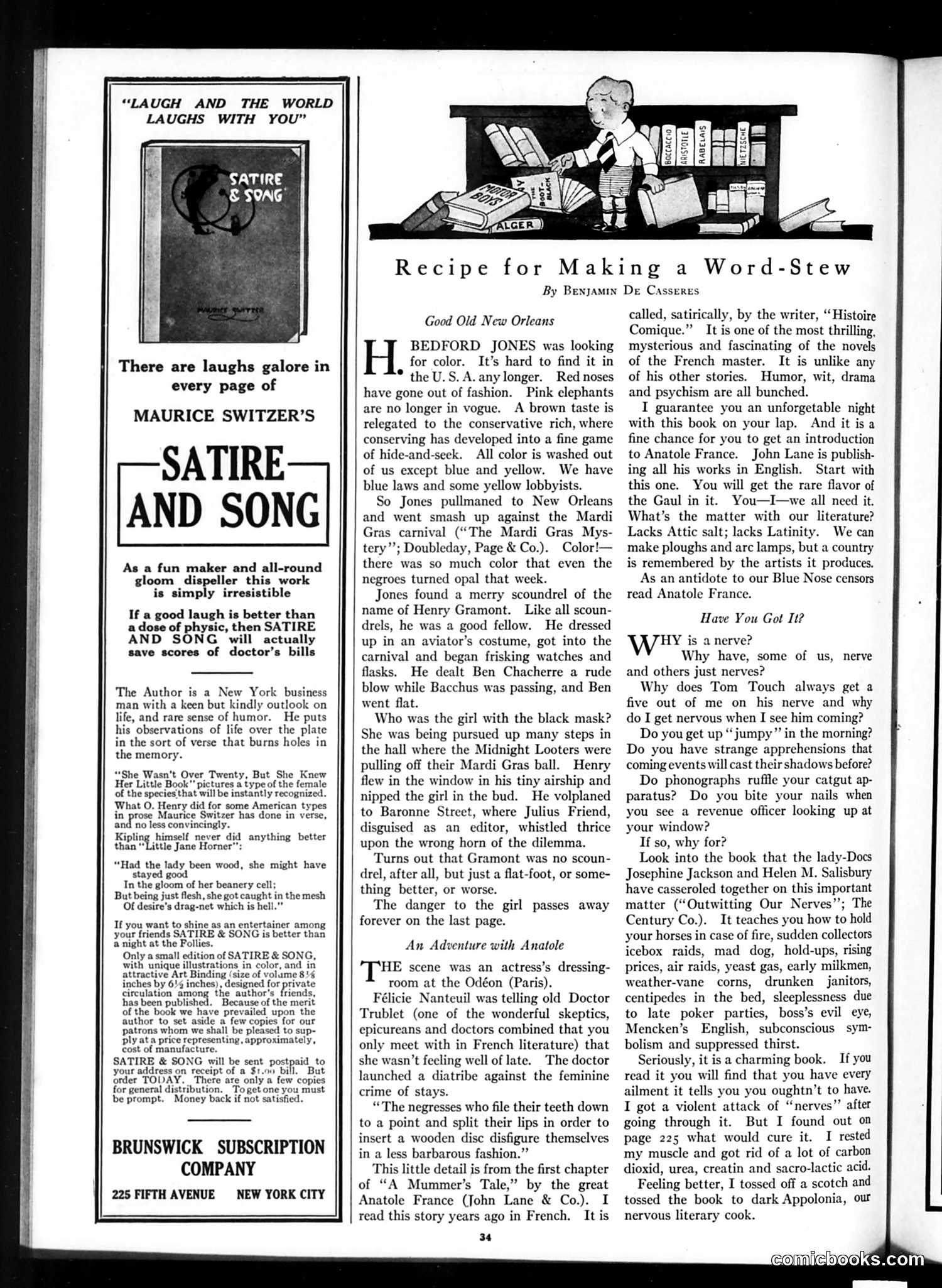
This page primarily consists of **advertising and book promotions** rather than political satire. The left side advertises Maurice Switzer's book *Satire and Song*, positioning it as humorous verse comparable to O. Henry and Kipling. It's marketed as entertaining enough to "save scores of doctor's bills" through laughter. The right side features literary content: Benjamin De Casseres's "Recipe for Making a Word-Stew," which reviews adventure novels set in New Orleans (featuring Mardi Gras) and Paris. The author uses playful language to describe plot summaries, treating fiction-writing as a whimsical recipe. The header illustration shows a figure at a bookshelf—likely representing the literary/intellectual focus of *Judge* magazine itself. **Missing context for modern readers:** This appears to be from an era when *Judge* regularly featured literary criticism and book advertisements alongside humor, reflecting early-20th-century magazine conventions. The references to Mardi Gras "color" and "negroes" reflect period attitudes now considered offensive.

This is a **government advertisement**, not satire. Published in *Judge* magazine (likely 1920s-30s), it promotes Treasury Savings Certificates as a safe alternative to risky stock speculation. The ad references the **$500 million in losses from fraudulent stock manipulation** that recently harmed American investors. It argues that ordinary people should avoid dangerous stock schemes and instead purchase government-backed certificates offering 4% interest, compounded quarterly—portrayed as completely safe because the government guarantees return of principal plus interest. The appeal to "busy people" suggests marketing to middle-class Americans. The specific example of a trustee buying sixteen certificates for estate beneficiaries emphasizes the product's safety and legitimacy compared to the stock market's dangers. This reflects post-WWI anxiety about financial fraud and represents government efforts to direct savings toward stable Treasury instruments rather than speculative equities.
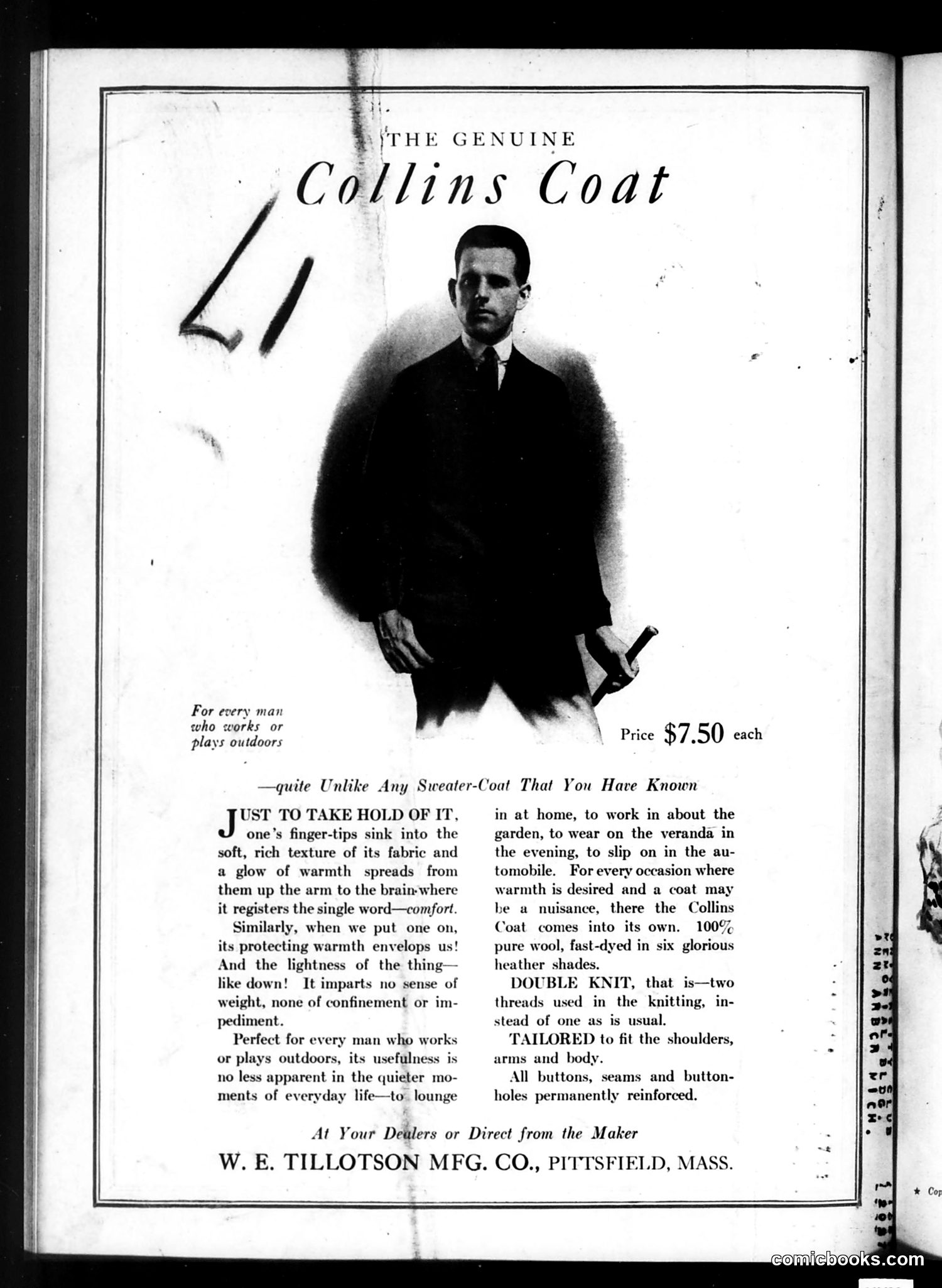
This is **not a political cartoon or satire**—it's a full-page **advertisement** for the Collins Coat, a men's wool sweater-jacket priced at $7.50, manufactured by W. E. Tillotson in Pittsfield, Massachusetts. The image shows a serious, formally-dressed man modeling the coat to demonstrate its tailored fit and versatility. The advertisement emphasizes practical features: lightweight warmth, double-knit construction, reinforced buttons and seams, and suitability for both outdoor work and casual indoor wear. The marketing copy uses persuasive language ("comfort," "protective warmth") typical of early 20th-century advertising, targeting working men and those who spend time outdoors. The claim that it's "quite Unlike Any Sweater-Coat That You Have Known" was standard competitive advertising rhetoric of the era. This appears in *Judge* simply as paid advertising content, not editorial satire.