
Judge, 1921-07-23 · page 13 of 36
Judge — July 23, 1921 — page 13: what you’re looking at
What you’re looking at
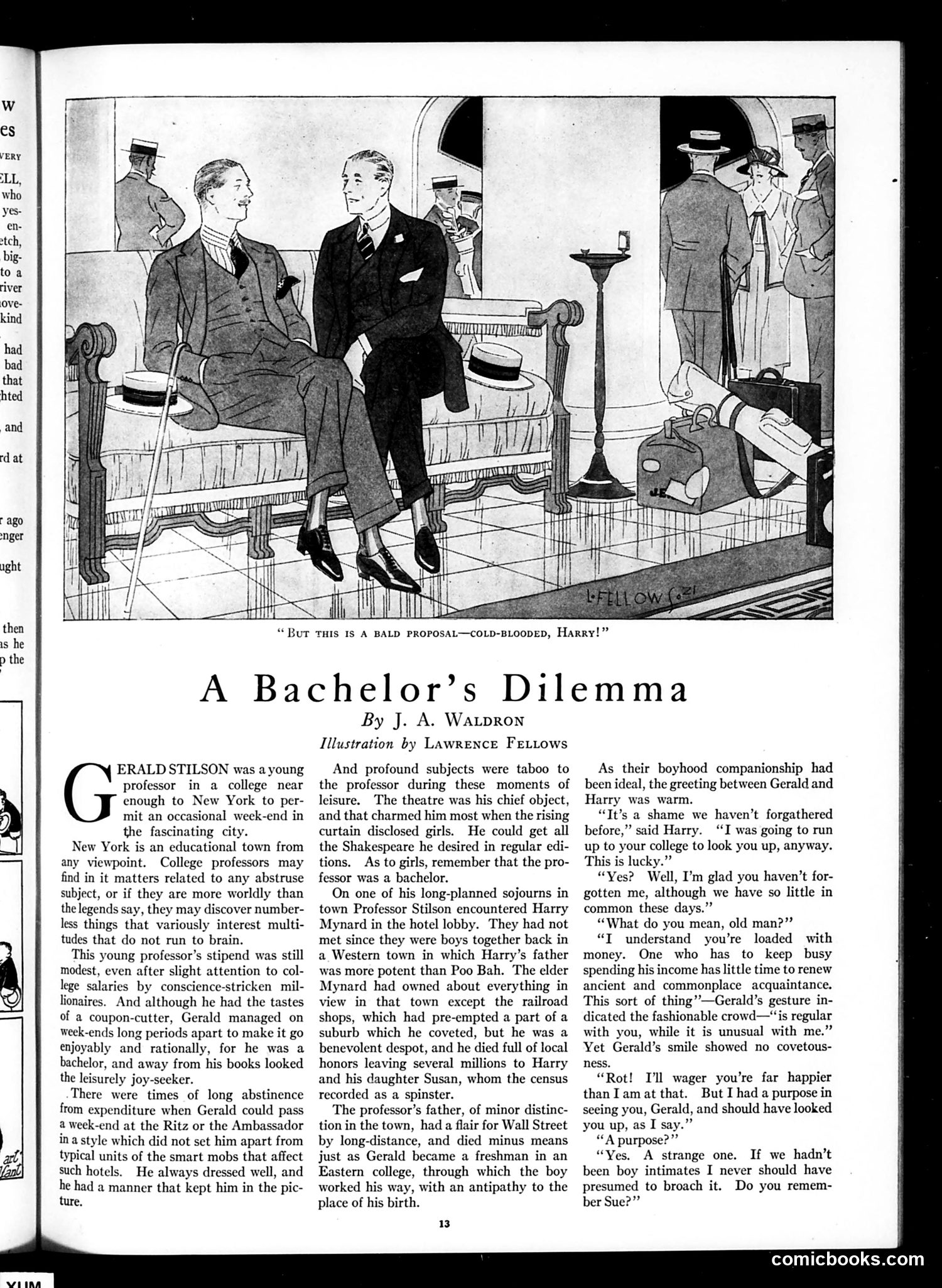
This is the opening of a serialized short story (not a political cartoon), illustrated in *Judge* magazine. The narrative establishes a class-conscious plot: Gerald Stilson, an underpaid college professor, encounters his wealthy childhood friend Harry Mynard in a New York hotel lobby. The satire targets turn-of-the-century social anxieties about money and masculinity. Gerald has "worked his way" through college and maintains intellectual dignity despite poverty, while Harry inherited millions. The story plays on period-specific tensions: professors' modest salaries, the nouveau riche lifestyle of Manhattan hotels (the Ritz, Ambassador), and the implicit awkwardness when former equals diverge economically. Harry's cryptic mention of "Sue" (his spinster sister) at the page's end suggests the "dilemma" involves a marriage proposal—likely Harry asking his poor friend to marry his sister, creating ethical conflict between love and financial security, a common theme in early 20th-century popular fiction.
📄 Transcribed text from this page (OCR, searchable)
Machine-transcribed from the original scan — historical spelling and the odd misread are preserved.
“But THIS IS A BALD PROPOSAL—COLD-BLOODED, Harry. 1 A Bachelor’s Dilemma By J. A. WatpRon Illustration by LAWRENCE FELLOws ERALDSTILSON was a young professor in a college near enough to New York to per- mit an occasional week-end in the fascinating city. New York is an educational town from any viewpoint. College professors may find in it matters related to any abstruse subject, or if they are more worldly than the legends say, they may discover number- less things that variously interest multi- tudes that do not run to brain. This young professor’s stipend was still modest, even after slight attention to col- lege salaries by conscience-stricken mil- lionaires. And although he had the tastes of a coupon-cutter, Gerald managed on week-ends long periods apart to make it go enjoyably and rationally, for he was a bachelor, and away from his books looked the leisurely joy-seeker. There were times of long abstinence from expenditure when Gerald could pass a week-end at the Ritz or the Ambassador ina style which did not set him apart from typical units of the smart mobs that affect such hotels. He always dressed well, and he had a manner that kept him in the pic- ture. And profound subjects were taboo to the professor during these moments of leisure. The theatre was his chief object, and that charmed him most when the rising curtain disclosed girls. He could get all the Shakespeare he desired in regular edi- tions. As to girls, remember that the pro- fessor was a bachelor. On one of his long-planned sojourns in town Professor Stilson encountered Harry Mynard in the hotel lobby. They had not met since they were boys together back in a Western town in which Harry’s father was more potent than Poo Bah. The elder Mynard had owned about everything in view in that town except the railroad shops, which had pre-empted a part of a suburb which he coveted, but he was a benevolent despot, and he died full of local honors leaving several millions to Harry and his daughter Susan, whom the census recorded as a spinster. The professor’s father, of minor distinc- tion in the town, had a flair for Wall Street by long-distance, and died minus means just as Gerald became a freshman in an Eastern college, through which the boy worked his way, with an antipathy to the place of his birth. 13 As their boyhood companionship had been ideal, the greeting between Gerald and Harry was warm. “It’s a shame we haven’t forgathered before,” said Harry. “I was going to run up to your college to look you up, anyway. This is lucky.” “Yes? Well, I’m glad you haven’t for- gotten me, although we have so little in common these days.”” “What do you mean, old man?” “T understand you’re loaded with money. One who has to keep busy spending his income has little time to renew ancient and commonplace acquaintance. This sort of thing”—Gerald’s gesture in- dicated the fashionable crowd—“‘is regular with you, while it is unusual with me.” Yet Gerald’s smile showed no covetous- ness. “Rot! I'll wager you’re far happier thanIamat that. But I had a purpose in seeing you, Gerald, and should have looked you up, as I say.” “A purpose?”’ “Yes. A strange one. If we hadn’t been boy intimates I never should have presumed to broach it. Do you remem- ber Sue?” comicbooks.com