
Judge, 1921-07-23 · page 26 of 36
Judge — July 23, 1921 — page 26: what you’re looking at
What you’re looking at
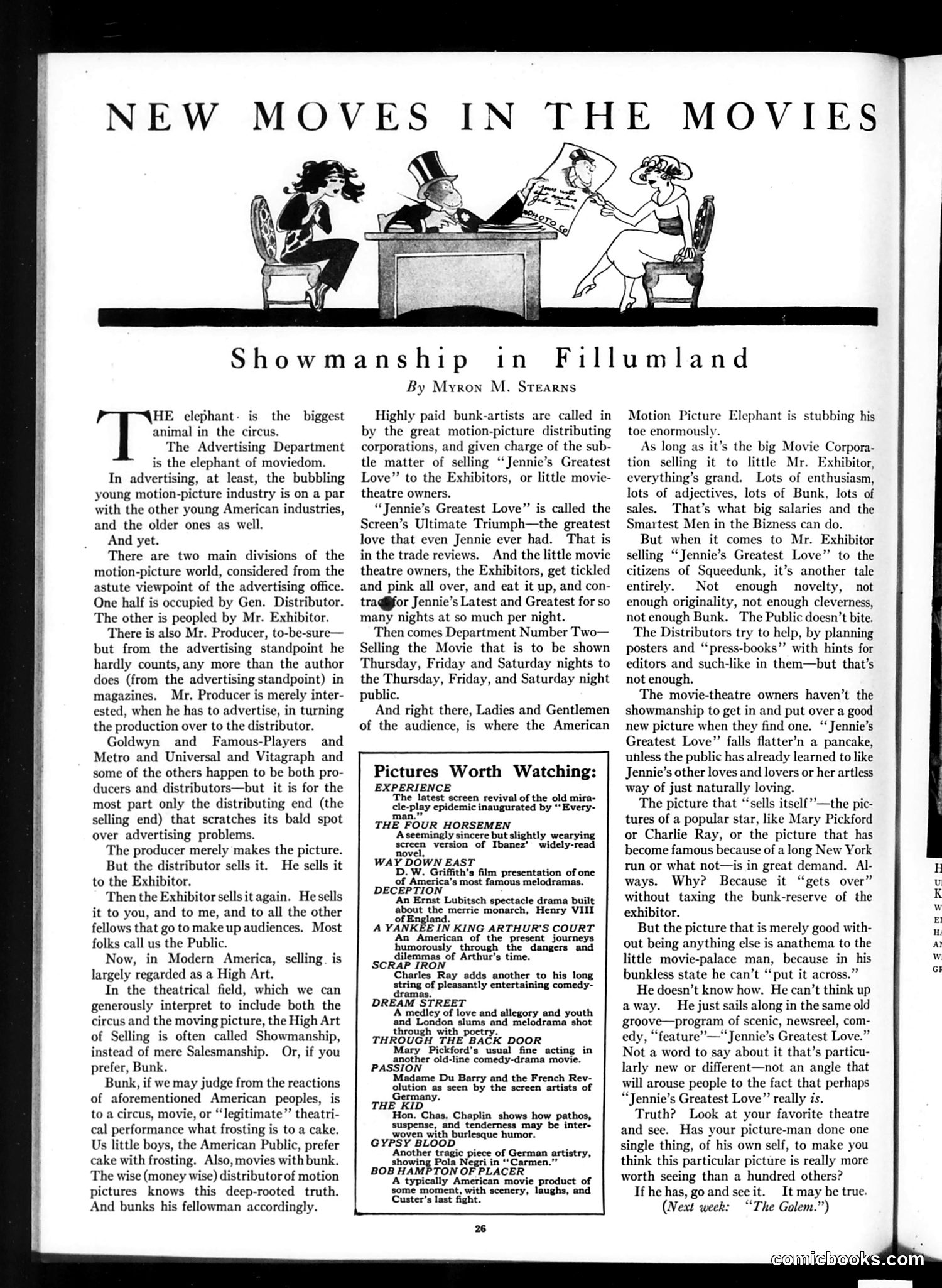
This article by Myron M. Stearns satirizes the motion picture industry's advertising and sales practices. The illustration shows three figures at a desk—likely representing the Producer, Distributor, and Exhibitor—engaged in the business of "selling" movies. Stearns argues that the film industry's real power lies not with filmmakers but with **distributors and exhibitors** who employ elaborate marketing tactics to sell films to theaters and audiences. He uses the term "**Bunk**"—meaning exaggerated promotional claims—to describe how the industry persuades the American public, comparing it to cake frosting: attractive but insubstantial. The satire targets how a mediocre film like "Jennie's Greatest Love" gets hyped as "the Screen's Ultimate Triumph," then resold through layers of middlemen using aggressive advertising. Stearns suggests Americans prefer entertainment *with* marketing hype, making dishonest salesmanship fundamental to filmdom's success.
📄 Transcribed text from this page (OCR, searchable)
Machine-transcribed from the original scan — historical spelling and the odd misread are preserved.
NEW MOVES IN THE MOVIES Showmanship HE elephant: is the animal in the circus. The Advertising Department is the elephant of moviedom. In advertising, at least, the bubbling young motion-picture industry is on a par with the other young American industries, and the older ones as well. And yet. There are two main divisions of the motion-picture world, considered from the astute viewpoint of the advertising office. One half is occupied by Gen. Distributor. The other is peopled by Mr. Exhibitor. There is also Mr. Producer, to-be-sure— but from the advertising standpoint he hardly counts, any more than the author does (from the advertising standpoint) in magazines. Mr. Producer is merely inter- ested, when he has to advertise, in turning the production over to the distributor. Goldwyn and Famous-Players and Metro and Universal and Vitagraph and some of the others happen to be both pro- ducers and distributors—but it is for the most part only the distributing end (the selling end) that scratches its bald spot over advertising problems. The producer merely makes the picture. But the distributor sells it. He sells it to the Exhibitor. Then the Exhibitor sellsit again. He sells it to you, and to me, and to all the other fellows that go to make up audiences. Most folks call us the Public. Now, in Modern America, selling. is largely regarded as a High Art. In the theatrical field, which we can generously interpret to include both the circus and the moving picture, the High Art of Selling is often called Showmanship, instead of mere Salesmanship. Or, if you prefer, Bunk. Bunk, if we may judge from the reactions of aforementioned American peoples, is to a circus, movie, or “‘legitimate”’ theatri- cal performance what frosting is to a cake. Us little boys, the American Public, prefer cake with frosting. Also, movies with bunk. The wise (money wise) distributor of motion pictures knows this deep-rooted truth. And bunks his fellowman accordingly. biggest By Myron M. Stearns Highly paid bunk-artists are called in by the great motion-picture distributing corporations, and given charge of the sub- tle matter of selling “Jennie’s Greatest Love”’ to the Exhibitors, or little movie- theatre owners. “Jennie’s Greatest Love” is called the Screen’s Ultimate Triumph—the greatest love that even Jennie ever had. That is in the trade reviews. And the little movie theatre owners, the Exhibitors, get tickled and pink all over, and eat it up, and con- tra@§for Jennie’s Latest and Greatest for so many nights at so much per night. Then comes Department Number Two— Selling the Movie that is to be shown Thursday, Friday and Saturday nights to the Thursday, Friday, and Saturday night public. And right there, Ladies and Gentlemen of the audience, is where the American Pictures Worth Watching: EXPERIENCE The latest screen revival of the old mira- Se lay epidemic inaugurated by “‘Every- THE. "FOUR HORSEMEN Aseemingly sincere but slightly wearying screen version of Ibanez’ widely-read novel. WAY DOWN EAST D. W. Griffith's film presentation of one of America’s most famous melodramas. DECEPTION An Ernst Lubitsch spectacle drama built about the merrie monarch, Henry VIII of England. A YANKEE IN KING ARTHUR'S COURT ‘An American of the present journeys b econege through the dangers dilemmas of Arthur's time. SCRAP IRON Charles Ray adds another to his long string of pleasantly entertaining comedy- dramas. DREAM STREET ‘A medley of love and allegory and youth and London sli slums and melodrama shot through with poet THROUGH THE PRACK DOOR Mary Pickford’s usual fine acting in another old-line comedy-drama movie. PASSION Madame Du Barry and the French Rev- olution as seen by the screen artists of Germany. THE KID Hon. Chas. Chaplin shows how pathos, suspense, and tenderness may be inter- woven with burlesque humor. GYPSY BLOOD Another tragic piece of German artistry, showing Pola Negri in ‘‘Carmen.” BOB HAMPTON OF PLACER A typically American movie product of some moment, with scenery, laughs, and Custer’s last fight. in Fillumland Motion Picture Elephant is stubbing his toe enormou: As long as it’s the big Movie Corpora- tion selling it to little Mr. Exhibitor, everything’s grand. Lots of enthusiasm, lots of adjectives, lots of Bunk, lots of sales. That’s what big salaries and the Smartest Men in the Bizness can do. But when it comes to Mr. Exhibitor selling “Jennie’s Greatest Love’’ to the citizens of Squeedunk, it’s another tale entirely. Not enough novelty, not enough originality, not enough cleverness, not enough Bunk. The Public doesn’t bite. The Distributors try to help, by planning posters and “press-books”’ with hints for editors and such-like in them—but that’s not enough. The movie-theatre owners haven’t the showmanship to get in and put over a good new picture when they find one. “Jennie’s Greatest Love”’ falls flatter’n a pancake, unless the public has already learned to like Jennie’s other loves and lovers or her artless way of just naturally loving. The picture that “sells itself” —the pic- tures of a popular star, like Mary Pickford or Charlie Ray, or the picture that has become famous because of a long New York run or what not—is in great demand. Al- ways. Why? Because it “gets over” without taxing the bunk-reserve of the exhibitor. But the picture that is merely good with- out being anything else is anathema to the little movie-palace man, because in his bunkless state he can’t “put it across.” He doesn’t know how. He can’t think up away. He just sails along in the same old groove—program of scenic, newsreel, com- edy, “feature’”—‘‘Jennie’s Greatest Love.” Not a word to say about it that’s particu- larly new or different—not an angle that will arouse people to the fact that perhaps “Jennie’s Greatest Love” really is. Truth? Look at your favorite theatre and see. Has your picture-man done one single thing, of his own self, to make you think this particular picture is really more worth seeing than a hundred others? If he has, goand see it. It may be true. (Next week: “The Golem.”)