
Judge, 1921-07-23 · page 11 of 36
Judge — July 23, 1921 — page 11: what you’re looking at
What you’re looking at
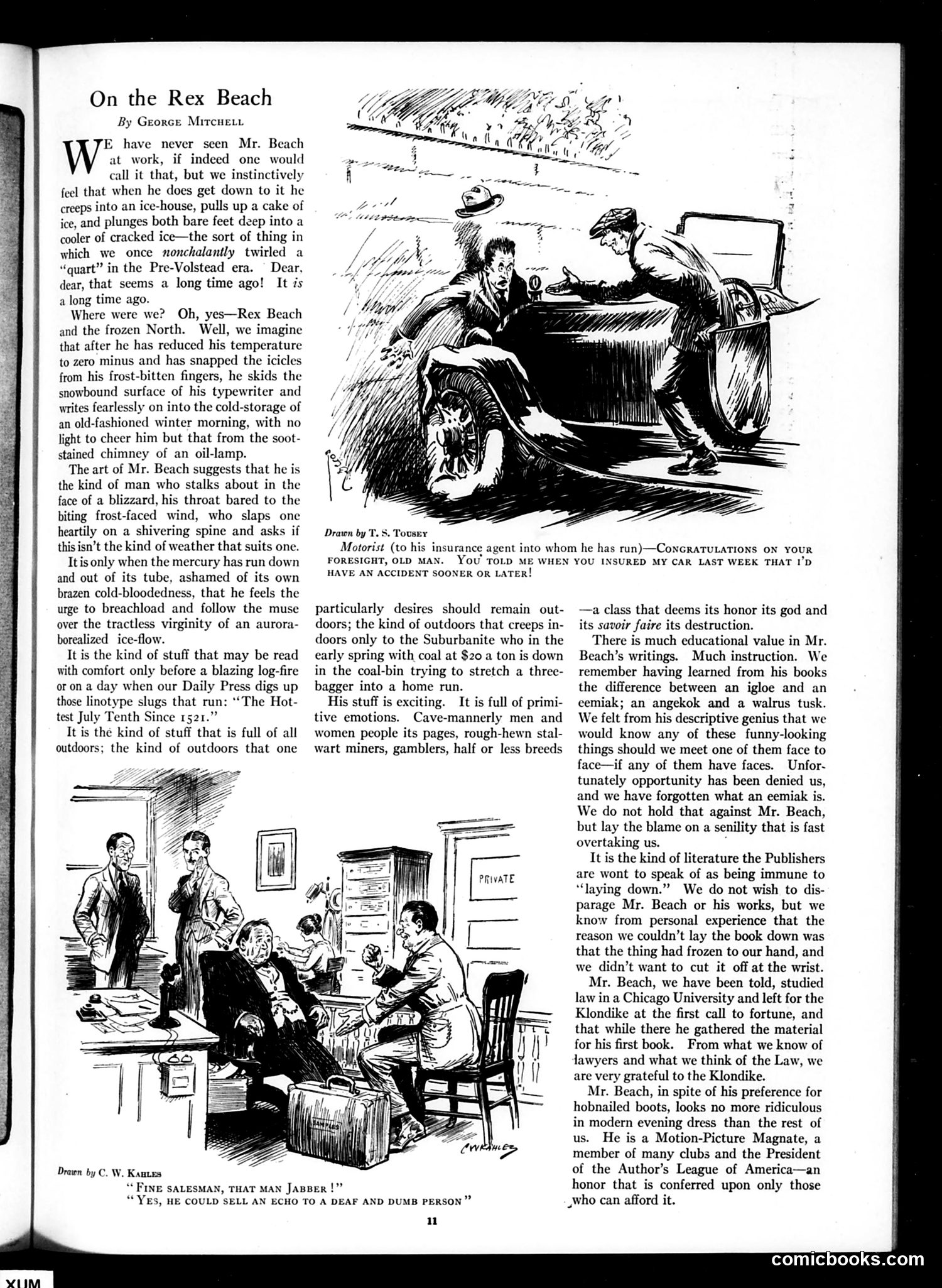
This article by George Mitchell humorously profiles **Rex Beach**, a popular adventure novelist known for stories set in the frozen North and Klondike. Mitchell satirizes Beach's writing by imagining him composing in extreme cold—literally freezing himself to achieve authenticity. The joke rests on Beach's reputation for vivid outdoor narratives filled with primitive emotions, miners, and Arctic terminology (igloos, eemiaks, angekoks). Mitchell gently mocks both Beach's intensity and the reading public's reaction, noting that one reader couldn't lay down his frozen book—a witty conflation of emotional engagement with literal ice. The accompanying cartoons are unrelated satirical sketches: one about aggressive salesmanship, another about an auto insurance claim. The piece celebrates Beach as a notable literary figure while poking fun at the overwrought earnestness of adventure fiction popular in the early 20th century.
📄 Transcribed text from this page (OCR, searchable)
Machine-transcribed from the original scan — historical spelling and the odd misread are preserved.
On the Rex Beach By Georcr Mrrcnen. — have never seen Mr. Beach W at work, if indeed one would call it that, but we instinctively feel that when he does get down to it he creeps into an ice-house, pulls up a cake of ice, and plunges both bare feet deep into a cooler of cracked ice—the sort of thing in which we once nonchalantly twirled a “quart” in the Pre-Volstead era. Dear, dear, that seems a long time ago! It is a long time ago. Where were we? Oh, yes—Rex Beach and the frozen North. Well, we imagine that after he has reduced his temperature to zero minus and has snapped the icicles from his frost-bitten fingers, he skids the snowbound surface of his typewriter and writes fearlessly on into the cold-storage of an old-fashioned winter morning, with no light to cheer him but that from the soot- stained chimney of an oil-lamp. The art of Mr. Beach suggests that he is the kind of man who stalks about in the face of a blizzard, his throat bared to the biting frost-faced wind, who slaps one heartily on a shivering spine and asks if this isn’t the kind of weather that suits one. Itis only when the mercury has run down and out of its tube, ashamed of its own brazen cold-bloodedness, that he feels the urge to breachload and follow the muse over the tractless virginity of an aurora- borealized ice-flow. It is the kind of stuff that may be read with comfort only before a blazing log-fire or on a day when our Daily Press digs up those linotype slugs that run: ‘The Hot- test July Tenth Since 1521.” It is the kind of stuff that is full of all outdoors; the kind of outdoors that one Drawn by C. W. Kannes Drawn by T. S. Tousey Motorist (to his insurance agent into whom he has run)—CoNnGRATULATIONS ON YOUR FORESIGHT, OLD MAN. HAVE AN ACCIDENT SOONER OR LATER! particularly desires should remain out- doors; the kind of outdoors that creeps in- doors only to the Suburbanite who in the early spring with coal at $20 a ton is down in the coal-bin trying to stretch a three- bagger into a home run. His stuff is exciting. It is full of primi- tive emotions. Cave-mannerly men and women people its pages, rough-hewn stal- wart miners, gamblers, half or less breeds PRIVATE INE SALESMAN, THAT MAN JABBER !”” “YES, HE COULD SELL AN ECHO TO A DEAF AND DUMB PERSON” 1 You TOLD ME WHEN YOU INSURED MY CAR LAST WEEK THAT I'D —a class that deems its honor its god and its savoir faire its destruction. There is much educational value in Mr. Beach’s writings. Much instruction. We remember having learned from his books the difference between an igloe and an eemiak; an angekok and a walrus tusk. We felt from his descriptive genius that we would know any of these funny-looking things should we meet one of them face to face—if any of them have faces. Unfor- tunately opportunity has been denied us, and we have forgotten what an eemiak is. We do not hold that against Mr. Beach, but lay the blame on a senility that is fast overtaking us. : It is the kind of literature the Publishers are wont to speak of as being immune to “laying down.” We do not wish to dis- parage Mr. Beach or his works, but we know from personal experience that the reason we couldn’t lay the book down was that the thing had frozen to our hand, and we didn’t want to cut it off at the wrist. Mr. Beach, we have been told, studied law in a Chicago University and left for the Klondike at the first call to fortune, and that while there he gathered the material for his first book. From what we know of Jawyers and what we think of the Law, we are very grateful to the Klondike. Mr. Beach, in spite of his preference for hobnailed boots, looks no more ridiculous in modern evening dress than the rest of us. He is a Motion-Picture Magnate, a member of many clubs and the President of the Author’s League of America—an honor that is conferred upon only those Who can afford it. comicbooks.com