
Judge, 1921-07-23 · page 5 of 36
Judge — July 23, 1921 — page 5: what you’re looking at
What you’re looking at
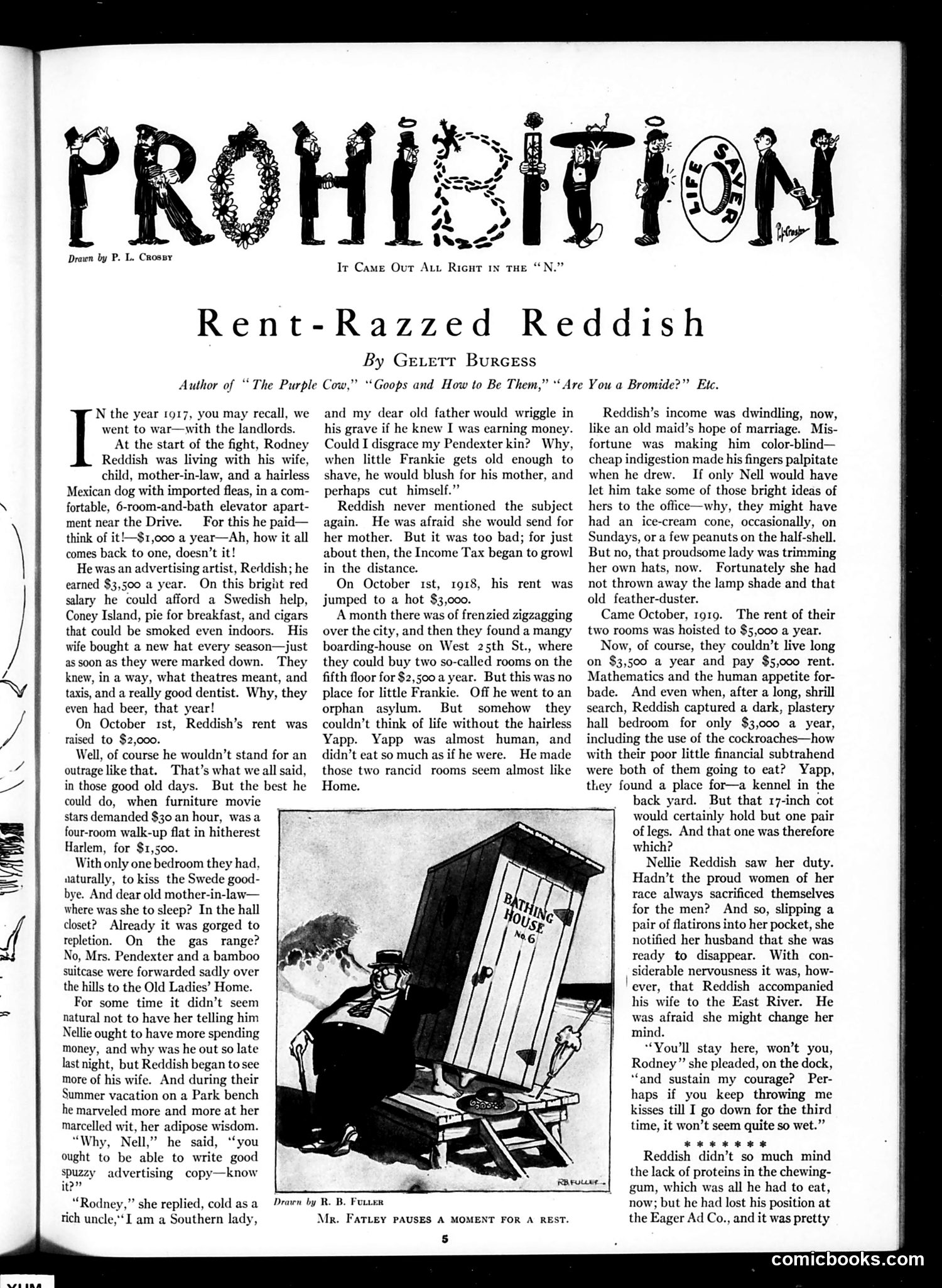
This is a satirical short story illustrated by P.L. Crosby, mocking the housing crisis of 1917 New York. The protagonist, Rodney Reddish, is an advertising artist struggling with skyrocketing rent—jumping from $1,000 to $3,000 yearly. The satire targets how landlords exploited tenants during WWI housing shortages. Reddish desperately seeks affordable housing, eventually finding a cheap two-room apartment, only to discover it's inadequate (barely fits furniture, includes a rooster-haunted space). The illustration shows him cramped in his tiny living situation. The story mocks both Reddish's delusions about middle-class stability and the predatory rental market that trapped working professionals. It's commentary on economic desperation dressed as comedy—a relatable complaint for Judge's urban, middle-class readership.
📄 Transcribed text from this page (OCR, searchable)
Machine-transcribed from the original scan — historical spelling and the odd misread are preserved.
UMMM SS a tig Drawn by P. L. Crosy N the year 1917, you may recall, we went to war—with the landlords. At the start of the fight, Rodney Reddish was living with his wife, child, mother-in-law, and a hairless Mexican dog with imported fleas, in a com- fortable, 6-room-and-bath elevator apart- ment near the Drive. For this he paid— think of it!—$1,000 a year—Ah, how it all comes back to one, doesn’t it! He was an advertising artist, Reddish; he earned $3,500 a year. On this bright red salary he could afford a Swedish help, Coney Island, pie for breakfast, and cigars that could be smoked even indoors. His wife bought a new hat every season—just as soon as they were marked down. They knew, in a way, what theatres meant, and taxis, and a really good dentist. Why, they even had beer, that year! On October 1st, Reddish’s rent was raised to $2,000. Well, of course he wouldn’t stand for an outrage like that. That’s what we all said, in those good old days. But the best he could do, when furniture movie stars demanded $30 an hour, was a four-room walk-up flat in hitherest Harlem, for $1,500. With only one bedroom they had, naturally, to kiss the Swede good- bye. And dear old mother-in-law— where was she to sleep? In the hall closet? Already it was gorged to repletion. On the gas range? No, Mrs. Pendexter and a bamboo suitcase were forwarded sadly over the hills to the Old Ladies’ Home. For some time it didn’t seem natural not to have her telling him Nellie ought to have more spending money, and why was he out so late last night, but Reddish began to see more of his wife. And during their Summer vacation on a Park bench he marveled more and more at her marcelled wit, her adipose wisdom. “Why, Nell,” he said, ‘‘you ought to be able to write good spuzzy advertising copy—know i” “Rodney,” she replied, cold as a tich uncle,‘ am a Southern lady, Ir Came Our Att Ricut in THE “N.” Rent-Razzed Reddish By Ge.retr BurcEss Author of “The Purple Cow,” ““Goops and How to Be Them,” “ Are You a Bromide?” Etc. and my dear old father would wriggle in his grave if he knew I was earning money. Could I disgrace my Pendexter kin? Why, when little Frankie gets old enough to shave, he would blush for his mother, and perhaps cut himself.” Reddish never mentioned the subject again. He was afraid she would send for her mother. But it was too bad; for just about then, the Income Tax began to growl in the distance. On October 1st, 1918, his rent was jumped to a hot $3,000. A month there was of frenzied zigzagging over the city, and then they found a mangy boarding-house on West 25th St., where they could buy two so-called rooms on the fifth floor for $2,500 a year. But this was no place for little Frankie. Off he went to an orphan asylum. But somehow they couldn’t think of life without the hairless Yapp. Yapp was almost human, and didn’t eat so much as if he were. He made those two rancid rooms seem almost like Home. Draven by R. B. Fuuer Mr. FatLey PAUSES A MOMENT FOR A REST. 5 Reddish’s income was dwindling, now, like an old maid’s hope of marriage. Mis- fortune was making him color-blind— cheap indigestion made his fingers palpitate when he drew. If only Nell would have let him take some of those bright ideas of hers to the office—why, they might have had an ice-cream cone, occasionally, on Sundays, or a few peanuts on the half-shell. But no, that proudsome lady was trimming her own hats, now. Fortunately she had not thrown away the lamp shade and that old feather-duster. Came October, 1919. The rent of their two rooms was hoisted to $5,000 a year. Now, of course, they couldn’t live long on $3,500 a year and pay $5,000 rent. Mathematics and the human appetite for- bade. And even when, after a long, shrill search, Reddish captured a dark, plastery hall bedroom for only $3,000 a year, including the use of the cockroaches—how with their poor little financial subtrahend were both of them going to eat? Yapp, they found a place for—a kennel in the back yard. But that 17-inch cot would certainly hold but one pair of legs. And that one was therefore which? Nellie Reddish saw her duty. Hadn’t the proud women of her race always sacrificed themselves for the men? And so, slipping a pair of flatirons into her pocket, she notified her husband that she was ready to disappear. With con- , siderable nervousness it was, how- ‘ever, that Reddish accompanied his wife to the East River. He was afraid she might change her mind. “You'll stay here, won’t you, Rodney” she pleaded, on the dock, “‘and sustain my courage? Per- haps if you keep throwing me kisses till I go down for the third time, it won’t seem quite so wet.”” eeeEEEEE Reddish didn’t so much mind the lack of proteins in the chewing- gum, which was all he had to eat, now; but he had lost his position at the Eager Ad Co., and it was pretty comicbooks.com