
Judge, 1921-07-23 · page 19 of 36
Judge — July 23, 1921 — page 19: what you’re looking at
What you’re looking at
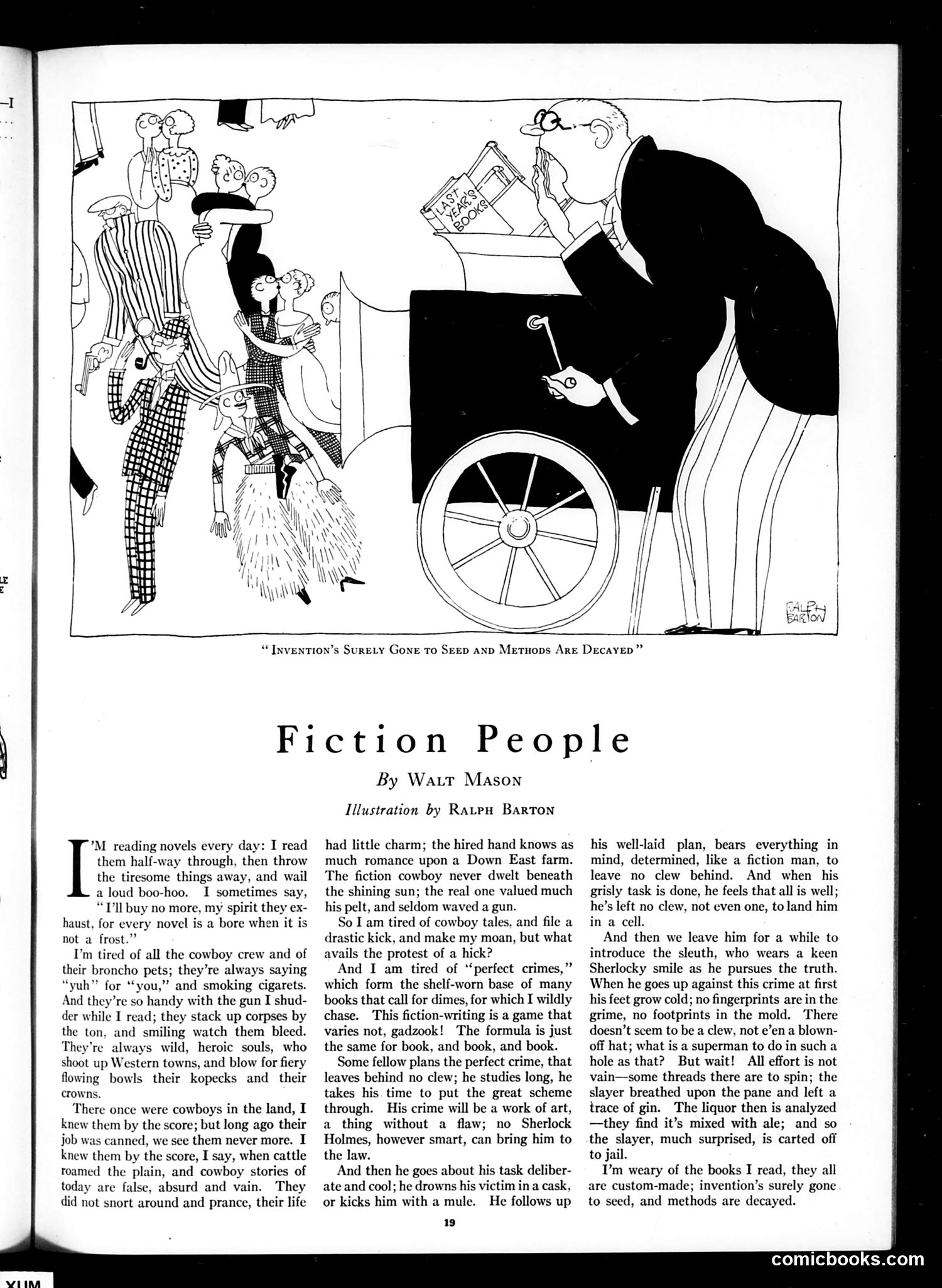
This page presents Walt Mason's essay criticizing the decline of American fiction, illustrated by Ralph Barton's cartoon at top. **The Cartoon:** Shows a well-dressed man in a carriage labeled "Invention's Surely Gone to Seed and Methods Are Decayed," pulled by figures representing tired literary tropes—a stereotypical cowboy and other stock characters—suggesting literature has become a mechanical, exhausted enterprise. **Mason's Complaint:** The essay attacks two dominant popular fiction genres of the era: 1. **Cowboy tales** - criticized as unrealistic and repetitive; real cowboys were unglamorous workers, not the trigger-happy, romantic heroes of pulp fiction 2. **Detective mysteries** - mocked for their predictable formula: a "perfect crime" with no clues, followed by a brilliant detective solving it through absurd, contrived evidence (a gin-stained fingerprint) **The Point:** Mason argues American popular fiction has become formulaic, mass-produced entertainment with no genuine imagination or originality—entertainment for "custom-made" consumption rather than art.
📄 Transcribed text from this page (OCR, searchable)
Machine-transcribed from the original scan — historical spelling and the odd misread are preserved.
“ Ixvention’s SuRELY Gone To SEED AND Metuops Are Decayep” Fiction People By Watt Mason ’M reading novels every day: I read them half-way through, then throw the tiresome things away, and wail a loud boo-hoo. I sometimes say, “T'll buy no more, my spirit they ex- haust, for every novel is a bore when it is not a frost.” I'm tired of all the cowboy crew and of their broncho pets; they’re always saying “yuh” for “‘you,” and smoking cigarets. And they’re so handy with the gun I shud- der while I read; they stack up corpses by the ton, and smiling watch them bleed. They're always wild, heroic souls, who shoot up Western towns, and blow for fiery flowing bowls their kopecks and their crowns. There once were cowboys in the land, I knew them by the score; but long ago their job was canned, we see them never more. I knew them by the score, I say, when cattle roamed the plain, and cowboy stories of today are false, absurd and vain. They did not snort around and prance, their life Illustration by Rateuw Barton had little charm; the hired hand knows as much romance upon a Down East farm. The fiction cowboy never dwelt beneath the shining sun; the real one valued much his pelt, and seldom waved a gun. So I am tired of cowboy tales, and file a drastic kick, and make my moan, but what avails the protest of a hick? And I am tired of “perfect crimes,” which form the shelf-worn base of many books that call for dimes, for which I wildly chase. This fiction-writing is a game that varies not, gadzook! The formula is just the same for book, and book, and book. Some fellow plans the perfect crime, that leaves behind no clew; he studies long, he takes his. time to put the great scheme through. His crime will be a work of art, a thing without a flaw; no Sherlock Holmes, however smart, can bring him to the law. And then he goes about his task deliber- ate and cool; he drowns his victim in a cask, or kicks him with a mule. He follows up 19 his well-laid plan, bears everything in mind, determined, like a fiction man, to leave no clew behind. And when his grisly task is done, he feels that all is well; he’s left no clew, not even one, to land him in a cell. And then we leave him for a while to introduce the sleuth, who wears a keen Sherlocky smile as he pursues the truth. When he goes up against this crime at first his feet grow cold; no fingerprints are in the grime, no footprints in the mold. There doesn’t scem to be a clew, not e’en a blown- off hat; what is a superman to do in such a hole as that? But wait! All effort is not vain—some threads there are to spin; the slayer breathed upon the pane and left a trace of gin. The liquor then is analyzed —they find it’s mixed with ale; and so the slayer, much surprised, is carted off to jail. I’m weary of the books I read, they all are custom-made; invention’s surely gone to seed, and methods are decayed. comicbooks.com