
Judge, 1921-07-23 · page 7 of 36
Judge — July 23, 1921 — page 7: what you’re looking at
What you’re looking at
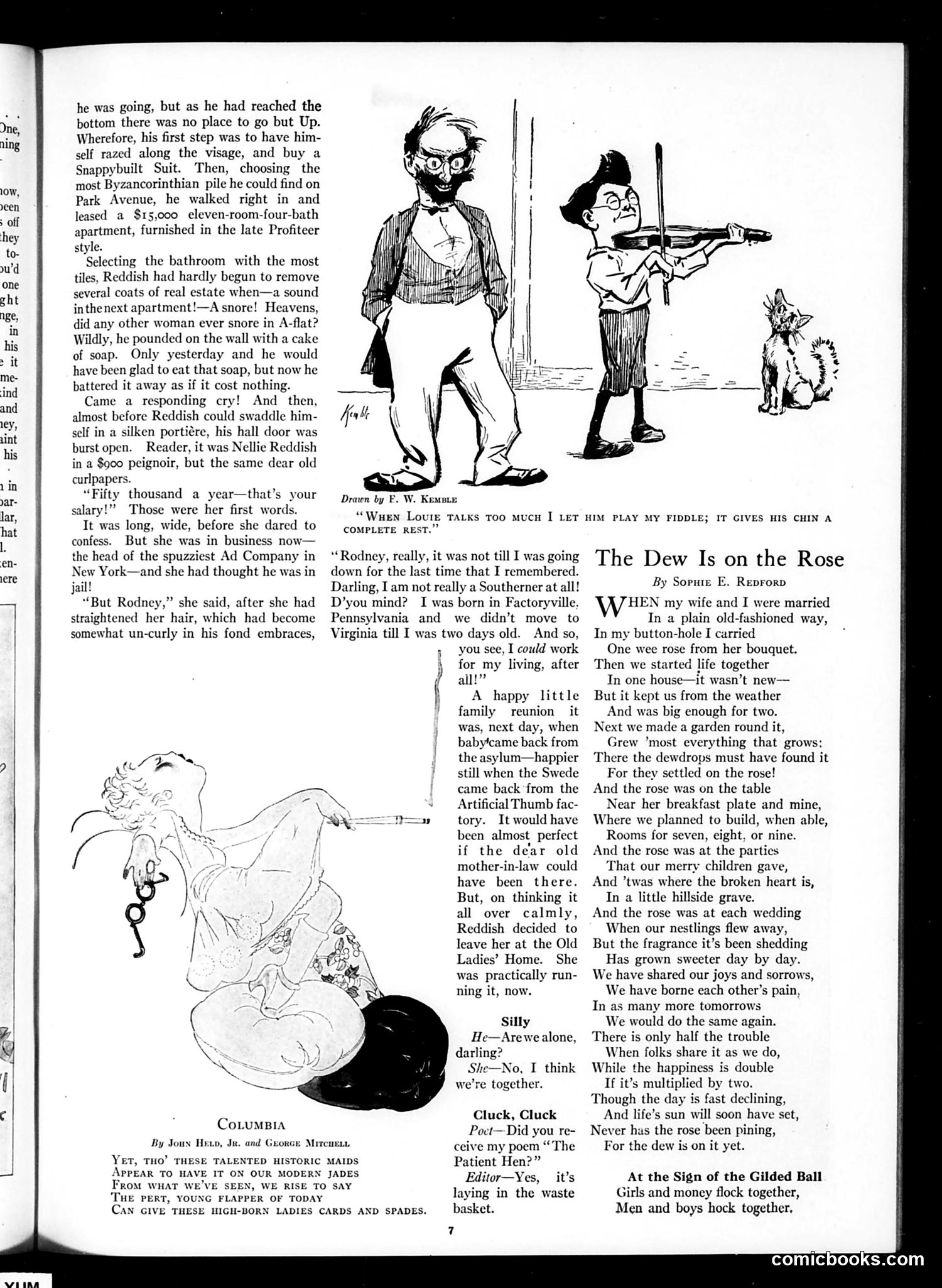
This page contains three distinct pieces from *Judge* magazine (likely early 20th century): **Main Story Cartoon** (top): A rags-to-riches narrative about "Reddish," a man who suddenly becomes wealthy and moves to a fancy Park Avenue apartment, only to discover his wife Nellie—whom he thought was in jail—has become a successful advertising executive. The satire mocks post-WWI "Profiteer" wealth (war profiteers), nouveau-riche excess, and changing gender roles (the wife as breadwinner surprised him). **"Columbia" Cartoon** (bottom left): A classical female allegorical figure (Columbia, representing America) illustrated by the credited artists. **Miscellaneous Humor Snippets** (center-right): Brief joke exchanges, including one about a poet's rejected manuscript. **Poetry** ("The Dew Is on the Rose"): Sentimental verse about married life and enduring love—likely filler content. The page primarily satirizes American wealth inequality and social mobility during the post-WWI era.
📄 Transcribed text from this page (OCR, searchable)
Machine-transcribed from the original scan — historical spelling and the odd misread are preserved.
he was going, but as he had reached the bottom there was no place to go but Up. Wherefore, his first step was to have him- self razed along the visage, and buy a Snappybuilt Suit. Then, choosing the most Byzancorinthian pile he could find on Park Avenue, he walked right in and leased a $15,000 eleven-room-four-bath apartment, furnished in the late Profiteer style. Selecting the bathroom with the most tiles, Reddish had hardly begun to remove several coats of real estate when—a sound inthenext apartment!—A snore! Heavens, did any other woman ever snore in A-flat? Wildly, he pounded on the wall with a cake of soap. Only yesterday and he would have been glad to eat that soap, but now he battered it away as if it cost nothing. Came a responding cry! And_ then, almost before Reddish could swaddle him- self in a silken portiére, his hall door was burst open. Reader, it was Nellie Reddish in a $900 peignoir, but the same dear old curlpapers. “Fifty thousand a year—that’s your salary!” Those were her first words. It was long, wide, before she dared to confess. But she was in business now— the head of the spuzziest Ad Company in New York—and she had thought he was in jail! “But Rodney,” she said, after she had straightened her hair, which had become somewhat un-curly in his fond embraces, CoLuMBIA By Jous Hex, Jn. and Georce Mrrcuen. YET, THO’ THESE TALENTED HISTORIC MAIDS Drawn by F. W. Keanu “Wuen Loure TALKs Too MuCH I LET HIM PLAY MY FIDDLE; IT GIVES HIS CHIN A COMPLETE REST.” “Rodney, really, it was not till I was going down for the last time that I remembered. Darling, I am not really a Southerner at all! D’you mind? I was born in Factoryville. Pennsylvania and we didn’t move to Virginia till I was two days old. And so, ; you see, I could work \ for my living, after J allt” } A happy little family reunion it was, next day, when baby'came back from the asylum—happier still when the Swede came back ‘from the Artificial Thumb fac- tory. It would have been almost perfect if the dear old mother-in-law could have been there. But, on thinking it all over calmly, Reddish decided to leave her at the Old Ladies’ Home. She was practically run- ning it, now. Silly He—Arewe alone, darling? She—No, I think we're together. Cluck, Cluck Poet—Did you re- ceive my poem “The Patient Hen?” Editor—Yes, it’s laying in the waste basket. 7 The Dew Is on the Rose By Sorue E. Reprorp WHEN my wife and I were married In a plain old-fashioned way, In my button-hole I carried One wee rose from her bouquet. Then we started life together In one house—it wasn’t new— But it kept us from the weather And was big enough for two. Next we made a garden round it, Grew ’most everything that grows: There the dewdrops must have found it For they settled on the rose! And the rose was on the table Near her breakfast plate and mine, Where we planned to build, when able, Rooms for seven, eight, or nine. And the rose was at the parties That our merry children gave, And ’twas where the broken heart is, In a little hillside grave. And the rose was at each wedding When our nestlings flew away, But the fragrance it’s been shedding Has grown sweeter day by day. We have shared our joys and sorrows, We have borne each other’s pain, In as many more tomorrows We would do the same again. There is only half the trouble When folks share it as we do, While the happiness is double If it’s multiplied by two. Though the day is fast declining, And life’s sun will soon have set, Never has the rose been pining, For the dew is on it yet. At the Sign of the Gilded Ball Girls and money flock together, Men and boys hock together, comicbooks.com