
A complete issue · 38 pages · 1921
Judge — July 16, 1921
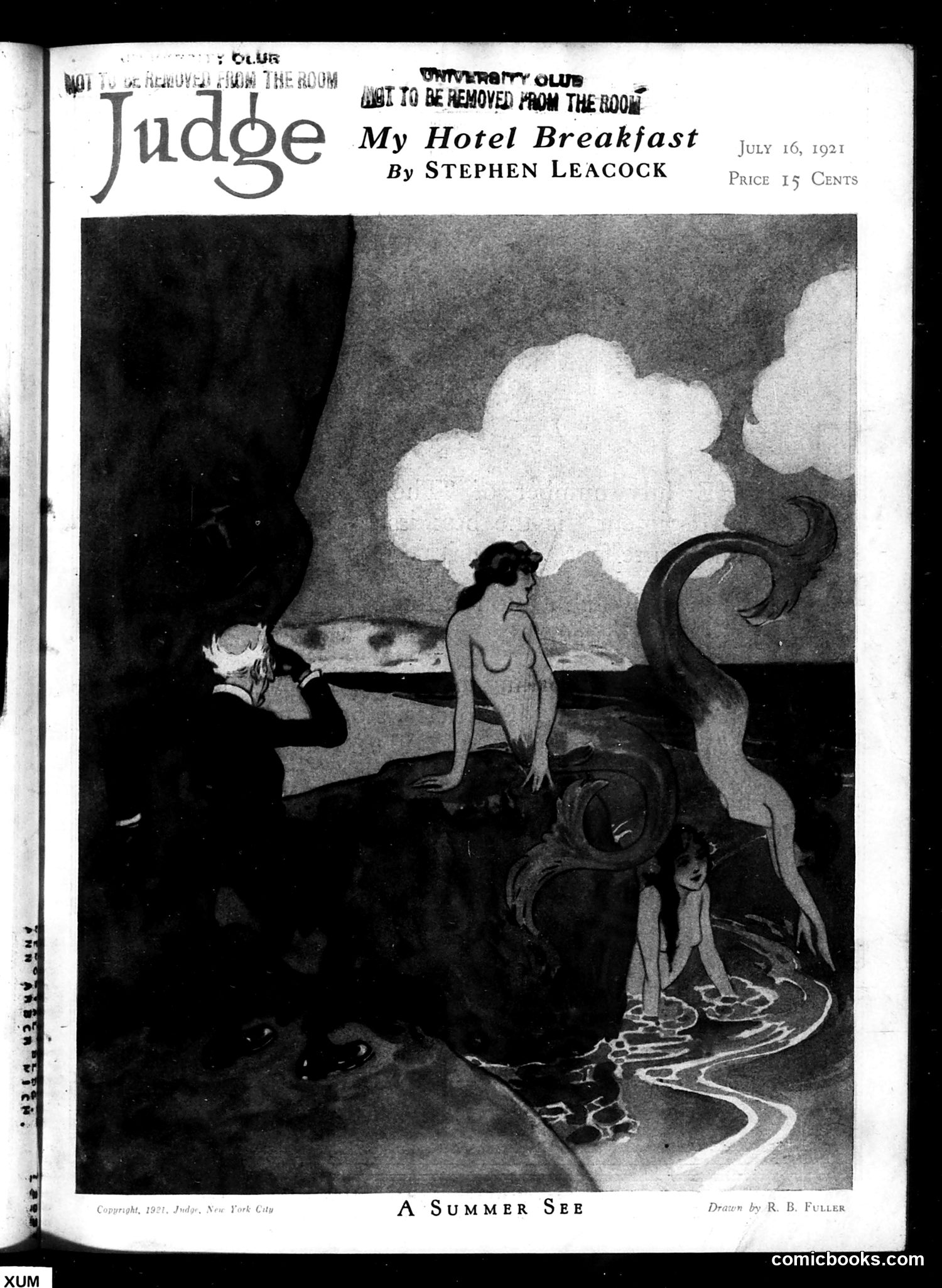
This illustration by R.B. Fuller accompanies Stephen Leacock's article "My Hotel Breakfast." The artwork depicts a whimsical, dreamlike scene: a nude or semi-nude figure stands in shallow water amid fantastical sea creatures with curled tentacles, while clouds billow above. The style is decorative and surreal rather than overtly political satire. The title "A Summer See" appears to be a visual pun—"see" rather than "sea." The image likely complements Leacock's humorous essay about hotel dining, using imaginative artwork to evoke leisurely vacation fantasies. The 1921 date places this during the Jazz Age, when lighter, more decorative illustration styles were popular in American magazines.
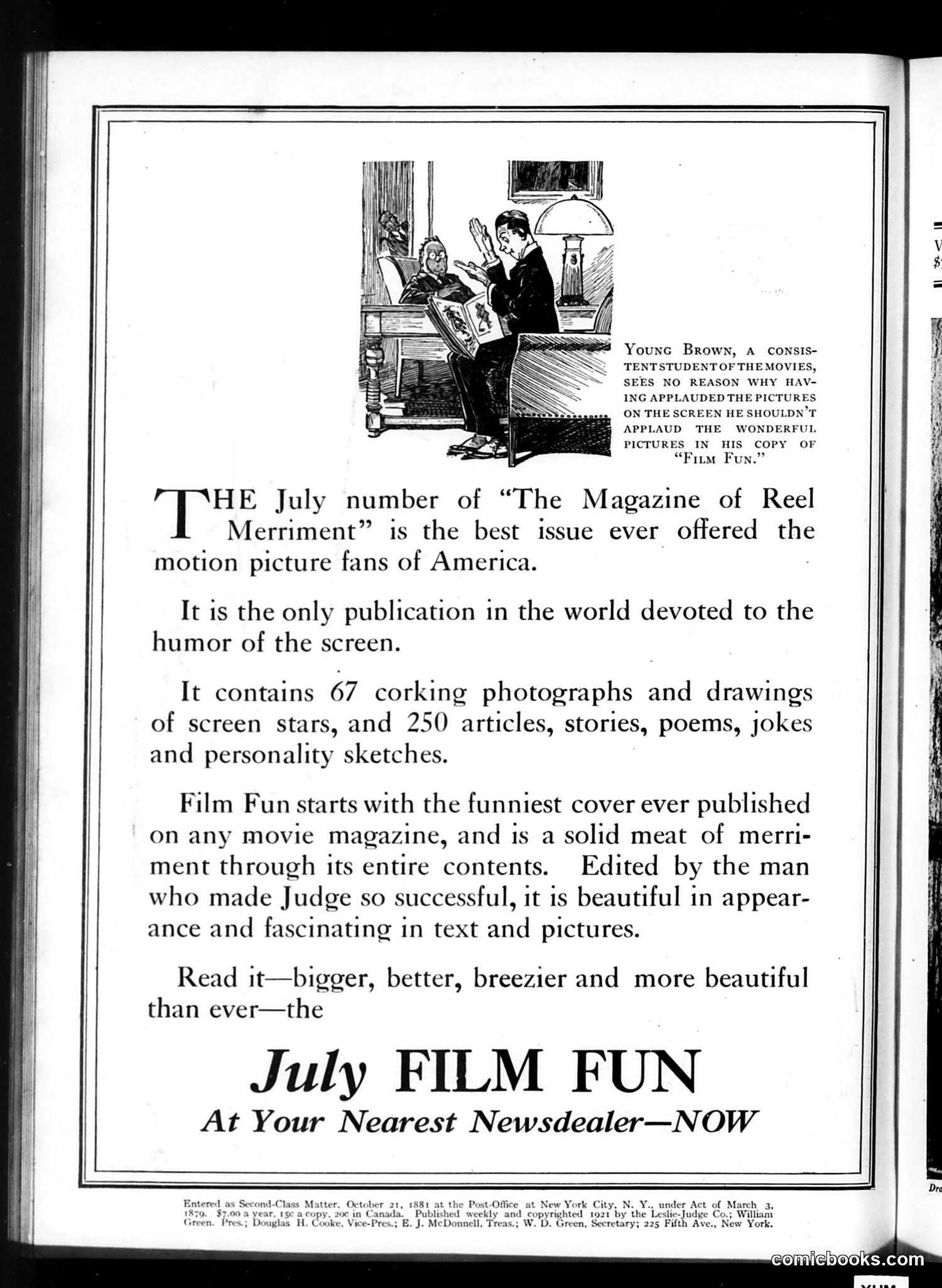
This page is primarily **advertising**, not editorial content or satire. It promotes the July issue of *Film Fun*, a humor magazine devoted to motion pictures. The illustration shows a young man ("Young Brown") reading a copy of *Film Fun* while seated at a desk. The advertisement's humor derives from a gentle joke: Brown is so absorbed in the magazine's comedic film content that he applauds the pictures printed on its pages—treating static illustrations as if they were moving pictures on a screen. The ad emphasizes *Film Fun*'s appeal: 67 photographs and drawings of screen stars, plus 250 articles, stories, poems, and jokes. It was edited by someone who "made Judge so successful," suggesting editorial credibility and cross-magazine promotion.
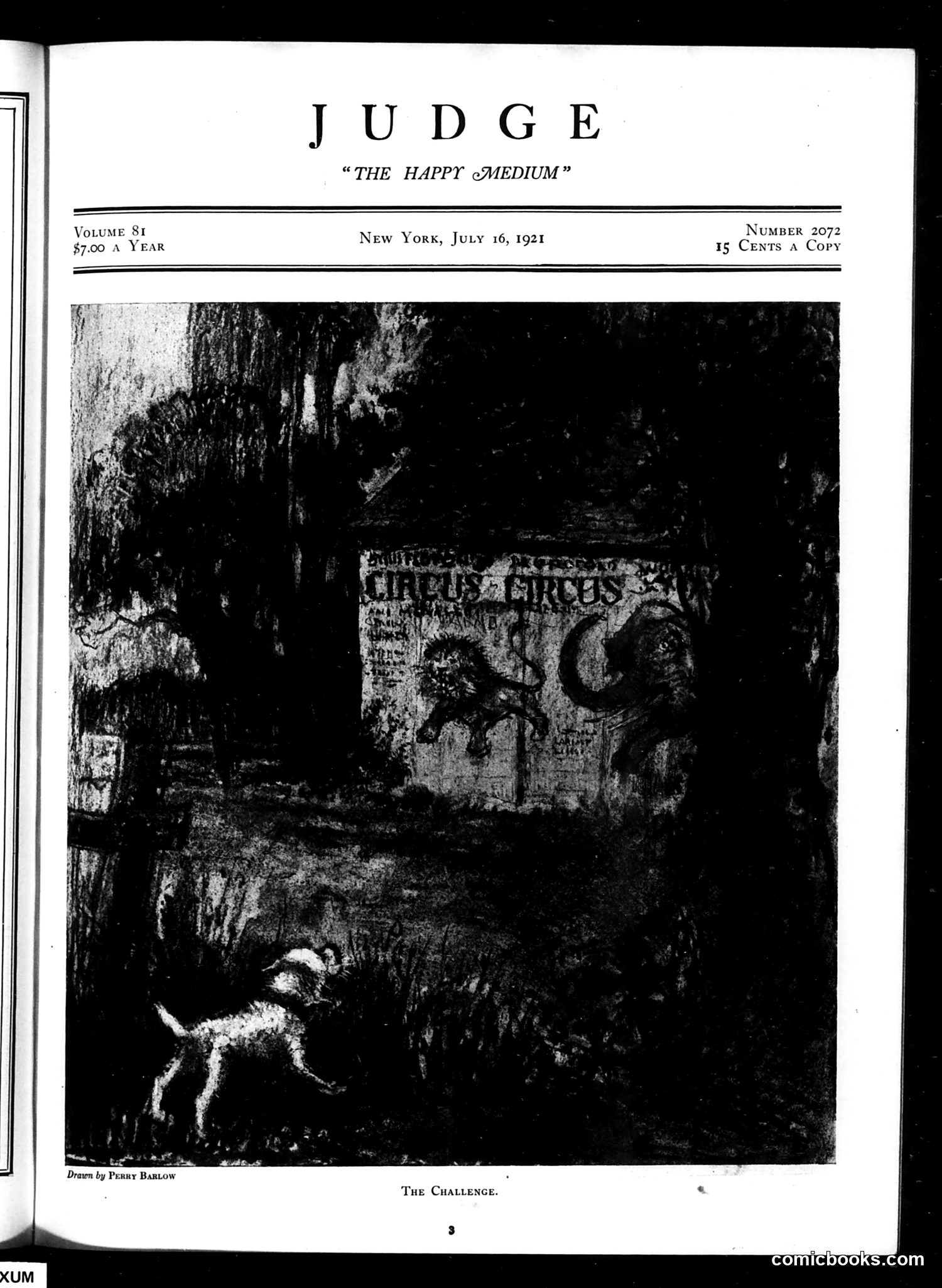
This cartoon by Penry Barlow depicts a small dog confronting a circus wagon bearing large cat imagery. The title "The Challenge" suggests a David-versus-Goliath confrontation. The specific meaning is unclear without additional context from the 1921 issue. However, the circus setting and animal imagery likely represent competing commercial or political entities—possibly involving the Ringling Bros. circus (a dominant force in American entertainment) versus a smaller rival enterprise. The dog could symbolize an underdog challenger or upstart competitor. The cartoon satirizes the disparity in power or resources between the antagonists, with the small dog's bold stance against the much larger, established operation being presented as either brave or foolhardy—a common Judge magazine theme about American business competition and ambition.
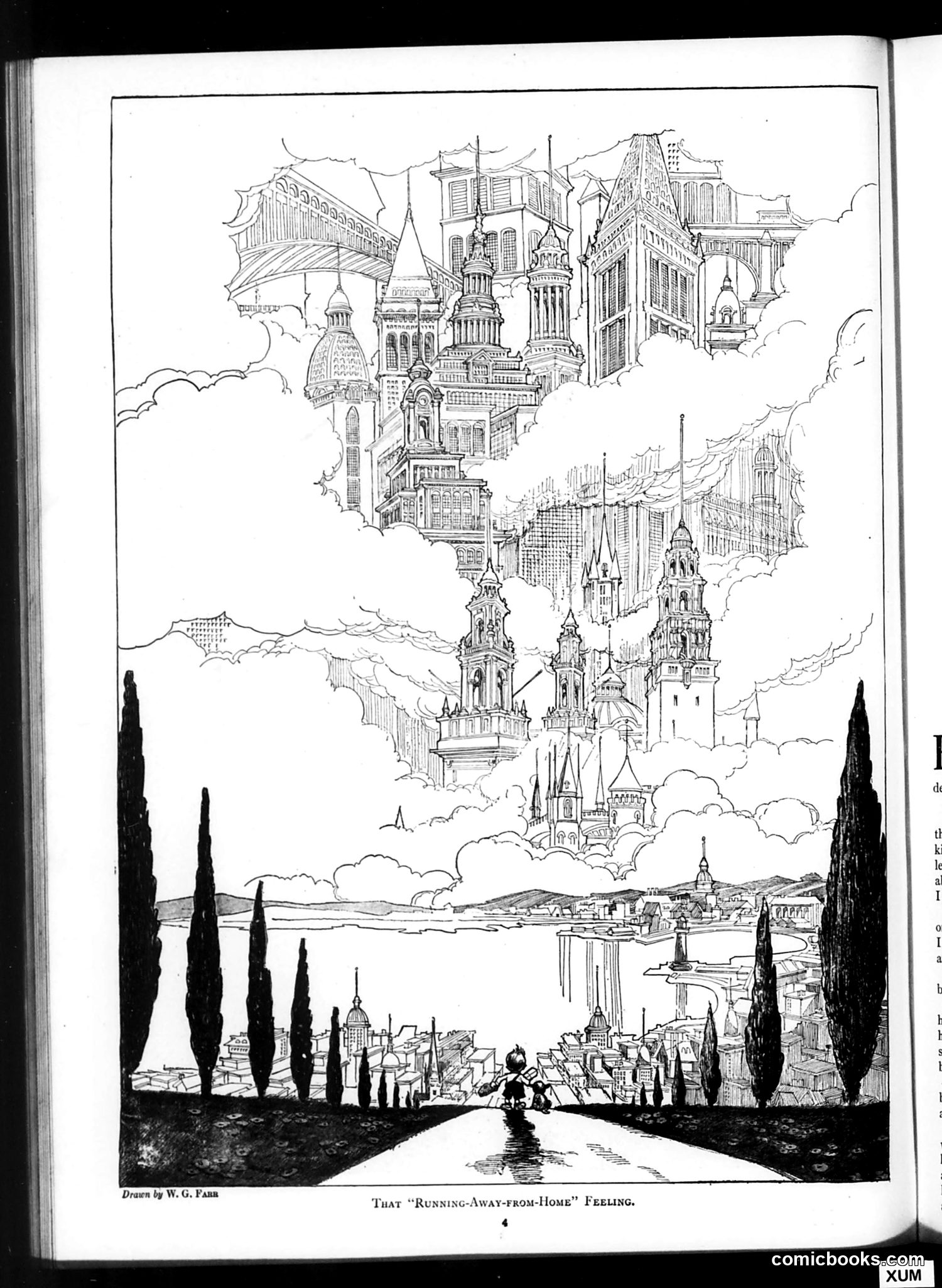
This illustration by W.G. Fabb depicts a fantastical cityscape suspended in clouds above a earthly landscape. The composition contrasts an idealized, impossibly grand architecture (appearing Eastern European or Russian in style, with onion domes and ornate spires) against a grounded reality below with cypress trees framing a figure gazing upward. The title suggests the satire concerns escapist fantasy—the allure of imagining oneself elsewhere. The elaborate dream-city represents an idealized place one wishes to flee toward, while the solitary observer below represents the reality-bound dreamer. This likely critiques either wanderlust, immigration yearnings, or romantic notions of distant lands during the early 20th century period.
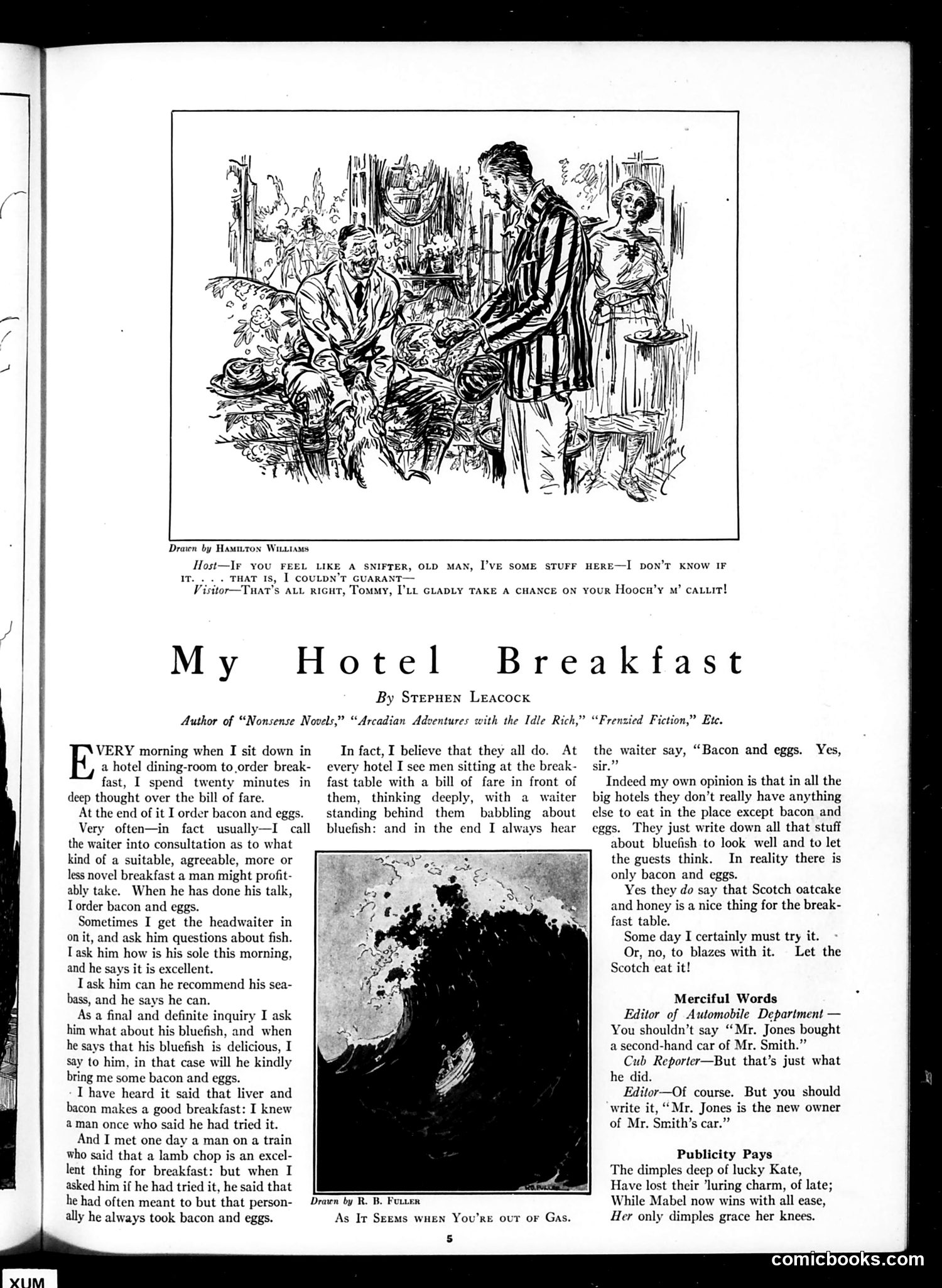
The top cartoon, drawn by Hamilton Williams, depicts a street scene where a well-dressed visitor encounters a homeless man. The visitor offers money ("I'll gladly take a chance on your Hooch'ry m' calit!"), while the poor man claims to have "stuff" to sell. This appears to satirize Prohibition-era illegal alcohol dealing—the casual way even respectable citizens engaged in obtaining bootleg liquor. The remainder of the page consists of Stephen Leacock's humorous essay "My Hotel Breakfast," discussing the mundane experience of ordering breakfast in hotel dining rooms, with accompanying illustration by H. Fisher. The content is primarily literary rather than political satire.
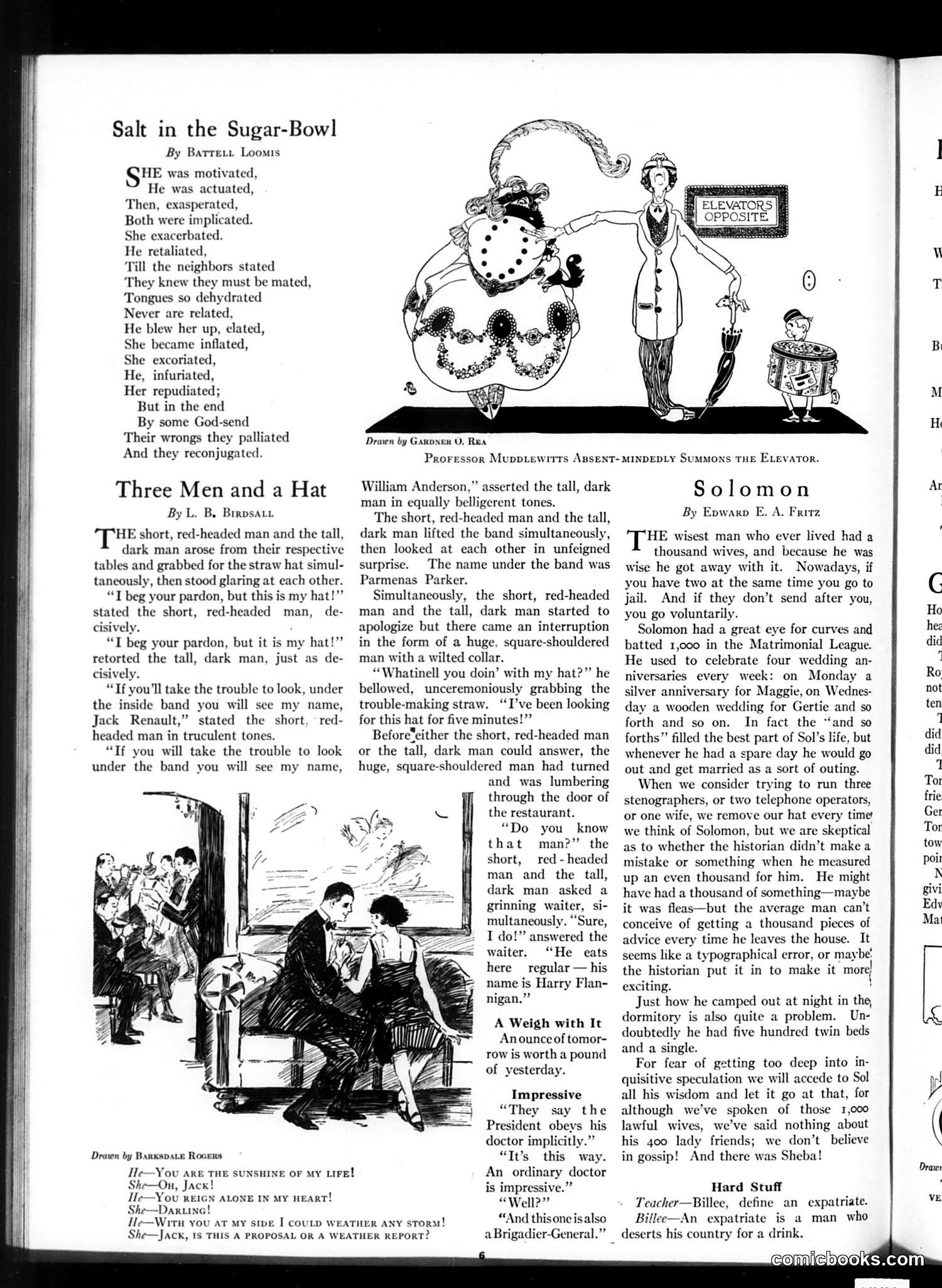
This page contains three separate humorous short stories with illustrations, typical of Judge's satirical format. **"Three Men and a Hat"** depicts a comedic dispute between men of different heights arguing over hat ownership, each claiming their name is inside the band. The joke plays on social pretension and the absurdity of identical claims. **"Solomon"** satirizes a wise man celebrated for his thousand wives and marital advice, yet who avoids using his own wisdom in practice—a commentary on hypocrisy and the gap between preached virtue and lived experience. The other pieces ("Salt in the Sugar-Bowl," "A Weigh with It," "Hard Stuff") are brief comic verses or definitions with minimal illustrations, offering wordplay and social observation typical of Judge's lighter content.
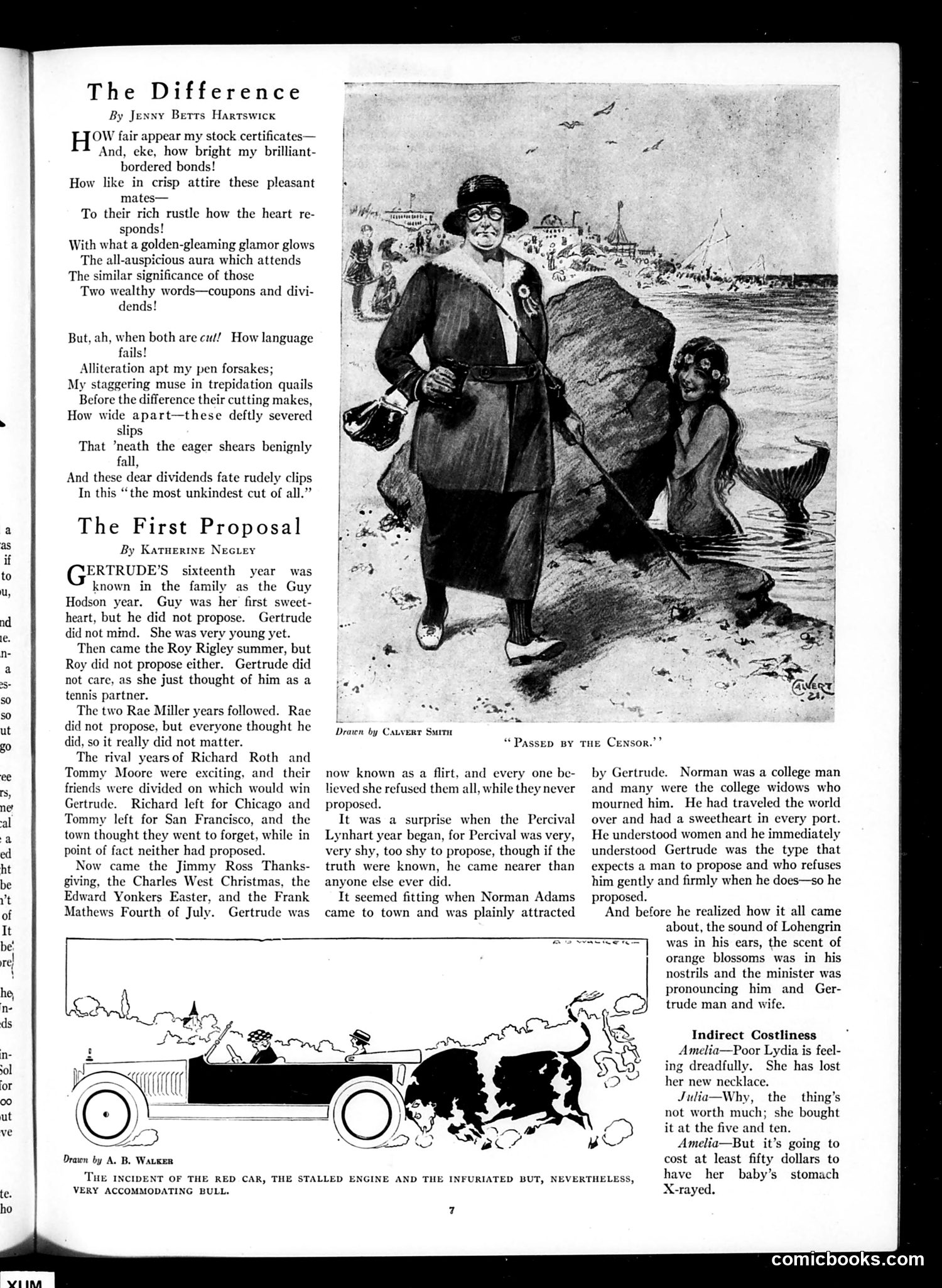
This page contains two satirical pieces reflecting early 20th-century concerns: **"The Difference"** is a poem mocking wealthy investors' emotional attachment to financial instruments—stocks and bonds—when profitable, but their distress when dividends are "cut." The satire targets the shallow materialism of the wealthy class and their dramatic overreaction to financial losses. **"The First Proposal"** humorously chronicles a young woman named Gertrude's dating years, where multiple suitors court her without proposing until Norman Adams finally does. The joke satirizes contemporary courtship rituals and the social expectation that men must propose, while women play coy by refusing (whether proposals actually occur or not). The cartoon below depicts a stalled car and an angry bull, captioned as "very accommodating," which appears to be physical comedy about automotive mishaps—likely satirizing early automobiles' unreliability and the chaos they caused. **"Indirect Costliness"** is a brief joke about how a lost necklace's replacement cost pales beside the medical expense of treating the owner's resulting stress-induced stomach problems—dark humor about psychosomatic illness among the wealthy.
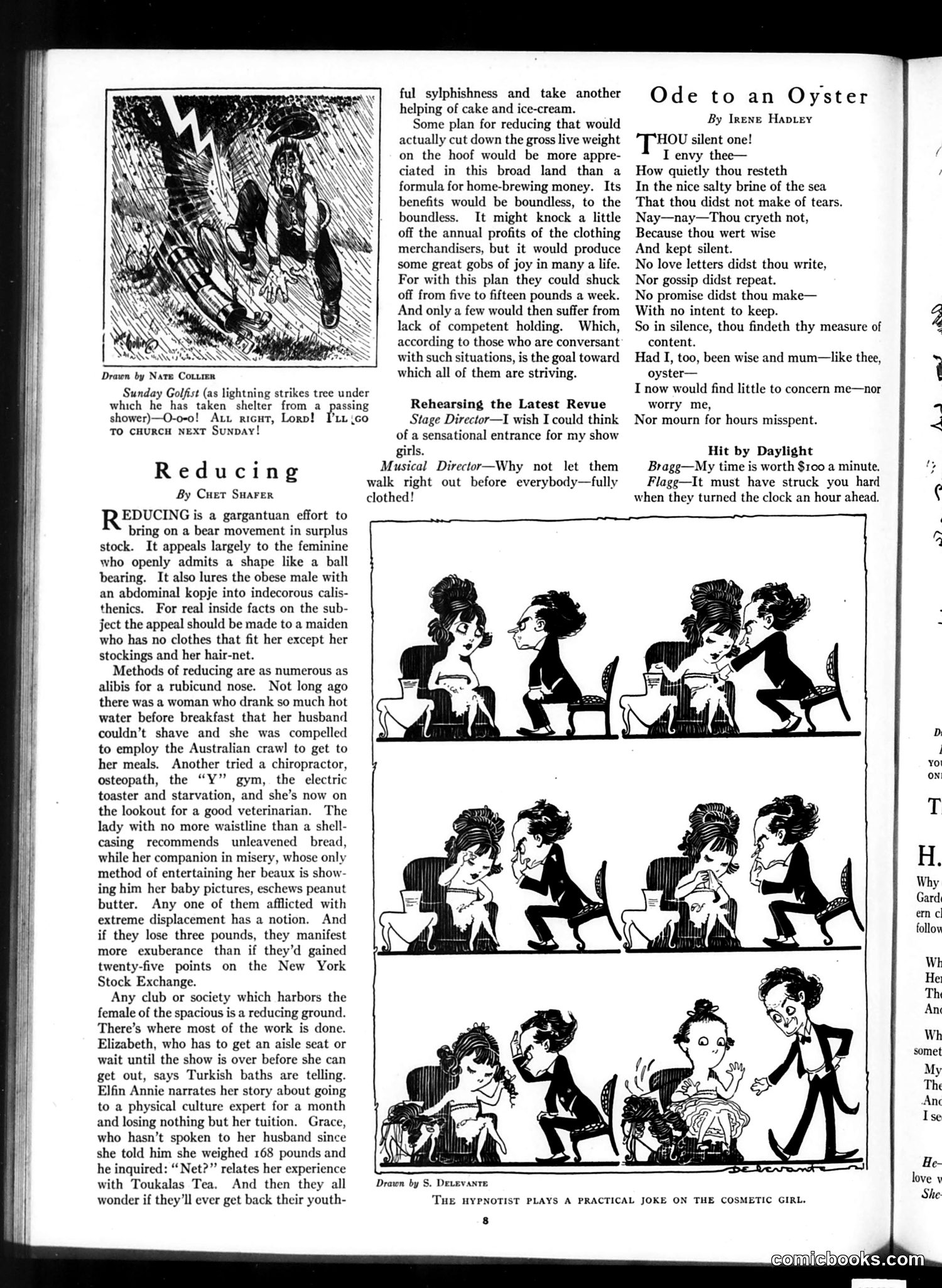
This page contains three distinct pieces of satirical content: **"Reducing"** mocks the obsession with weight loss among women of the era. The article humorously catalogs absurd dieting methods—excessive hot water, chiropractors, electric toasters, starvation—while portraying women as desperate and gullible. It satirizes how women congregate in "reducing grounds" (clubs/societies) to share fad remedies, manifesting "exuberance" over losing mere pounds. **"Rehearsing the Latest Revue"** jokes that the most "sensational" theatrical entrance would be showing girls *fully clothed*—implying contemporary revues relied on scantily-clad performers rather than genuine talent or production value. **"Ode to an Oyster"** is a sentimental poem praising oysters' silence and discretion, implicitly contrasting them with gossipy, letter-writing humans who create their own misery through loose tongues. The cartoon by S. DeLevante (bottom) illustrates the revue joke visually through sequential panels showing a theatrical entrance scenario.
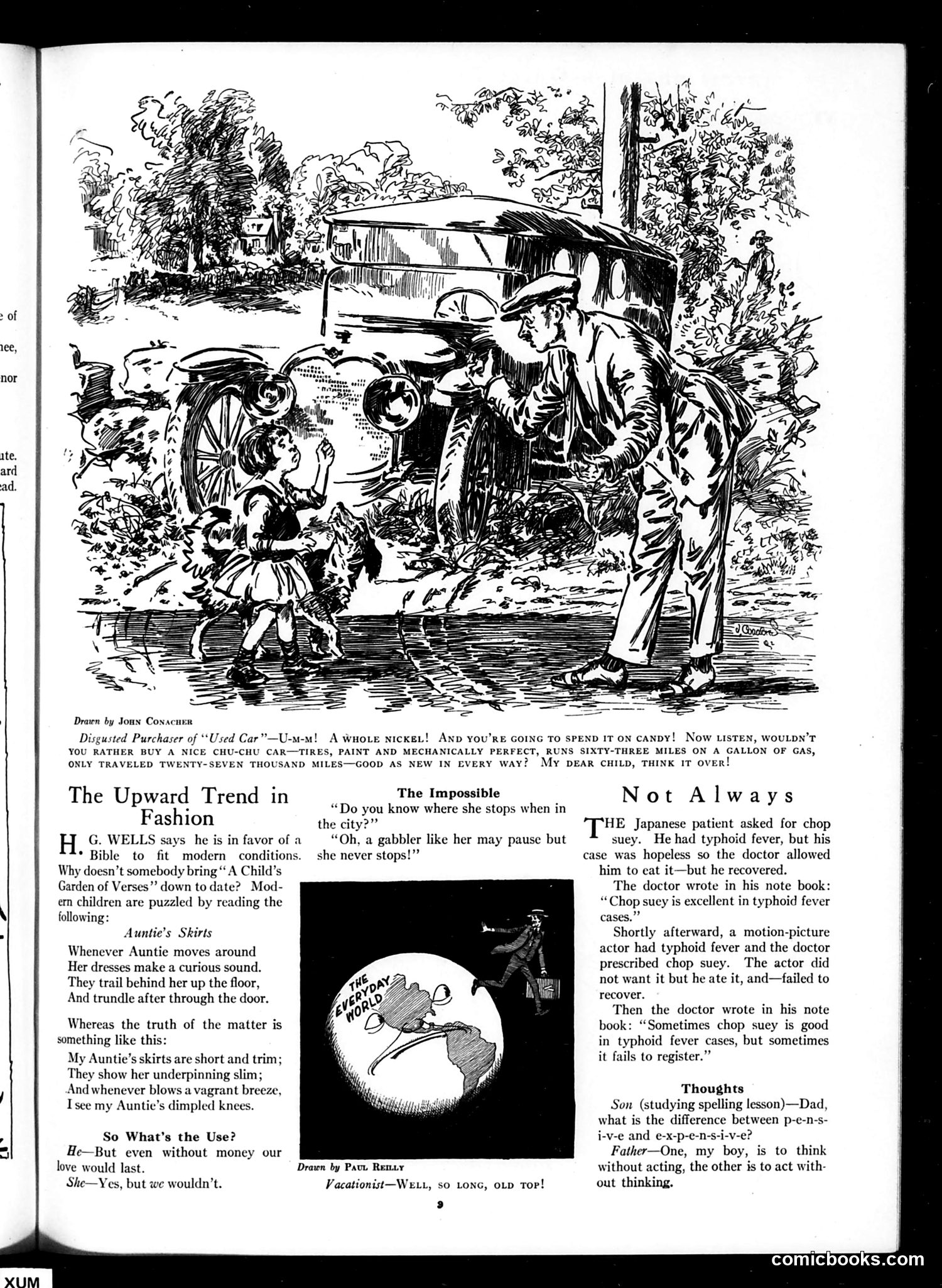
The top cartoon by John Coxachon satirizes the used-car market. A slick dealer pressures a customer into buying a decrepit vehicle with 27,000 miles, claiming it's "good as new." The humor targets deceptive automotive salesmen who exploit buyers with dubious claims—a timeless con that was apparently already well-established by this publication's era. The remaining pieces are humorous prose sketches unrelated to each other: - "Upward Trend in Fashion" mocks how women's hemlines have risen, exposing knees and legs—scandalous by earlier Victorian standards referenced in the parody of Stevenson's poem. - "The Impossible" jokes about women never stopping their errands. - "Not Always" uses a Japanese typhoid patient's recovery after eating chop suey to satirize doctors' faulty logic: they credit the meal when it succeeds, blame it when it fails. - "Thoughts" distinguishes pensiveness from expensiveness through a dad-joke pun about thinking versus acting.
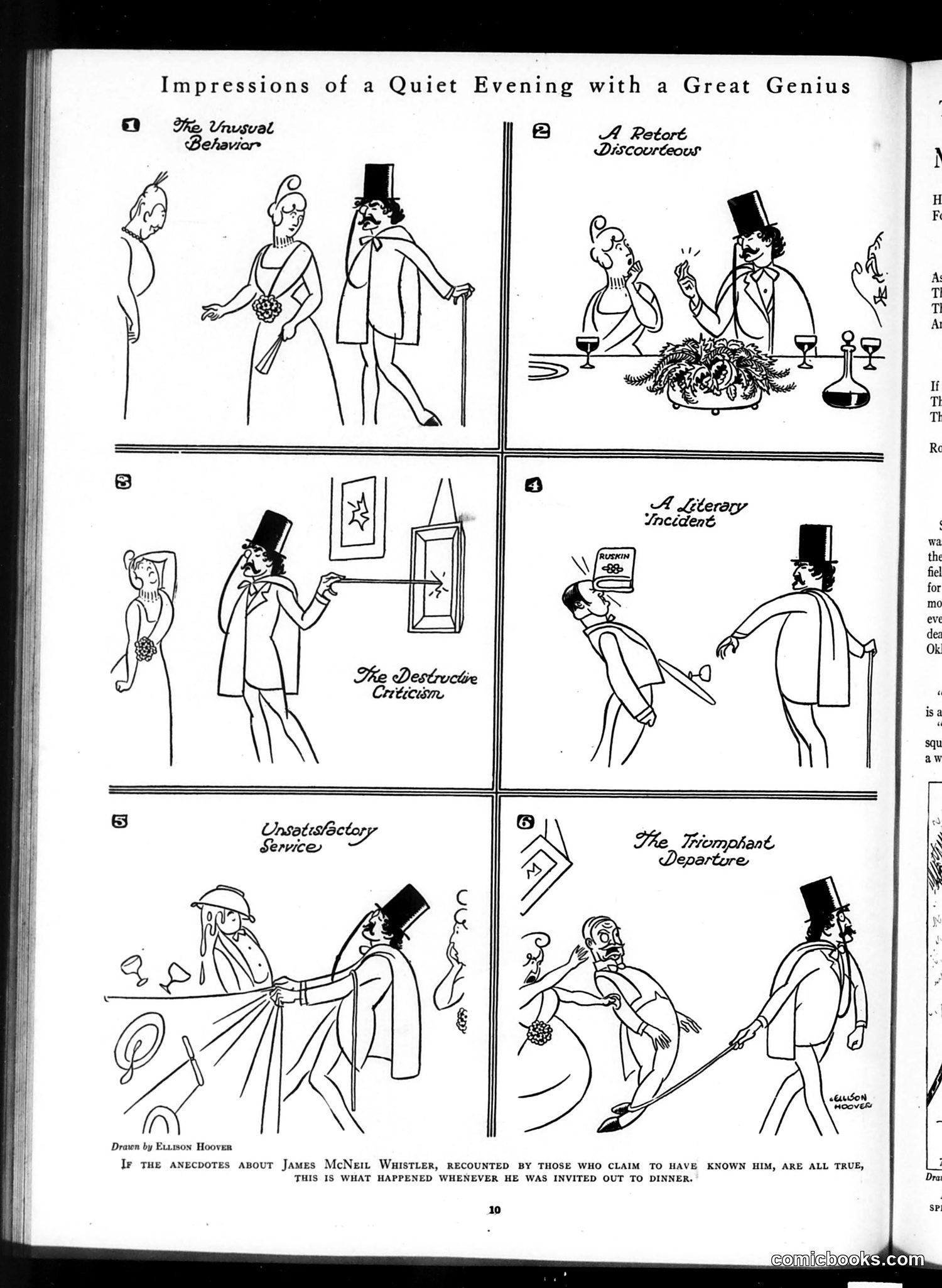
This cartoon satirizes **James McNeill Whistler**, the famous 19th-century American painter and notorious socialite known for his wit, arrogance, and combative personality. The six panels humorously depict what allegedly happened whenever Whistler attended a dinner party: 1. **Unusual Behavior** - He acts strangely among guests 2. **A Retort Discourteous** - He insults his hosts 3. **The Destructive Criticism** - He mocks artwork on the walls 4. **A Literary Incident** - He attacks someone's book 5. **Unsatisfactory Service** - He berates the wait staff 6. **The Triumphant Departure** - He leaves victoriously The satire mocks Whistler's legendary rudeness and artistic arrogance. The cartoon suggests he was such a difficult guest that his attendance guaranteed social chaos. Whistler was famously litigious and sharp-tongued; this piece plays on his real reputation for feuds and cutting remarks, making him a perfect subject for Judge magazine's satirical humor.
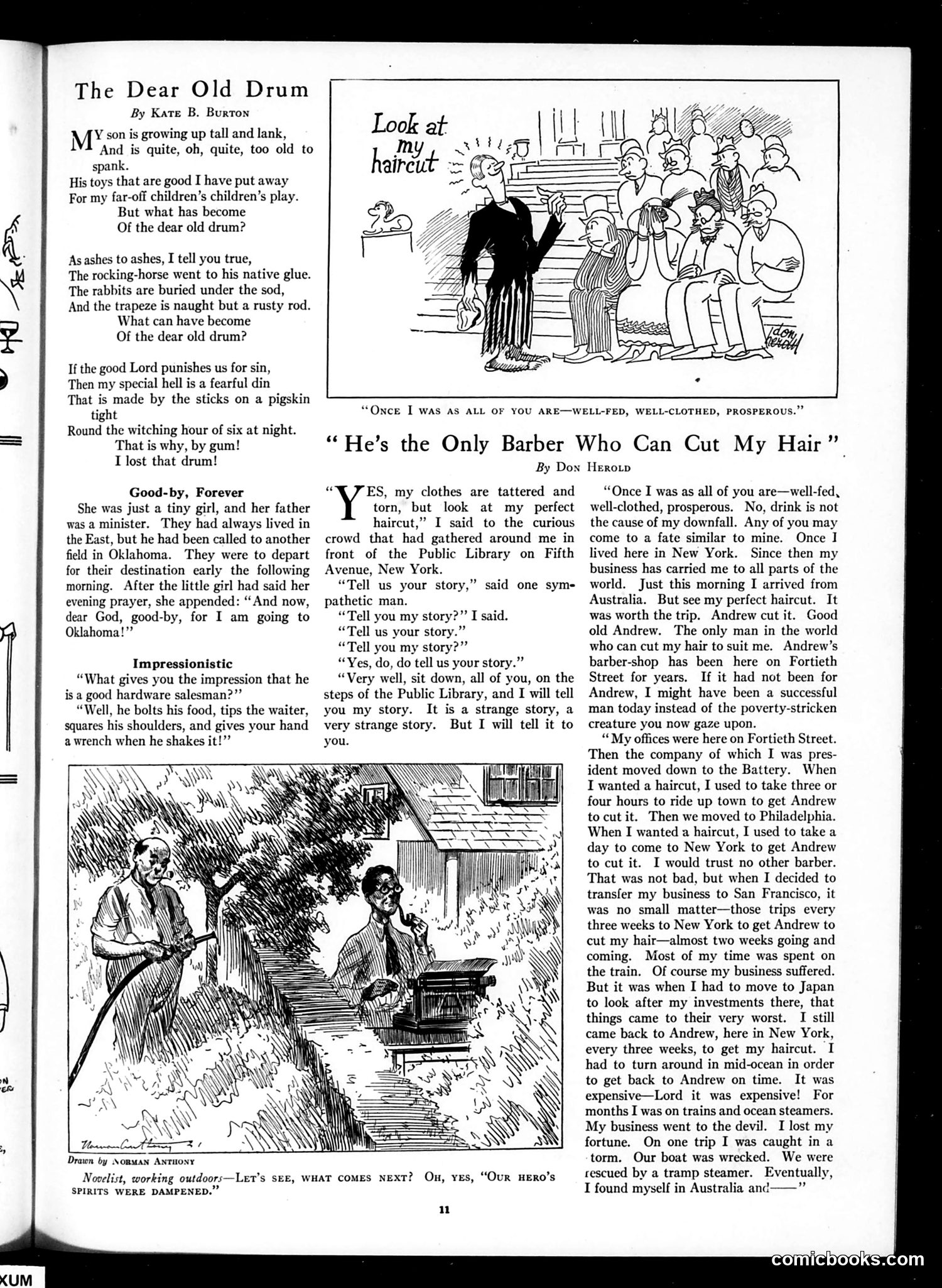
This satirical story mocks obsessive consumer loyalty and misplaced priorities. A prosperous businessman has systematically ruined himself—traveling constantly across the globe (Australia, San Francisco, Japan, Philadelphia) for haircuts from one barber named Andrew on Fortieth Street, New York. The joke is the absurd inversion of values: he sacrifices his business, fortune, and respectability for perfect hair maintenance. By the story's end, he's impoverished and begging on the library steps—yet still emphasizing his "perfect haircut" to justify his decisions. This satirizes Gilded Age commercialism and the American obsession with appearance and brand loyalty, suggesting how trivial consumer choices can mask serious self-destruction. The ragged clothes versus pristine hair visually embodies the satire's point: misplaced vanity.
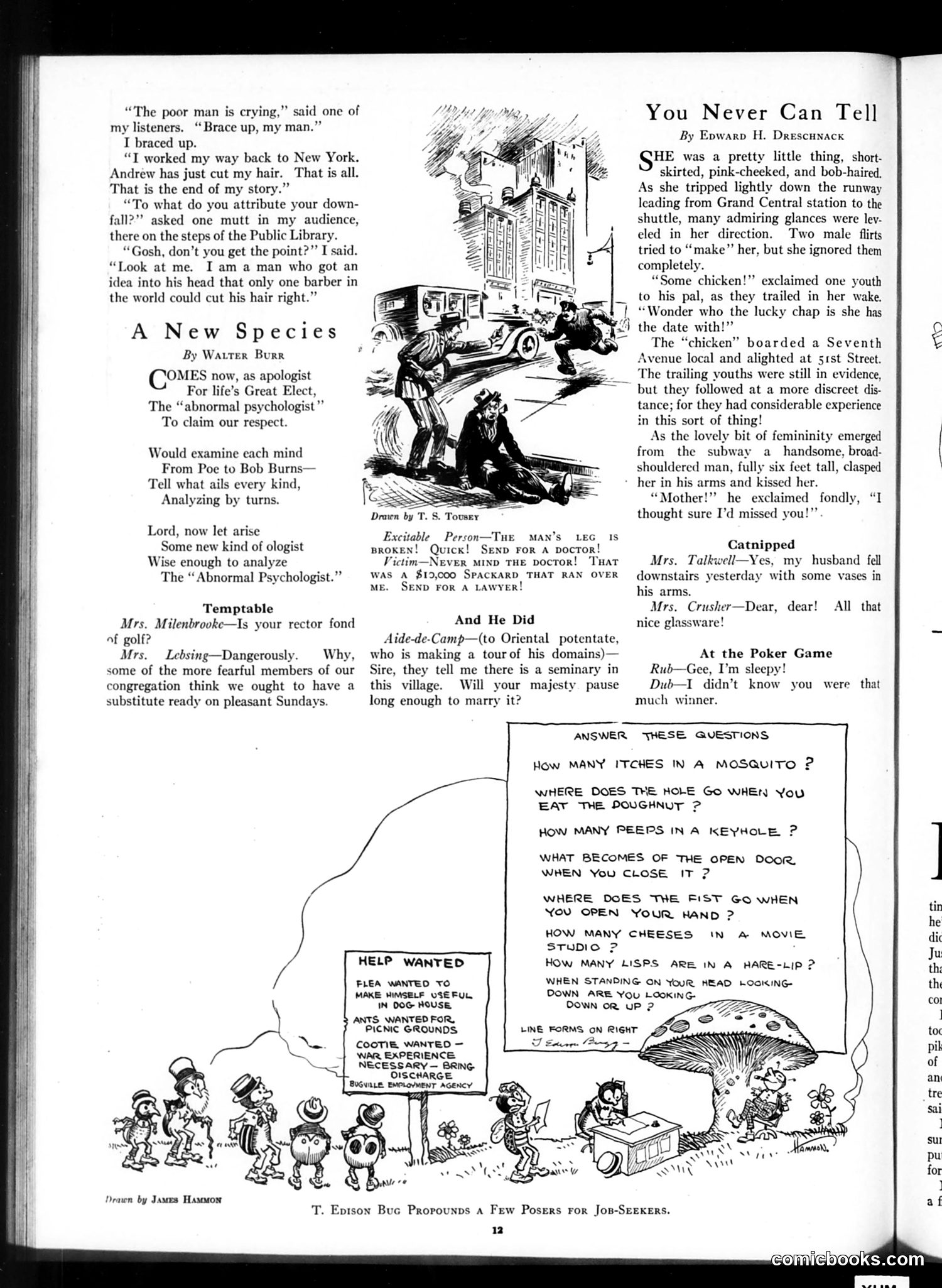
This page contains several satirical pieces typical of early-20th-century Judge magazine: **"A New Species"** satirizes psychology's growing prominence, mocking the new field of "abnormal psychology" by suggesting we need psychologists to analyze the psychologists themselves—implying the discipline is itself abnormal or pretentious. **"You Never Can Tell"** is a humorous short story playing on assumptions: readers expect a young woman being followed by men to have a romantic adventure, but the punchline reveals her "date" is actually her mother, subverting expectations of modern courtship. **The cartoon at bottom** shows Edison-style bugs posing riddle-questions (nonsensical logic puzzles like "how many itches in a mosquito?") to job-seekers, mocking both absurd interview questions and the struggling job market. Other brief items include gentle mockery of clergy priorities (golf-loving rectors) and marital mishaps, standard light humor fare for the publication.
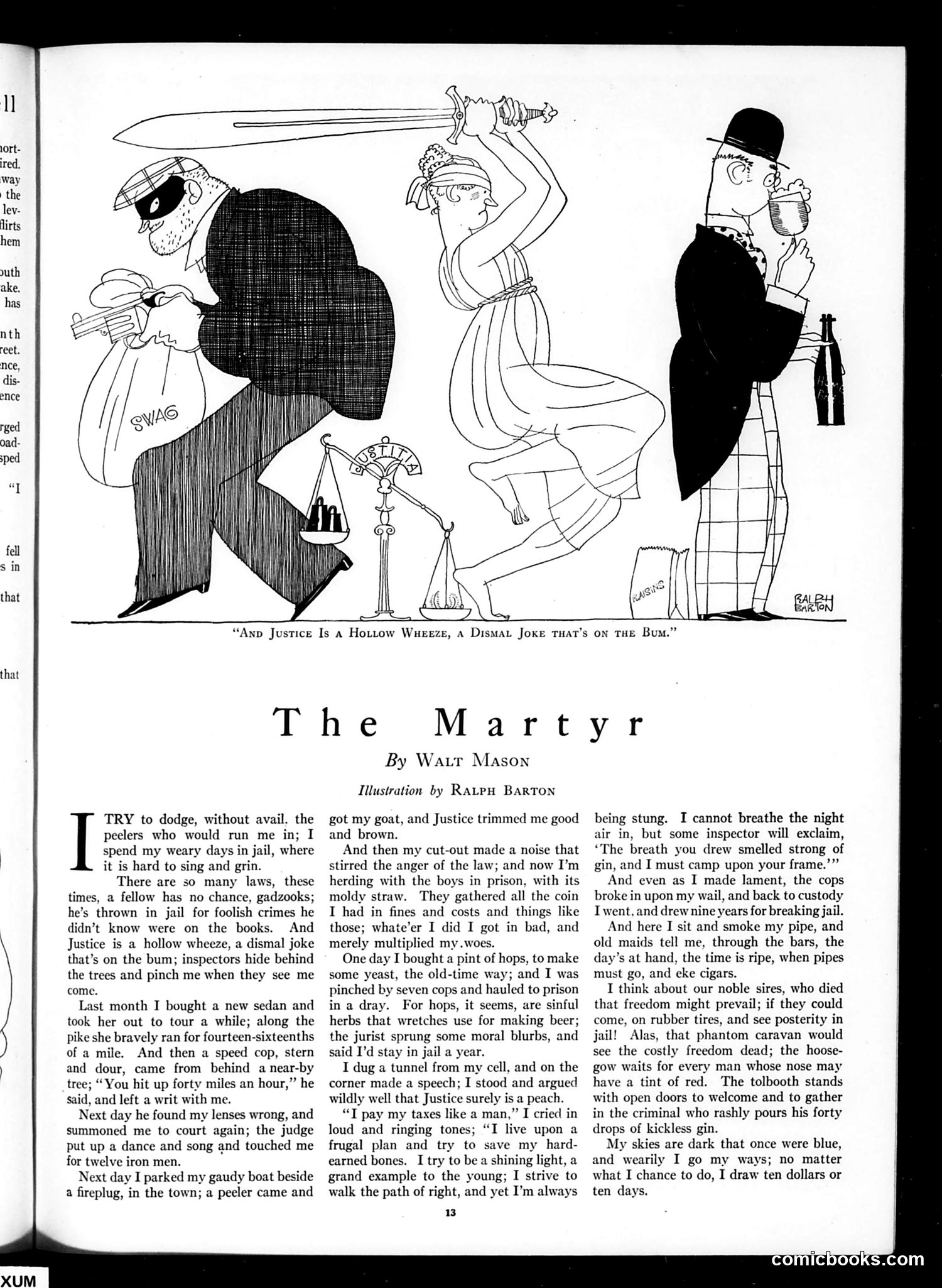
This 1920s-era satirical story, illustrated by Ralph Barton, critiques the absurd proliferation of laws and petty enforcement that ensnared ordinary citizens. The protagonist describes a cascade of legal troubles: speeding violations, parking infractions, and—most tellingly—arrest for homebrewing ("a pint of hops"), clearly referencing Prohibition. The cartoon's caption—"Justice Is a Hollow Wheeze, a Dismal Joke that's on the Bum"—frames the central satire: Justice (depicted as a blindfolded female figure) is portrayed as corrupt or incompetent. The figure on the left appears to represent a lawbreaker or common man being squeezed or punished. The narrator, claiming to be a law-abiding citizen paying taxes and striving for virtue, finds himself repeatedly arrested and fined, eventually imprisoned for nine years for "breaking jail." The piece mocks both excessive criminalization and the irony that even attempts to escape unjust punishment result in harsher sentences—suggesting the legal system itself is the true injustice.
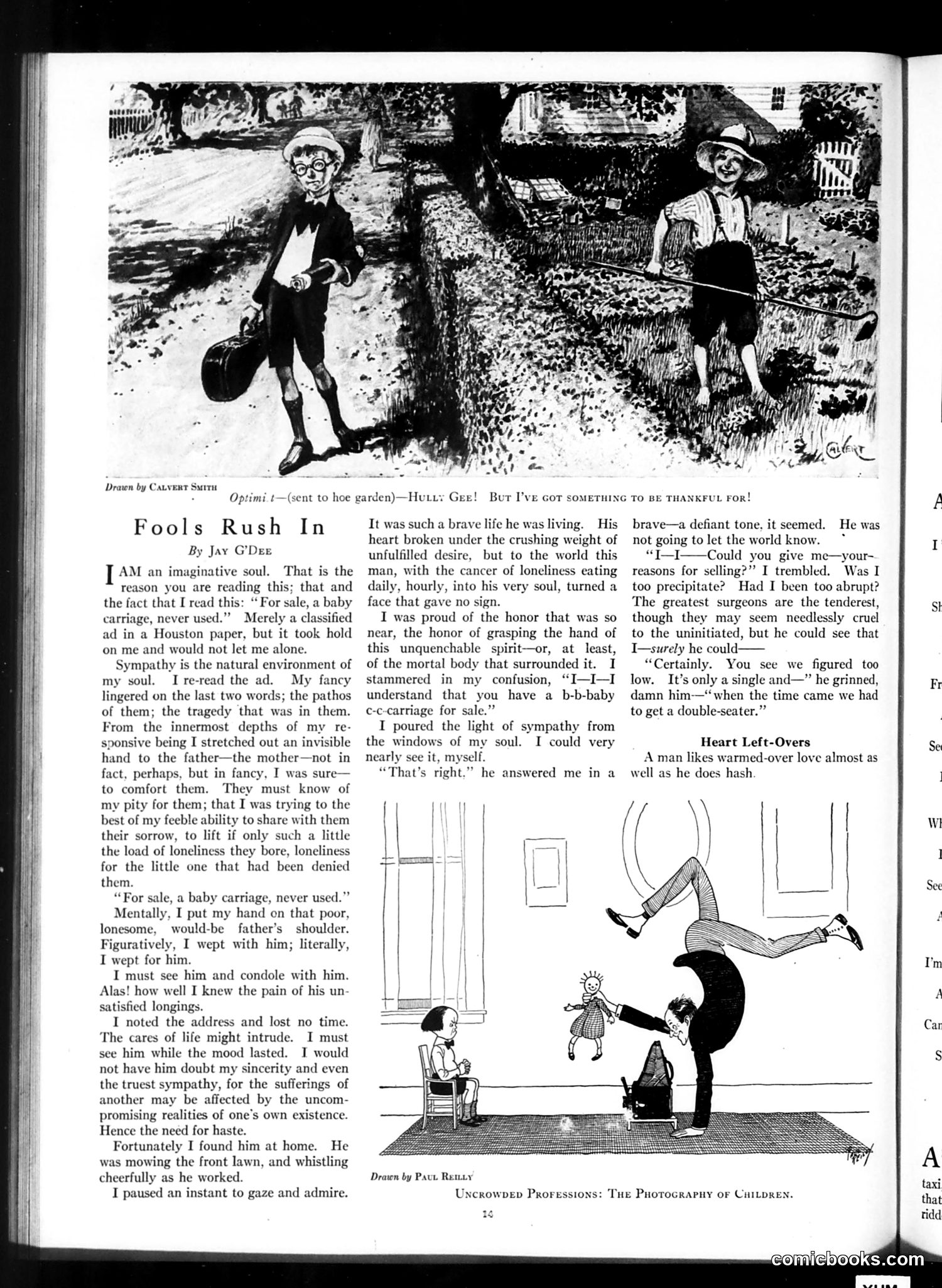
This satirical piece mocks sentimental, overly imaginative people who project tragedy onto minor situations. **The main cartoon** (top): Shows two boys—one carrying a baby carriage marked "for sale," the other with a fishing rod. The caption reveals the setup: the narrator read a classified ad for an unused baby carriage and constructed an elaborate fantasy of a couple's heartbreak and infertility. **The joke**: When he finally visits the seller, he discovers the mundane truth—the family simply outgrew a single carriage and needed a larger "double-seater" for a second child. The seller whistles cheerfully while mowing, showing no suffering whatsoever. **The satire targets**: People who indulge in excessive emotional self-indulgence and assume dark narratives without evidence. The narrator's theatrical sympathy ("I wept for him") contrasts absurdly with reality. Judge mocks this tendency toward melodramatic empathy as foolish sentimentality disconnected from actual facts. The secondary cartoon about "Heart Left-Overs" continues this theme of emotional self-deception.
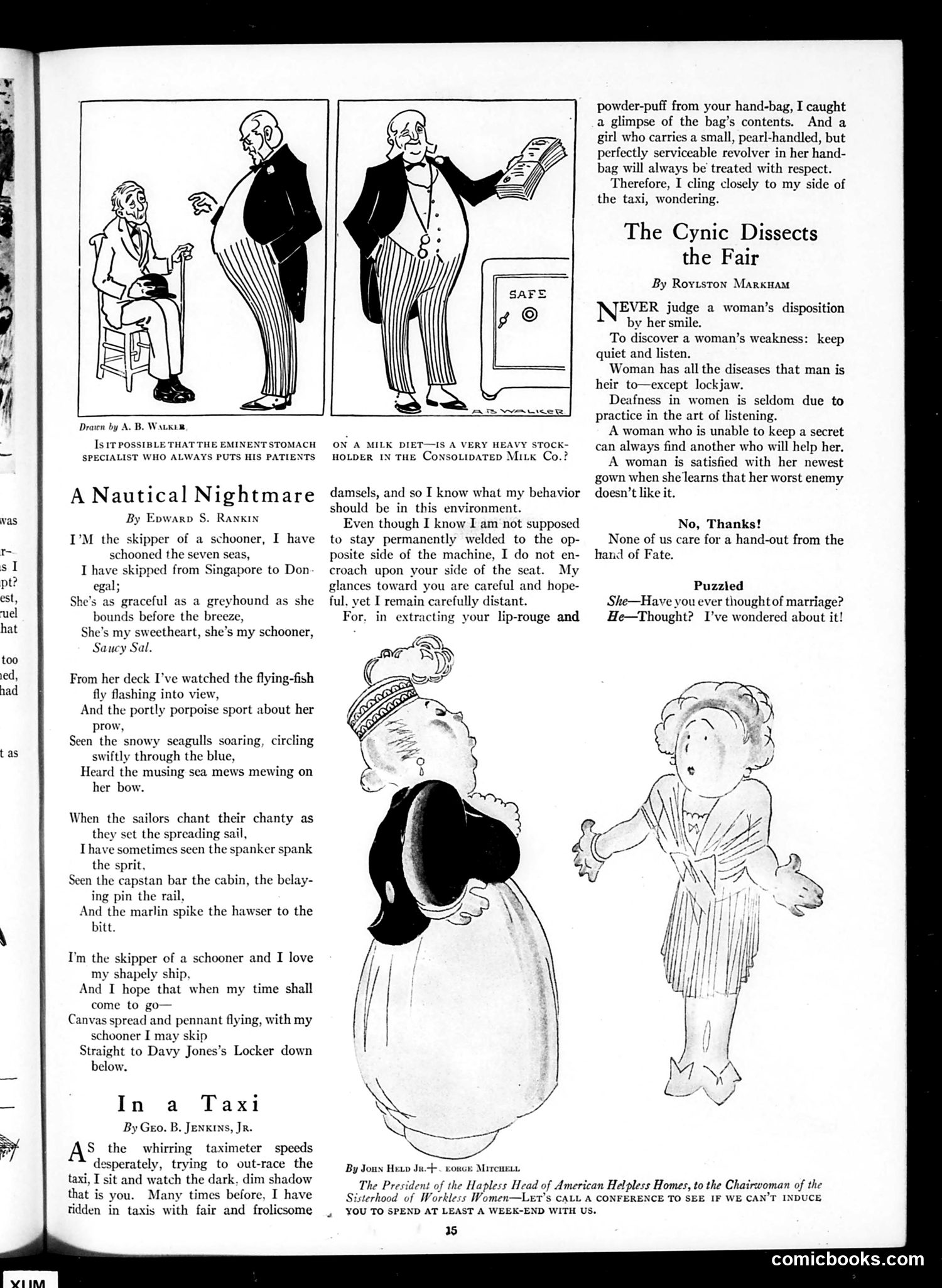
This page contains several satirical pieces from *Judge* magazine: **"A Nautical Nightmare"** is a humorous poem about a ship captain's romantic attachment to his vessel, written in overwrought, flowery language that parodies sentimental seafaring literature. **"In a Taxi"** satirizes male behavior around women—the narrator describes maintaining careful distance and respect toward a female passenger, specifically because he glimpsed a revolver in her handbag. The joke is that the threat of female violence ensures gentlemanly conduct, implying that traditional chivalry alone wouldn't suffice. **"The Cynic Dissects the Fair"** presents misogynistic "observations" about women's character flaws (poor listening skills, gossip, materialism), typical of period satire targeting women. The top cartoon appears to mock a stomach specialist who profits from a milk company—suggesting conflict of interest or that he profits from keeping patients sick. The bottom illustration and caption humorously juxtapose struggling "helpless" women with a plea for them to visit, likely satirizing contemporary social welfare debates or women's organizations of the era.
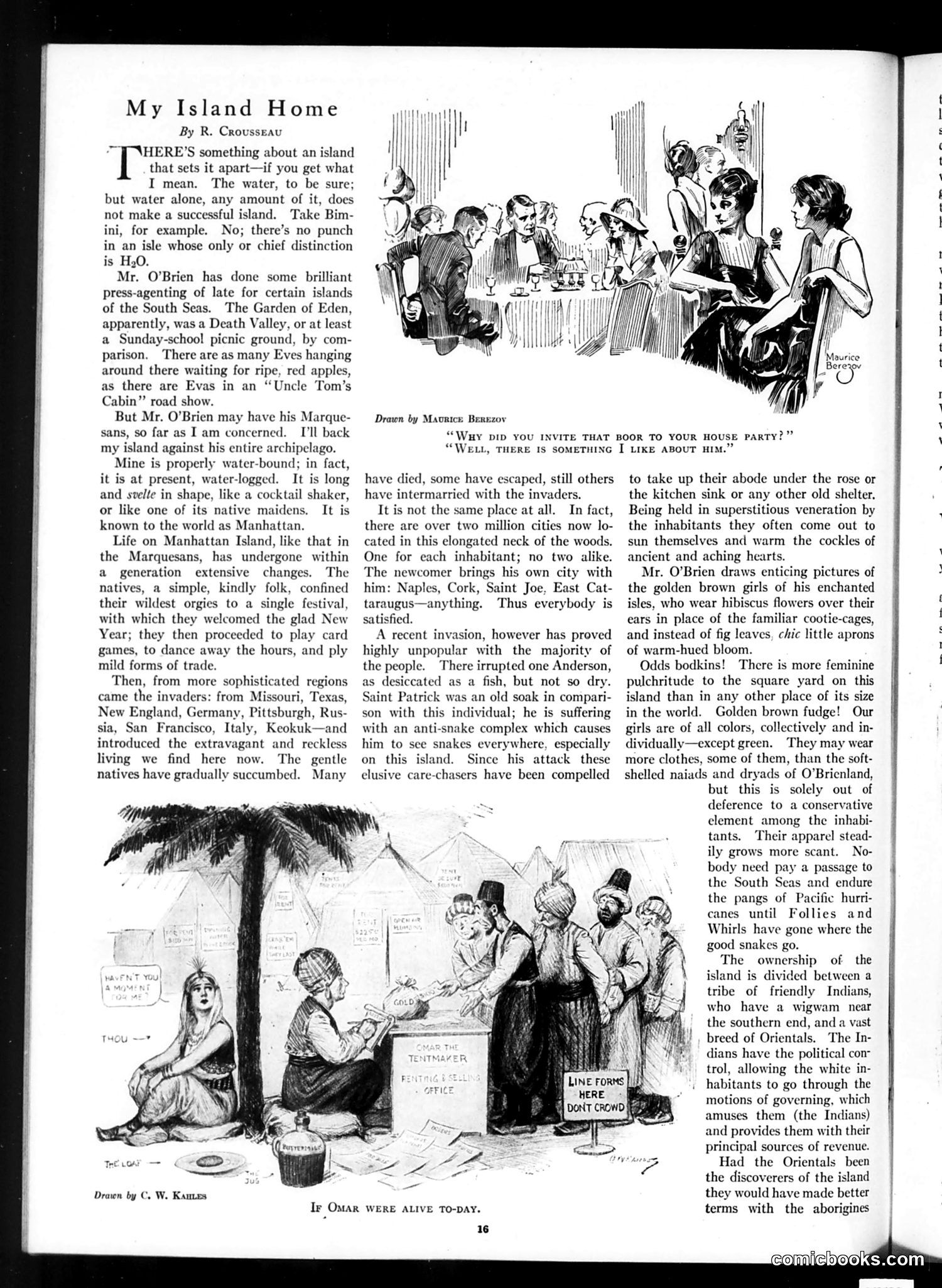
This article satirizes the romanticized marketing of South Seas islands, likely referencing promoter **Richard O'Brien**, who heavily publicized Polynesian locations (particularly the Marquesas) as tropical paradises with attractive women. The author counters by ironically defending **Manhattan Island** as superior, describing it as similarly "exotic" but overcrowded with immigrant populations from Missouri, Texas, Germany, Russia, etc.—each bringing their own cultural enclaves (Naples, Cork, Saint Joe). The satire mocks both the exaggerated promotion of South Seas "golden brown girls" and the rapid transformation of Manhattan through immigration. A secondary cartoon shows someone promoting an unpopular resident ("Anderson") with an "anti-snake complex," forcing snakes into hiding—a commentary on unwanted immigration or social disruption. The humor targets American consumerism and racial/ethnic anxieties of the era, presenting Manhattan's immigrant diversity as equally "foreign" as actual Pacific islands.
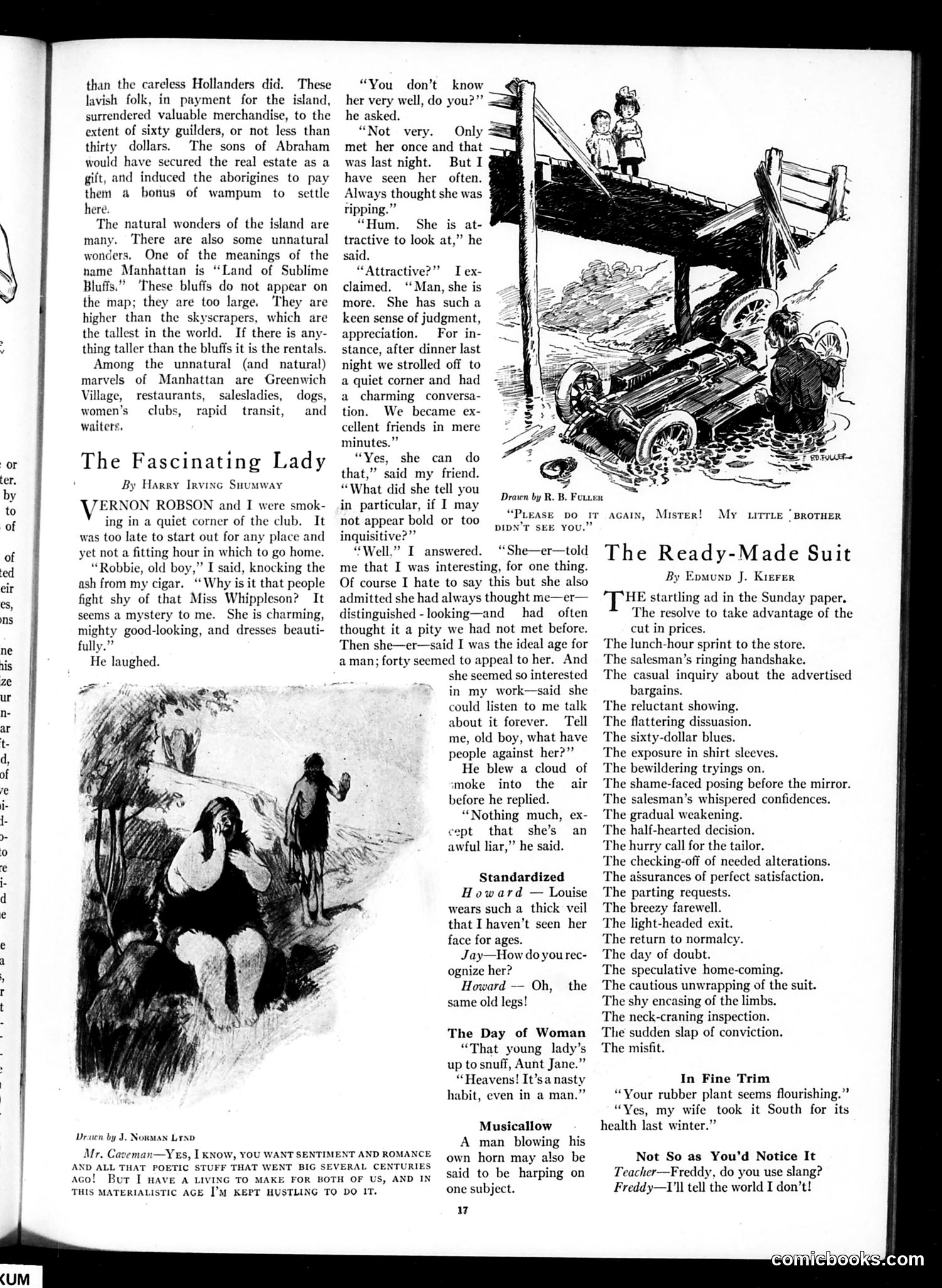
This page contains three distinct pieces of satirical humor typical of early 20th-century American magazines. **"The Fascinating Lady"** satirizes a social type: the charming woman who flatters every man she meets. The narrator believes Miss Whippleson genuinely appreciates him after one dinner conversation, unaware she uses identical compliments on everyone. The joke exposes male vanity and gullibility—men want to believe they're "interesting" and "distinguished-looking," making them easy marks for insincere flattery. **The cartoon by J. Norman Lynd** shows a caveman dismissing romance and sentiment as luxuries he cannot afford while working to survive in the modern age—a commentary on industrial capitalism's dehumanizing effects. **"The Ready-Made Suit"** humorously catalogs the emotional journey of buying a discounted suit: initial excitement, the salesman's manipulation, physical discomfort in the fitting room, and the buyer's gradual rationalization into purchasing an ill-fitting garment. It mocks both aggressive salesmanship and consumer weakness. All three pieces target human folly: romantic delusion, economic pressure, and susceptibility to persuasion.
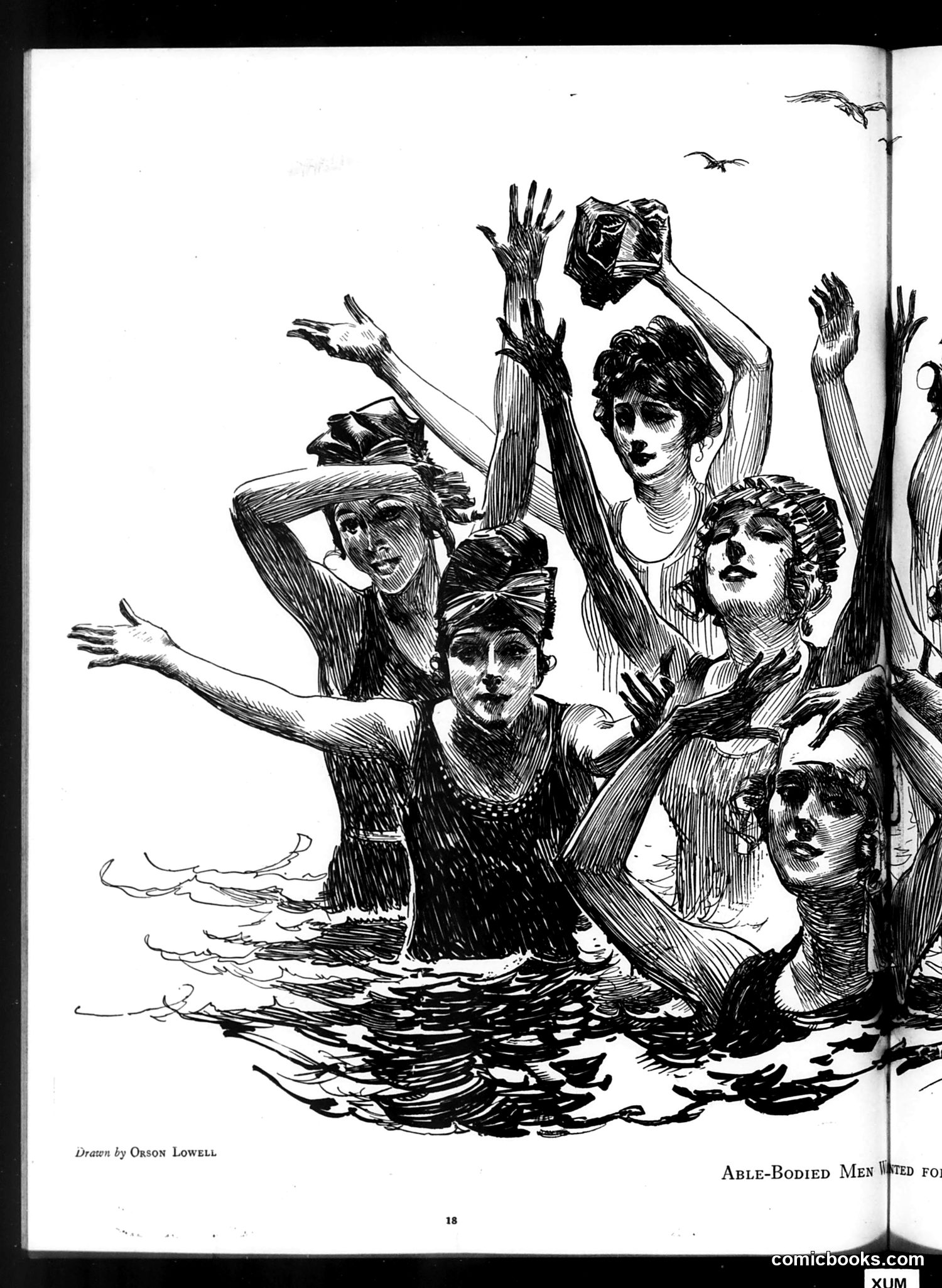
This appears to be a political cartoon by Orson Lowell from *Judge* magazine satirizing the recruitment of "able-bodied men" (likely for military service). The illustration depicts women in water, enthusiastically gesturing and calling upward—seemingly appealing to or summoning men. The women are drawn in period dress with elaborate hairstyles, rendered in Lowell's characteristic cross-hatching style. The cartoon likely comments on wartime recruitment efforts or women's roles in encouraging male enlistment, possibly during World War I or another conflict requiring conscription. The women's animated poses and raised arms suggest they're actively promoting military participation among men. The exact historical context and specific targets of the satire are unclear without additional publication date information.
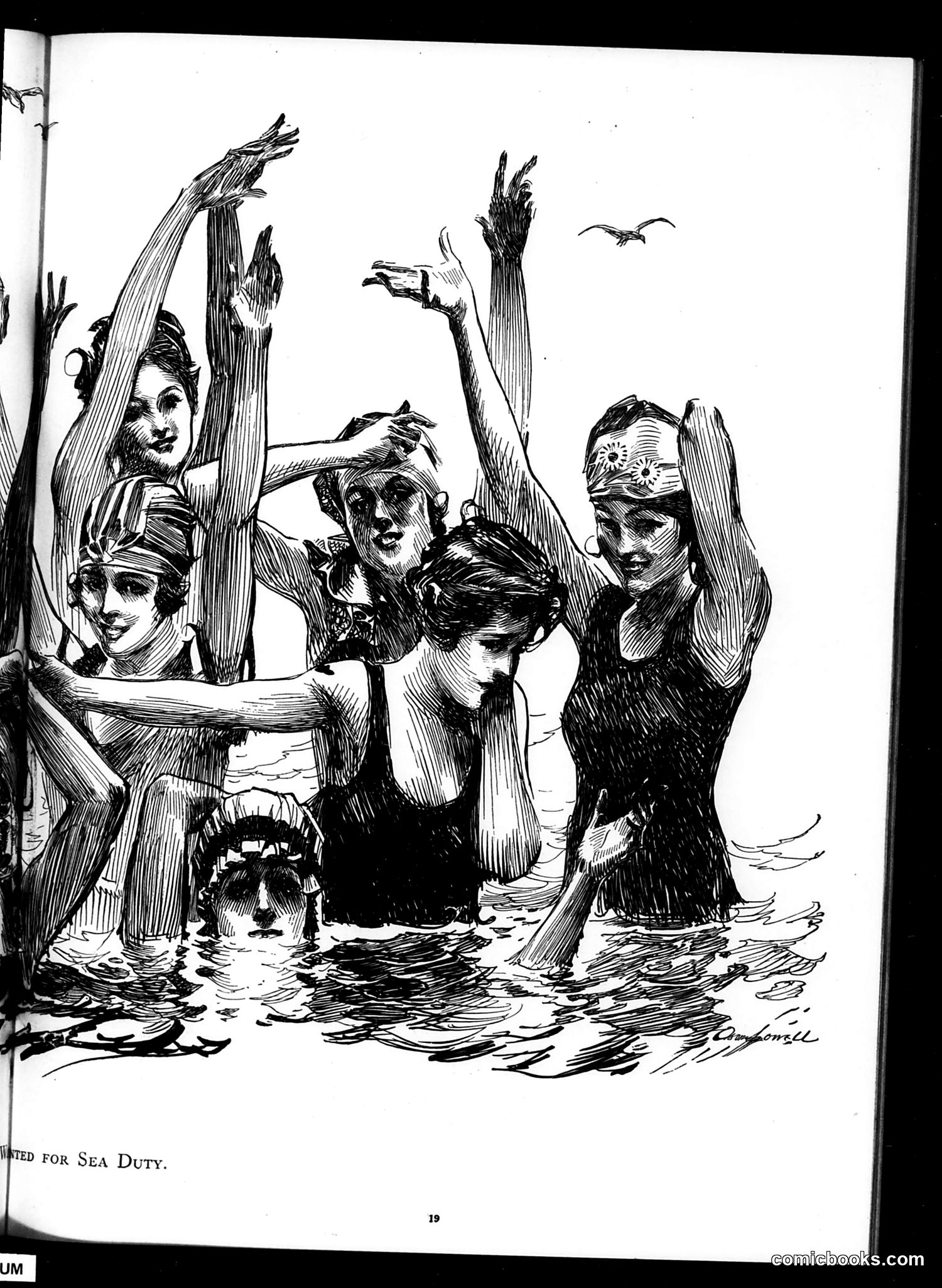
This cartoon depicts several figures in water wearing headbands and festive attire, with their arms raised enthusiastically. The caption reads "Wanted for Sea Duty." The satire appears to reference women being recruited or volunteered for naval service, likely during wartime (possibly WWI era, given Judge magazine's period). The decorative headbands and festive clothing suggest these are society women or debutantes—upper-class figures being humorously conscripted for maritime work. The joke likely satirizes either: 1. Women's wartime service recruitment efforts, treating serious military duty as a social occasion 2. The notion of society women being "drafted" for unglamorous work The artist's signature appears at bottom right. Without more specific historical context visible on this page, the exact event referenced remains unclear, though the humor turns on the incongruity between celebratory appearance and serious military service.
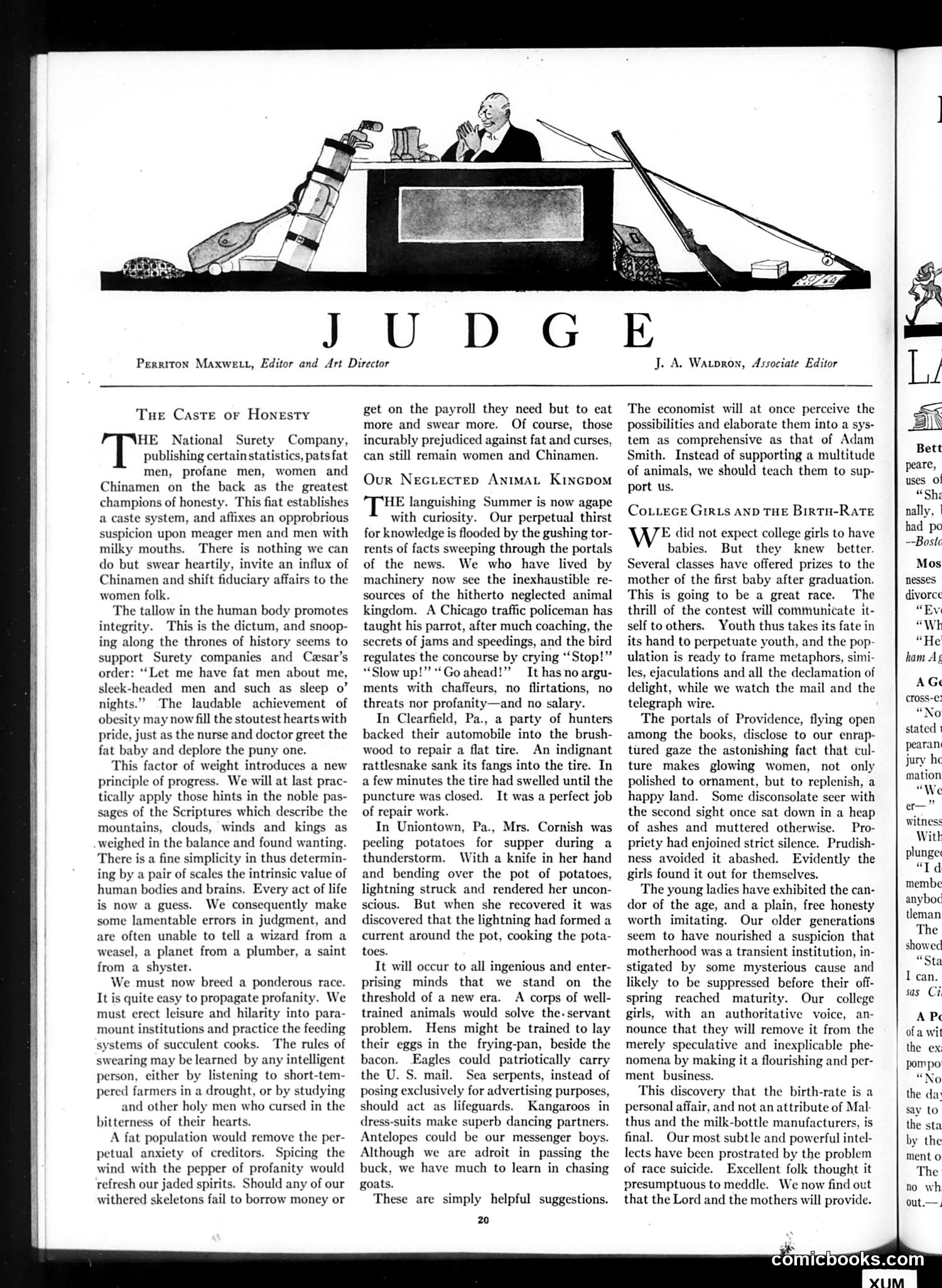
The masthead cartoon depicts a judge presiding over a cluttered desk—a visual metaphor for the magazine's satirical editorial role. **"The Caste of Honesty"** mocks the National Surety Company's claim that fat men are more trustworthy than thin ones. The satire argues this absurd "caste system" suggests society should breed fat, profane people and exclude "women and Chinamen" from positions of trust. The piece sarcastically proposes feeding people excessively and encouraging swearing as paths to financial reliability—exposing the illogic of judging character by appearance. **"Our Neglected Animal Kingdom"** presents humorous anecdotes (a trained parrot directing traffic, a rattlesnake patching a tire, lightning cooking potatoes) as evidence that animals deserve greater roles in society. The satire mocks both the newspaper sensationalism of the era and earnest technological optimism, suggesting animals could solve human problems more efficiently than people—a commentary on misplaced faith in progress. Both pieces use exaggerated absurdity to critique contemporary American prejudices and naive thinking.
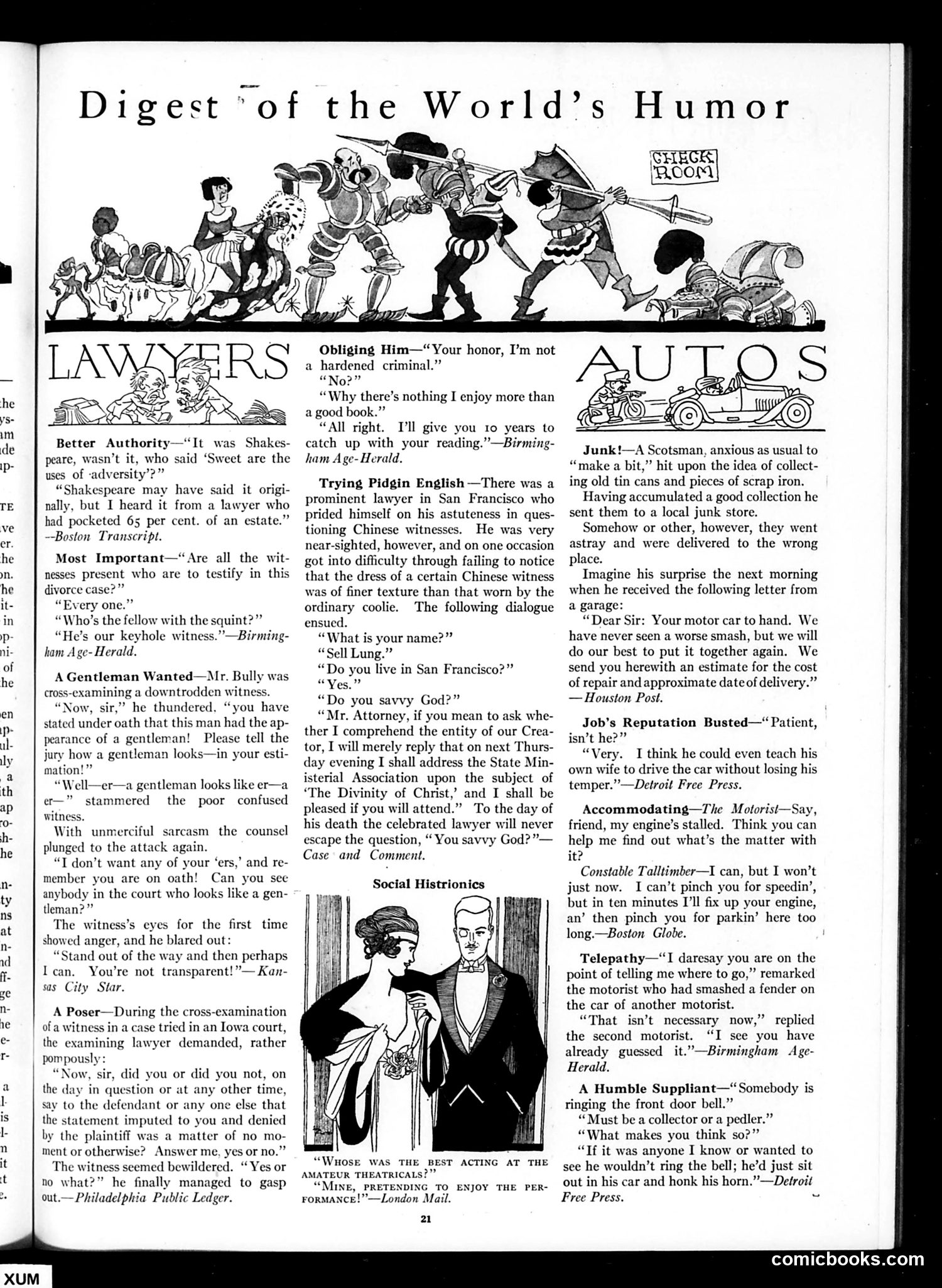
This page collects brief satirical anecdotes mocking lawyers, courts, and social pretension. Key jokes include: **Legal humor**: A lawyer misquotes Shakespeare while pocketing 65% of an estate; a bullying cross-examiner is silenced when a witness tells him to "stand out of the way" since he's blocking the view; a pompous lawyer's convoluted question leaves a witness baffled. **The "Pidgin English" anecdote** satirizes a near-sighted San Francisco lawyer who condescendingly uses broken English ("savvy God?") when questioning a Chinese witness—who turns out to be educated and gives a sophisticated response about addressing the ministerial association on Christ's divinity. The joke mocks the lawyer's racist assumptions. **Lower section jokes** include a motorist mistaking scrap metal for a car part, and social commentary on amateur theatricals where the "best acting" is pretending to enjoy bad performances. The humor targets professional pomposity, racial stereotyping, and social hypocrisy typical of early 20th-century satirical magazines.
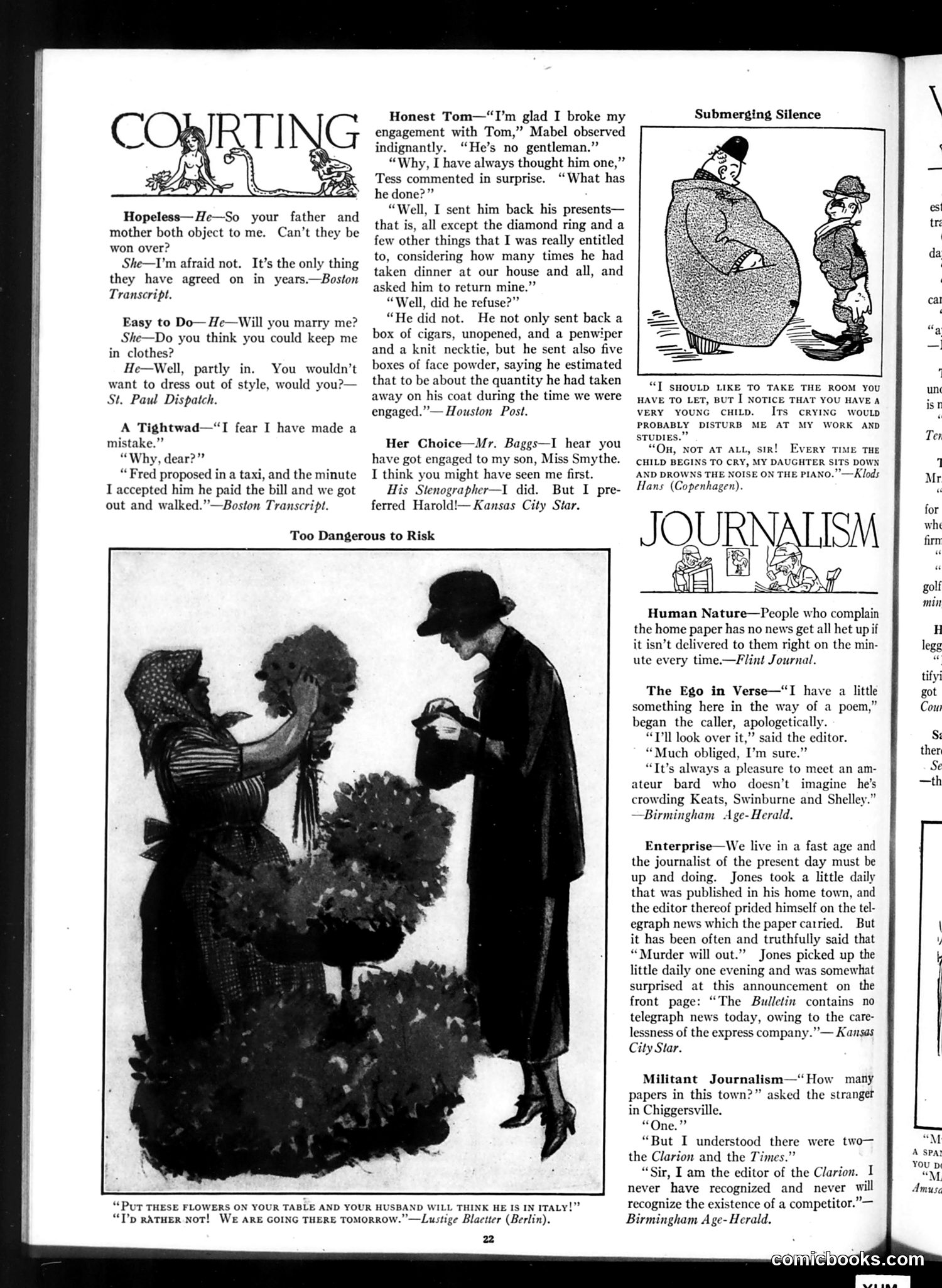
This page contains humorous short jokes and satirical commentary typical of early 20th-century Judge magazine. The main visual cartoon depicts a woman showing potted flowers to a man, with the caption suggesting the flowers will make him think he's in Italy—but she refuses because they're actually going there tomorrow. The joke satirizes superficial domestic deception and false romanticism. The text sections mock various social types: men who won't commit financially to marriage, misers, fortune-hunters who keep engagement gifts, and—in the "Journalism" section—small-town newspaper editors with inflated egos who refuse to acknowledge competitors. The "Submerging Silence" cartoon humorously depicts a landlord explaining that tenants needn't worry about a baby's crying because his daughter drowns it out on piano—dark humor about domestic noise problems. Overall, the page satirizes courtship customs, financial hypocrisy in relationships, and provincial pomposity—reflecting early 1900s middle-class anxieties and social pretensions.
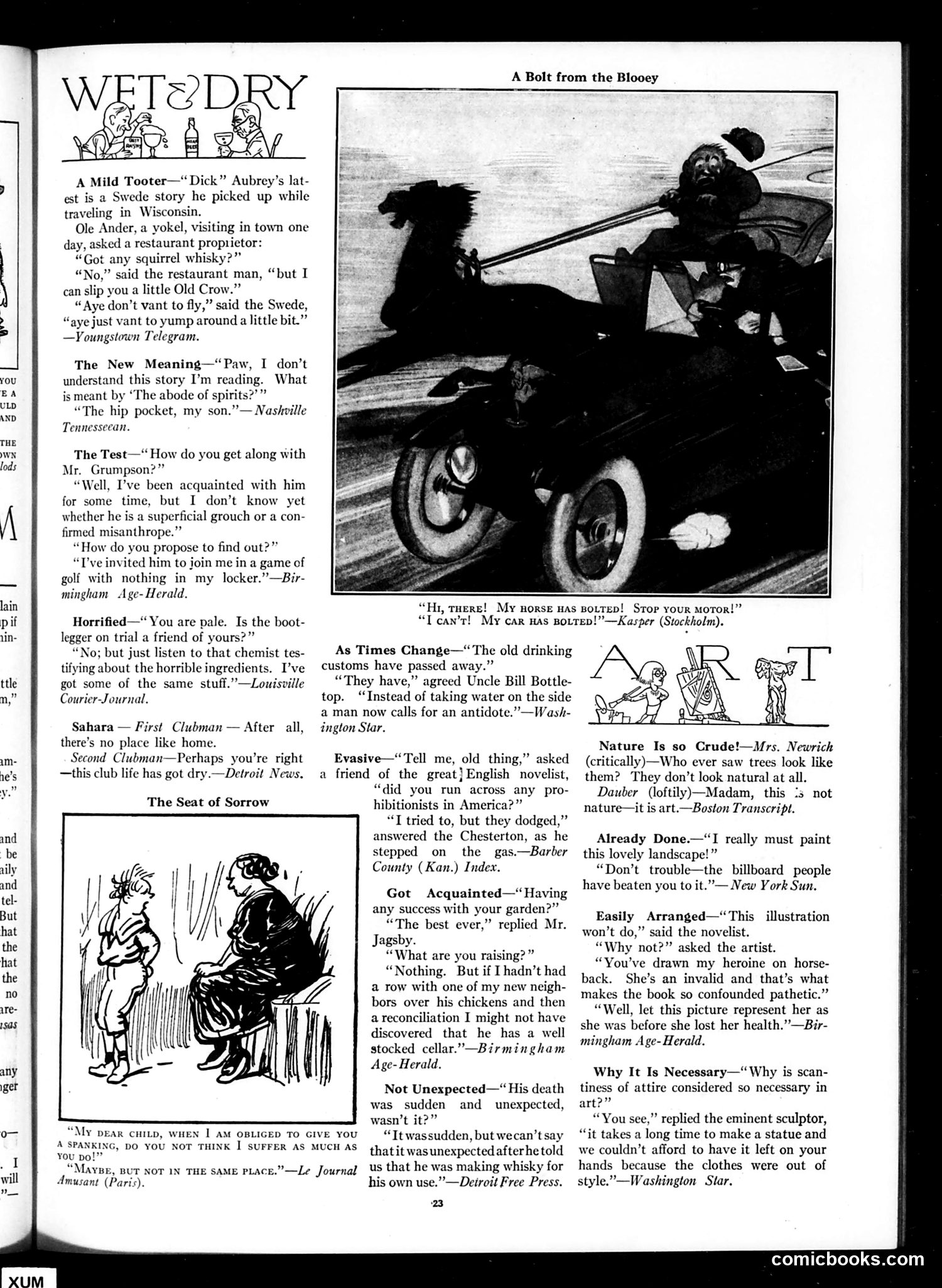
This page from Judge magazine (appears to be 1920s-era, based on Prohibition references) contains humor pieces satirizing American life during Prohibition and the Jazz Age. **Key themes:** The cartoons mock bootlegging and illegal alcohol production. "The New Meaning" jokes that "spirits" now refers to hip-pocket whisky rather than ghosts. Multiple pieces reference homemade whisky and the casual acceptance of illegal drinking—Uncle Bill Bottletop asks for an "antidote" instead of water, and a man dies making whisky "for his own use." **Social satire:** "A Bolt from the Blooey" (top image) appears to depict a motorist collision, contrasting modern automobile accidents with horse-related disasters. The piece titled "The Test" mocks golf-obsessed wealthy clubmen. The page reflects widespread Prohibition-era cynicism about law enforcement and middle-class hypocrisy regarding illegal alcohol consumption.
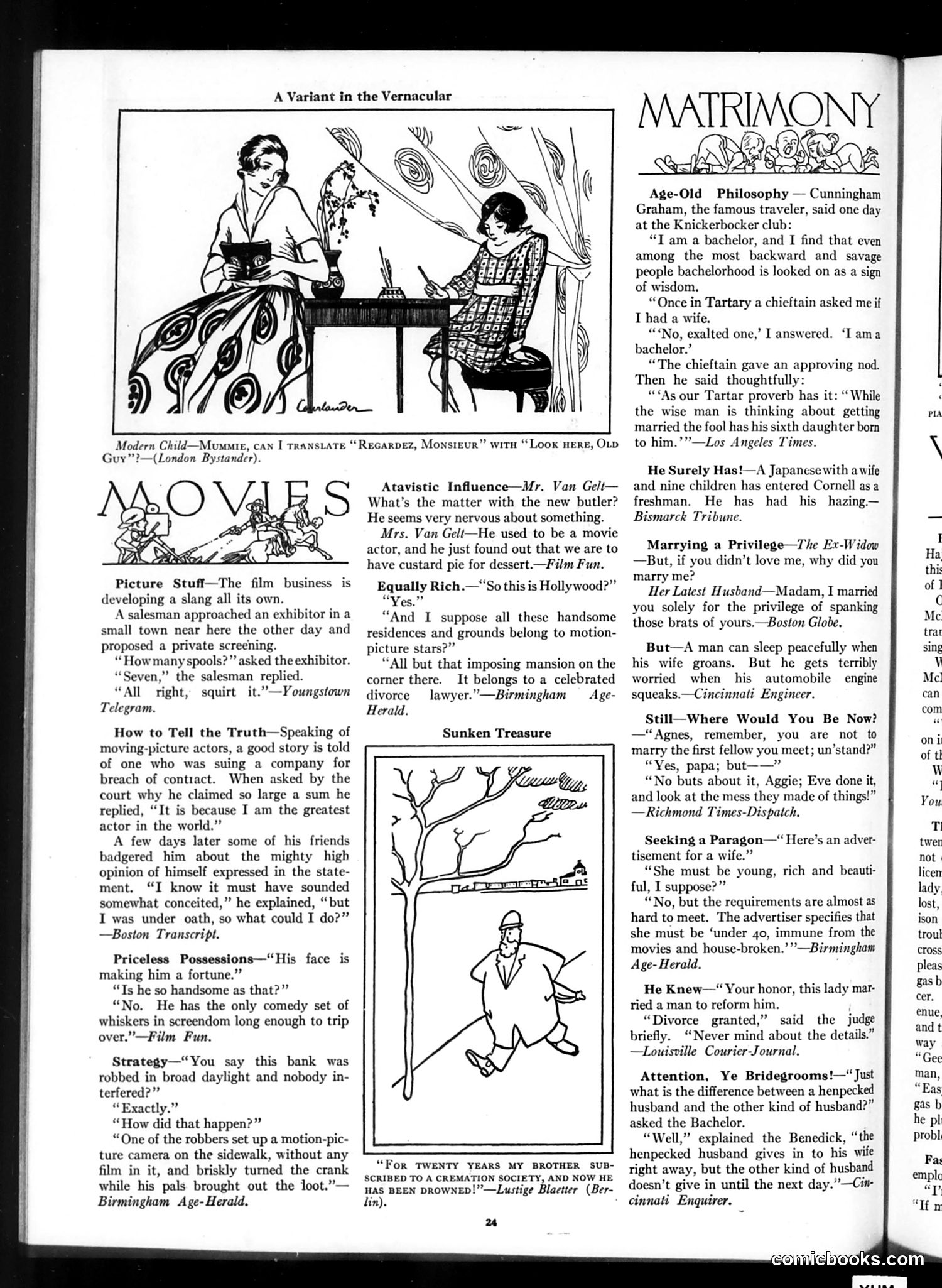
This page from *Judge* magazine satirizes early cinema and marriage through brief comedic anecdotes. **Cinema jokes** mock Hollywood's emerging jargon and the film industry's absurdities. One anecdote describes a bank robbery where a fake movie camera (without film) distracted bystanders—satirizing how Americans were becoming obsessed with motion pictures. Another jokes that a former movie actor fears custard pie (referencing slapstick comedy staple). A third notes that a divorce lawyer's mansion is the only non-star-owned property in Hollywood, sarcastically suggesting divorce is as profitable as acting. **Marriage section** presents cynical observations about matrimony. A famous traveler claims Tartary considers bachelorhood wise. A Japanese student's hazers presumably target his large family. An "ex-widow" remarries purely for spanking rights. The recurring theme: marriage is disadvantageous or foolish—contrasting sharply with the section's title "Matrimony," creating ironic humor typical of *Judge's* satirical tone.
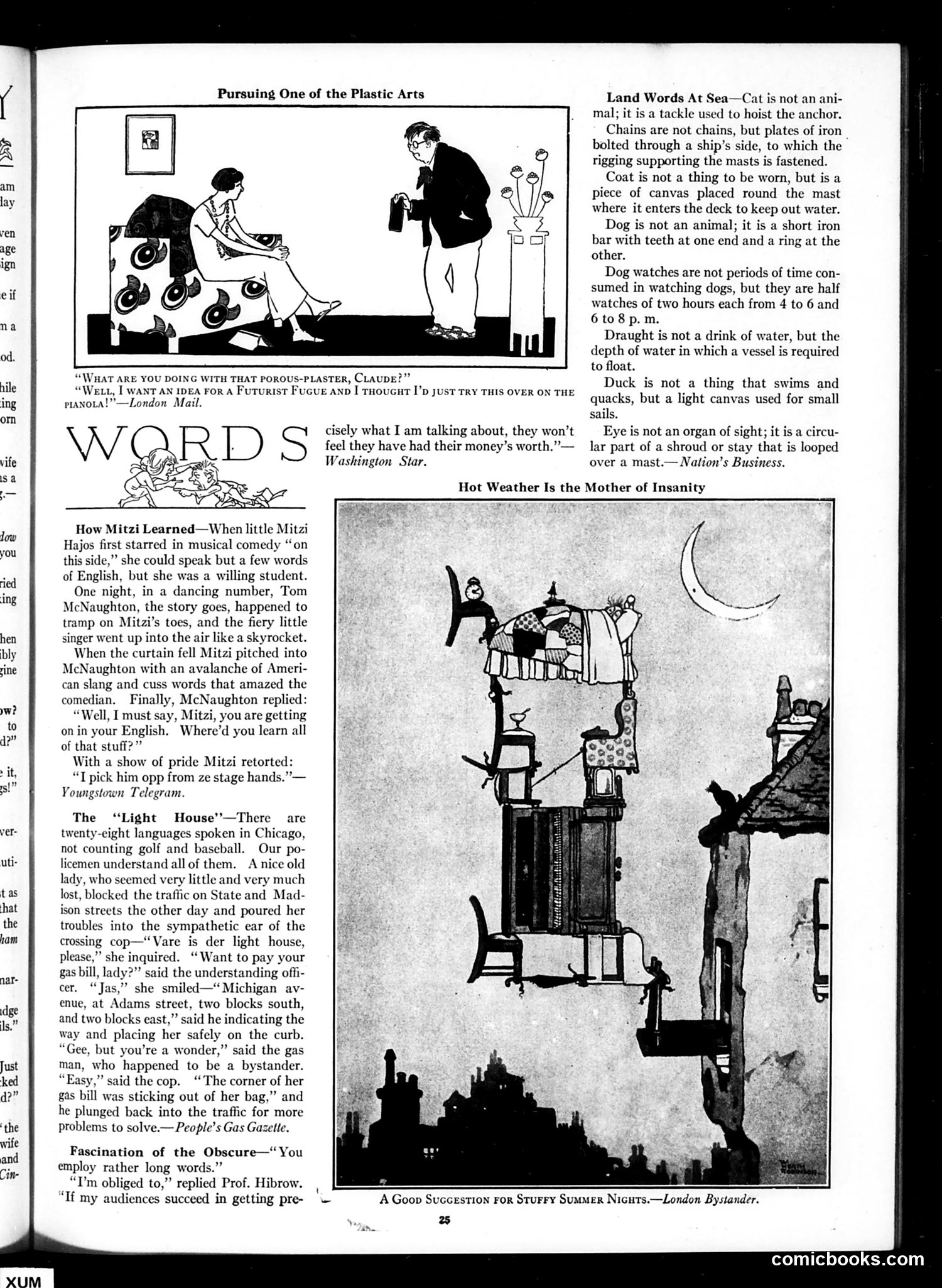
This page contains several short humorous anecdotes and one cartoon, typical of Judge magazine's satirical style. **Top Cartoon:** Shows a woman examining patterned fabric while a man holds up what appears to be plaster. The caption jokes about a "Futurist Fugue" and porous plaster—likely mocking avant-garde modern art movements gaining popularity in the 1910s-20s. The satire suggests pretentious artists experiment recklessly with unconventional materials. **Text Stories:** Include: - **"How Mitzi Learned"**: A anecdote about actress Mitzi Hajos learning English slang from stagehands, poking fun at immigrant performers - **"The Light House"**: Satirizes miscommunication when a non-English speaker asks a Chicago cop for directions (she meant "lighthouse" but meant the gas company office). The joke celebrates the patient cop's resourcefulness - **"Fascination of the Obscure"**: Mocks pretentious academics who deliberately use obscure language to justify charging admission **Right Illustration & Text**: "A Good Suggestion for Stuffy Summer Nights"—surreal/fantastical image with literary reference (London Bylander), suggesting escapist entertainment during hot weather. The page's overall theme: satirizing pretension, immigrant confusion, and intellectual affectation.
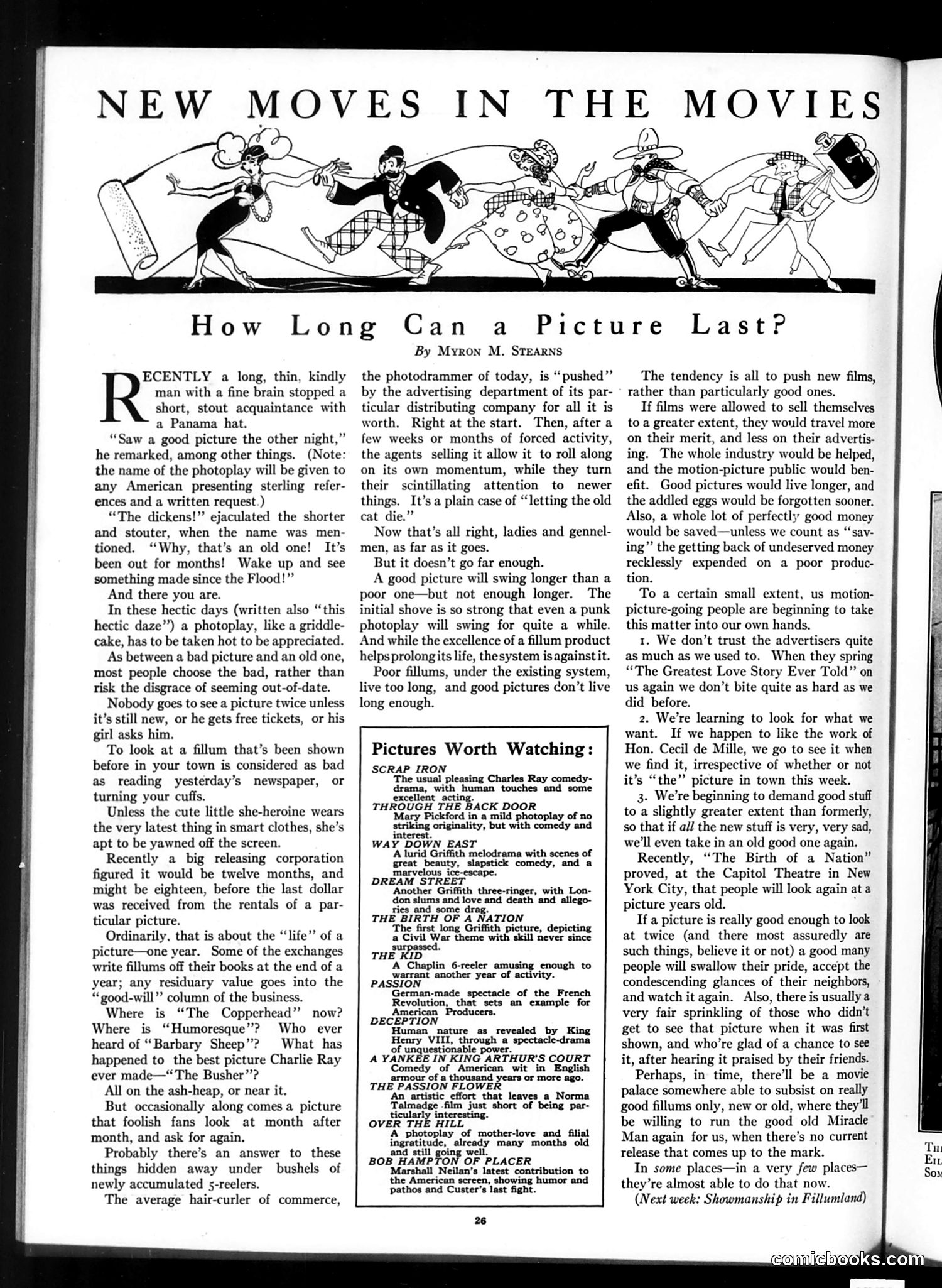
This article, by Myron M. Stearns, satirizes the film industry's obsession with novelty over quality. The cartoon header depicts characters engaged in exaggerated physical comedy—typical of silent-era slapstick—illustrating the frenetic pace of movie production. The satire's core complaint: studios aggressively promote new films regardless of merit, then abandon them after months, while the public treats older pictures as shameful to watch. Stearns argues this system punishes good films (which deserve longer theatrical runs) and artificially extends the lives of poor ones. The article cites specific examples—"The Copperhead," "Humoresque," "Barbary Sheep"—once-popular films now forgotten, suggesting that the industry's churn-and-discard model wastes potentially enduring material. He calls for reconsidering how long quality pictures circulate, positioning artistic merit against commercial pressure for constant novelty.
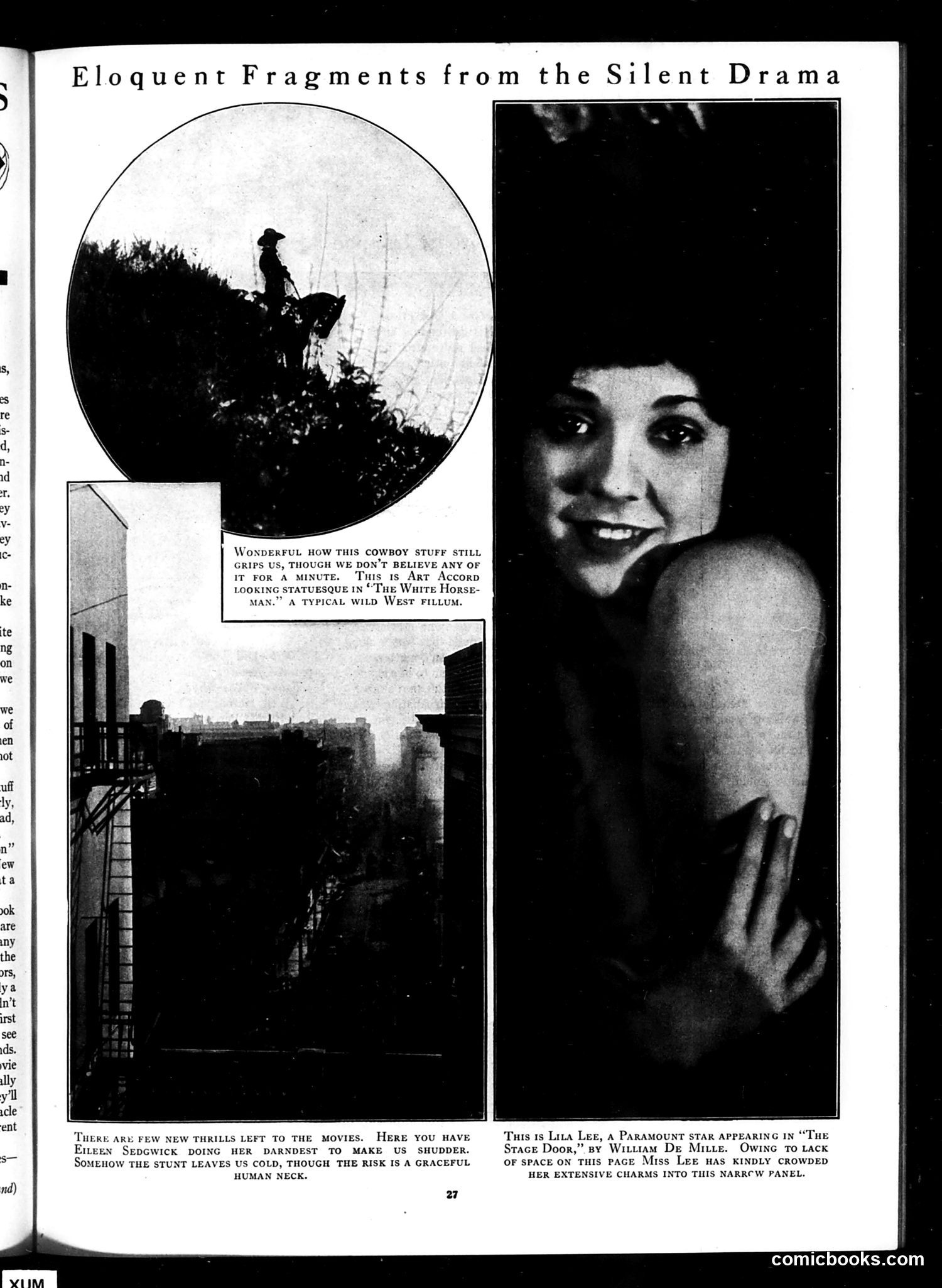
This Judge page critiques 1920s silent cinema's reliance on formulaic thrills. The left images show two popular film genres: a Western featuring Art Accord in "The White Horseman" (a cowboy on horseback silhouetted against the moon), and Eileen Sedgwick performing a dangerous stunt. The satire mocks audiences for finding these scenarios exciting despite disbelieving them ("we don't believe any of it for a minute"). The commentary suggests cinema has exhausted genuinely novel thrills. The right panel features Paramount star Lila Lee from "The Stage Door" by William De Mille. The caption's flirtation—noting her "extensive charms" are "crowded into this narrow panel"—suggests the magazine used her glamorous photograph partly as space-filler, poking fun at how studios marketed stars' physical appeal alongside their acting. The overall tone is weary toward both silent film conventions and celebrity promotion.
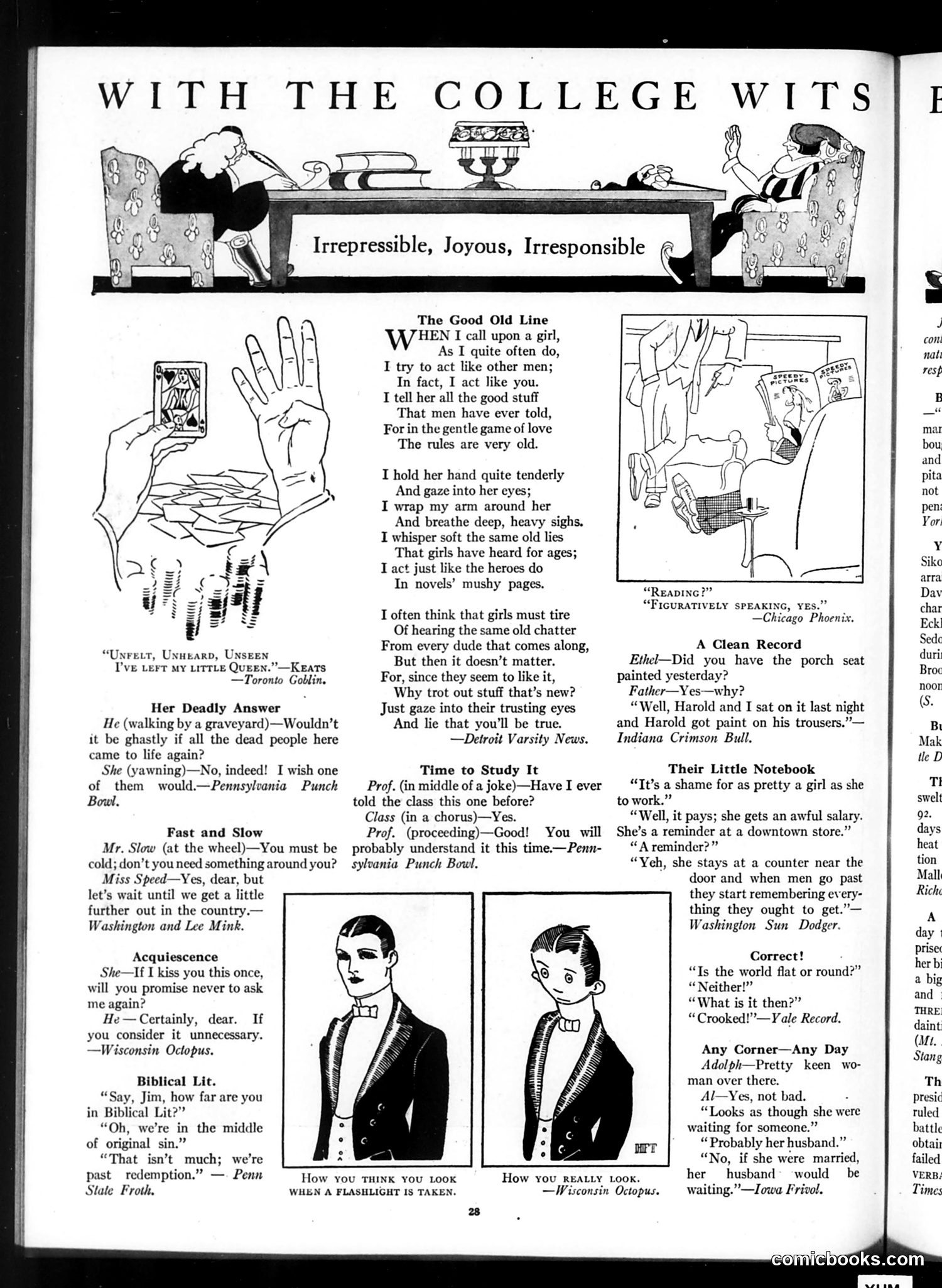
This page collects humorous short jokes and quips from college humor magazines, a common feature in Judge. The content satirizes college courtship rituals and student life in the early 20th century. **Key satirical targets:** - **Dating conventions**: "The Good Old Line" mocks male romantic rhetoric as formulaic deception—men recycle identical compliments and promises across generations, yet women accept them anyway. - **Gender dynamics**: Multiple jokes portray women as pragmatic about male dishonesty ("they seem to like it"), suggesting courtship operates on mutual performance rather than sincerity. - **The flashlight photo gag** contrasts vanity (how men imagine they look) versus reality (unflattering truth), mocking male self-delusion. - **Academic humor**: Jokes about professors repeating lectures and students in "Biblical Lit" approaching redemption satirize institutional mediocrity. The overall tone suggests resigned cynicism about romance and education—not reform, but wry acceptance that systems perpetuate tired routines.
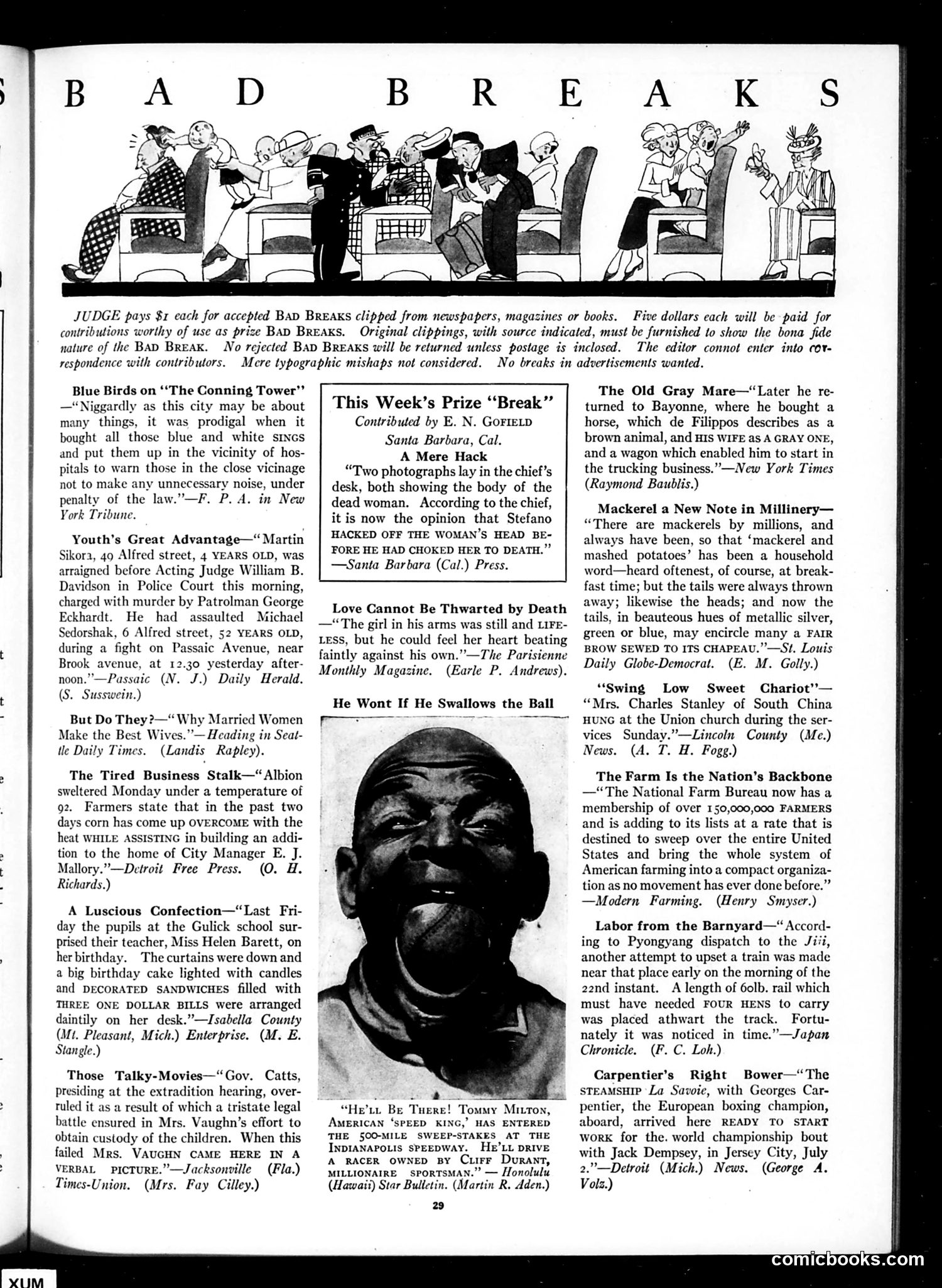
This page from *Judge* magazine showcases "Bad Breaks"—a humor feature paying readers for printing mistakes or unintentionally absurd sentences clipped from newspapers. The cartoon header depicts newspaper offices where writers and editors discover these accidental errors. The examples are genuinely funny because they contain jarring contradictions or logical absurdities caused by careless proofreading. For instance, a boy charged with murdering someone "52 years old" when he's only "4 years old"; someone being "overcome with the heat while assisting" in construction; or a dead woman whose heartbeat is still felt. These aren't intentional jokes—they're real publishing errors that created unintended humor through context-clash or factual impossibilities. The feature relied on readers' eagle eyes to catch what newspapers missed, making it a participatory humor column that satirized journalism's sloppiness while providing entertainment.
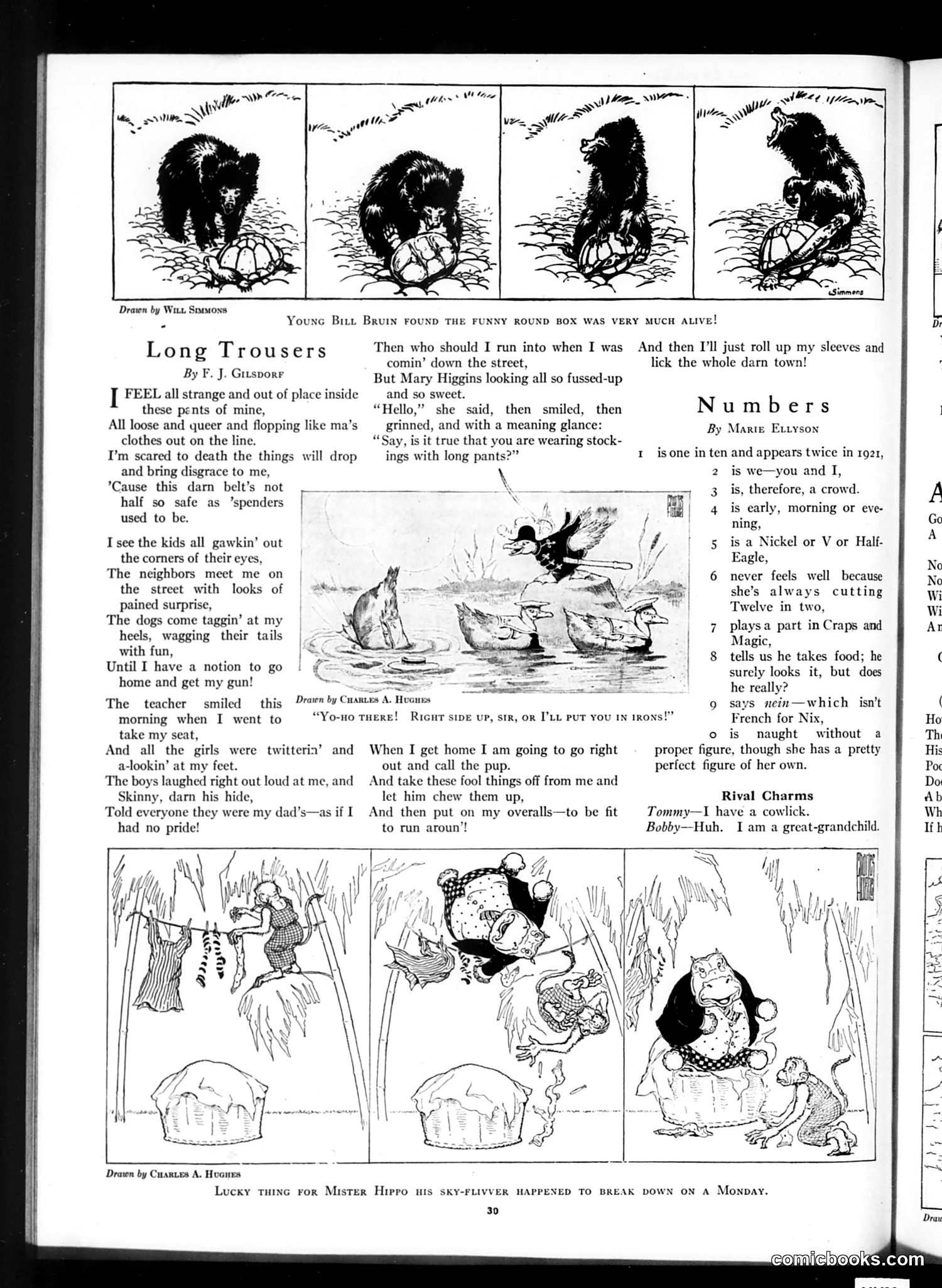
This page features humor about **a boy's embarrassment wearing long pants for the first time**—a significant coming-of-age moment in early 20th-century America. The poem by F. J. Gildorf captures the social awkwardness: kids stare, neighbors look shocked, even dogs follow him. Most humiliating is Mary Higgins pointedly asking if he's wearing "stockings with long pants"—implying the pants are unfashionably tight or feminine. His solution is indignant: change back into overalls and fight the whole town. The other content includes: - **"Young Bill Bruin"** (top): A cartoon about a bear cub discovering a "funny round box" (beehive) that's "very much alive"—slapstick animal humor. - **"Numbers"** and **"Rival Charms"**: Wordplay riddles and children's jokes. - **"Lucky Thing for Mister Hippo"**: A three-panel comic about a hippo's car breaking down on a Monday. All content reflects early 1920s magazine humor aimed at family audiences.
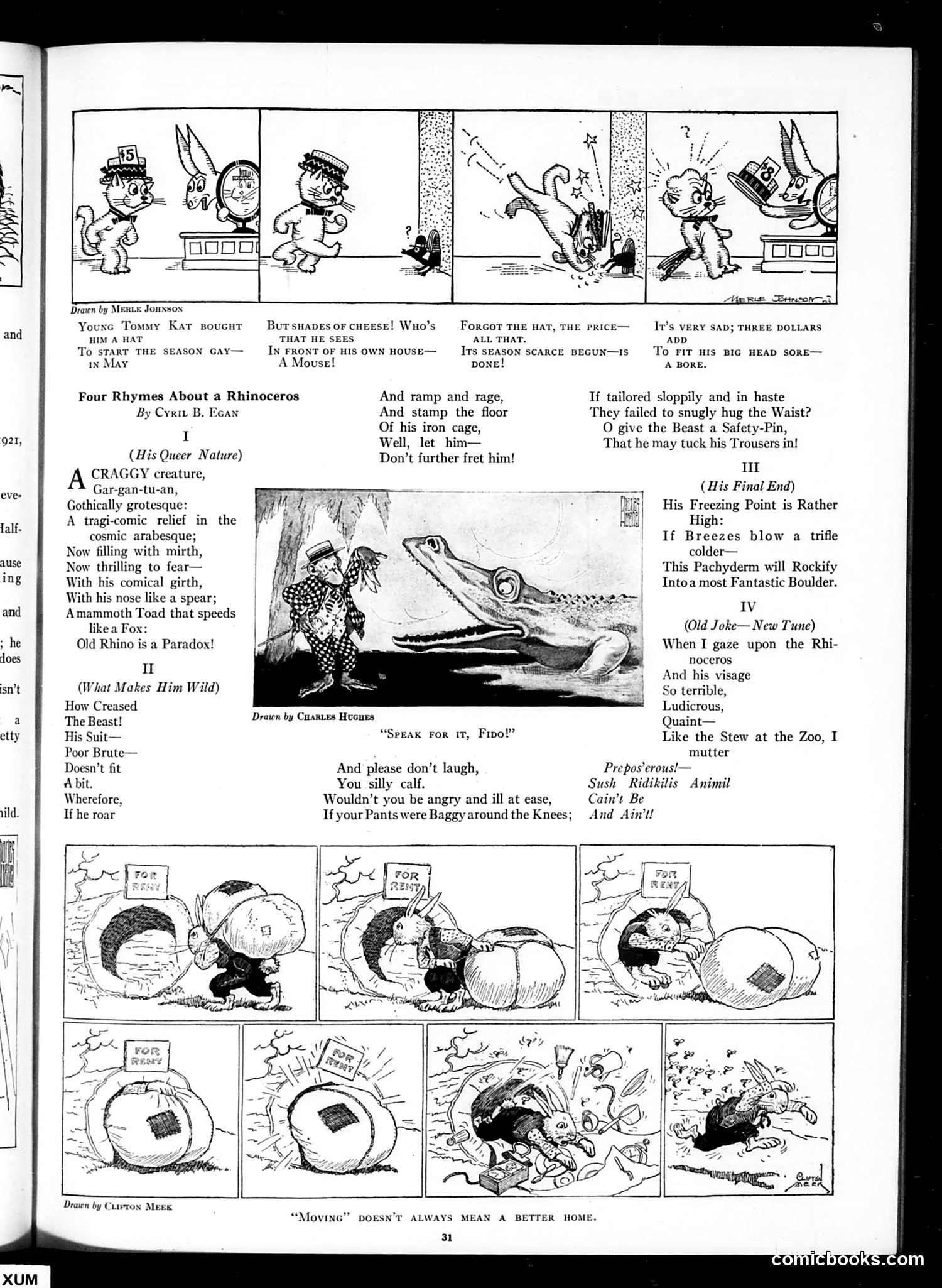
This page contains light, whimsical content rather than political satire. The top strip by Merle Johnson shows a simple domestic joke: Tommy Kat buys a hat to start the spring season cheerfully, but it causes escalating problems—he forgets it, loses it, and it costs three dollars to fit his large head, ultimately proving "a bore." The bulk of the page features "Four Rhymes About a Rhinoceros" by Cyril B. Egan, a humorous poem treating the rhinoceros as a paradoxical creature—simultaneously comic and fearsome, powerful yet comically frustrated by ill-fitting clothes (baggy pants, tight suit). The verses are playful wordplay emphasizing the beast's absurdity. The bottom comic strip by Clifton Meek titled "'Moving' doesn't always mean a better home" depicts a round creature attempting to relocate its belongings, apparently failing comedically. This is **children's humor and light verse**—no political figures or social commentary are evident. The satire, if any, is gentle and fantastical, focused on amusing animal antics rather than contemporary issues.
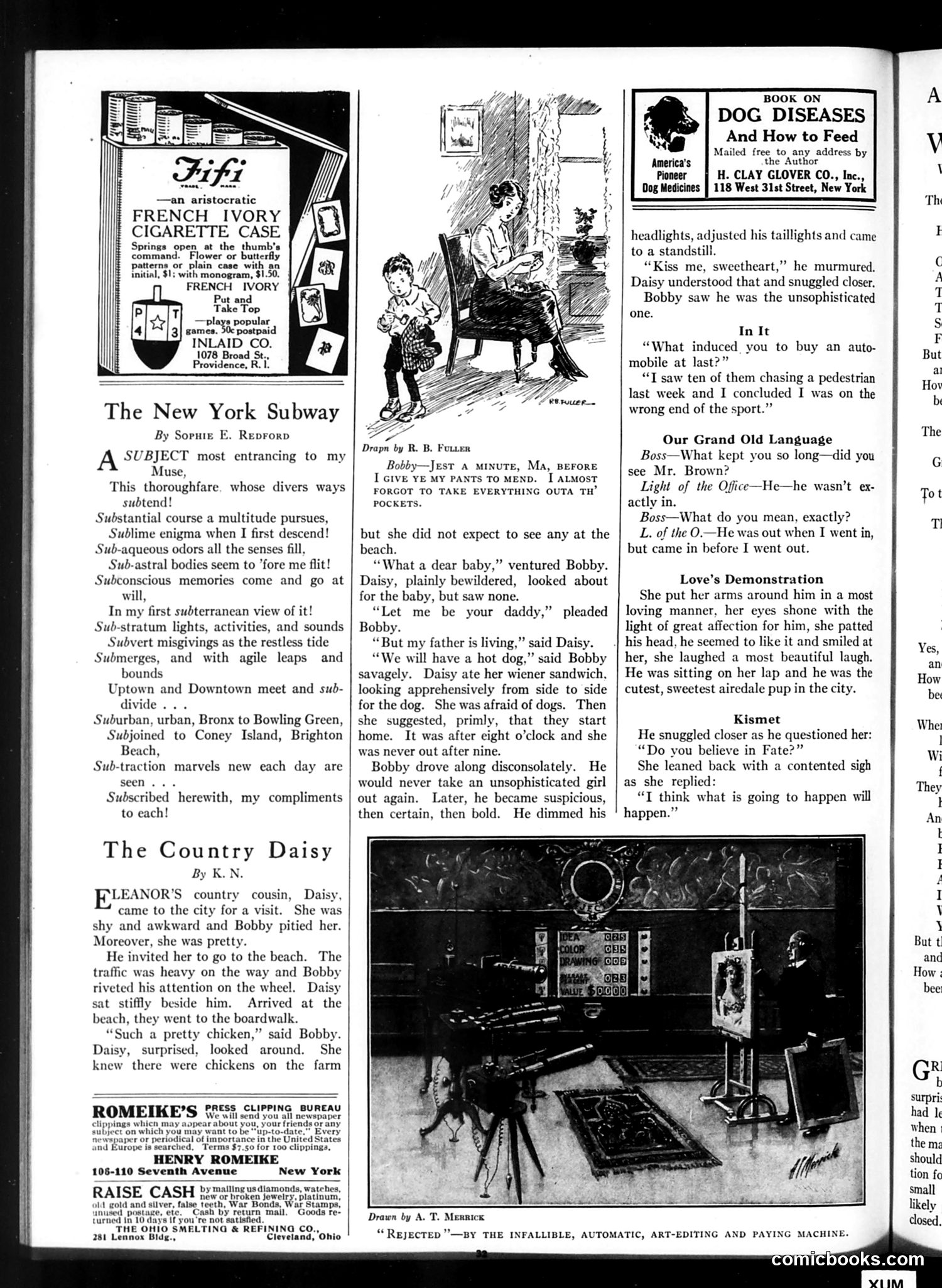
This satirical story mocks urban sophistication versus rural innocence. Bobby, a city dweller, takes his country cousin Daisy to the beach, using slang she literally interprets: he calls an attractive woman a "pretty chicken"—Daisy looks for actual poultry. When he says "Let me be your daddy," she's confused because her father is alive. Bobby finds her hopelessly unsophisticated and gives up on the date. The joke's reversal: Daisy gets the last laugh. When Bobby finally makes a romantic move, she responds naturally and affectionately, while *he* realizes *he* was the unsophisticated one all along—unable to recognize genuine feeling beneath rural manners. The satire targets urban pretension: city sophistication and slang mask emotional shallowness compared to sincere country values.
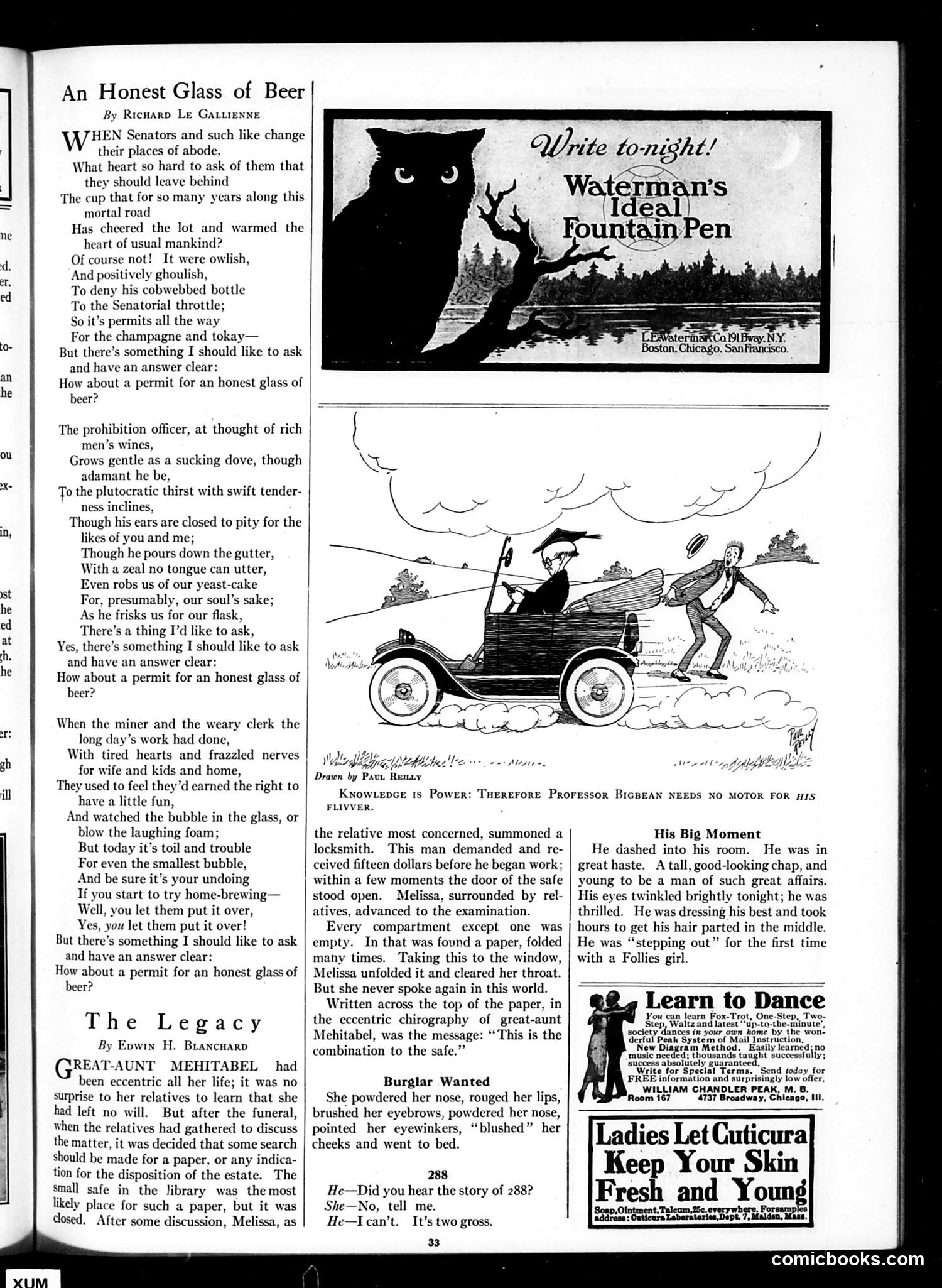
**"An Honest Glass of Beer"** by Richard Le Gallienne is satire about Prohibition hypocrisy. The poem protests that while wealthy senators and politicians receive permits to drink fine wines and champagne, ordinary working-class people—miners, clerks—are denied even beer. The "prohibition officer" is depicted as selectively enforcing the law: sympathetic to the rich man's "plutocratic thirst" but ruthless toward common folk, pouring their beer down gutters and raiding home breweries. The repeated refrain demands an answer: why can't working people have an honest glass of beer? It exposes Prohibition as class-based enforcement favoring the wealthy elite while punishing the poor—a key criticism of 1920s Prohibition policy. The cartoon accompanying it (with the figure and automobile) reinforces this message through visual satire, though the specific reference is unclear from this image alone.
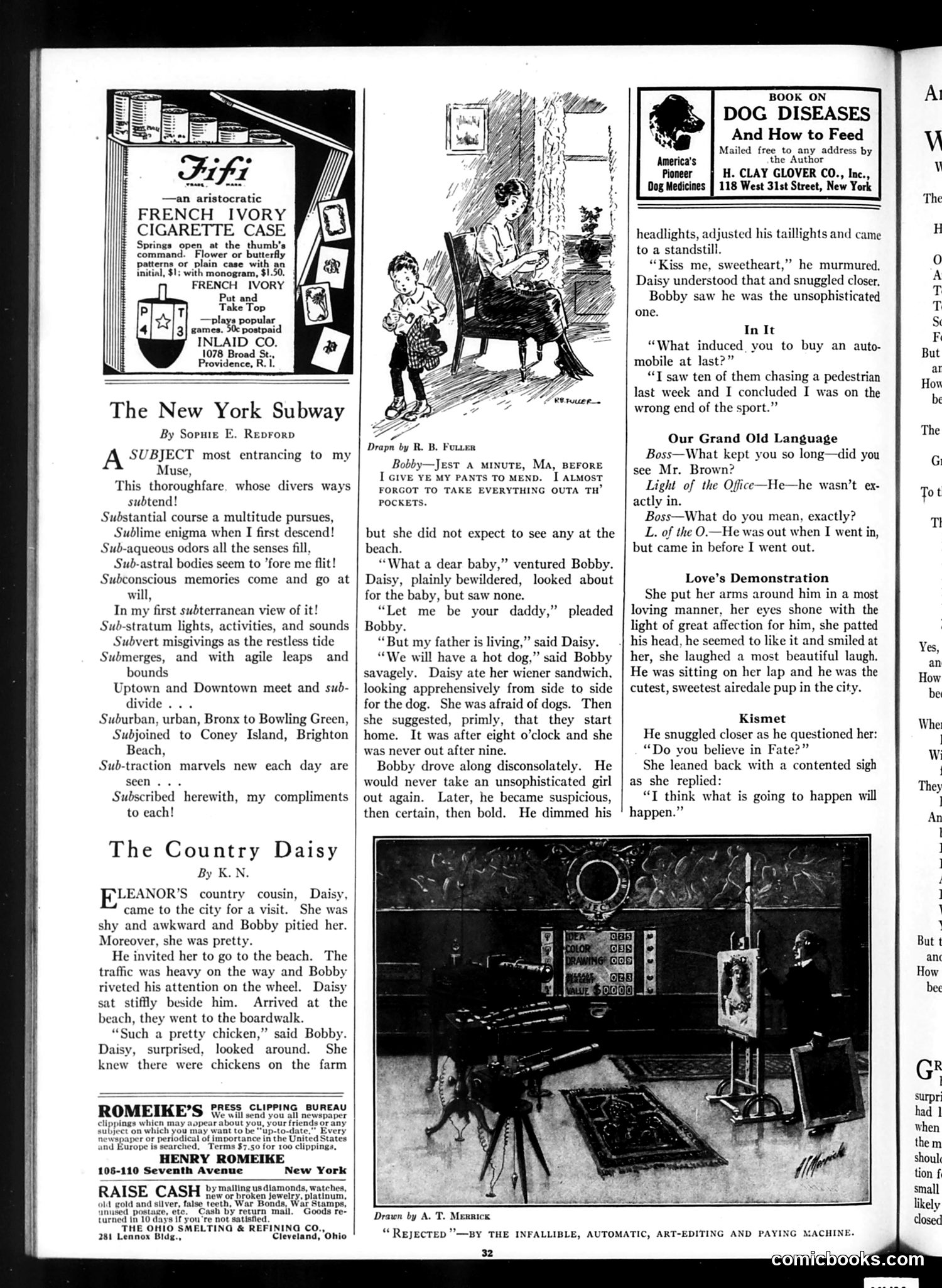
This page contains short fiction and advertisements rather than political cartoons. The main content includes: **"The Country Daisy"** is a humorous story satirizing city sophistication versus rural innocence. Bobby, a city man, takes his country cousin Daisy on a date, using slang ("chicken," "hot dog," "daddy") that she misinterprets literally—she looks for actual chickens and dogs, misunderstanding his urban flirtation attempts. The joke mocks both Bobby's failed seduction of an "unsophisticated girl" and Daisy's naive literalism. The punchline reveals Bobby himself is the truly unsophisticated one. Other brief humorous pieces include wordplay about office etiquette and automobile purchases. The page is primarily **advertisements** for cigarette cases, press clipping services, and cash-for-valuables schemes typical of 1920s periodicals. No significant political satire appears on this particular page.
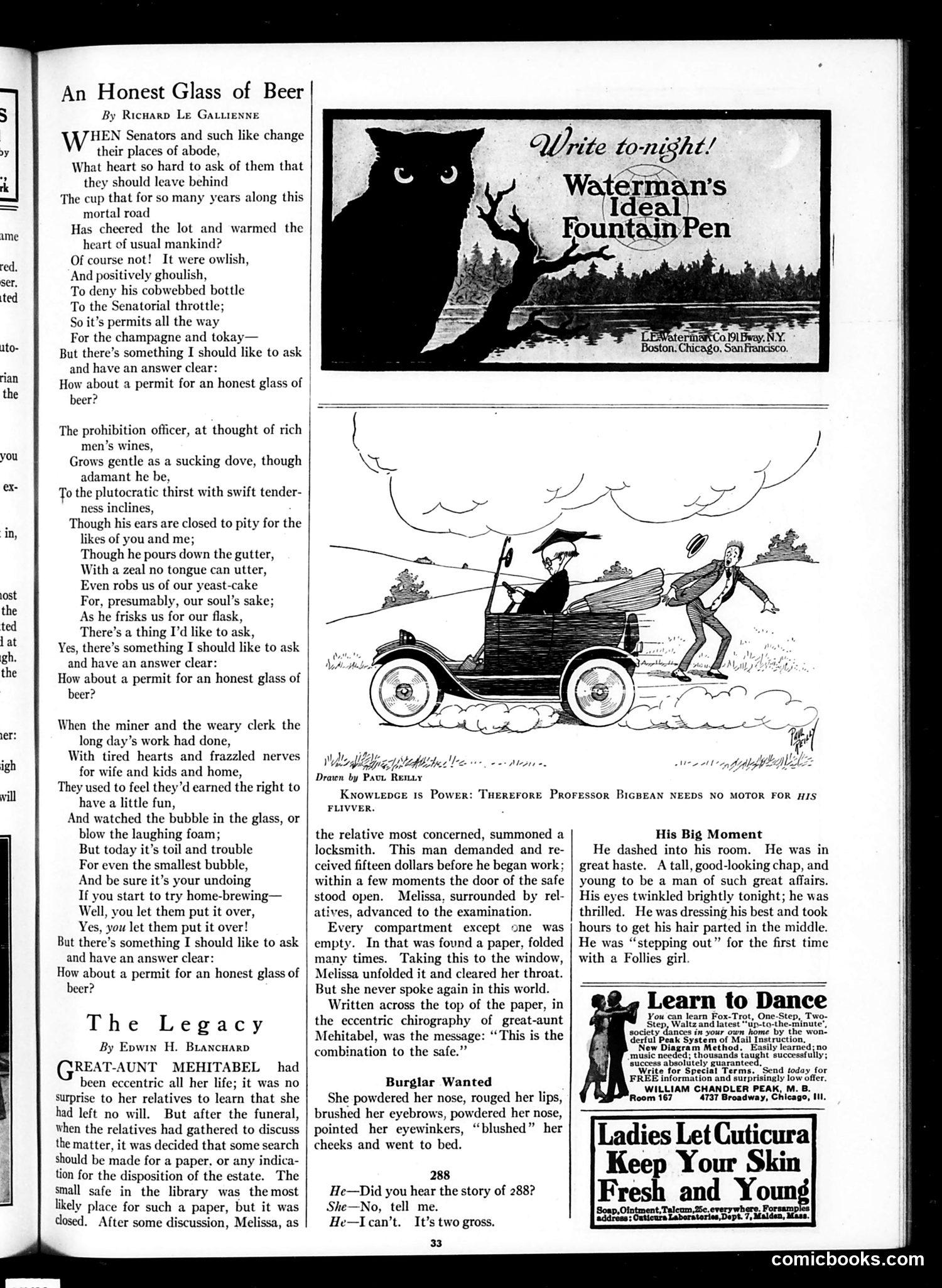
This poem by Richard Le Gallienne critiques the **hypocrisy of Prohibition enforcement** (1920-1933). The satire contrasts how wealthy senators and politicians receive permits for champagne and fine wines while ordinary working people—miners, clerks—are denied beer. The poem's repeated refrain "How about a permit for an honest glass of beer?" mocks the two-tiered system: prohibition officers are portrayed as gentle toward the rich ("grows gentle as a sucking dove") but zealously destroy common people's modest home brews and flasks. The working class, who "earned the right to have a little fun," are criminalized while the elite enjoy legal exemptions. This reflects real Prohibition-era corruption where wealthy citizens obtained permits while enforcement targeted the poor. The poem attacks both the law's selective application and the moral pretense that framing working-class drinking as a "soul's sake" issue while protecting wealth's indulgences.
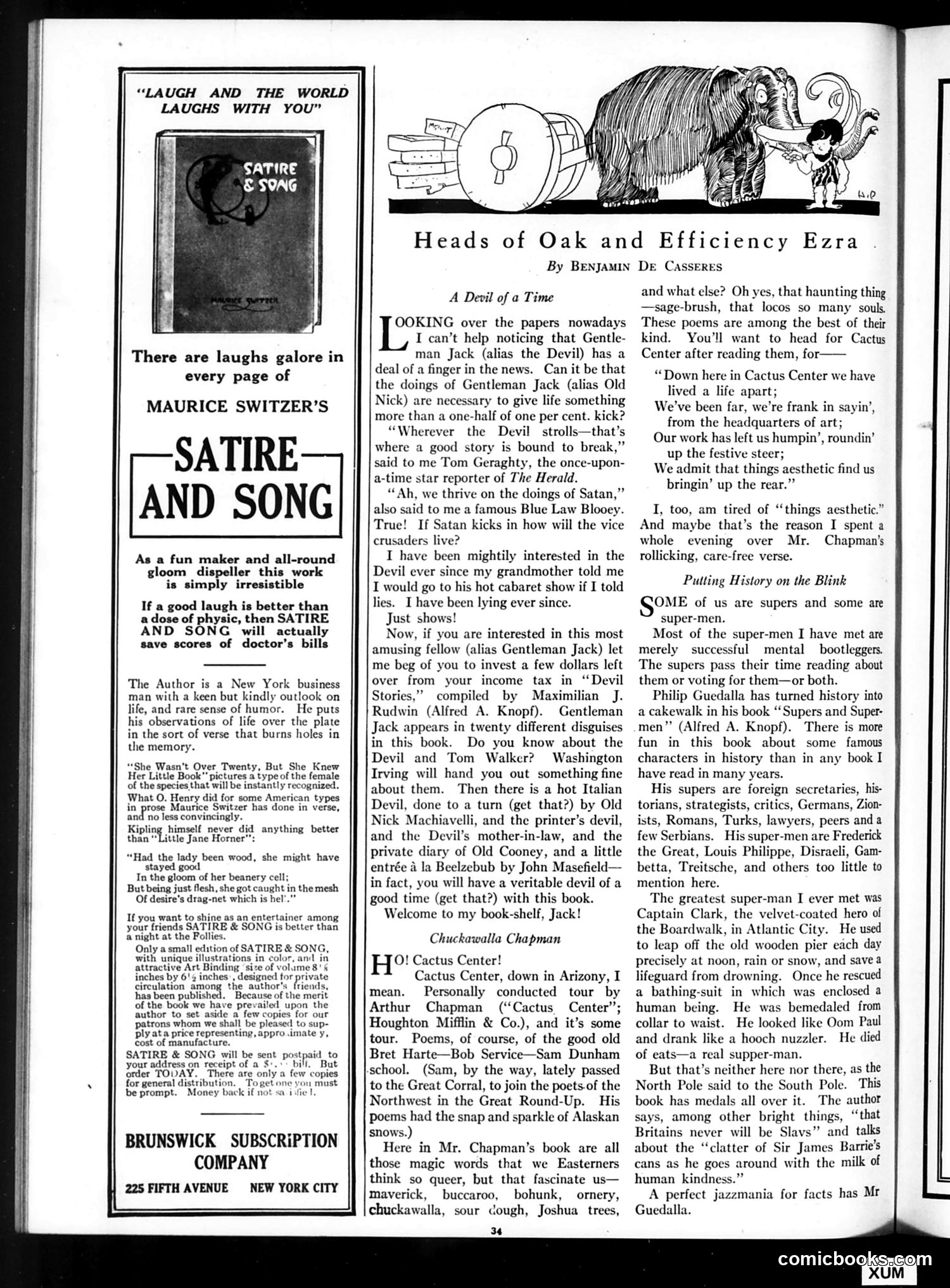
This page combines advertising and literary criticism from an early 20th-century American humor magazine. The left side advertises Maurice Switzer's book *Satire and Song*, positioning it as entertainment that delivers laughs better than medicine. The main content features two book reviews by "Chuckawalla Chapman" (a pen name). The first reviews a collection called *Devil Stories*, compiled by Maximilian J. Rudwin. Chapman humorously suggests that the Devil ("Gentleman Jack") is necessary for good news stories and that vice crusaders depend on Satan's activities for their crusade's relevance. He references classic literary devil tales including Washington Irving's "The Devil and Tom Walker" and works by John Masefield. The second review briefly introduces Arthur Chapman's poetry collection about Arizona's "Cactus Center." The cartoons at top appear decorative rather than satirical—showing an elephant with a small figure, likely illustrating the magazine's humorous tone rather than making specific political commentary.
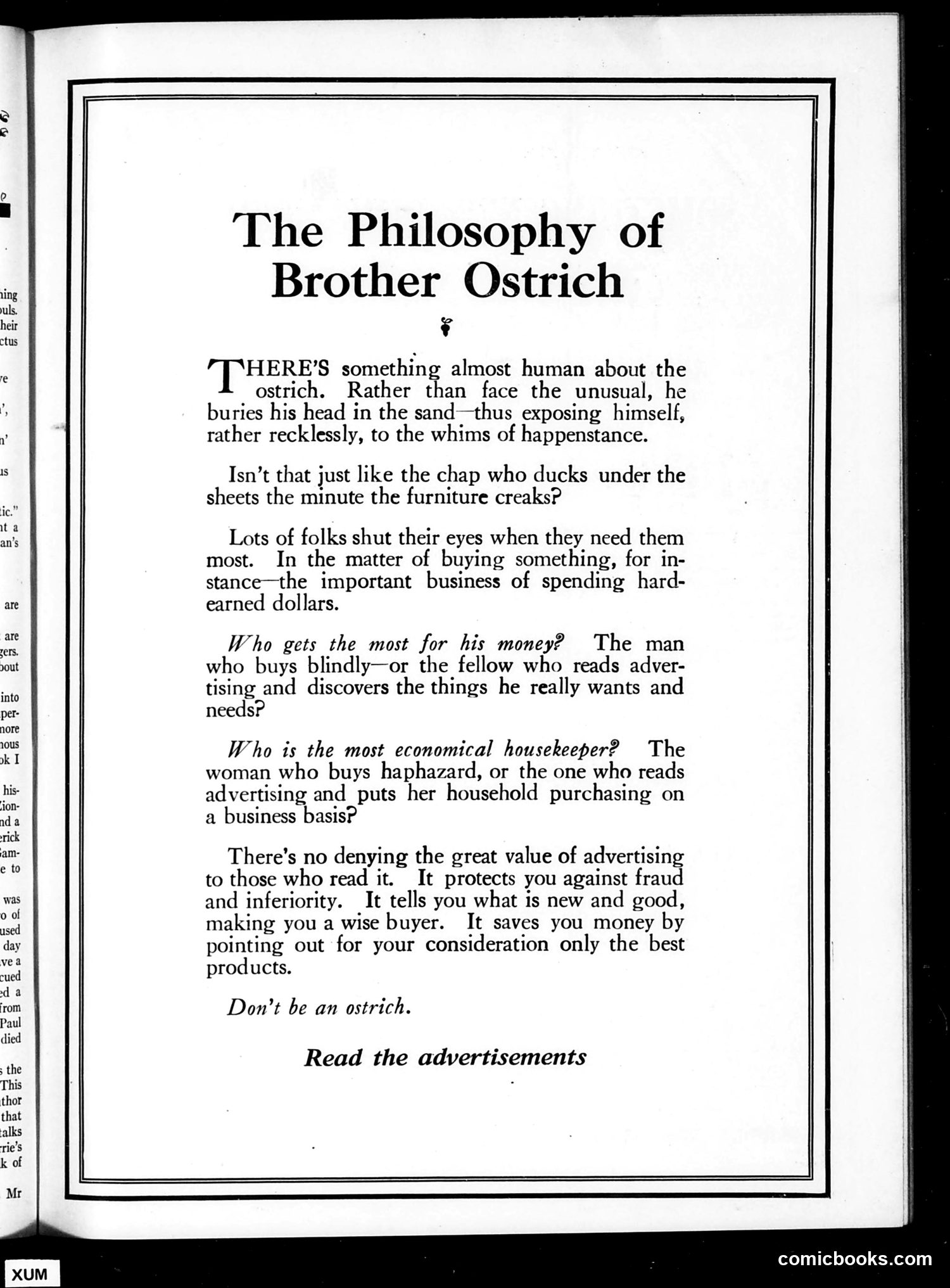
This is an advertisement masquerading as satirical commentary. The piece uses the ostrich metaphor—the bird that supposedly buries its head in sand to avoid danger—to shame readers into reading advertisements. The satire targets people who avoid looking at ads or ignore them when making purchases. The author argues that ignoring advertising is equivalent to willful blindness, comparing it to someone who "ducks under the sheets" at unexpected noises. The piece makes a rhetorical argument: smart shoppers read ads to get better value and protect themselves from fraud; foolish ones buy "blindly" or "haphazard." The conclusion—"Don't be an ostrich. Read the advertisements"—frames ad-avoidance as cowardly self-deception. For modern readers: this represents early 20th-century advertising industry messaging promoting the *value* of advertising itself, before consumer skepticism became mainstream. It's essentially propaganda disguised as humorous philosophy, encouraging readers to accept ads as beneficial guidance rather than persuasion.
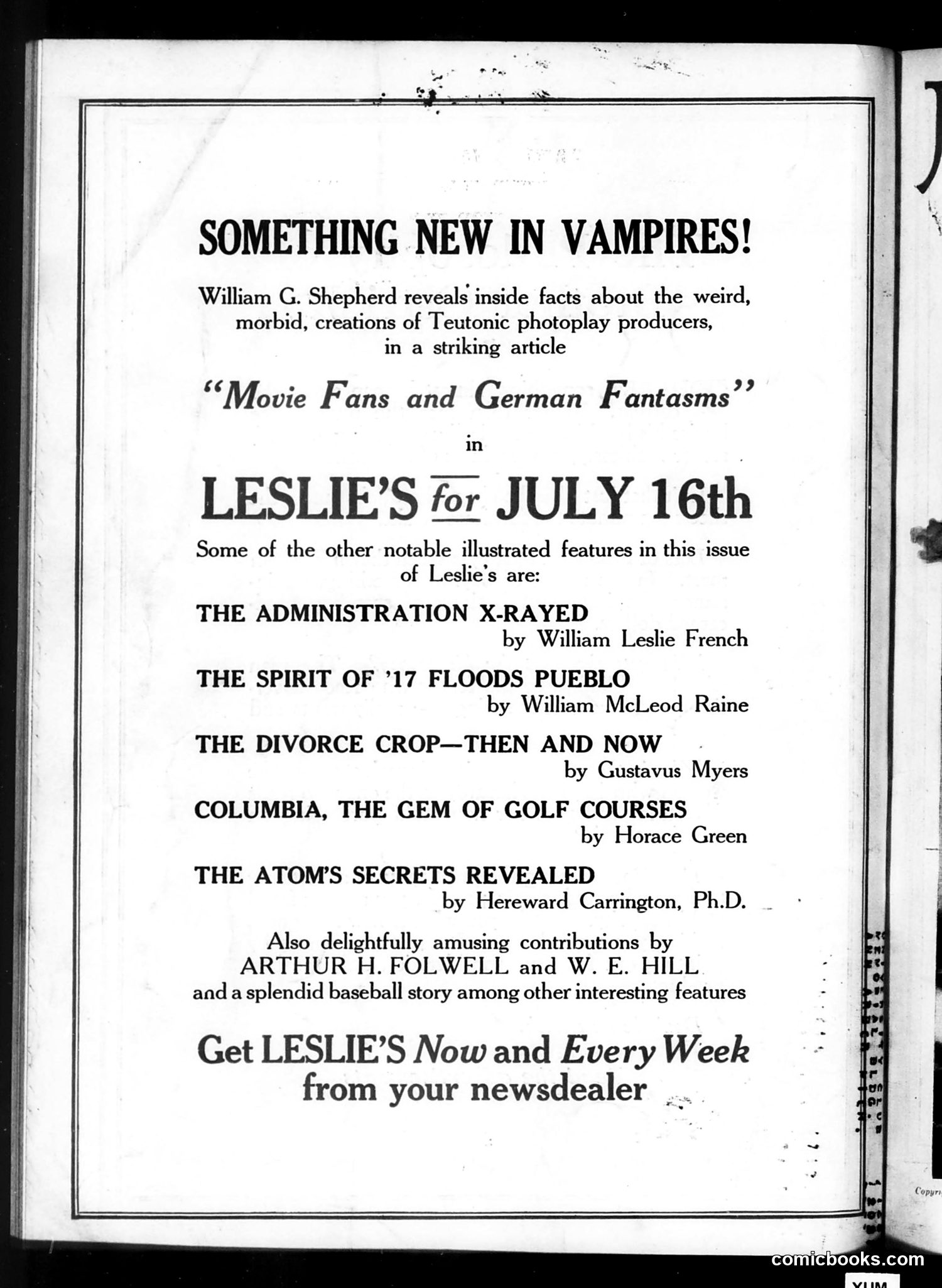
This is a **table of contents/advertisement page** for Leslie's magazine, dated July 16th (year unclear from image, but likely 1920s based on typography and references). The headline "SOMETHING NEW IN VAMPIRES!" advertises an article by William G. Shepherd about German film productions—likely referencing the expressionist horror films emerging from Weimar Germany (such as *Nosferatu*, 1922). The term "Teutonic photoplay producers" signals post-WWI American suspicion of German cultural exports. The page lists other contemporary articles addressing 1920s American concerns: government transparency ("The Administration X-Rayed"), natural disasters ("Spirit of '17 Floods Pueblo"), social change ("The Divorce Crop"), leisure culture (golf), and science ("The Atom's Secrets Revealed"). This is primarily **promotional material** rather than satirical cartoon content—it's selling Leslie's as a magazine covering modern anxieties, sensationalism, and novelty.