
Judge, 1921-07-16 · page 11 of 38
Judge — July 16, 1921 — page 11: what you’re looking at
What you’re looking at
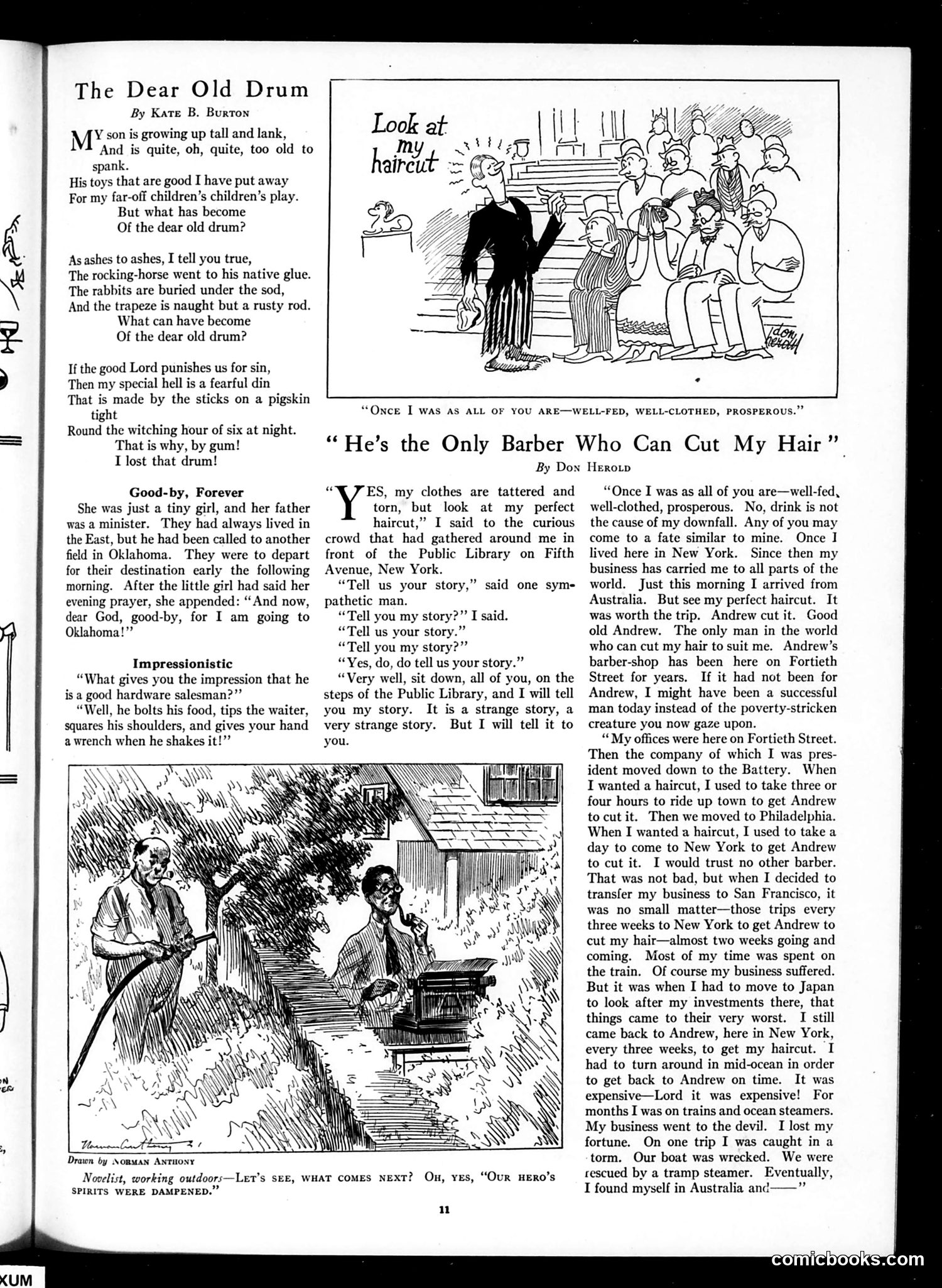
This satirical story mocks obsessive consumer loyalty and misplaced priorities. A prosperous businessman has systematically ruined himself—traveling constantly across the globe (Australia, San Francisco, Japan, Philadelphia) for haircuts from one barber named Andrew on Fortieth Street, New York. The joke is the absurd inversion of values: he sacrifices his business, fortune, and respectability for perfect hair maintenance. By the story's end, he's impoverished and begging on the library steps—yet still emphasizing his "perfect haircut" to justify his decisions. This satirizes Gilded Age commercialism and the American obsession with appearance and brand loyalty, suggesting how trivial consumer choices can mask serious self-destruction. The ragged clothes versus pristine hair visually embodies the satire's point: misplaced vanity.
📄 Transcribed text from this page (OCR, searchable)
Machine-transcribed from the original scan — historical spelling and the odd misread are preserved.
The Dear Old Drum By Kate B. Burton M’. son is growing up tall and lank, And is quite, oh, quite, too old to spank. His toys that are good I have put away For my far-off children’s children’s play. But what has become Of the dear old drum? As ashes to ashes, I tell you true, The rocking-horse went to his native glue. The rabbits are buried under the sod, And the trapeze is naught but a rusty rod. What can have become Of the dear old drum? If the good Lord punishes us for sin, Then my special hell is a fearful din That is made by the sticks on a pigskin tight Round the witching hour of six at night. That is why, by gum! I lost that drum! Good-by, Forever She was just a tiny girl, and her father was a minister. They had always lived in the East, but he had been called to another field in Oklahoma. They were to depart for their destination early the following morning. After the little girl had said her evening prayer, she appended: “And now, dear God, good-by, for I am going to Oklahoma!” Impressionistic “What gives you the impression that he is a good hardware salesman?” “Well, he bolts his food, tips the waiter, squares his shoulders, and gives your hand a wrench when he shakes it!”” awd hee 2 = “Once I was AS ALL OF YOU ARE—WELL-FED, WELL-CLOTHED, PROSPEROUS.” “He’s the Only Barber Who Can Cut My Hair” By Dox Herou “ ES, my clothes are tattered and torn, but look at my perfect haircut,” I said to the curious crowd that had gathered around me in front of the Public Library on Fifth Avenue, New York. “Tell us your story,” pathetic man. “Tell you my story?” I said. “Tell us your story.” “Tell you my story?” “Yes, do, do tell us your story.” “Very well, sit down, all of you, on the steps of the Public Library, and I will tell you my story. It is a strange story, a very strange story. But I will tell it to you. said one sym- N WW Pe a RN eS S <A \\ Pe “i il hig \\\5 4 Drawn by NonMan AanenDr Novelist, working outdoors—Let’s SEE, WHAT COMES NEXT? Ou, YES, “OUR HERO’S SPIRITS WERE DAMPENED.” n “Once I was as all of you are—well-fed, well-clothed, prosperous. No, drink is not the cause of my downfall. Any of you may come to a fate similar to mine. Once I lived here in New York. Since then my business has carried me to all parts of the world. Just this morning I arrived from Australia. But see my perfect haircut. It was worth the trip. Andrew cut it. Good old Andrew. The only man in the world who can cut my hair to suit me. Andrew’s barber-shop has been here on Fortieth Street for years. If it had not been for Andrew, I might have been a successful man today instead of the poverty-stricken creature you now gaze upon. “My offices were here on Forticth Street. Then the company of which I was pres- ident moved down to the Battery. When I wanted a haircut, I used to take three or four hours to ride up town to get Andrew to cut it. Then we moved to Philadelphia. When I wanted a haircut, I used to take a day to come to New York to get Andrew to cut it. I would trust no other barber. That was not bad, but when I decided to transfer my business to San Francisco, it was no small matter—those trips every three weeks to New York to get Andrew to cut my hair—almost two weeks going and coming. Most of my time was spent on the train. Of course my business suffered. But it was when I had to move to Japan to look after my investments there, that things came to their very worst. I still came back to Andrew, here in New York, every three weeks, to get my haircut. I had to turn around in mid-ocean in order to get back to Andrew on time. It was expensive—Lord it was expensive! For months I was on trains and ocean steamers. My business went to the devil. I lost my fortune. On one trip I was caught in a torm. Our boat was wrecked. We were rescued by a tramp steamer. Eventually, I found myself in Australia and——”