
Judge, 1921-07-16 · page 26 of 38
Judge — July 16, 1921 — page 26: what you’re looking at
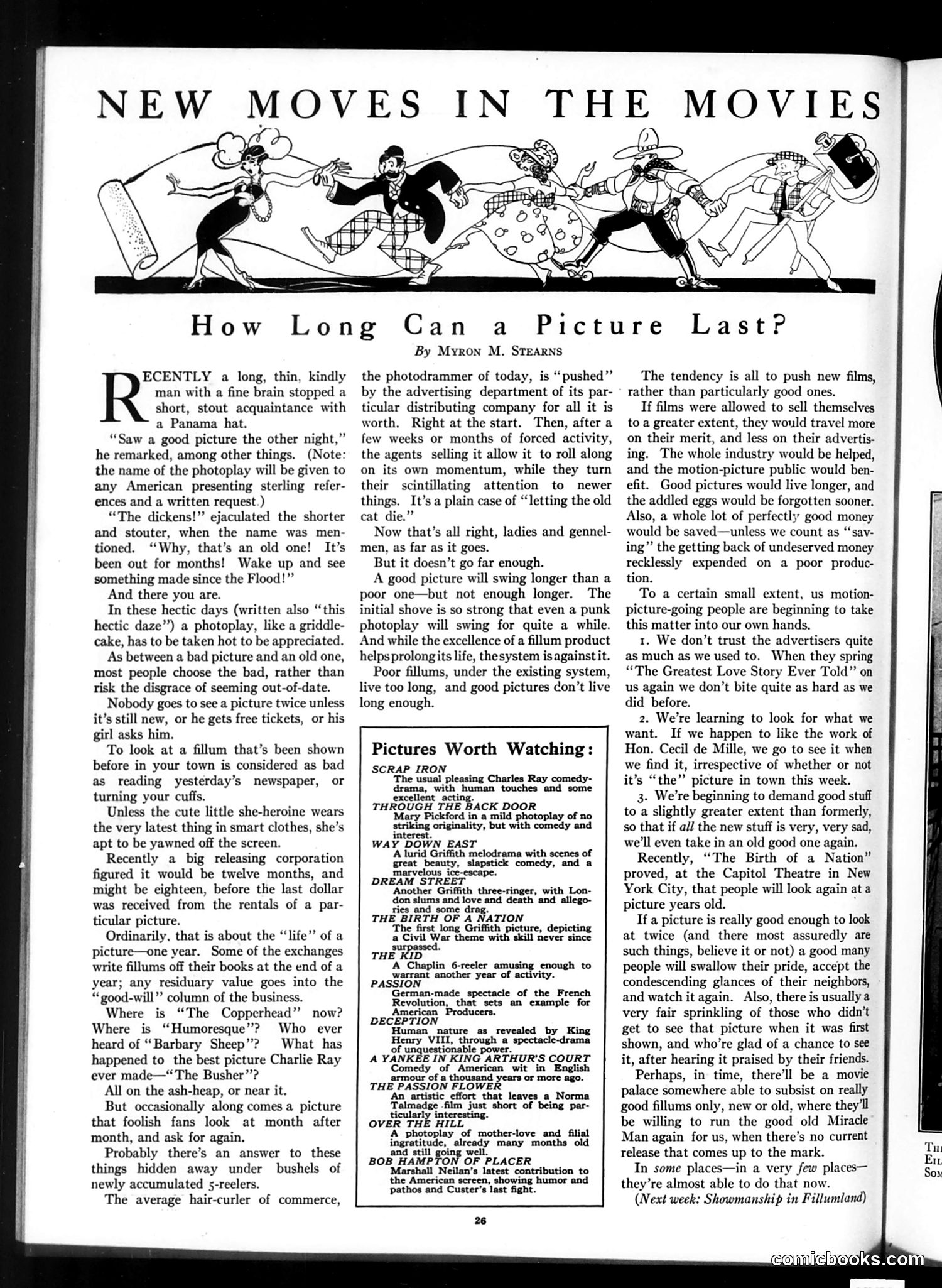
What you’re looking at
This article, by Myron M. Stearns, satirizes the film industry's obsession with novelty over quality. The cartoon header depicts characters engaged in exaggerated physical comedy—typical of silent-era slapstick—illustrating the frenetic pace of movie production. The satire's core complaint: studios aggressively promote new films regardless of merit, then abandon them after months, while the public treats older pictures as shameful to watch. Stearns argues this system punishes good films (which deserve longer theatrical runs) and artificially extends the lives of poor ones. The article cites specific examples—"The Copperhead," "Humoresque," "Barbary Sheep"—once-popular films now forgotten, suggesting that the industry's churn-and-discard model wastes potentially enduring material. He calls for reconsidering how long quality pictures circulate, positioning artistic merit against commercial pressure for constant novelty.
📄 Transcribed text from this page (OCR, searchable)
Machine-transcribed from the original scan — historical spelling and the odd misread are preserved.
NEW M I 7 How Long Can a Picture Last? ECENTLY a long, thin, kindly man with a fine brain stopped a short, stout acquaintance with a Panama hat. “Saw a good picture the other night,” he remarked, among other things. (Note: the name of the photoplay will be given to any American presenting sterling refer- ences and a written request.) “The dickens!” ejaculated the shorter and stouter, when the name was men- tioned. ‘Why, that’s an old one! It’s been out for months! Wake up and see something made since the Flood!” And there you are. In these hectic days (written also “this hectic daze”) a photoplay, like a griddle- cake, has to be taken hot to be appreciated. As between a bad picture and an old one, most people choose the bad, rather than risk the disgrace of seeming out-of-date. Nobody goes to see a picture twice unless it’s still new, or he gets free tickets, or his girl asks him. To look at a fillum that’s been shown before in your town is considered as bad as reading yesterday’s newspaper, or turning your cuffs. Unless the cute little she-heroine wears the very latest thing in smart clothes, she’s apt to be yawned off the screen. Recently a big releasing corporation figured it would be twelve months, and might be eighteen, before the last dollar was received from the rentals of a par- ticular picture. Ordinarily, that is about the “life” of a picture—one year. Some of the exchanges write fillums off their books at the end of a year; any residuary value goes into the “good-will” column of the business. Where is “The Copperhead” now? Where is “Humoresque”? Who ever heard of “Barbary Sheep”? What has happened to the best picture Charlie Ray ever made—“The Busher”’? All on the ash-heap, or near it. But occasionally along comes a picture that foolish fans look at month after month, and ask for again. Probably there’s an answer to these things hidden away under bushels of newly accumulated 5-reelers. The average hair-curler of commerce, By Myron M. STEARNS the photodrammer of today, is “pushed” by the advertising department of its par- ticular distributing company for all it is worth. Right at the start. Then, after a few weeks or months of forced activity, the agents selling it allow it to roll along on its own momentum, while they turn their scintillating attention to newer things. It’s a plain case of “letting the old cat die.” Now that’s all right, ladies and gennel- men, as far as it goes. But it doesn’t go far enough. A good picture will swing longer than a poor one—but not enough longer. The initial shove is so strong that even a punk photoplay will swing for quite a while. And while the excellence of a fillum product helps prolongits life, thesystem is against it. Poor fillums, under the existing system, live too long, and good pictures don’t live long enough. Pictures Worth Watching: SCRAP IRON The usual pleasing Charles Ray comedy- drama, with human touches and some excellent acting. THROUGH THE BACK DOOR , fary Pickford in a mild photoplay of no iking originality, but with comedy and interest. WAY DOWN EAST A lurid Griffith melodrama with scenes of great beauty, slapstick comedy, and a marvelous ice-escape. DREAM STREET Another Griffith three-ringer, with Lon- don slums and love and death and allego- ries and some drag. THE BIRTH OF A NATION The first long Griffith picture, depicting a Civil War theme with skill never since surpa: THE KID ‘A Chaplin 6-reeler amusing enough to warrant year of activity. PASSION German-made spectacle of the French Revolution, that sets an example for American Producers. DECEPTION Human nature as revealed by King Henry VIII, through a spectacle-drama of unquestionable power, A YANKEE IN KING ARTHUR'S COURT Comedy of American wit in English armour of a thousand years or more ago. THE PASSION FLOWER ‘An artistic effort that leaves a Norma Talmadge -film just short of being par- ticularly interesting. OVER THE HILL ‘A photoplay of mother-love and filial ingratitude, already many months old and still going well. BOB HAMPTON OF PLACER Marshall Neilan’s latest contribution to the American screen, showing humor and pathos and Custer’s last fight. The tendency is all to push new films, rather than particularly good ones. If films were allowed to sell themselves to a greater extent, they would travel more on their merit, and less on their advertis- ing. The whole industry would be helped, and the motion-picture public would ben- efit. Good pictures would live longer, and the addled eggs would be forgotten sooner, Also, a whole lot of perfectly good money would be saved—unless we count as “sav- ing” the getting back of undeserved money recklessly expended on a poor produc- tion. To a certain small extent, us motion- picture-going people are beginning to take this matter into our own hands. 1. We don’t trust the advertisers quite as much as we used to. When they spring “The Greatest Love Story Ever Told” on us again we don’t bite quite as hard as we did before. 2. We're learning to look for what we want. If we happen to like the work of Hon. Cecil de Mille, we go to see it when we find it, irrespective of whether or not it’s “the” picture in town this week. 3- We're beginning to demand good stuff to a slightly greater extent than formerly, so that if a// the new stuff is very, very sad, we'll even take in an old good one again. Recently, “The Birth of a Nation” proved, at the Capitol Theatre in New York City, that people will look again at a picture years old. If a picture is really good enough to look at twice (and there most assuredly are such things, believe it or not) a good many people will swallow their pride, accept the condescending glances of their neighbors, and watch it again. Also, there is usually a very fair sprinkling of those who didn’t get to see that picture when it was first shown, and who’re glad of a chance to see it, after hearing it praised by their friends. Perhaps, in time, there’ll be a movie palace somewhere able to subsist on really good fillums only, new or old, where they'll be willing to run the good old Miracle Man again for us, when there’s no current release that comes up to the mark. In some places—in a very few places— they’re almost able to do that now. (Next week: Showmanship in Fillumland) Tw En Sox