
Judge, 1921-07-16 · page 16 of 38
Judge — July 16, 1921 — page 16: what you’re looking at
What you’re looking at
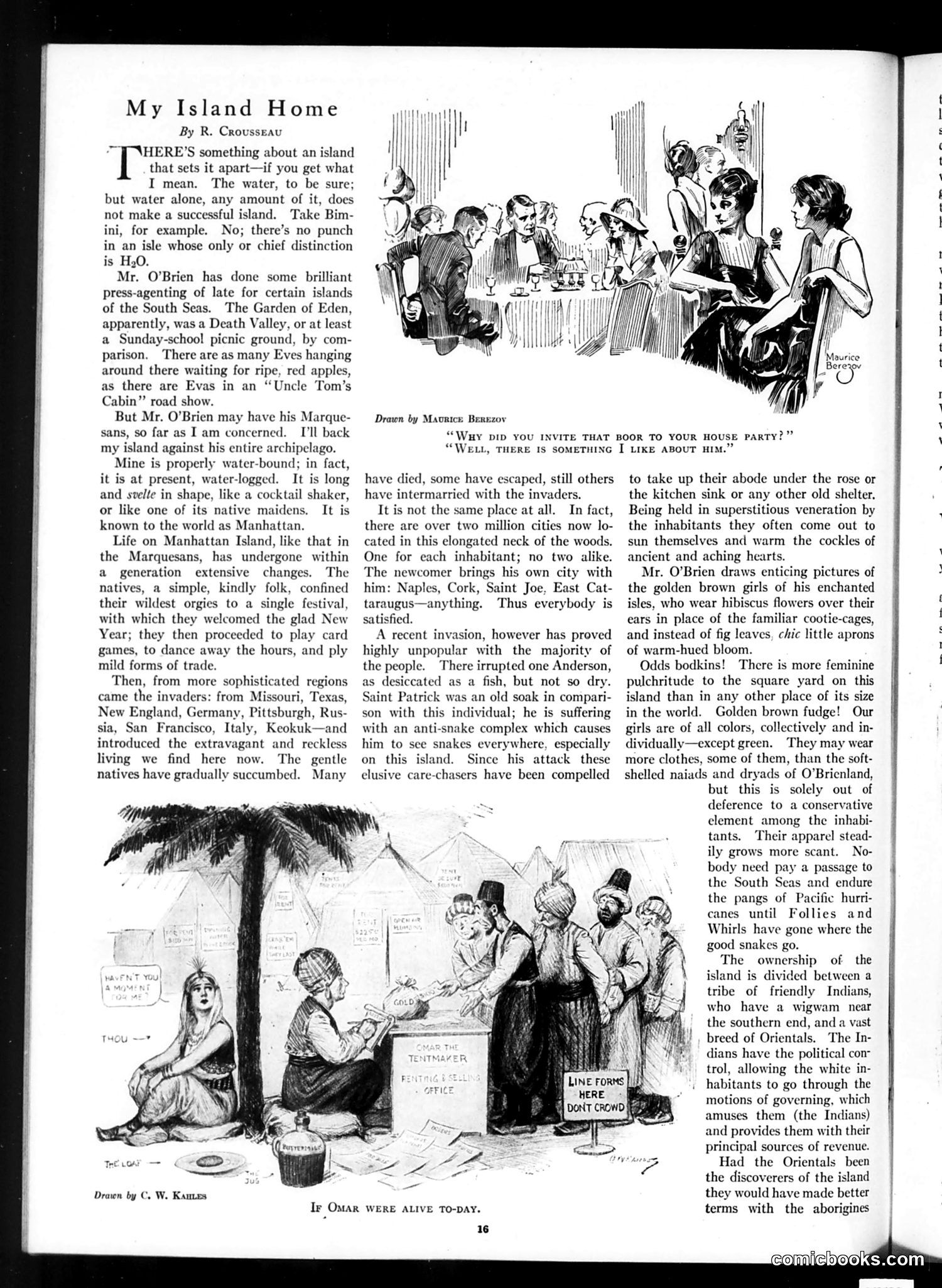
This article satirizes the romanticized marketing of South Seas islands, likely referencing promoter **Richard O'Brien**, who heavily publicized Polynesian locations (particularly the Marquesas) as tropical paradises with attractive women. The author counters by ironically defending **Manhattan Island** as superior, describing it as similarly "exotic" but overcrowded with immigrant populations from Missouri, Texas, Germany, Russia, etc.—each bringing their own cultural enclaves (Naples, Cork, Saint Joe). The satire mocks both the exaggerated promotion of South Seas "golden brown girls" and the rapid transformation of Manhattan through immigration. A secondary cartoon shows someone promoting an unpopular resident ("Anderson") with an "anti-snake complex," forcing snakes into hiding—a commentary on unwanted immigration or social disruption. The humor targets American consumerism and racial/ethnic anxieties of the era, presenting Manhattan's immigrant diversity as equally "foreign" as actual Pacific islands.
📄 Transcribed text from this page (OCR, searchable)
Machine-transcribed from the original scan — historical spelling and the odd misread are preserved.
My Island Home By R. Crousseau HERE’S something about an island that sets it apart—if you get what I mean. The water, to be sur but water alone, any amount of it, does not make a successful island. Take Bim- ini, for example. No; there’s no punch in an isle whose only or chief distinction is H,0. Mr. O’Brien has done some brilliant press-agenting of late for certain islands of the South Seas. The Garden of Eden, apparently, was a Death Valley, or at least a Sunday-school picnic ground, by com- parison. There are as many Eves hanging around there waiting for ripe, red apples, as there are Evas in an “Uncle Tom’s Cabin” road show. But Mr. O’Brien may have his Marque- sans, so far as I am concerned. I'll back my island against his entire archipelago. Mine is properly water-bound; in fact, it is at present, water-logged. It is long and svelte in shape, like a cocktail shaker, or like one of its native maidens. It is known to the world as Manhattan. Life on Manhattan Island, like that in the Marquesans, has undergone within a generation extensive changes. The natives, a simple, kindly folk, confined their wildest orgies to a single festival, with which they welcomed the glad New Year; they then proceeded to play card games, to dance away the hours, and ply mild forms of trade. Then, from more sophisticated regions came the invaders: from Missouri, Texas, New England, Germany, Pittsburgh, Rus- sia, San Francisco, Italy, Keokuk—and introduced the extravagant and reckless living we find here now. The gentle natives have gradually succumbed. Many Drawn by C. W. Kanes Drawn by Mavrict: Berzzov “Wuy pip you 1 “WELL, THERE IS have died, some have escaped, still others have intermarried with the invaders. It is not the same place at all. In fact, there are over two million cities now lo- cated in this elongated neck of the woods. One for each inhabitant; no two alike. The newcomer brings his own city with him: Naples, Cork, Saint Joe, East Cat- taraugus—anything. Thus everybody is satisfied. A recent invasion, however has proved highly unpopular with the majority of the people. There irrupted one Anderson, as desiccated a fish, but not so dry. Saint Patrick was an old soak in compari- son with this individual; he is suffering with an anti-snake complex which causes him to see si everywhere, especially on_ this nd. Since his attack these elusive care-chasers have been compelled Ir Omar WERE ALIVE TO-DAY. 16 VITE THAT BOOR TO YOUR HOUSE PARTY?” METHING I LIKE ABOUT HIM.” to take up their abode under the rose or the kitchen sink or any other old shelter, Being held in superstitious veneration by the inhabitants they often come out to sun themselves and warm the cockles of ancient and aching hearts. Mr. O’Brien draws enticing pictures of the golden brown girls of his enchanted isles, who wear hibiscus flowers over their ears in place of the familiar cootie-cages, and instead of fig leaves, chic little aprons of warm-hued bloom. Odds bodkins! There is more feminine pulchritude to the square yard on this island than in any other place of its size in the world. Golden brown fudge! Our girls are of all colors, collectively and in- dividually—except green. They may wear more clothes, some of them, than the soft- shelled naiads and dryads of O’Brienland, but this is solely out of deference to a conservative element among the inhabi- tants. Their apparel stead- ily grows more scant. No- body need pay a passage to the South Seas and endure the pangs of Pacific hurri- canes until Follies and Whirls have gone where the good snakes go. The ownership of the island is divided between a tribe of friendly Indians, who have a wigwam_ near the southern end, and a vast breed of Orientals. The In- dians have the political con- trol, allowing the white in- habitants to go through the motions of governing, which amuses them (the Indians) and provides them with their principal sources of revenue. Had the Orientals been the discoverers of the island they would have made better terms with the aborigines