
Judge, 1921-07-16 · page 36 of 38
Judge — July 16, 1921 — page 36: what you’re looking at
What you’re looking at
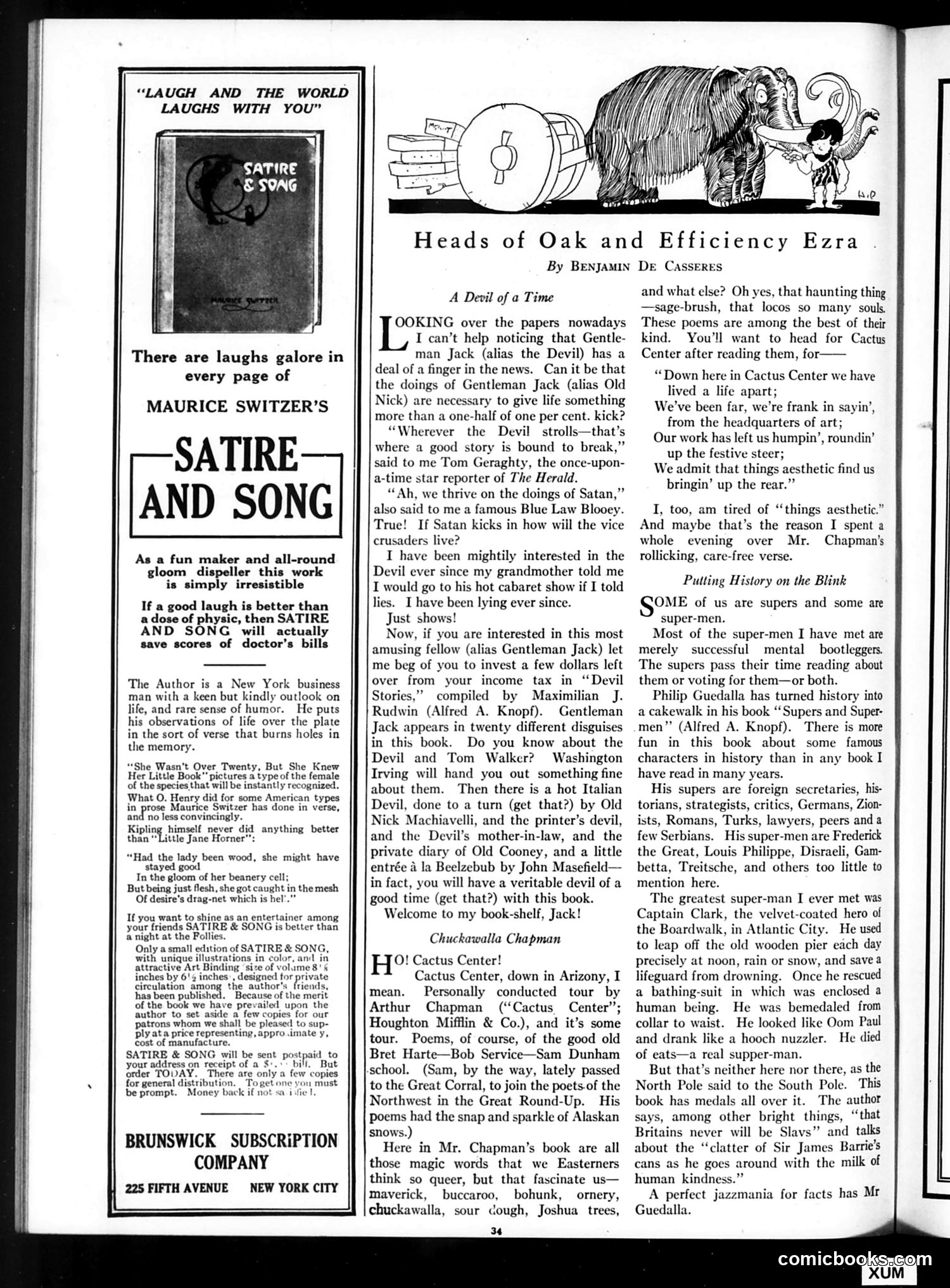
This page combines advertising and literary criticism from an early 20th-century American humor magazine. The left side advertises Maurice Switzer's book *Satire and Song*, positioning it as entertainment that delivers laughs better than medicine. The main content features two book reviews by "Chuckawalla Chapman" (a pen name). The first reviews a collection called *Devil Stories*, compiled by Maximilian J. Rudwin. Chapman humorously suggests that the Devil ("Gentleman Jack") is necessary for good news stories and that vice crusaders depend on Satan's activities for their crusade's relevance. He references classic literary devil tales including Washington Irving's "The Devil and Tom Walker" and works by John Masefield. The second review briefly introduces Arthur Chapman's poetry collection about Arizona's "Cactus Center." The cartoons at top appear decorative rather than satirical—showing an elephant with a small figure, likely illustrating the magazine's humorous tone rather than making specific political commentary.
📄 Transcribed text from this page (OCR, searchable)
Machine-transcribed from the original scan — historical spelling and the odd misread are preserved.
“LAUGH AND THE WORLD LAUGHS WITH YOU” SATIRE S SONG There are laughs galore in every page of MAURICE SWITZER’S SATIRE AND SONG As a fun maker and all-round gloom dispeller thi: is simply irresistible If a good laugh is better than a dose of physic, then SATIRE AND SONG will actually save scores of doctor’s bills The Author is a New York business man with a keen but kindly outlook on life, and rare sense of humor. He puts his observations of life over the plate in the sort of verse that burns holes in the memory. “She Wasn't Over Twenty, But She Knew Her Little Book" pictures a type of the female of the species that will be instantly recognized. What O. Henry did for some American types in prose Maurice Switzer has done in verse, and no less convincingly. Kipling himself never did anything better than “Little Jane Horner": “Had the lady been wood, she might have stayed good In the gloom of her beanery cell; But being just flesh, she got caught in the mesh Of desire’s drag-net which is hel’." If you want to shine as an entertainer among your friends SATIRE & SONG is better than a night at the Follies. Only a small edition of SATIRE & SONG, with unique illustrations in color, ant i attractive Art Binding size of vol¥ inches by 6's inches, designed for p circulation among the author's friends, has been published. Because of the merit of the book we have prevailed upon the author to set aside a few copies for our patrons whom we shall be pleased to sup ply ata price representing, appro .imate y, cost of manufacture. SATIRE & SONG will be sent postpaid to your address on receipt of a $*.* bill, But order TOVAY. There are only a for general distribution. 1 be prompt. Money ba BRUNSWICK SUBSCRiPTION COMPANY 225 FIFTH AVENUE NEW YORK CITY Heads of Oak and Efficiency Ezra By BENJAMIN A Devil of a Time OOKING over the papers nowadays I I can’t help noticing that Gentle- man Jack (alias the Devil) has a deal of a finger in the news. Can it be that the doings of Gentleman Jack (alias Old Nick) are necessary to give life something more than a one-half of one per cent. kick? “Wherever the Devil strolls—that’s where a good story is bound to break,” said to me Tom Geraghty, the once-upon- a-time star reporter of The Herald. “Ah, we thrive on the doings of Satan,” also said to me a famous Blue Law Blooey. True! If Satan kicks in how will the vice crusaders live? I have been mightily interested in the Devil ever since my grandmother told me I would go to his hot cabaret show if I told lies. I have been lying ever since. Just shows! Now, if you are interested in this most amusing fellow (alias Gentleman Jack) let me beg of you to invest a few dollars left over from your income tax in “Devil Stories,” compiled by Maximilian J. Rudwin (Alfred A. Knopf). Gentleman Jack appears in twenty different disguises in this book. Do you know about the Devil and Tom Walker? Washington Irving will hand you out something fine about them. Then there is a hot Italian Devil, done to a turn (get that?) by Old Nick Machiavelli, and the printer’s devil, and the Devil’s mother-in-law, and the private diary of Old Cooney, and a little entrée a la Beelzebub by John Masefield— in fact, you will have a veritable devil of a good time (get that?) with this book. Welcome to my book-shelf, Jack! Chuckawalla Chapman O! Cactus Center! Cactus Center, down in Arizony, I mean. Personally conducted tour by Arthur Chapman (‘Cactus Center’; Houghton Mifflin & Co.), and it’s some tour. Poems, of course, of the good old Bret Harte—Bob Service—Sam Dunham school. (Sam, by the way, lately passed to the Great Corral, to join the poets.of the Northwest in the Great Round-Up. His poems had the snap and sparkle of Alaskan snows.) Here in Mr. Chapman’s book are all those magic words that we Easterners think so queer, but that fascinate us— maverick, buccaroo, bohunk, ornery, chuckawalla, sour cough, Joshua trees, 34 De CAaSSERES and what else? Oh yes, that haunting thing —sage-brush, that locos so many souls. These poems are among the best of their kind. You'll want to head for Cactus Center after reading them, for—— “Down here in Cactus Center we have lived a life apart; We've been far, we’re frank in sayin’, from the headquarters of art; Our work has left us humpin’, roundin’ up the festive steer; We admit that things aesthetic find us bringin’ up the rear.” I, too, am tired of “things aesthetic.” And maybe that’s the reason I spent a whole evening over Mr. Chapman's rollicking, care-free verse. Putting History on the Blink SOME of us are supers and some are super-men. Most of the super-men I have met are merely successful mental bootleggers. The supers pass their time reading about them or voting for them—or both. Philip Guedalla has turned history into a cakewalk in his book “Supers and Super- men” (Alfred A. Knopf). There is more fun in this book about some famous characters in history than in any book I have read in many years. His supers are foreign secretaries, his- torians, strategists, critics, Germans, Zion- ists, Romans, Turks, lawyers, peers and a few Serbians. His super-men are Frederick the Great, Louis Philippe, Disraeli, Gam- betta, Treitsche, and others too little to mention here. The greatest super-man I ever met was Captain Clark, the velvet-coated hero of the Boardwalk, in Atlantic Ci He used to leap off the old wooden pier each day precisely at noon, rain or snow, and save a lifeguard from drowning. Once he rescued a bathing-suit in which was enclosed a human being. He was bemedaled from collar to wa He looked like Oom Paul and drank like a hooch nuzzler. He died of eats—a real supper-man. But that’s neither here nor there, as the North Pole said to the South Pole. This book has medals all over it. The author says, among other bright things, “that Britains never will be Slavs” and talks about the “clatter of Sir James Barrie's cans as he goes around with the milk of human kindness.” A perfect jazzmania for facts has Mr Guedalla. comicbooks; m