
A complete issue · 32 pages · 1920
Judge — November 6, 1920
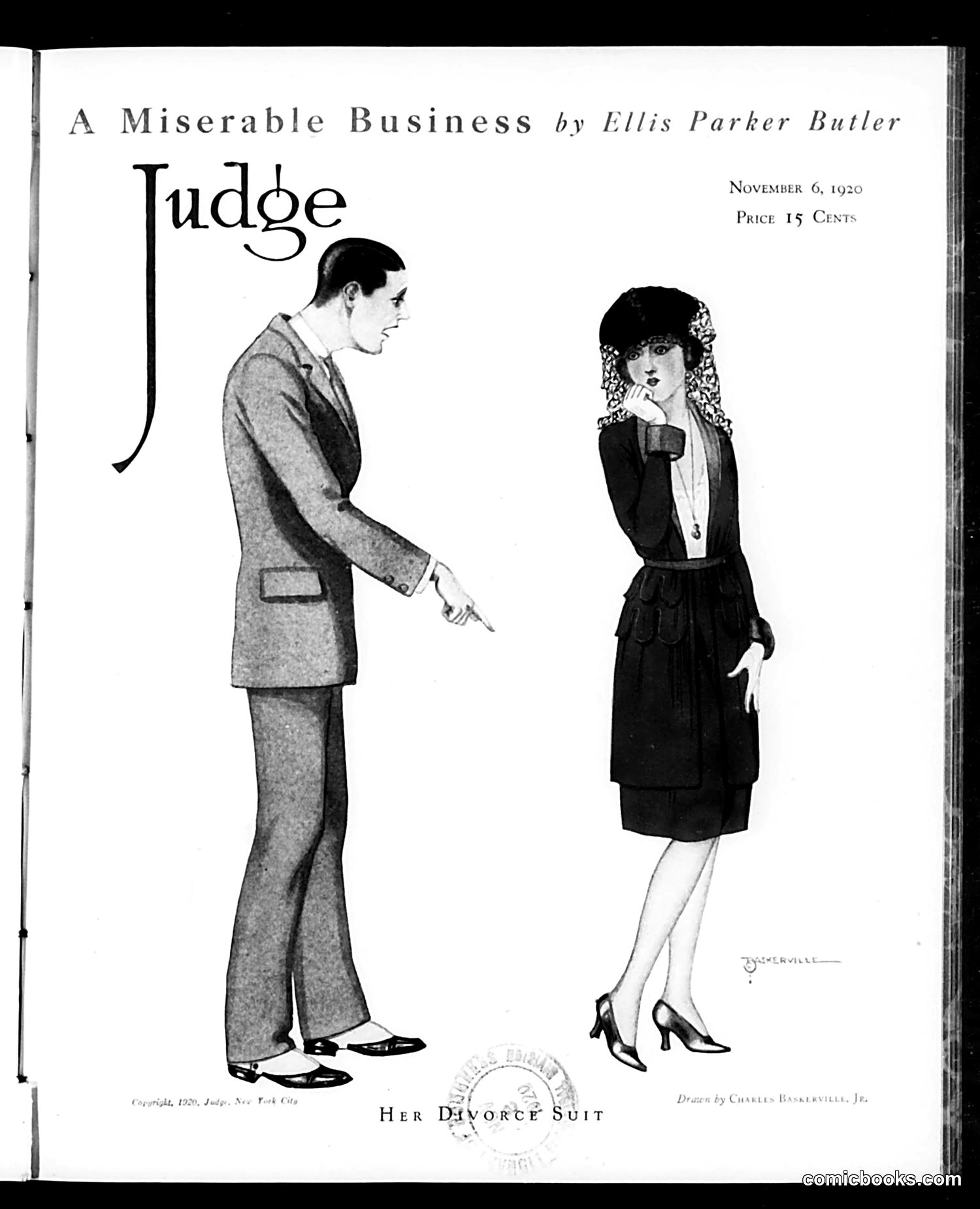
This satirical illustration by Ellis Parker Butler depicts "Her Divorce Suit." The cartoon shows a man in a business suit pointing at a woman in fashionable 1920s attire, with the caption emphasizing the unpleasant nature of divorce proceedings. The satire targets the business-like, transactional handling of divorce cases—treating personal relationships as commercial matters to be resolved through legal procedures. The woman's composed, fashionable appearance contrasts with the man's accusatory gesture, suggesting the performative and adversarial nature of divorce court. Published just after women gained voting rights (1920), this reflects contemporary anxieties about changing gender relations and the growing visibility of divorce, which remained socially stigmatized but increasingly common among middle and upper classes.
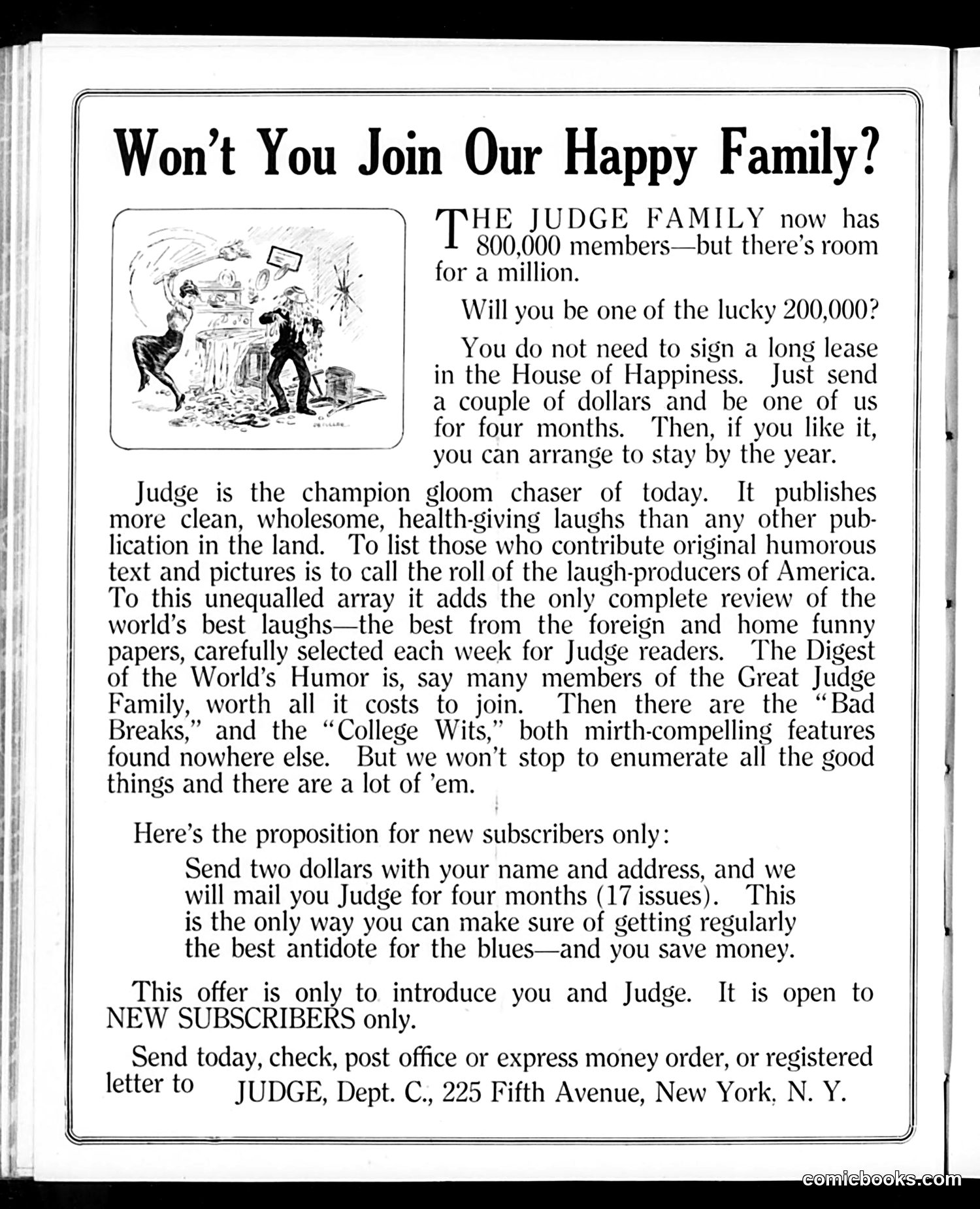
This is primarily an **advertisement for Judge magazine itself**, not a political cartoon. The small illustration in the upper left appears to show two figures in a chaotic scene with money flying—likely depicting slapstick humor or comedic chaos, meant to exemplify the magazine's comedic content. The ad promotes Judge as "the champion gloom chaser," emphasizing it publishes "clean, wholesome, health-giving laughs." It highlights features like "The Digest of the World's Humor," "Bad Breaks," and "College Wits," positioning itself as a premier humor publication. The subscription offer—two dollars for four months (17 issues)—targets new subscribers only. This was Judge's membership model, inviting readers to join the "Happy Family" of 800,000+ subscribers. The page reflects early 20th-century magazine marketing and humor culture rather than political satire.
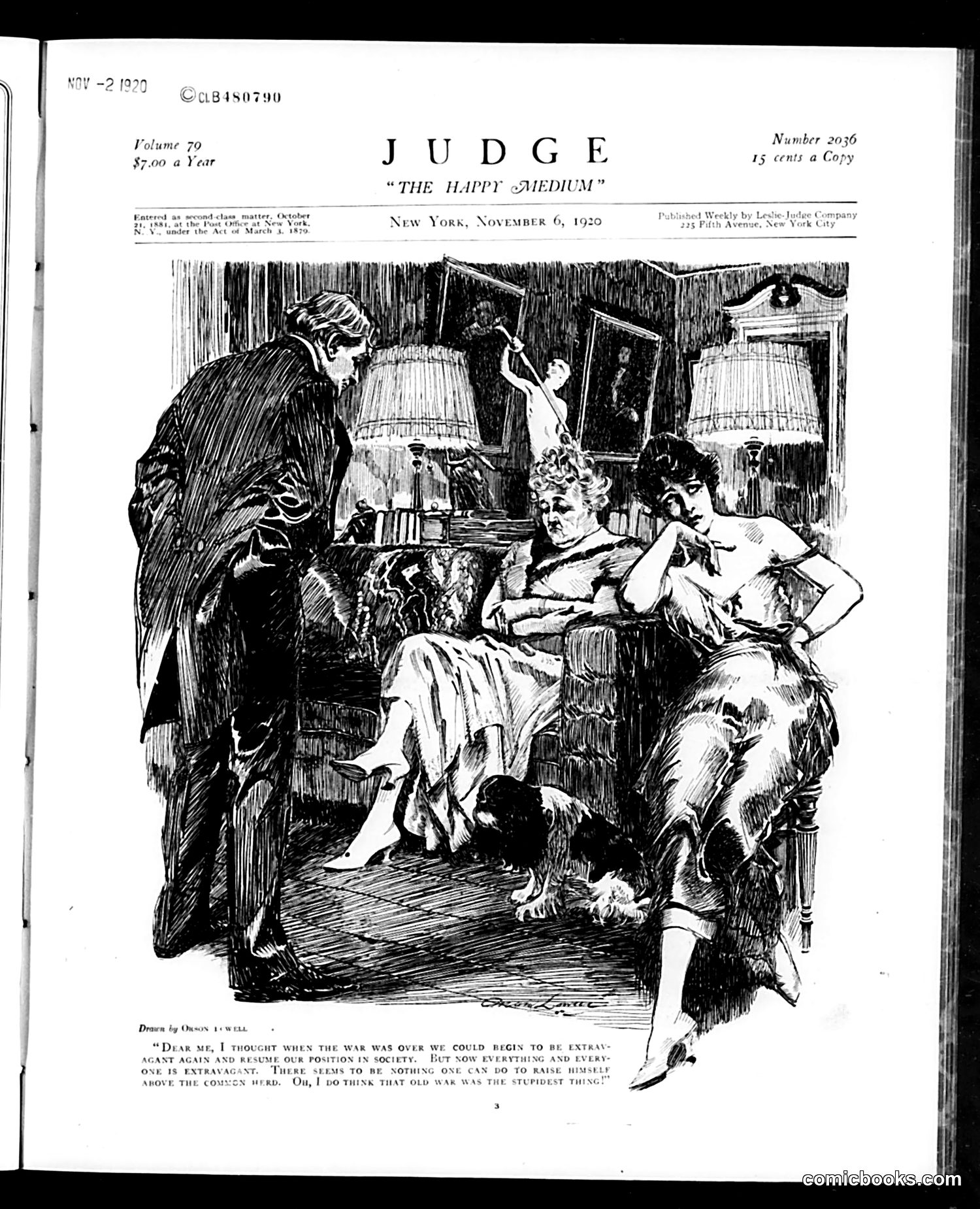
This illustration by Orson Lowell depicts a post-World War I social scene. A distinguished gentleman (left) converses with two fashionably dressed women in an elegant drawing room. The caption reveals the satire: the man laments that post-war society expected to restore social order and propriety, but instead "everything and everyone is extravagant" with "nothing one can do to raise himself above the common herd." The cartoon mocks the anxiety of the upper classes about social upheaval following WWI. The wealthy man complains that the traditional class hierarchy has collapsed—even ordinary people now behave extravagantly, making it impossible for the elite to distinguish themselves through refined conduct. It's social commentary on 1920s egalitarianism threatening traditional class distinctions.
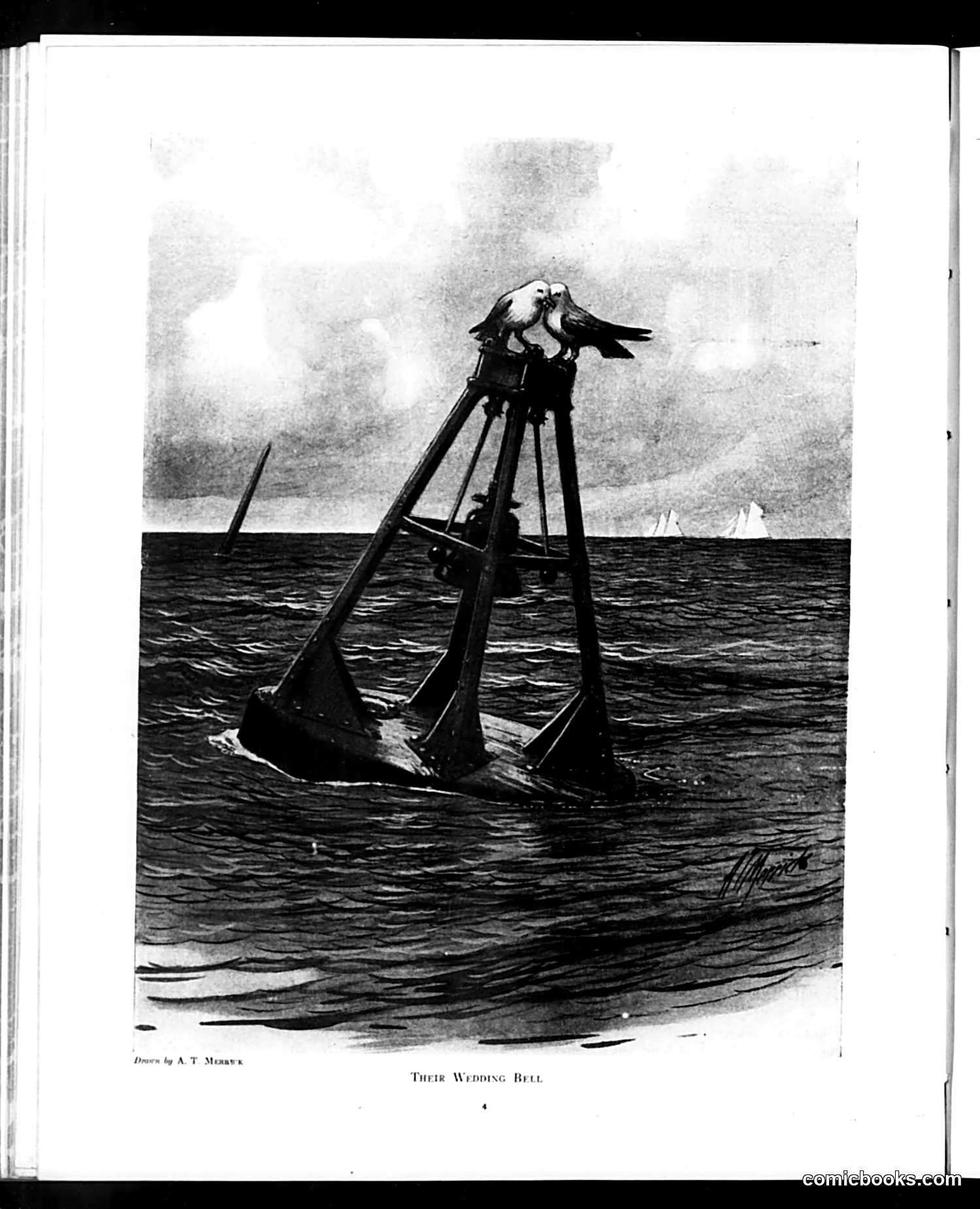
This illustration by A.T. Meanys depicts a large bell structure partially submerged in ocean waves, with two birds (appearing to be doves or similar creatures) perched atop it. The caption "Their Wedding Bell" suggests this is satirical commentary on a maritime or naval wedding theme, likely referencing a specific historical event or couple of the period. The submerged bell may symbolize something sinking, endangered, or troubled about the union being referenced. Without additional context about Judge magazine's publication date or contemporary events, the specific couple or marriage being satirized remains unclear, though the ocean setting suggests naval or political significance typical of Judge's satirical commentary on American affairs.
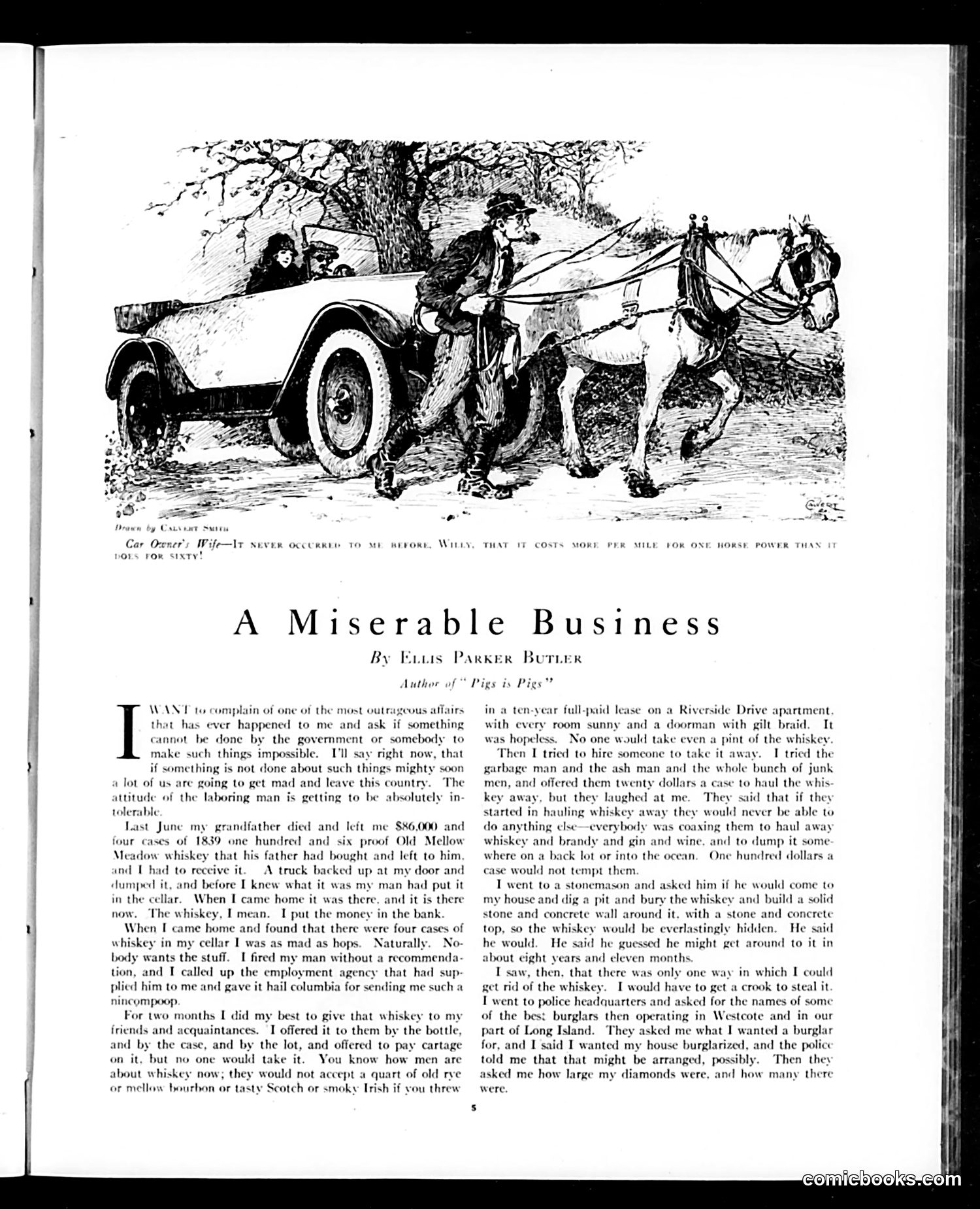
The cartoon and story "A Miserable Business" by Ellis Parker Butler illustrate Prohibition-era frustrations. The sketch shows a man attempting to transport a car being pulled by horses—a visual joke about the impracticality of trying to move forward using outdated methods. The accompanying story describes the narrator's inheritance of illegal whiskey during Prohibition and his inability to dispose of it legally. He tries various methods—giving it away, hiring people to remove it, even consulting burglars—but everyone refuses, knowing possession is a federal crime. The satire targets Prohibition's absurdity: it created situations where perfectly good property became impossible to manage or sell. The car-and-horses image symbolizes how Prohibition forced people into ridiculous, backward positions, undermining practical commerce and common sense.
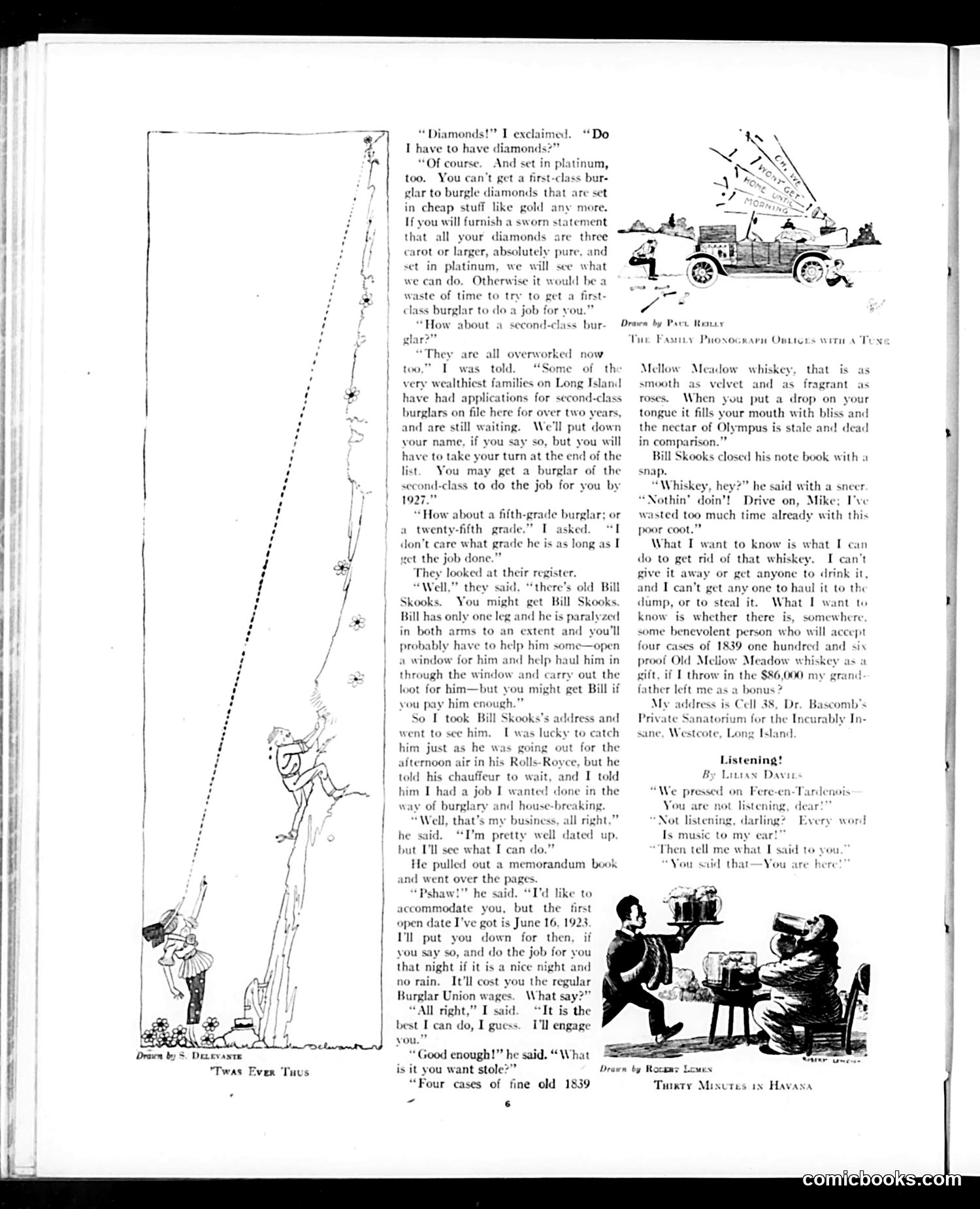
This page contains three separate satirical pieces with illustrations: 1. **"'Twas Ever Thus"** (left): A cartoon depicting a man climbing a rope or pole toward what appears to be wealth or success at the top, while falling or struggling below. The title suggests ironic commentary on perpetual human struggle. 2. **"The Family Phonograph Obliged with a Tune"** (top right): Shows a car with figures, likely satirizing early automobile culture and the novelty of phonograph technology in vehicles—poking fun at modern conveniences. 3. **"Thirty Minutes in Havana"** (bottom right): Features figures with cameras, apparently satirizing tourists in Cuba, likely referencing the quick excursion tourism popular after U.S.-Cuba relations normalized. The main text discusses burglary and whiskey smuggling in prohibition-era language, suggesting 1920s content addressing illegal alcohol trade.
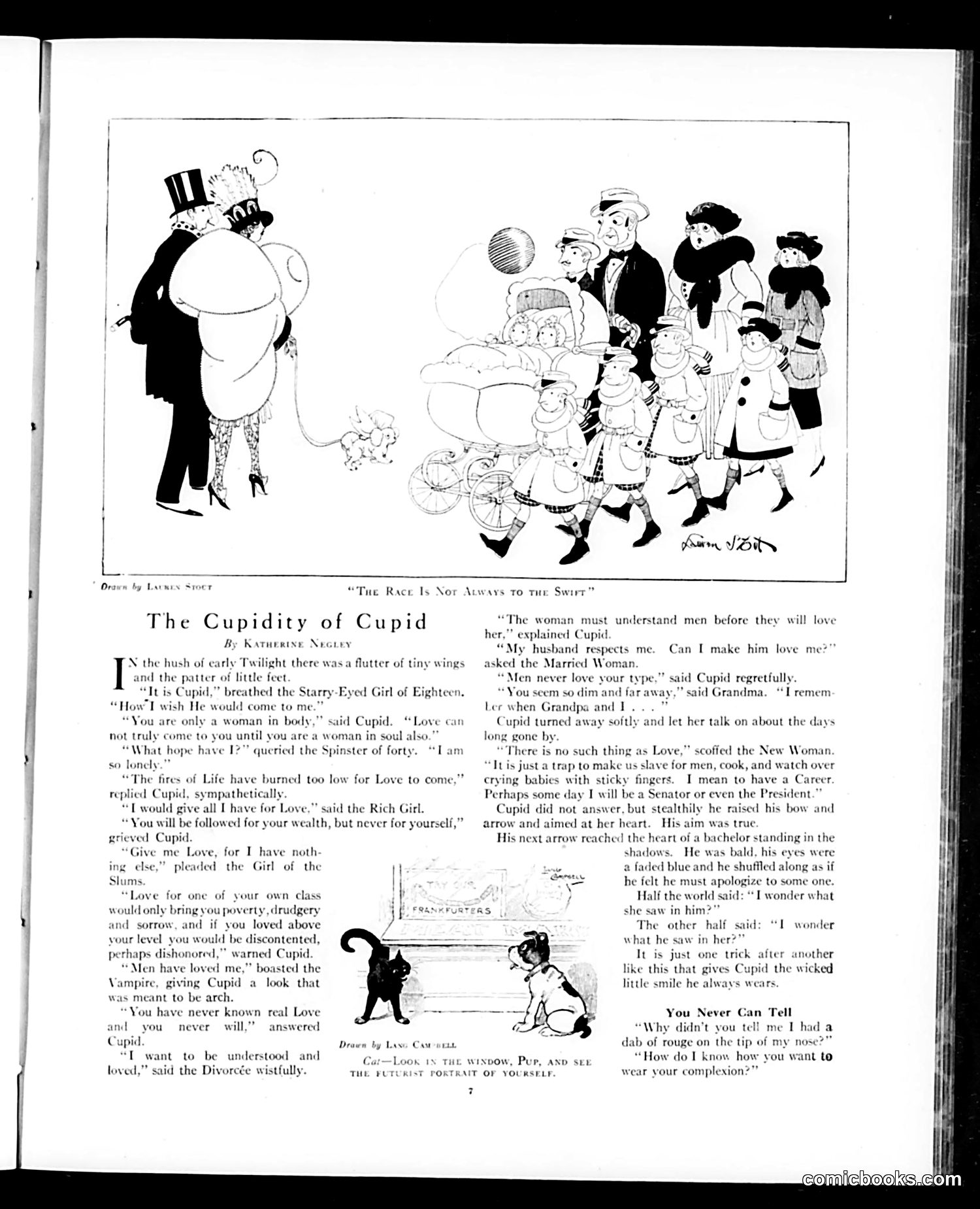
This story-cartoon satirizes romantic expectations across different female archetypes of the era. Cupid encounters women representing various social types—a starry-eyed young girl, a married woman, a spinster, a wealthy woman, a "New Woman" (the era's term for feminists seeking careers), and a divorcée—each with unrealistic demands about love. The satire targets women's perceived contradictions: they want love yet also independence, respect yet romance, emotional understanding yet social advancement. Cupid's resigned responses mock how impossible their expectations are. The accompanying cartoon "The Race Is Not Always to the Swift" (top) uses a wealthy woman's overweight silhouette as visual comedy about materialism versus true love. The humor assumes a conservative stance: women seeking careers ("Senator or even President") or independence are foolishly rejecting their natural role in romantic relationships. The page ultimately mocks modern women's aspirations as incompatible with real love.
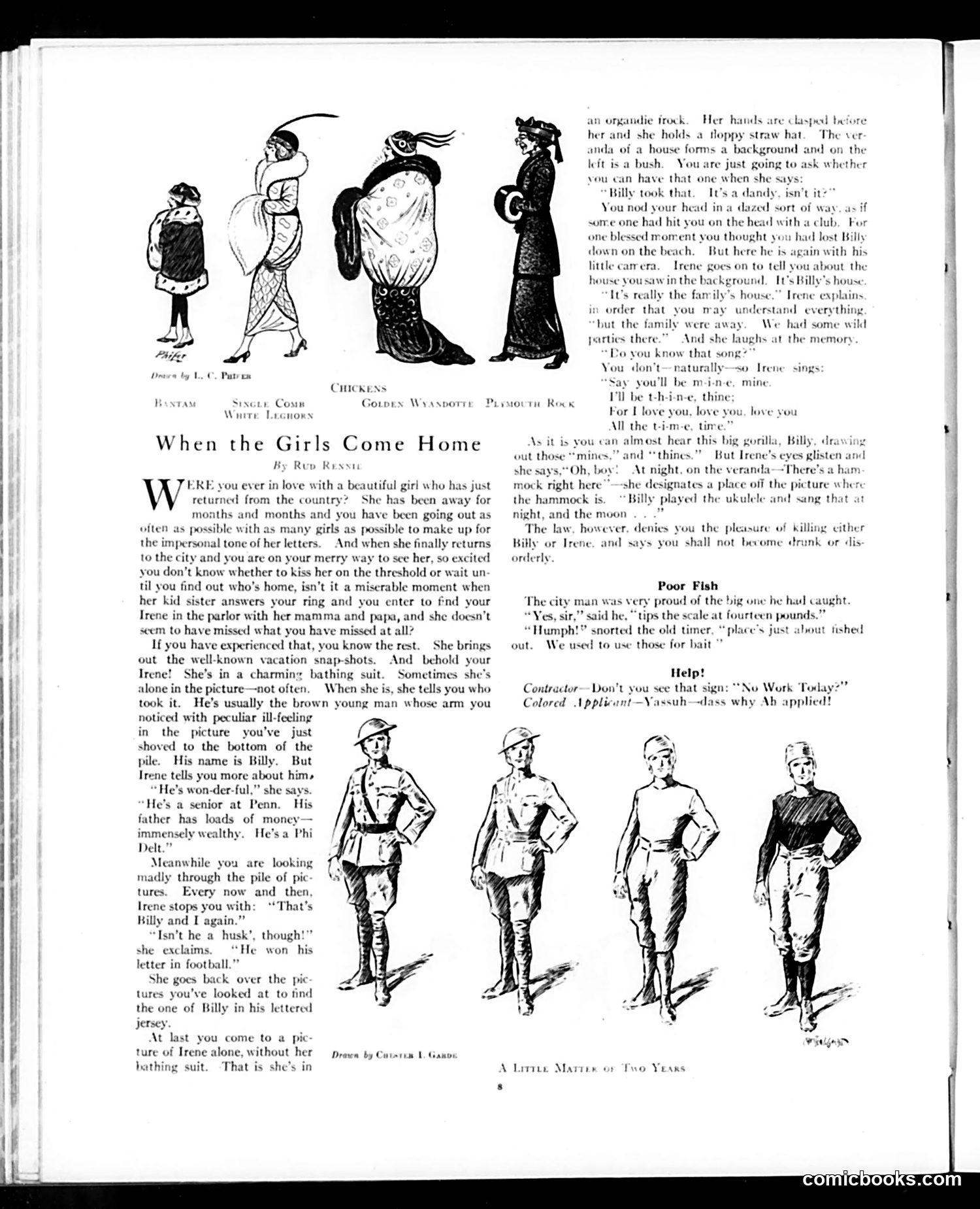
This page contains a satirical short story titled "When the Girls Come Home" about romantic jealousy. The narrative depicts a young man visiting his girlfriend Irene after her summer vacation in the country. She enthusiastically shows him photographs from her time away, repeatedly featuring a wealthy, athletic young man named Billy—who appears in nearly every picture. As Irene describes Billy's accomplishments (football letter, Phi Delta Theta fraternity membership, wealthy family) and sings romantic songs they shared, the narrator grows increasingly frustrated and jealous, ultimately wishing he could harm them both (though legally prevented). The satire mocks both male insecurity and the casual cruelty of women who flaunt their summer romantic interests to their jealous city suitors. Below are two brief joke items: "Poor Fish" (about fishing depletion) and "Help!" (a racial stereotype joke about a Black applicant misunderstanding a "No Work Today" sign). The page includes fashion illustrations titled "A Little Matter of Two Years" showing women's clothing evolution, drawn by Cesare L. Giardino.
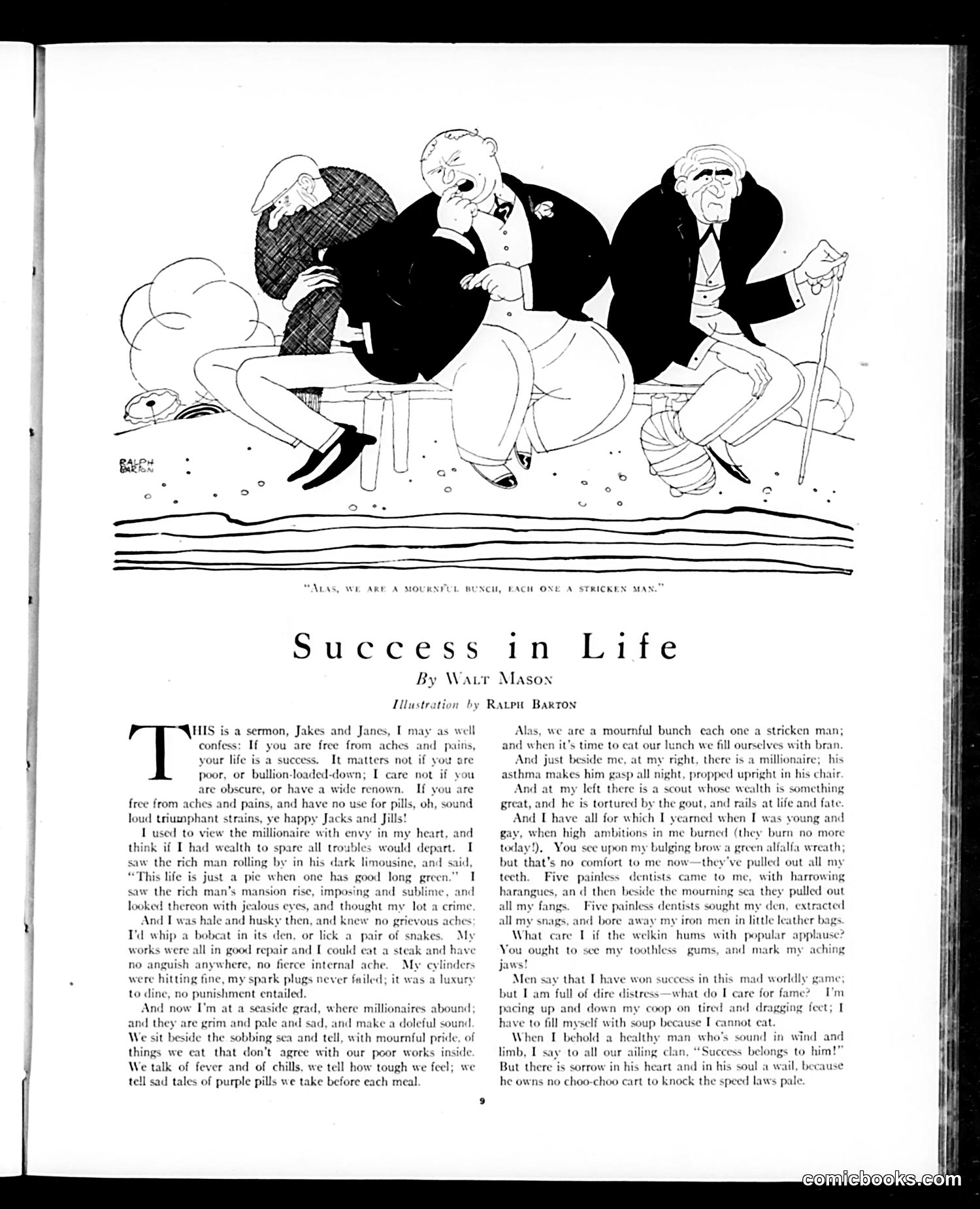
This 1920s-era piece by Walt Mason satirizes the American obsession with material success. The cartoon depicts three wealthy men at a seaside resort, all visibly suffering from ailments—a commentary on the irony that money cannot buy health. Mason's sermon argues that true success means freedom from physical pain, not wealth or status. The narrator, initially envious of the rich, discovers that millionaires suffer identical afflictions: asthma, gout, dental problems. The joke undercuts the "self-made man" mythology of the era—that accumulating riches solves life's problems. The detailed complaints about dentists, digestive issues, and chronic pain reflect early 20th-century anxieties about modern life's toll on bodies. The final irony: even the healthy envy the rich for possessing automobiles ("choo-choo carts"), suggesting no class escapes dissatisfaction. The satire mocks both wealth-worship and the perpetual human tendency to want what others have.
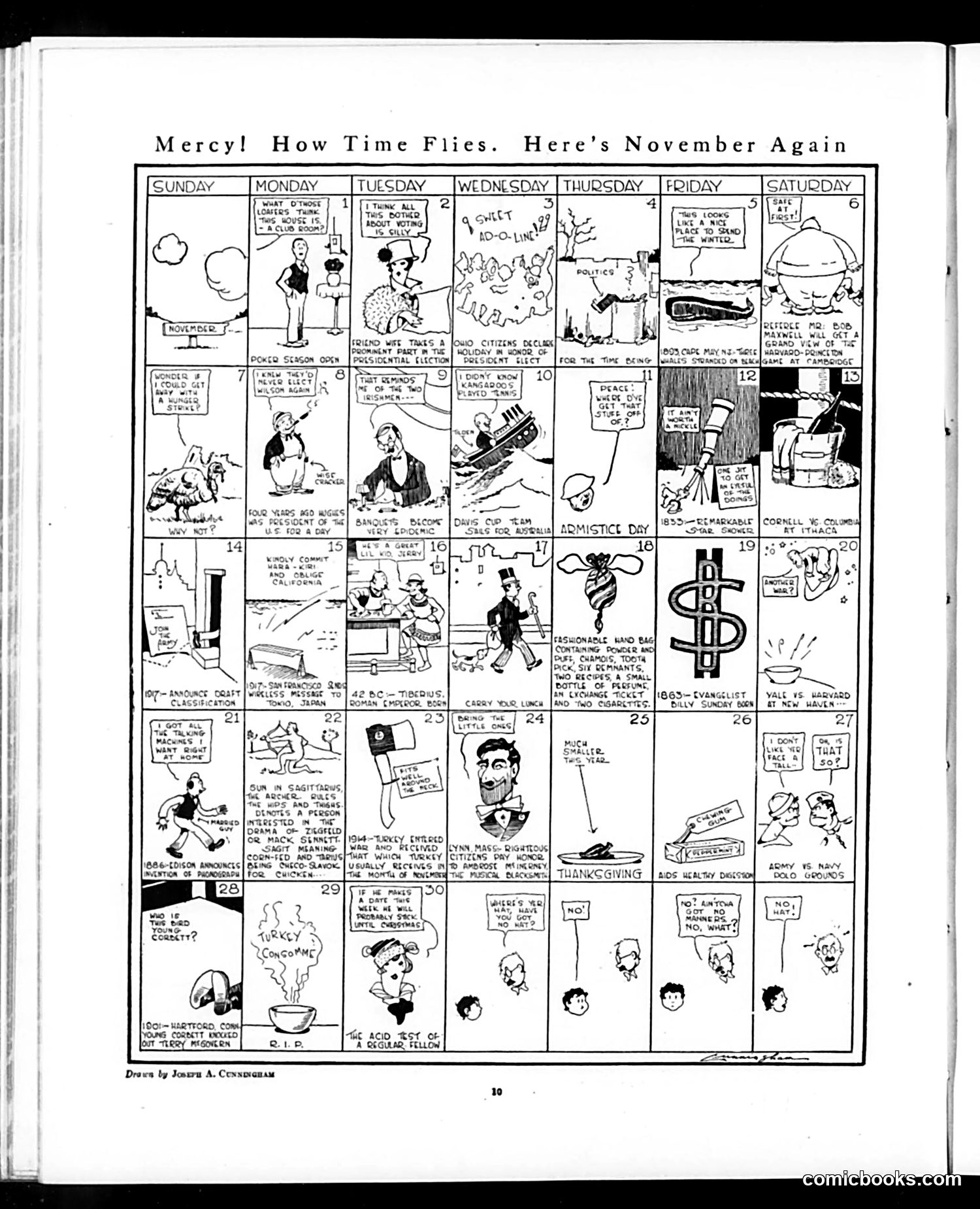
This is a satirical calendar strip by Joseph A. Cesare (signed Cesare) mocking November 1920s American culture and politics. The daily panels contain topical references including: - **Billy Sunday**: The famous evangelist appears in panel 19, satirizing his religious revival campaigns - **Thanksgiving**: Referenced on the 25th with typical holiday humor - **Prohibition-era jokes**: References to drinking and alcohol appear throughout, mocking the recently-enacted dry laws - **Social commentary**: Panels mock consumerism, dating customs, and contemporary social behaviors The strip's title "Mercy! How Time Flies" suggests the rapid passing of months and the repetitive nature of seasonal activities. Each day contains brief gags and observations about everyday life, typical of Judge magazine's satirical format, targeting readers' recognition of current events and cultural figures.
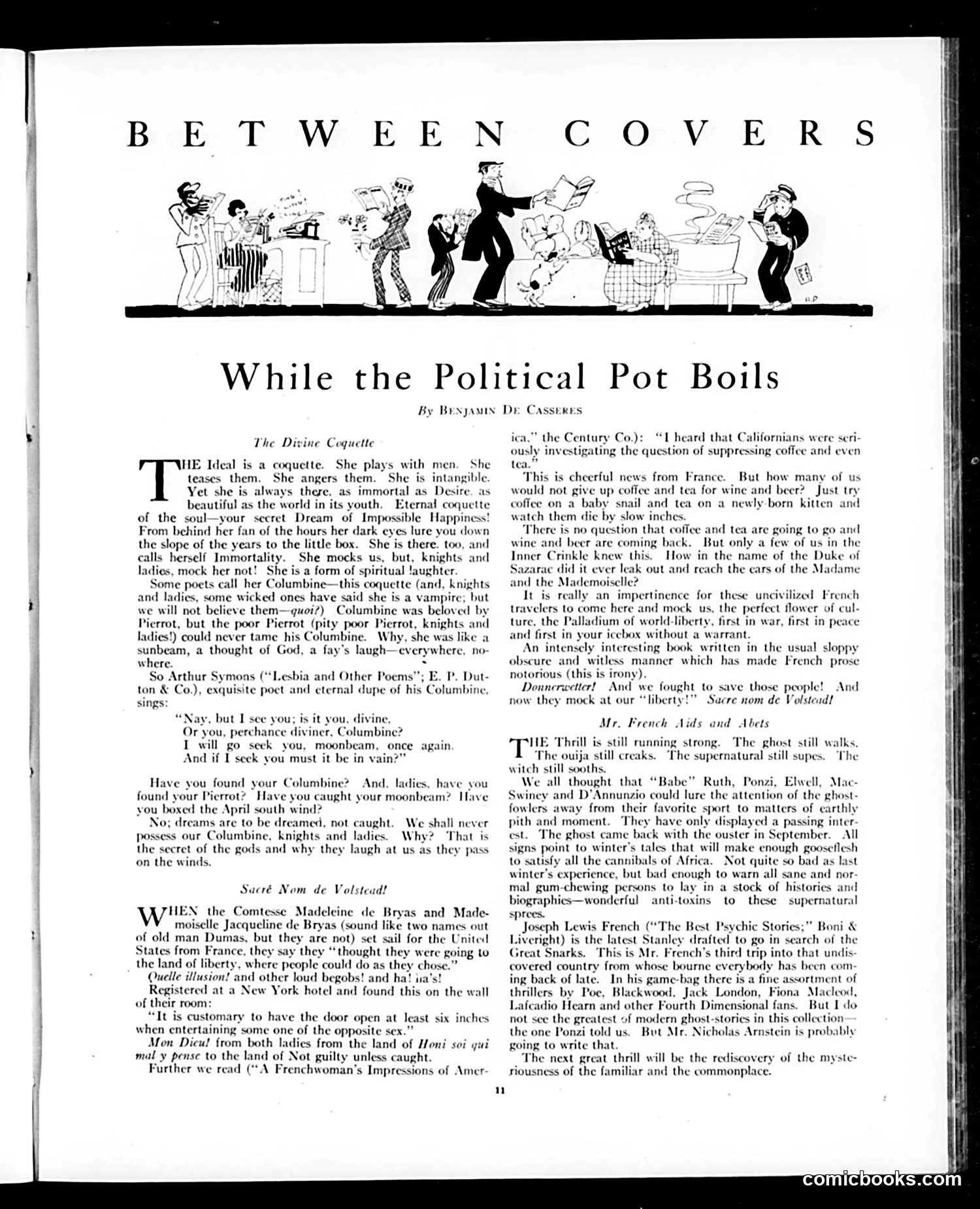
This page from Judge combines literary criticism with political satire about Prohibition-era America. **The Cover Illustration** depicts various figures in chaos—likely representing competing political interests during the heated debates over Prohibition ("While the Political Pot Boils"). **"The Divine Coquette"** section reviews poetry by Arthur Symons, using theatrical metaphors about an elusive ideal (Columbine, the stock character). **The Main Satire** ("Sacré Nom de Volstead!") mocks French visitors—the Countess and her daughter—who were shocked by American moral restrictions, particularly hotel rules separating unmarried couples and (more importantly) Prohibition. The author sarcastically criticizes the French for laughing at American "liberty" while America had sacrificed to help France in WWI. The reference to "Volstead" invokes the Volstead Act, which enforced Prohibition. The piece expresses indignation that foreigners dare mock American values and restrictions. **Context**: This reflects 1920s American defensiveness about Prohibition and anxiety about European criticism of American morality and "progress."
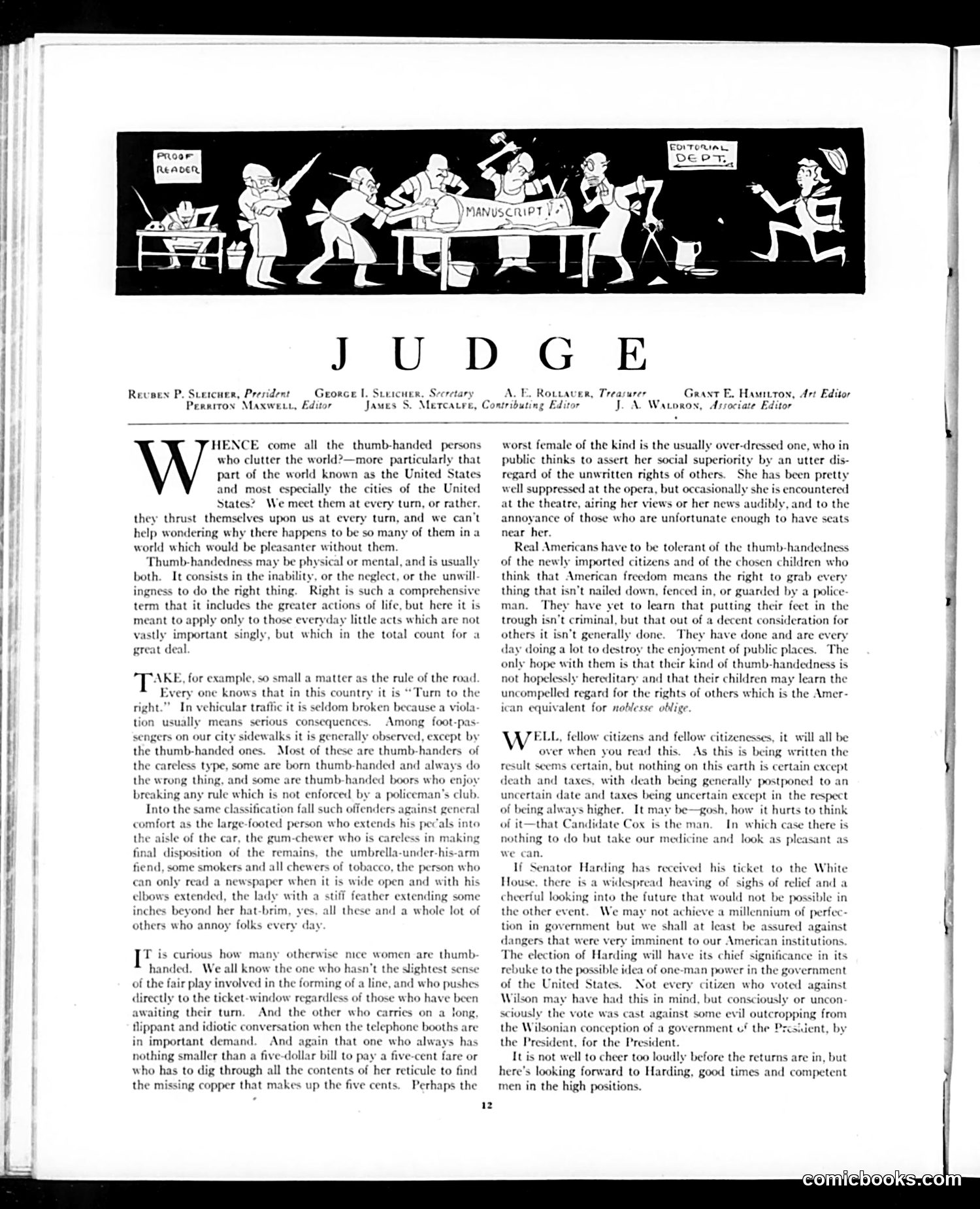
This editorial satirizes thoughtless, inconsiderate public behavior—termed "thumb-handedness" (physical or mental inability/unwillingness to "do the right thing"). The cartoon header depicts a chaotic newspaper editorial office where staff members jostle and disrupt work. The piece catalogs everyday inconsiderations: violating traffic rules, blocking sidewalks, monopolizing telephone booths, spreading newspapers wide on public transit, wearing oversized feathered hats, and—most sharply—"over-dressed" women who assert social superiority by talking loudly in theaters, ignoring others' rights. The author argues Americans must tolerate newly-arrived immigrants' and children's rudeness, hoping they'll learn civic consideration. The satire's target isn't immigrants themselves but the broader social problem of thoughtlessness in crowded modern cities. References to "Candidate Cox" and "Senator Harding" (visible in text) suggest this piece addresses post-WWI American civic behavior and social cohesion.
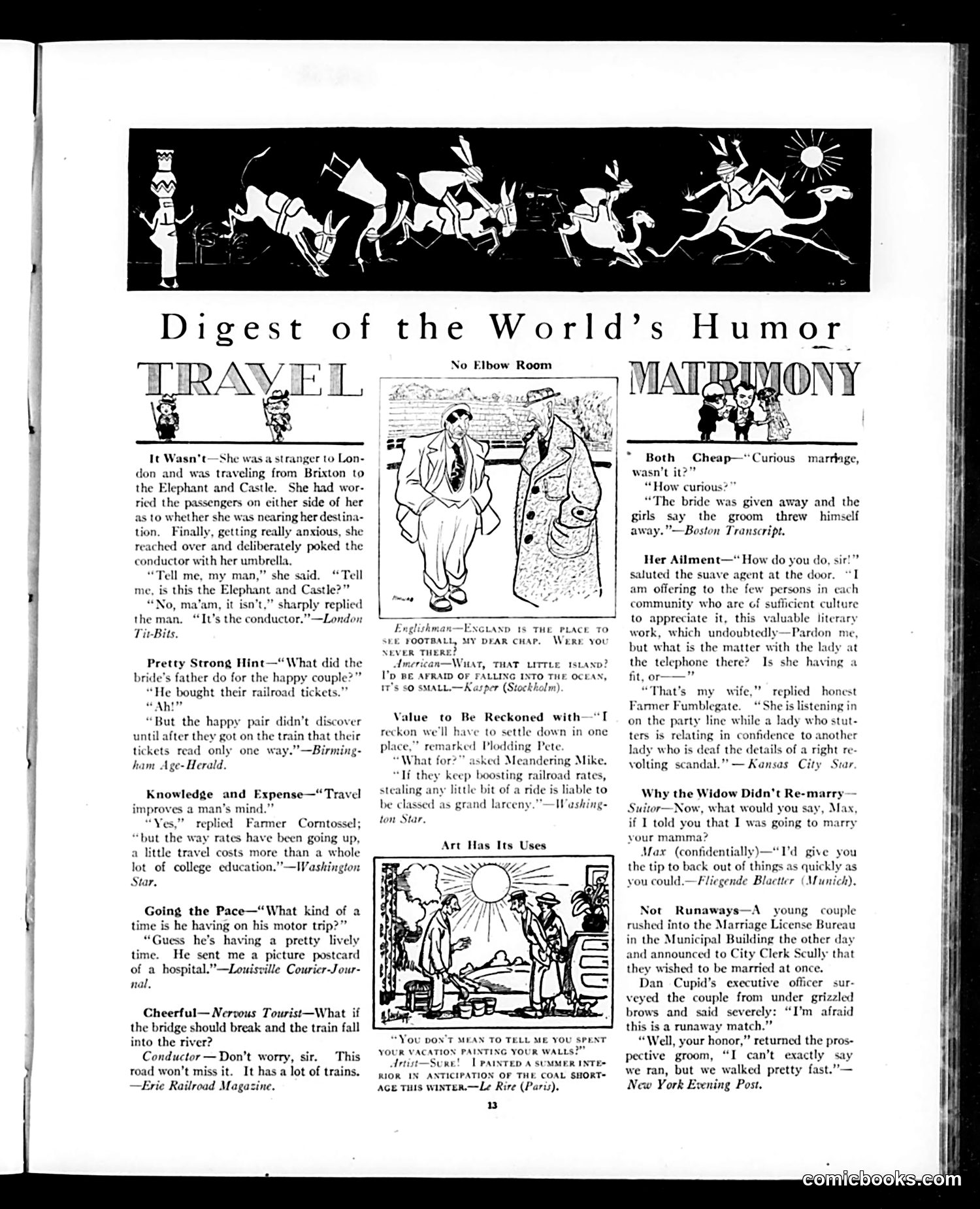
This page from *Judge* presents a collection of short humorous anecdotes—typical of early 20th-century satirical magazines—organized around three themes: travel, matrimony, and art. **The humor relies on:** - **Misunderstandings**: A woman mistakes a London bus conductor for the "Elephant and Castle" destination; an American confuses England with a tiny island. - **Social commentary**: Rising railroad ticket prices make even modest travel prohibitively expensive; marriage is treated as both cheap and foolish (parents eager to marry off daughters, grooms fleeing). - **Class/cultural satire**: A door-to-door book salesman encounters a working-class woman eavesdropping on party-line gossip; a widow's child warns against marrying her. - **Contemporary references**: Coal shortages (wartime/winter anxiety); party-line telephones (shared phone lines were common then). The cartoons' simple line drawings and the anecdotes' punchy delivery reflect *Judge's* accessible, populist humor style. The satire targets everyday frustrations—transportation costs, matrimonial misadventures, pretentious salesmen—rather than specific political figures.
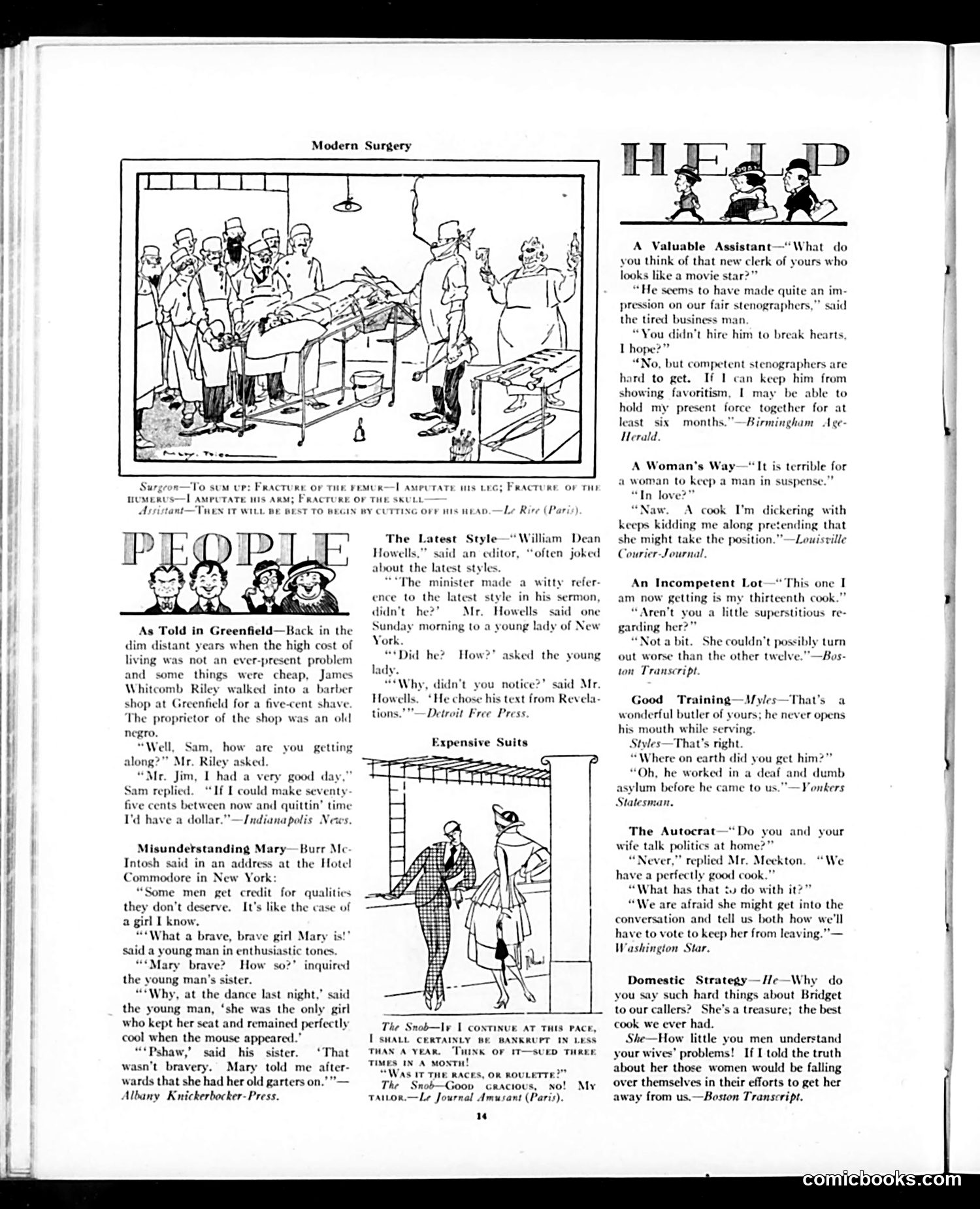
This page contains several short humor pieces typical of early-20th-century American satirical magazines, reflecting social anxieties of the era. The top cartoon mocks excessive surgical amputation—a surgeon claims he'll remove a patient's leg and arm, prompting an absurd suggestion to "begin by cutting off his head." This satirizes overzealous or unnecessary medical intervention. Below are anecdotes, mostly involving domestic service and employment relationships. Several jokes concern household cooks—a recurring subject reflecting class tensions and the difficulty hiring reliable servants. Other pieces joke about business incompetence, fashion excess, and gender dynamics (particularly male confusion about women's logic). The "Misunderstanding Mary" anecdote plays on the difference between perceived bravery and practical self-interest. The "Snob" cartoon jokes about debt from expensive tailoring. References to stenographers and office life reflect early-20th-century workplace demographics. Overall, the page reflects contemporary preoccupations: servants' scarcity, class relations, and modern business life, presented through the lens of genteel humor targeting educated, affluent readers.
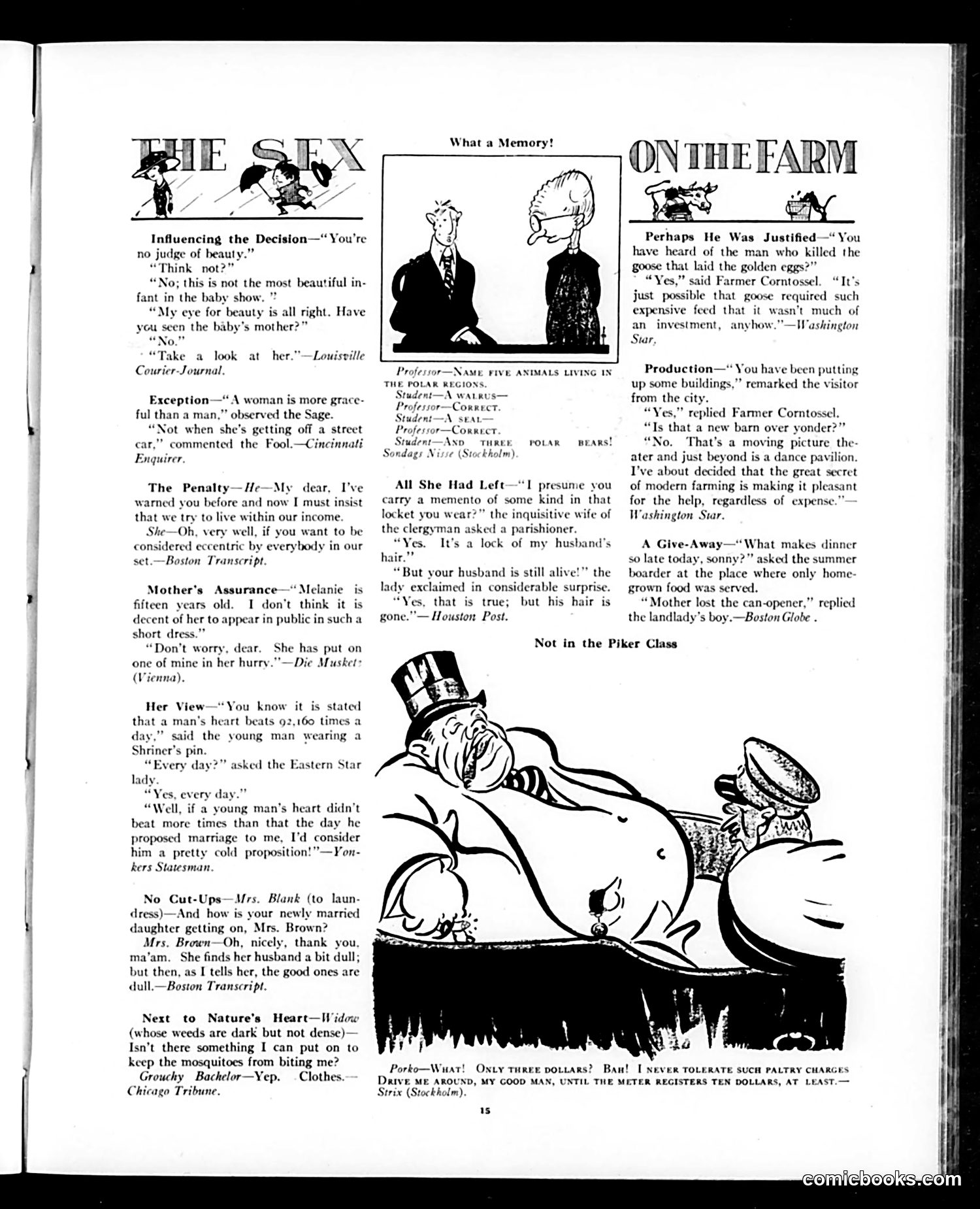
This page from *Judge* collects brief humorous anecdotes mocking early 20th-century social conventions and gender dynamics. The jokes target: **Marriage & Gender Relations**: Men complain about wives' spending habits; women demand emotional intensity from suitors; husbands find wives dull but accept it as inevitable. **Class & Pretension**: A widow in mourning dress rebuffs a bachelor's suggestion she wear clothes to avoid mosquitoes—implying her "weeds" (widow's garments) are a status display. **Rural vs. Urban**: "Farmer Corntossel" represents rural pragmatism, justifying killing a profitable goose (if feed costs exceeded returns) and modernizing farms with theaters and dance halls for worker retention. **The cartoon** shows a portly taxi driver ("Porko") demanding the meter run to ten dollars rather than three—satirizing excessive greed or pretension among working-class immigrants (likely Swedish, given "Strix" and "Stockholm" attribution). Overall, the page reflects period anxieties about women's independence, rural modernization, and immigrant behavior, using gentle mockery to reinforce conventional values.
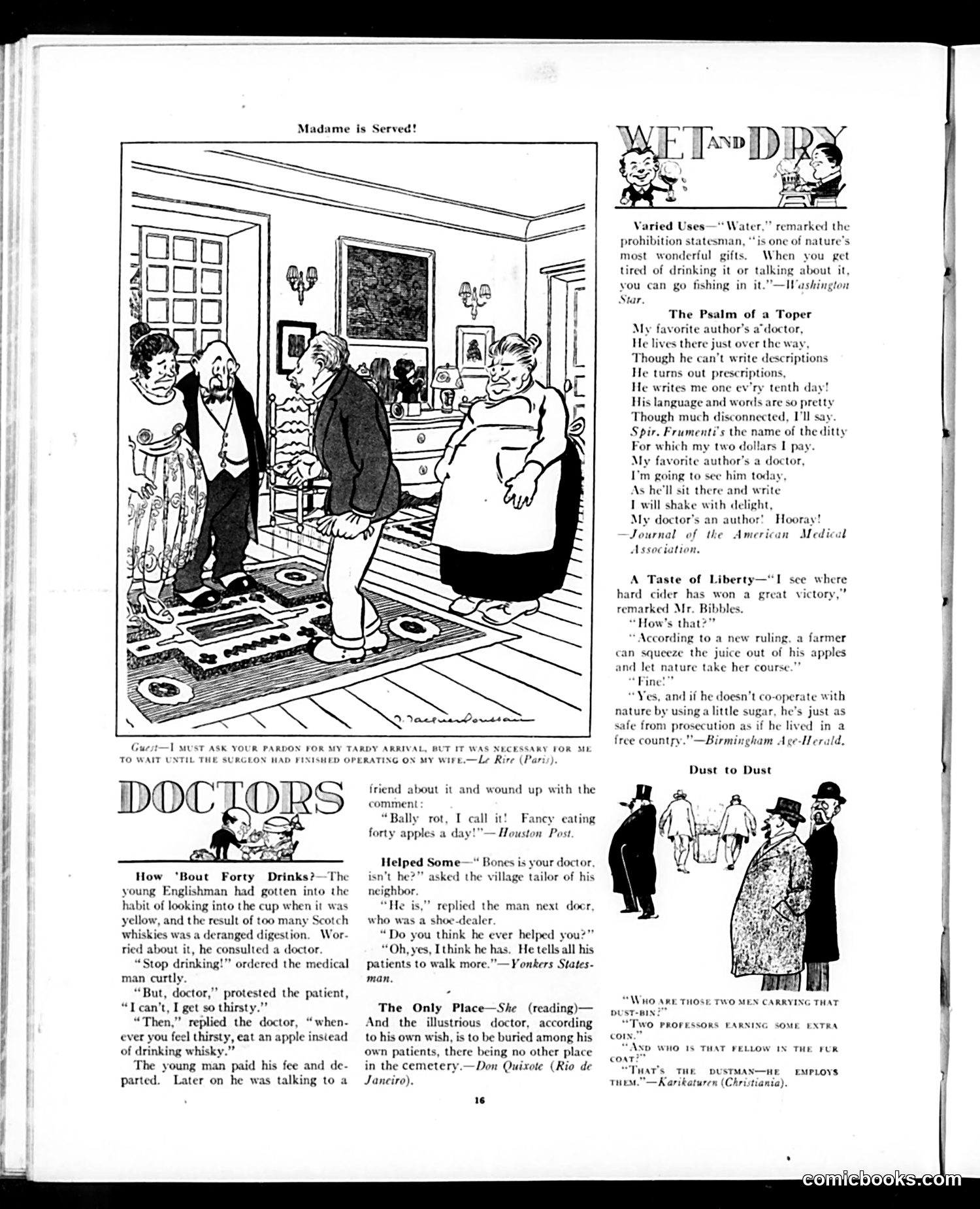
This page collects humorous anecdotes satirizing doctors and medical practice, reflecting early 20th-century skepticism about physicians. **Main cartoon** ("Madame is Served!"): A Parisian husband apologizes for late dinner arrival, claiming he waited for a surgeon to finish operating on his wife. The joke mocks both medical incompetence and marital indifference—treating his wife's surgery as a mere inconvenience to his schedule. **Recurring theme**: Multiple jokes ridicule doctors' actual ineffectiveness. One anecdote has a doctor advising whisky-drinker to "eat forty apples a day" instead (impractical); another shows a shoe-dealer crediting his doctor only for recommending walks (trivial advice); a third suggests doctors are so deadly that their preferred burial spot is among their own patients (dark humor about mortality rates). **"Psalm of a Toper"** satirizes prescription-writing doctors as enablers of alcoholism, with "Spir. Frumenti" (spirits/alcohol) thinly disguised as medicine—reflecting Prohibition-era tensions and doctors' actual practice of prescribing alcohol medicinally. The page expresses popular distrust of medical authority and incompetence during this era.
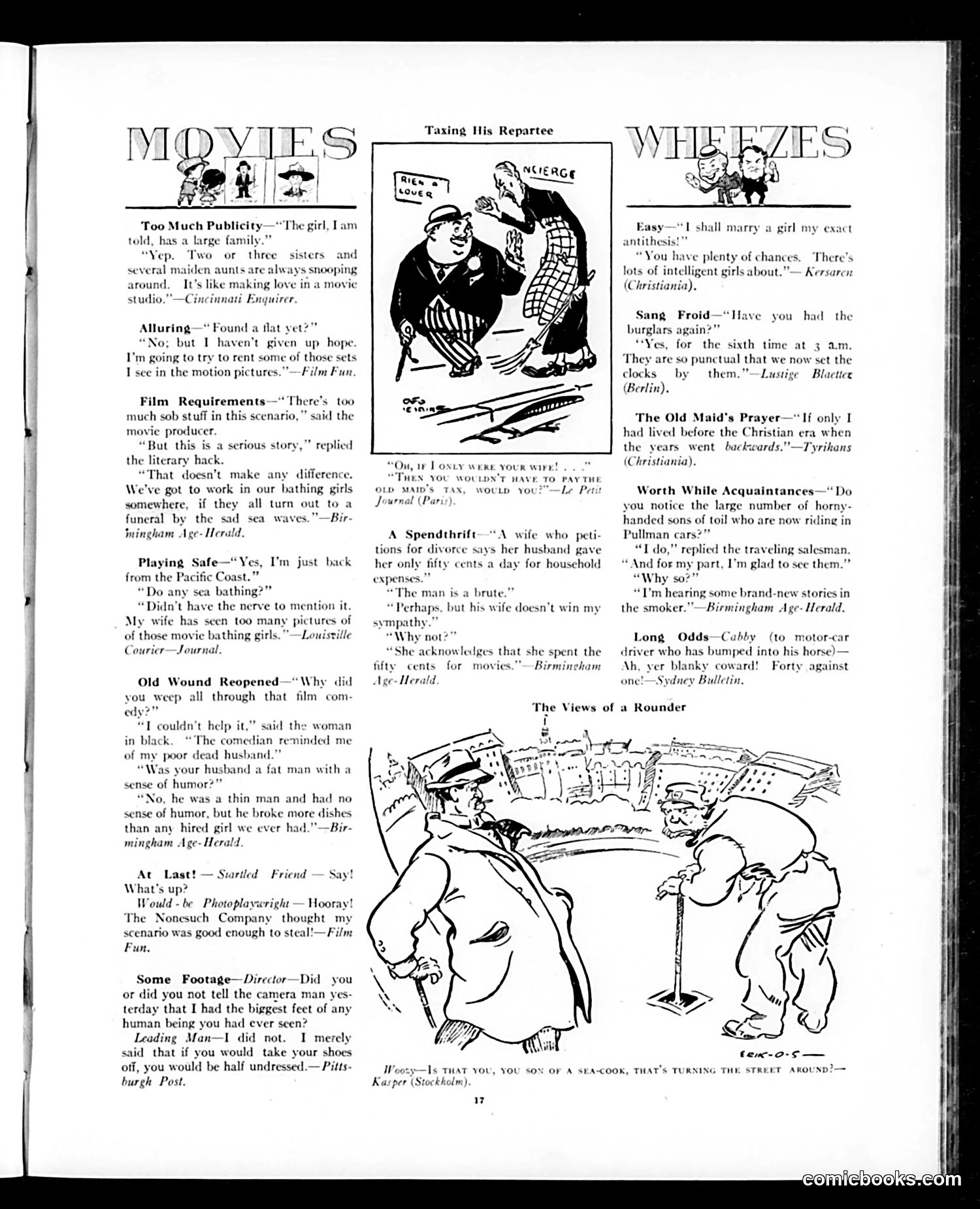
This page collects brief satirical jokes about early cinema and social manners, circa 1910s-1920s. The humor targets: **Film Industry Satire**: Multiple jokes mock Hollywood's formulaic approach—producers demanding "bathing girls" in serious dramas, theft of screenplays, and actors' vanity (the director's enormous feet joke). **Marriage & Divorce**: Several items joke about wives spending household money on movies instead of necessities, and husbands avoiding their wives' jealousy over "movie bathing girls"—reflecting anxieties about cinema's influence on relationships. **Class Commentary**: One joke mentions wealthy industrialists now riding Pullman cars, suggesting working-class prosperity and upward mobility. **The Central Cartoon** ("Taxing His Repartee"): Shows a man being confronted about his wife by someone holding a document labeled "Divorce." The joke plays on "old maid's tax"—likely a European tax concept—implying he'd avoid paying wife-related taxes if unmarried. The page reflects 1920s concerns: cinema's cultural power, shifting gender relations, and economic change. Most jokes appeared in international publications (Paris, Berlin, Stockholm papers credited), suggesting these were reprinted from European sources.
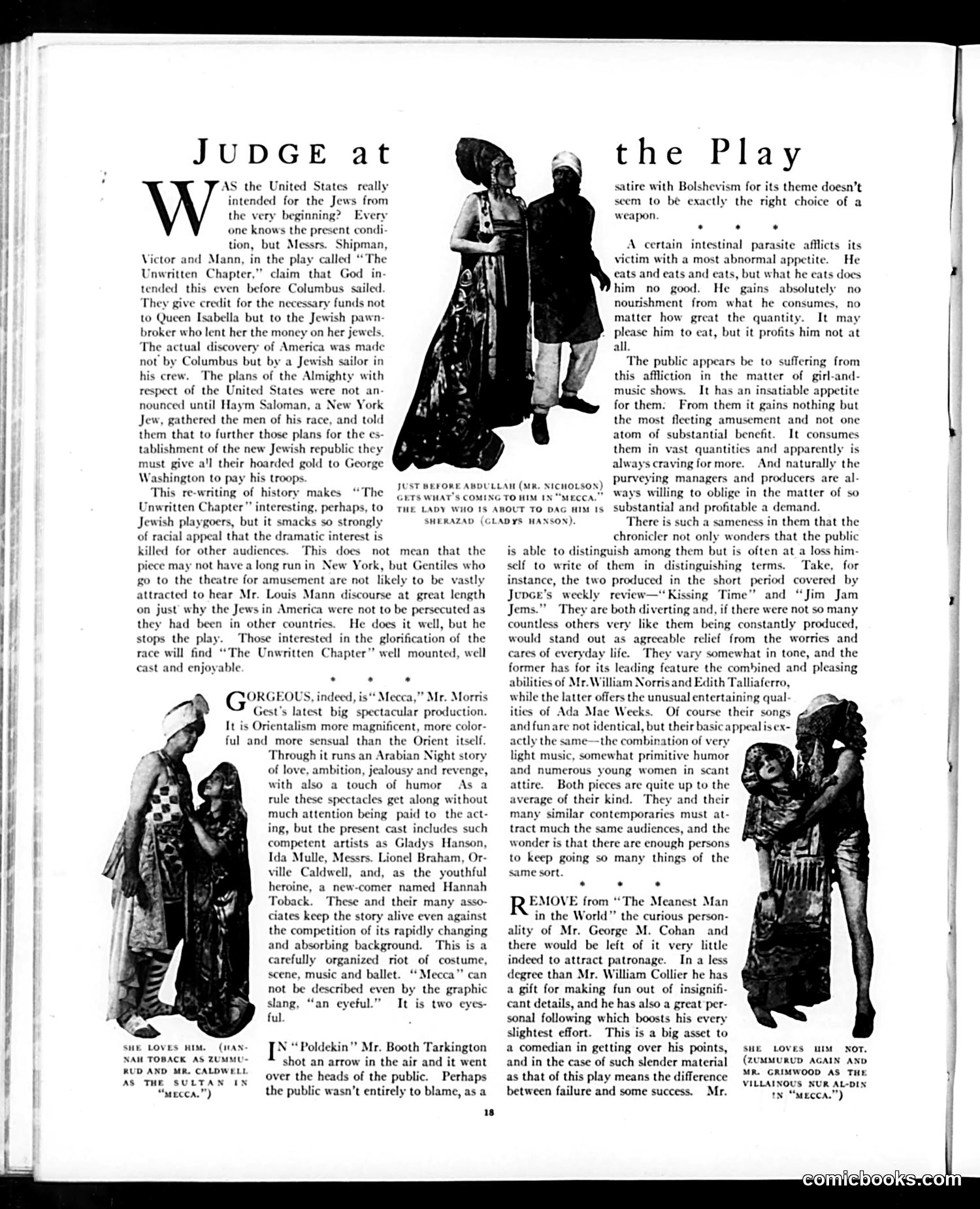
This page reviews three Broadway productions. The main critique targets "The Unwritten Chapter," a play by Shipman, Victor, and Mann starring Louis Mann. The reviewer objects that the play presents an explicitly pro-Jewish nationalist narrative—claiming Jews funded Columbus, sailed with him, and that Jewish financier Haym Salomon (historical figure) funded the American Revolution specifically to establish a "Jewish republic." The critic acknowledges the play is well-mounted but argues its heavy-handed ethnic propagandizing alienates non-Jewish audiences and undermines dramatic interest, though it may succeed commercially with Jewish theatergoers. The page also briefly reviews "Mecca," an orientalist spectacle by Morris Gest, and "Poldekin" by Booth Tarkington. The Mecca review praises its visual spectacle and cast (including Hannah Toback) while noting such productions typically rely more on scenery than acting. This reflects early 20th-century theater criticism and the era's explicit ethnic categorization of audiences and artistic appeal.
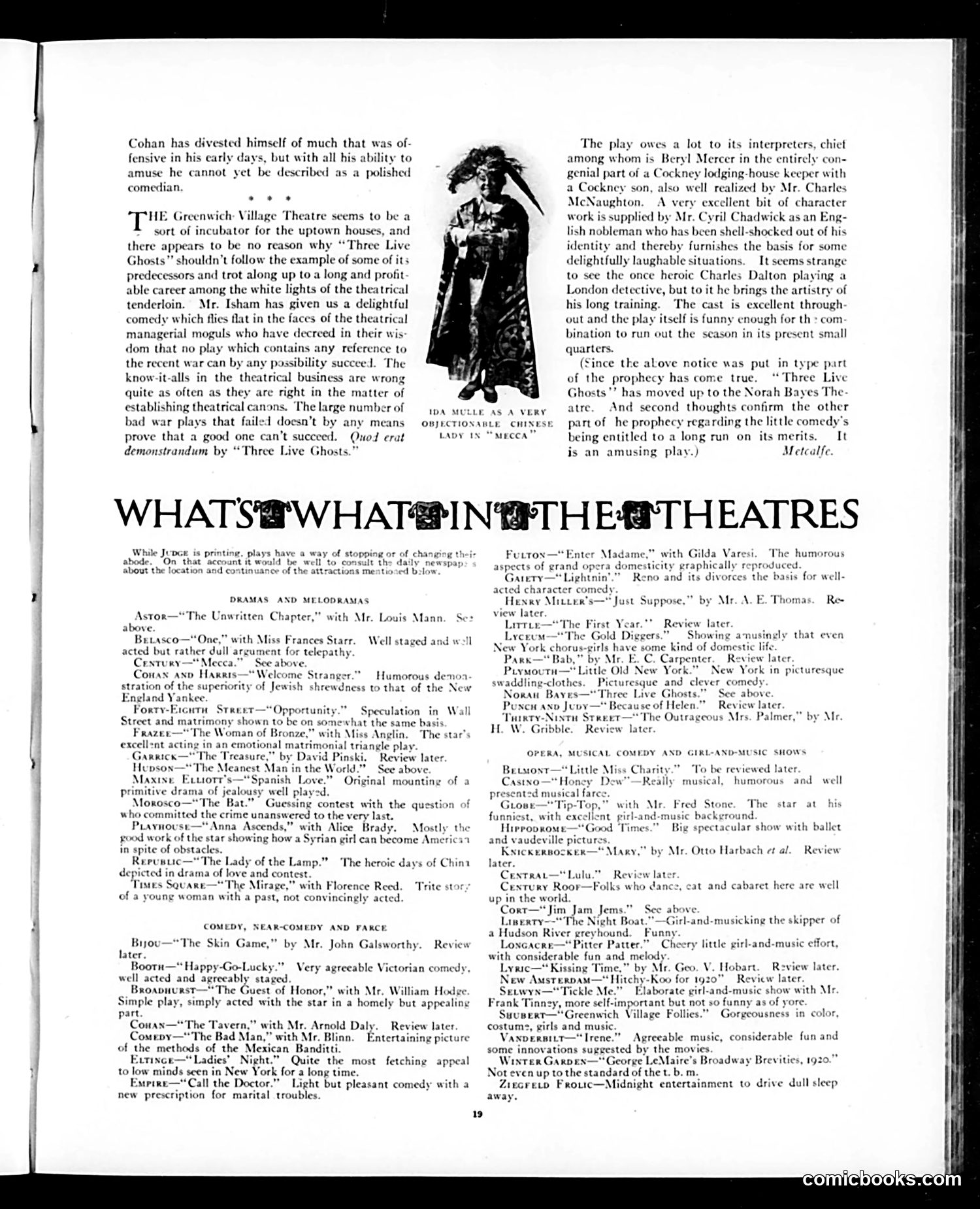
This page from *Judge* magazine contains theatre reviews and listings—not political cartoons or satire in the traditional sense. The single illustration shows an actress (identified in the caption as "IDA MÜLLE AS A VERY OBJECTIONABLE CHINESE LADY IN 'MECCA'"), depicting a stereotypical "Chinese lady" character, likely reflecting the casual ethnic caricaturing common in early 20th-century American theatre. The main content comprises brief reviews of contemporary Broadway plays. Notable mentions include "Three Live Ghosts" (a WWI-themed comedy that defies theatrical pessimism about war plays) and various dramas, melodramas, and comedies. The reviews employ the era's casual, often dismissive critical style—calling some plays "entertaining" while others are "trite" or "dull." The page reflects theatrical tastes and racial attitudes of the 1920s rather than explicit political satire.
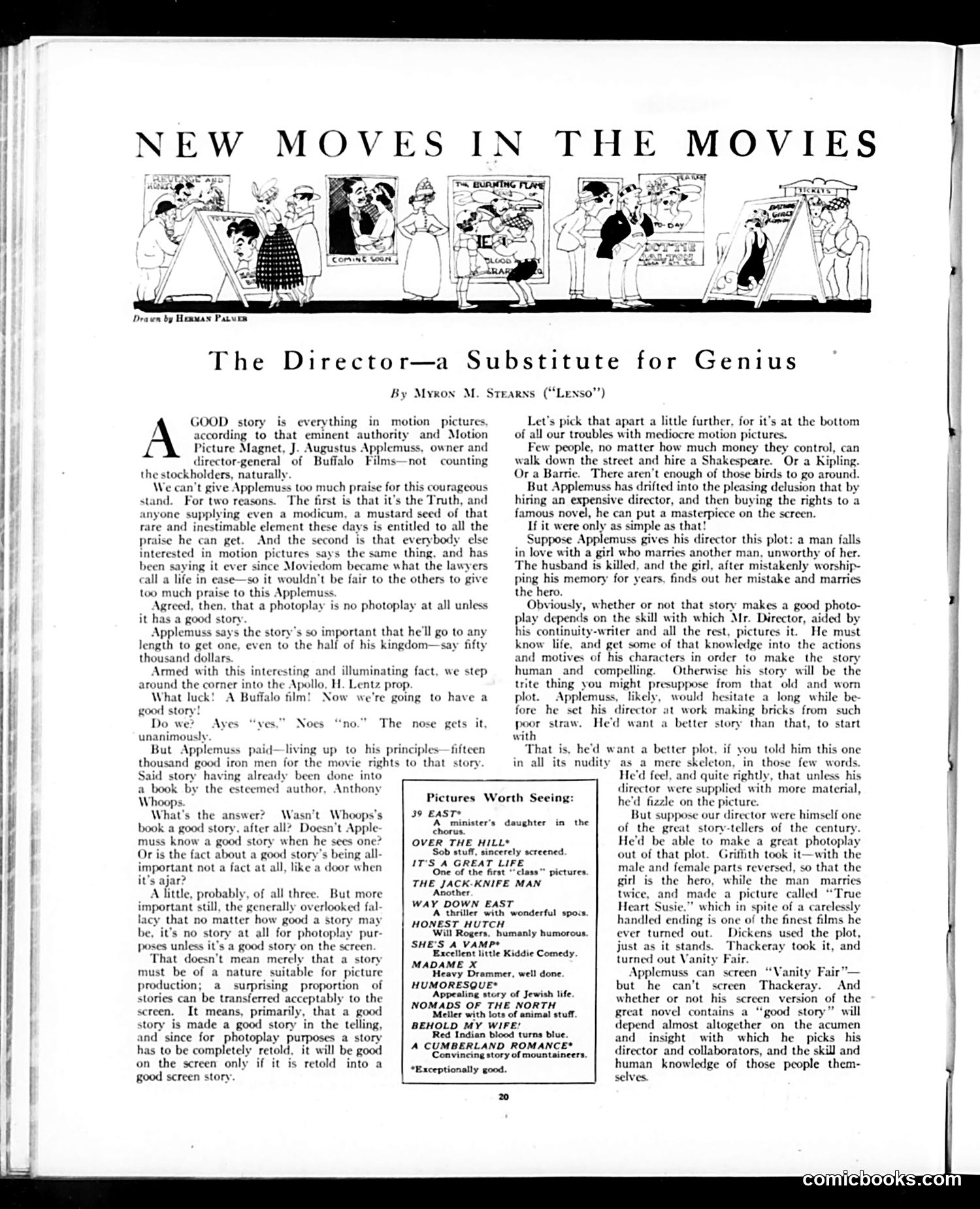
This article satirizes film producer J. Augustus Applemuss (a fictional character representing real studio moguls of the silent era) who believes that buying expensive literary properties and hiring directors automatically produces great movies. The satire's point: Applemuss paid $15,000 for film rights to a successful novel by author "Anthony Whoops," yet the resulting film flopped. The author argues that a good *story* alone doesn't make a good *film*—the story must be retold effectively for cinema. Studios mistakenly believed that hiring expensive directors and adapting famous books guaranteed quality, overlooking that filmmaking requires different storytelling skills than literature. The accompanying "Pictures Worth Seeing" sidebar lists contemporary 1920s films as examples of successful screen adaptations. The criticism reflects genuine early Hollywood struggles: adapting literature to silent film was an art executives hadn't yet mastered, leading to predictable failures despite prestigious source material and big budgets.
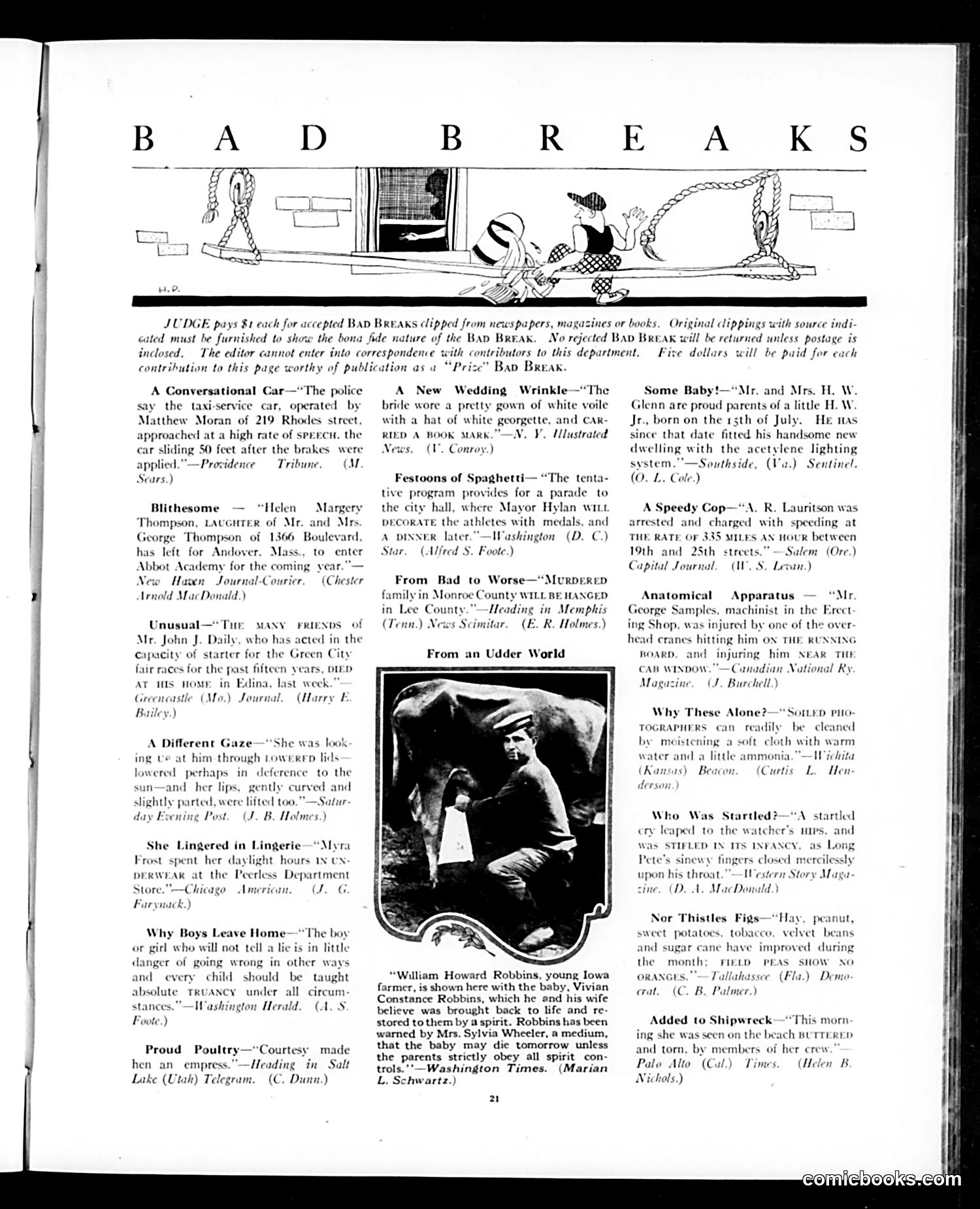
**Page Content:** This is a "Bad Breaks" humor section where Judge magazine published comical newspaper typographical errors and awkward phrasings submitted by readers. **The Main Cartoon:** The masthead illustration shows a figure being struck by a large wooden mallet labeled "Bad Breaks," with papers flying everywhere—visual representation of journalism errors. **The Jokes:** These are real newspaper blunders exploiting absurd word placement: - A police car that "slid 50 feet after brakes were applied" (unclear if brakes worked) - A man who "died at his home" yet was known for racing activities - A baby decorated with medals at city hall (confusing phrasing) - A farmer claiming his dead baby was "brought back to life" by a spirit - 335 miles-per-hour speeding charge (physically impossible) **Purpose:** Judge satirizes newspapers by highlighting how careless editing creates unintentionally hilarious or absurd meanings—poking fun at journalism quality while inviting readers to submit similar errors for payment ($1 each).
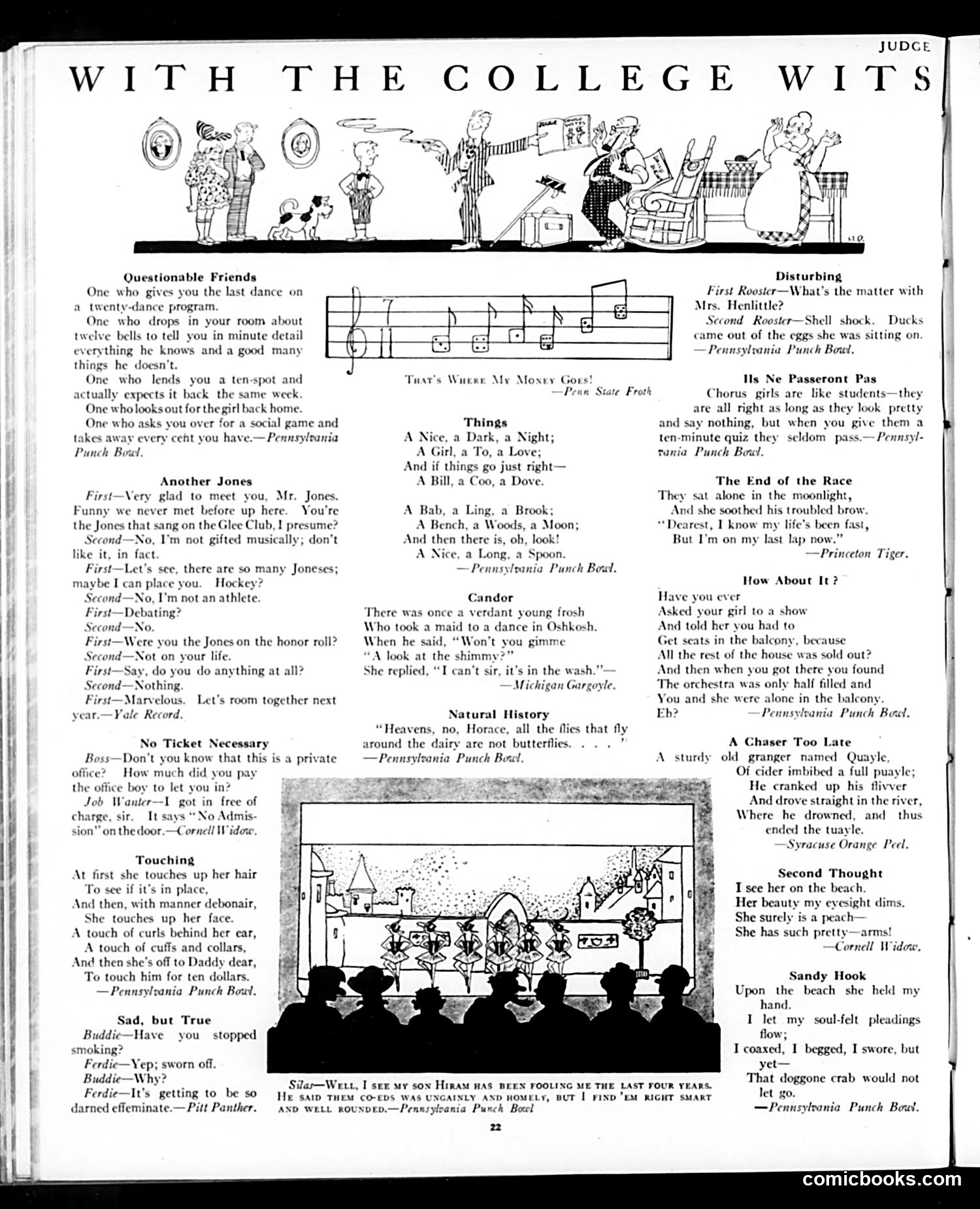
This page collects humorous sketches about college life, drawn from various university humor publications (Pennsylvania Punch Bowl, Yale Record, Cornell Widow, etc.). The satire targets typical undergraduate experiences and social types: **Main targets:** - Parasitic "friends" who exploit you financially or socially - The unremarkable student who does nothing noteworthy - Social pretense and dating rituals - "Flappers" and changing gender dynamics (the "shimmy" reference mocks 1920s dancing) - Rural fathers discovering college girls aren't "ungainly" as promised **Key context:** The "Ils Ne Passeront Pas" joke compares chorus girls to students—both look pretty but "fail" under scrutiny. References to "shell shock" and WWI dancing suggest post-war modernity. The satire assumes a male college reader amused by romantic mishaps and social climbing. The page represents interwar college culture's anxieties about changing morality, gender roles, and courtship among the educated elite.
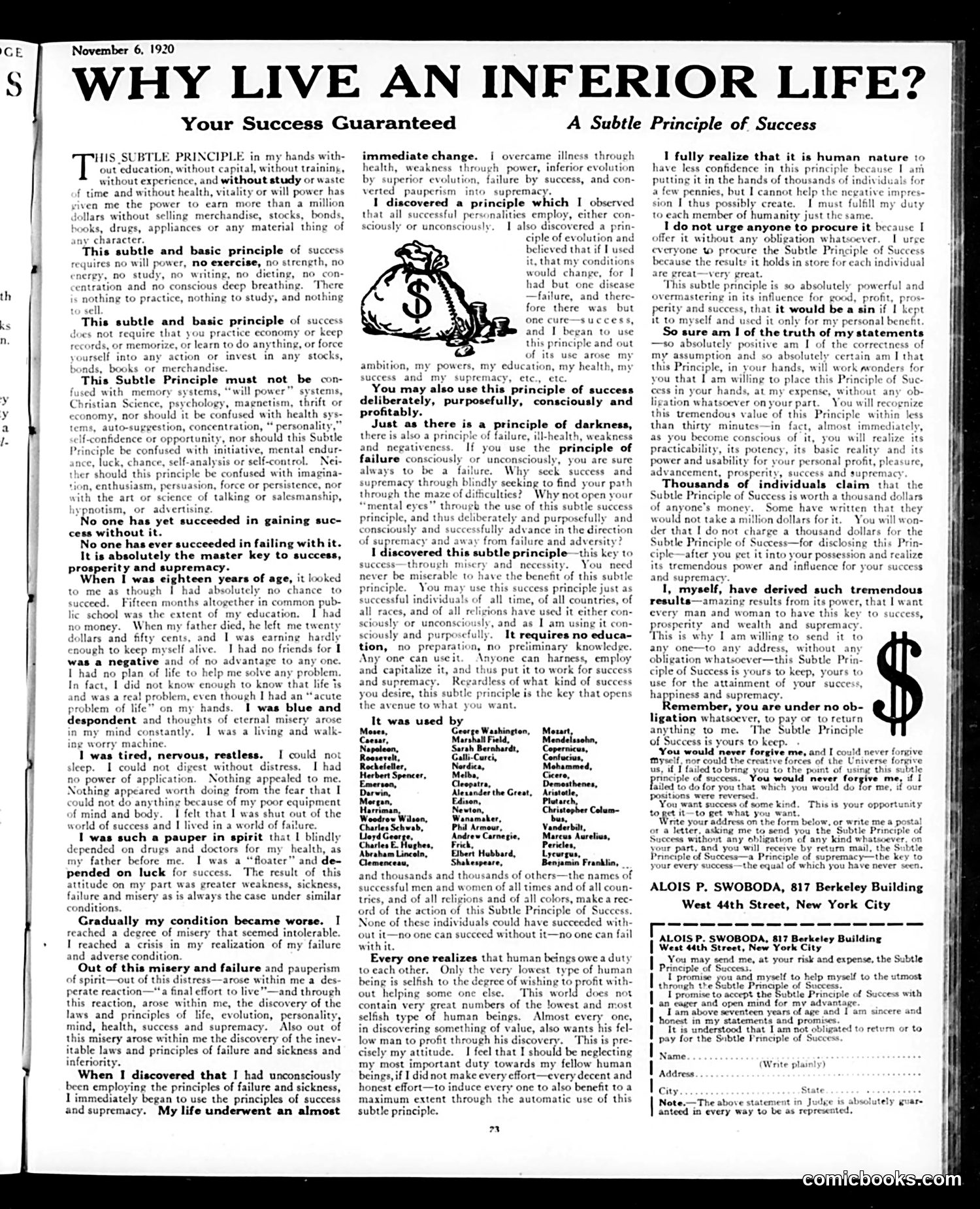
This 1920 Judge magazine page is primarily **self-help advertising**, not political satire. It's a promotional piece by Alois P. Sworoda advertising his "Subtle Principle of Success"—a purported self-improvement system. The appeal targets economically struggling readers: Sworoda claims his principle requires "no education, without capital, without training" and promises wealth without "selling merchandise." He presents his personal rags-to-riches narrative (poor at eighteen, now earning "more than a million dollars") as proof. The humor—if intended—lies in the **absurdity of the pitch**: a vague "principle" that requires nothing, teaches nothing, yet guarantees success. The dollar-sign illustration and breathless testimonials represent the quintessential hard-sell prosperity scam, likely already recognized by 1920 readers as dubious. This reflects post-WWI American optimism mixed with entrepreneurial hucksterism. The page reveals how early 20th-century magazines monetized hope selling to economically anxious audiences.
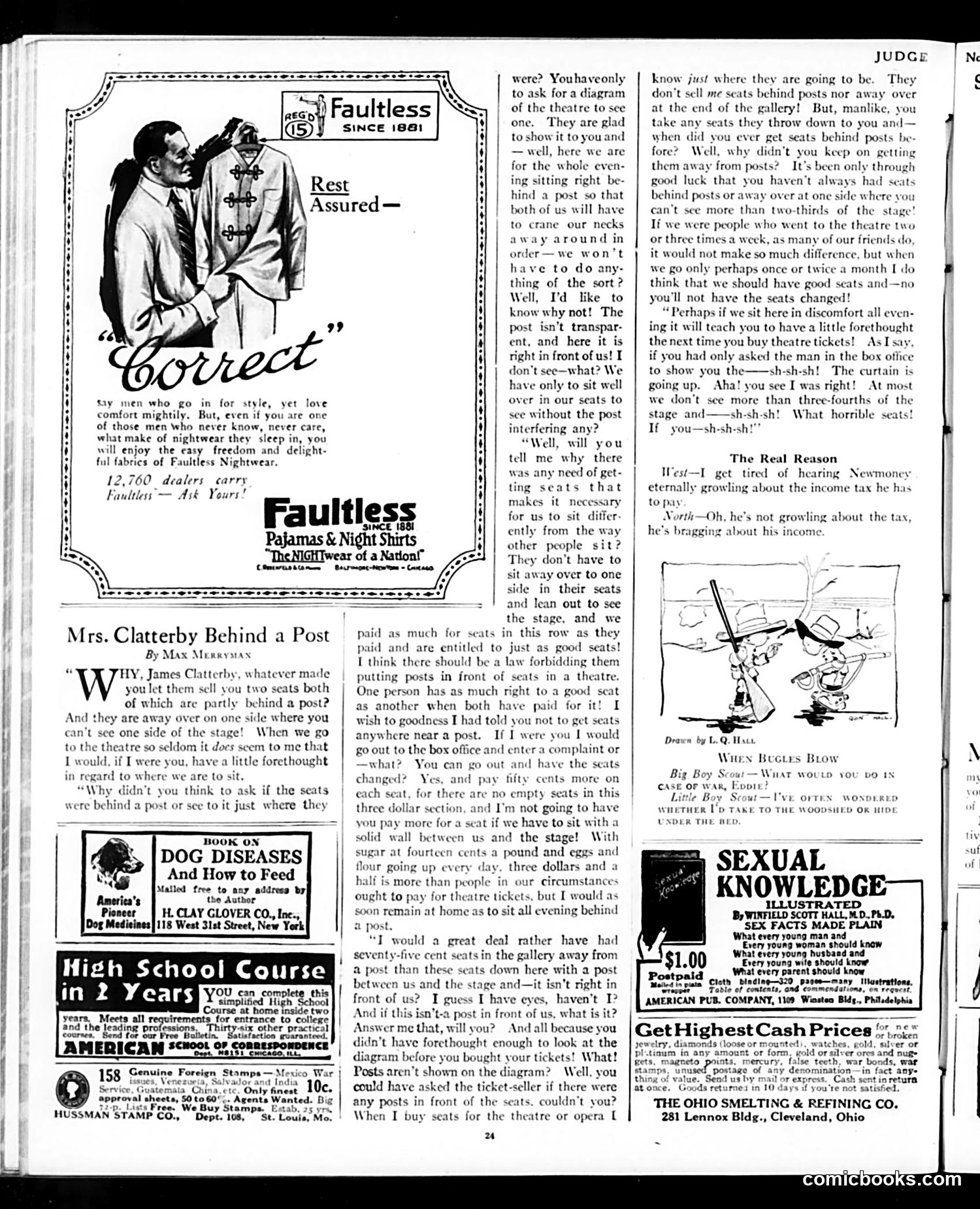
This is a humorous domestic dispute presented as a short story-cartoon hybrid. Mrs. Clatterby scolds her husband James for purchasing theater seats partially obstructed by a post—forcing them to crane their necks to see the stage. The satire targets both theatrical practices and marital dynamics of the era. Mrs. Clatterby represents the rational consumer: she criticizes the theater for selling inferior seats at full price and argues posts shouldn't be placed in front of paying customers. Her complaint about costs (sugar at fourteen cents, eggs and flour prices rising) reflects post-WWI economic concerns. However, the real humor lies in her relentless nagging—she blames James for lack of forethought, suggests he should have asked the ticket-seller about obstructions, and contrasts his negligence with her own careful planning when purchasing seats. The piece satirizes both consumer frustration with deceptive theater seating and the archetypal "nagging wife" character common to early 20th-century humor publications.
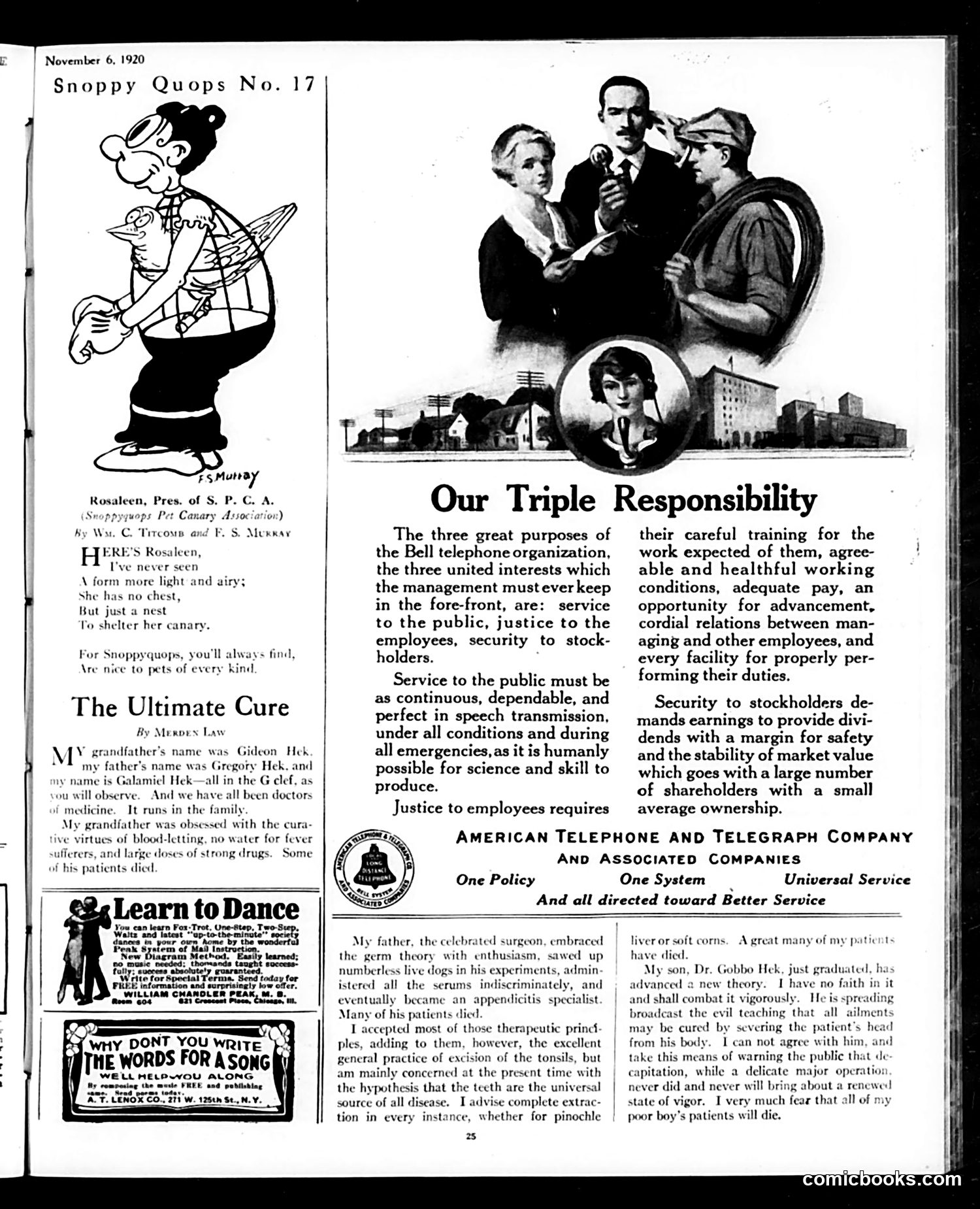
This page contains satirical commentary on medical practice and corporate responsibility rather than political cartooning. **"The Ultimate Cure"** is a three-generation satire on medical fads. Each doctor—grandfather (bloodletting), father (germ theory/appendectomies), and son (tooth extraction)—pursues a different therapeutic theory with equal conviction and equal mortality rates. The joke: medicine progresses by replacing one unfounded certainty with another, killing patients throughout. This reflects 1920s skepticism about medical orthodoxy. **"Our Triple Responsibility"** is an American Telephone & Telegraph advertisement defining corporate obligations: service to public, justice to employees, and security to stockholders. It's earnest corporate messaging, not satire—presenting the telephone monopoly as balancing three competing interests fairly. **"Snoppy Quops No. 17"** (left) is a whimsical character cartoon unrelated to the page's themes. The page juxtaposes cynical medical satire against idealistic corporate rhetoric—whether intentionally ironic or simply editorial sequencing is unclear.
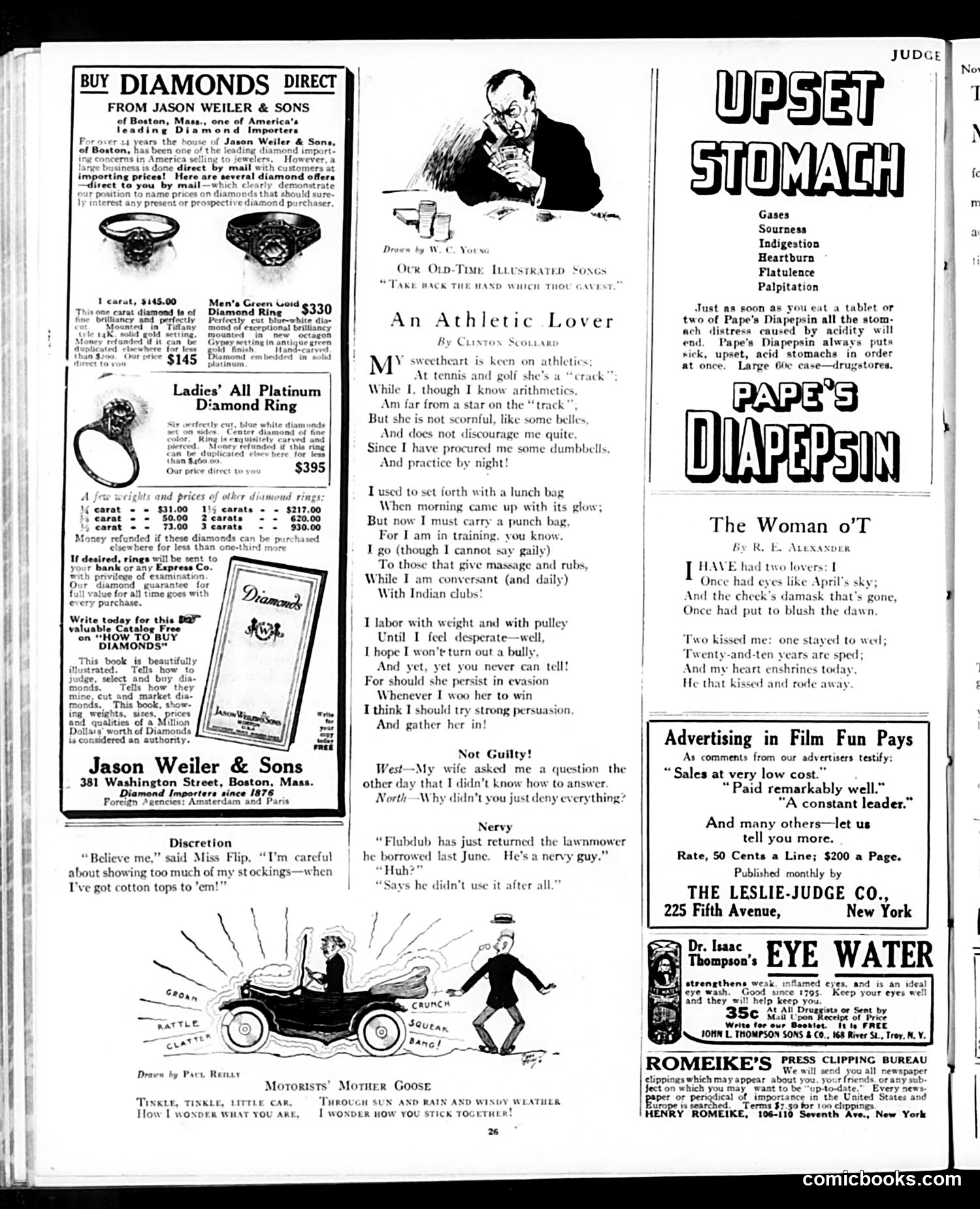
This page from Judge magazine contains primarily **advertising and light verse** rather than political satire. The main cartoon is "Motorists' Mother Goose" — a whimsical illustrated nursery rhyme about automobiles, playing on the durability of cars in bad weather ("Through sun and rain and windy weather / I wonder how you stick together!"). **"An Athletic Lover"** is a humorous poem about a man taking up weightlifting and dumbbells to impress his athletic girlfriend. The joke is self-deprecating: he's not naturally athletic but desperate to win her approval. **"The Woman o'T"** is a sentimental poem about lost love and the passage of time. The page is dominated by **advertisements**: Jason Weiler & Sons diamonds, Pope's Diapepsin (stomach remedy), Dr. Isaac Thompson's Eye Water, Leslie-Judge Company advertising rates, and Romeike's Press Clipping Bureau. There is minimal social/political commentary. The "Discretion" cartoon about showing stockings is a mild joke about feminine modesty. This appears to be a typical Judge page mixing light entertainment, poetry, and commerce.
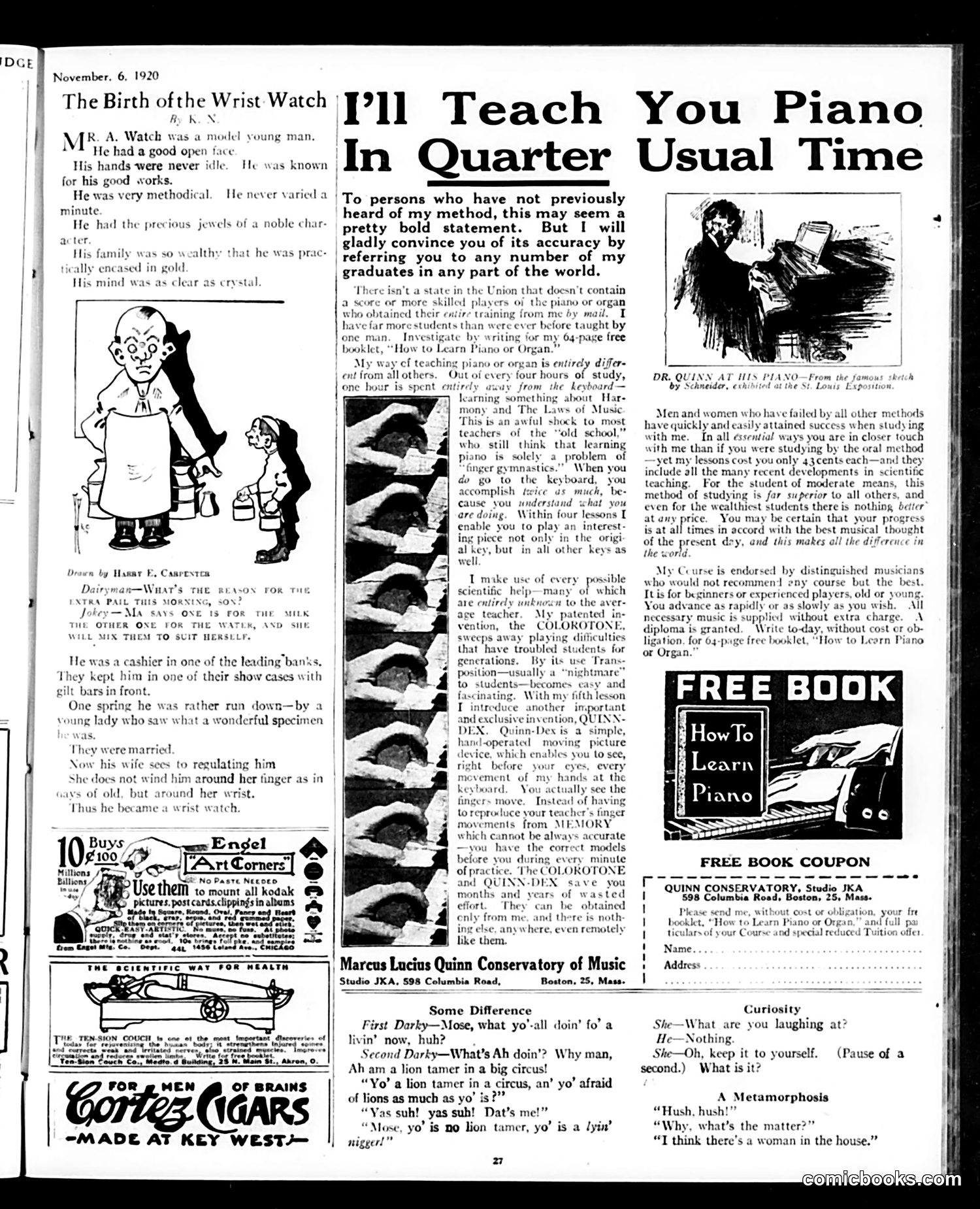
This page is primarily **advertising and instructional content** rather than political satire. The main feature is a piano-teaching advertisement from Marcus Lucius Quinn Conservatory, claiming to teach piano in "quarter usual time" using patented devices called the "Coloritone" and "Quinn-Dex" (a moving-picture hand-position guide). The copy emphasizes scientific methodology over traditional instruction. **"The Birth of the Wrist Watch"** is a brief humorous story (not political) about a methodical banker whose wife puts him in her wrist, making him into the first wrist watch—a pun on his mechanical precision and regularity. A **racist dialect joke** about "Mose" and a Black circus lion-tamer uses period-standard caricature and slurs common to 1920s humor magazines. The page also includes advertisements for **Engel Pianos** and **Cortez Cigars**. There is **no significant political content** on this page—it represents typical commercial and entertainment material from a 1920 satirical magazine.
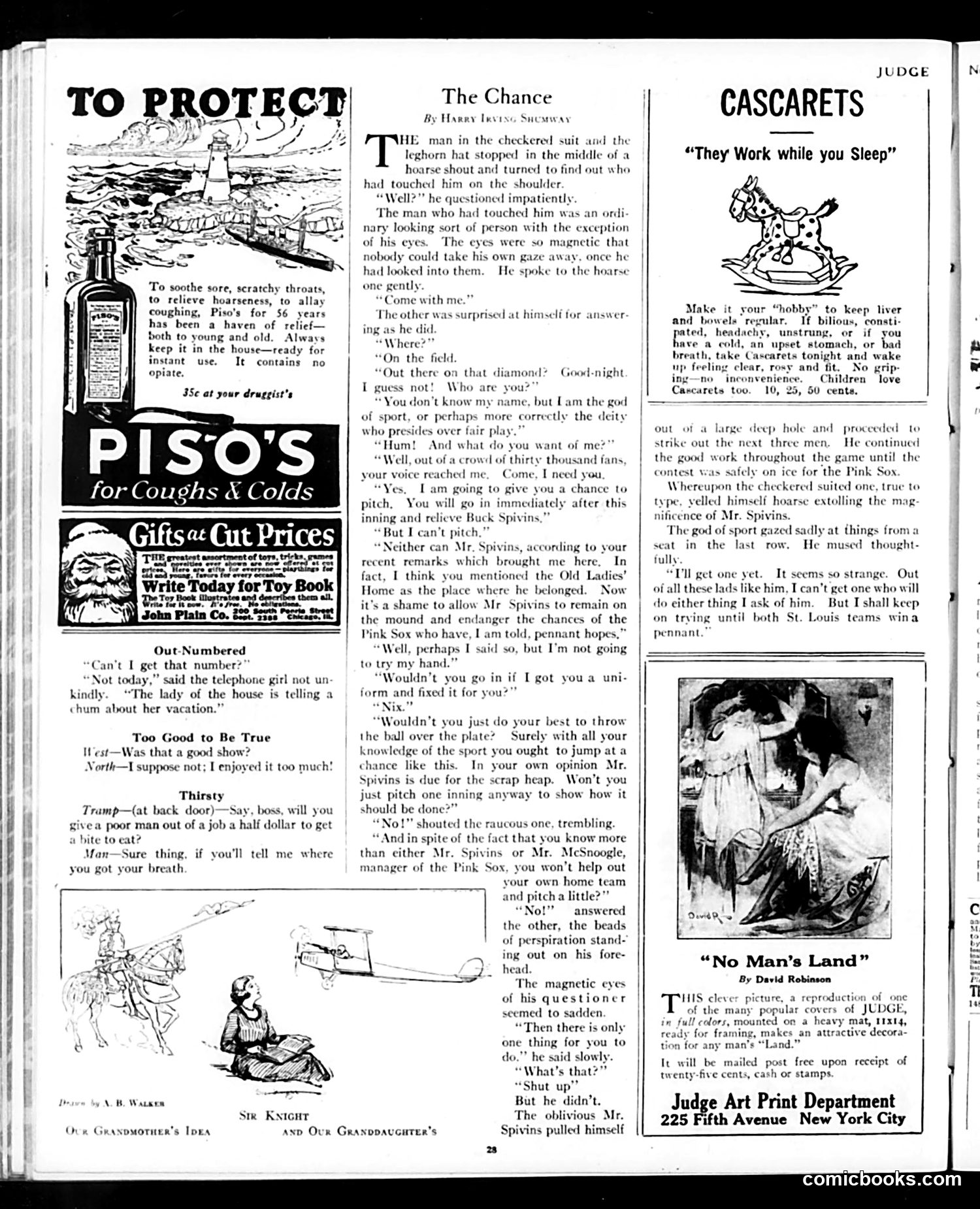
This page contains primarily **advertisements and light humor sketches** rather than political satire. The main content includes: **Advertisements:** - Piso's cough remedy and Cascarets laxative dominate the page - A "Judge Art Print Department" offering "No Man's Land" artwork **Short Humor Pieces:** Several untitled jokes ("Out-Numbered," "Too Good to Be True," "Thirsty") are simple one-liners about everyday situations—a man can't reach his wife, someone enjoyed a bad show, a vagrant begs at a door. **"The Chance" (main story):** A mysterious deity appears to a raucous baseball fan at a game and pressures him to pitch, despite his protests. The fan refuses until shamed, then successfully pitches. The story appears to satirize **American boosterism and peer pressure**—the deity essentially forces civic duty and self-sacrifice upon an unwilling participant, who then succeeds. The cartoons are minor illustrations by A.B. Walker. Overall, this is a typical **magazine contents page mixing ads with light entertainment**, not hard political commentary.
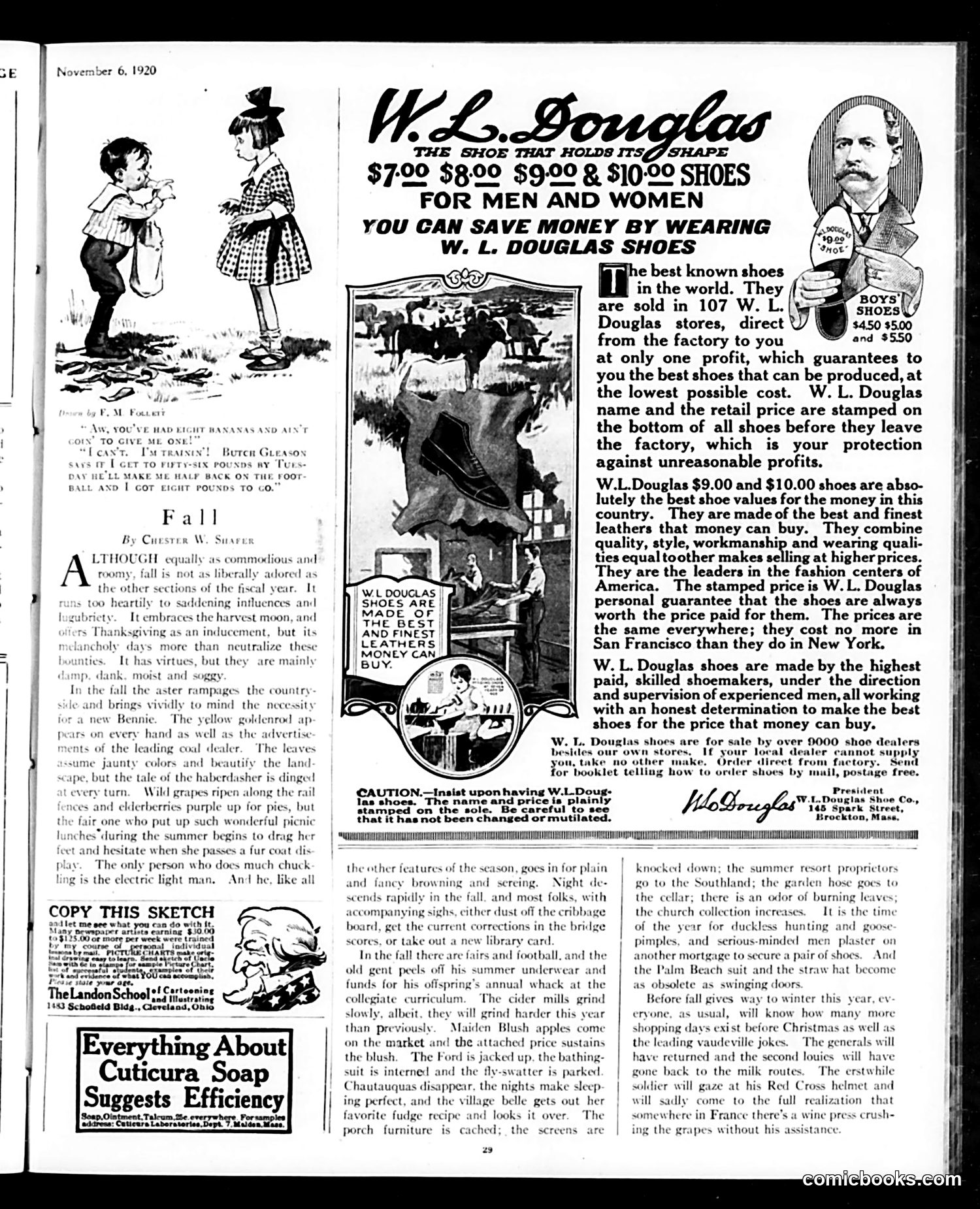
This page is primarily **advertising**, not satire. The dominant content is a W.L. Douglas Shoes advertisement occupying roughly half the page, promoting shoes at $7-$10 with claims about direct factory sales and price guarantees. The small cartoon at top left, captioned "Fall" by Chester W. Shafer, shows a boy and girl with dialogue about bananas and boxing—a light domestic joke with no evident political content. The accompanying "Fall" essay by Shafer is a nostalgic, melancholic seasonal reflection on autumn's weather and emotional qualities, not satirical commentary. Below is an advertisement for the "Larkspur School of Cartooning" encouraging readers to copy sketches for potential income. The Cuticura Soap advertisement appears at bottom. This appears to be a standard issue mixing **editorial content with commercial advertising**—characteristic of Judge's business model. There is no identifiable political satire or social commentary on this particular page.
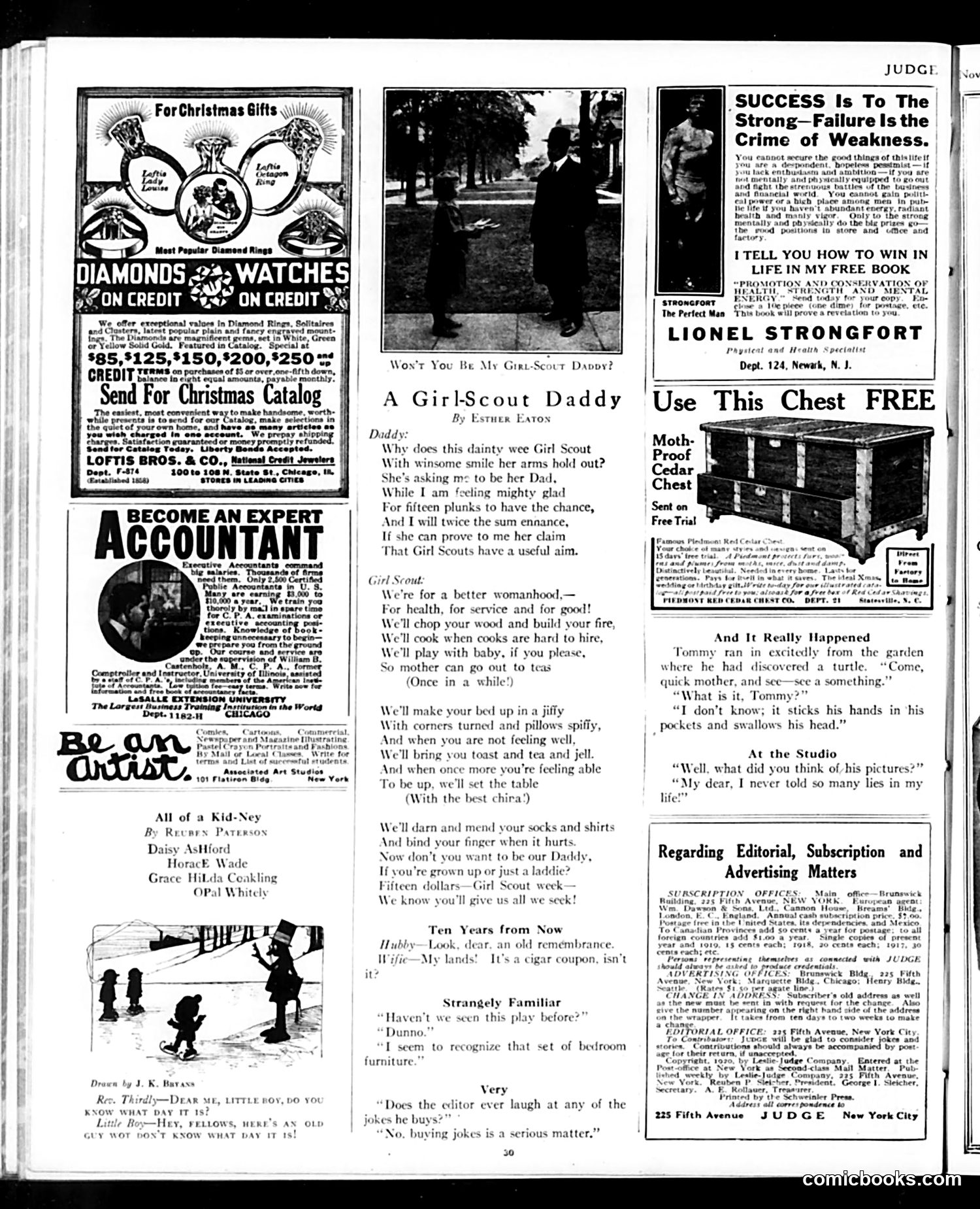
This is a satirical piece about the Girl Scout movement's relationship to urban middle-class domestic economics. The cartoon presents a deal: a Girl Scout ("dainty wee") asks a man to be her "Daddy" for "fifteen plunks" (dollars) per week—understood as sponsorship of her troop. The satire cuts both ways. The Girl Scout promises practical domestic labor (cooking, cleaning, childcare, mending) that working-class families actually needed—services absent when "cooks are hard to hire" and mothers want leisure to "go out to teas." Meanwhile, the man's cynical negotiation ("I will twice the sum ennance") treats scouting as transactional. The joke critiques how Girl Scouts marketed themselves as useful, economical alternatives to paid domestic help, while also exposing how middle-class leisure depended on exploiting unpaid female labor—even from children. The Girl Scouts' language about "better womanhood" and "service" is undercut by their literal offer to perform cooking and mending work.
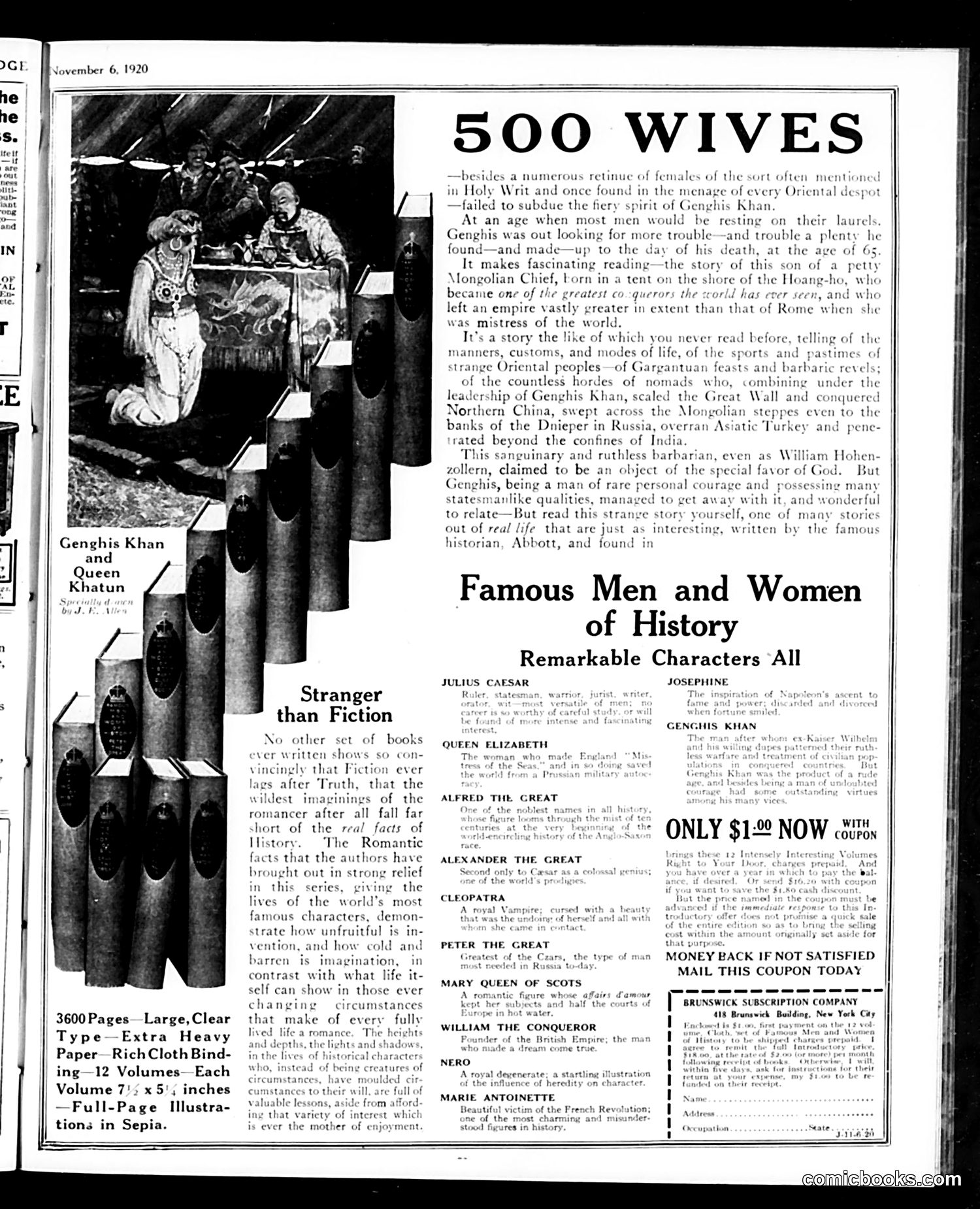
This page is primarily an **advertisement** for a 12-volume encyclopedia called "Famous Men and Women of History," disguised as editorial content in Judge magazine (November 6, 1920). The left side shows an illustrated scene labeled "Genghis Khan and Queen Khatun," depicting the Mongol conqueror with one of his wives. The accompanying text sensationalizes his life—his 500 wives, his conquests, his death at 65—to hook readers into purchasing the book series. The framing device, "Stranger than Fiction," argues that real history is more dramatic than invented stories, positioning this encyclopedia as essential reading. The advertisement lists famous historical figures included (Julius Caesar, Cleopatra, Queen Elizabeth, etc.) and emphasizes the books' physical specifications: 3,600 pages, large type, heavy paper, 12 volumes. The "$1.00 NOW WITH COUPON" offer and "MONEY BACK IF NOT SATISFIED" guarantee are standard early-20th-century direct-mail sales tactics. This represents Judge's advertising model rather than satirical commentary.
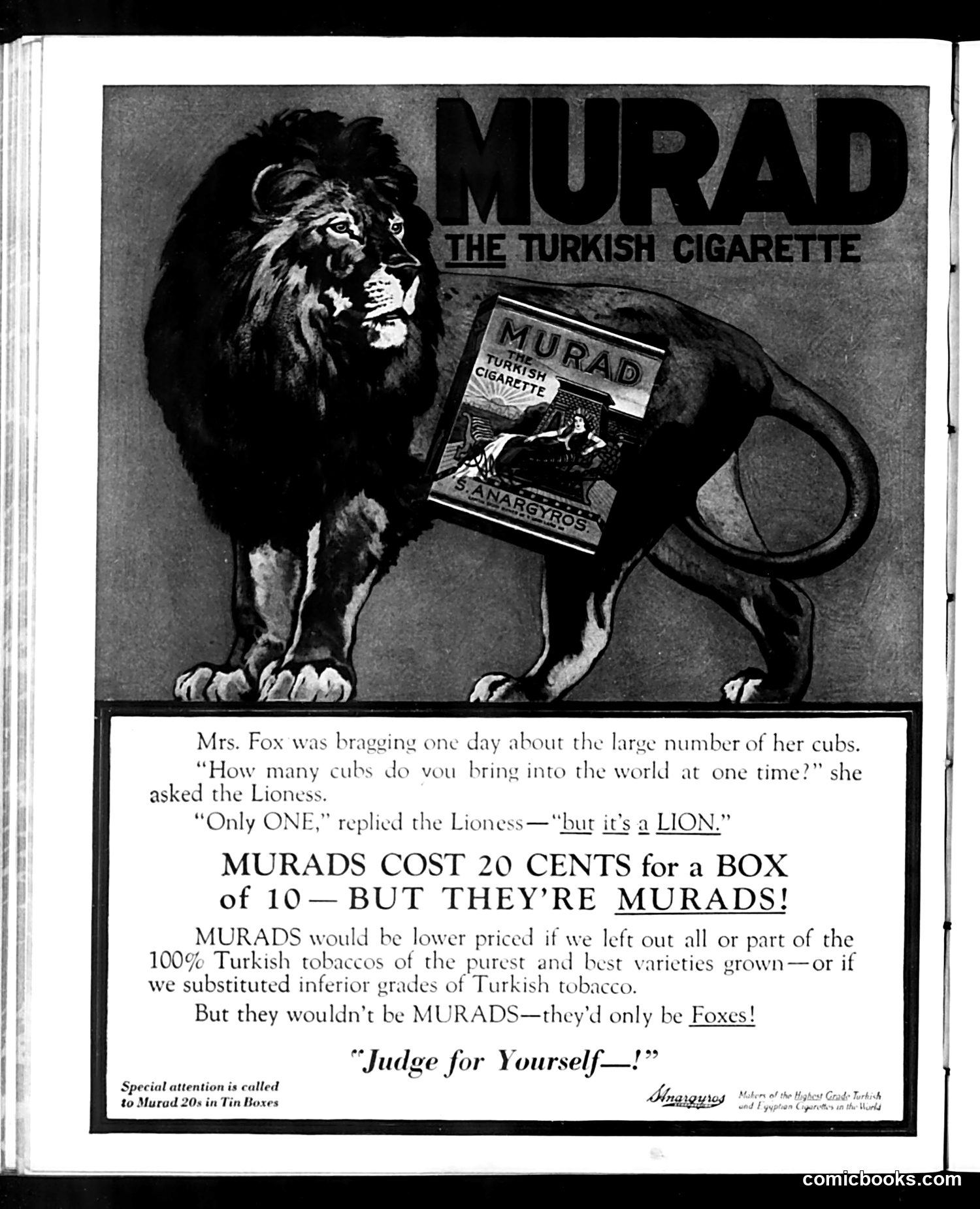
This is a **cigarette advertisement**, not political satire. It uses a fable-style anecdote to promote Murad Turkish cigarettes. The joke compares a fox bragging about quantity (many cubs) to a lioness valuing quality (one superior cub). This parallels the product pitch: Murad cigarettes cost more (20 cents per box of 10) but are premium because they use 100% pure Turkish tobacco rather than cheaper substitutes. The lion imagery reinforces superiority and prestige. The punchline "they'd only be **Foxes**!" (inferior imitation) drives home that cheap alternatives aren't true Murads—the brand name carries value. This reflects early-20th-century cigarette marketing emphasizing Turkish tobacco as a luxury ingredient, before health concerns changed advertising approaches.