
Judge, 1920-11-06 · page 11 of 32
Judge — November 6, 1920 — page 11: what you’re looking at
What you’re looking at
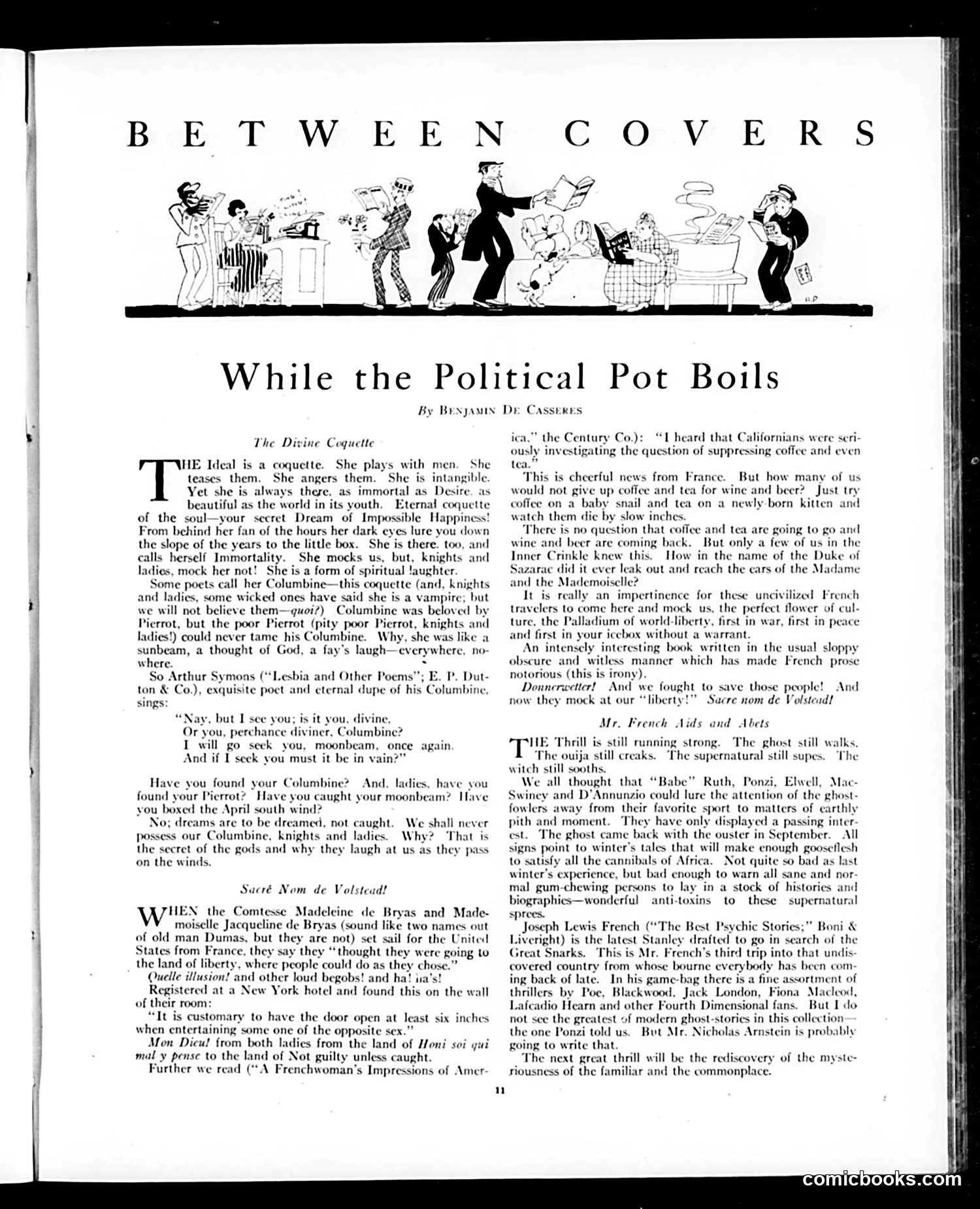
This page from Judge combines literary criticism with political satire about Prohibition-era America. **The Cover Illustration** depicts various figures in chaos—likely representing competing political interests during the heated debates over Prohibition ("While the Political Pot Boils"). **"The Divine Coquette"** section reviews poetry by Arthur Symons, using theatrical metaphors about an elusive ideal (Columbine, the stock character). **The Main Satire** ("Sacré Nom de Volstead!") mocks French visitors—the Countess and her daughter—who were shocked by American moral restrictions, particularly hotel rules separating unmarried couples and (more importantly) Prohibition. The author sarcastically criticizes the French for laughing at American "liberty" while America had sacrificed to help France in WWI. The reference to "Volstead" invokes the Volstead Act, which enforced Prohibition. The piece expresses indignation that foreigners dare mock American values and restrictions. **Context**: This reflects 1920s American defensiveness about Prohibition and anxiety about European criticism of American morality and "progress."
📄 Transcribed text from this page (OCR, searchable)
Machine-transcribed from the original scan — historical spelling and the odd misread are preserved.
Bek TP We EE N A While the Political Pot Boil COVER S By Brxyamty Dr Casseres The Divine Coquette JHE Ideal is a coquette. She plays with men. She teases them. She angers them. She is intangible. Yet she is ys there, as immortal as Desire. as beautiful as the world in its youth. Eternal coquette of the soul—your secret Dream of Impossible Happiness! From behind her fan of the hours her dark eyes lure you down the slope of the years to the little box. She is there. too, and calls herself Immortality. She mocks us, but, knights and ladies, mock her not! She is a form of spiritual !aughter Some poets call her Columbine—this coquette (and, knights and ladies, some wicked ones have said she is a vampire; but we will not believe them—quoi?) Columbine was beloved by Pierrot, but the poor Pierrot (pity poor Pierrot, knights and ladies!) could never tame his Columbine. Why, she was like a sunbeam, a thought of God, a fay’s laugh—everywhere, no- where. : So Arthur Symons (“‘Lesbia and Other Poems”; E. P. Dut- ton & Co.), exquisite poct and eternal dupe of his Columbine. sings: yy. but I see you; is it you, divine, Or you, perchance diviner, Columbine? I will ‘go seck you, moonbeam, once again And if I seek you must it be in vain?” Have you found your Columbine? And. ladies, have you found your Pierrot? Have you caught your moonbeam? Have you boxed the April south wind? No; dreams are to be dreamed, not caught. We shall never possess our Columbine, knights and ladies. Why? That is the secret of the gods and why they laugh at us as they pass on the winds. Sacré Nom de Volstead! HEN the Comtesse Madeleine de Bryas moiselle Jacqueline de Bryas (sound i of old man Dumas, but the and Made- two names out are not) set sail for the United States from France, they say they “thought they were going to the land of liberty, where people could do as they chose.” Quelle illusioy nd other loud begobs! and ha! ia’s! Registered at a New York hotel and found this on the wall of their room: “It is customary to have the door open at least six inches when entertaining some one of the opposite sex.” Mon Dicu! from both ladies from the land of Honi soi gui mal y pense to the land of Not guilty unless caught. Further we read (“A Frenchwoman’s Impressions of Amer. ica.” the Century Co.): “LT heard that Californians were seri- ously investigating the question of suppressing coffee and even tea.” This is cheerful news from France. But how many of us would not give up coffce and tea for wine and beer? Just try coffee on a baby snail and tea on a newly-born kitten and watch them die by slow inches. There is no question that coffee and tea are going to go and wine and beer are coming back. But only a few of us in the Inner Crinkle knew this. How in the name of the Duke of Sazarac did it ever leak out and reach the ears of the Madame and the Mademoiselle? It is really an impertinence for these uncivilized French travelers to come here and mock us, the perfect flower of cul- ture, the Palladium of world-liberty, first in war, first in peace and first in your icebox without a warrant An intensely interesting book written in the usual sloppy obscure and witless manner which has made French prose notorious (this is irony). Donnerwetter! And we fought to save those people! And now they mock at our “liberty!” Sacre nom de Volstead! Mr. French Aids and Abets HE Thrill is still running strong. The ghost still walks. The ouija still creaks. The supernatural still supes. The witch still sooths. 7 | thought that “Babe” Ruth, Ponzi, Elwell, Mac- y and D’Annunzio could lure the attention of the ghost- fowlers away from their favorite sport to matters of carthly pith and moment. They have only displayed a passing inter The ghost came back with the ouster in September. All signs point to winter's tales that will make enough gooseflesh to satisfy all the cannibals of Africa. Not quite so bad as last winter's experience, but bad enough to warn all sane and nor- gum-chewing persons to lay in a stock of histories and biographies—wonderful anti-toxins to these supernatural sprees. Joseph Lewis French (“The Best Psychic Stories;”” Boni & Liveright) is the latest Stanley drafted to go in search of the eat Snarks. This is Mr. French's third trip into that undis. covered country from whose bourne everybody has been com- ing back of late. In his game-bag there is a assortment of thrillers by Poe, Blackwood, Jack London, Fiona Macleod, Lafcadio Hearn and other Fourth Dimensional fans. But I do not see the greatest of modern ghost-stories in this collection the one Ponzi told us. But Mr, Nicholas Arnstein is probably jing to write that. he next great thrill will be the rediscovery of the myste- riousness of the familiar and the commonplace. n