
Judge, 1920-11-06 · page 5 of 32
Judge — November 6, 1920 — page 5: what you’re looking at
What you’re looking at
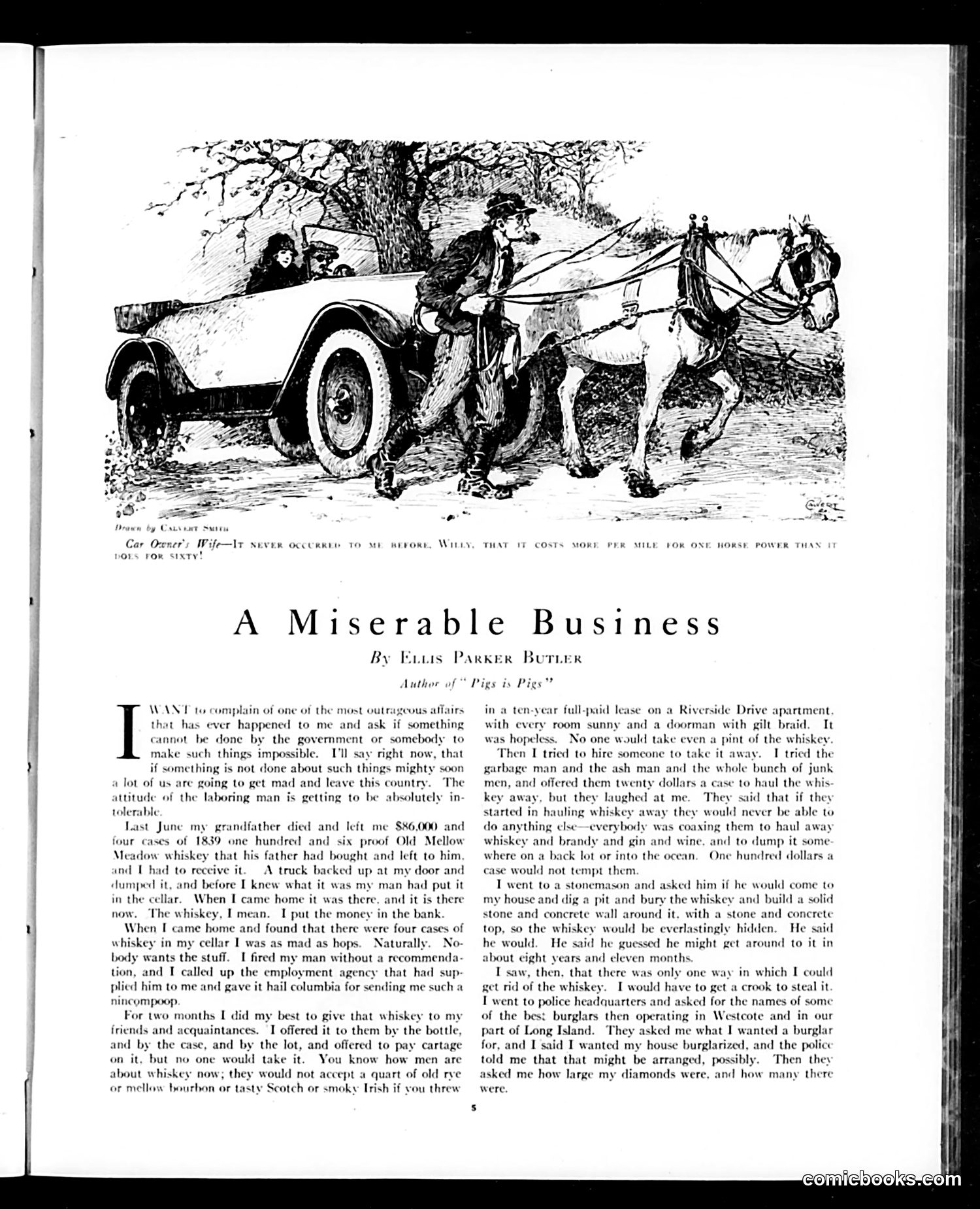
The cartoon and story "A Miserable Business" by Ellis Parker Butler illustrate Prohibition-era frustrations. The sketch shows a man attempting to transport a car being pulled by horses—a visual joke about the impracticality of trying to move forward using outdated methods. The accompanying story describes the narrator's inheritance of illegal whiskey during Prohibition and his inability to dispose of it legally. He tries various methods—giving it away, hiring people to remove it, even consulting burglars—but everyone refuses, knowing possession is a federal crime. The satire targets Prohibition's absurdity: it created situations where perfectly good property became impossible to manage or sell. The car-and-horses image symbolizes how Prohibition forced people into ridiculous, backward positions, undermining practical commerce and common sense.
📄 Transcribed text from this page (OCR, searchable)
Machine-transcribed from the original scan — historical spelling and the odd misread are preserved.
Draven surne Car Ovner’s Wife—lt sever occerniy To sth weroKE, Winty Ors FOR Sixty! THAT 1F COSTS MORE PER MILE FOR ONE HORSE POWER THAN A Miserable Business By Euuis Parker Butter Author of WANT to complain of one of the most outrageous affairs that has ever happened to me and ask if something cannot be done by the government or somebody to make such things impossible. [ll say right now, that if something is not done about such things mighty soon 1 lot of us are going to get mad and leave this country. The attitude of the laboring man is getting to be absolutely in- tolerable Last June my grandfather die nd left: me $86,000 and four cases of 1839 one hundred and six proof Old Mellow Meadow whiskey that his father had bought and left to him, ind Thad to receive it. A truck backed up at my door and dumped it, and before I knew what it was my man had put it in the cellar. When [I came home it was there, and it is there now. The whiskey, I mean. I put the money in the bank. When I came home and found that there were four cases of whiskey in my cellar I was as mad as hops. Naturally. No- body wants the stuff. I fired my man without a recommenda- tion, and T called up the employment agency that had sup- plicd him to me and gave it hail columbia for sending me such a nincompoop For two months I did my best to give that whiskey to my friends and acquaintances. I offered it to them by the bottle, and by the case, and by the lot, and offered to pay cartage on it, but no one would take it. You know how men are about whiskey now; they would not accept a quart of old rye bourbon or tasty Scotch or smoky Irish if you threw or mel in a ten-year full-paid lease on a Riverside Drive apartment. with every room sunny and a doorman with gilt braid. It was hopeless. No one would take even a pint of the whiskey. Then I tried to hire someone to take it away. I tried the garbage man and the ash man and the whole bunch of junk men, and offered them twenty dollars a case to haul the whis key away, but they laughed at me. They said that if they started in hauling whiskey away they would never be able to do anything clse—everybody was coaxing them to haul away whiskey and brandy and gin and wine, and to dump it some: where on a back lot or into the ocean. One hundred dollars a case would not tempt them I went to a stonemason and asked him if he would come to my house and dig a pit and bury the whiskey and build a solid stone and concrete wall around it. with a stone and concrete top, so the whiskey would be everlastingly hidden. He said he would. He said he guessed he might get around to it in about cight years and eleven months. T saw, then, that there was only one way in which I could get rid of the whiskey. I would have to get a crook to steal it I went to police headquarters and asked for the names of some of the bes: burglars then operating in Westcote and in our part of Long Island. They asked me wl I wanted a burglar for, and I said I wanted my house burglarized, and the police told me that that might be arranged, possibly. Then thes asked me how large my diamonds were, and how many there were.