
Judge, 1920-11-06 · page 20 of 32
Judge — November 6, 1920 — page 20: what you’re looking at
What you’re looking at
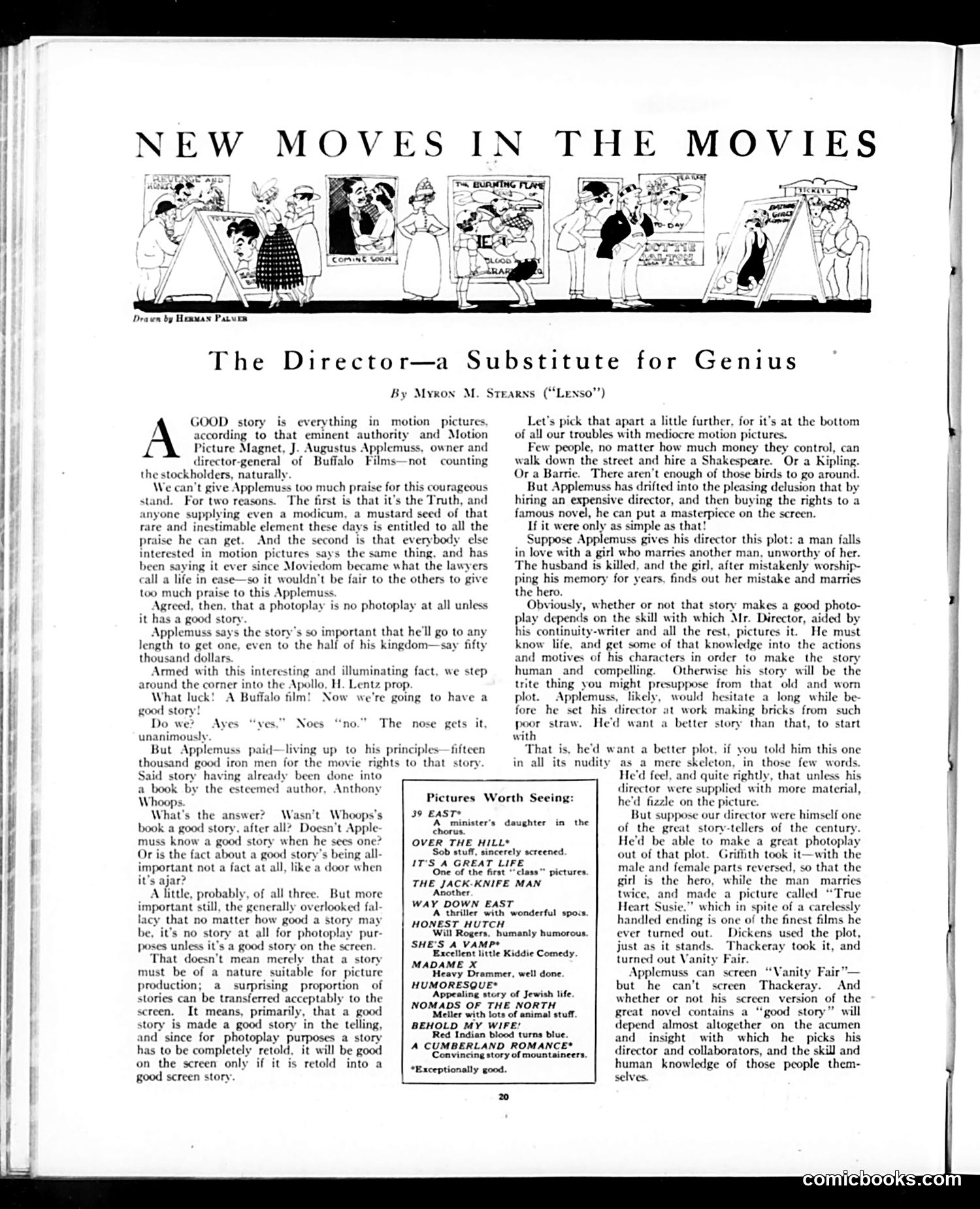
This article satirizes film producer J. Augustus Applemuss (a fictional character representing real studio moguls of the silent era) who believes that buying expensive literary properties and hiring directors automatically produces great movies. The satire's point: Applemuss paid $15,000 for film rights to a successful novel by author "Anthony Whoops," yet the resulting film flopped. The author argues that a good *story* alone doesn't make a good *film*—the story must be retold effectively for cinema. Studios mistakenly believed that hiring expensive directors and adapting famous books guaranteed quality, overlooking that filmmaking requires different storytelling skills than literature. The accompanying "Pictures Worth Seeing" sidebar lists contemporary 1920s films as examples of successful screen adaptations. The criticism reflects genuine early Hollywood struggles: adapting literature to silent film was an art executives hadn't yet mastered, leading to predictable failures despite prestigious source material and big budgets.
📄 Transcribed text from this page (OCR, searchable)
Machine-transcribed from the original scan — historical spelling and the odd misread are preserved.
——— NEW MOVES Drawn by Hexwax Paiwrn IN THE MOVIES The Director—a Substitute for Genius By Myron M. Stearns (“Lenso”’) GOOD story is everything in motion pictures, cording to that eminent authority and Motion icture Magnet, J. Augustus Applemuss, owner and director-general of Buffalo Films—not counting the stockholders, naturally. We can’t give Applemuss too much praise for this courageous stand. For two reasons. The first is that it’s the Truth, and anyone supplying even a modicum, a mustard seed of that rare and inestimable element these days is entitled to all the praise he can get. And the second is that everybody else interested in motion pictures says the same thing, and has been saying it ever since Moviedom became what the lawyers call a life in ease—so it wouldn't be fair to the others to give too much praise to this Applemuss. Agreed, then, that a photoplay is no photoplay at all unless it has a good story Applemuss says the story’s so important that he'll go to any length to get one, even to the half of his kingdom—say fifty thousand dollars. Armed with this interesting and illuminating fact, we step around the corner into the Apollo, H. Lentz prop. What luck! A Buffalo film! Now we're going to have a good story Do we? Ayes “ves,” Noes “no.” The nose gets it, unanimously But Applemuss paid—living up to his principles—fifteen thousand good iron men for the movie rights to that story aid story having already been done into a book by the esteemed author, Anthony Whoops. © Pictures Worth Seeing: What's the answer? Wasn't Whoops’s 39 EAST* book a good story. after all? Doesn't Apple- Ae muss know a good story when he sees one? Or is the fact about a good story’s being all- important not a fact at all, like a door when A little, probably, of all three. But more ‘Another, important still, the generally overlooked fal- lacy that no matter how good a Ste be, it’s no story at all for photoplay poses unless it’s a good story on the screen. That doesn’t mean merely that a story must be of a nature suitable for picture production; a surprising proportion of stories can be transferred acceptably to the screen. It means, primarily, that story is made a good story in the telling, and since for photoplay purposes a story has to be completely retold, it will be good on the screen only if it is retold into a good screen story. pur- Will Rogers. MADAME X A’ minister's daughter in the OVER THE HILL* Sob stuff, sincerely screened IT’S_A GREAT LIFE ‘One of the first it’s ajar? THE JACK-KNIFE MAN WAY DOWN EAST A thriller with wonderful spois. may HONEST HUTCH humanly humorous. SHE'S A VAMP? Excellent little Kiddie Comedy. Heavy Drammer, well done. HUMORESQUE* Appealing story of Jewish life NOMADS OF THE NORTH good Meller with lots of animal stuff. BEHOLD MY WIFE: Red Indian blood turns blue. A CUMBERLAND ROMANCE* Convincing story of mountaineers, “Exceptionally good. Let’s pick that apart a little further, for it’s at the bottom of all our troubles with mediocre motion pictures. Few people, no matter how much money they control, can walk down the street and hire a Shakespeare. Or a Kipling. Ora Barrie. There aren't enough of those birds to go around. But Applemuss has drifted into the pleasing delusion that by hiring an expensive director, and then buying the rights to a famous novel, he can put a masterpiece on the screen. If it were only as simple as that! Suppose Applemuss gives his director this plot: a man falls in love with a girl who marries another man, unworthy of her. The husband is killed, and the girl, after mistakenly ‘worship- ping his memory for years, finds out her mistake and marries the hero. Obviously, whether or not that story makes a good photo- play depends on the skill with which Mr. Director, aided by his continuity-writer and all the rest, pictures it. He must know life, and get some of that knowledge into the actions and motives of his characters in order to make the story human and compelling. Otherwise his story will be the trite thing you might presuppose from that old and wom plot. Applemuss, likely, would hesitate a long while be- fore he set his director at work making bricks from such poor straw. He'd want a better story than that, to start with That is, he'd want a better plot, if you told him this one in all its nudity a mere skeleton, in those few words. He'd feel, and quite rightly, that unless his director were supplied with more material, he'd fizzle on the picture. But suppose our director were himself one of the great story-tellers of the century He'd be able to make a great photoplay out of that plot. Griffith took it—with the and female parts reversed, so that the girl is the hero, while the man marries twice, and made a picture called “True Heart Susie.” which in spite of a carelessly handled ending is one of the finest films he ever turned out. Dickens used the plot, just as it stands. Thacke took it, and turned out Vanity Fair. Applemuss can screen “Vanity Fair”— but he can’t screen Thackeray. And whether or not his screen version great novel contains a “good story” depend almost altogether on the acumen and insight with which he picks director and collaborators, and the skill and human knowledge of those pcople them- selves. class” pictures.