
Judge, 1920-11-06 · page 3 of 32
Judge — November 6, 1920 — page 3: what you’re looking at
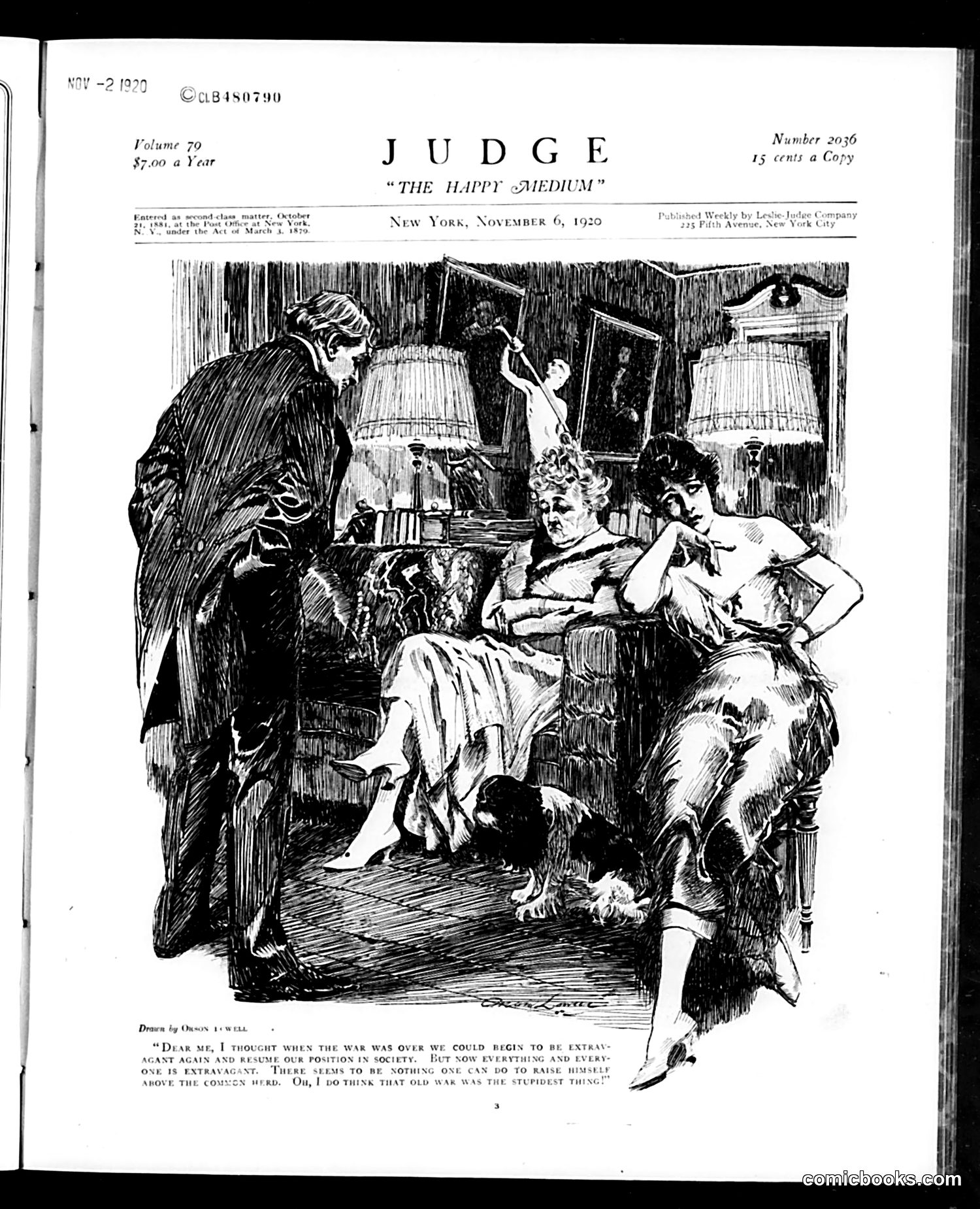
What you’re looking at
This illustration by Orson Lowell depicts a post-World War I social scene. A distinguished gentleman (left) converses with two fashionably dressed women in an elegant drawing room. The caption reveals the satire: the man laments that post-war society expected to restore social order and propriety, but instead "everything and everyone is extravagant" with "nothing one can do to raise himself above the common herd." The cartoon mocks the anxiety of the upper classes about social upheaval following WWI. The wealthy man complains that the traditional class hierarchy has collapsed—even ordinary people now behave extravagantly, making it impossible for the elite to distinguish themselves through refined conduct. It's social commentary on 1920s egalitarianism threatening traditional class distinctions.
📄 Transcribed text from this page (OCR, searchable)
Machine-transcribed from the original scan — historical spelling and the odd misread are preserved.
NOY -2 1999 ©CcBaso7gvo ee JUDGE “THE HAPPY cAIEDIUM ” New York, NovemBer 6, 1920 Drawn by Onsor sew ens “Dear we, | THOUGHT WHEN THE WAR WAS OVER WE COULD BEGIN TO BE EXTRAV- AGANT AGAIN AND RESUME OUR POSITION IN socteTY. BUT NOW EVERYTHING AND EVERY- ! PA ONE IS EXTRAVAGANT. THERE SEEMS TO BE NOTHING ONE CAN DO TO RAISE HIMSELE 4 AHOVE THE ComNcN HERD. Ou, 1 DO THINK THAT OLD WAR WAS THE STUPIDEST THING!” 3 Number 2036 15 cents a Copy