
Judge, 1920-11-06 · page 12 of 32
Judge — November 6, 1920 — page 12: what you’re looking at
What you’re looking at
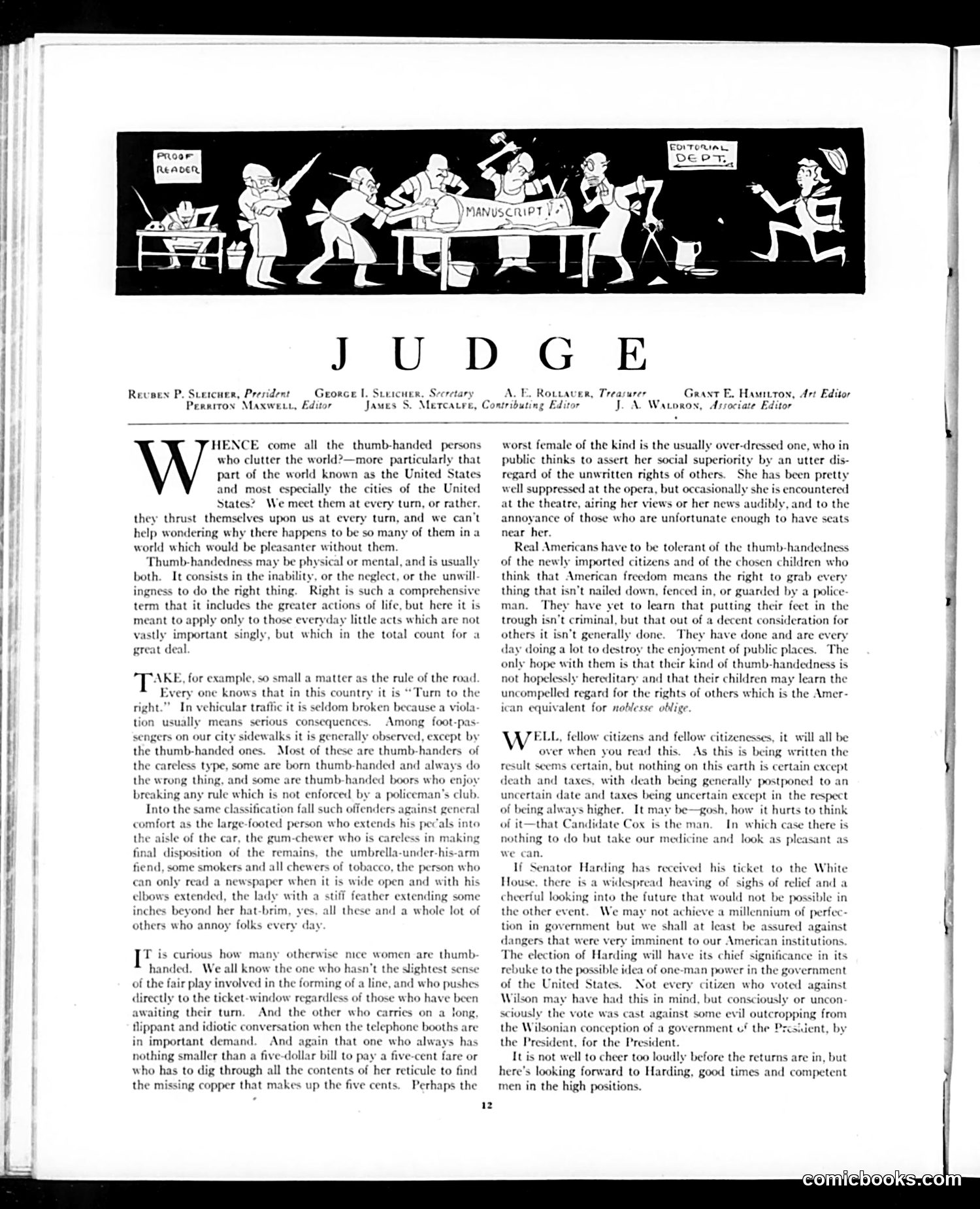
This editorial satirizes thoughtless, inconsiderate public behavior—termed "thumb-handedness" (physical or mental inability/unwillingness to "do the right thing"). The cartoon header depicts a chaotic newspaper editorial office where staff members jostle and disrupt work. The piece catalogs everyday inconsiderations: violating traffic rules, blocking sidewalks, monopolizing telephone booths, spreading newspapers wide on public transit, wearing oversized feathered hats, and—most sharply—"over-dressed" women who assert social superiority by talking loudly in theaters, ignoring others' rights. The author argues Americans must tolerate newly-arrived immigrants' and children's rudeness, hoping they'll learn civic consideration. The satire's target isn't immigrants themselves but the broader social problem of thoughtlessness in crowded modern cities. References to "Candidate Cox" and "Senator Harding" (visible in text) suggest this piece addresses post-WWI American civic behavior and social cohesion.
📄 Transcribed text from this page (OCR, searchable)
Machine-transcribed from the original scan — historical spelling and the odd misread are preserved.
PRoor Reaver JUDGE Revaes P. Srercuer, President Georce I. Steicurr. Seer Perarron Maxweut, Editor James S. Mercatre, Contributing Editor J. A. Watoros, Associate Ed: A. FE. Rottaver, Treasurer Grant E. Hasutron, Art Editor HENCE come all the thumb-handed persons who clutter the world?—more particularly that part of the world known as the United States and most especially the cities of the United States? We meet them at every turn, or rather, they thrust themselves upon us at every turn, and we can't help wondering why there happens to be so many of them ina world which would be pleasanter without them. Thumb-handedness may be physical or mental, and is usually both. It consists in the inability, or the neglect, or the unwill ingness to do the right thing. Right is such a comprehensive term that it includes the greater actions of life, but here it is meant to apply only to those everyday little acts which are not vastly important singly, but which in the total count for a KE, for example, so small a matter as the rule of the road. Every one knows that in this country it is “Turn to the right.” In vehicular traffic it is seldom broken b tion usually means serious consequences. Ame sengers on our city sidewalks it is generally observed, except by the thumb-handed ones. Most of these are thumb-handers of the careless type, some are born thumb-handed and always do the wrong thing, and some are thumb-handed boors who enjoy ‘ause a viola g foot-pas breaking any rule which is not enforced by a policeman’s club Into the same classification fall such offenders against general srt as the large-footed person who extends his pecals f the car, the gum-chewer who is careless in making final disposition of the remains, the umbrella-under-his-arm fiend, some smokers and all chewers of tobacco, the person who can only read a newspaper when it is wide open and with his elbows extended, the lady with a stiff feather extend! inches beyond her hat-brim, yes. all these and a whe { tay com the aisle g some lot others who annoy folks every « T is curious how many otherwise n men are thumb: handed. We all know the one who hasn't slightest sense of the fair play involved in the forming of a line, and who pushes directly to the ticket-window re; awaiting their turn. And the other who carries on a long, flippant and idiotic conversation when the telephone booths are in important demand. And again that one who always has nothing smaller than a five-dollar bill to pay a five-cent fare or who has to dig through all the contents of her reticule to find the missing copper that makes up the five cents. Perhaps the urdless of those who have been 12 worst female of the kind is the usually over-dressed one, who in public thinks to assert her social superiority by an utter dis- regard of the unwritten rights of others. She has been pretty well suppressed at the opera, but occasionally she is encountered at the theatre, airing her views or her news audibly, and to the annoyance of those who are unfortunate enough to have seats near her. Real Americans have to be tolerant of the thumb-handedness of the newly imported citizens and of the chosen children who think that American freedom means the right to grab every thing that isn’t nailed down, fenced in, or guarded by a police: man. They have yet to learn that putting their feet in the trough isn’t criminal, but that out of a decent consideration for others it isn’t generally done. They have done and are every day doing a lot to destroy the enjoyment of public places. The only hope with them is that their kind of thumb-handedness is not hopelessly hereditary and that their children may learn the uncompelled regard for the rights of others which is the Amer- Ali ge ican equivalent for noblesse o WELL. fellow citizens and fellow citizenesses, it will all be over when you read this. As this is being written the result seems certain, but nothing on this earth is certain except ath and taxes, with death being generally postponed to an uncertain date and taxes being uncertain except in the respect of being always higher. It may be—gosh, how it hurts to think of it—that Candidate Cox is the man. In which case there is nothing to do but take our medicine and look as pleasant as we can, If Senator Harding has received his ticket to the White House, there is a widespread heaving of sighs of relief and a cheerful looking into the future that would not be possible in the other event. We may not achieve a millennium of perfec- tion in government but we shall at least be assured against dangers that were very imminent to our American institutions. The election of Harding will have its chief significance its rebuke to the possible idea of one-man power in the government of the United States. Not every citizen who voted against Wilson may have had this in mind, but consciously or uncon sciously the vote was cast against some evil outcropping from the Wilsonian conception of a government of the the President, for the President. It is not well to cheer too loudly before the returns a here's looking forward to Harding, good times and competent men in the high positions. President, by re in, but ees |