
Judge, 1920-11-06 · page 18 of 32
Judge — November 6, 1920 — page 18: what you’re looking at
What you’re looking at
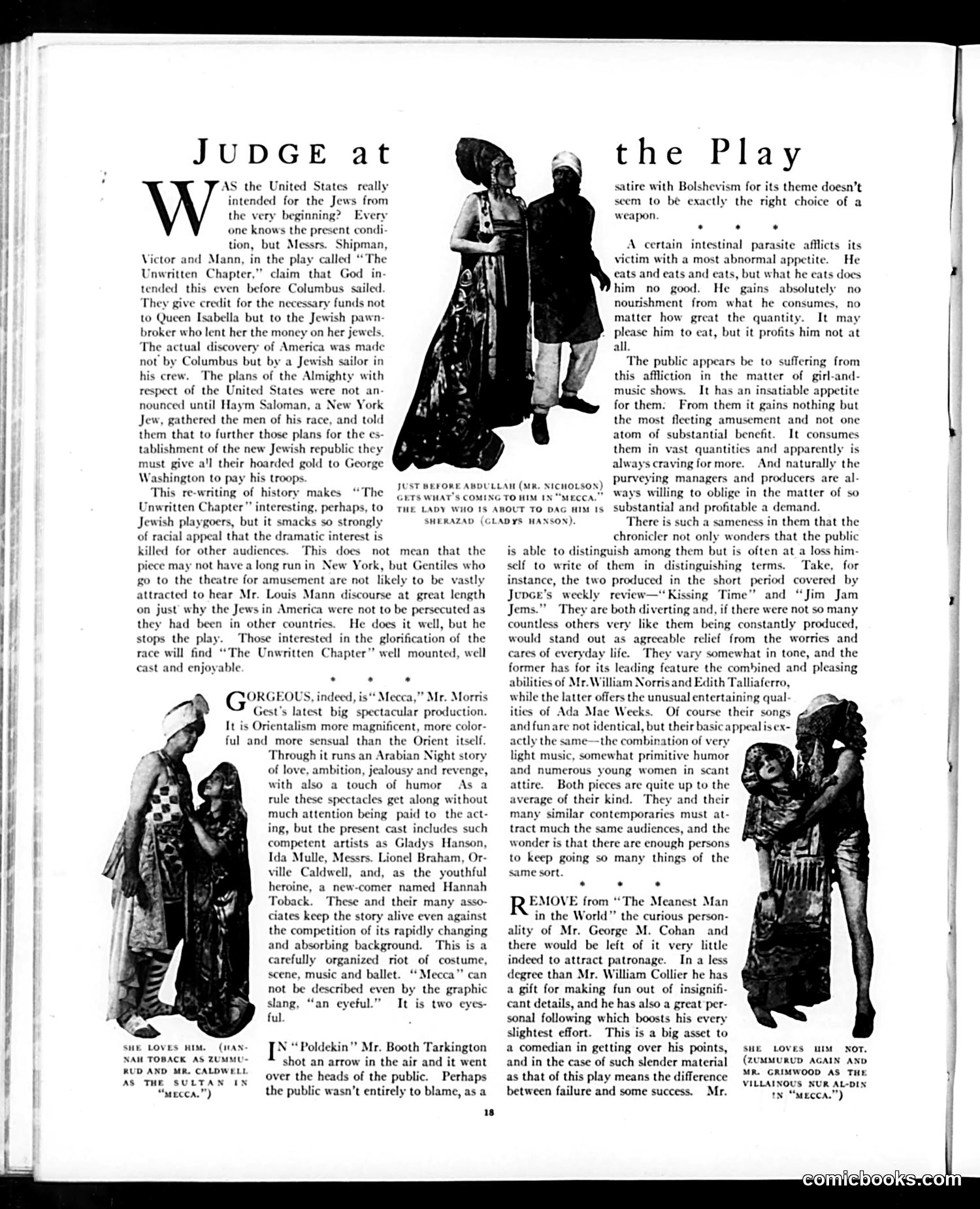
This page reviews three Broadway productions. The main critique targets "The Unwritten Chapter," a play by Shipman, Victor, and Mann starring Louis Mann. The reviewer objects that the play presents an explicitly pro-Jewish nationalist narrative—claiming Jews funded Columbus, sailed with him, and that Jewish financier Haym Salomon (historical figure) funded the American Revolution specifically to establish a "Jewish republic." The critic acknowledges the play is well-mounted but argues its heavy-handed ethnic propagandizing alienates non-Jewish audiences and undermines dramatic interest, though it may succeed commercially with Jewish theatergoers. The page also briefly reviews "Mecca," an orientalist spectacle by Morris Gest, and "Poldekin" by Booth Tarkington. The Mecca review praises its visual spectacle and cast (including Hannah Toback) while noting such productions typically rely more on scenery than acting. This reflects early 20th-century theater criticism and the era's explicit ethnic categorization of audiences and artistic appeal.
📄 Transcribed text from this page (OCR, searchable)
Machine-transcribed from the original scan — historical spelling and the odd misread are preserved.
JUDGE at AS the United States really intended for the Jews from the very beginning? Every j one knows the present condi tion, but Messrs. Shipman, Victor and Mann, in the play called “The Unwritten Chapter,” claim that God in- tended this even before Columbus sailed. They give credit for the necessary funds not to Queen Isabella but to the Jewish pawn broker who lent her the money on her jewels. The actual discovery of America was made not by Columbus but by a Jewish sailor in his crew. The plans of the Almighty with respect of the United States were not an- nounced until Haym Saloman, a New York Jew, gathered the men of his race, and told them that to further those plans for the es- tablishment of the new Jewish republic they must give a'l their hoarded gold to George Washington to pay his troops ] Jewish playgoers, but it smacks so strongly of racial appeal that the dramatic interest is killed for other audiences. This does not mean that the piece may not have a long run in New York, but Gentiles who go to the theatre for amusement are not likely to be vastly attracted to hear Mr. Louis Mann discourse at great length on just why the Jews in America were not to be persecuted as | they had been in other countries. He does it well, but he i stops the play. Those interested in the glorification of the race will find “The Unwritten Chapter” well mounted, well cast and enjoyable . . . ORGEOUS, indeed, is** Mecca,” Mr. Morris Gest’s latest big spectacular production. It is Orientalism more magnificent, more color- ful and more sensual than the Orient itself, ‘Through it runs an Arabian Night story of love, ambition, jealousy and revenge, with also a touch of humor As a rule these spectacles get along without much attention being paid to the act- ing, but the present cast includes such competent artists as Gladys Hanson, Ida Mulle, Messrs. Lionel Braham, Or- ville Caldwell, and, as the youthful heroine, a new-comer named Hannah Toback. These and their many asso- ciates keep the story alive even against the competition of its rapidly changing and absorbing background. This is a carefully organized riot of costume, scene, music and ballet. ‘ Mecca” can not be described even by the graphic slang, ‘‘an eyeful.” It is two eyes- ful. « SUE LOVES HIM. (IAN. N “Poldekin” Mr. Booth Tarkington NAM TOBACK AS piee . shot an arrow in the air and it went RUD AND ME. CALDWELL over the heads of the public. Perhaps AS THE SULTAN IN d Oe “seecea.”) the public wasn’t entirely to blame, as a 18 prs oe Ss Geer, JUST BEFORE ABDULLAM (MR. NICHOLSON) ae This re-writing of history makes (nee eee ee aie a oii re'inecean’ Ways willing to obli Unwritten Chapter” interesting, perhaps, to rue Lapy wito ts ABOUT TO DAG Him 1s Substantial and profitable a demand. SHERAZAD (GLADYS HANSON). the Play satire with Bolshevism for its theme doesn’t seem to be exactly the right choice of a weapon . . . A certain intestinal parasite afflicts its victim with a most abnormal appetite. He s and eats and eats, but what he eats does him no good. He gains absolutely no nourishment from what he consumes, no matter how great the quantity. It may please him to eat, but it profits him not at all. The public appears be to suffering from this affliction in the matter of girl-and- music shows. It has an insatiable appetite for them: From them it gains nothing but the most fleeting amusement and not one atom of substantial benefit. It consumes them in vast quantities and apparently is always craving for more. And naturally the purveying managers and producers are al- in the matter of so There is such a sameness in them that the chronicler not only wonders that the public is able to distinguish among them but is often at a loss him- self to write of them in distinguishing terms. Take, for instance, the two produced in the short period covered by Jupce’s weekly review—“Kissing Time” and “Jim Jam Jems.”” They are both diverting and, if there were not so many countless others very like them being constantly produced, would stand out as agreeable relief from the worries and cares of everyday life. They vary somewhat in tone, and the former has for its leading feature the combined and pleasing abilities of Mr. William Norris and Edith Talliaferro, while the latter offers the unusual entertaining qual ities of Ada Mae Weeks. Of course their songs and fun are not identical, but their basic appeal is ex- actly the same—the combination of very light music, somewhat primitive humor and numerous young women in scant tire. Both pieces are quite up to the average of their kind. They and their many similar contemporaries must at- tract much the same audiences, and the wonder is that there are enough persons to keep going so many things of the same sort. . . . EMOVE from “The Meanest Man in the World” the curious person- ality of Mr. George M. Cohan and there would be left of it very little indeed to attract patronage. In a less degree than Mr. William Collier he has a gift for making fun out of insignifi- cant details, and he has also a great per- sonal following which boosts his every slightest effort. This is a big asset to a comedian in getting over his points, sux Loves umm Not. and in the case of such slender material (2UMMURUD AGAIN AND as that of this play means the difference M¥ GRIMWOOD AS THE . VILLAINOUS. NUR AL-DIN between failure and some success. Mr. ty aeeca.”)