
Judge, 1920-11-06 · page 8 of 32
Judge — November 6, 1920 — page 8: what you’re looking at
What you’re looking at
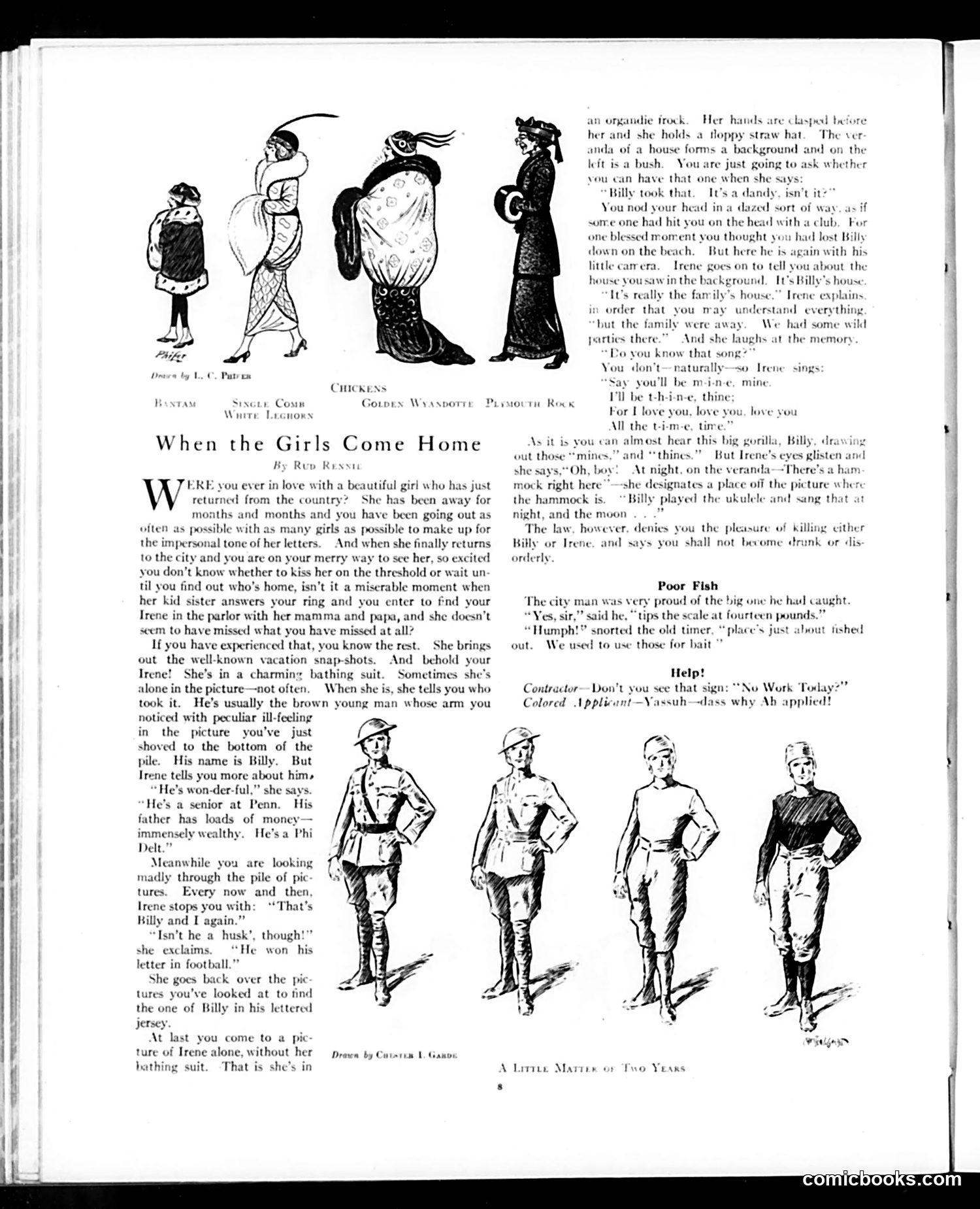
This page contains a satirical short story titled "When the Girls Come Home" about romantic jealousy. The narrative depicts a young man visiting his girlfriend Irene after her summer vacation in the country. She enthusiastically shows him photographs from her time away, repeatedly featuring a wealthy, athletic young man named Billy—who appears in nearly every picture. As Irene describes Billy's accomplishments (football letter, Phi Delta Theta fraternity membership, wealthy family) and sings romantic songs they shared, the narrator grows increasingly frustrated and jealous, ultimately wishing he could harm them both (though legally prevented). The satire mocks both male insecurity and the casual cruelty of women who flaunt their summer romantic interests to their jealous city suitors. Below are two brief joke items: "Poor Fish" (about fishing depletion) and "Help!" (a racial stereotype joke about a Black applicant misunderstanding a "No Work Today" sign). The page includes fashion illustrations titled "A Little Matter of Two Years" showing women's clothing evolution, drawn by Cesare L. Giardino.
📄 Transcribed text from this page (OCR, searchable)
Machine-transcribed from the original scan — historical spelling and the odd misread are preserved.
CHICKENS Stxete Comm Gotpex Wyasporrs Whore Lecnors When the Girls Come Home By Rup Resxst \ ERE you ever in love with a beautiful girl who has just returned from the country? She has been away for months and months and you have been going out as witen as possible with as many girls as possible to make up for the impersonal tone of her letters. And when she finally returns to the city and you are on your merry way to see her, so excited you don’t know whether to kiss her on the threshold or wait un til you find out who's home, isn’t it a miserable moment when her kid sister answers your ring and you enter to fnd your Irene in the parlor with her mamma and papa, and she doesn’t seem to have missed what you have missed at all? If you have experienced that, you know the rest. She brings out the well-known vacation snap-shots. And behold your Irene! She’s in a charming bathing suit. Sometimes she’s alone in the picture—not often. When she is, she tells you who took it. He’s usually the brown young man whose arm you noticed with peculiar ill-feeling in the picture you've just shoved to the bottom of the pile. His name is Billy. But Irene tells you more about him» *He’s won-der-ful,” she says. He’s a senior at Penn. His father has loads of money— immensely wealthy. He's a Phi Delt.” Meanwhile you are looking madly through the pile of pic tures. Every now and then, Irene stops you with: “That's Hilly and I again.” ‘Isn't he a hu: though!” she exclaims. “He won his letter in football.” She goes back over the pic tures you've looked at to find the one of Billy in his lettered jersey. At last you come to a pic ture of Irene alone, without her — praen by Carsrun b. Ganne bathing suit. That is she’s in an organdie frock. Her hands are clasped bei her and she holds a floppy straw hat. The ver anda of a house forms a background and on the left isa bush. You are just going to ask whether you ean have that one when she says Billy took that. It’s a dandy, isn’t it?” You nod your head ina daz some one had hit you on the head with a club, For one blessed moment you thought you had lost Billy down on the beach. But here he is again with his little carrera. Irene goes on to tell you about the house vou saw inthe background, [t's Billy’s house It’s really the farrily’s house.” Irene explains 1 sort of way in order that you may understand everythir but the family were away. We had some wild yerties there.” And she laughs at the memory Do you know that song You don’'t—naturally—so frene sings Say you'll be m-i-n-e, mine Vl be t-h-i-n-e, thine For I love y Ml the t-i-m-e, time.” As it is you can almost hear this big gorilla, Billy, drawing moutH Rook 1, love you, love you out those “mines.”? and “thines.”” But Irene’s eves glisten a she says," Oh, boy A\t night, on the veranda—There’s a ham mock right here”’—she designates a place off the picture where the hammock is. Billy played the ukulele and sang that at night, and the moon ‘” The law, however. denies you the pleasure of killing cither Billy or Irene. and says you shall not become drunk or dis orderly Poor Fish ‘The man was very proud of the big one he had caught. “y r,”’ said he, “tips the scale at fourteen pounds.” “Humph!” snorted the old timer, “place's just about fished out. We used to use those for bait Help! Contractor— Don't you see that sign: “No Work ‘Toda Colored A pplicunt—Vassuh—dass why Ab applied! A Livtte Marien or Pwo Years