
A complete issue · 32 pages · 1920
Judge — September 4, 1920
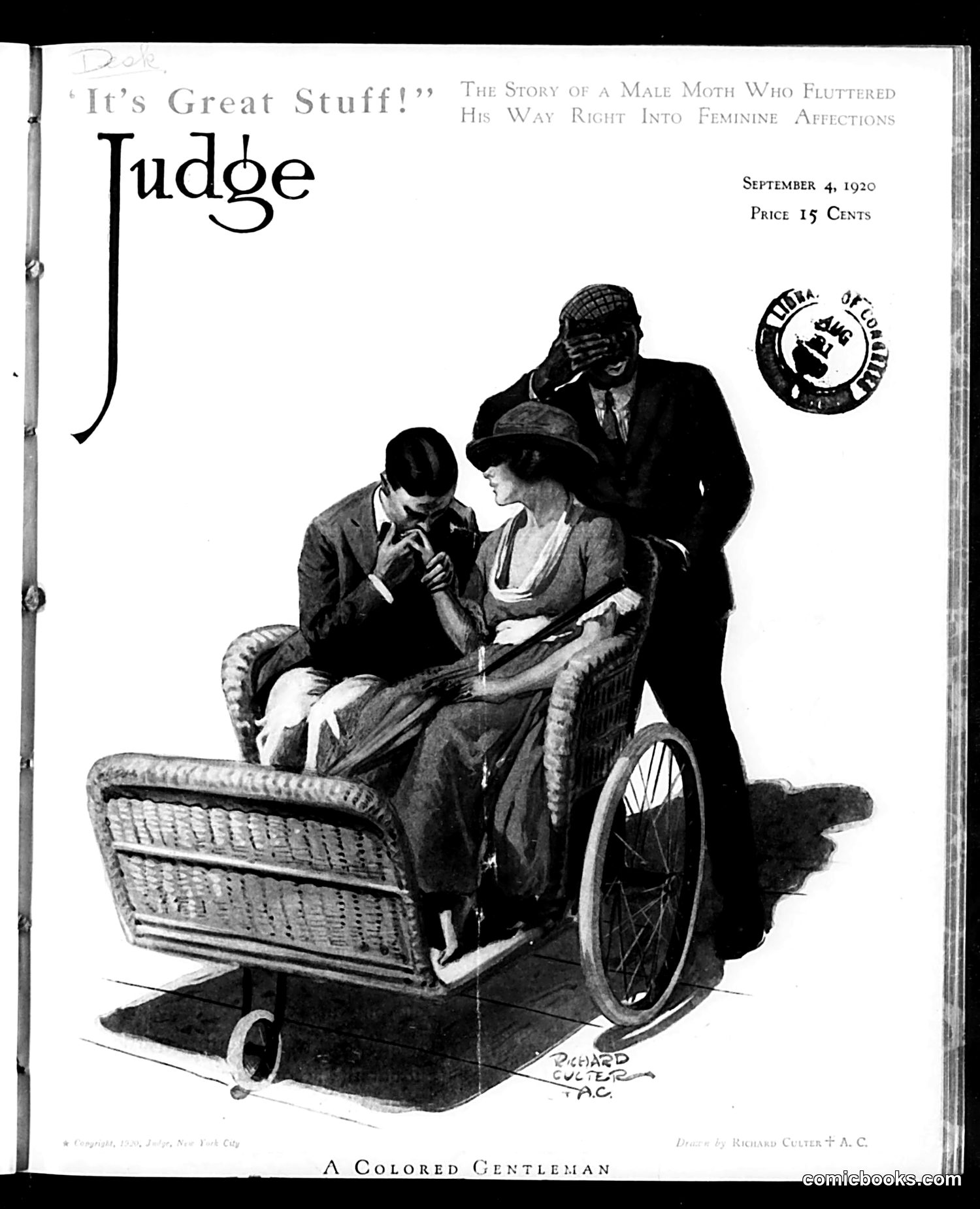
This *Judge* magazine cover from September 4, 1920 presents a satirical illustration titled "A Colored Gentleman" by Richard Culter. The subtitle—"The Story of a Male Moth Who Fluttered His Way Right Into Feminine Affections"—uses insect metaphor as a thin veil for commentary on race and attraction. The image depicts three figures in a bicycle rickshaw: a woman in the center appears receptive to attention from two men (one seated beside her, one standing behind). The "colored gentleman" reference and the "moth" metaphor suggest the cartoon satirizes interracial romantic or social interactions, reflecting the racist attitudes prevalent in 1920s American media. The humor relies on dehumanizing caricature typical of that era's deeply prejudiced publication standards.
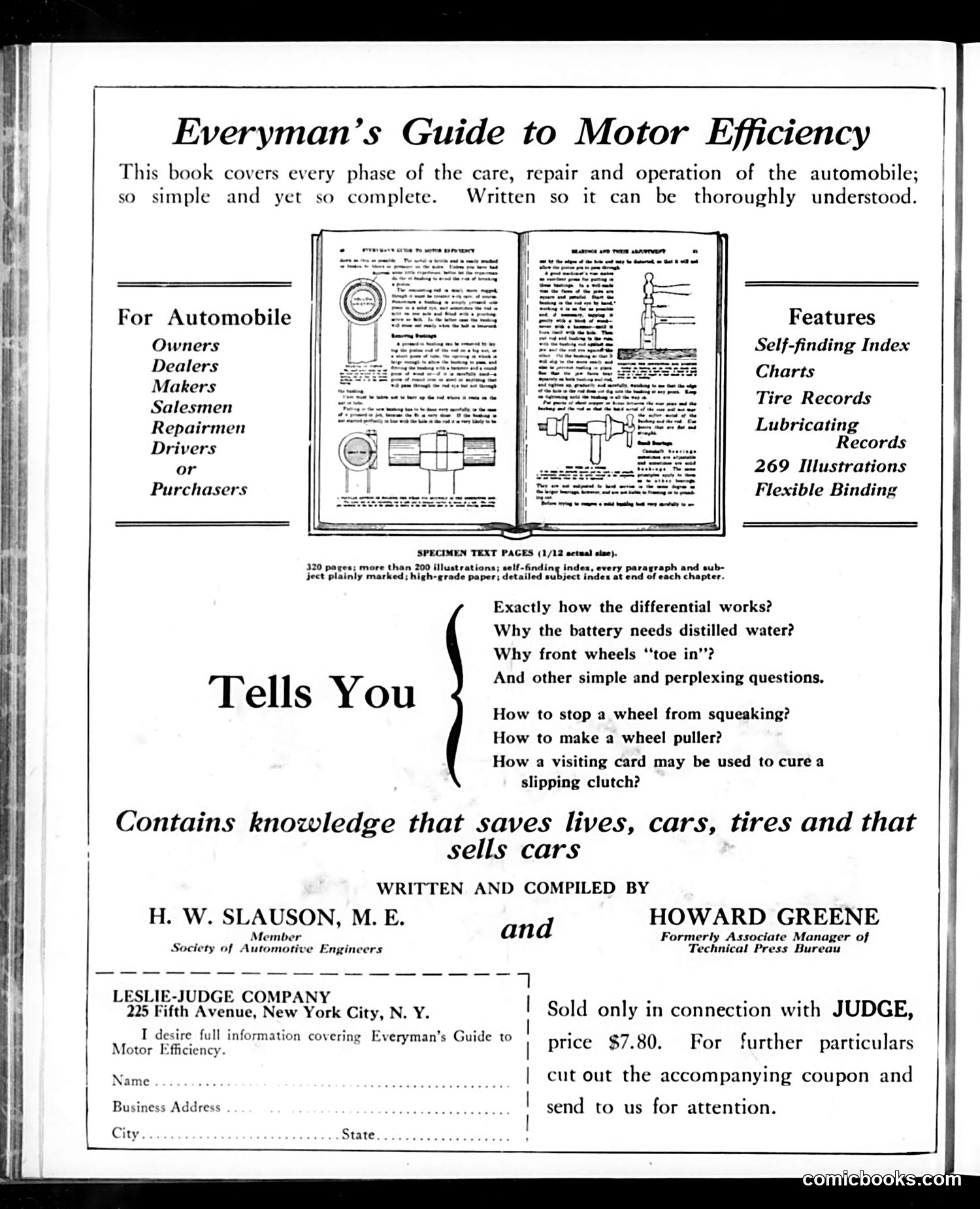
This page is **primarily advertising**, not political satire. It promotes "Everyman's Guide to Motor Efficiency," a 320-page automobile maintenance manual published by Leslie-Judge Company in New York City, priced at $7.80. The content targets practical audiences: car owners, dealers, salesmen, repairmen, and drivers. The book promises to explain automotive mechanics through 269 illustrations and a self-finding index, answering questions like how differentials work and why batteries need distilled water. The only quasi-humorous element is the "Tells You" section, which lists quirky practical tips (stopping wheel squeaks, making a wheel puller) presented in a tongue-in-cheek tone. However, this is straightforward instructional marketing rather than political or social satire.
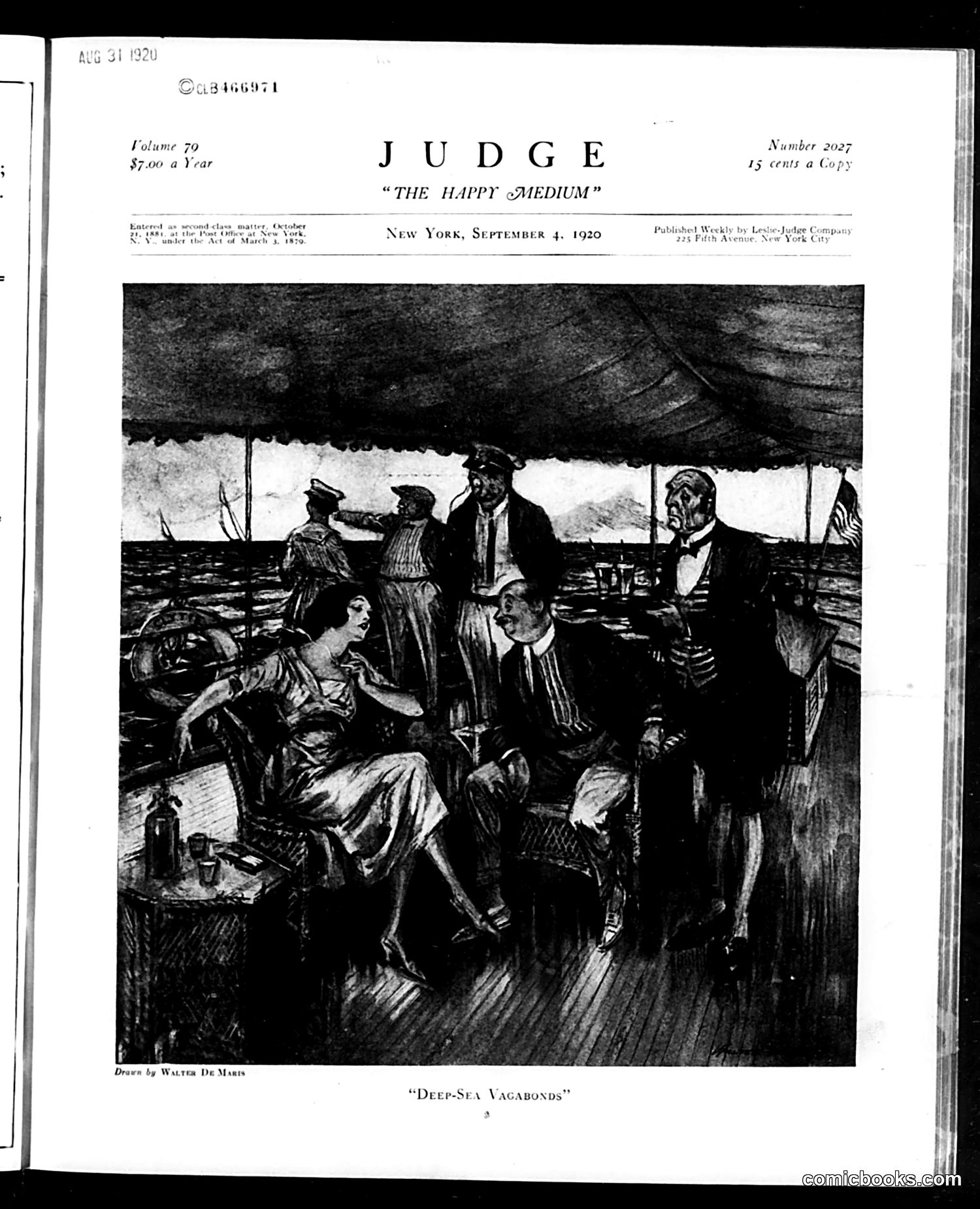
This September 4, 1920 *Judge* cartoon, drawn by Walter De Maris, depicts well-dressed passengers aboard a ship under an awning. The title "Deep-Sea Vagabonds" appears ironic—these are clearly wealthy travelers, not actual vagabonds. The cartoon likely satirizes wealthy Americans taking luxury ocean voyages during the early 1920s, perhaps mocking their leisure pursuits or idle wandering. The formal dress and relaxed shipboard setting suggest the cartoon comments on the leisure class enjoying expensive travel. Without additional context, the specific political or social target remains unclear, though it may relate to post-World War I attitudes toward wealth, class, or American leisure culture during the Roaring Twenties.
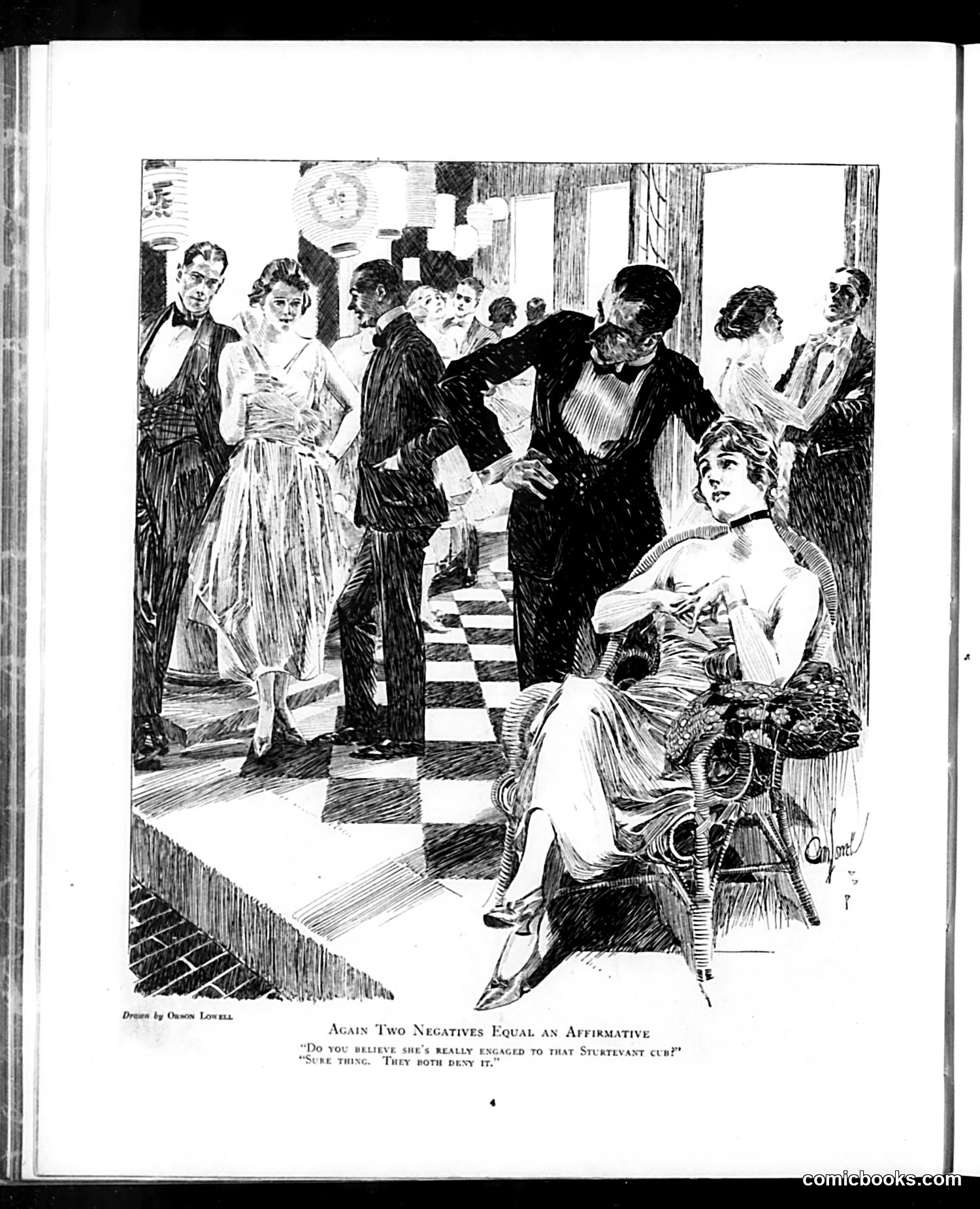
This Judge magazine cartoon satirizes social hypocrisy regarding engagements and denials. The title plays on the logical principle that two negatives make a positive. The scene depicts a formal social gathering where a seated woman denies being engaged to a "Stubbyvast Cub" (unclear reference, possibly a nickname or social type). A man gestures while speaking to others, seemingly spreading gossip or contradiction. The satire targets the contradiction between public denials and private reality—two people both denying an engagement suggests they're actually engaged, since mutual denial appears suspicious or coordinated. This mocks how high society handles romantic rumors through carefully rehearsed denials that often confirm what they're meant to conceal. The drawing style and formal dress indicate upper-class social circles as the target.
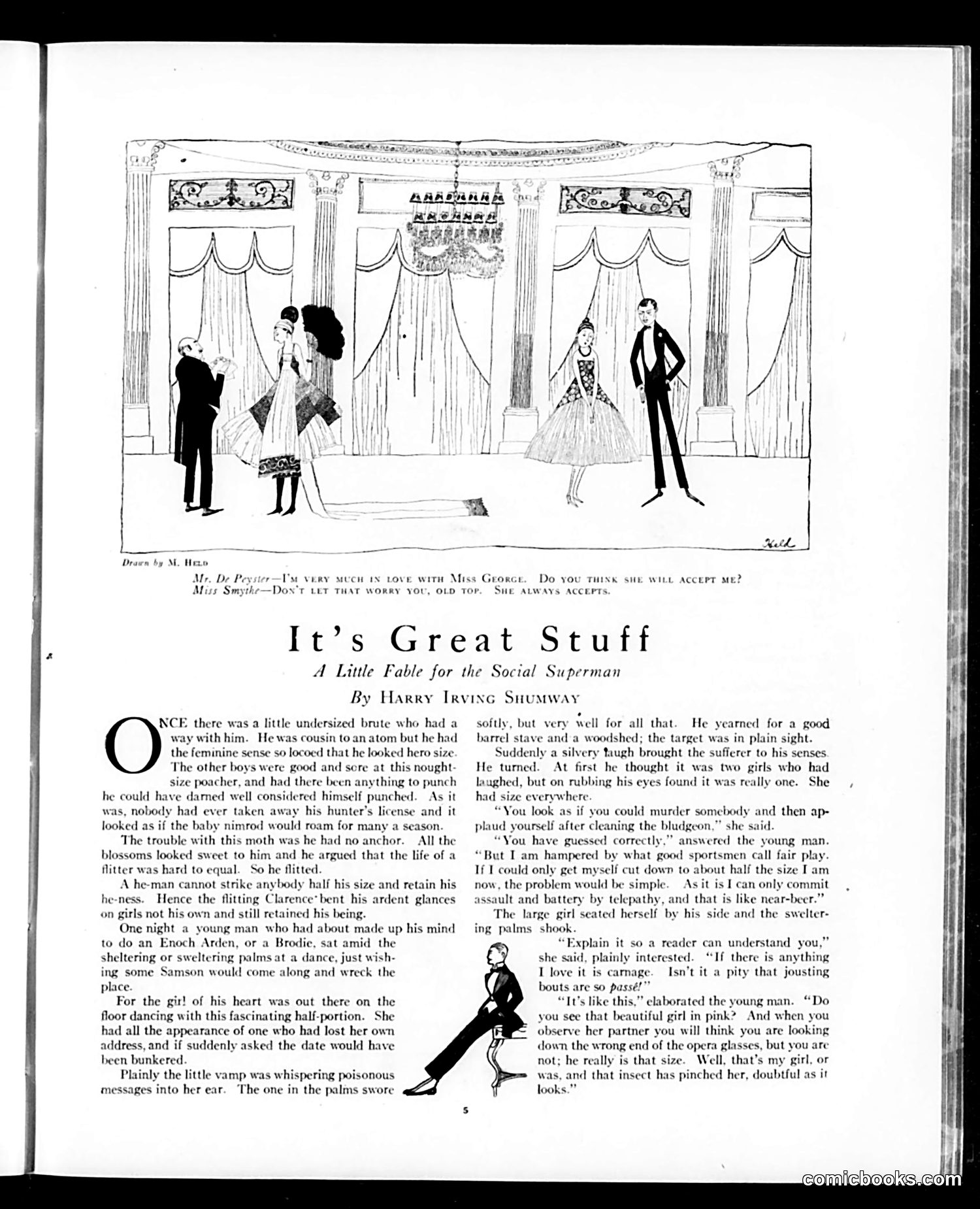
**The Cartoon (top):** This is a society drawing satirizing courtship among the wealthy. A nervous suitor asks an older gentleman (likely the girl's father) for permission to propose to "Miss George," expressing anxiety about acceptance. The father reassures him that "She always accepts"—suggesting the young woman is so eager to marry that she'll accept any proposal. The joke mocks both the girl's desperation and the formal ritual of asking paternal permission, standard among upper-class families of the era. **The Story Below:** "It's Great Stuff" is a comic fable about a shy, undersized young man at a dance who becomes emboldened after drinking, then attempts to impress a girl by punching someone. The satire targets masculine insecurity and alcohol-fueled bravado among young men navigating social situations. Both pieces humorously critique early 20th-century courtship customs and male anxiety.
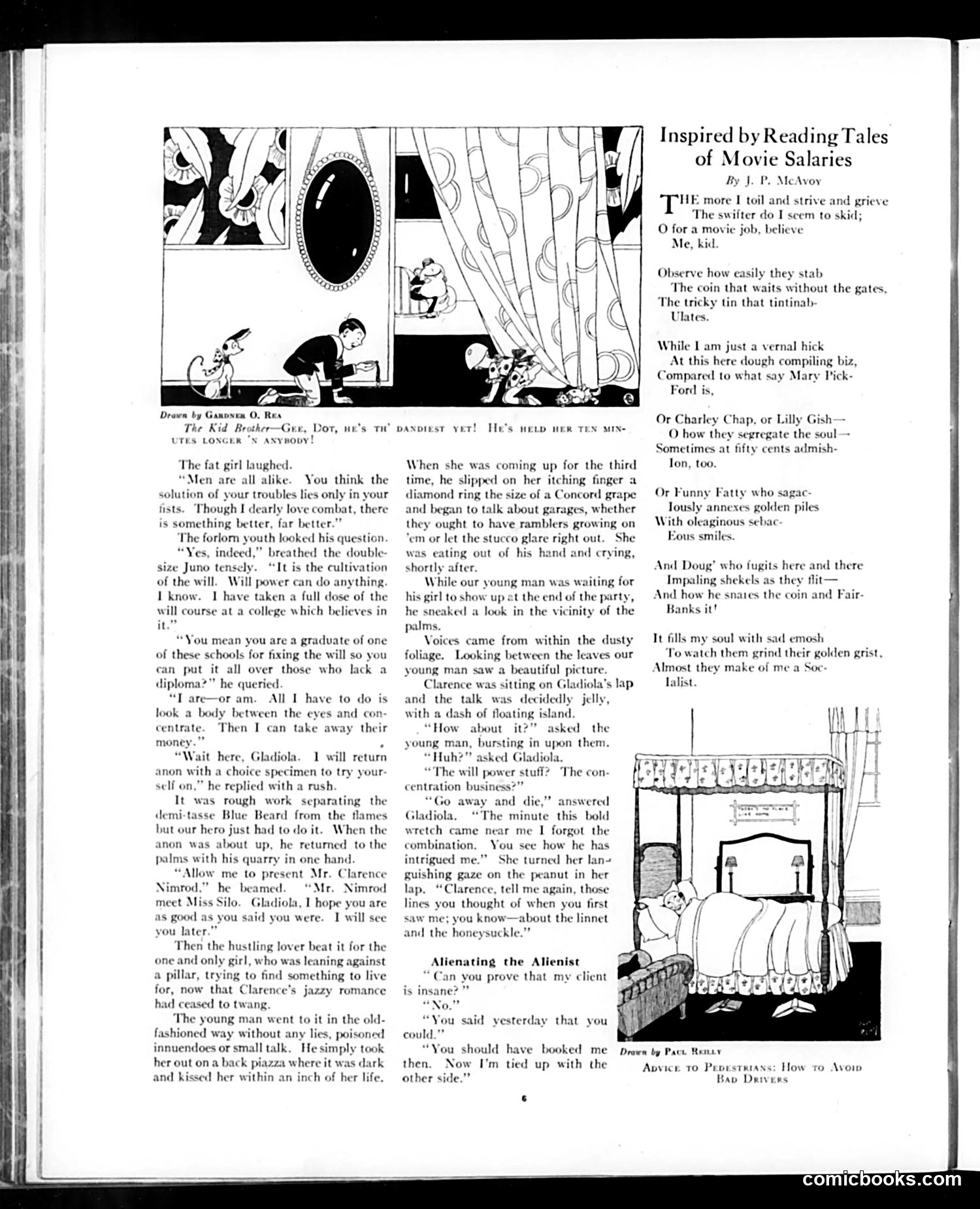
This page contains two distinct pieces: **Left side:** A short story titled "The Kid Broker" illustrated by Gantonia O. Bea, depicting a young girl negotiating financial matters (discussing wills, trusts, and money management) with adult sophistication. The satire targets child prodigies and precocious youth who adopt adult behaviors. **Right side:** A poem "Inspired by Reading Tales of Movie Salaries" by J.P. McAvoy lamenting writers' struggles compared to film industry wealth. References include Mary Pickford, Charlie Chaplin, and Fatty Arbuckle—major silent film stars whose substantial salaries contrasted sharply with writers' compensation during Hollywood's early era. **Bottom illustration** by Paul Henley titled "Advice to Pedestrians: How to Avoid Bad Drivers" shows a bedroom scene, apparently suggesting one should stay indoors to avoid traffic dangers.
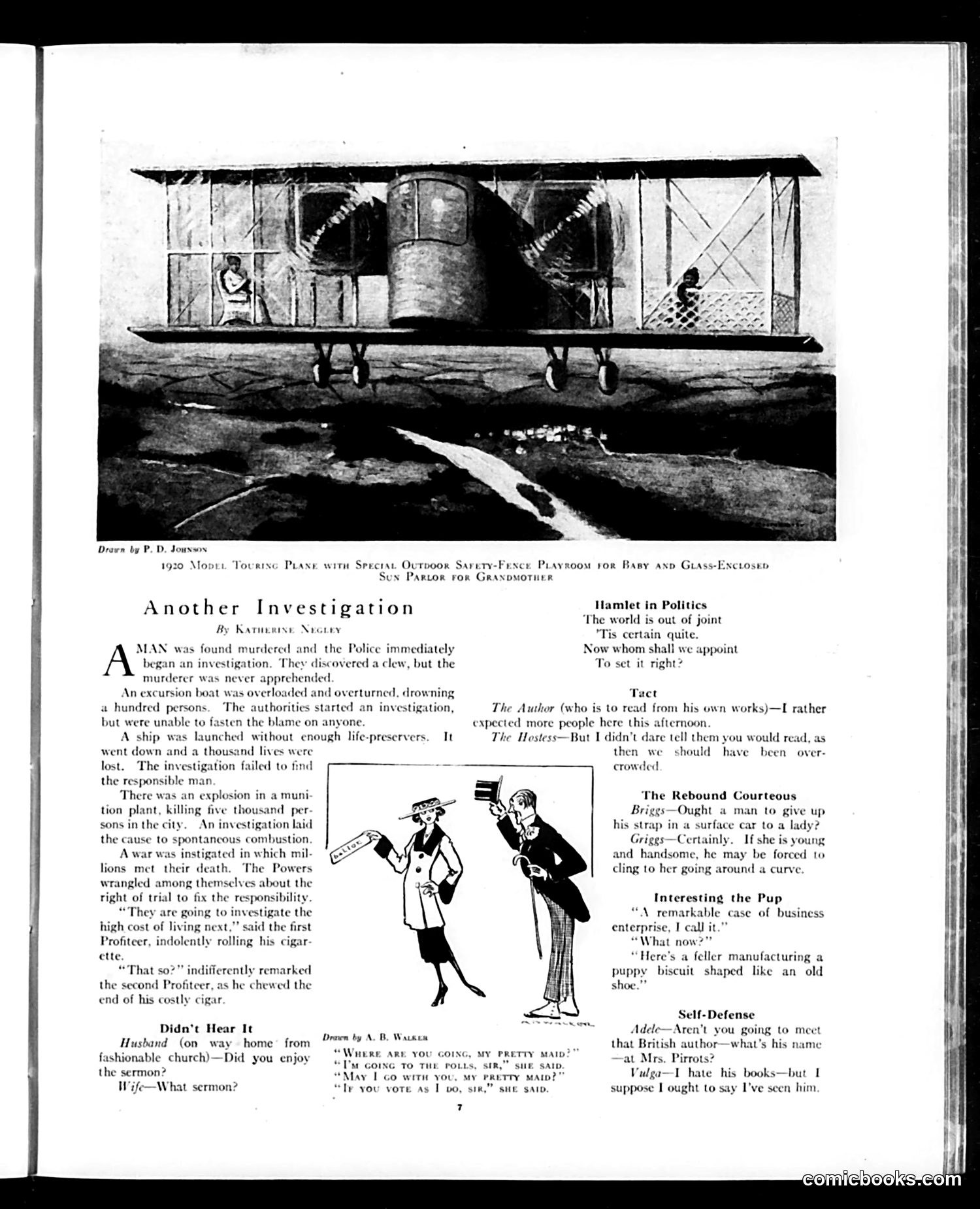
This 1920 *Judge* page satirizes bureaucratic incompetence and profiteering during the Progressive Era. **"Another Investigation"** (main story by Katherine Negley) mocks official investigations into major disasters—murdered victims, capsized ships, industrial explosions killing thousands—where authorities consistently fail to assign responsibility. The punchline: profiteers remain unconcerned because the government will inevitably investigate the "high cost of living next" with equal ineffectiveness. This targets both corporate negligence and government's inability or unwillingness to hold the powerful accountable. **Secondary items** include lighter social humor: a husband who didn't listen to church sermons, a woman humorously claiming she'll vote (contemporary to women's suffrage), and a joke about British literary snobbery. The airplane illustration at top depicts contemporary aviation technology—unrelated to the text below. The satire reflects Progressive-Era frustration with corporate malfeasance, governmental inadequacy, and the sense that investigations served as theatrical performances masking inaction rather than genuine accountability.
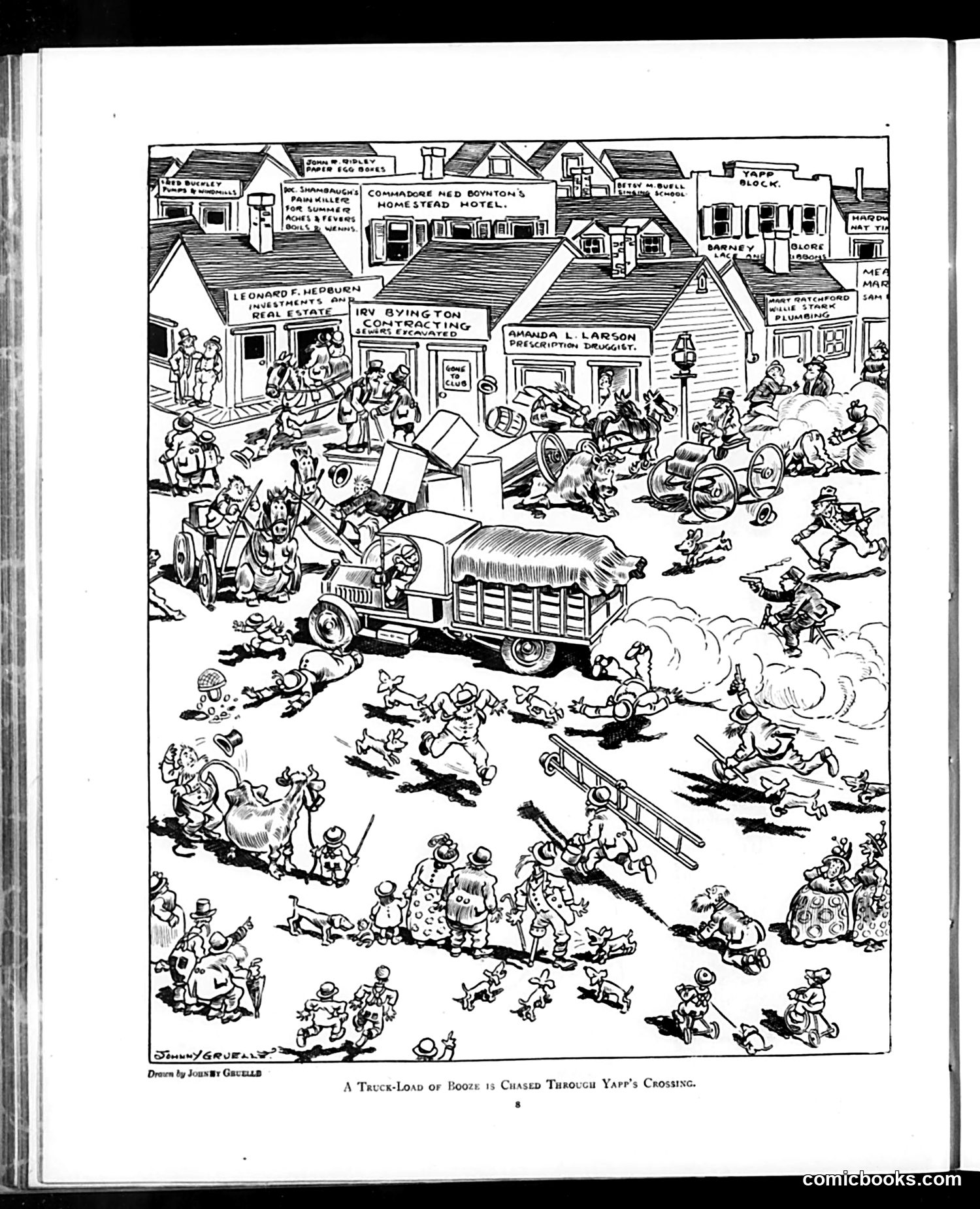
This cartoon satirizes Prohibition-era bootlegging. The scene depicts chaos in a small town as a truck loaded with alcohol is pursued, scattering residents everywhere. Business signs visible include "Homestead Motel" and various local establishments. The satire targets the absurdity of Prohibition enforcement: a massive quantity of illegal alcohol moving openly through town, causing pandemonium among ordinary citizens. The cartoon mocks both the difficulty of enforcing the alcohol ban and the prevalence of bootlegging operations that continued despite the law. The artist is **Jimmie Greivell** (per the signature). This reflects Judge magazine's typical stance criticizing Prohibition's impracticality and its chaotic social consequences during the 1920s-early 1930s.
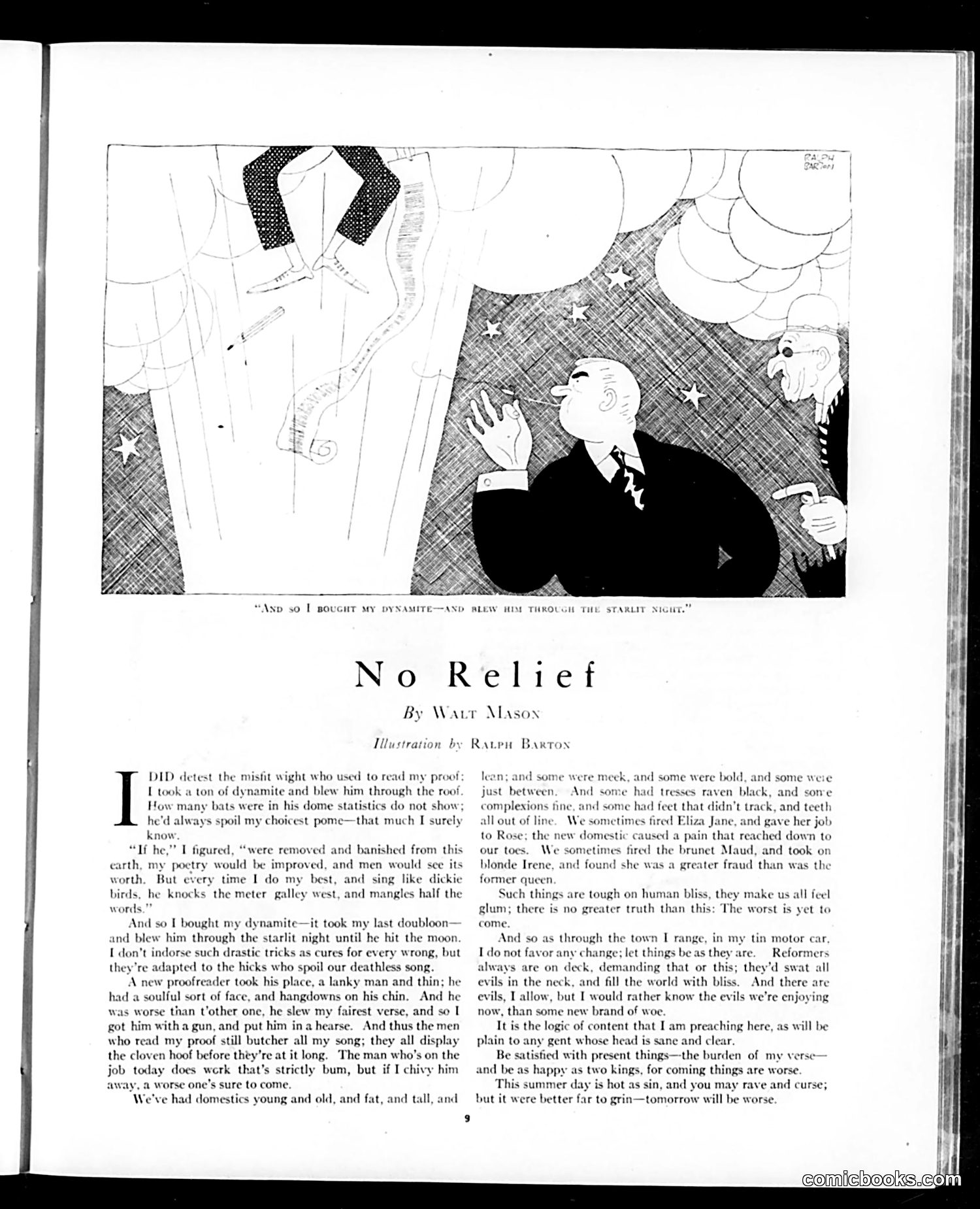
This is a humorous poem illustrated by Ralph Barton, not a political cartoon. The satirical point is a pessimistic meditation on life's inevitable disappointments. The speaker describes hiring a proofreader who constantly ruins his poetry by mangling meter and language. In frustration, he blows the man through the roof with dynamite—but the replacement is even worse. This pattern repeats: he fires domestic servants hoping for improvement, but each new hire proves a greater disaster. The poem's philosophy is darkly comic: accepting present misery because any change will only be worse. The narrator warns against "reformers" who demand to "fix" evils, arguing the devil you know beats unknown future troubles. The refrain is bleak—"tomorrow will be worse"—suggesting resignation to perpetual decline. This reflects early 20th-century conservative skepticism toward social reform and progressive change, wrapped in wry humor about universal human frustration with service workers and domestic help.
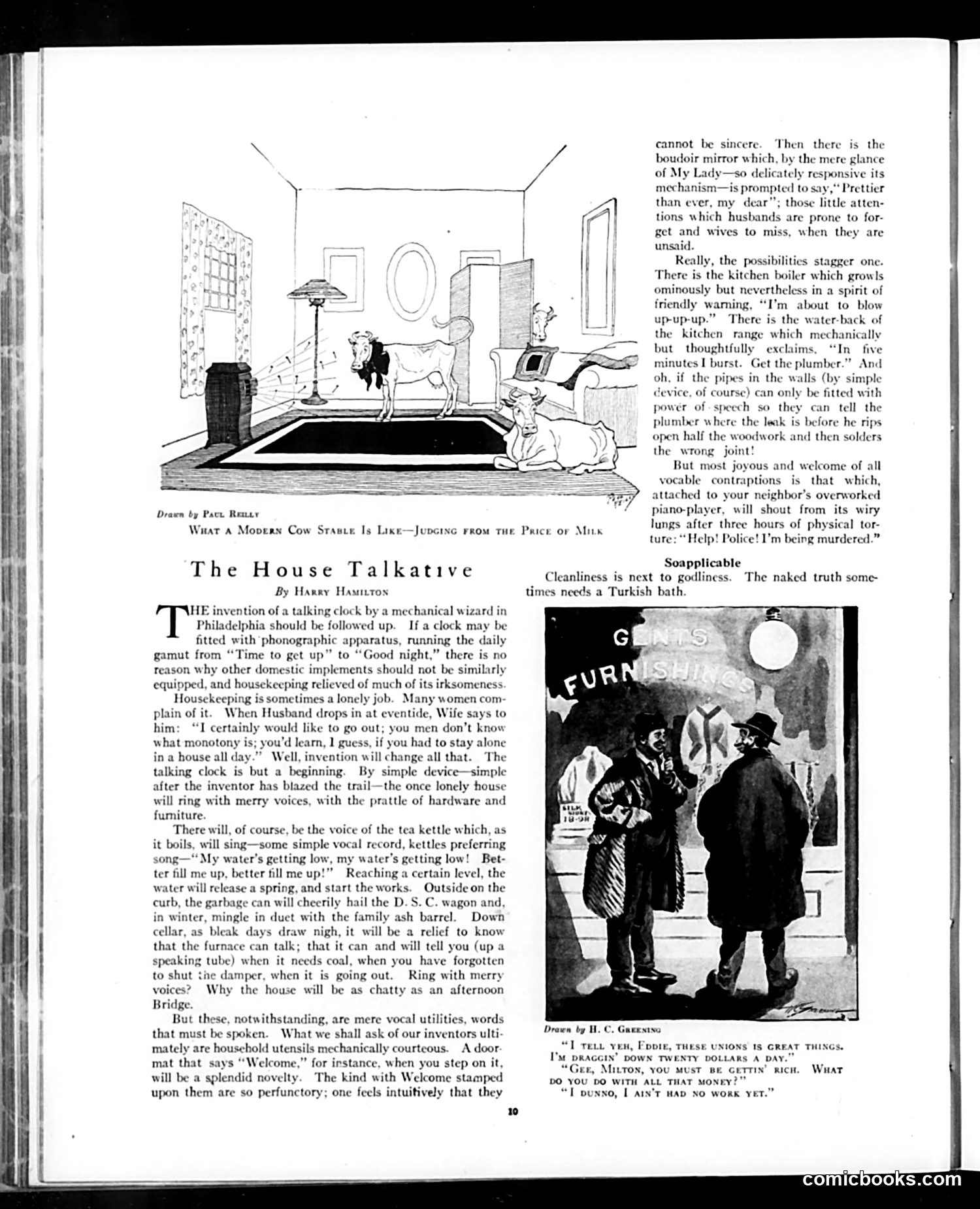
This page contains two distinct pieces of satire from an early 20th-century *Judge* magazine: **"The House Talkative"** (main article): Harry Hamilton satirizes the recent invention of the talking clock by imagining a future where all household appliances verbally communicate. He mocks the monotony of housekeeping by suggesting that lonely housewives would welcome chatty tea kettles, boilers, furnaces, and even piano players that shout "Help! Police! I'm being murdered!" after three hours. The satire targets both the isolation of domestic labor and the era's faith that mechanical solutions could solve human problems. **"What a Modern Cow Stable Is Like"** (top cartoon): Paul Revere's illustration depicts an anthropomorphized cow in a modern house interior, surrounded by furniture and fixtures. The caption jokes about judging the "price of milk"—likely satirizing how modernization affects dairy production or pricing. **Bottom photograph/caption**: Shows two men discussing union wages, with one bragging about earning "twenty dollars a day" while the other admits he "ain't had no work yet"—mocking labor union claims during the period.
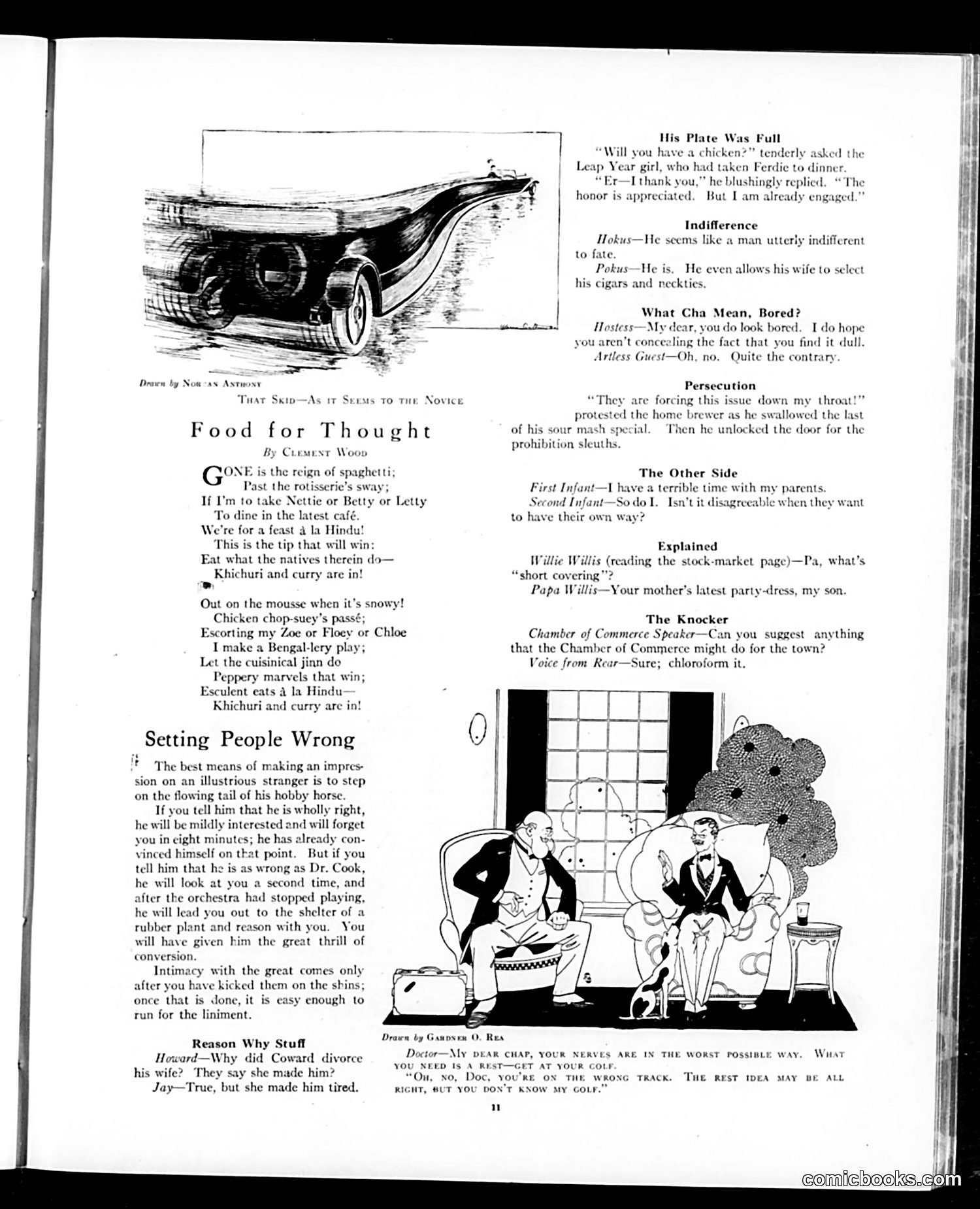
This page from *Judge* contains several brief humorous vignettes satirizing early 20th-century social conventions and contemporary issues: **"His Plate Was Full"** mocks Leap Year traditions (when women could propose to men) by showing a young man declining a dinner invitation because he's already engaged—deflating romantic expectations. **"Indifference" and "What Cha Mean, Bored?"** satirize social awkwardness and dishonesty in polite company—guests pretending to enjoy themselves while hosts anxiously probe for genuine reactions. **"Persecution"** references Prohibition-era enforcement, with a home brewer being raided by "prohibition sleuths" after serving illegal alcohol. **"Setting People Wrong"** offers cynical advice: people are more interested in disagreement than agreement—challenging someone's opinions captures their attention better than flattery. The bottom cartoon depicts a doctor advising a stressed patient to take up golf for relaxation, which the patient dismissively rejects as unhelpful. Overall, the page uses humor to critique social pretense, legal overreach, and masculine anxieties of the period.
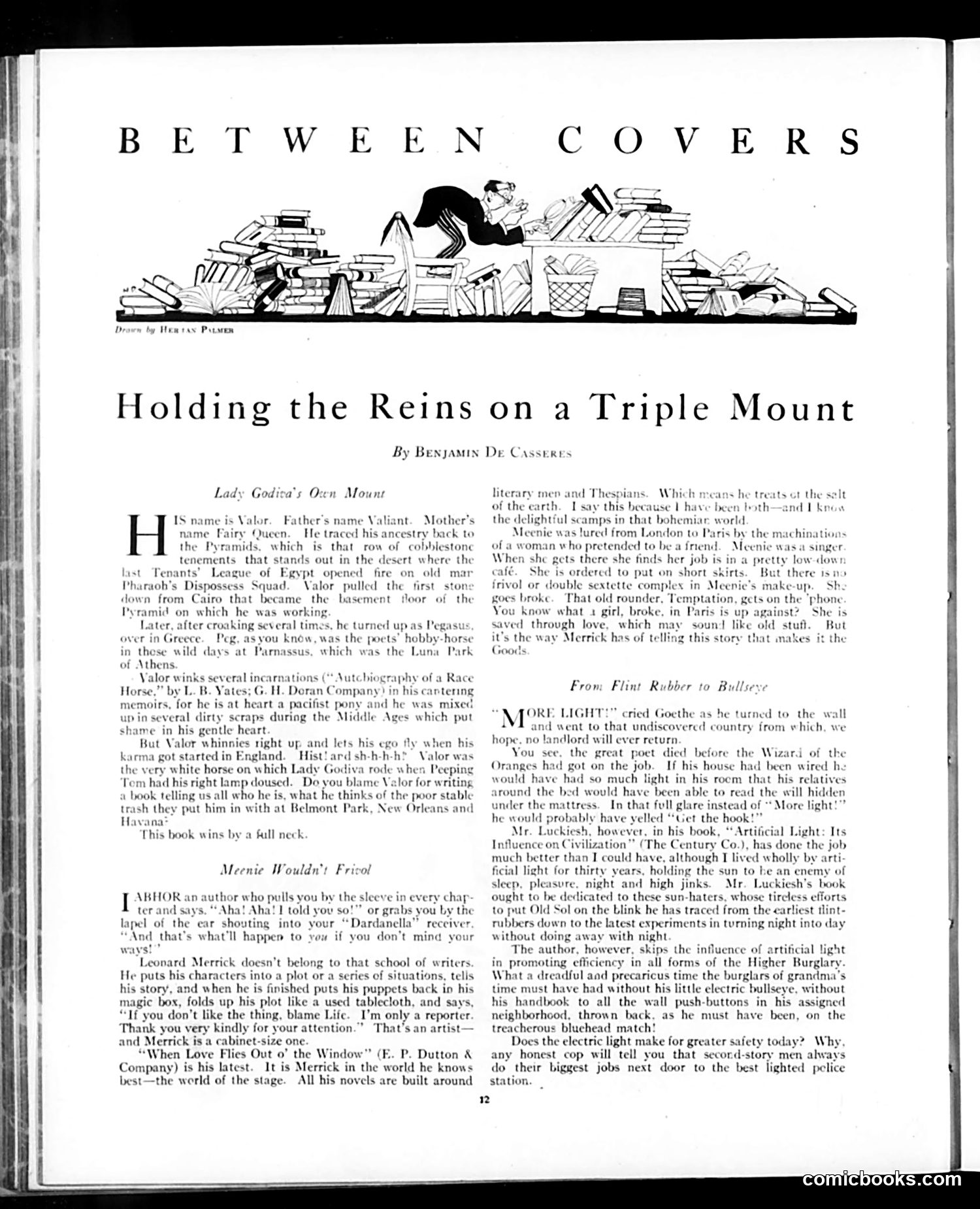
This page from *Judge* magazine consists primarily of **book reviews**, not political cartoons. The decorative header illustration shows a figure surrounded by stacked books—a common "Between Covers" column motif about literature. The reviews discuss three books: 1. **"Holding the Reins on a Triple Mount"** by Benjamin De Casseres—a satirical autobiography of a horse named Valor who claims descent from Lady Godiva's mount and reincarnates across history. 2. **"When Love Flies Out o' the Window"** by Leonard Merrick—praised as artistic storytelling about bohemian life in Paris, featuring a singer named Meenie. 3. **"Artificial Light: Its Influence on Civilization"** by Matthew Luckiesh—a serious work about electric lighting's societal impact, humorously introduced via a riff on Goethe's deathbed plea for "more light." The satire is **literary rather than political**—mocking pretentious authors and celebrating honest storytellers. The Valor review is particularly absurdist, treating a horse's invented genealogy as earnest autobiography.
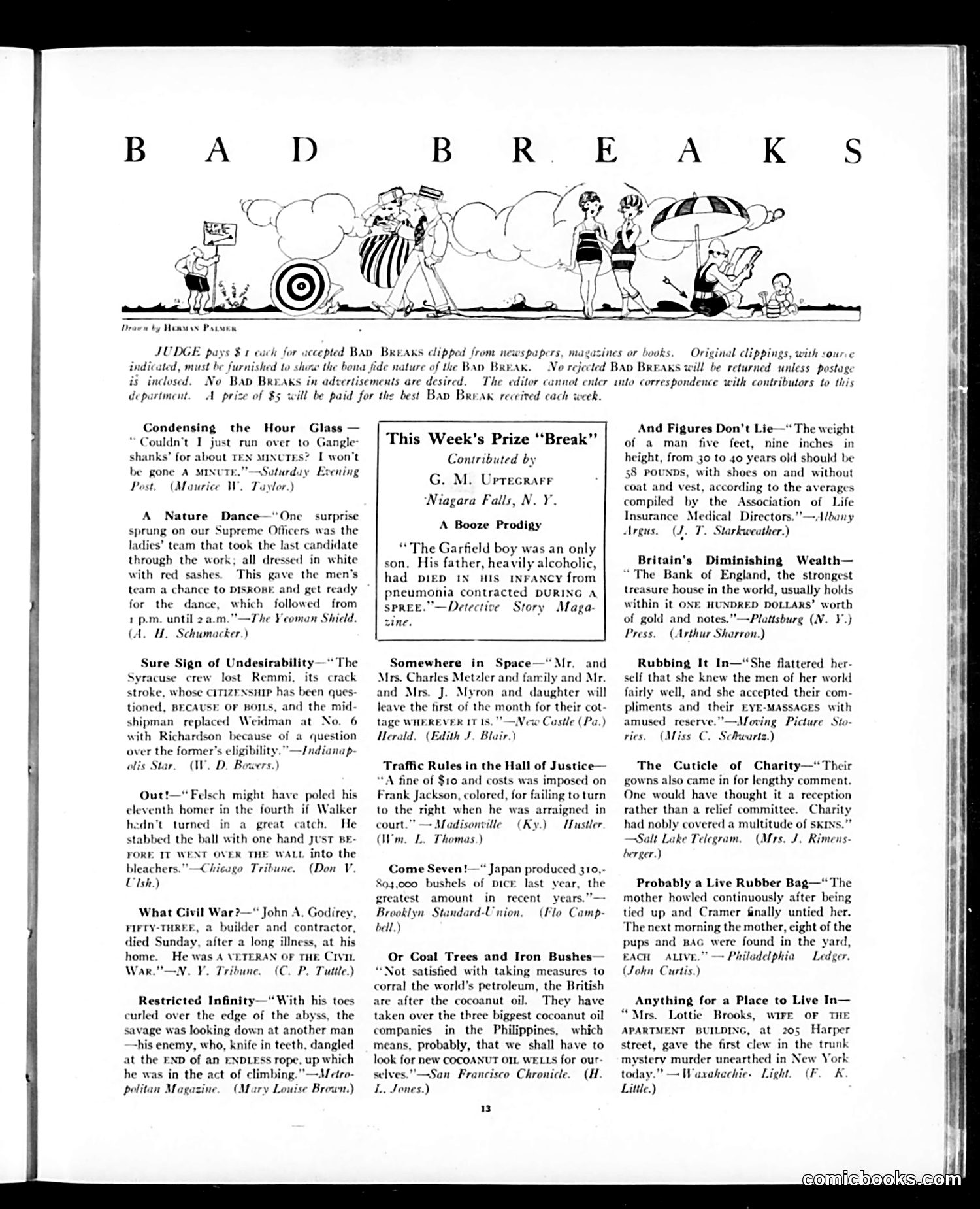
This page from *Judge* magazine features "Bad Breaks"—humorous newspaper clipping errors submitted by readers. The cartoon header shows figures reading and collecting these mistakes. The "Bad Breaks" themselves are absurd or contradictory statements clipped from real newspapers and magazines, highlighting unintentional humor through: - **Logical contradictions** (a man weighing 38 pounds; a father dying "during a spree" while his infant son survived pneumonia) - **Awkward phrasing** ("leave for their cottage WHEREVER IT IS") - **Unintended double meanings** (a judge fining a Black man specifically for not turning right, possibly satirizing discriminatory enforcement) - **Improbable claims** (Japan producing an impossibly large rice harvest) The magazine paid readers $1 for accepted submissions, rewarding them for catching editorial blunders in newspapers and magazines. This satirical feature mocks both the carelessness of professional publications and provides light comedy—a common form of humor in early 20th-century satirical magazines before modern fact-checking existed.
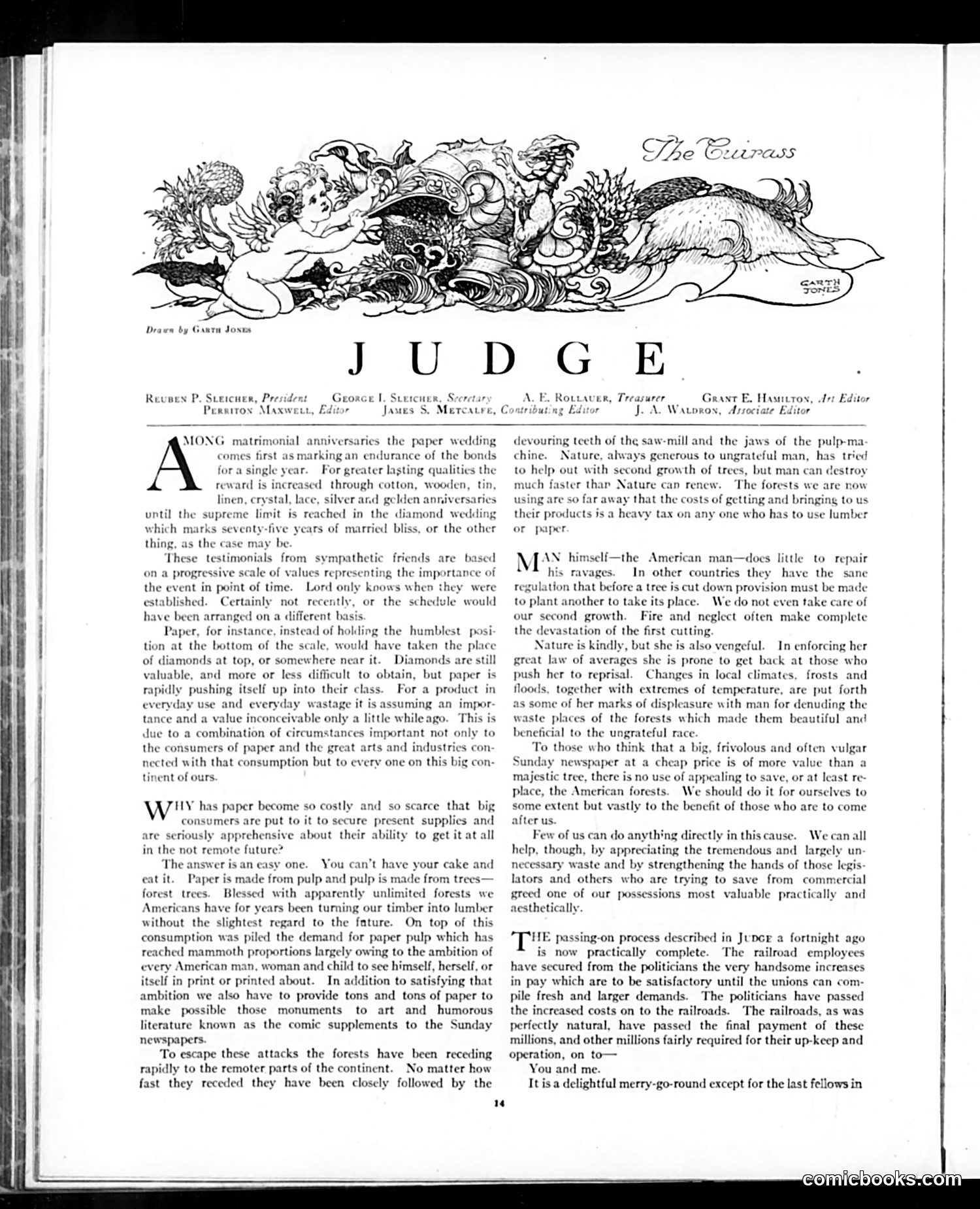
This is primarily an editorial essay, not a political cartoon. The decorative header by Gantx Jones depicts cherubs and classical imagery but serves as ornamental framing rather than satire. The text is a serious environmental argument about America's wasteful timber harvesting. The author criticizes Americans for thoughtlessly clear-cutting forests to produce paper and lumber without replanting, unlike regulated European practices. He argues that while Nature attempts renewal through second growth, human destruction outpaces it—especially since mills now harvest from distant forests, raising costs. The piece expresses concern about paper scarcity and warns of environmental consequences: climate changes, floods, and frosts resulting from deforestation. The author appeals to readers' self-interest and patriotism to support forest conservation. This represents **progressive-era environmental advocacy** in Judge, advocating for regulated forestry practices before such conservation became standard policy.
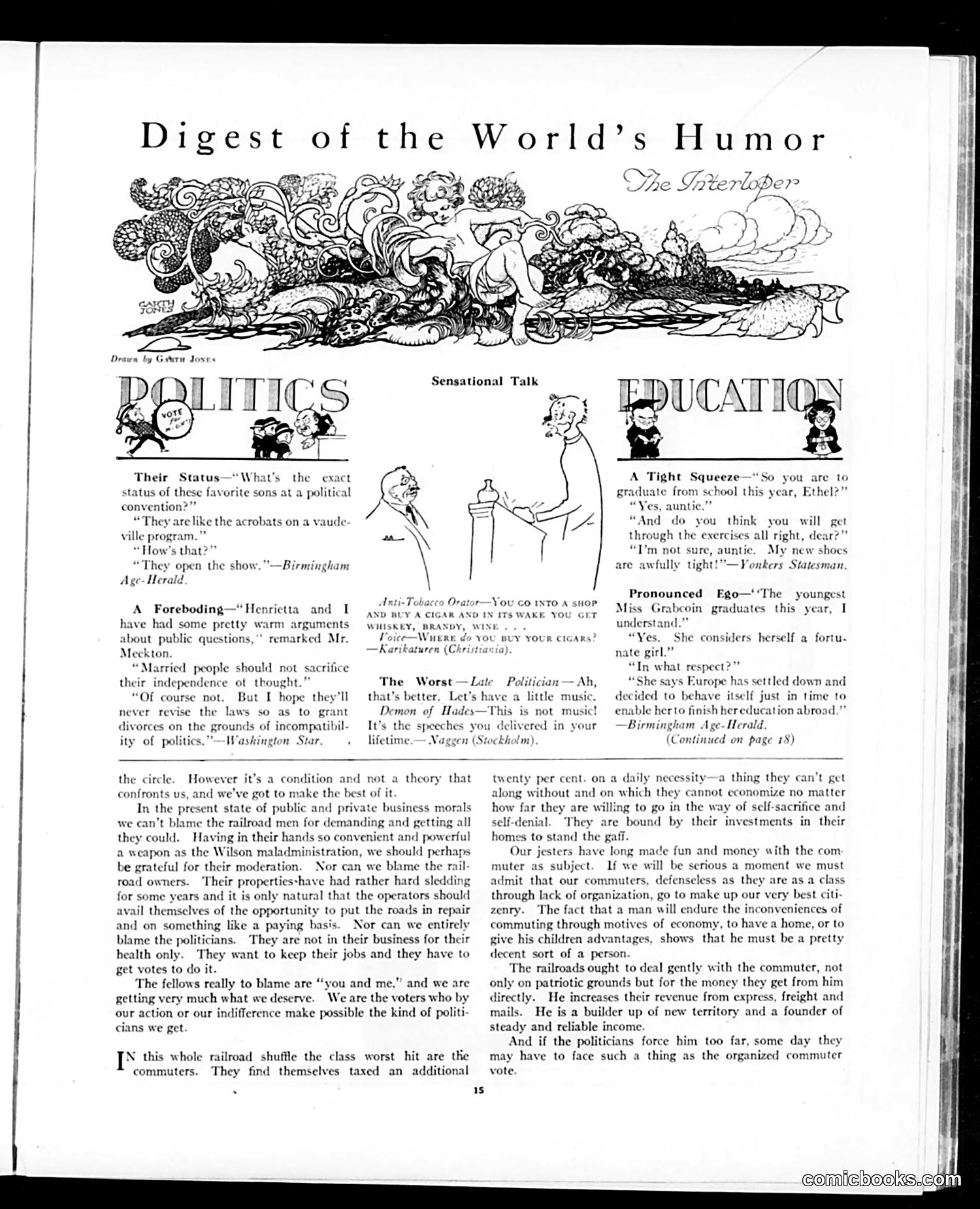
This page from Judge magazine presents satirical humor pieces about early 20th-century American life and politics. **The cartoons mock:** 1. **Political conventions** - Politicians are compared to vaudeville acrobats who merely "open the show" - suggesting they're performers rather than substantive contributors. 2. **Marital discord over politics** - A couple argues about public questions, with the satirist joking that divorce laws should cover "incompatibility of politics." 3. **Anti-tobacco hypocrisy** - An anti-smoking orator is asked where he buys cigars, exposing his own contradictions. 4. **Afterlife punishments** - A deceased politician in Hell finds demon torturers playing his old political speeches as worse than music. 5. **The longer editorial piece defends railroad commuters** as decent, self-sacrificing citizens deserving fair treatment, arguing they're essential to building communities and shouldn't be exploited by either rail companies or politicians. The satire targets political phoniness, personal hypocrisy, and corporate indifference toward working-class commuters—issues clearly resonant in that era's American society.
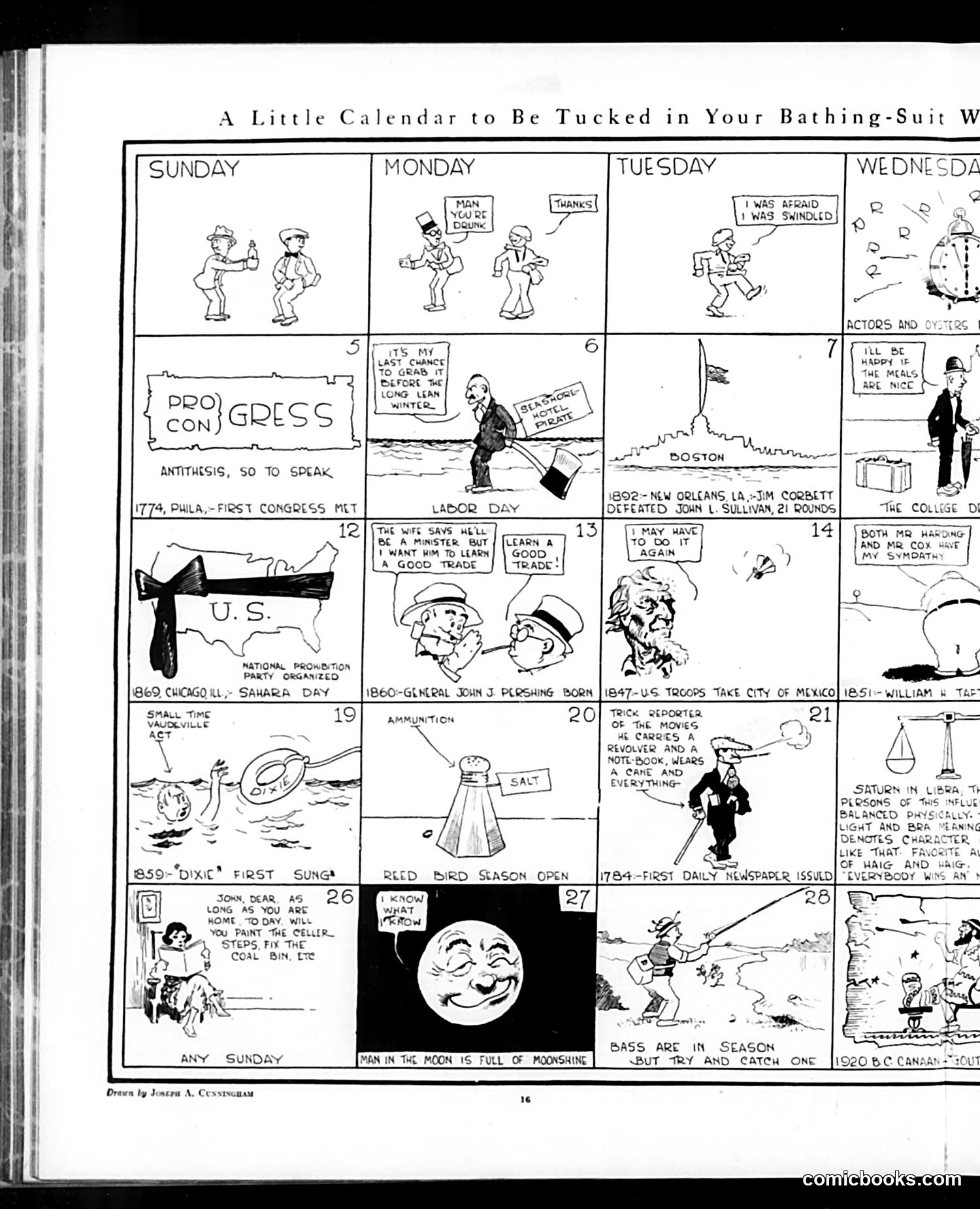
This is a humorous weekly calendar grid mixing historical dates with contemporary domestic humor. Each day references an actual historical event alongside a joke about modern married life or social situations. The satirical contrast is the format's core joke: grand historical moments (First Congress, Labor Day, General Corbett defeating John L. Sullivan in boxing, the first daily newspaper) sit beside petty domestic complaints—a husband begging time before winter to grab something, a wife demanding home repairs (painting cellar steps, fixing the coal bin), a wife questioning her husband's choice of professions. The 1920 references (Harding and Cox's presidential campaign, the "bathing-suit" framing) date this as early 1920s Judge magazine. The humor targets the contrast between momentous history and the grinding, unglamorous realities of married domestic life—a common Judge theme mocking both domestic drudgery and historical pretension.
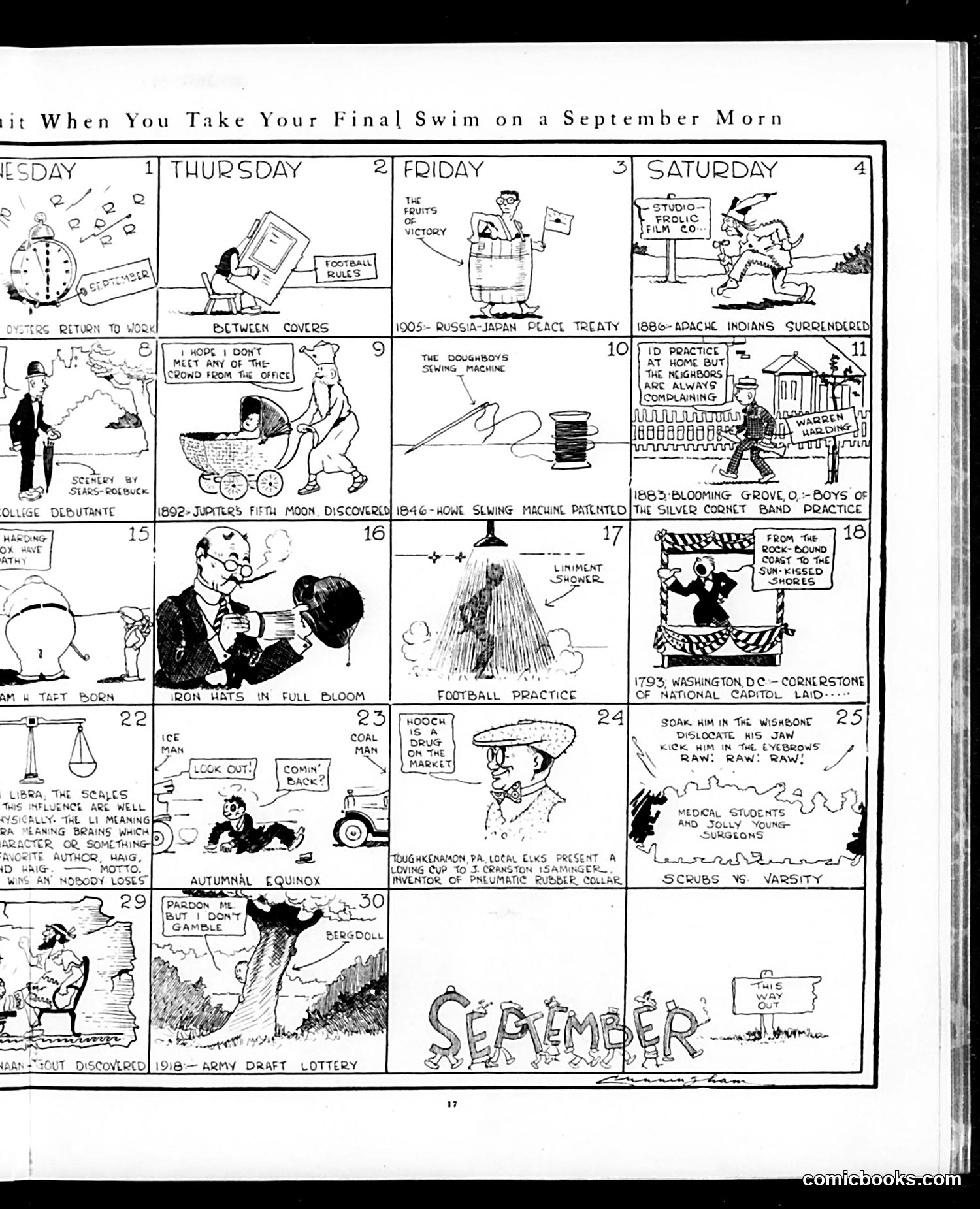
This is a satirical calendar page from Judge magazine depicting "When You Take Your Final Swim on a September Morn"—marking summer's end and autumn's arrival. The cartoons mock various September activities and historical events. Panel 4 shows "Apache Indians Surrounded" (1880), referencing Western conflicts. Panel 10 depicts "The Doughboys Sewing Machine" (1846), likely satirizing military preparedness. Panel 18 references the 1793 Washington D.C. Capitol cornerstone laying ceremony with crude humor about kissing. The recurring motif involves college football season. Panels show football practice with exaggerated violence—athletes being "dislocated," kicked, and generally brutalized. This satirizes the rough, dangerous nature of early American football. Panel 25 shows "Scrubs vs. Varsity," medical students observing the violence. The overall theme: September represents the return to serious activities—school, football, military matters—after summer leisure, portrayed through exaggerated violent and crude imagery typical of Judge's irreverent satire style.
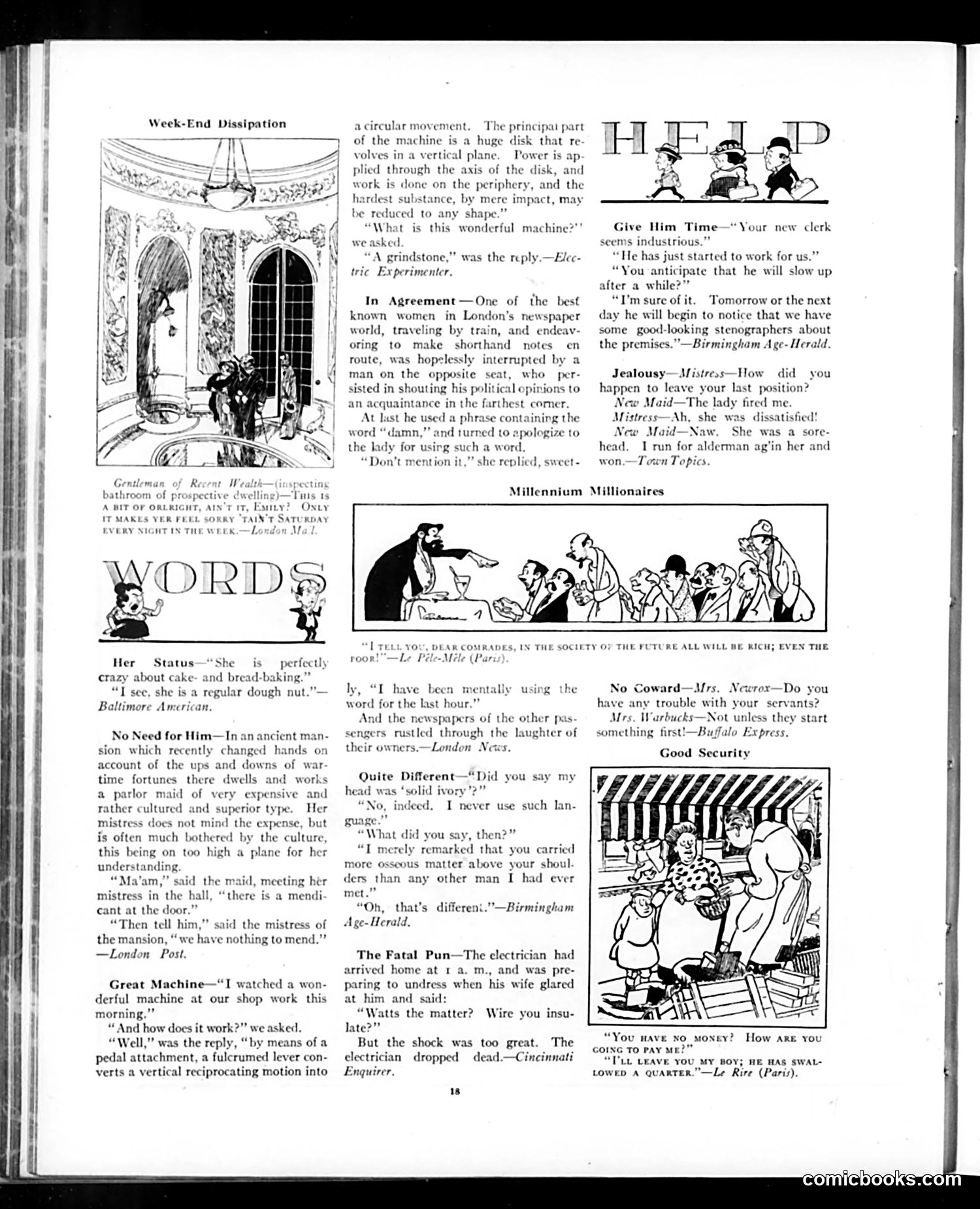
This page contains multiple short humorous anecdotes and cartoons satirizing early 20th-century social conventions and class dynamics. **"Week-End Dissipation"** depicts working-class leisure—likely mocking how laborers find entertainment in modest activities, contrasted with upper-class recreation. **"Her Status"** jokes about a refined parlor maid whose cultured manner exceeds her employer's social station, satirizing class pretension. **"Great Machine"** mocks pseudo-intellectual jargon—a worker uses elaborate technical language to describe a simple grindstone, ridiculing pompous verbosity. **"Millennium Millionaires"** cartoon shows socialists claiming future equality, satirizing utopian political rhetoric. The remaining brief jokes target domestic servants, courtship delays, domestic disputes, and financial anxiety—common middle-class concerns of the era. "The Fatal Pun" employs dark humor around electricity, then-modern and somewhat dangerous technology. Overall, the page satirizes class pretension, marital conflict, servants' independence, and contemporary anxieties about technology and social change.
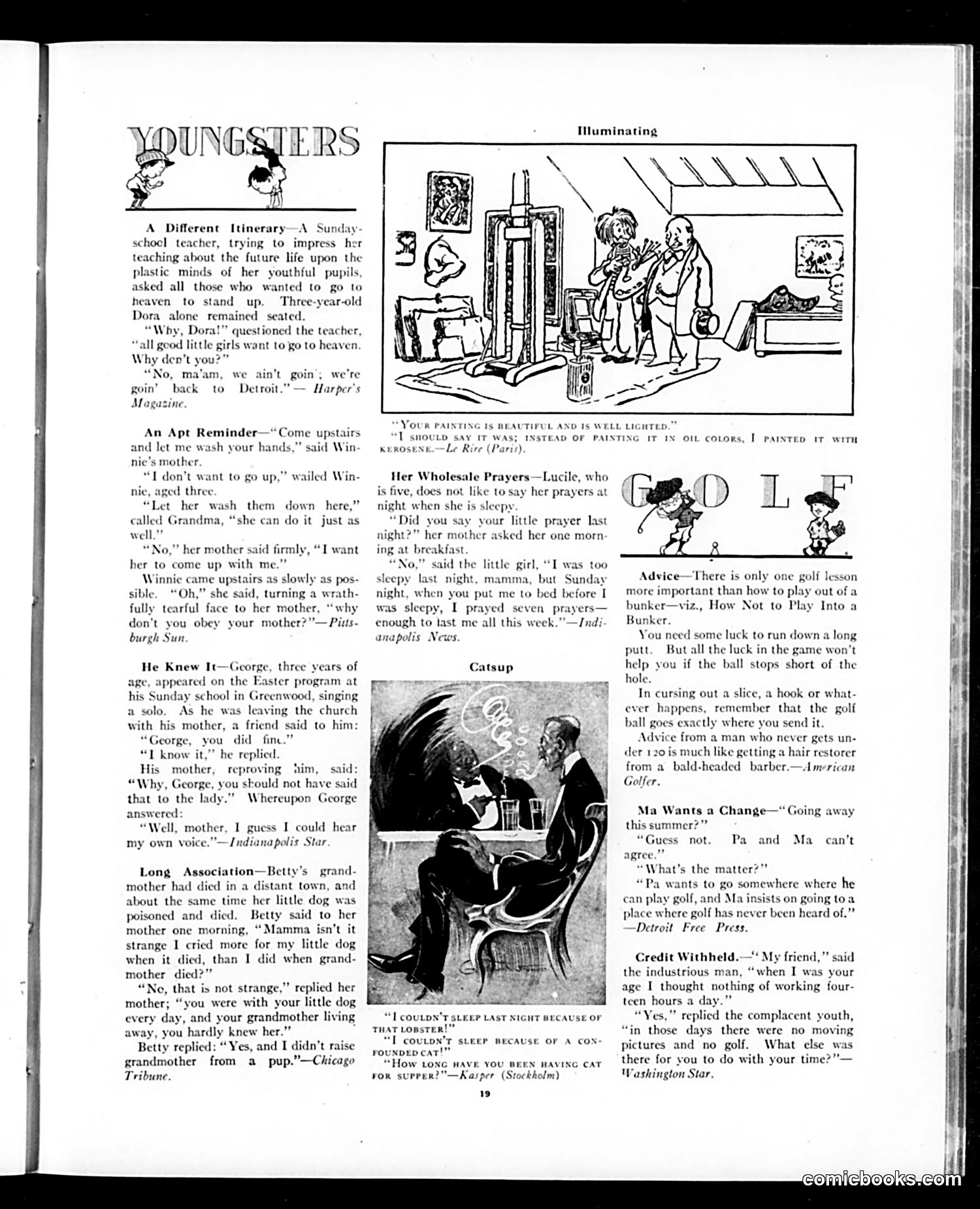
This page contains several humorous anecdotes about children's logic and adult follies, typical of Judge's "Youngsters" section. **Key items:** The **"Illuminating" cartoon** shows a Parisian artist explaining his well-lit painting—the joke being he painted it using kerosene lamps rather than proper studio lighting, a commentary on bohemian artist poverty. The **"Catsup" cartoon** depicts two men unable to sleep: one blames a lobster dinner, the other a foundling cat he's been feeding—implying both indulgence and sentimentality keep them awake. **Other anecdotes mock:** - Children's blunt honesty (a 3-year-old preferring Detroit to heaven) - Adult hypocrisy (a boy correctly noting he heard his own singing voice) - Selective sentimentality (a girl mourning her dog more than her grandmother) - Golf obsession among men (even preventing vacations with wives) - Modern leisure replacing work ethic (blaming movies and golf for youth's supposed softness) The humor relies on class assumptions, nostalgia for stricter childhoods, and satirizing contemporary middle-class preoccupations like golf.
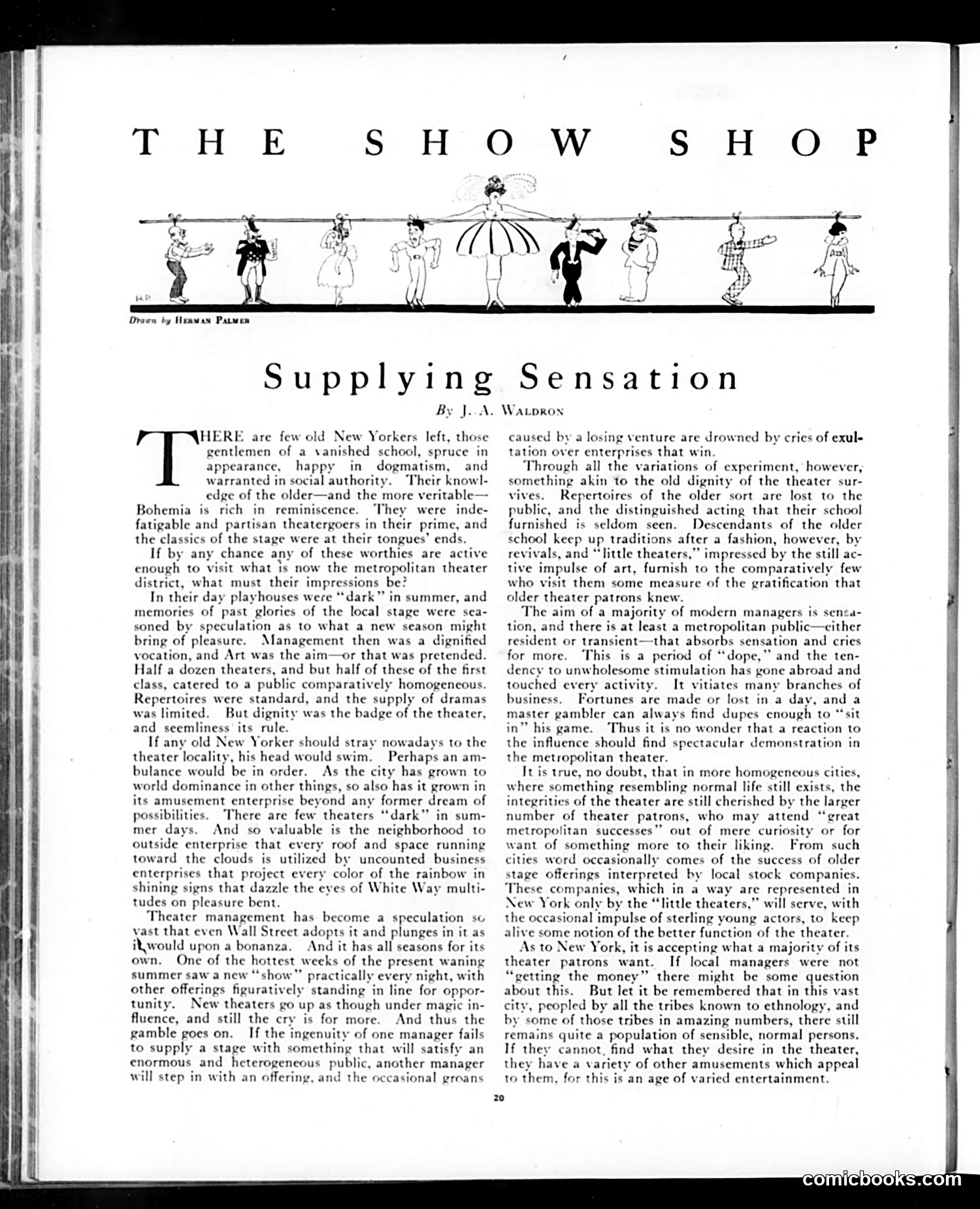
This article by J.A. Waldron contrasts old New York theater culture with the modern (1920s-era) entertainment industry. **The Point:** Theater management has transformed from a dignified art form into a speculative gambling business. The accompanying illustration shows various theatrical character types—performers in different costumes and styles—representing the proliferation of entertainment offerings. **Key References:** - "Old New Yorkers" = nostalgic theatergoers who appreciated classical repertory theater - "Dark" theaters in summer = theaters that closed seasonally (traditional practice) - The "White Way" = Broadway's illuminated theater district - Wall Street speculation = treating theater as financial commodity rather than art **The Satire:** Modern managers chase "sensation" and "dope" (stimulation) to satisfy "an enormous and heterogeneous public," driven by profit-motive gambling rather than artistic integrity. New shows open constantly; theaters compete frantically. The author suggests this reflects broader 1920s American culture: fast money, speculation, and artificial stimulation replacing older values of craftsmanship and restraint.

This page showcases actresses from the theatrical production **"Ladies' Night in a Turkish Bath,"** a farce produced by Al Woods. The images feature performers including Eleanor Dawn, Evelyn Gosnell, Adele Row, Allyn King (a former Follies dancer), and Suzon (a maid character). The accompanying text is essentially **promotional content**, celebrating the show's appeal by emphasizing both the actresses' attractiveness and their comedic performances in related productions like "Up in Mabel's Room." The humor relies on the premise of the farce—men mistakenly entering a women's Turkish bath—and suggests the combination of beautiful actresses and slapstick comedy makes it irresistible entertainment. Rather than political satire, this represents how **Judge magazine blended entertainment coverage with advertising**, using photographs of stage actresses to promote Broadway productions to its readers.
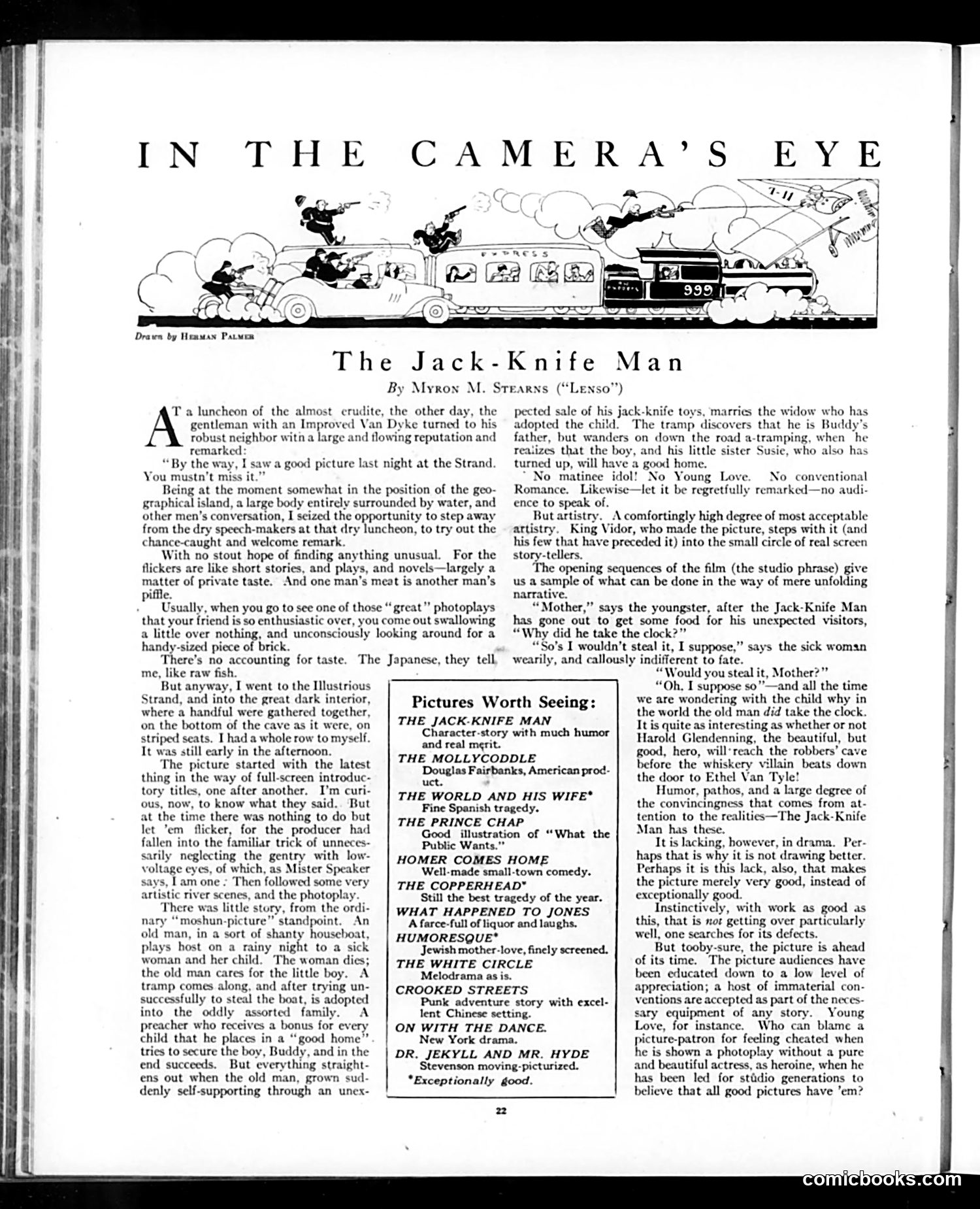
This page reviews a 1919 film directed by King Vidor, praised for its artistic merit despite lacking commercial appeal. The author critiques the film industry's tendency toward melodrama and conventional romance, contrasting this with "The Jack-Knife Man's" modest, character-driven story about a tramp, an elderly man, and orphaned children—depicting genuine human connection rather than glamorous fantasy. The cartoon header by Hermon Palmer shows a train carrying movie-related imagery, illustrating cinema's cultural prominence. The reviewer notes the film played to nearly empty theaters ("an audience to speak of"), suggesting artistic achievement didn't guarantee box-office success. The piece exemplifies Judge magazine's role critiquing both entertainment and American consumer culture, while the sidebar "Pictures Worth Seeing" recommends other worthwhile films, establishing critical standards against shallow commercial fare.
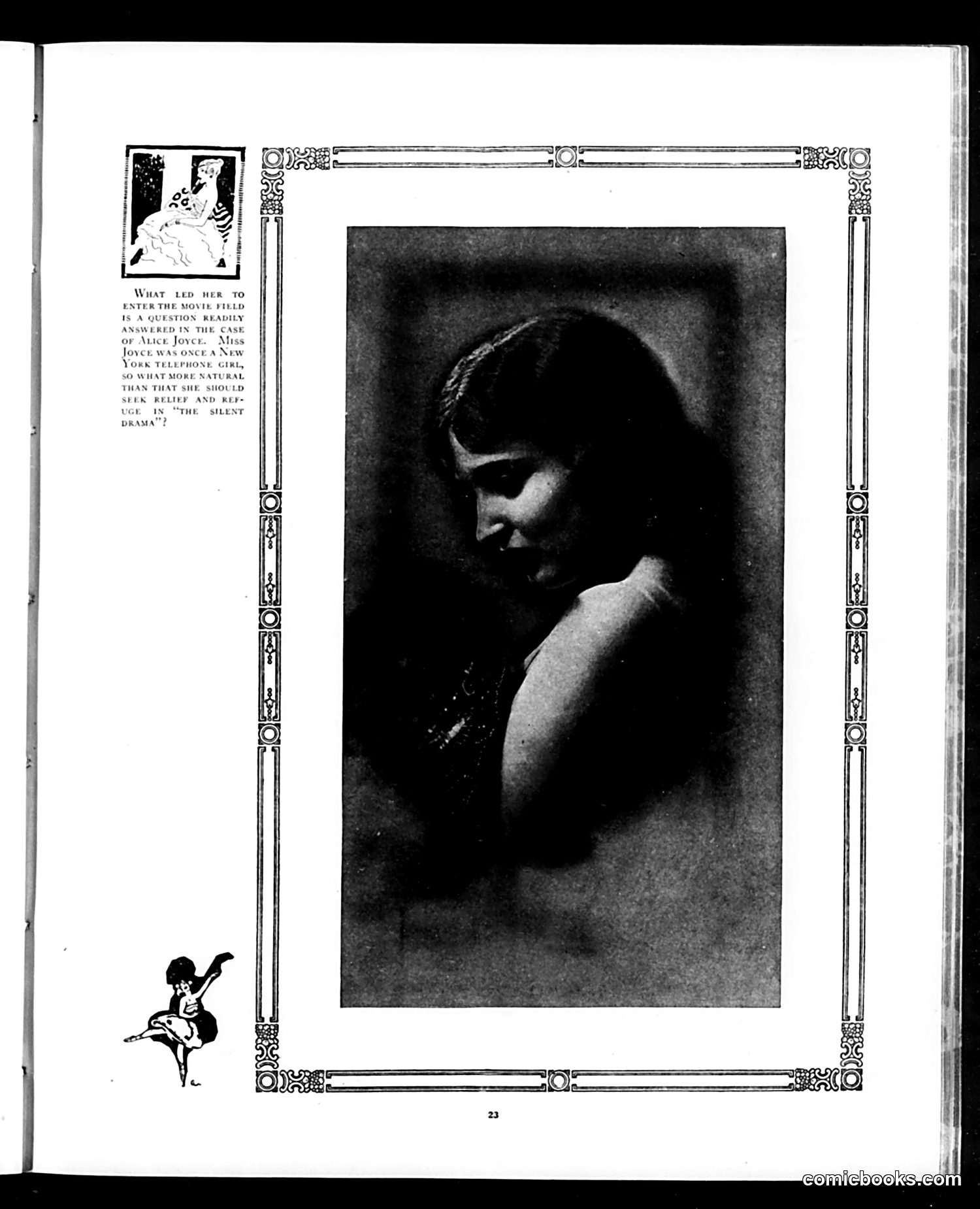
This page features a photograph of a woman (identified as Alice Joyce) with accompanying text explaining her transition from telephone operator to film actress. The small illustration at top left depicts a woman in what appears to be a domestic scene, while the decorative border frames the central photograph. The satire addresses the early 20th-century phenomenon of working-class women entering the emerging film industry. The implied joke—suggested by the headline's rhetorical question about what "led her" to movies—appears to mock the notion that a telephone girl would naturally aspire to cinema work, or conversely, that the film industry readily recruited from humble occupations. This reflects period attitudes about both the film industry's perceived frivolousness and ambitions of working-class women seeking social advancement through entertainment.
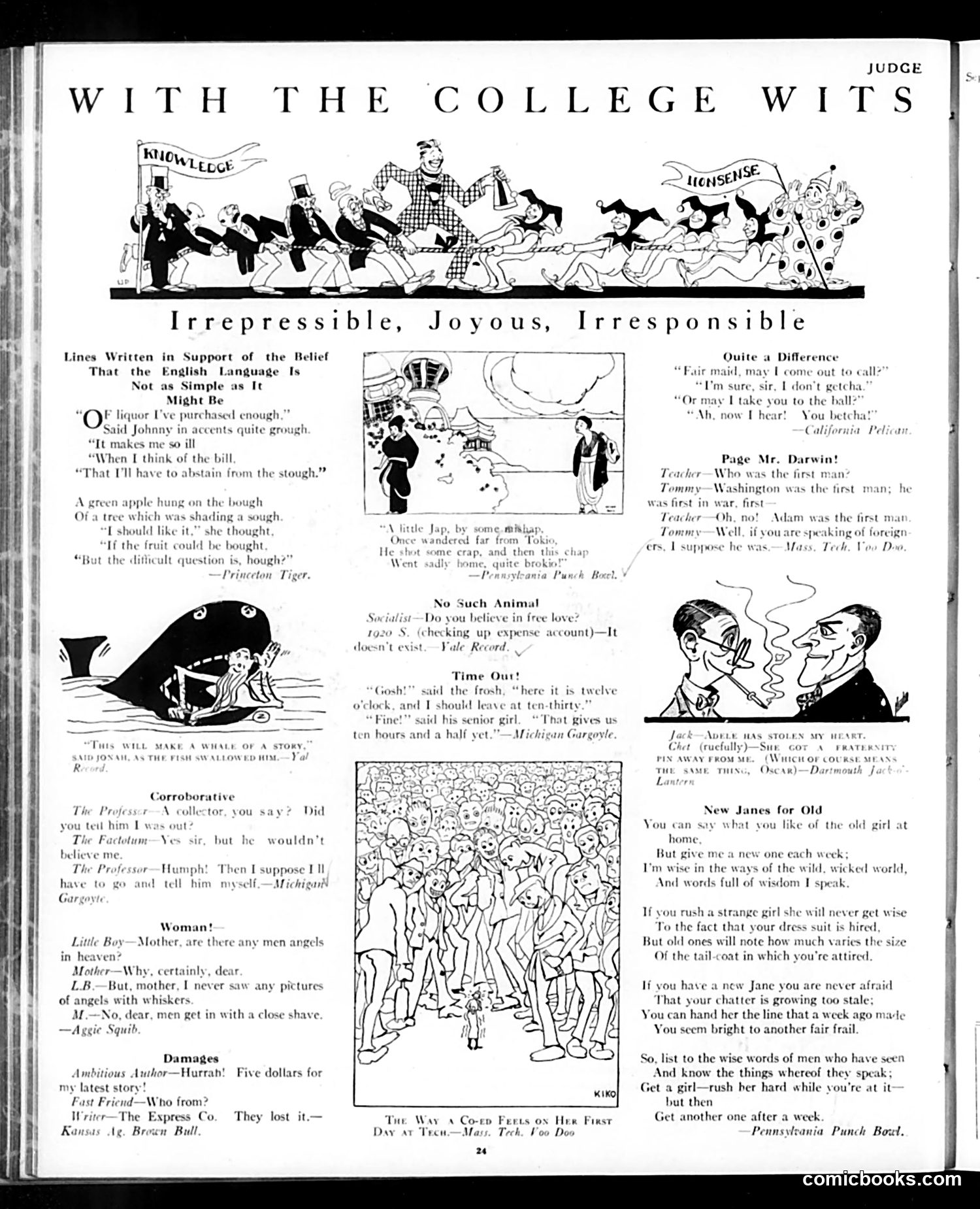
This page collects humorous pieces mocking the English language's inconsistencies and poking fun at college life and romantic behavior. The top cartoon shows a tug-of-war between "Knowledge" and "License," suggesting tension between education and youthful irresponsibility. The satirical poems and jokes target: **Language absurdities**: Multiple pieces mock English pronunciation and spelling quirks (words like "bough," "sough," "hough" that sound different despite similar spelling). **College culture**: The "College Wits" section ridicules typical undergraduate behavior—romantic posturing, expense-account cheating, and the "new Jane for Old" piece cynically advises constantly pursuing different girls rather than developing genuine relationships. **Gender dynamics**: A dialogue shows how men use manipulative lines on new girlfriends but fear detection by experienced ones (noting variation in rented suit quality). The tone throughout is lighthearted mockery of collegiate excess, linguistic confusion, and shallow romance—typical Judge magazine material satirizing American social conventions of the 1920s era.
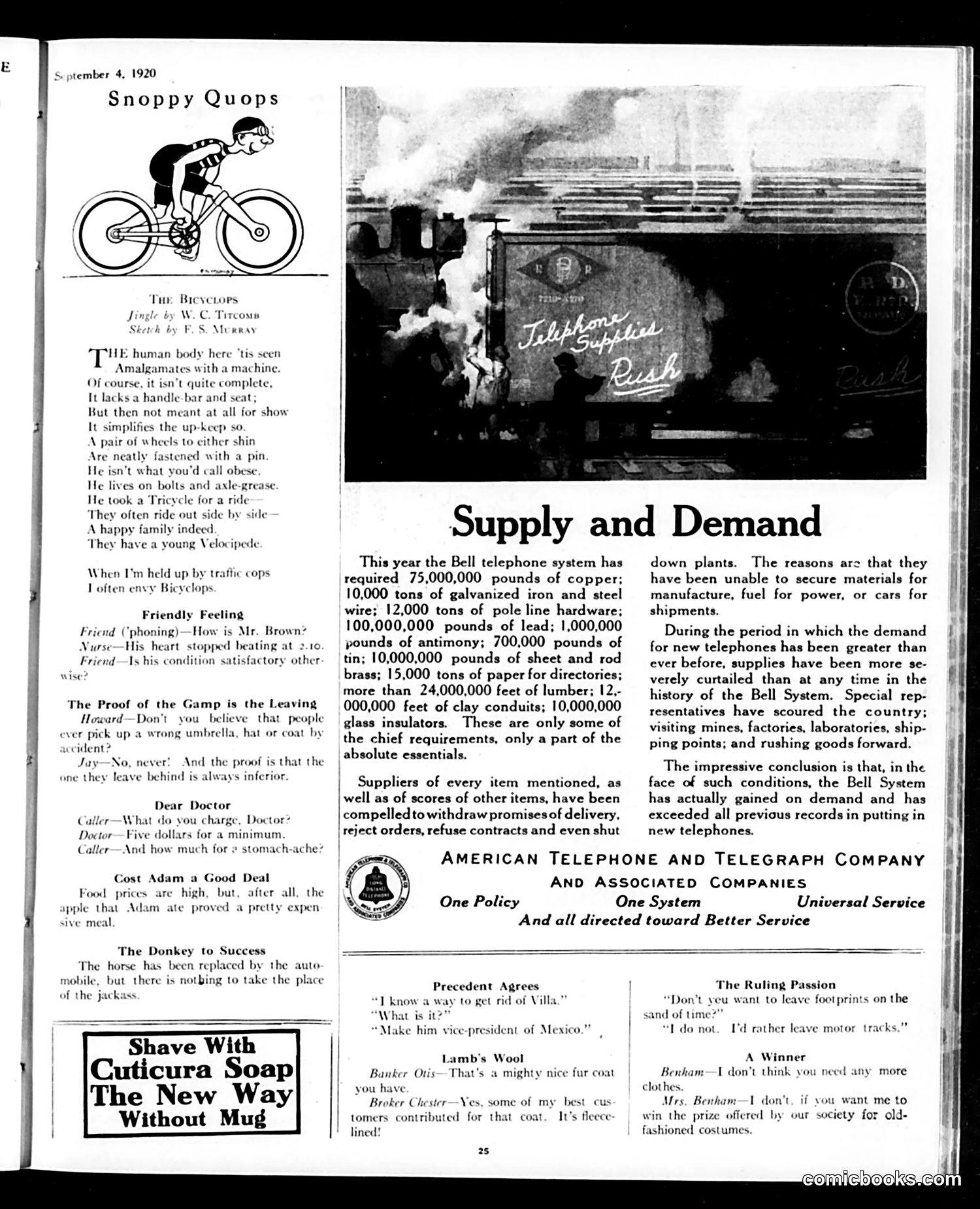
This page combines humorous short items with a substantial Bell Telephone advertisement. The "Snoppy Quops" cartoon depicts a man who has literally fused with a bicycle, becoming "Bicyclops"—a visual pun playing on the mythological Cyclops. The accompanying verse humorously describes this hybrid creature's maintenance and lifestyle. The remaining short jokes are typical Judge fare: wordplay about umbrellas, doctor fees, and Adam's apple (pun intended). One item references Pancho Villa, the Mexican revolutionary, suggesting he'd be neutralized as a vice-president—political humor dated to the ongoing Mexican instability of that era. The dominant feature is Bell Telephone's "Supply and Demand" advertisement, which addresses post-WWI material shortages. It catalogs massive material requirements and acknowledges suppliers' inability to fulfill orders due to manufacturing constraints and fuel/transportation shortages. The ad celebrates Bell's success *despite* these conditions—essentially corporate boasting during economic scarcity. This reflects 1920's transition from wartime to peacetime economy.
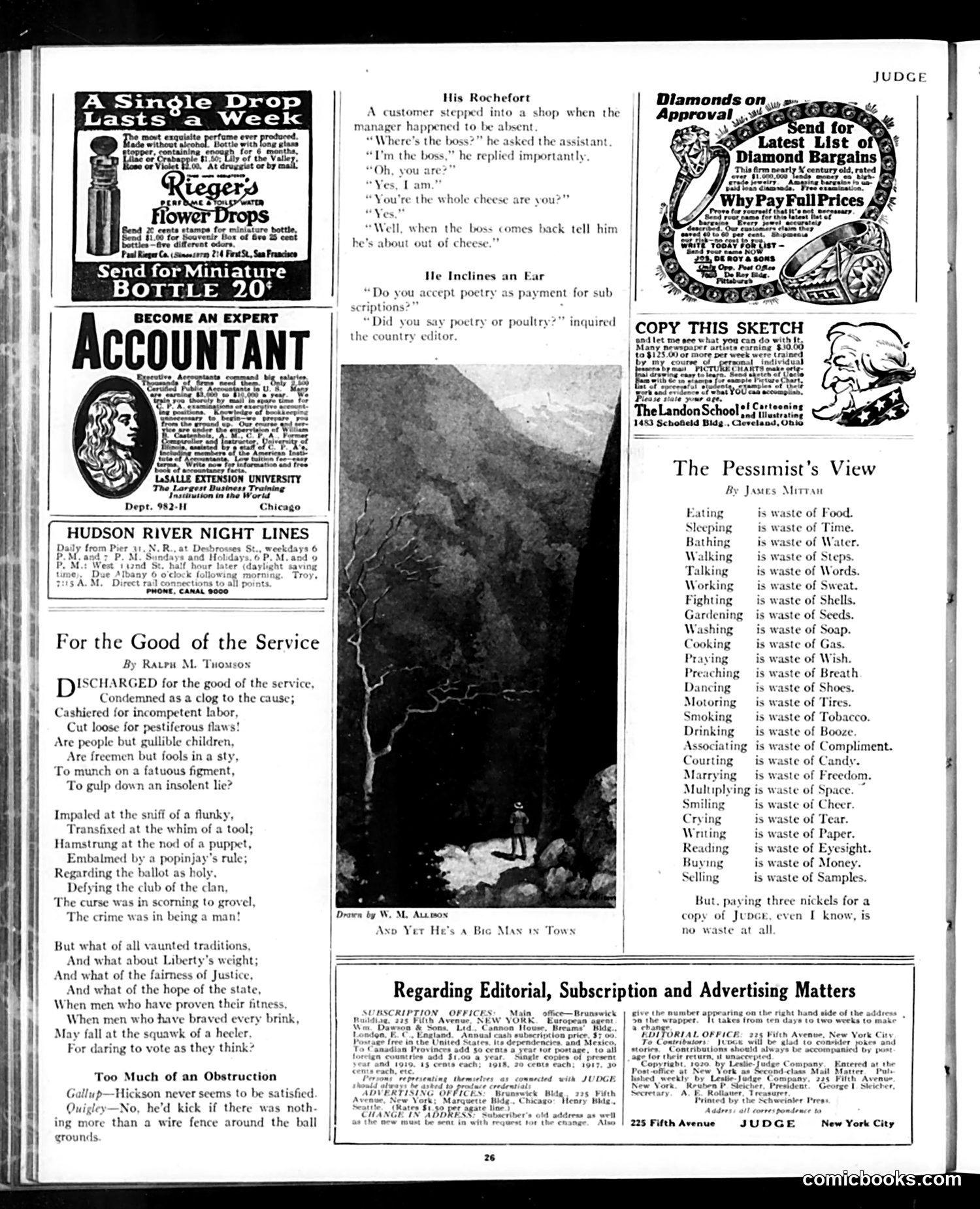
This page contains miscellaneous advertisements and satirical pieces typical of the magazine's format. **Key Content:** The poem **"For the Good of the Service"** by Ralph M. Thomson is a political critique attacking government bureaucracy and patronage systems. It protests the firing of competent workers based on political loyalty rather than merit—the "sniff of a flunky" and "whim of a tool." The poem criticizes suppression of free voting and questions whether democracy is merely theater when citizens "may fall at the squawk of a heeler" (ward boss) for voting independently. **"The Pessimist's View"** is a humorous list declaring nearly every human activity "waste"—of food, time, water, words, etc.—ending with the joke that *Judge* magazine itself proves waste is worthwhile. Minor humorous anecdotes appear (manager as "whole cheese," editor confusing "poetry" and "poultry"), alongside vintage advertisements for perfume, accounting courses, and river steamboat services. The page reflects Progressive-era anxieties about machine politics and government corruption.
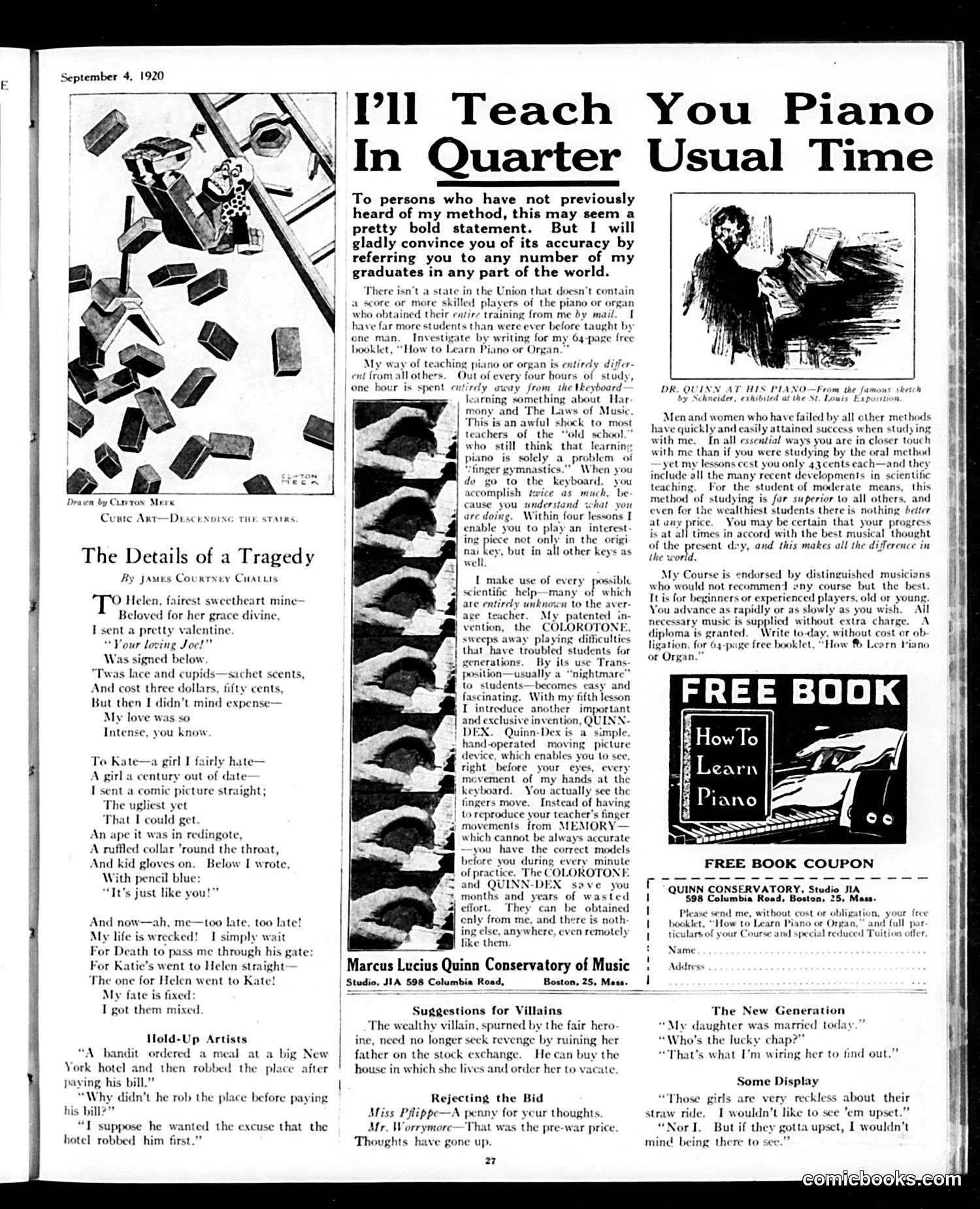
**Main Cartoon ("The Details of a Tragedy"):** A comedic cautionary tale about a young man who mixed up two Valentine's Day cards. He sent an expensive, romantic valentine to Helen (whom he loves) but accidentally mailed a crude, insulting comic picture to Kate (whom he dislikes). The card meant for Kate—comparing her to an ape—reached Helen instead, destroying his romantic prospects. The satire mocks romantic mishaps and the consequences of carelessness. **"Hold-Up Artists" joke:** A humorous anecdote about a bandit who paid for his meal before robbing the hotel, creating absurd logic—the criminal wanted to claim the *hotel* robbed *him* first to justify his crime. It's satirizing criminal rationalization and twisted ethics. **Right side:** Primarily advertising for Marcus Lucius Quinn's mail-order piano lessons, featuring testimonials and promotional materials—not satirical content. The page is mostly light comedy and advertising rather than political satire.
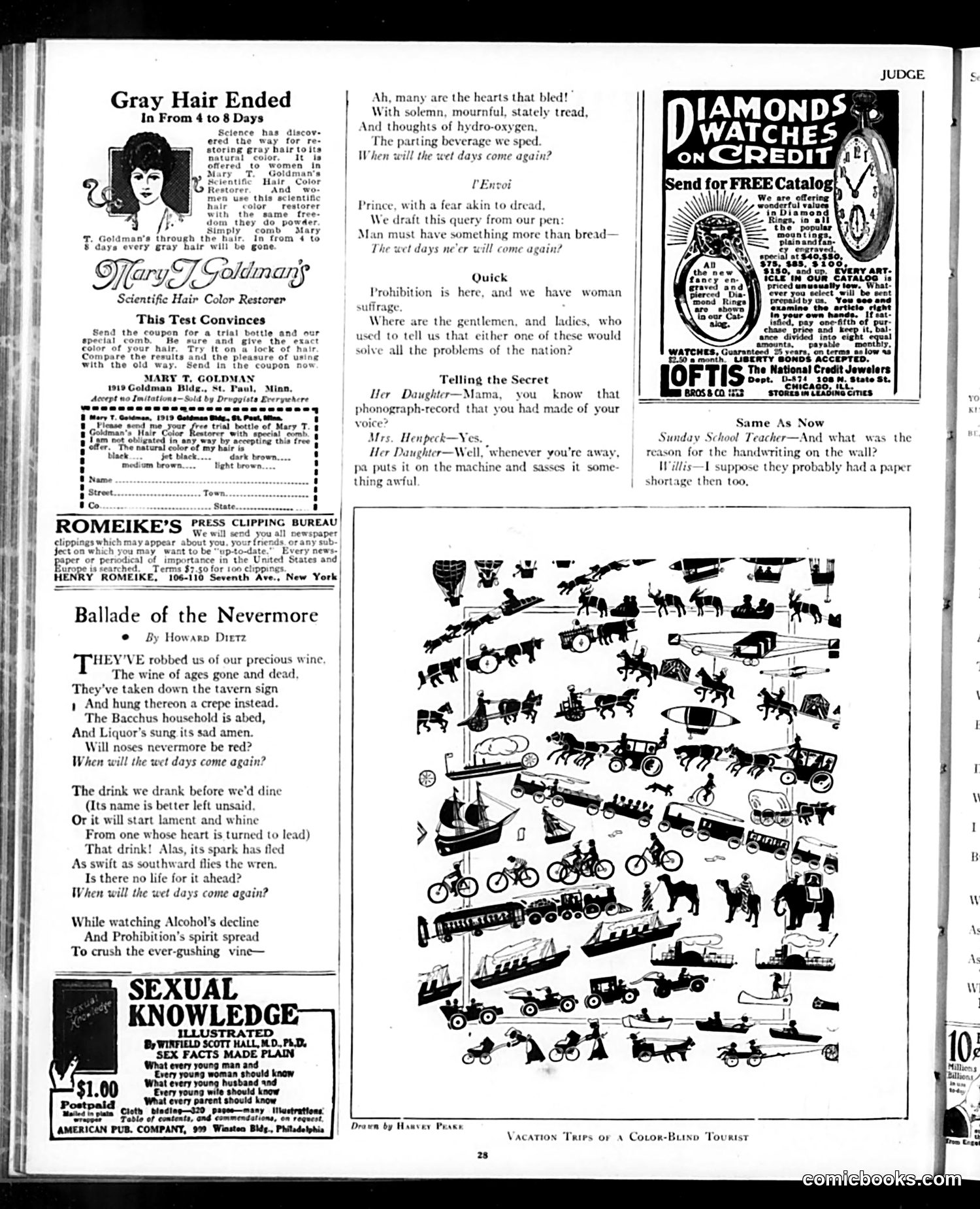
This page contains **Prohibition-era satire** (early 1920s) lamenting the recently enacted alcohol ban. Key elements: **Main Cartoon**: "Vacation Trips of a Color-Blind Tourist" by Harvey Peirce depicts a chaotic travel scene—horses, carriages, trains, ships, bicycles—all rendered in silhouette. The title's joke: a color-blind person seeing this black-and-white illustration wouldn't miss visual detail, making their "vacation" experiences identical to anyone else's. **Textual Content**: Multiple pieces mock Prohibition's effects: - "Ballade of the Nevermore" mourns closed taverns and banned alcohol, repeatedly asking "When will the wet days come again?"—"wet days" meaning the pre-Prohibition era - "Telling the Secret" jokes about a phonograph recording of a wife's voice - The page criticizes Prohibition and women's suffrage as failed solutions to national problems **Context**: Judge was a Republican satirical magazine. This reflects anti-Prohibition sentiment common among certain circles during the 1920s-1930s.
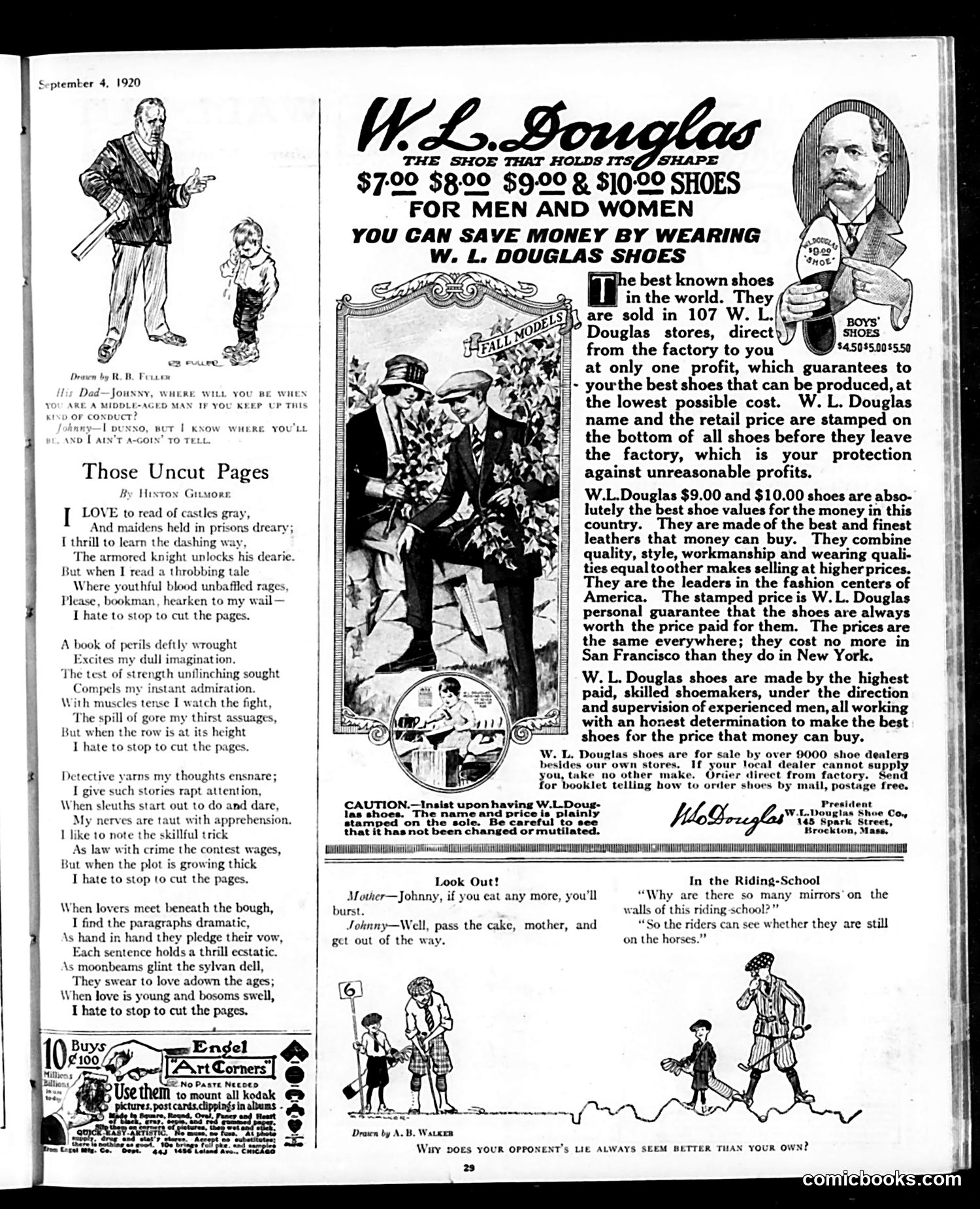
This page combines satirical poetry, advertisements, and humor comics typical of Judge magazine's format. **"Those Uncut Pages"** by Hilton Gismore is a humorous poem mocking readers (particularly men) who complain about having to cut the pages of newly-bound books to read them. The repeated refrain—"I hate to stop to cut the pages"—satirizes impatient readers seeking thrills from adventure, detective, and romance narratives who resent this minor inconvenience. The joke targets leisured classes who could afford new books but apparently found even minimal effort tedious. **The W.L. Douglas Shoe advertisement** dominates the right side, featuring the company's founder/trademark figure and promotional copy emphasizing factory-direct pricing and quality control. **Two brief joke comics** appear at bottom: one depicts a mother-son exchange about overeating (physical comedy), the other explains mirrors in riding schools so riders can verify they're still mounted—absurdist humor playing on equestrian pretension. The page reflects 1920 consumer culture, reading habits, and class humor accessible to Judge's educated, prosperous audience.
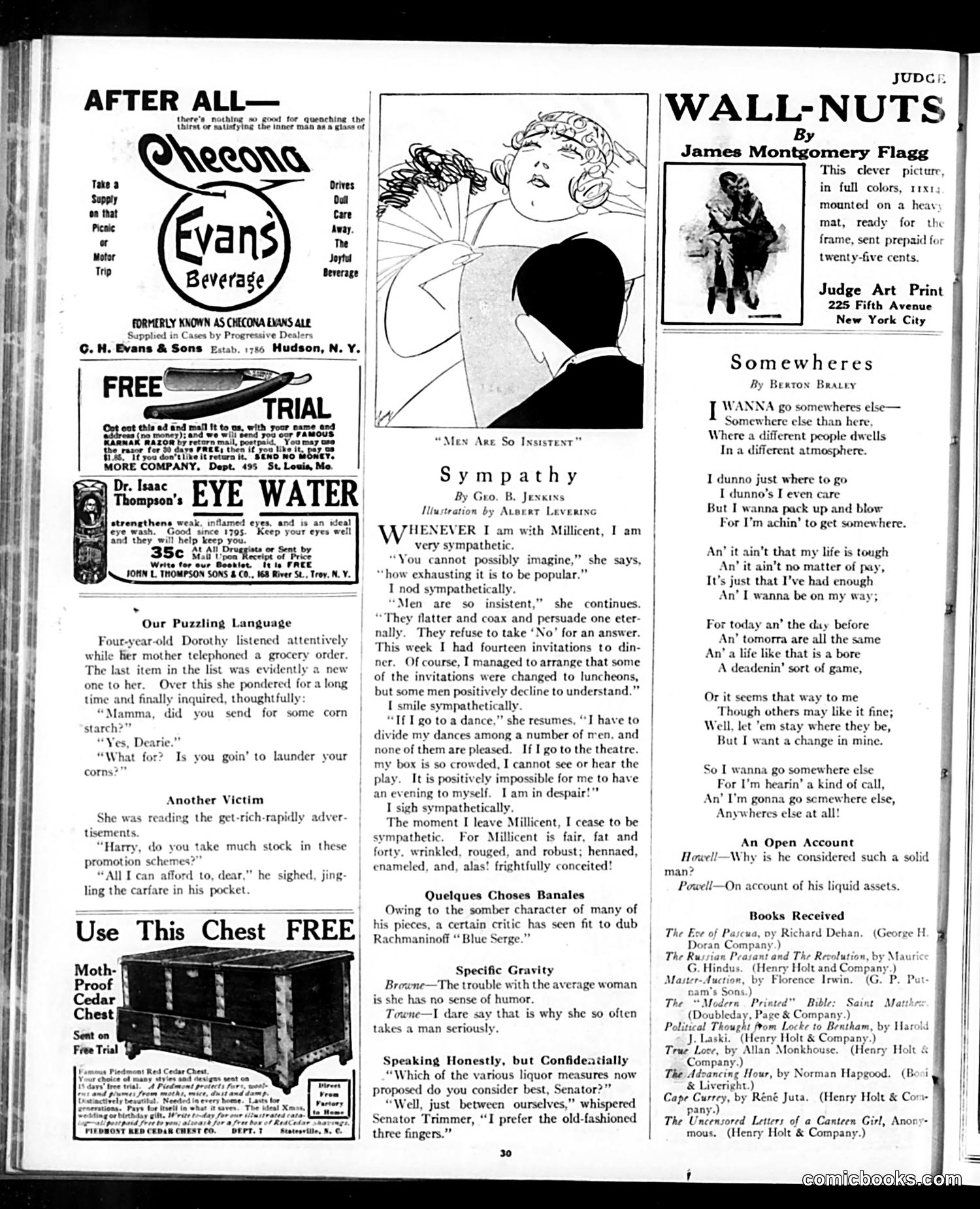
This is primarily an **advertising and light humor page** from Judge magazine. The main content includes: **Advertisements:** Cheona Evans Beverage, Dr. Isaac Thompson's Eye Water, and a "Moth-Proof Cedar Chest" dominate the layout—typical early 20th-century product promotions. **Humor pieces:** - "Our Puzzling Language": A child mishears "corn starch" as something to launder, playing on linguistic confusion - "Another Victim": A man ironically says he invests "all he can afford" in get-rich schemes while counting his carfare—mocking those seduced by dubious financial promotions - "Sympathy": Satirizes a vain, aging woman (Millicent) who complains about being "too popular" while the narrator secretly finds her conceited and unattractive **Poetry and illustrations** round out the page, including James Montgomery Flagg's art print advertisement. The satire targets **vanity, credulous investors, and linguistic absurdities**—typical Judge magazine fare of social observation and gentle ridicule.
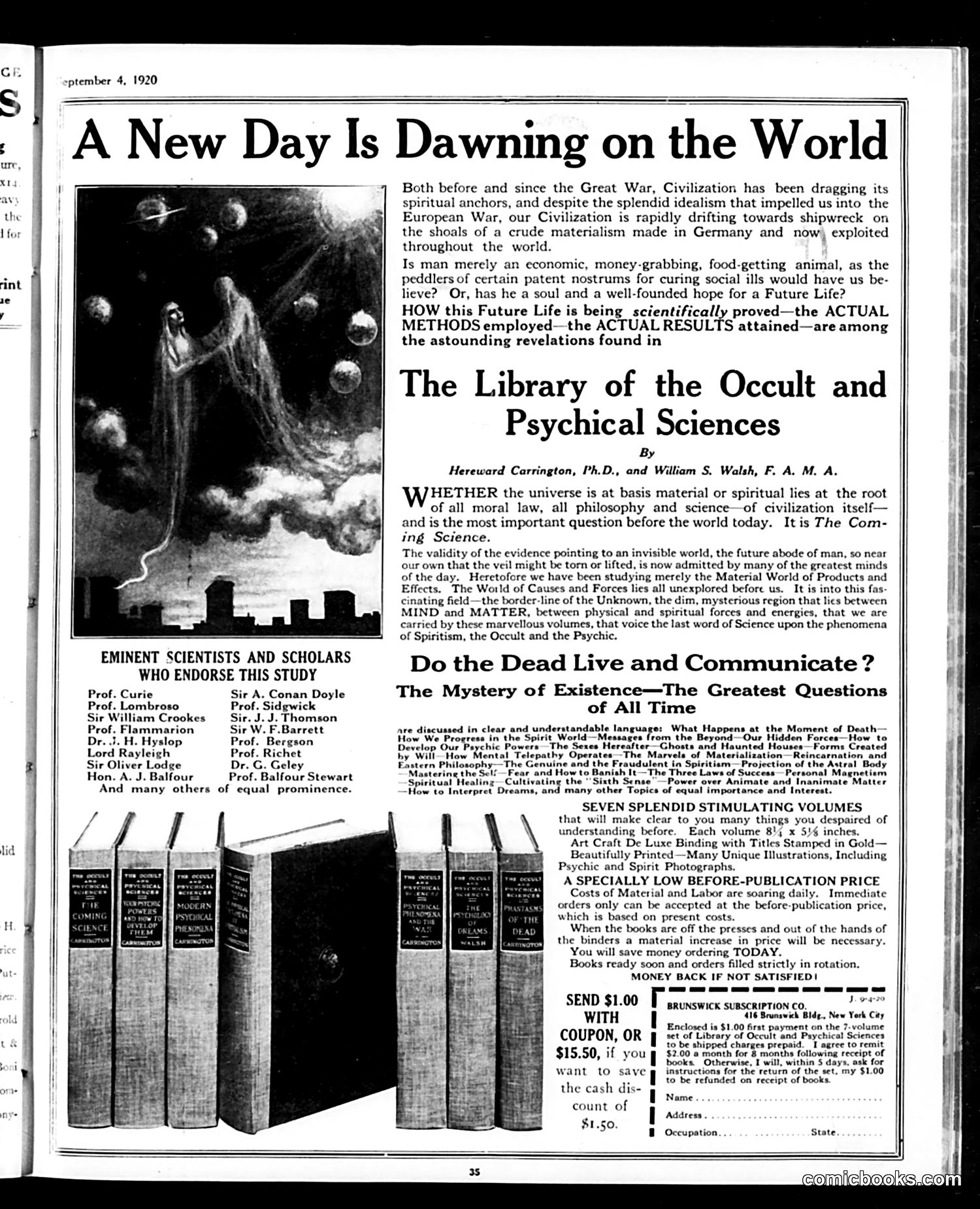
This is primarily a **full-page advertisement** for "The Library of the Occult and Psychical Sciences," published September 4, 1920. It's not satirical content, but rather a commercial pitch. The ad exploits post-WWI anxieties about materialism and spiritual decline. It argues that modern civilization, tainted by "crude materialism made in Germany," has abandoned the soul. The pitch positions occultism as scientifically legitimate by listing famous endorsers—Curie, Conan Doyle, Oliver Lodge (a real spiritualist), and others—lending false credibility. The seven-volume set promises to answer whether the dead communicate, explain mental telepathy, and explore the boundary between material and spiritual worlds. The urgency ("MONEY BACK IF NOT SATISFIED," special pre-publication pricing) reflects classic mail-order sales tactics. **For modern readers**: This reveals how spiritualism and pseudoscience were actively marketed to educated people as scientific solutions to post-war existential dread—a period when spiritualism genuinely attracted serious scholars alongside charlatans.
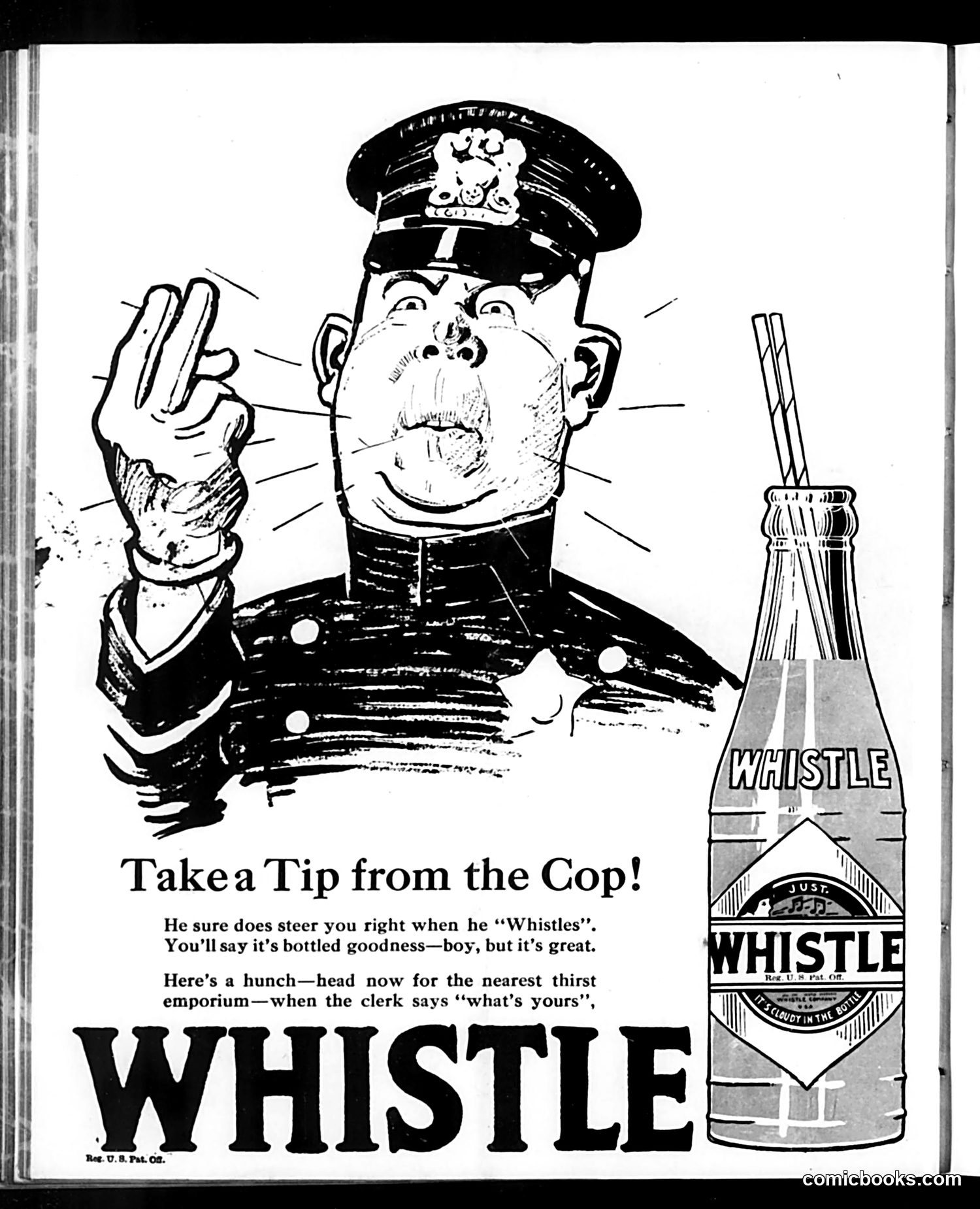
This is a vintage advertisement for Whistle soft drink, disguised as satirical humor. The "cop" caricature isn't political commentary—it's a marketing device using a uniformed authority figure to endorse the beverage. The pun plays on the word "whistle": the policeman "whistles" (his job) to steer people right, just as Whistle brand steers drinkers toward "bottled goodness." The joke's appeal to modern readers: it's a soft drink being promoted through a pun and an authority figure's endorsement—standard advertising of that era. The line "head now for the nearest thirst emporium" (bar or soda fountain) shows Whistle competed in casual refreshment markets. This represents early 20th-century advertising's reliance on wordplay and trusted figures to market products.