
Judge, 1920-09-04 · page 15 of 32
Judge — September 4, 1920 — page 15: what you’re looking at
What you’re looking at
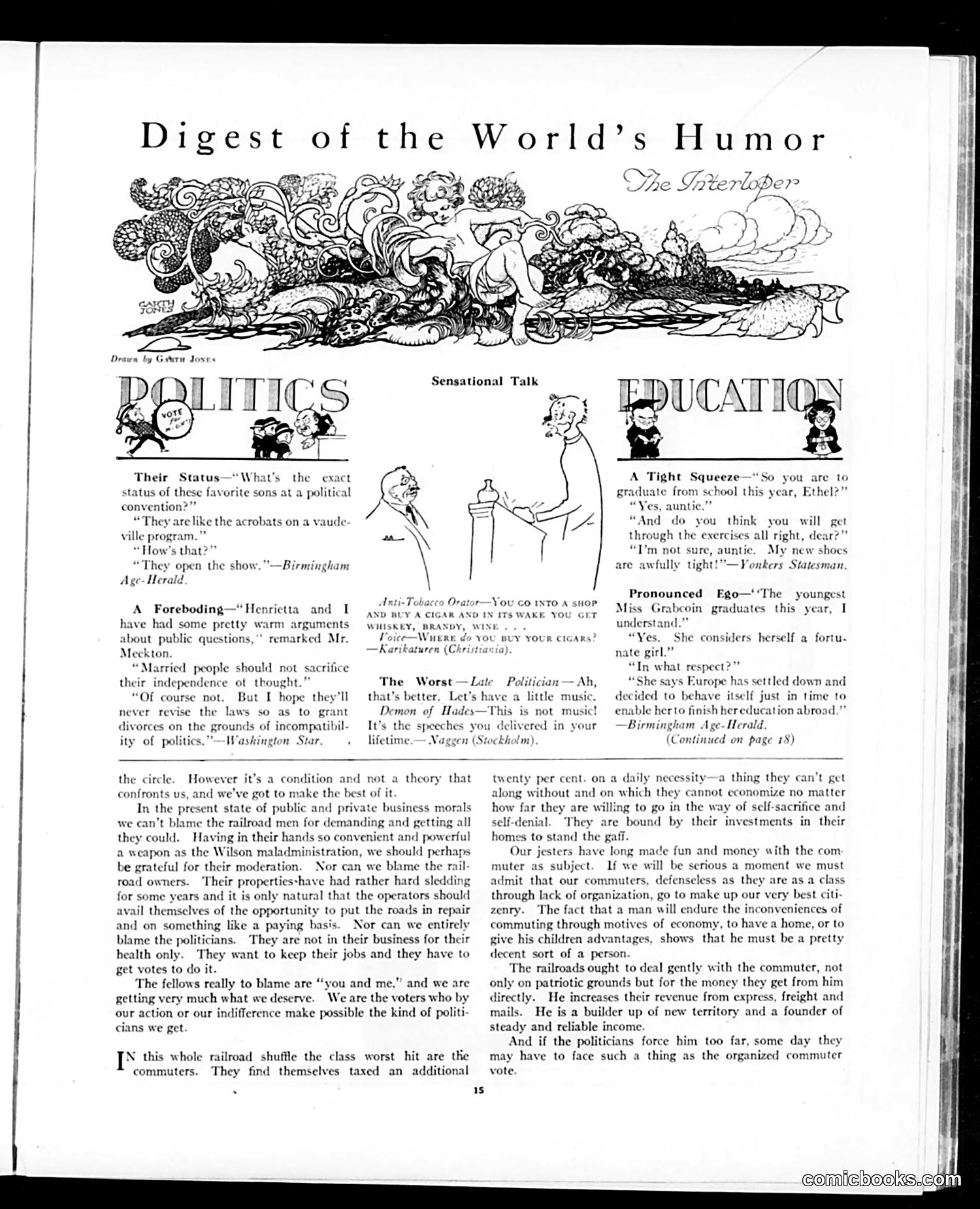
This page from Judge magazine presents satirical humor pieces about early 20th-century American life and politics. **The cartoons mock:** 1. **Political conventions** - Politicians are compared to vaudeville acrobats who merely "open the show" - suggesting they're performers rather than substantive contributors. 2. **Marital discord over politics** - A couple argues about public questions, with the satirist joking that divorce laws should cover "incompatibility of politics." 3. **Anti-tobacco hypocrisy** - An anti-smoking orator is asked where he buys cigars, exposing his own contradictions. 4. **Afterlife punishments** - A deceased politician in Hell finds demon torturers playing his old political speeches as worse than music. 5. **The longer editorial piece defends railroad commuters** as decent, self-sacrificing citizens deserving fair treatment, arguing they're essential to building communities and shouldn't be exploited by either rail companies or politicians. The satire targets political phoniness, personal hypocrisy, and corporate indifference toward working-class commuters—issues clearly resonant in that era's American society.
📄 Transcribed text from this page (OCR, searchable)
Machine-transcribed from the original scan — historical spelling and the odd misread are preserved.
Digest of the World’s Humor Their Status—“What’s the exact status of these favorite sons at a political convention?” “They are like the acrobats on a vaude ville program.” “How’s that?” “They open the show.” —Birmingham Age- Herald. A Foreboding—“Henrictta and I have had some pretty warm arguments about public questions,” remarked Mr. Meckton Jarried people should not sacrifice their independence ot thought.” “Of course not. But I hope they'll never revise the laws so as to grant divorces on the grounds of incompatibil- ity of politics.”’—Washington Star. SORT BN ay aA Ae ea SY) 3) 9) ad. 2) Tee Z ve Anti-Tobacco Orator—You co 1Nto 4 sor AND BUY A CIGAR AND IN ITS WAKE YOU GUT WHISKEY, BRANDY, WINE Voice—Wuer. do you buy your ¢ —Karikaturen (Christiania The Worst —Late Politician — Ah, that’s better. Let’s have a little mu Demon of Hades—This is not music! It’s the speeches you delivered in your lifetime.— Vaggen (Stockholm) Ny 6 Dep re Ga terlof A Tight Squeeze graduate from school this yea Yes, auntie.” “And do you think you will get through the exercises all right, dear?” “T'm not sure, auntie. My new shoes are awfully tight!" —Yonkers Statesman. “So you are to , Ethel?” Pronounced Ego—‘‘The youngest Miss Grabcoin graduates this year, I understand.” “Yes. She considers herself a fortu- nate girl.” “In what respect?” “She says Europe has settled down and decided to behave itself just in time to enable her to finish her education abroad,” —Birmingham Age-Herald. (Continued on page 18) the circle. How confronts us, and we In the present state of public be grateful for their modet for some hing like a paying basis. and on som blame the poli get votes to do it. The fellows really to blame are “you and me,” and we are getting very much what we deserve. We are the voters who by it’s a condition and not a theory that e got to make the best of it d private business morals we can’t blame the railroad men for demanding and getting all se they could. Having in their hands so convenient and powerful homes to stand the gaff. a weapon as the Wilson maladministration, we should perhaps tion. Nor can we blame the rail- road owners. Their properties-have had rather hard sledding years and it is only natural that the operato avail themselves of the opportunity to put the roads in repair — zenry Nor can we entirely They are not in their business for their health only. They want to keep their jobs and they have to muter as subject. Our jesters have long made If we will be serious a moment we must admit that our commuters, defenseless as they sshould through lack of organization, go to make up our very best citi- y. The fact that a man will endure the inconveniences of commuting through motives of economy, to have a home, or to give his children advantages, shows that he must be a pretty decent sort of a person. The railroads ought to deal gently with the commuter, not only on patriotic grounds but for the money they get from him directly. He increas twenty per cent. on a daily necessity—a thing they can’t get along without and on which they : far they are willing to go in the way of self-sacrifice and ial. They are bound by their investments in their y cannot economize no matter fun and money with the com a class rea their revenue from express, freight and our action or our indifference make possible the kind of politi: mails. He is a builder up of new territory and a founder of steady and reliable income. And if the politicians force him too far, some day they cians we get N this whole railroad shuffle the class worst hit are the may commuters. They find themselves taxed an additional vote. 1s ave to face such a thing as the organized commuter comichooks. a i =, ae ee |