
Judge, 1920-09-04 · page 9 of 32
Judge — September 4, 1920 — page 9: what you’re looking at
What you’re looking at
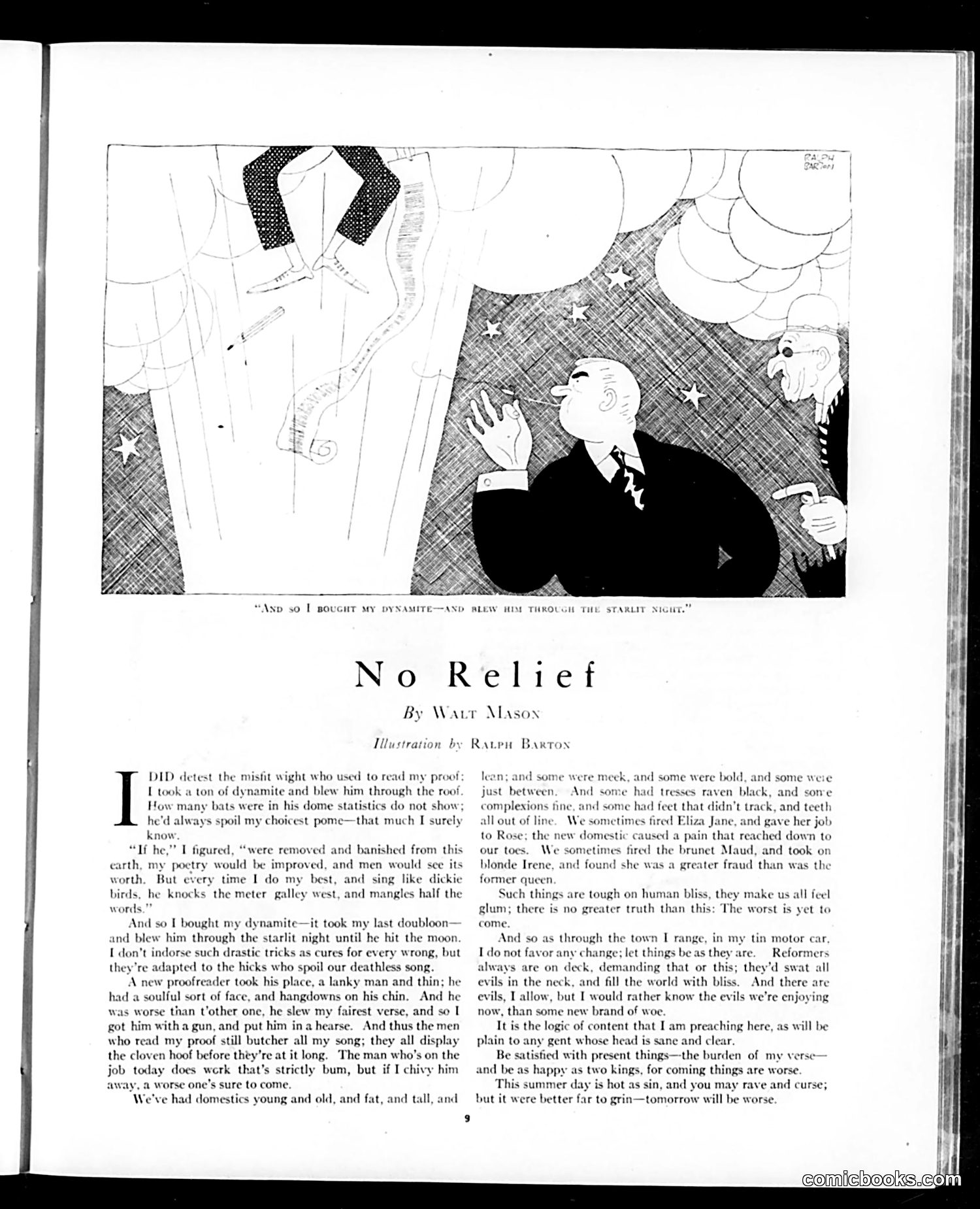
This is a humorous poem illustrated by Ralph Barton, not a political cartoon. The satirical point is a pessimistic meditation on life's inevitable disappointments. The speaker describes hiring a proofreader who constantly ruins his poetry by mangling meter and language. In frustration, he blows the man through the roof with dynamite—but the replacement is even worse. This pattern repeats: he fires domestic servants hoping for improvement, but each new hire proves a greater disaster. The poem's philosophy is darkly comic: accepting present misery because any change will only be worse. The narrator warns against "reformers" who demand to "fix" evils, arguing the devil you know beats unknown future troubles. The refrain is bleak—"tomorrow will be worse"—suggesting resignation to perpetual decline. This reflects early 20th-century conservative skepticism toward social reform and progressive change, wrapped in wry humor about universal human frustration with service workers and domestic help.
📄 Transcribed text from this page (OCR, searchable)
Machine-transcribed from the original scan — historical spelling and the odd misread are preserved.
“Asp so | poucut sty pyNAMITE “AND BLEW HI THROU. MW OTHE STARLIT Nout.” No Relief By Wat Illustration by DID detest the misfit wight who used to read my proof: 1 took a ton of dynamite and blew him through the roof How many bats were in his dome statistics do not show; he'd always spoil my choicest pome—that much I surely know “If he,” I figured, “were remov earth, my poetry would be improved, and men would see its But every time I do my best, and sing like dickie he knocks the meter galley west, and mangles half the words.” And so I bought my dynamite—it took my last doubloon: and blew him through the starlit night until he hit the moon I don’t indorse such drastic tricks as cures for every wrong, but they’re adapted to the hicks who spoil our deathless song. ‘A new proofreader took his place, a lanky man and thin; he had a soulful sort of face, and hangdowns on his chin. And he was worse than Uother one, he slew my fairest verse, and so | got him witha gun, and put him ina hearse. And thus the men who read my proof still butcher all my song; they all display the cloven hoof before they're at it long. The man who's on the job today does werk that’s strictly bum, but if I chivy him 1 worse one’s sure to come. We've had domestics young and old, and fat, and tall, a and banished from this worth birds. away nd t Mason Rateu Bartox were meek, and some were bold, and some weie just between, And some had tresses raven black, and some complexions fine, and some had feet that didn’t track, and teeth all out of line. We sometimes fired Eliza Jane, and gave her job to Rose; the new domestic caused a pain that reached down to our toes. We sometimes fired the brunet Maud, and took on blonde Irene, and found she was a greater fraud than was the former queen Such things are tough on human bliss, they make us all feel glum; there is no greater truth than this: The worst is yet to come. And so as through the town I range, in my tin motor car, I do not favor any change; let things be as they are. Reformers always are on deck, demanding that or this; they’d swat all evils in the neck, and fill the world with bliss. And there are evils, I allow, but I would rather know the evils we're enjoying now, than some new brand of woe. It is the logic of content that I am preaching he: plain to any gent whose head is e and clear. he burden of my verse— as happy as two kings, for coming things are worse. This summer day is hot as sin, and you may rave and curse; but it were better far to grin—tomorrow will be worse. ¢, as will be comichooks..