
Judge, 1920-09-04 · page 18 of 32
Judge — September 4, 1920 — page 18: what you’re looking at
What you’re looking at
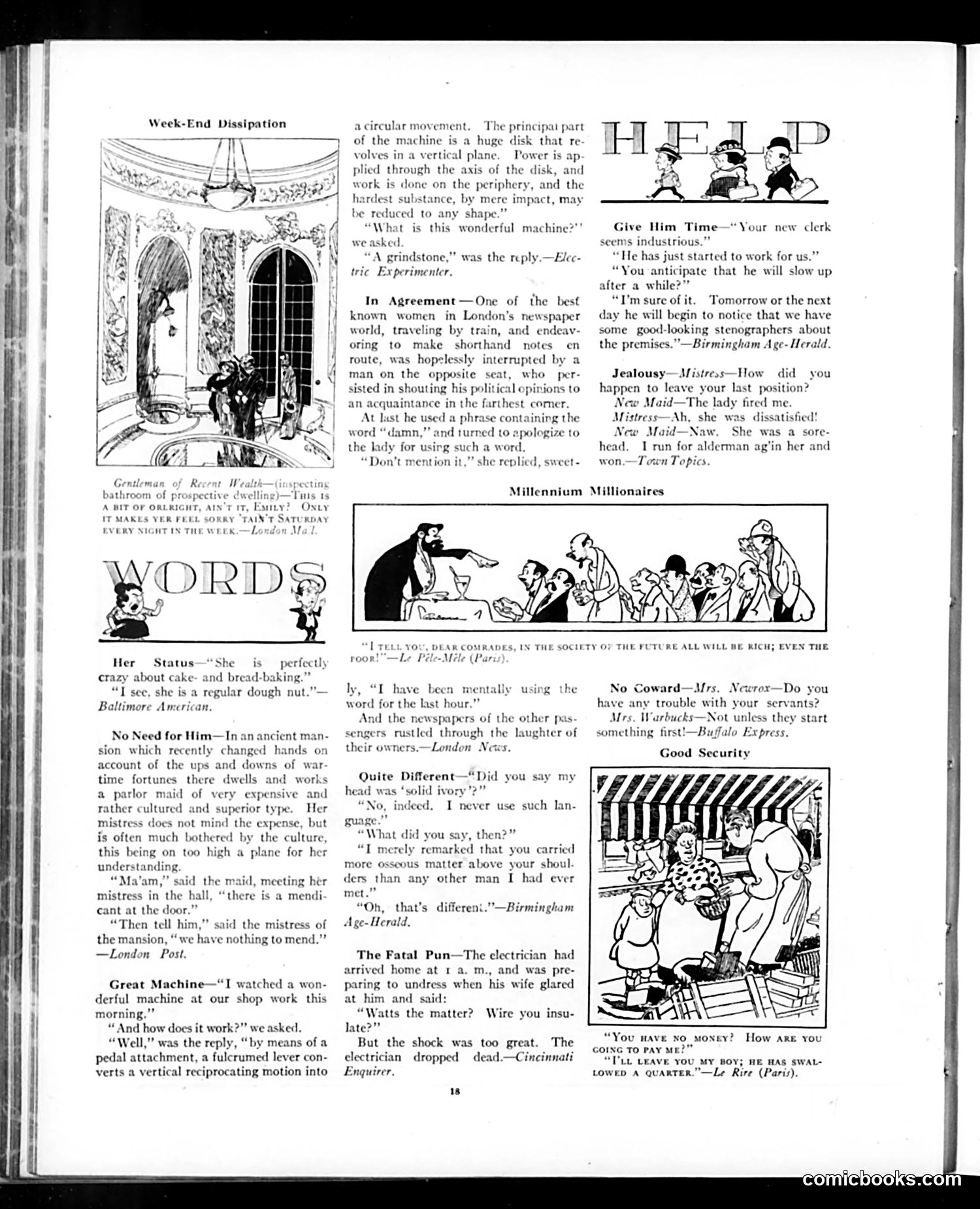
This page contains multiple short humorous anecdotes and cartoons satirizing early 20th-century social conventions and class dynamics. **"Week-End Dissipation"** depicts working-class leisure—likely mocking how laborers find entertainment in modest activities, contrasted with upper-class recreation. **"Her Status"** jokes about a refined parlor maid whose cultured manner exceeds her employer's social station, satirizing class pretension. **"Great Machine"** mocks pseudo-intellectual jargon—a worker uses elaborate technical language to describe a simple grindstone, ridiculing pompous verbosity. **"Millennium Millionaires"** cartoon shows socialists claiming future equality, satirizing utopian political rhetoric. The remaining brief jokes target domestic servants, courtship delays, domestic disputes, and financial anxiety—common middle-class concerns of the era. "The Fatal Pun" employs dark humor around electricity, then-modern and somewhat dangerous technology. Overall, the page satirizes class pretension, marital conflict, servants' independence, and contemporary anxieties about technology and social change.
📄 Transcribed text from this page (OCR, searchable)
Machine-transcribed from the original scan — historical spelling and the odd misread are preserved.
Week-End Dissipation ee 1 | ti \ Lh )—Tuis ts A BIT OF ORLRIGHT, AIN'T IT, Extty? Onty IT MAKES VER FEEL SORRY "TAIN'T SATURDAY EVERY NIGHT IN THE WeEK.— Lond: She is perfectly and bread-baking.”” ¢, she is a regular dough nut.”"— Baltimore American, Her = Status No Need for Him—In an ancient man- sion which recently changed hands on account of th and downs of war- time fortunes nd works re dwells the a parlor maid of very expensive and rather cultured and superior type. Her mistress does not mind the expense, but is often much bothered by the culture, this being on too high a plane for her understanding. “Ma‘am,” said the maid, meeting her mistress in the hall, “there is a mendi cant at the door.” “Then tell him,” the mansion, “we —London Post. id the mistress of ¢ nothing to mend.” Great Machine—“I watched a won- derful machine at our shop work this morning.” “ And how does it work?” we asked. “Well,” was the reply, “by means of a pedal attachment, a fulcrumed lever con- verts a vertical reciprocating motion into acircular movement. The principat part of the machine is a huge disk that re- volves in a vertical plane. Power is ap. plied through the axis of the disk, and work is done on the periphery, and the hardest substance, by mere impact, may be reduced to any shape.” “What is this wonderful machine?’’ we asked. “A grindstone,” trie Experimenter. was the reply.—Elec- In Agreement —One of the best known women in London’s newspaper world, traveling by train, and endeav- oring to make shorthand en route, was hopelessly interrupted by man on the opposite who per- sisted in shouting his political opinions to an acquaintance in the farthest comer. At last he used a phrase containing the word “damn,” and turned to apologize to the y for using such a word, “Don’t mention it,” she replied, sweet - notes seat, Millennium Give Him Time—* Your new clerk seems industrious.” “He has just started to work for us.” You anticipate that he will slow up after a while?” I'm sure of it. Tomorrow or the next lay he will begin to notice that we have some good-looking stenographers about the premises.” —Birmingham Age-Herald. Mistress—How did your last position? New Maid—The lady fired m Mistress—Ah, she was dissatisfied! New Maid—Naw. She was a sore- head. I run for alderman ag'in her and won.—Town Topics. Jealousy happen to | you Millionaires DEAR COMRADES, IN THE SOCIETY OF THE FUTURE ALL WILL BE RICH; EVEN THE ly, “I have been mentally the word for the last hour.”” And the newspapers of the other pas sengers rustled through the laughter of London News. using their owners.— Quite Different—“Did you say my head was ‘solid ivory’?” i indeed. I never use such lan- A then?” 1 that you carried more osscous matter above your shoul- ders than any other man I had ever met.” “On, that’s differeni.”—Birmingham Age- Herald, “What did you say, The Fatal Pun—The electrician had arrived home at 1 a. m., and was pre- paring to undress when his wife glared at him and said: “Watts the matter? late?” But the shock was too great. The electrician dropped dead.—Cincinnati Enquirer. Wire you insu- No Coward—Mrs, Newrox—Do you have any trouble with your servants? Mrs, Warbucks—Not unless they start Talo Express. Good Security something first!—Buf “You nave xo soney? How are you GOING TO PAY ME?” “I'LL LEAVE YOU MY BOY; HE HAS SWAL- Lowen A quarter.”—Le Rire (Paris).