
Judge, 1920-09-04 · page 14 of 32
Judge — September 4, 1920 — page 14: what you’re looking at
What you’re looking at
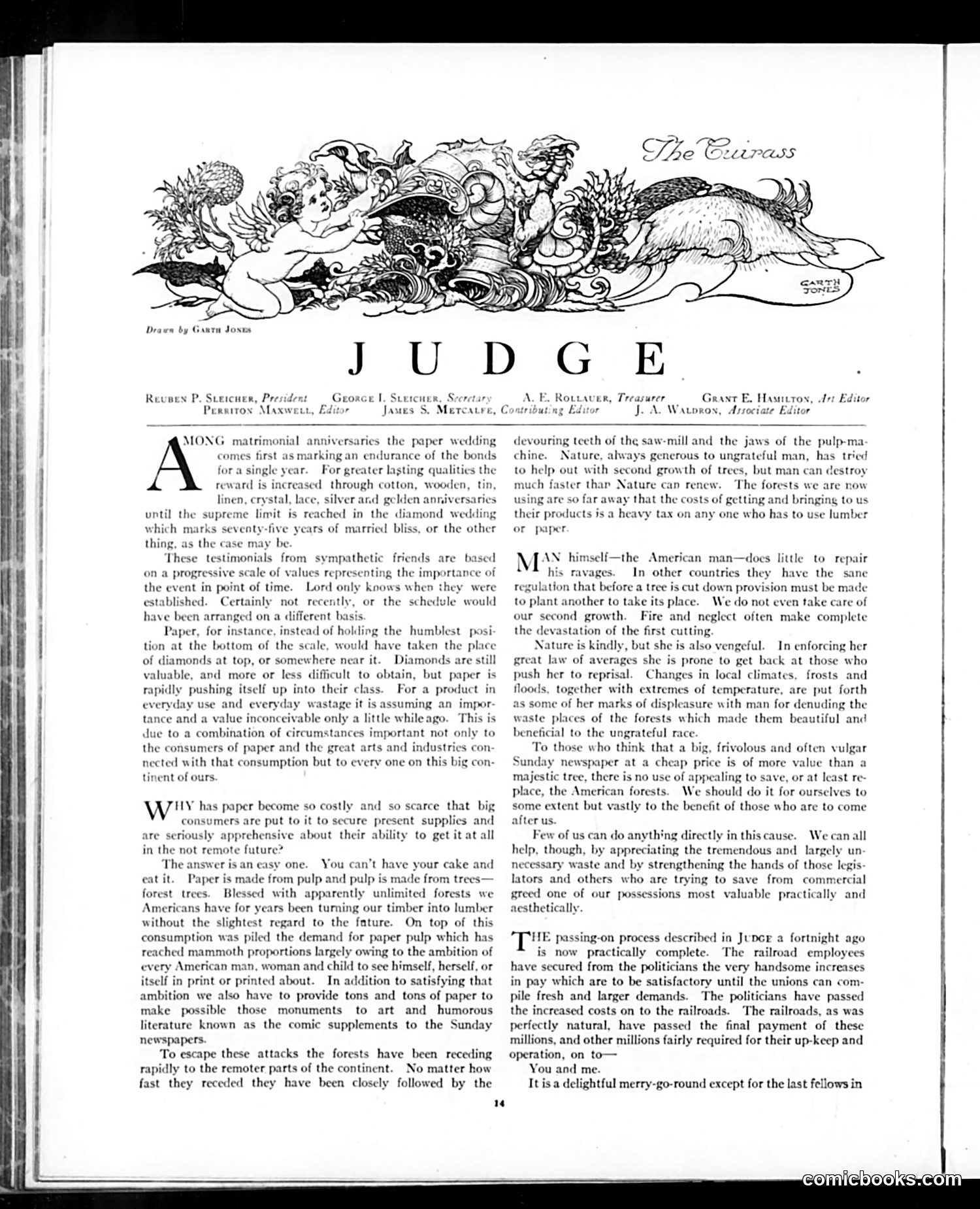
This is primarily an editorial essay, not a political cartoon. The decorative header by Gantx Jones depicts cherubs and classical imagery but serves as ornamental framing rather than satire. The text is a serious environmental argument about America's wasteful timber harvesting. The author criticizes Americans for thoughtlessly clear-cutting forests to produce paper and lumber without replanting, unlike regulated European practices. He argues that while Nature attempts renewal through second growth, human destruction outpaces it—especially since mills now harvest from distant forests, raising costs. The piece expresses concern about paper scarcity and warns of environmental consequences: climate changes, floods, and frosts resulting from deforestation. The author appeals to readers' self-interest and patriotism to support forest conservation. This represents **progressive-era environmental advocacy** in Judge, advocating for regulated forestry practices before such conservation became standard policy.
📄 Transcribed text from this page (OCR, searchable)
Machine-transcribed from the original scan — historical spelling and the odd misread are preserved.
i LF 1] Drawn by Ganta Joxes Geoace I, Srercuer, Sreretar ’ James Mercatre, Suercuer, President Peratrox Maxwett, Revses P. E, Routaver, Treasurer Grawt E. Hasittoy, fr uting J. A. Watnroy, Associate MONG matrimonial anniversaries the paper wedding marking an endurance of the bonds fora single year. For greater lasting qualities the reward is increased through cotton, wooden, tin, linen, crystal, lace, silver and gelden anniversaries until the supreme limit is reached in the diamond wedding which marks seventy-five years of married bliss, or the other comes first a be. thing, as the case m. These testimonials from sympathetic friends are based on a progressive scale of values representing the importance of the event in point of time. Lord only knows when they were established. Ci inly not recently, or the schedule would have been arranged on a different t Paper, for instance, instead of holding the humblest posi tion at the bottom of the scale, would have taken the place of diamonds at top, or somewhere near it. Diamonds are still valuable, and more or less difficult to obtain, but paper is rapidly pushing itself up into their class. For a product in everyday use and everyday wastage it is assuming an impor- tance and a value inconceivable only a little whileago. This is due to a combination of circumstances important not only to the consumers of paper and the great arts and industries con- nected with that consumption but to every one on this big con- tinent of ours. W LEY has paper become so costly and so scarce that big co! ners are put to it to secure present supplies and apprehensive about their ability to get it at all in the not remote future? The answer isan easy one. You can’t have your cake and cat it. Paper is made from pulp and pulp is made from trees— forest trees. Blessed with apparently unlimited forests we Americans have for years been turning our timber into lumber without the slightest regard to the fature. On top of this consumption was piled the demand for paper pulp which has reached mammoth proportions largely owing to the ambition of ery American man, woman and child to see himself, herself, or itself in print or printed about. In addition to satisfying that ambition we also have to provide tons and tons of paper to make possible those monuments to art and humorous literature known as the comic supplements to the Sunday newspapers. To escape these attacks the forests have been receding rapidly to the remoter parts of the continent. No matter how fast they receded they have been closely followed by the are seriously “ devouring teeth of the saw-mill and the jaws of the pulp-ma chine. Nature, always generous to ungrateful man, has tried to help out with second growth of trees, but man can cestroy much faster thar Nature can renew. The forests we are now using are so far away that the costs of getting and bringing to us their products is a heavy tax on any one who has to use lumber or paper N AN himself—the American man—does little to repair ‘Ya his ravages. In other countries they have the sane regulation that before a tree is cut down provision must be mad to plant another to take its place. We do not even take care of our second growth. Fire and neglect often make complete the devastation of the first cutting. Nature is kindly, but she is also vengeful. In enforcing her great law of averages she is prone to get back at those who push her to reprisal. Changes in local climates, frosts and floods, together with extremes of temperature, are put forth as some of her marks of displeasure with man for denuding the waste places of the forests which made them beautiful and beneficial to the ungrateful race. those who think that a big, frivolous and often vulgar y newspaper at a cheap price is of more value than a ¢ tree, there is no use of appealing to oF at Teast re- place, the American forests. We should do it for ourselves to some extent but vastly to the benefit of those who are to come after us. Few of us can do anything directly in this c: We can all help, though, by appreciating the tremendous and largely un necessary waste and by strengthening the hands of those legi: lators and others who are trying to save from commercial greed one of our possessions most valuable practically and sthetically. TH S passing-on process described in Jupcr a fortnight ago is now practically complete. The railroad employees have secured from the pol ns the very handsome increases in pay which are to be satisfactory until the unions can com- pile fresh and larger demands. The politicians have passed the increased costs on to the railroads. The railroads, as was perfectly natural, have passed the final payment of these millions, and other millions fairly required for their up-keep and operation, on to— You and me. Itis a delightful merry-go-round except for the last fellows in