
Judge, 1920-09-04 · page 20 of 32
Judge — September 4, 1920 — page 20: what you’re looking at
What you’re looking at
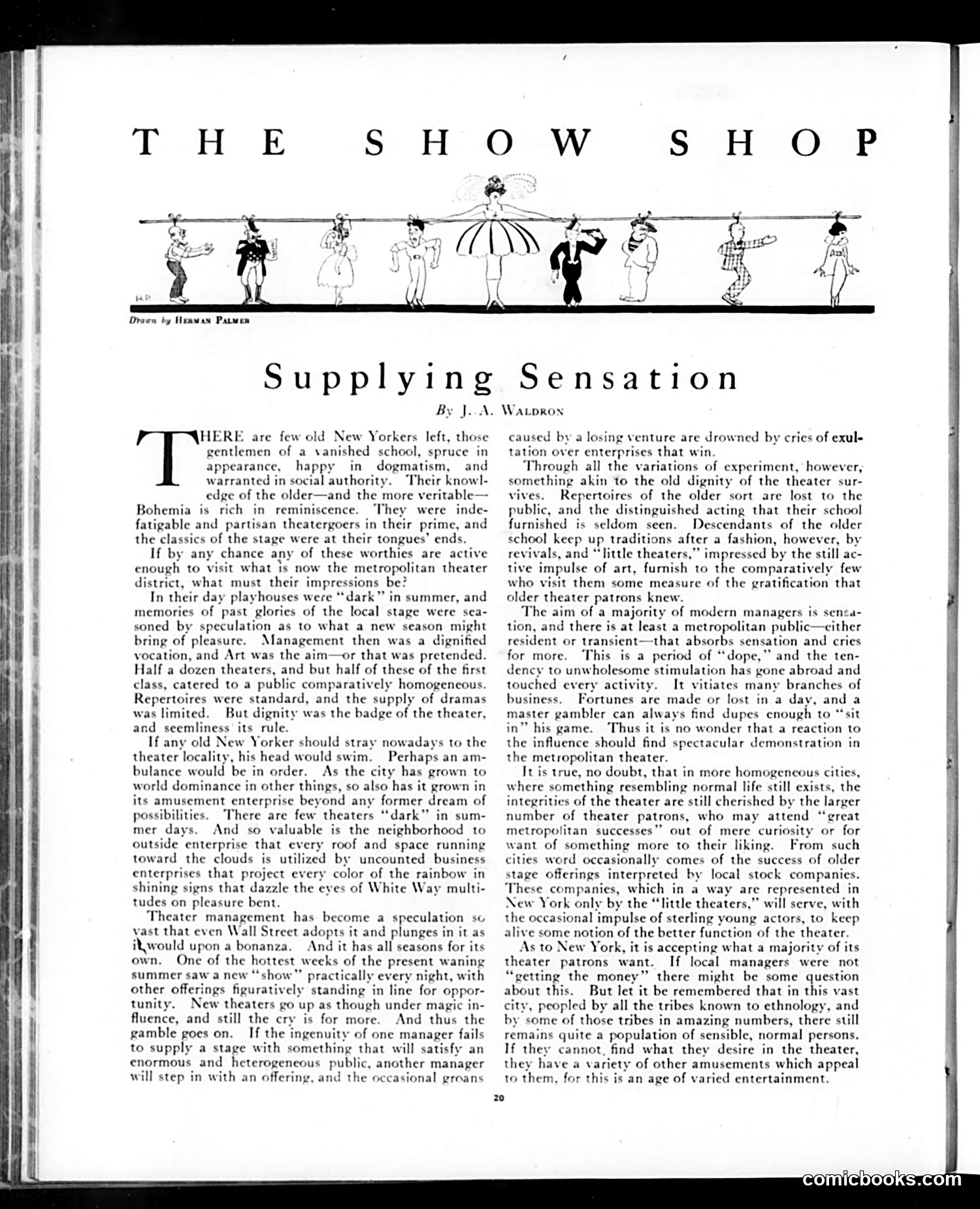
This article by J.A. Waldron contrasts old New York theater culture with the modern (1920s-era) entertainment industry. **The Point:** Theater management has transformed from a dignified art form into a speculative gambling business. The accompanying illustration shows various theatrical character types—performers in different costumes and styles—representing the proliferation of entertainment offerings. **Key References:** - "Old New Yorkers" = nostalgic theatergoers who appreciated classical repertory theater - "Dark" theaters in summer = theaters that closed seasonally (traditional practice) - The "White Way" = Broadway's illuminated theater district - Wall Street speculation = treating theater as financial commodity rather than art **The Satire:** Modern managers chase "sensation" and "dope" (stimulation) to satisfy "an enormous and heterogeneous public," driven by profit-motive gambling rather than artistic integrity. New shows open constantly; theaters compete frantically. The author suggests this reflects broader 1920s American culture: fast money, speculation, and artificial stimulation replacing older values of craftsmanship and restraint.
📄 Transcribed text from this page (OCR, searchable)
Machine-transcribed from the original scan — historical spelling and the odd misread are preserved.
Drown by Heawan Patwen Supplying Sensation By Joa. HERE are few old New Yorkers left, those gentlemen of a vanished school, spruce in appearance, happy in dogmatism, and warranted in social authority. Their knowl- edge of the older—and the more veritable— Bohemia is rich in reminiscence. They were inde- fatigable and partisan theatergoers in their prime, and the classics of the stage were at their tongues’ ends. If by any chance any of these worthies are active enough to visit what is now the metropolitan theater district, what must their impressions be? In their day playhouses were “dark” in summer, and memories of past glories of the local stage were sea- soned by speculation as to what a new season might bring of pleasure. Management then was a dignified vocation, and Art was the aim—or that was pretended. Half a dozen theaters, and but half of these of the first class, catered to a public comparatively homogeneous. Repertoires were standard, and the supply of dramas was limited. But dignity was the badge of the theater, and seemliness its rule. If any old New Yorker should stray nowadays to the theater locality, his head would swim. Perhaps an am- bulance would be in order. As the city has grown to world dominance in other things, so also has it grown in its amusement enterprise beyond any former dream of possibilities. There are few theaters “dark” in sum- mer days. And so valuable is the neighborhood to outside enterprise that every roof and space running toward the clouds is utilized by uncounted business enterprises that project ev color of the rainbow in shining signs that dazzle the eyes of White Way multi- tudes on pleasure bent. Theater management has become a speculation 8G vast that even Wall Street adopts it and plunges in it as iXwould upon a bonanza. And it has all seasons for its own. One of the hottest weeks of the present waning summer saw a new “show” practically every night, with other offerings figuratively standing in line for oppor- ‘ew theaters go up as though under magic in- fluence, and still the cry is for more. And thus the gamble goes on. If the ingenuity of one manager fails to supply a stage with something that will satisfy an enormous and heterogeneous public, another manager will step in with an offering, and the occasional groans Wa.pron caused by a losing venture are drowned by cries of exul- tation over enterprises that win. Through all the variations of experiment, however, something akin to the old dignity of the theater sur- vives. Repertoires of the older sort are lost to the public, and the distinguished acting that their school furnished is seldom seen. Descendants of the older school keep up traditions after a fashion, however, by revivals, and “little theaters,” impressed by the still a tive impulse of art, furnish to the comparatively few who visit them some measure of the gratification that older theater patrons knew. The aim of a majority of modern managers is sensa- tion, and there is at least a metropolitan public—cither resident or transient—that absorbs sensation and cries for more. This is a period of “dope,” and the ten- dency to unwholesome stimulation has gone abroad and touched every activity. It vitiates many branches of business. Fortunes are made or lost in a day, and a master gambler can always find dupes enough to “sit in” his game. Thus it is no wonder that a reaction to the influence should find spectacular demonstration in the metropolitan theater. It is true, no doubt, that in more homogeneous cities, where something resembling normal life still exists, the integrities of the theater are still cherished by the larger number of theater patrons, who may attend “great metropolitan successes” out of mere curiosity or for want of something more to their liking. From such cities word occasionally comes of the success of older stage offerings interpreted by local stock companie: ‘These companies, which in a way are represented in New York only by the “little theaters,” will serve, with the occasional ‘impulse of sterling young actors, to keep alive some notion of the better function of the theater. As to New York, it is accepting what a majority of its heater patrons want. If local managers were not etting the money” there might be some question about this. But let it be remembered that in this vast ity, peopled by all the tribes known to ethnology, and by some of those tribes in amazing numbers, there still remains quite a population of sensible, normal persons. If they cannot, find what they desire in the theater, they have a variety of other amusements which appeal to them, for this is an age of varied entertainment. 20