
Judge, 1920-09-04 · page 22 of 32
Judge — September 4, 1920 — page 22: what you’re looking at
What you’re looking at
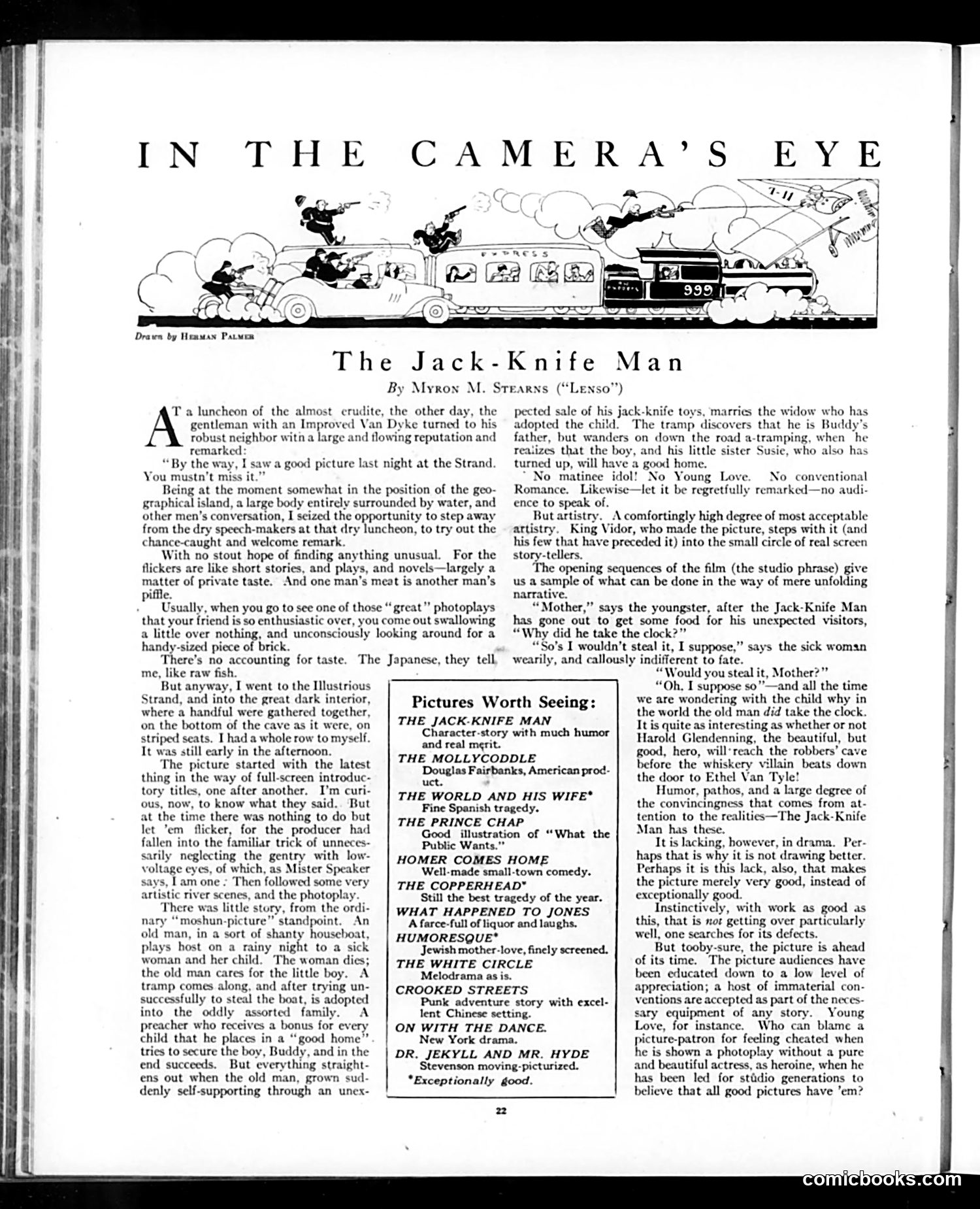
This page reviews a 1919 film directed by King Vidor, praised for its artistic merit despite lacking commercial appeal. The author critiques the film industry's tendency toward melodrama and conventional romance, contrasting this with "The Jack-Knife Man's" modest, character-driven story about a tramp, an elderly man, and orphaned children—depicting genuine human connection rather than glamorous fantasy. The cartoon header by Hermon Palmer shows a train carrying movie-related imagery, illustrating cinema's cultural prominence. The reviewer notes the film played to nearly empty theaters ("an audience to speak of"), suggesting artistic achievement didn't guarantee box-office success. The piece exemplifies Judge magazine's role critiquing both entertainment and American consumer culture, while the sidebar "Pictures Worth Seeing" recommends other worthwhile films, establishing critical standards against shallow commercial fare.
📄 Transcribed text from this page (OCR, searchable)
Machine-transcribed from the original scan — historical spelling and the odd misread are preserved.
a ! ' Draven by Heawax Patwen The Jack-Knife Man By Myron M. Stearns (“Le T a luncheon of the almost crudite, the other day, the gentleman with an Improved Van Dyke turned to his robust neighbor with a large and flowing reputation and remarked: “ By the way, I saw a good picture last night at the Strand. You mustn't miss it.” Being at the moment somewhat in the position of the geo- graphical island, a large body entirely surrounded by water, and other men’s conversation, I seized the opportunity to step away from the dry speech-makers at that dry luncheon, to try out the chance-caught and welcome remark. With no stout hope of finding anything unusual. For the flickers are like short stories, and plays, and novels—largely a matter of private taste. And one man’s meat is another man’s pected sale of his jack-knife toys, marries the widow who has adopted the child. The tramp discovers that he is Buddy's father, but wanders on down the road a- tramping, when ‘he realizes that the boy, and his little sister Susie, who also has turned up, will have a good home. No matinee idol! No Young Love. No conventional Romance. Likewise—let it be regretfully remarked—no audi- ence to speak of. Butartistry. A comfortingly high degree of most acceptable artistry. King Vidor, who made the picture, steps with it (and his few that have preceded it) into the small circle of real screen story-tellers. The opening sequences of the film (the studio phrase) give us a sample of what can be done in the way of mere unfolding pifile. handy-sized piece of brick. There’s no accounting for taste. The Japanese, they tell me, like raw fish. But anyway, I went to the Illustrious Strand, and into the great dark interior, where a handful were gathered together, ‘on the bottom of the cave as it were, on striped seats. I hada whole row to myself. It was still early in the afternoon. picture started with the latest n the way of full-screen introduc- tory titles, one after another. I’m curi- ous, now, to know what they said. But at the time there was nothing to do but let ’em flicker, for the producer had fallen into the familiar trick of unneces- sarily neglecting the gentry with low- voltage eyes, of which, as Mister Speaker , Lam one - Then followed some very i and the photoy There was little story, from the o1 ary “‘moshun-picture” standpoint. An old man, in a sort of shanty housel plays host on a rainy night to a sick woman and her child. The woman dies; the old man cares for the little boy. A tramp comes along, and after trying un- successfully to st the boat, is adopted into the oddly assorted family. A preacher who receives a bonus for every child that he places in a “good home” tries to secure the boy, Buddy, and in the end succeeds. But everything straight- ens out when the old man, grown sud- denly self-supporting through an unex- Usually, when you go to see one of those “great” photoplays that your friend is so enthusiastic over, you come out swallowing a little over nothing, and unconsciously looking around fora “Wh narrative. Pictures Worth Seeing: THE JACK-KNIFE MAN Character-story with much humor and real merit. THE MOLLYCODDLE Douglas Fairbanks, American prod uct. THE WORLD AND HIS WIFE* Fine Spanish tragedy. THE PRINCE CHAP Good illustration of “What the Public Wants.” HOMER COMES HOME Well-made small-town comedy. THE COPPERHEAD” Still the best tragedy of the year. WHAT HAPPENED TO JONES A farce-full of liquor and laughs. HUMORESQUE* Jewish mother-love, finely screened. THE WHITE CIRCLE Melodrama as is. CROOKED STREETS Punk adventure story with excel- lent Chinese setting. ON WITH THE DANCE. New York drama. DR. JEKYLL AND MR. HYDE Stevenson moving-picturized. “Exceptionally good. “Mother,” says the youngster, after the Jack-Knife Man has gone out to get some food y did he take the clock?” So's I wouldn’t steal it, I suppose,” says the sick woman wearily, and callously indifferent to fate. for his unexpected visitors, “Would you steal it, Mother?” “Oh, I suppose so” —and all the time we are wondering with the child why in the world the old man did take the clock. It is quite as interesting as whether or not Harold Glendenning, the beautiful, but good, hero, will:reach the robbers’ cave before the whiskery villain beats down the door to Ethel Van Tyle! Humor, pathos, and a large degree of the convincingness that comes from at- tention to the realities—The Jack-Knife Man has these. It is lacking, however, in drama. Per- haps that is why it is not drawing better. Perhaps it is this Jack, also, that makes the picture merely very good, instead of exceptionally good. Instinctively, with work as good as this, that is nor getting over particularly well, one searches for its defects. But tooby-sure, the picture is ahead of its time. The picture audiences have been educated down to a low level of appreciation; a host of immaterial con- ventions are accepted as part of the neces- sary equipment of any story. Young Love, for instance. Who can blame a picture-patron for feeling cheated when he is shown a photoplay without a pure and beautiful actress, as heroine, when he has been led for stadio generations to believe that all good pictures have ’em?