
A complete issue · 36 pages · 1919
Judge — November 22, 1919
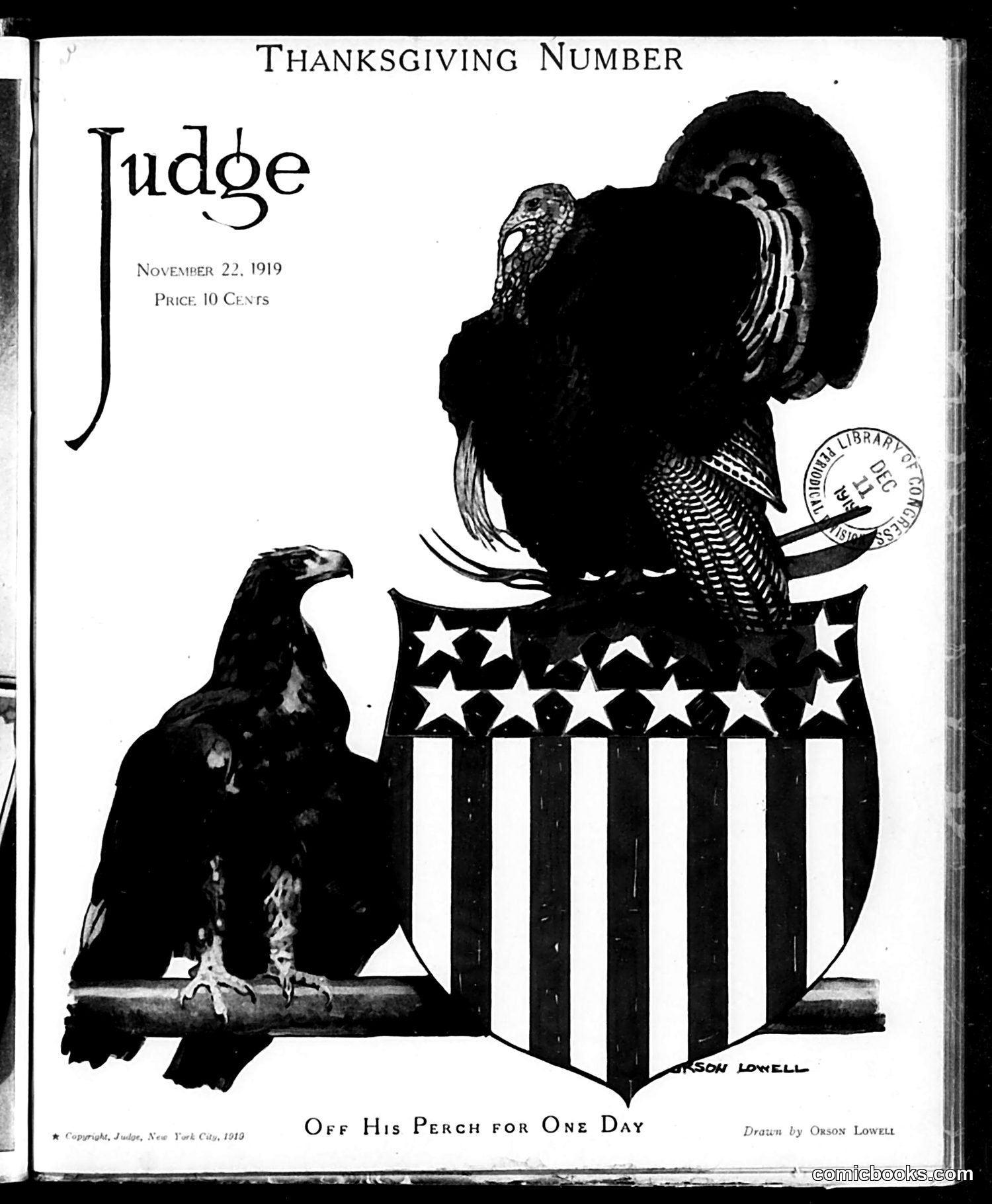
This Thanksgiving-themed cover from November 22, 1919 depicts an eagle perched atop a shield bearing stars and stripes—classic American patriotic symbols. A turkey stands beside it, looking at the eagle. The cartoon's caption, "Off His Perch for One Day," suggests a role reversal or holiday respite. The joke appears to be that on Thanksgiving, the eagle (representing American authority/government) temporarily steps aside, allowing the turkey—the traditional holiday bird destined for the dinner table—a brief moment of prominence or freedom before its fate. This is a lighthearted visual pun playing on the holiday's traditions rather than a political commentary. The artist is Orson Lowell.
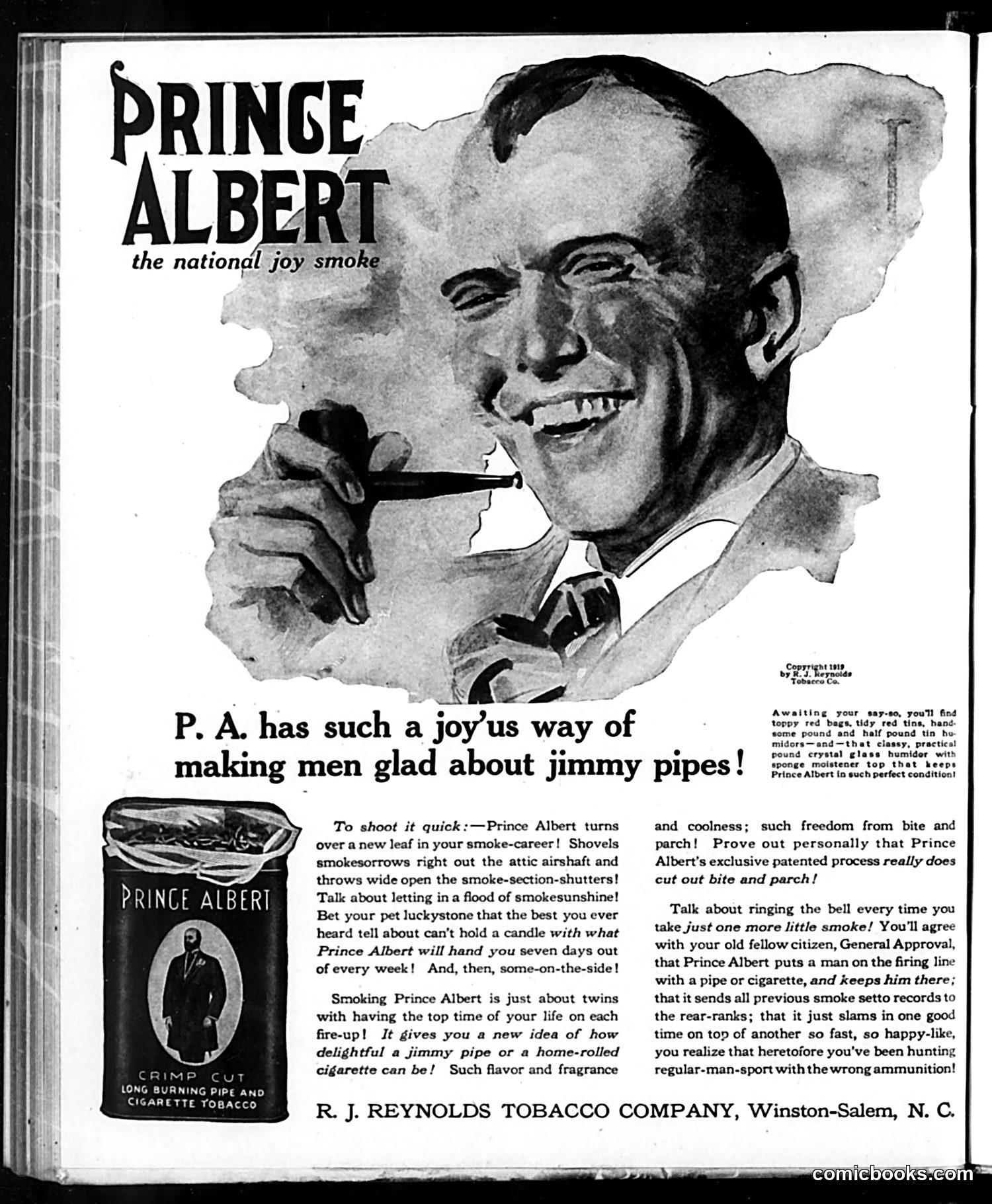
This page is **primarily a cigarette advertisement**, not political satire. It promotes Prince Albert pipe and cigarette tobacco by R.J. Reynolds Tobacco Company. The ad uses a generic smiling man's portrait—not a specific historical or political figure—as the brand mascot "Prince Albert." The text humorously exaggerates the product's appeal, claiming it makes smoking so pleasurable that users will be constantly reaching for "just one more little smoke." References to "General Apropos" and "regular-man-sport" appear to be playful language designed to make smoking seem manly and accessible to ordinary citizens, rather than elite or pretentious. The "national joy smoke" tagline reflects early 20th-century tobacco marketing that presented smoking as wholesome entertainment. The page contains no discernible political commentary—it's straightforward product promotion typical of Judge magazine's advertising.
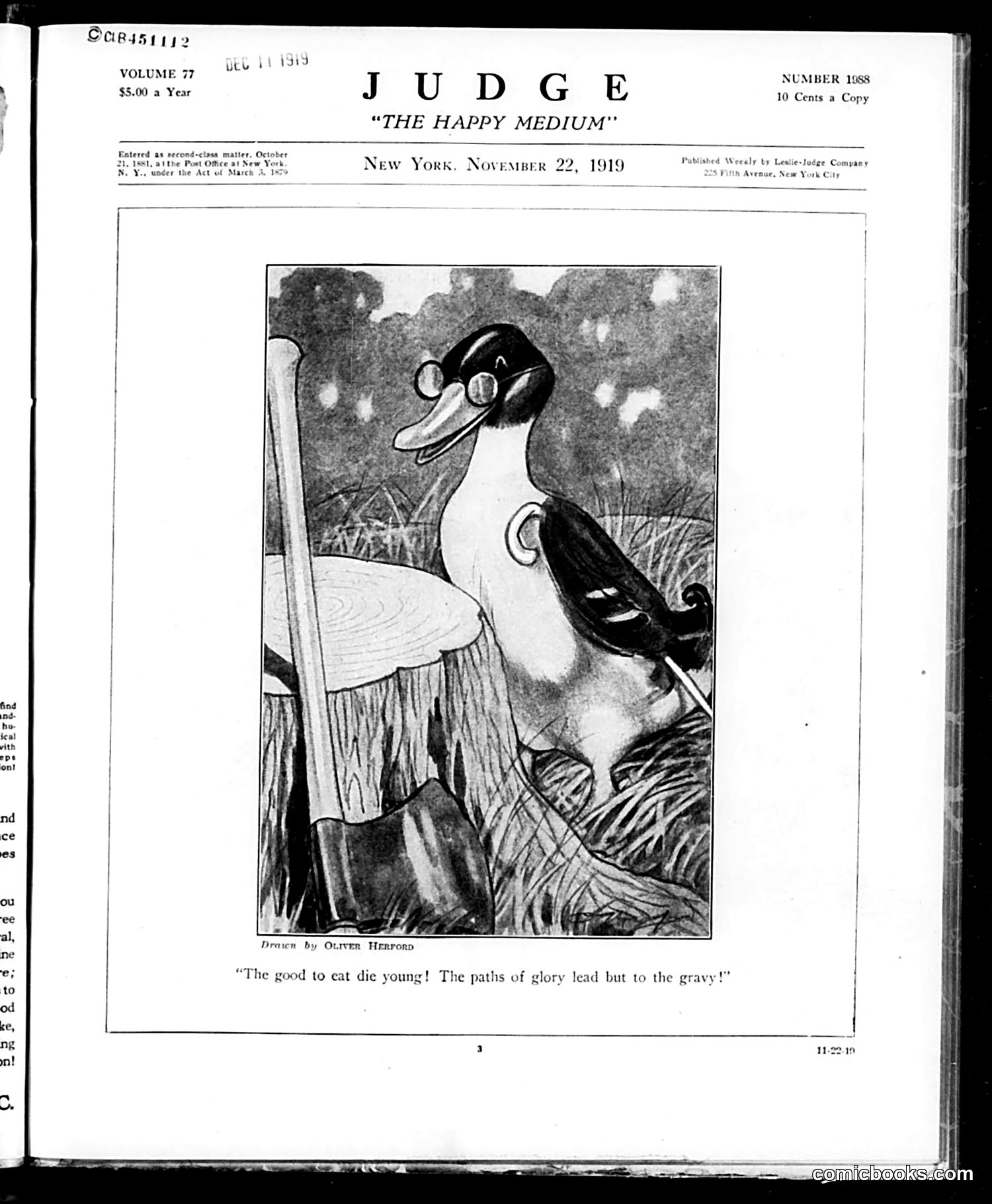
This cartoon by Oliver Herford depicts a bird—likely a duck or similar waterfowl—confronting what appears to be a young soldier or hunter with a rifle. The caption reads: "The good to eat die young! The paths of glory lead but to the grave!" The satire appears to reference World War I, which ended just days before this publication (November 11, 1919). The cartoon criticizes the sacrifice of young soldiers, juxtaposing the predatory relationship between hunter and hunted with the loss of youth in warfare. The quote invokes both mortality and the famous line from Thomas Gray's poem "Elegy Written in a Country Churchyard," suggesting that glory and honor are hollow consolations for death. The cartoon condemns the waste of young lives in military conflict.
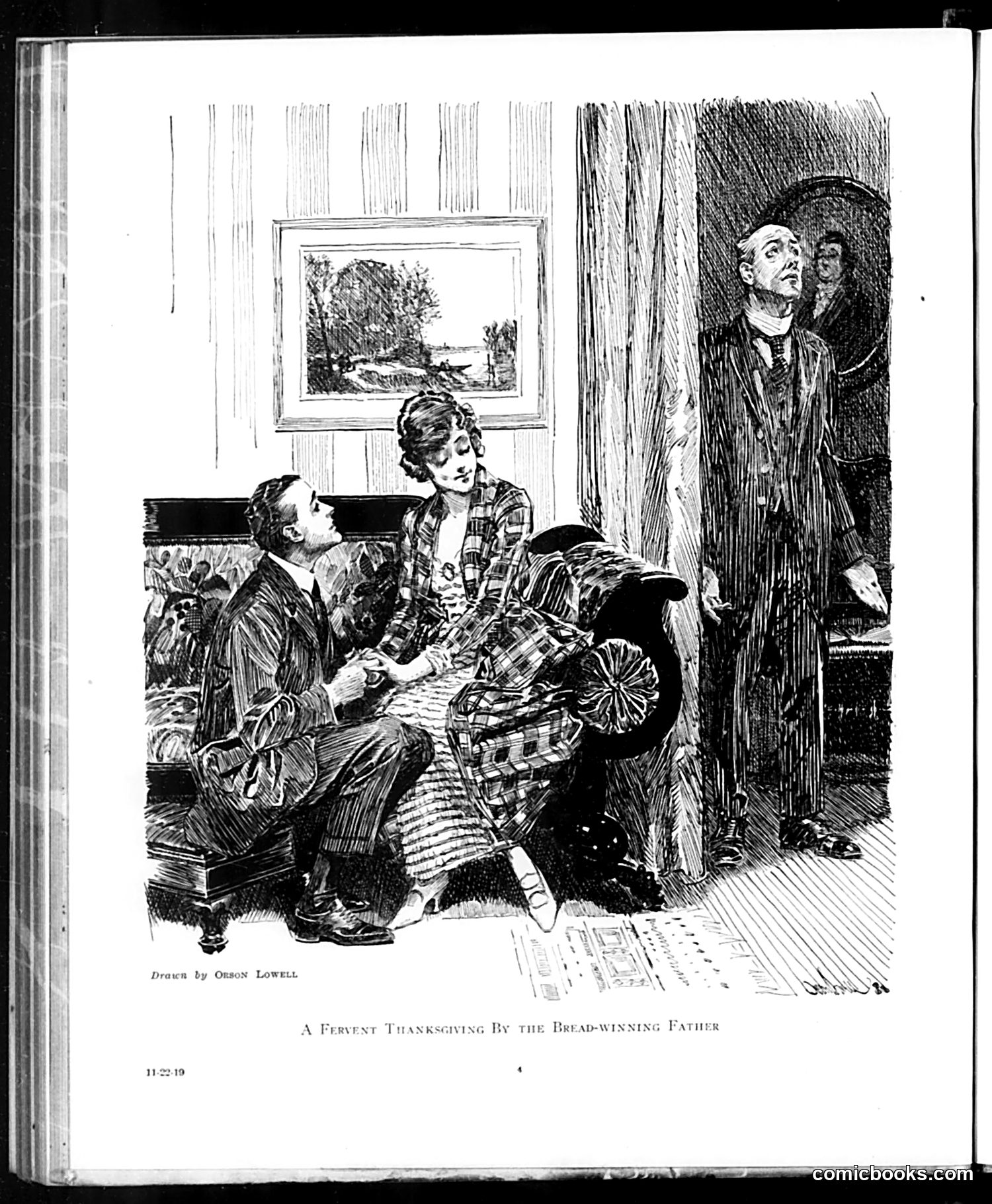
**The Scene:** A working-class man sits with a woman and child, while two stern-looking men observe from a doorway. **The Satire:** The title ironically references a father's "fervent thanksgiving"—likely for employment or economic stability. The presence of the observing figures (appearing to be authority figures or creditors) suggests the family's gratitude is conditional or overshadowed by financial pressure. The sketched newspapers on the floor may reference economic news or job listings. **Historical Context:** This appears to address early 20th-century working-class anxieties about employment, housing, and economic security. The "bread-winning father" was a culturally important ideal, but this cartoon suggests his gratitude is performed under duress rather than genuine relief. The satire critiques how working families' thanksgiving celebrations occur amid persistent financial strain.
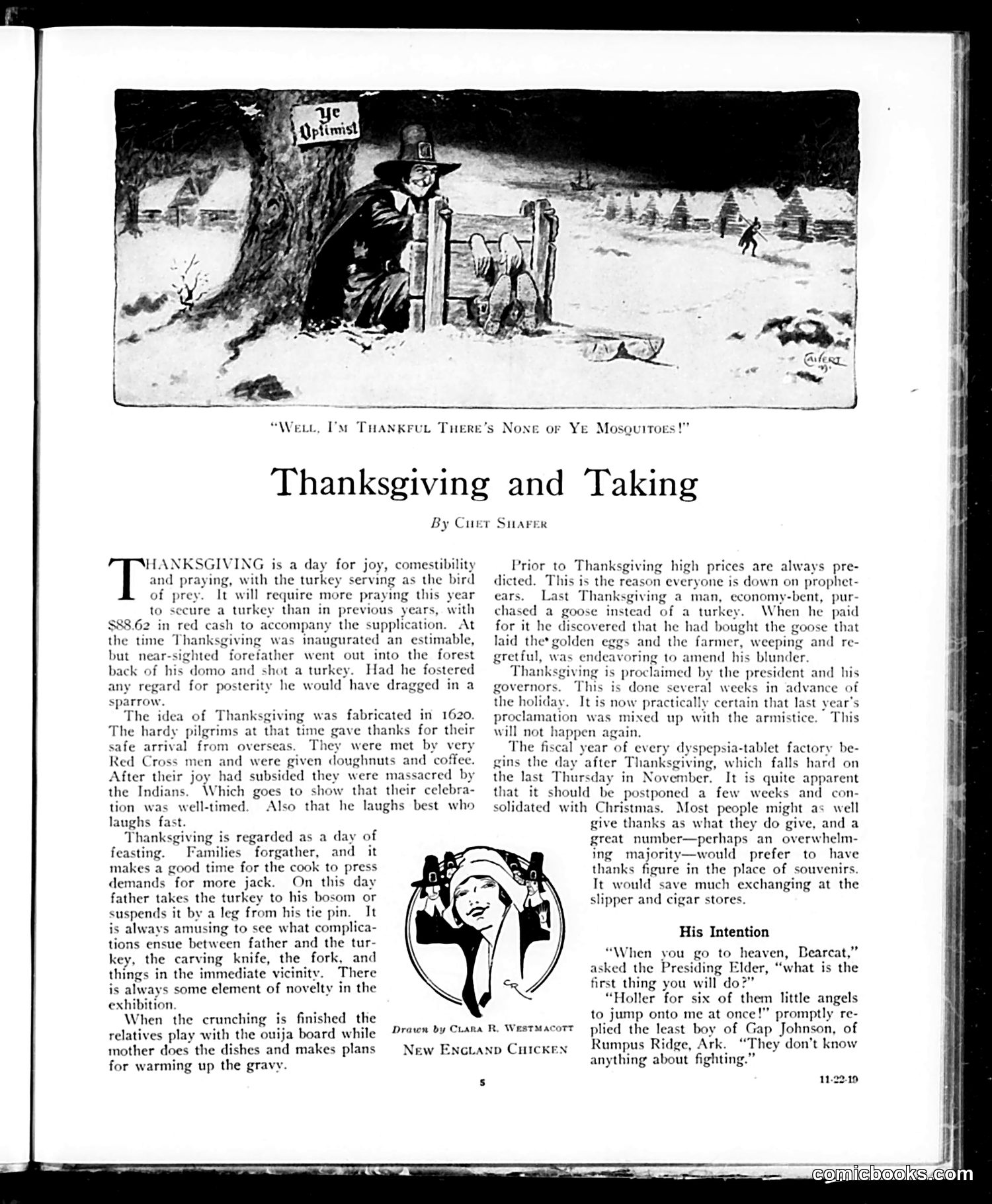
The main cartoon depicts a figure in winter clothing standing by a crude shelter marked "Ye Ultimist" in a snowy landscape. The figure expresses gratitude that there are "None of Ye Mosquitoes!"—a joke about extreme winter conditions making mosquitoes disappear. The article "Thanksgiving and Taking" by Clef Shafer discusses Thanksgiving traditions and costs. It notes that turkey prices have risen significantly compared to previous years, and mentions a humorous anecdote about someone who bought a goose instead of a turkey the previous year, only to discover it had laid golden eggs. The lower section includes a small illustration titled "New England Chicken" and a brief humorous dialogue called "His Intention" about heavenly aspirations. The page appears primarily satirical commentary on holiday economics and rural/frontier life rather than explicit political commentary.
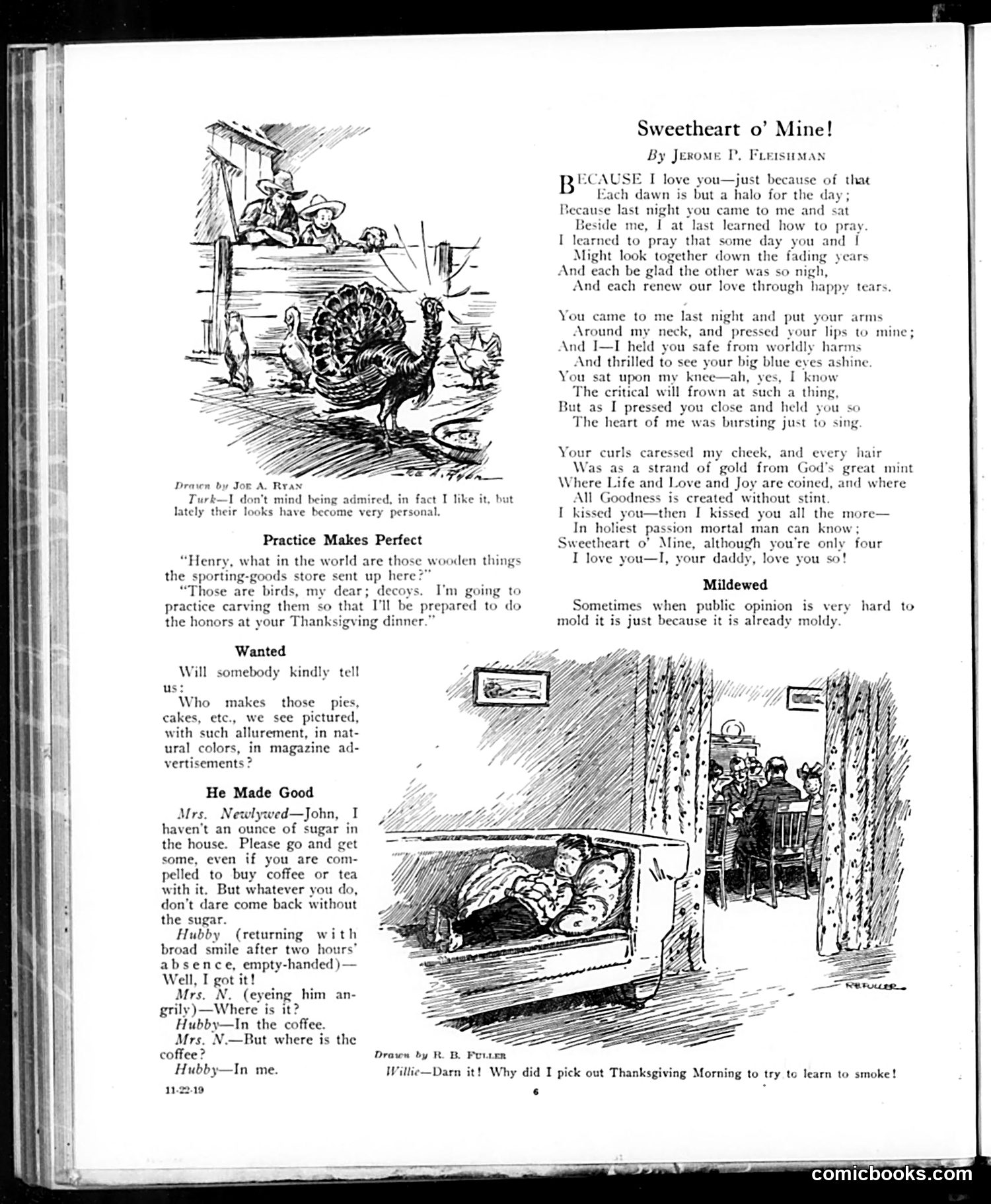
This page contains three separate pieces of humor rather than unified political commentary: 1. **"Practice Makes Perfect"**: A domestic joke about a husband practicing carving wooden decoys for Thanksgiving dinner, misunderstanding his wife's complaint about the "spring-goods store" sending up wooden birds. 2. **"Wanted"** and **"He Made Good"**: Brief humorous anecdotes about domestic life—one asking who creates alluring food illustrations in ads, another depicting a husband returning with sugar after being sent for coffee. 3. **"Mildewed"**: A one-liner about public opinion being difficult to change because it's already formed. 4. **"Willis—Darn it!"**: A cartoon showing a child learning to smoke on Thanksgiving morning, caught by family members in the next room. These are light domestic humor pieces typical of Judge magazine's general entertainment content, without apparent political satire or social commentary.
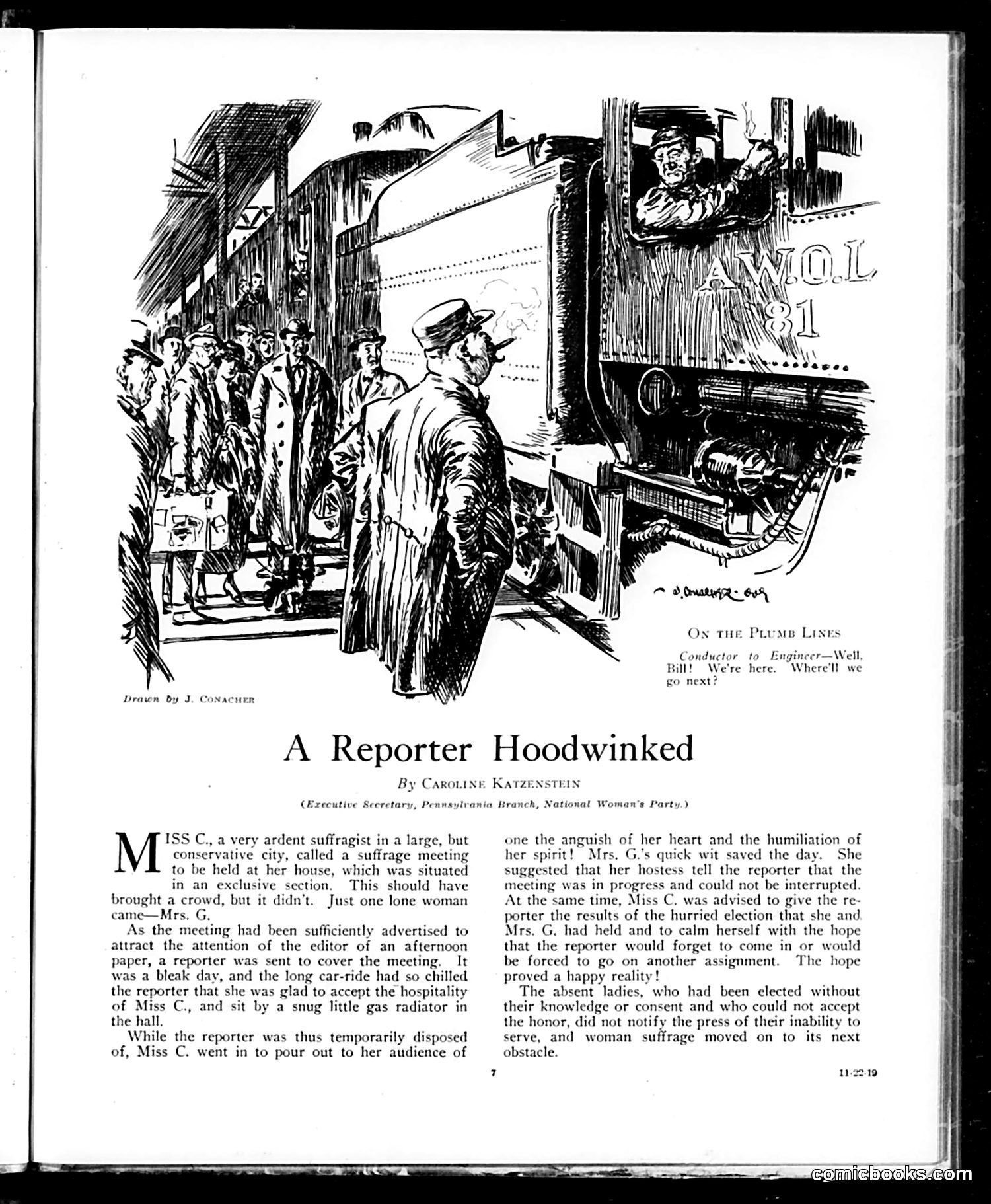
This is satirical commentary on women's suffrage activism, specifically mocking the ineffectiveness of a poorly-attended suffrage meeting. Miss C. organized what should have been a prominent gathering in an exclusive neighborhood, but only one attendee (Mrs. G.) showed up. To avoid embarrassment before the newspaper reporter sent to cover the event, Miss C. and Mrs. G. deceived her by claiming a meeting was "in progress" while actually holding a fake election of absent women who never consented to be nominated. The satire targets the disconnect between suffragists' grand ambitions and their actual grassroots support—and their willingness to fabricate success rather than honestly report failure to the press. The title "A Reporter Hoodwinked" emphasizes the deception as the story's focal point. This reflects early-20th-century skepticism about women's political organizing and their credibility.
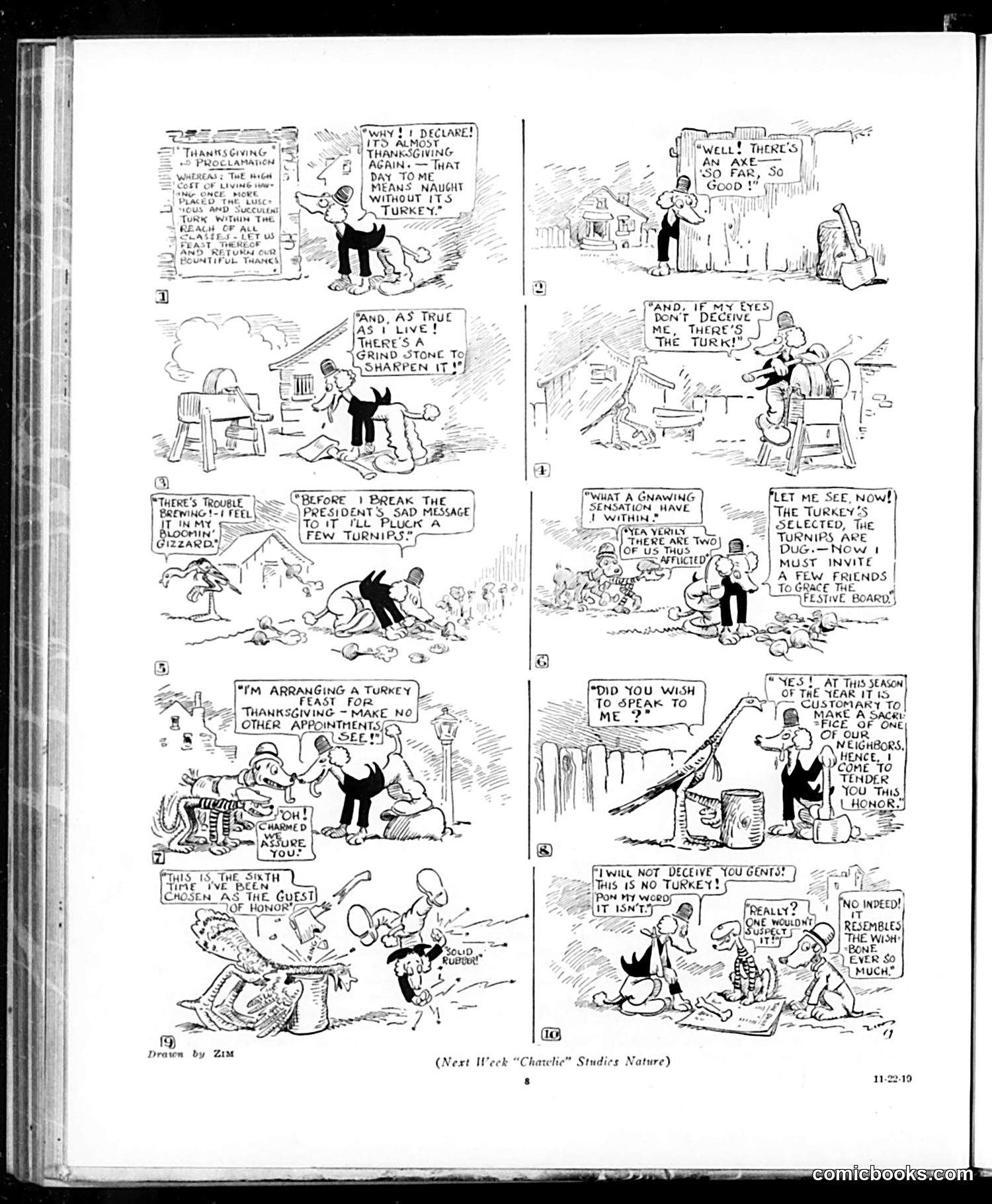
This is a comic strip satirizing American Thanksgiving traditions and domestic life, centered on the obsessive pursuit of the perfect turkey dinner. The unnamed male protagonist—appearing to be an ordinary householder—becomes increasingly consumed with arranging an elaborate Thanksgiving feast, moving from initial enthusiasm through anxiety about securing the turkey and grindstone (for knife-sharpening), to frantically organizing guest lists and managing social obligations. The satire targets the commercialization and social pretension surrounding Thanksgiving, where what should be a simple family meal becomes an exhausting performance of hospitality and status-consciousness. The repeated guest-of-honor references suggest competitive social entertaining. By the final panels, his wife's deadpan responses highlight the absurdity of his elaborate schemes—the humor lies in contrasting his overwrought preparations against her pragmatic indifference, a common marital dynamic in early 20th-century domestic comedy.
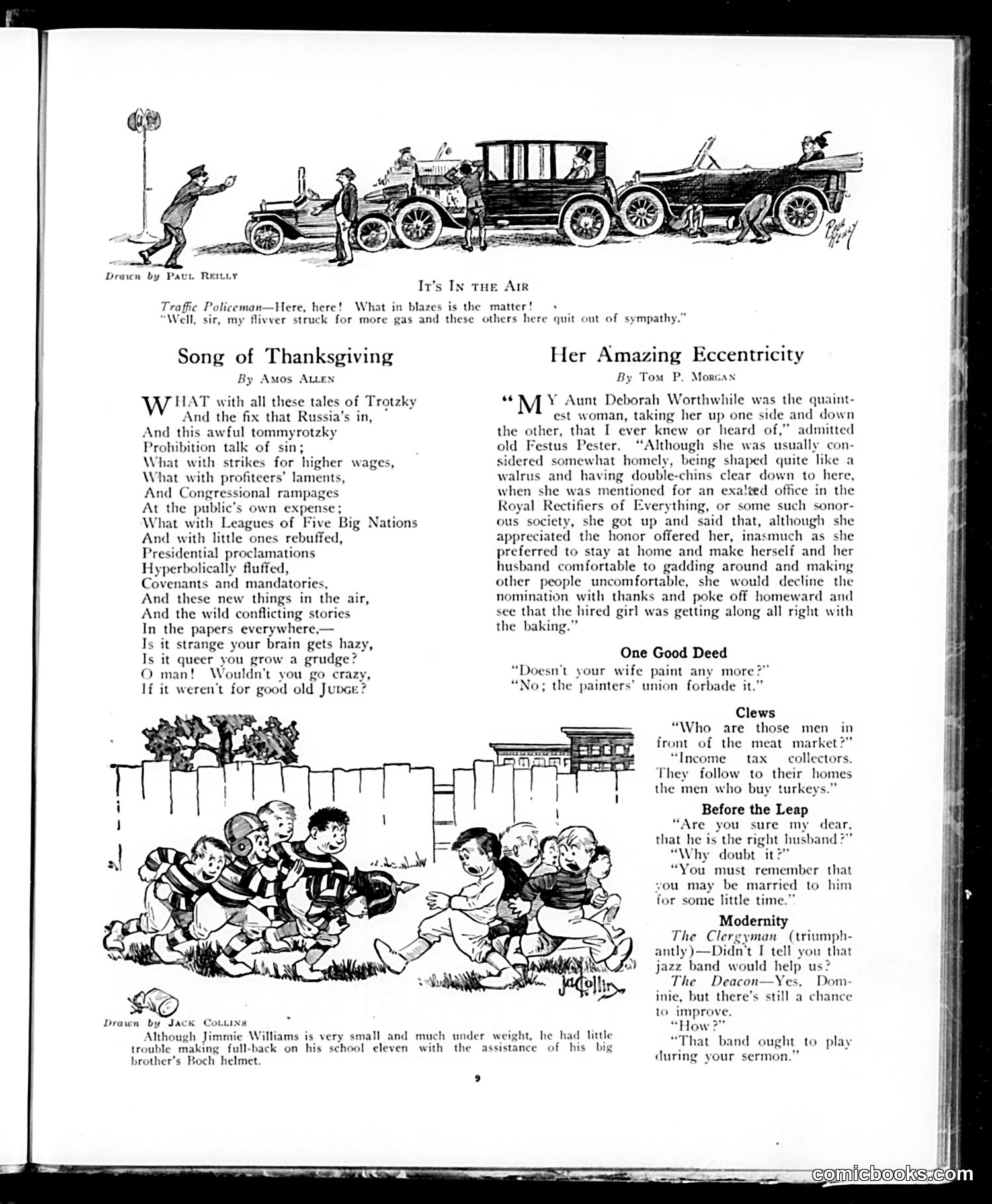
**"It's in the Air"** cartoon depicts a traffic policeman confronting drivers whose vehicles have stalled in sympathy with a striking "flivver" (Model T Ford). This satirizes labor unrest of the 1920s—workers striking for higher wages and sympathetic work stoppages that disrupted commerce and daily life. **"Song of Thanksgiving"** by Amos Allen catalogs post-WWI anxieties: Prohibition, labor strikes, war profiteering, Congressional corruption, and failed international diplomacy (the League of Nations). The poem's refrain suggests readers would "go crazy" without humor to cope—Judge itself provides this relief. **Other pieces** include humorous domestic sketches ("Her Amazing Eccentricity," "Modernity") and brief jokes about income tax and marriage, typical of the magazine's lighthearted social commentary. The page reflects early 1920s American frustrations: economic instability, political cynicism, and social upheaval following World War I.
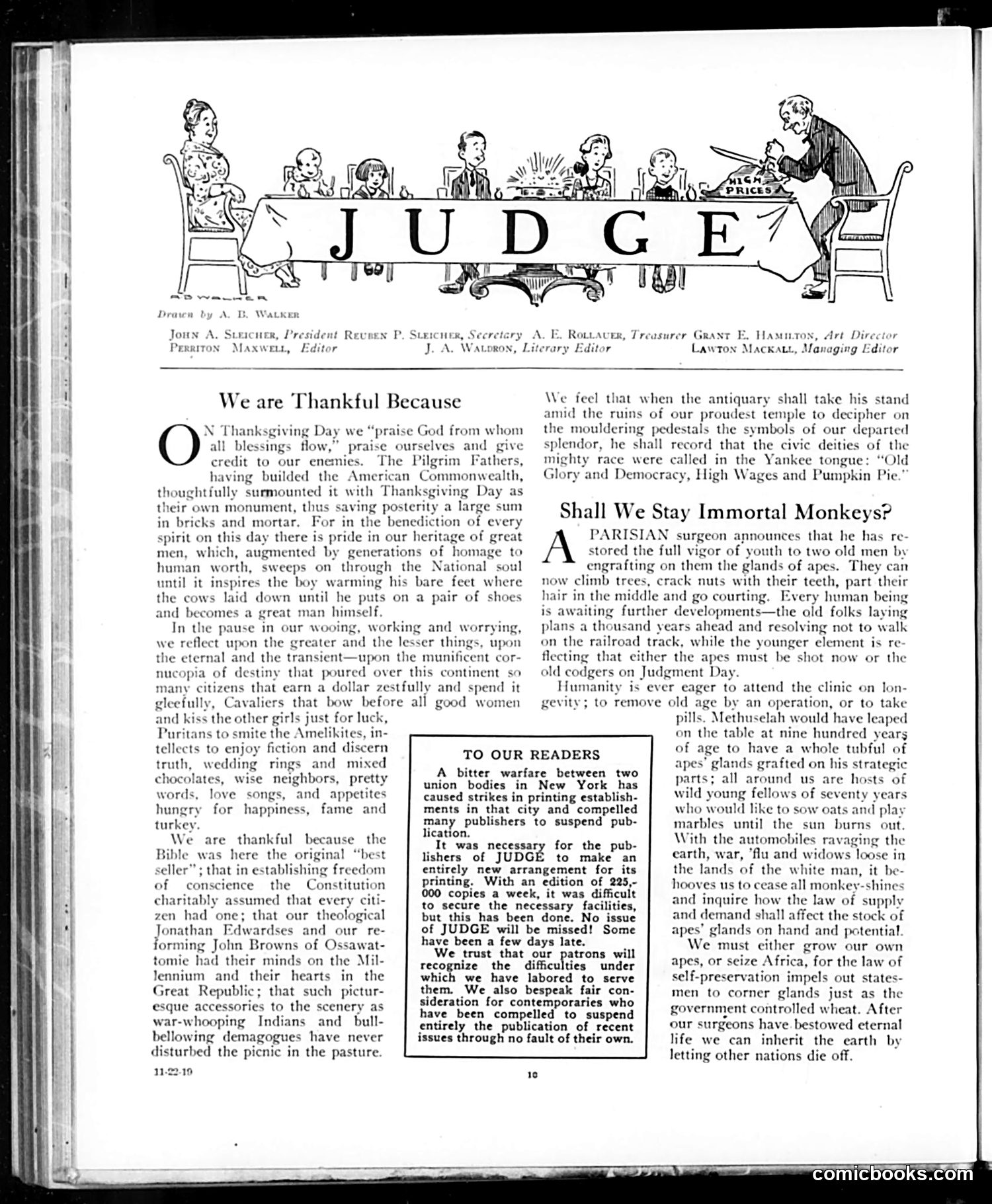
This is the title page and opening editorial of Judge magazine (dated 11-22-19, likely November 1919). The masthead illustration shows a courtroom scene with "JUDGE" presiding—a visual pun on the magazine's name. **Main Content:** The editorial "We are Thankful Because" is a Thanksgiving piece celebrating American ideals: democracy, high wages, and distinctly American values. It's patriotic satire with gentle mockery of different American types (Cavaliers, Puritans). **"Shall We Stay Immortal Monkeys?"** satirizes a real contemporary medical claim: a Parisian surgeon allegedly restored youth to elderly men by grafting ape glands onto them. Judge ridicules both the implausible procedure and humanity's desperate longing for immortality—imagining old men suddenly climbing trees and cracking nuts, younger people scheming to either shoot the apes or wait for Judgment Day. **The "To Our Readers" box** explains a labor dispute between printing unions in New York forced Judge to temporarily relocate production. This explains potential delays—a pragmatic disclosure wrapped in reassurance. The page blends satire, current events commentary, and light humor typical of early-20th-century American magazines.
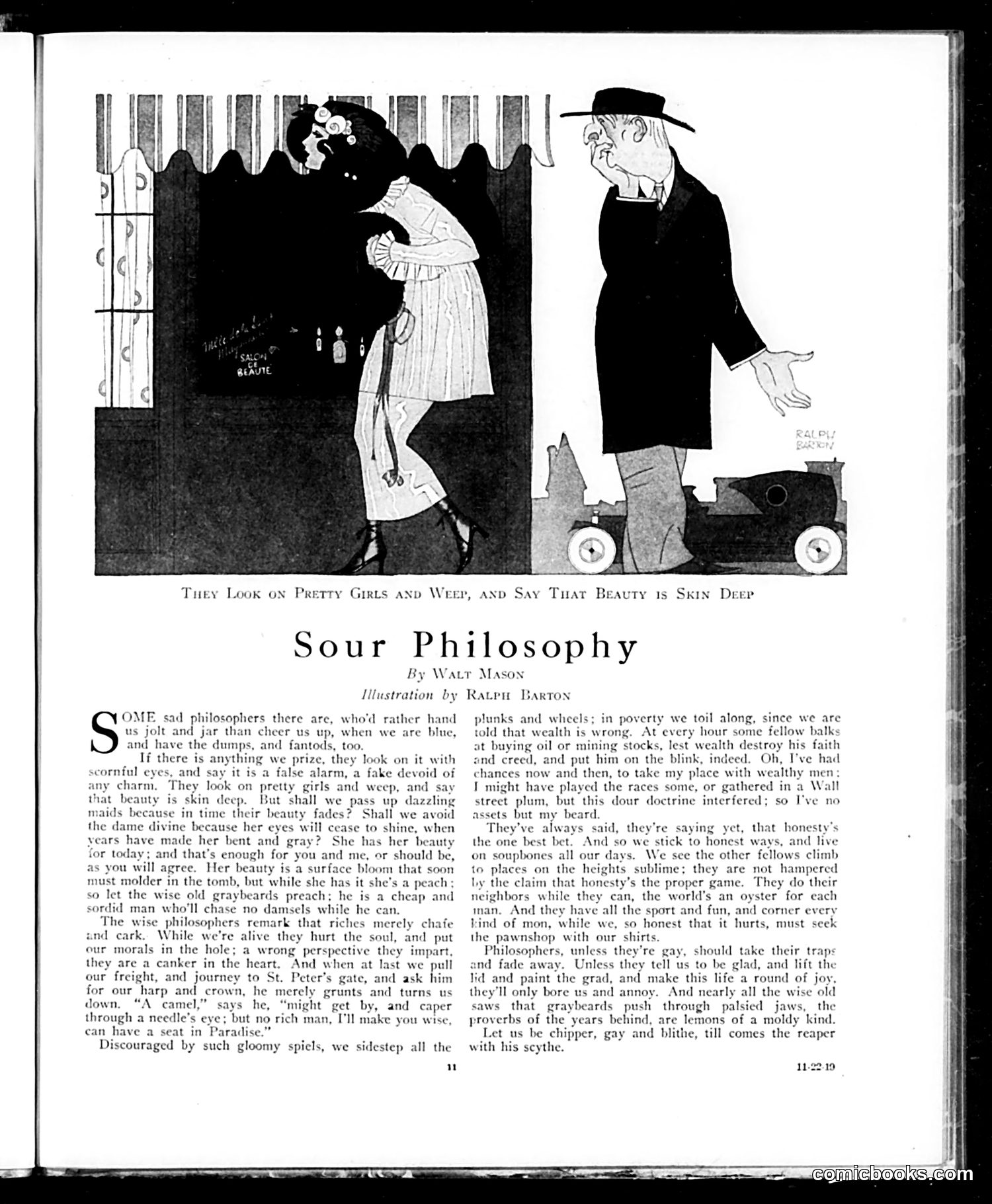
This satirical piece by Walt Mason critiques philosophers and moralists who preach gloomy doctrines that discourage life's pleasures. The illustration shows a well-dressed, elderly man (representing conventional wisdom/the "sour philosopher") gesturing disapprovingly at a young woman in an embrace—embodying the clash between restrictive moral teaching and youthful vitality. Mason's text mocks three prevalent pieties: that "beauty is skin deep" (so why pursue attractive women?), that wealth is sinful (so avoid success), and that honesty alone matters (ignoring that dishonest people prosper). The satire's point: these grim philosophies paralyze followers into poverty and joylessness while offering no practical benefit. Mason advocates instead for a "chipper, gay and blithe" approach to life—embracing pleasure and opportunity rather than self-denying asceticism. The cartoon ridicules moralizing hypocrisy that restricts common people while the world's actual winners ignore such advice.
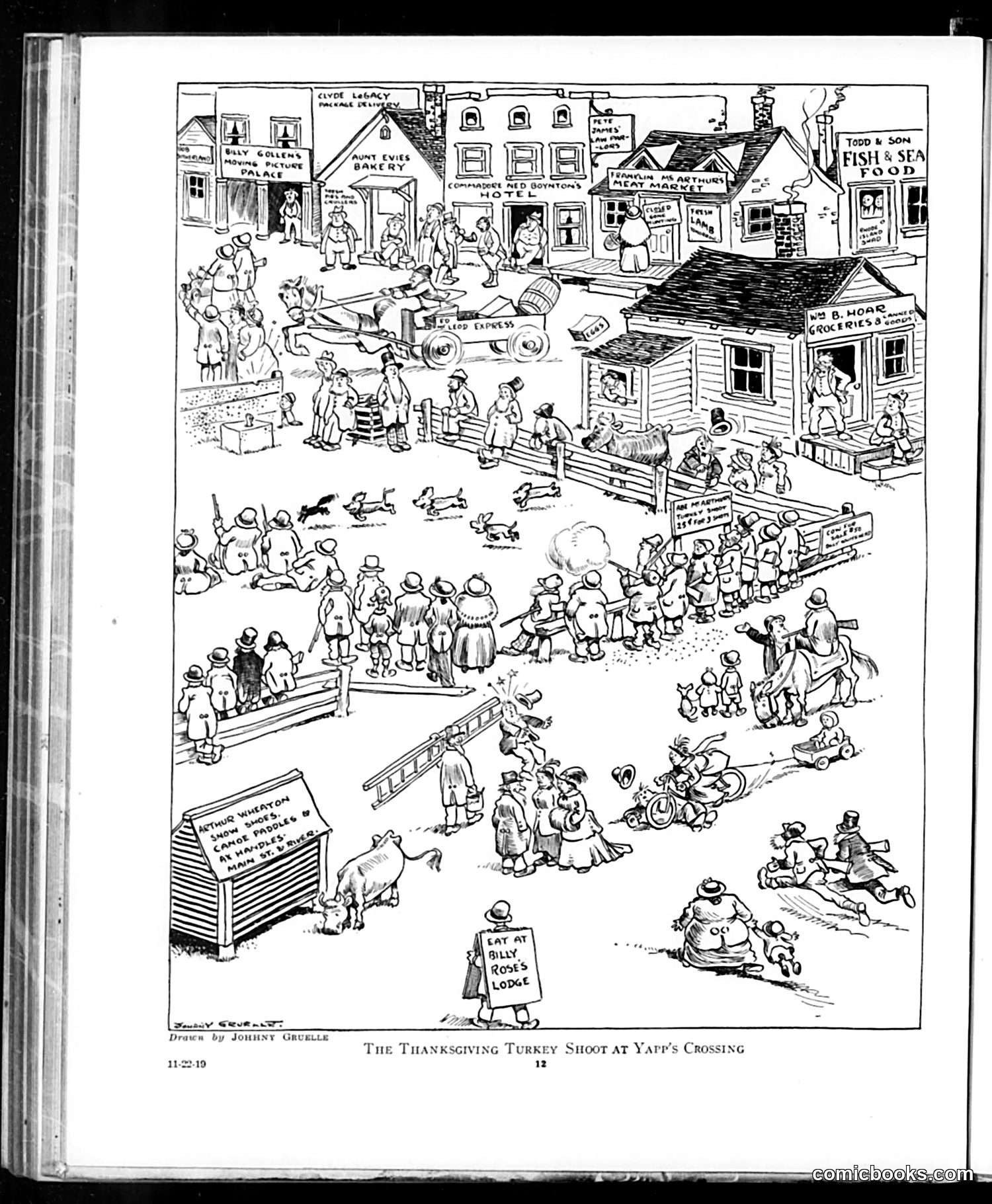
This is a humorous illustration titled "The Thanksgiving Turkey Shoot at Yapp's Crossing," drawn by Johnny Gruelle for *Judge* magazine (dated 11-22-19, so November 1919). The cartoon depicts a chaotic small-town scene centered on a turkey shoot—a popular competitive sport where participants shoot at targets, with turkeys as prizes. The image shows: - Various storefronts labeled with period businesses (bakery, fish market, groceries) - Numerous townspeople engaged in shooting activities and celebrations - Children playing with toy guns and vehicles - A festive, somewhat anarchic atmosphere The satire appears to mock small-town American life and holiday traditions, portraying the turkey shoot as a communal event that draws the entire village into competitive, gun-focused revelry. The chaotic composition and numerous simultaneous activities suggest gentle mockery of rural American customs and the earnestness of holiday celebrations in provincial communities.
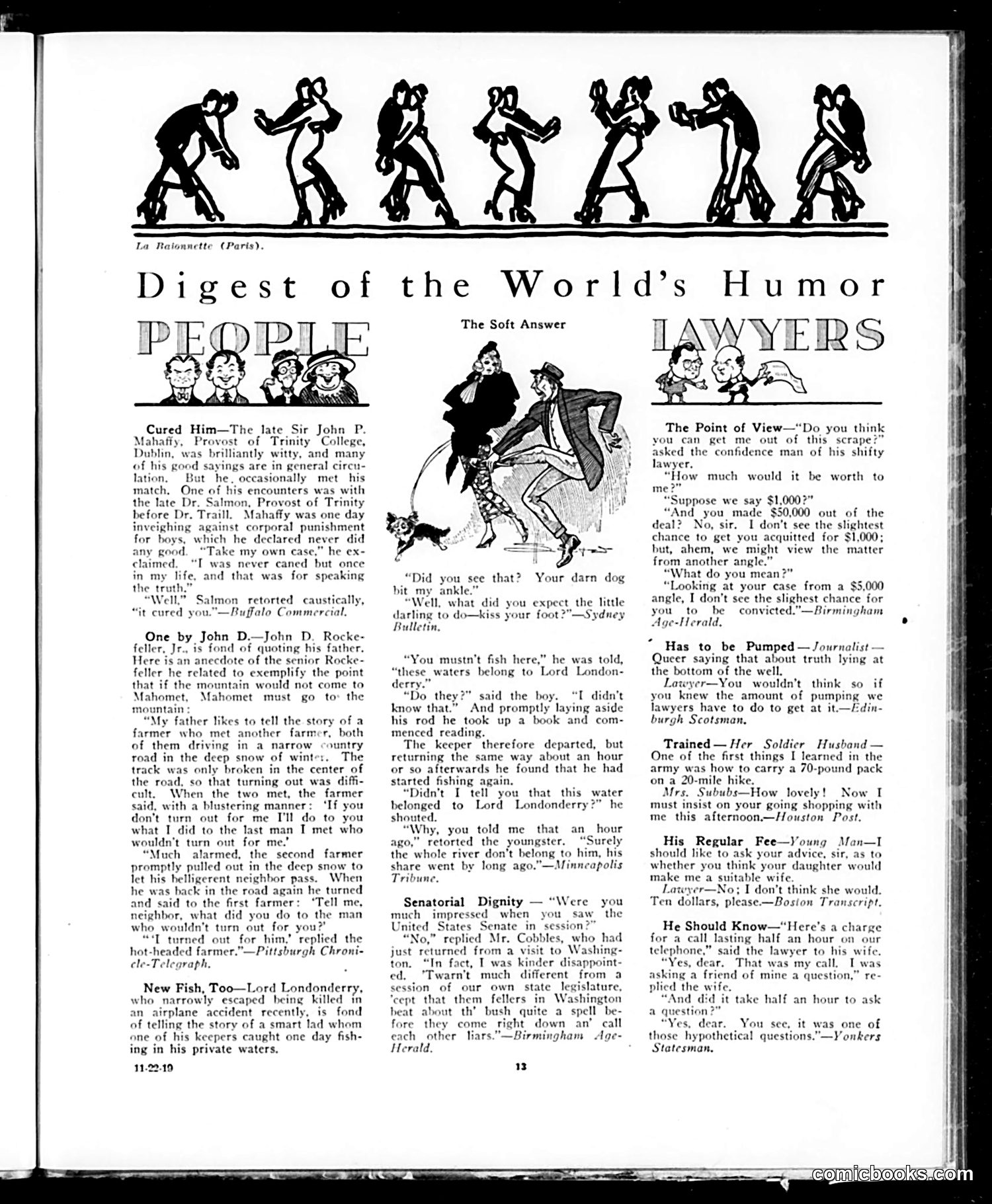
This page collects brief humorous anecdotes organized by theme. The top illustration shows *La Raionnette* (a French cabaret dance), setting a lighthearted tone. The stories satirize human nature and social hypocrisy: **"Cured Him"** mocks a wit (Sir John P. Mahaffy) who claims he was never caned—until a colleague points out the caning apparently worked, since he stopped speaking truthfully. **"The Soft Answer"** shows a dog-bite victim receiving a wisecrack instead of sympathy—humor through deflection. **"One by John D."** illustrates stubbornness: two farmers meet on a narrow road; one demands the other yield, but when asked what he did to the last holdout, reveals he backed down too—exposing bluster as performance. **"Senatorial Dignity"** satirizes American politics by comparing the U.S. Senate unfavorably to state legislatures, suggesting senators are merely louder liars. **"The Point of View"** mocks a shady lawyer's fee-scaling based on client perspective rather than case merit—cynical commentary on legal ethics. These reflect early-20th-century attitudes: skepticism toward authority, business, and law.
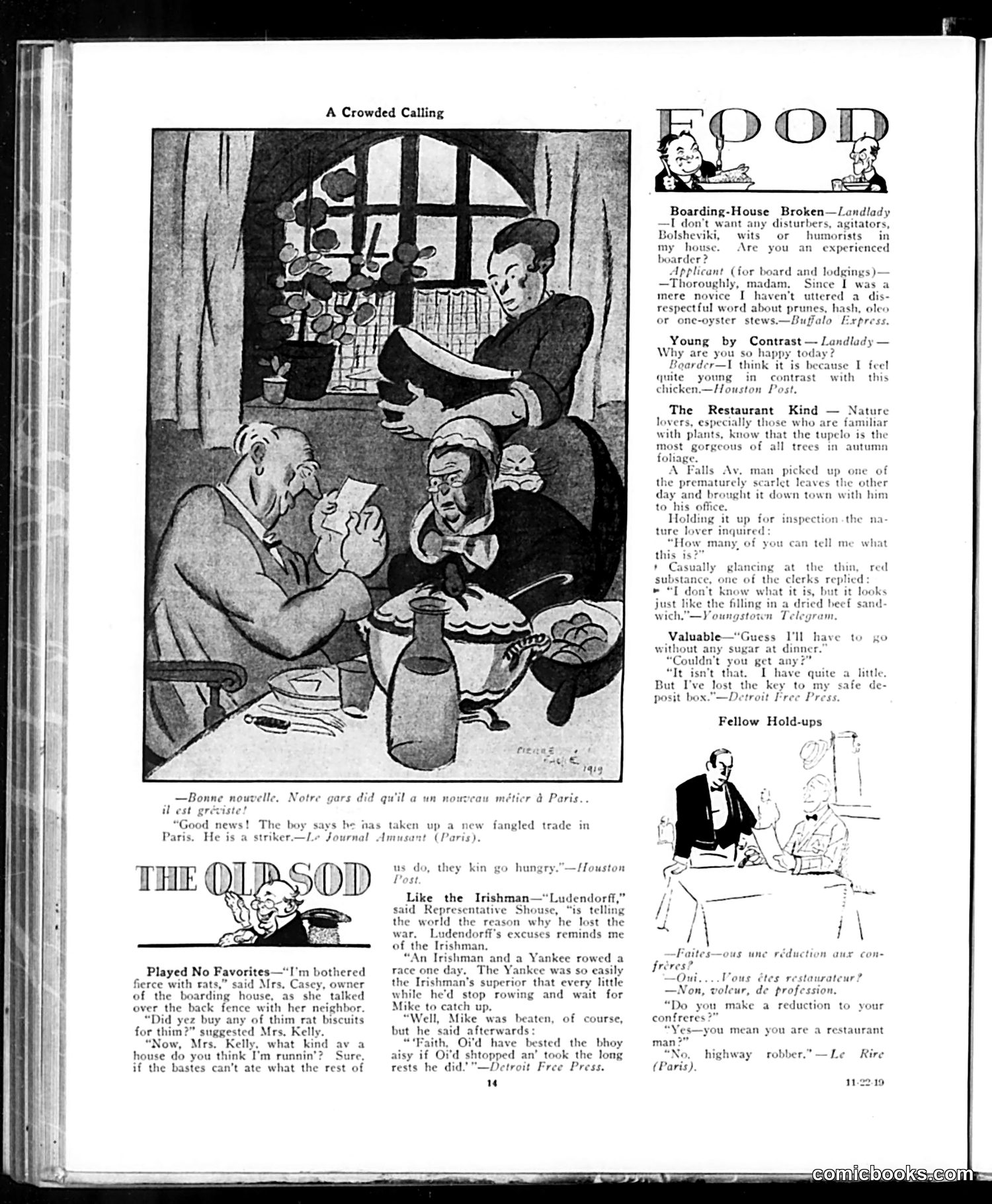
This 1919 page contains several brief satirical anecdotes rather than a single cartoon. The main image, "A Crowded Calling," depicts Parisians discussing a young man who has become a "striker" (labor agitator)—treating labor unrest as a newfangled trade or profession. Other jokes reference: - **Post-WWI politics**: A congressman compares German General Ludendorff's war excuses to an Irishman's fishing story—mocking both Ludendorff and Irish stereotypes. - **Class tensions**: Boarding-house humor about difficult tenants and cheap food (prunes, oyster stews). - **Social anxiety**: References to "Bolsheviki" (Communists) reflect American fears of radical agitation following the Russian Revolution. - **Casual racism**: Irish dialect humor was standard period fare. The satire targets labor activism, postwar German leadership, and working-class boarding-house life, while reflecting contemporary anxieties about political upheaval and immigration.
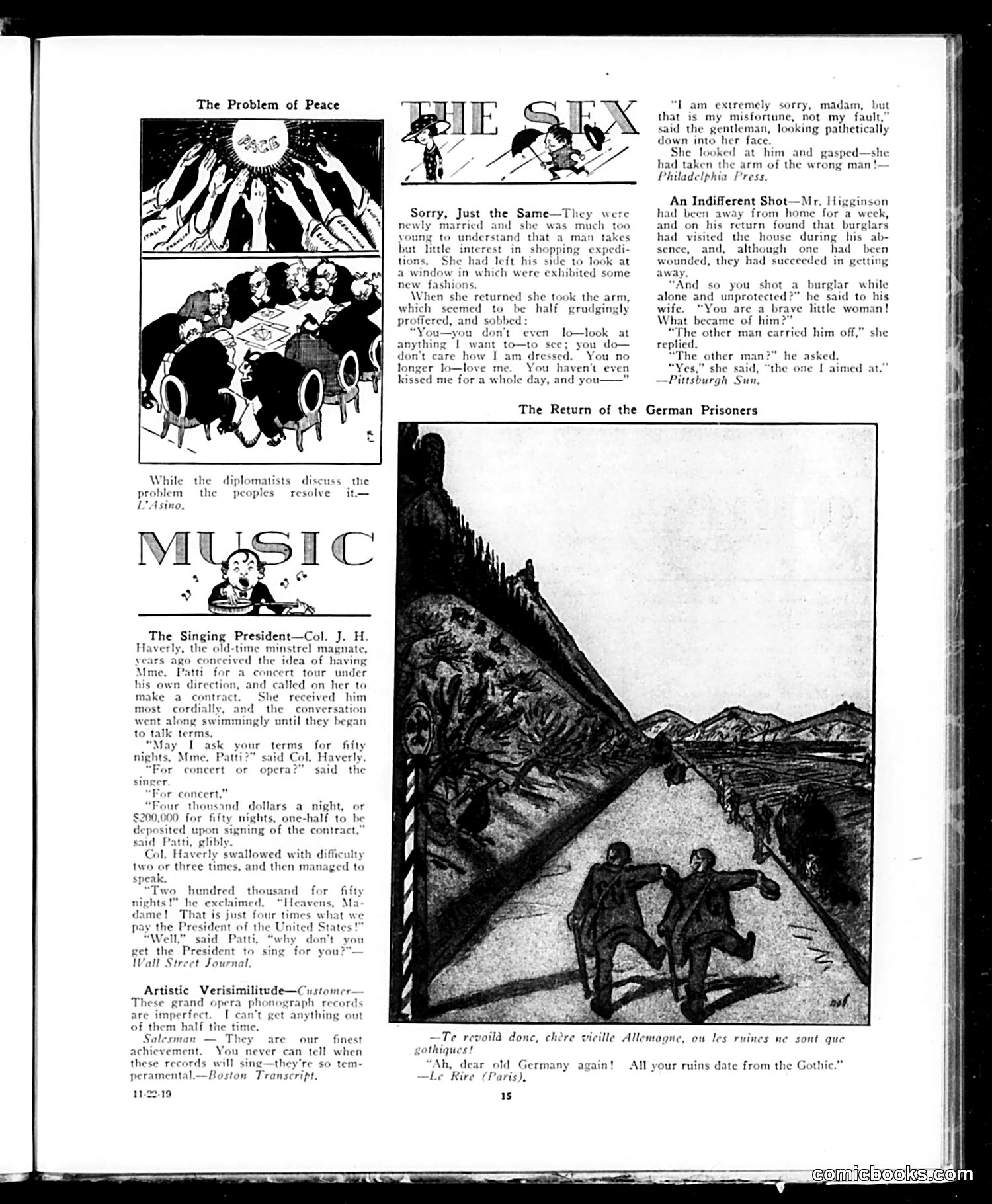
This page contains several humorous anecdotes satirizing American social dynamics circa early 1900s: **"The Singing President"** mocks the exorbitant fees of opera star Mme. Patti. Col. Haverly negotiates her concert terms; she demands $4,000 nightly (or $200,000 for fifty nights). When Haverly protests this exceeds presidential salary, Patti quips he should hire the President himself—satirizing both her inflated ego and American wealth inequality. **"Sorry, Just the Same"** ridicules newlywed marital dynamics: a neglectful husband ignores his shopping-obsessed bride. When she tearfully accuses him of not loving her, he coldly replies it's his "misfortune, not fault"—mocking masculine indifference and failed romance. **"An Indifferent Shot"** jokes about female incompetence: a woman claims she shot a burglar, but reveals she "aimed at" a different man who escaped—satirizing women as poor shots and unreliable. **"The Return of German Prisoners"** (bottom illustration with French caption) appears to mock post-war Germany's Gothic architectural ruins, though details are unclear from the visible image.
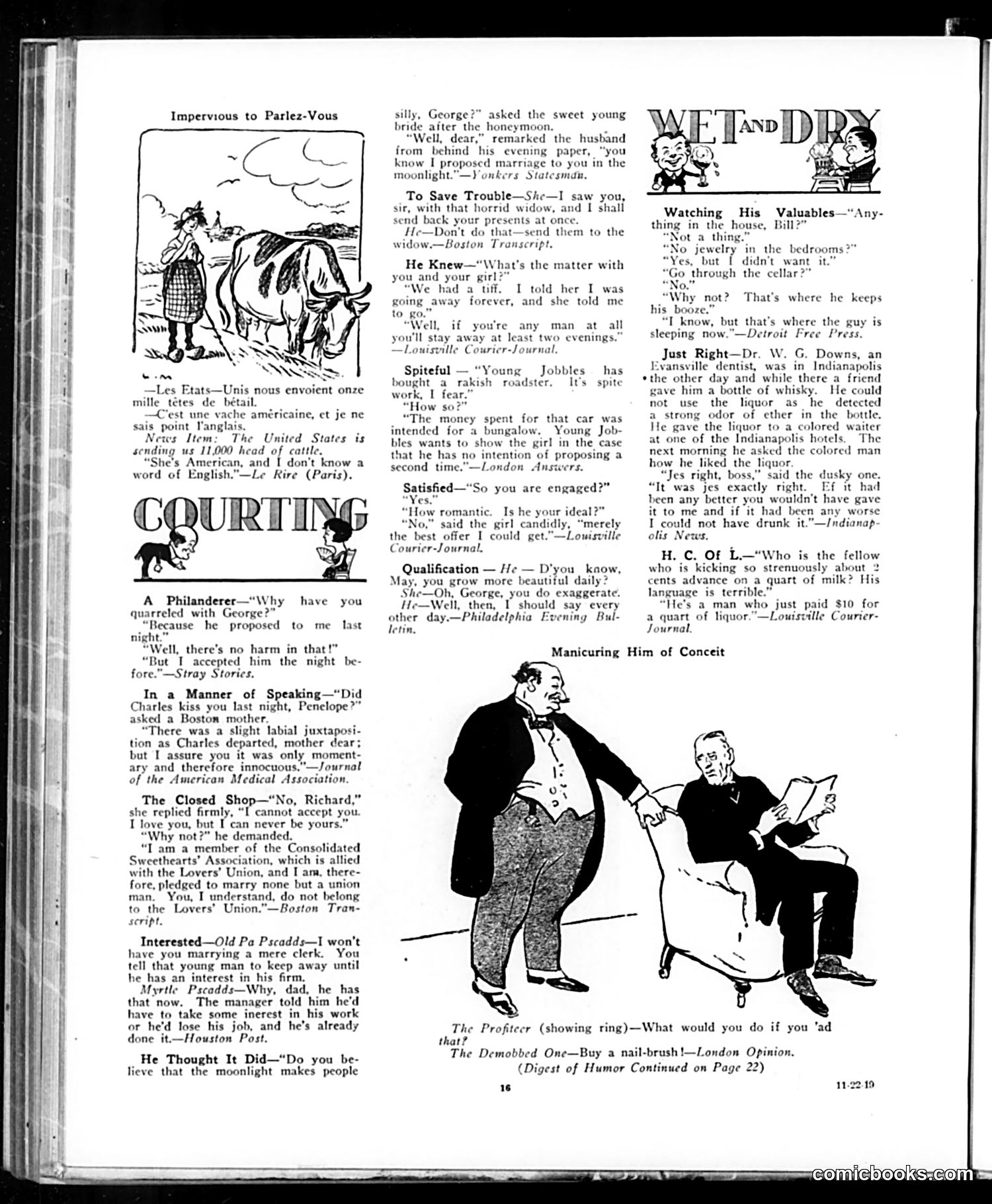
This page from *Judge* magazine contains multiple short humorous anecdotes targeting early 20th-century social conventions, primarily concerning courtship, marriage, and gender relations. **Key Satires:** The jokes mock rigid social formality (a woman describes a kiss using medical jargon), labor union culture applied absurdly to romance ("Consolidated Sweethearts' Association"), and class anxiety (fathers forbidding daughters to marry clerks without financial advancement). **The cartoon "Manicuring Him of Conceit"** depicts a vain man having his nails done while reading, presumably being figuratively cut down to size by the manicurist—a visual pun on "manicuring" his ego. **Main targets:** Pretentious language, courtship rituals, economic insecurity, and gender dynamics of the era. One anecdote references whisky/ether confusion, likely reflecting Prohibition-era anxieties. The French epigraph jokes that American cattle exports to France are "American" because they don't speak French—satirizing American cultural insularity. The humor is distinctly period-specific, relying on now-obscure social conventions and propriety concerns.
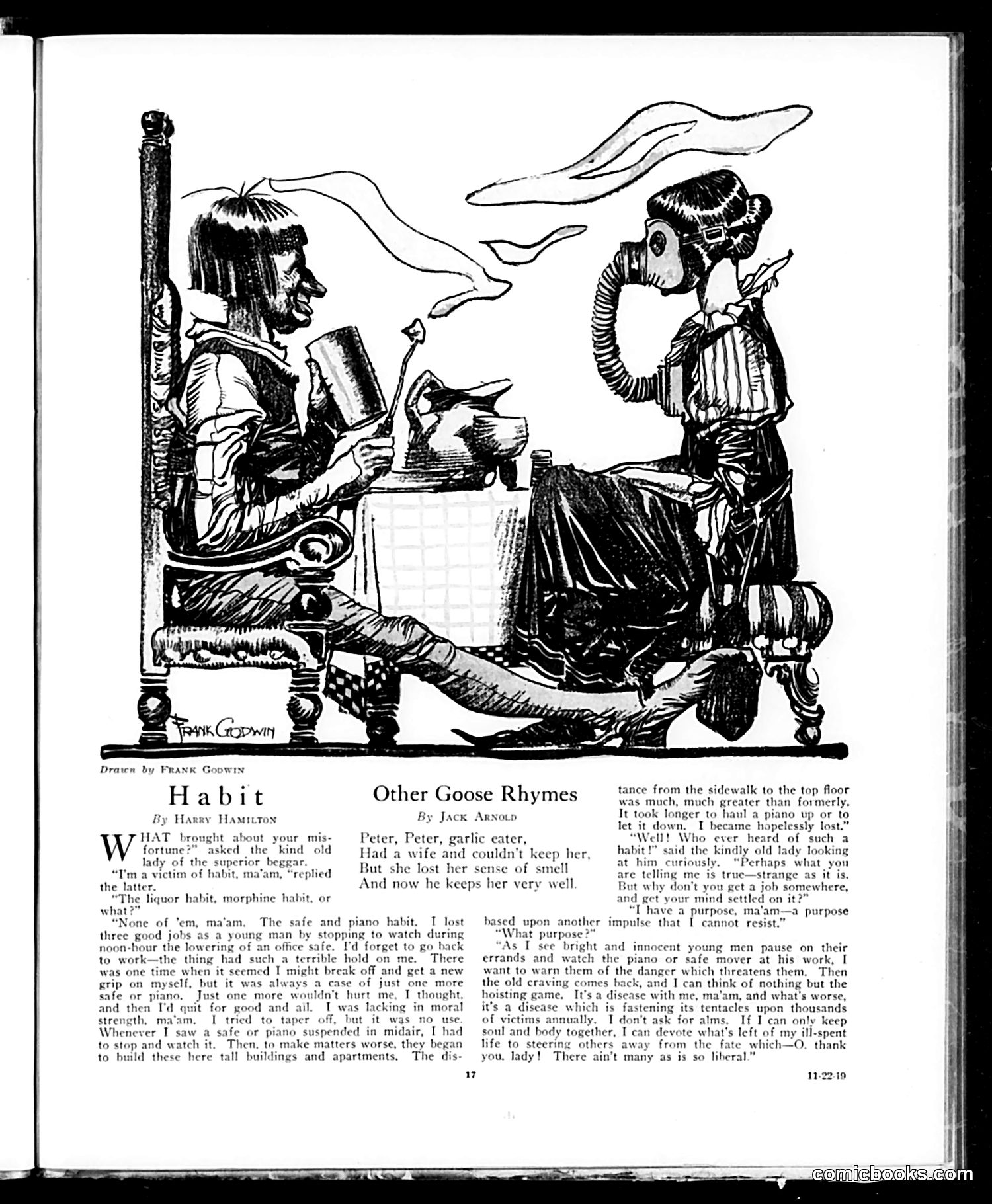
This cartoon depicts a man confessing to an elderly woman about his compulsive addiction to watching pianos and safes being hoisted up building facades. The joke plays on the absurdity of this specific obsession: the man has lost multiple jobs because he cannot resist stopping to watch whenever construction workers raise these items to upper floors of the tall apartment buildings then becoming common in America. The satire appears to mock both the man's pathological behavior and the broader cultural anxiety about modern urban development and the dangers of industrial work. By treating this ridiculous fixation with the serious language of moral weakness and disease, Hamilton creates dark humor about addiction and self-deception. The man's grandiose claim that he'll warn others suggests how addicts rationalize their compulsions. The accompanying "Peter, Peter, garlic eater" rhyme offers lighter comic relief on the same page.
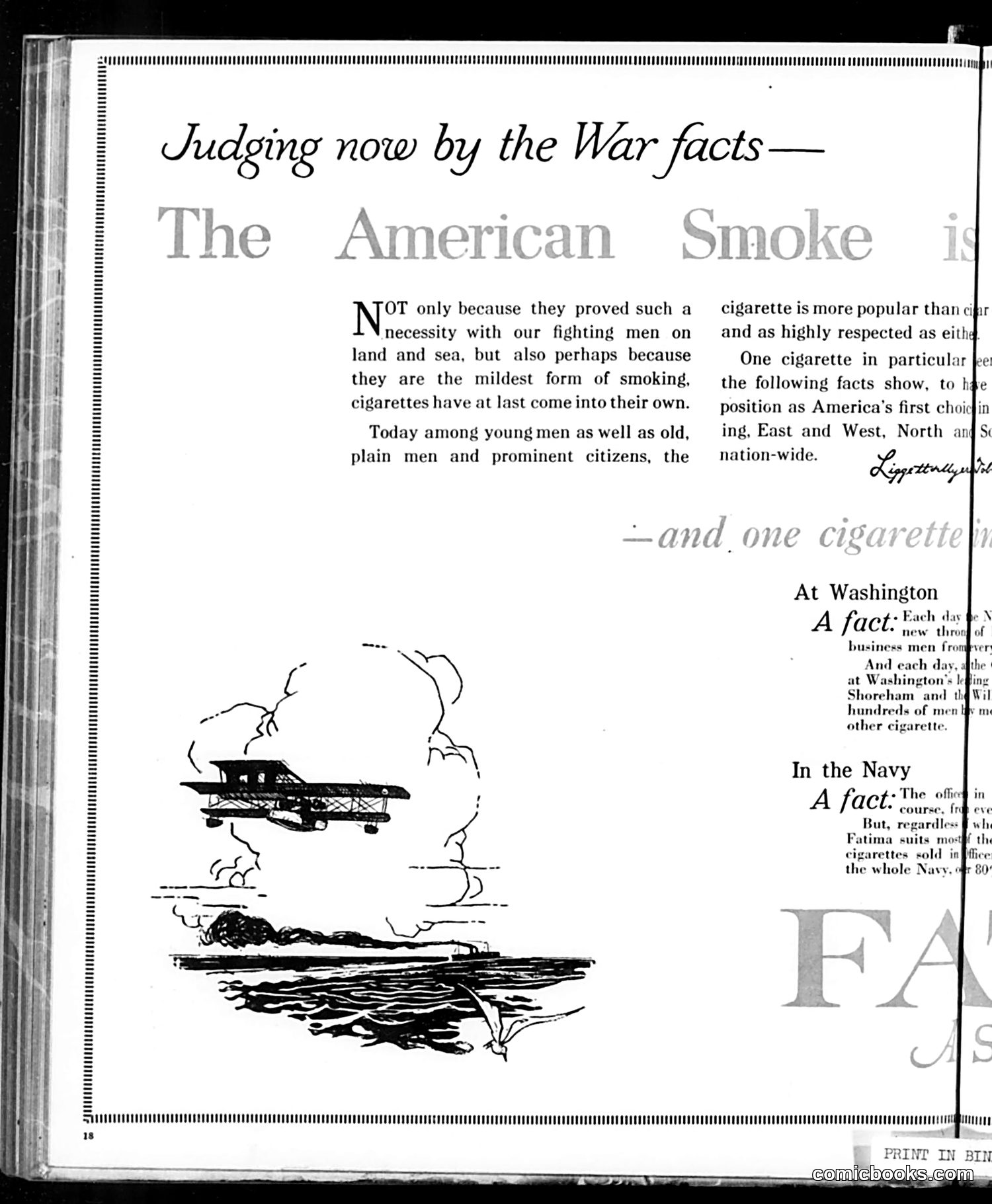
This is a **cigarette advertisement disguised as editorial content**, using World War I patriotism as its sales pitch. The headline "Judging now by the War facts" claims cigarettes became popular among soldiers because they're "the mildest form of smoking," implying this war-driven adoption proves their superiority. The central illustration shows a **military plane under fire**—visual evidence of wartime necessity. Below it are sections titled "At Washington" and "In the Navy," presenting alleged "facts" about how business leaders and naval officers prefer this specific (unnamed) cigarette brand, with claims it's "America's first choice." **The satire/manipulation**: Judge magazine appears to be mocking how advertisers exploit patriotic war narratives to sell consumer goods. By presenting unsubstantiated claims as "facts" and leveraging soldiers' wartime experiences, the ad exemplifies cynical commercial exploitation of national sentiment—a critique many publications made about post-WWI advertising practices. The page demonstrates how wartime conditions were leveraged for commercial advantage.
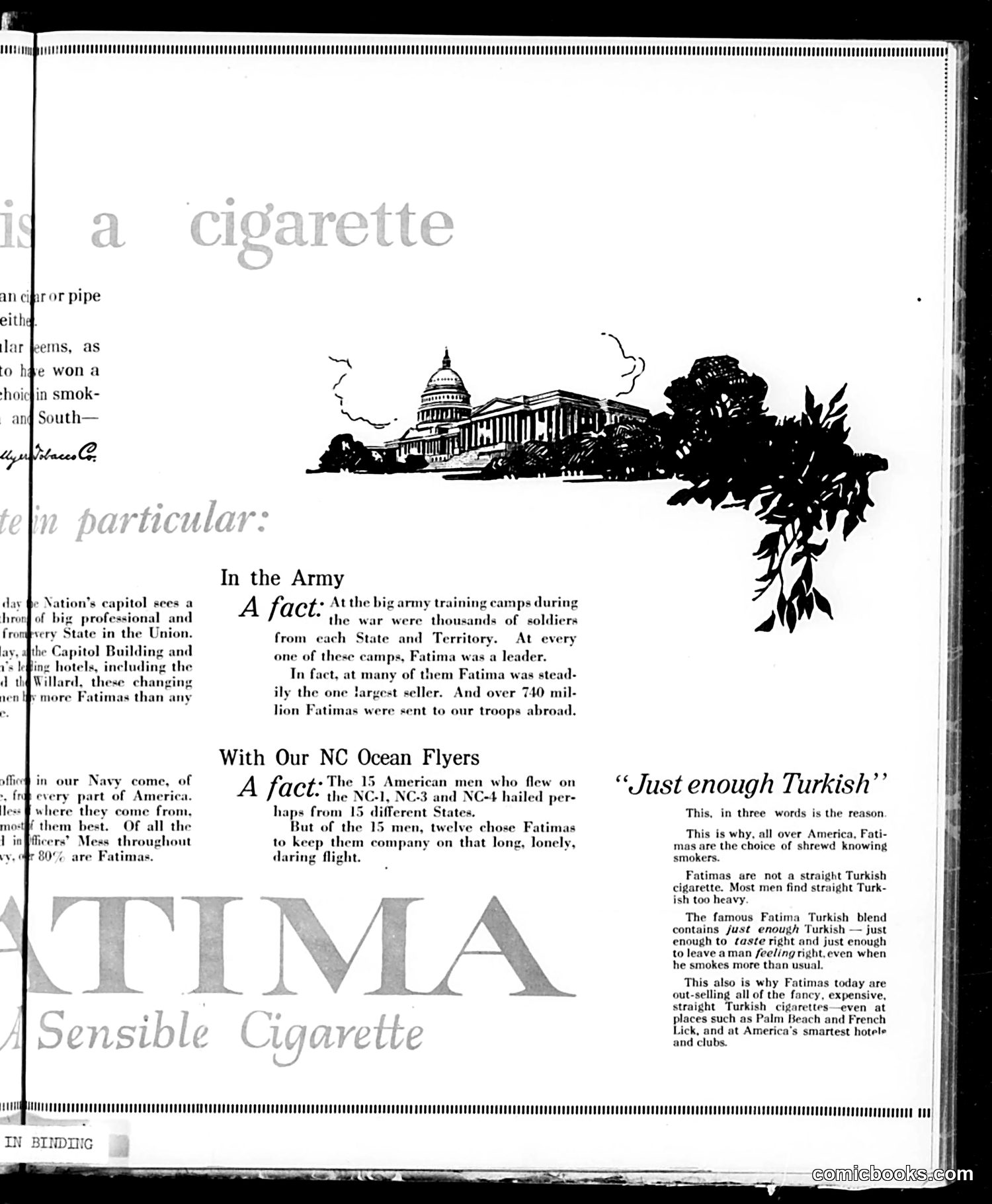
This is primarily **advertising content**, not political satire. The page promotes Fatima cigarettes by claiming they were the preferred brand among American soldiers and military personnel during World War I. The "satire" angle, if any exists, is subtle marketing positioning: Fatimas are presented as the choice of "shrewd knowing smokers" and military men—implying sophistication and masculine approval. The Capitol building illustration establishes patriotic credibility. The key claims are factual assertions rather than jokes: soldiers at training camps preferred Fatimas, 740 million were sent abroad, and Navy pilots chose them for long flights. The tagline "Just enough Turkish" positions Fatimas as a balanced middle ground—not too heavy like pure Turkish cigarettes, but authentic enough to appeal to discriminating tastes. This reflects early-20th-century advertising strategies that weaponized patriotism and military endorsement to sell consumer products.
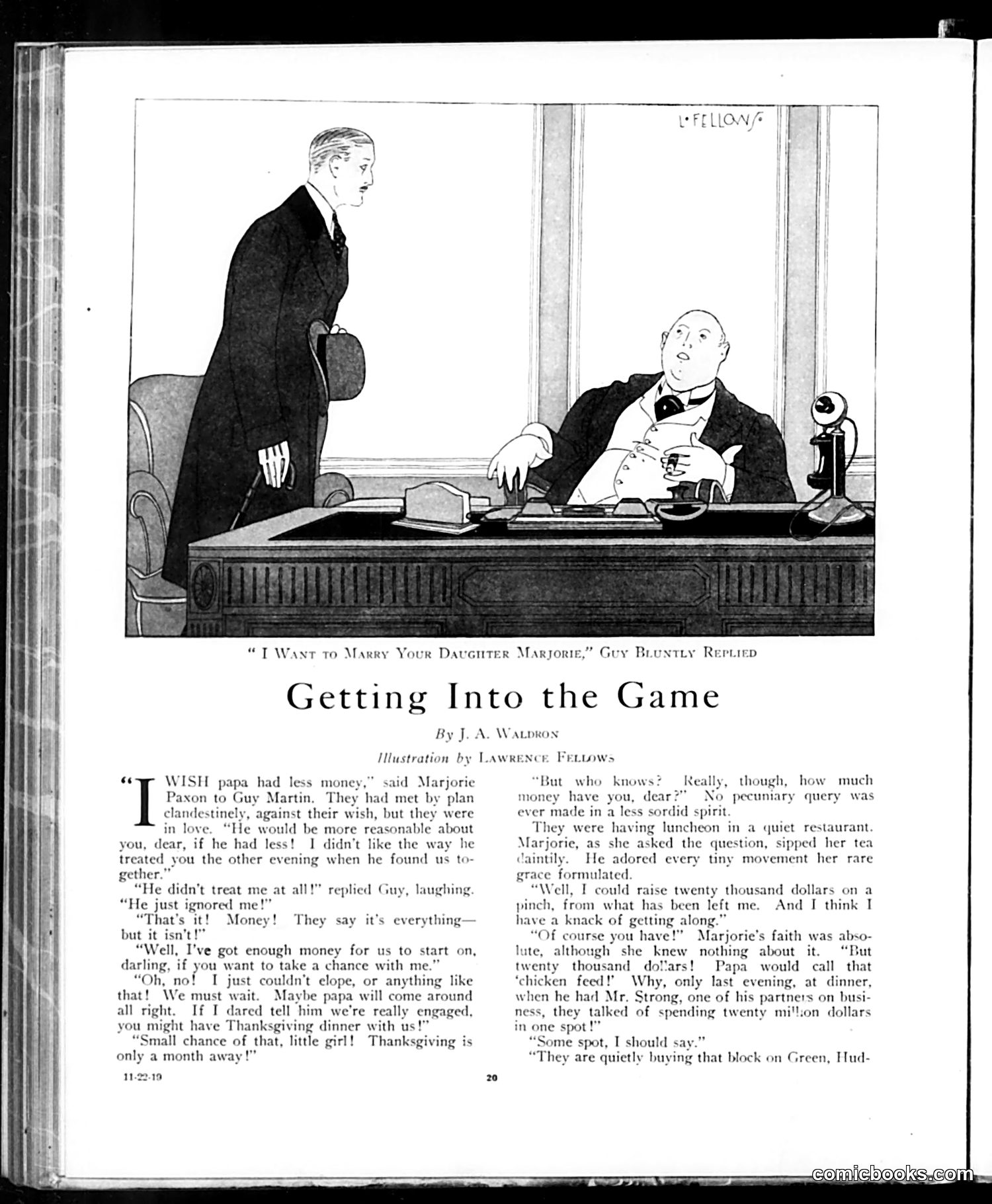
This is a satirical story illustration about young love meeting financial reality. Guy Martin proposes to Marjorie Paxon, but her wealthy father opposes the match because Guy lacks money. The satire centers on the couple's contradictory attitudes: Marjorie claims to wish her father were poorer (so he'd be "reasonable"), yet immediately interrogates Guy about his finances in a supposedly delicate way. The joke mocks the pretense of romance among the wealthy classes. Despite Marjorie's declarations of love, the conversation quickly becomes transactional—she's reassured when Guy mentions twenty thousand dollars and her father's million-dollar real-estate dealings. The cartoon satirizes how financial considerations utterly dominate courtship among the affluent, even as the parties maintain romantic postures. Guy's comment about Thanksgiving dinner—that there's little chance her father will accept him—underscores that money, not affection, determines the outcome.
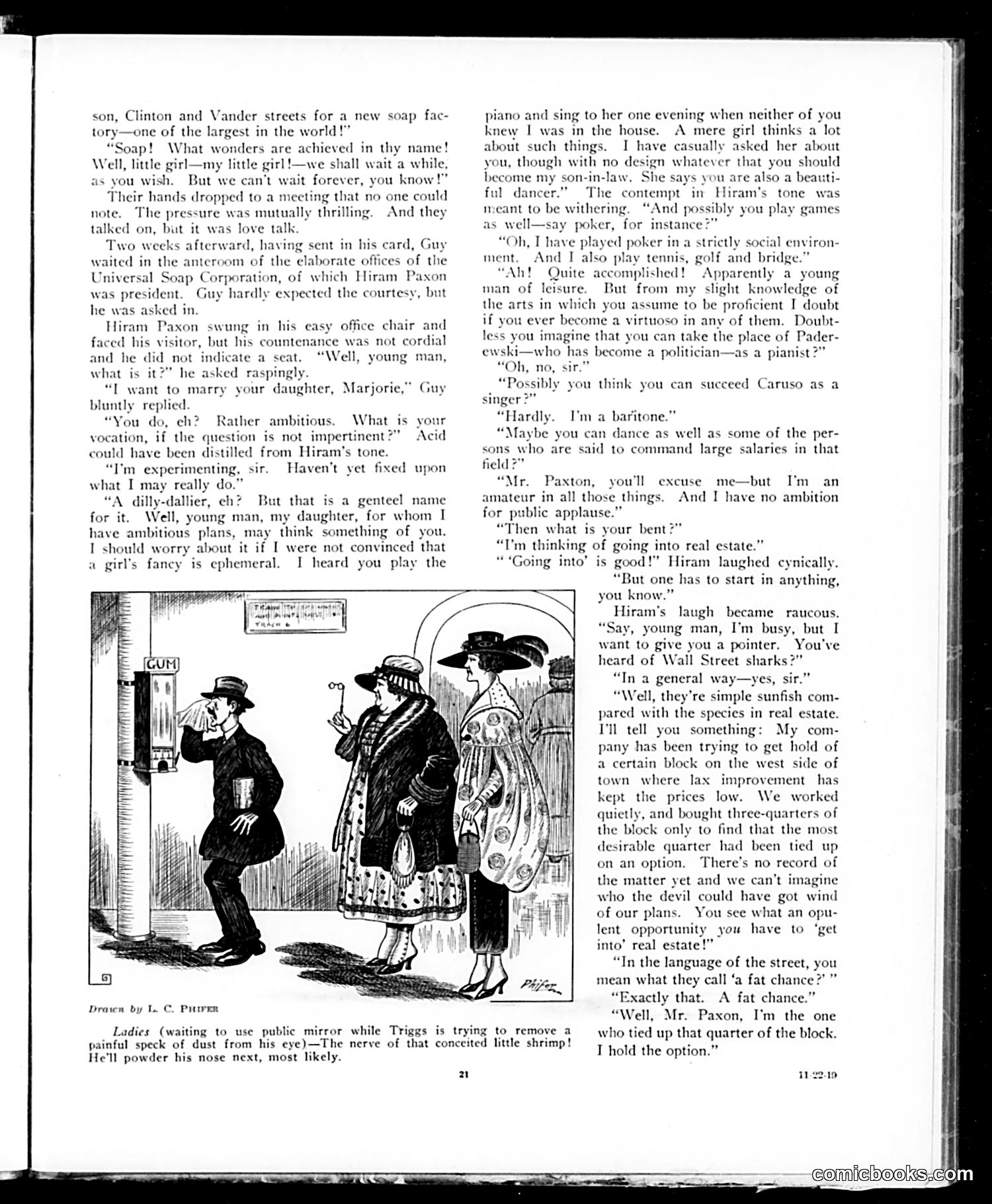
This page depicts a narrative about social ambition and class conflict in early 20th-century America. The main story follows a young man seeking to marry Hiram Paxon's daughter Marjorie. When Guy meets with the wealthy Paxon—president of a soap corporation—to ask permission, Paxon is deliberately contemptuous, dismissing Guy's accomplishments (music, dancing, sports) as those of an idle dilettante with no real profession or prospects. Paxon then reveals the satire's point: he describes a real estate scheme where his company was outsmarted by an unknown competitor who secretly acquired the last crucial quarter-block. He sarcastically suggests this represents Guy's "opportunity" in real estate—implying the young man lacks both the cunning and capital to succeed. The cartoon below mocks vanity: a woman uses a public mirror while a man struggles to remove dust from his eye, with onlookers assuming he's primping. The satire targets both nouveau riche arrogance and the illusion of "opportunity" for the working classes.
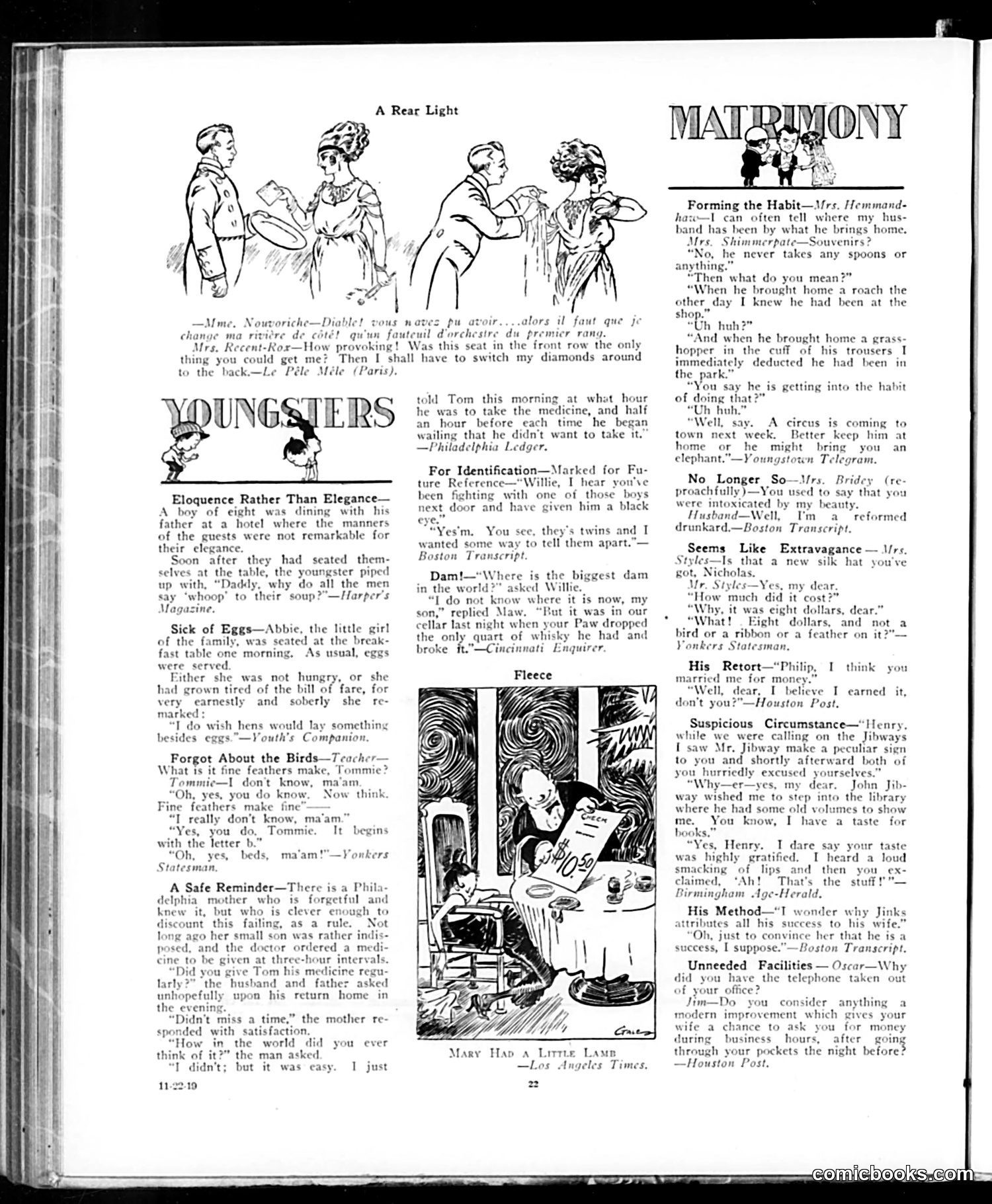
This page contains short humor pieces satirizing early 20th-century American social conventions and marriage dynamics. Key themes include: **"A Rear Light"**: A wealthy woman (Mme. Nouverich, "new rich") complains about theater seating, revealing nouveau riche pretension and materialism—she must relocate her diamonds to show them off from the back row. **Marriage & Gender Dynamics**: Multiple pieces mock husbands and wives. "His Retort" suggests men marry for money while claiming otherwise. "No Longer So" jokes about waning romantic passion. "Suspicious Circumstance" depicts a wife's jealous distrust of her husband's library visit with another man. **Class Humor**: "Eloquence Rather Than Elegance" mocks lower-class dinner manners. Several pieces feature working-class or immigrant characters with dialectal speech. **Domestic Life**: Stories about children's innocence, wives deducing husbands' activities from brought-home objects (roaches, grasshoppers from outings). The satire targets wealthy pretension, marital discord, class divisions, and gender relations—standard Judge fare reflecting contemporary anxieties about American social mobility and changing family structures.
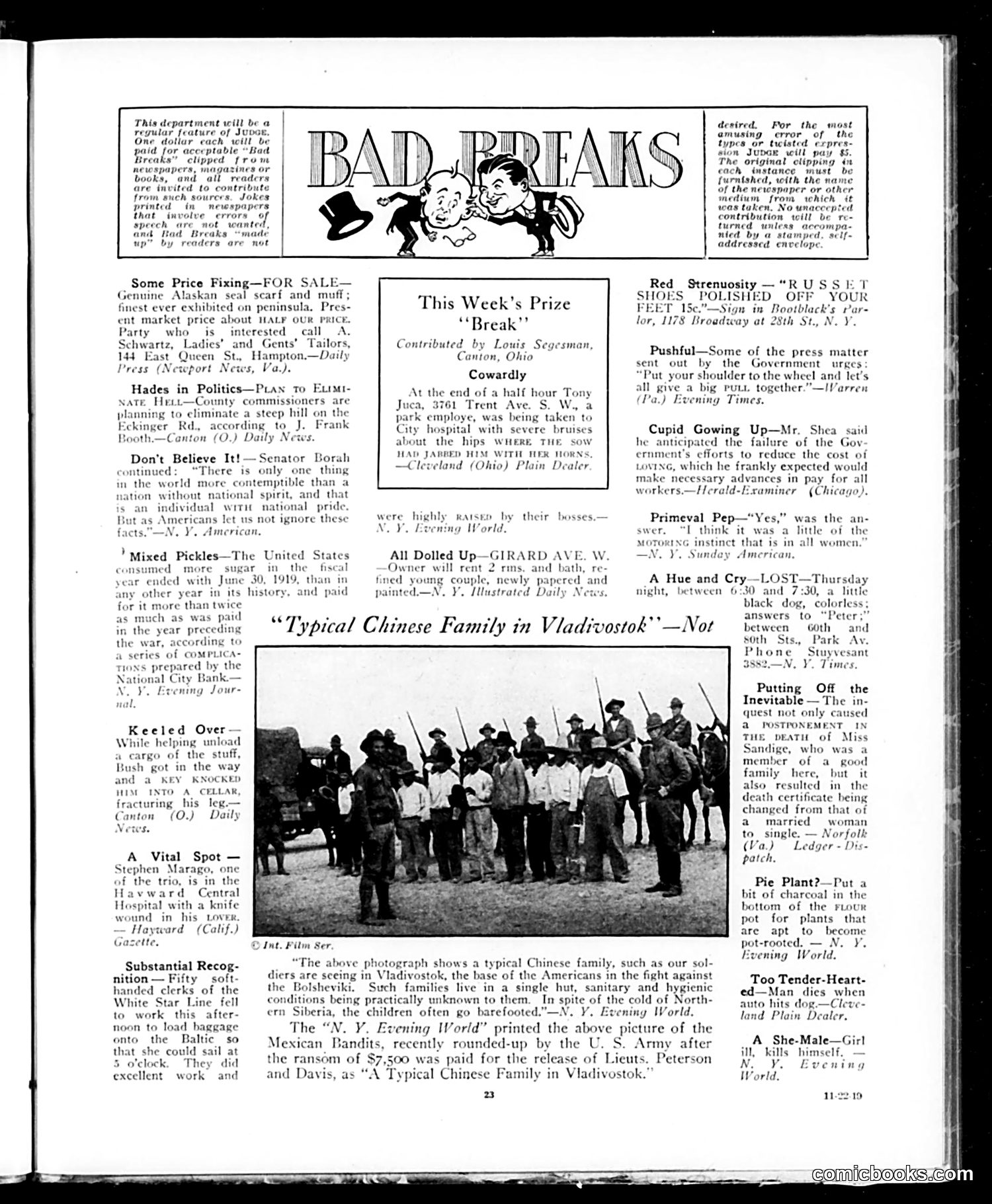
This page collects humorous errors ("Bad Breaks") clipped from newspapers and magazines—a recurring Judge feature inviting reader contributions. The humor relies on unintentional double meanings, malapropisms, and awkward phrasing in published text. Examples include: a real estate ad selling a seal scarf at "HALF OUR PRICE" (contradicting the "price fixing" headline), a county plan to "eliminate a steep hill" (suggesting removal rather than improvement), and a government message about "putting your shoulder to the wheel" with odd phrasing. The centerpiece photograph captioned "Typical Chinese Family in Vladivostok" appears to satirize American Cold War anxieties, showing Russian soldiers and Chinese civilians—likely mocking both the exotic "otherness" and contemporary anti-communist rhetoric. The page primarily ridicules poor editorial judgment and careless newspaper writing through these collected gaffes.
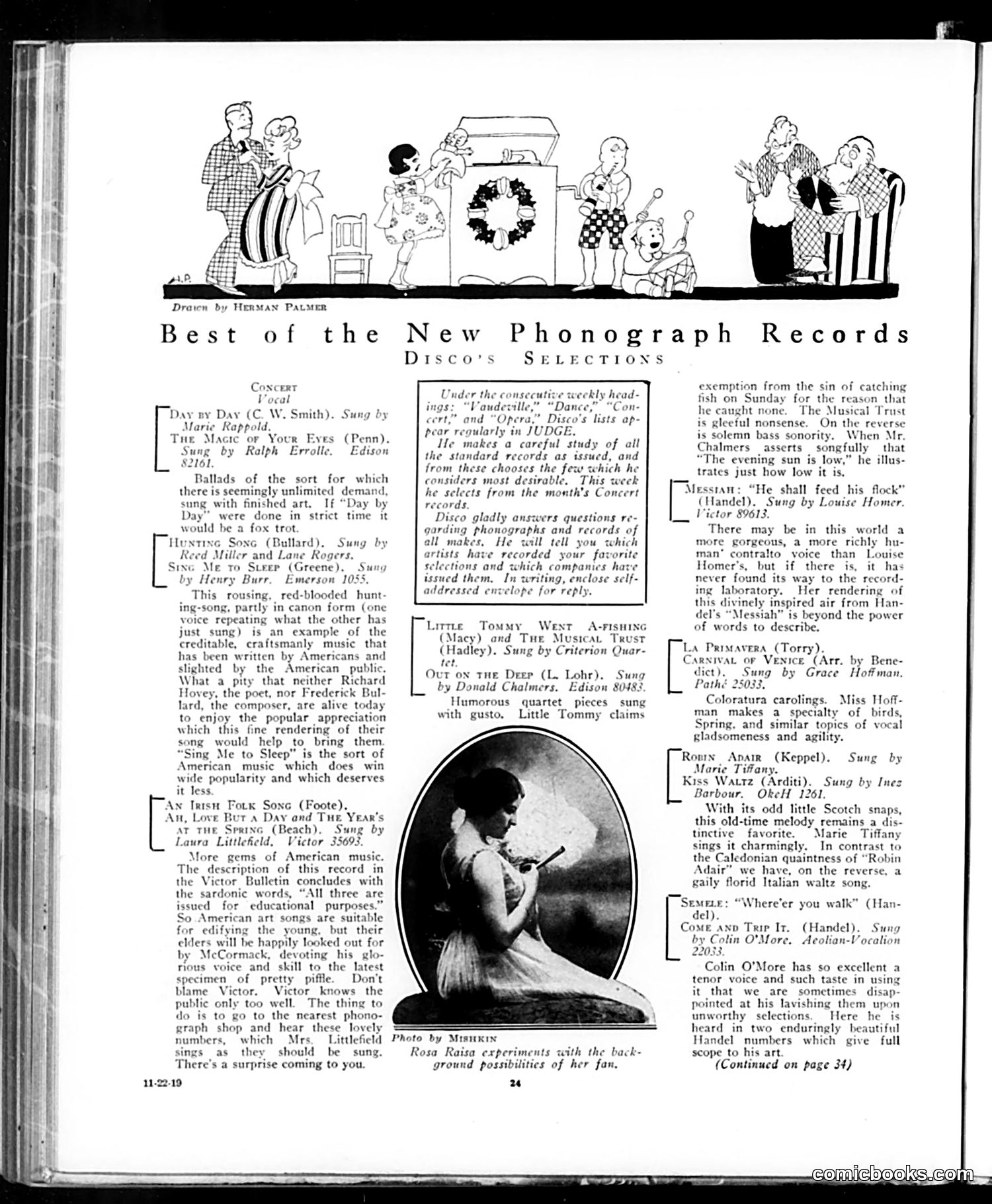
This is a **record review column**, not political satire. The page features Herman Palmer's illustration of a family with a phonograph and discusses newly released classical and popular vocal recordings. The reviews are **critical commentary on American musical taste**. The author (signing as "Disco") repeatedly expresses frustration that Americans neglect serious art songs by native composers (Hovey, Bullard, Foote) in favor of popular entertainment. He sarcastically notes that educational recordings are marketed to "edify the young," implying the public prefers lighter fare. **Key figures reviewed**: vocalists Rosa Raisa, Louise Homer, and Colin O'More perform selections ranging from Handel's *Messiah* to folk songs and operatic arias on various labels (Victor, Edison, Pathé). The underlying social critique is that **American audiences and record companies prioritize commercial popularity over artistic merit**—a common modernist-era complaint about mass culture prioritizing profit over culture.
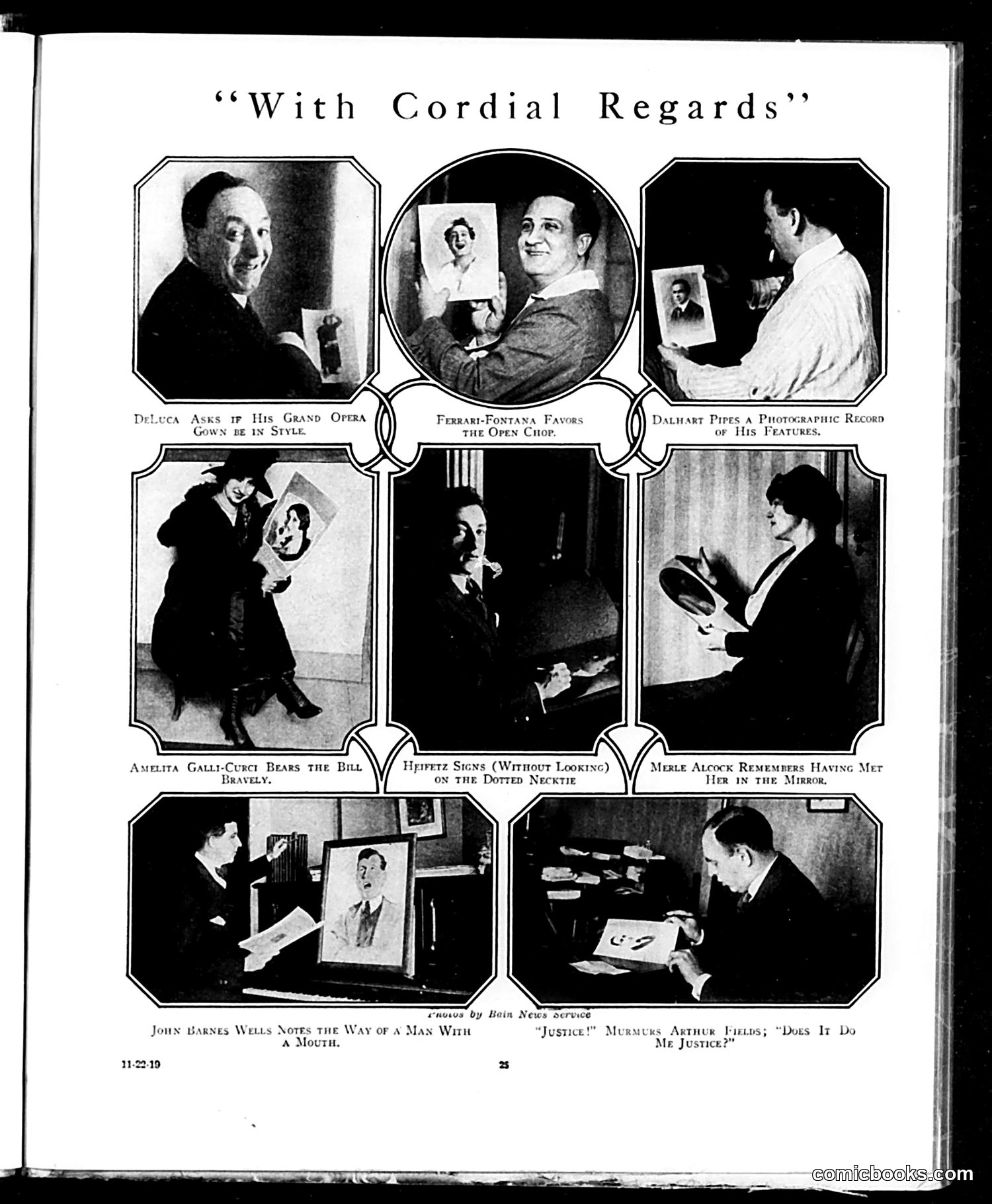
This page presents eight vignettes satirizing celebrities and public figures of the era, each supposedly sending "cordial regards" through photographs or mirrors. The humor relies on celebrity vanity and pretension. Identifiable figures include opera singers (DeLuca, Ferrari-Fontana), and performers like Amelia Galli-Curci and Hippolyte (Hyppitz). The jokes play on stereotypes: DeLuca obsessing over opera fashion, celebrities admiring their own photographs, Merle Alcock gazing at herself in a mirror. The bottom panels reference theatrical figures—John Barnes Wells and Arthur Fields—with wordplay on "Justice" (possibly referencing a character or production). The overall satirical point appears to be lampooning theatrical and entertainment world self-absorption and vanity during the post-WWI era, mocking how celebrities constantly concern themselves with appearance and public image. The "cordial regards" framing is ironic—these are self-centered gestures rather than genuine goodwill.
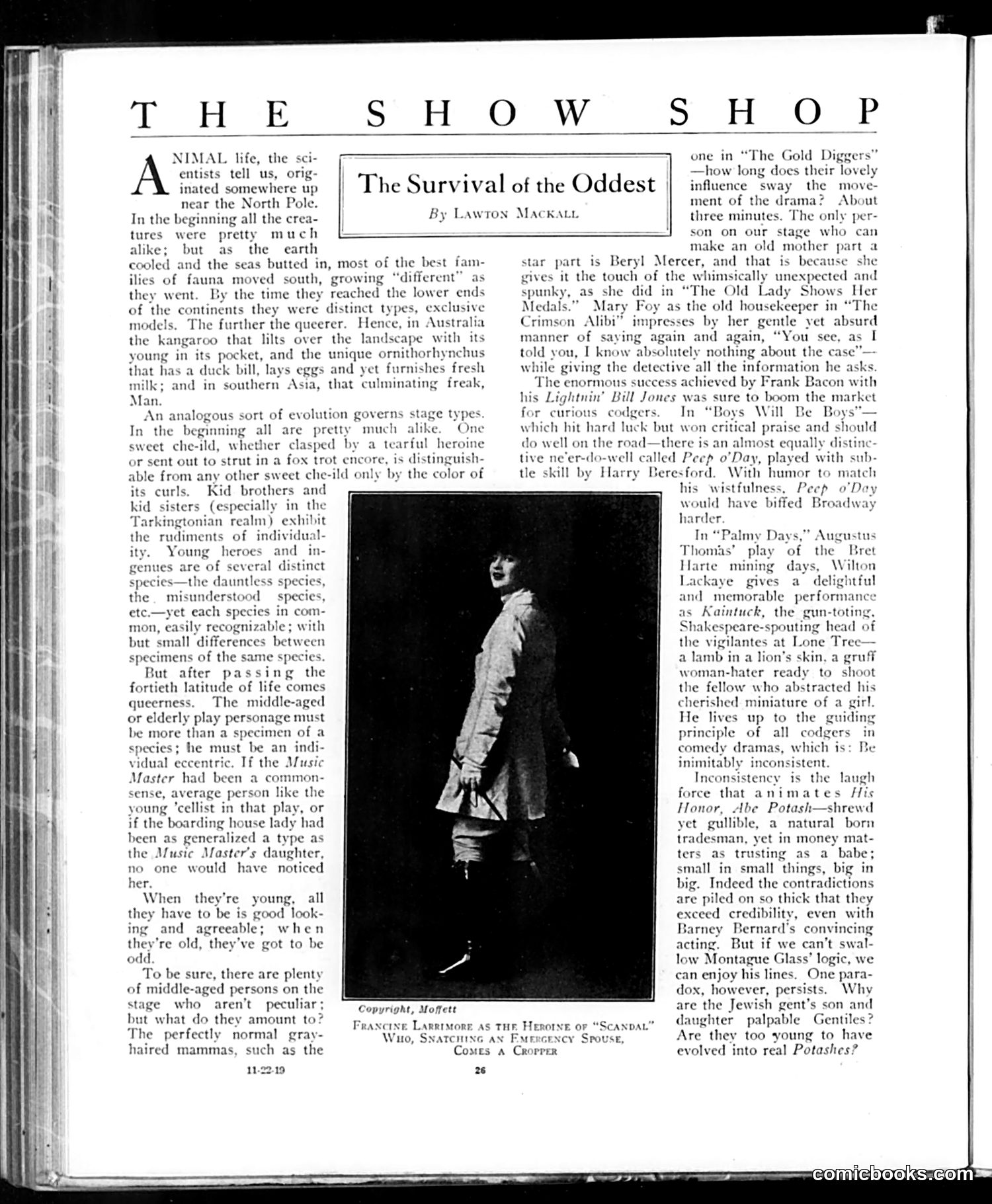
This theater column by Lawton Mackall discusses character types in stage plays. The accompanying photograph shows actress Francine Larrimore in a dramatic role. Mackall uses evolutionary biology as a metaphor for theatrical character development: just as animals become more "different" and specialized moving away from the North Pole, stage characters must evolve from generic "sweet child" types when young to eccentric, individualized personalities when middle-aged or elderly to remain interesting to audiences. The column praises specific actors—Beryl Mercer, Frank Bacon, and Harry Beresford—for bringing quirky, memorable eccentricity to older roles rather than playing generic "normal" types. The central point: successful theater requires aging characters to be oddly specific individuals, not bland generalized types. This oddness is what makes them compelling to audiences.
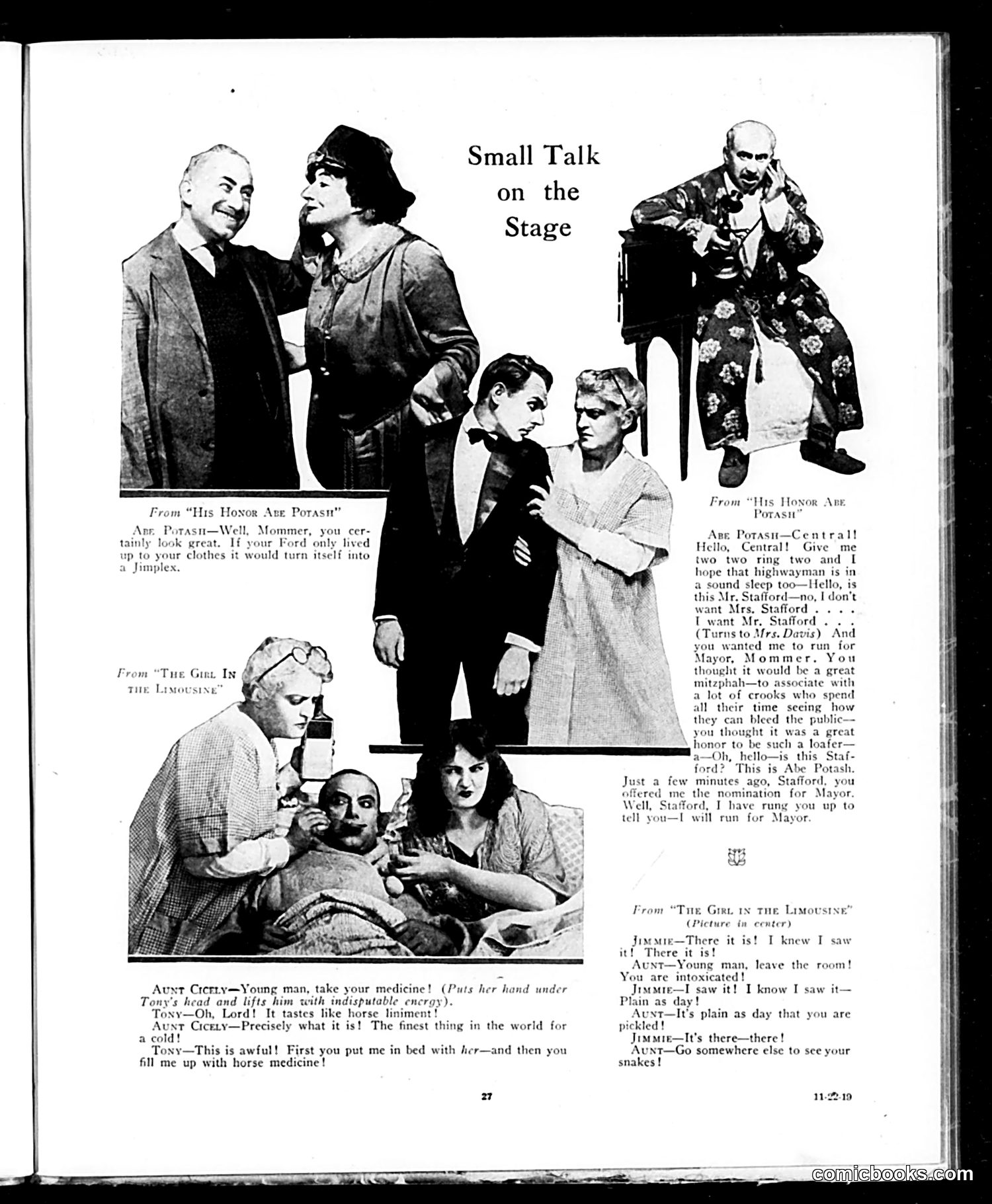
This page presents theatrical dialogue excerpts from multiple stage productions, showcasing humorous exchanges meant to entertain readers. **Key Content:** The page features scenes from plays including "His Honor Abe Potash" and "The Girl in the Limousine." The humor relies on character types recognizable to contemporary theater audiences—including an aunt figure dispensing dubious medicine and an intoxicated young man. **Notable Satire:** One scene mocks political ambition, with a character declining a mayoral nomination, sarcastically noting that associating with politicians means joining "crooks who spend all their time seeing how they can bleed the public." This reflects early 20th-century cynicism about municipal politics and corruption. **Overall Purpose:** Rather than political cartoon satire, this functions as entertainment journalism—showcasing brief comedic moments from Broadway/stage productions to amuse readers familiar with these plays, while also promoting theatrical attendance. The page appears designed for middle-class readers who attended or aspired to attend live theater.
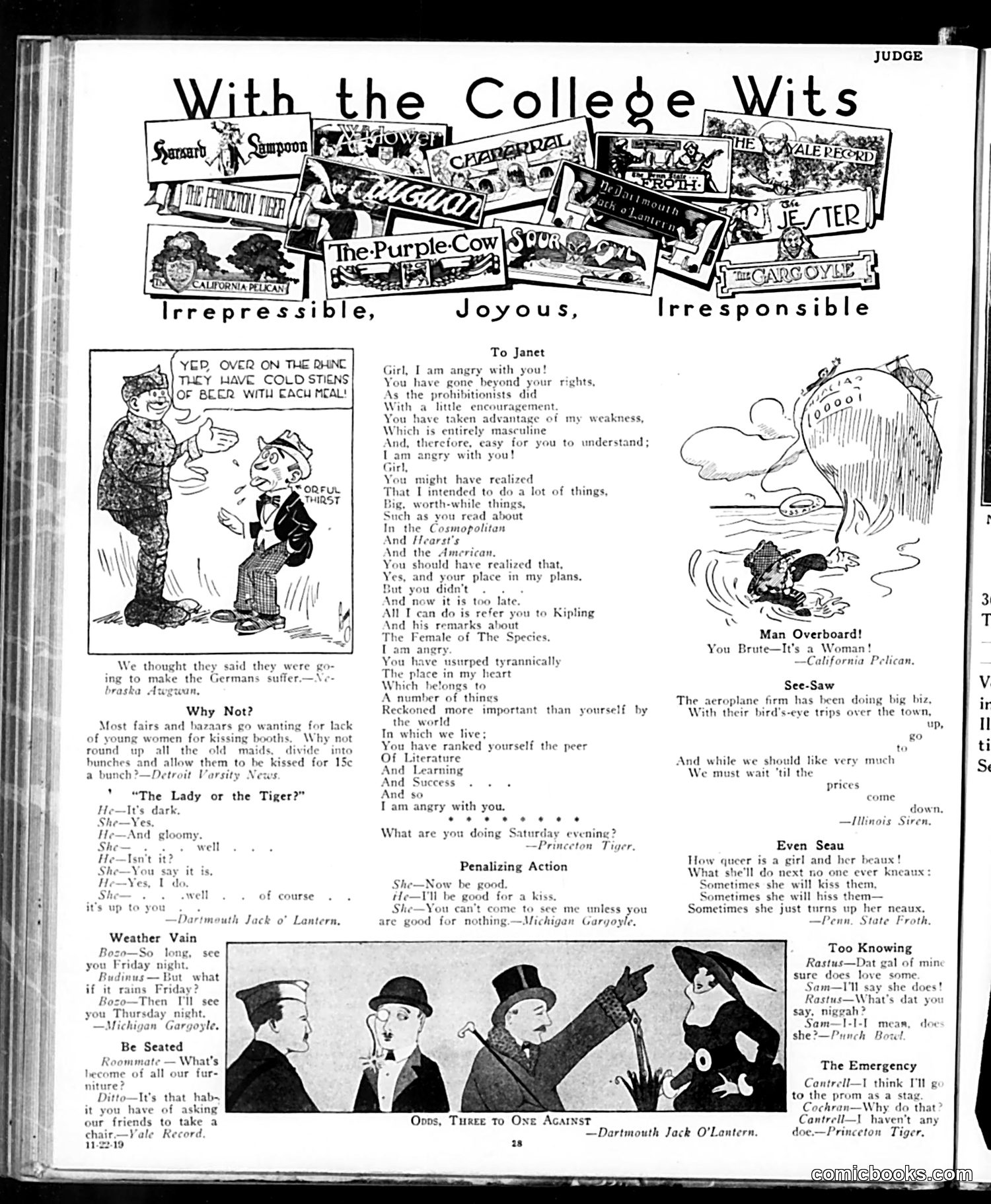
This page collects humorous pieces from college humor magazines, satirizing early 20th-century collegiate life and social attitudes. **Key content:** - **"To Janet"** poem mocks romantic melodrama—a man complains that a woman has interfered with his grand ambitions (literature, learning, success), treating her assertion of importance as tyrannical usurpation of his rightful place. - **College humor bits** satirize dating customs ("Man Overboard! You Brute—It's a Woman!"), airplane joy-rides being too expensive, and romantic indecision ("Even Seau"—a girl juggling multiple suitors). - **"Dartmouth Jack O'Lantern"** cartoon shows three men pointing/confronting one, captioned "Odds, Three to One Against"—likely satirizing peer pressure or social conflict. - Scattered jokes mock kissing booths, weather excuses, and social climbing. **The satire targets** collegiate pretension, romantic posturing, and gender dynamics of the era—presenting college students as self-important while navigating modern social anxieties around courtship and ambition.
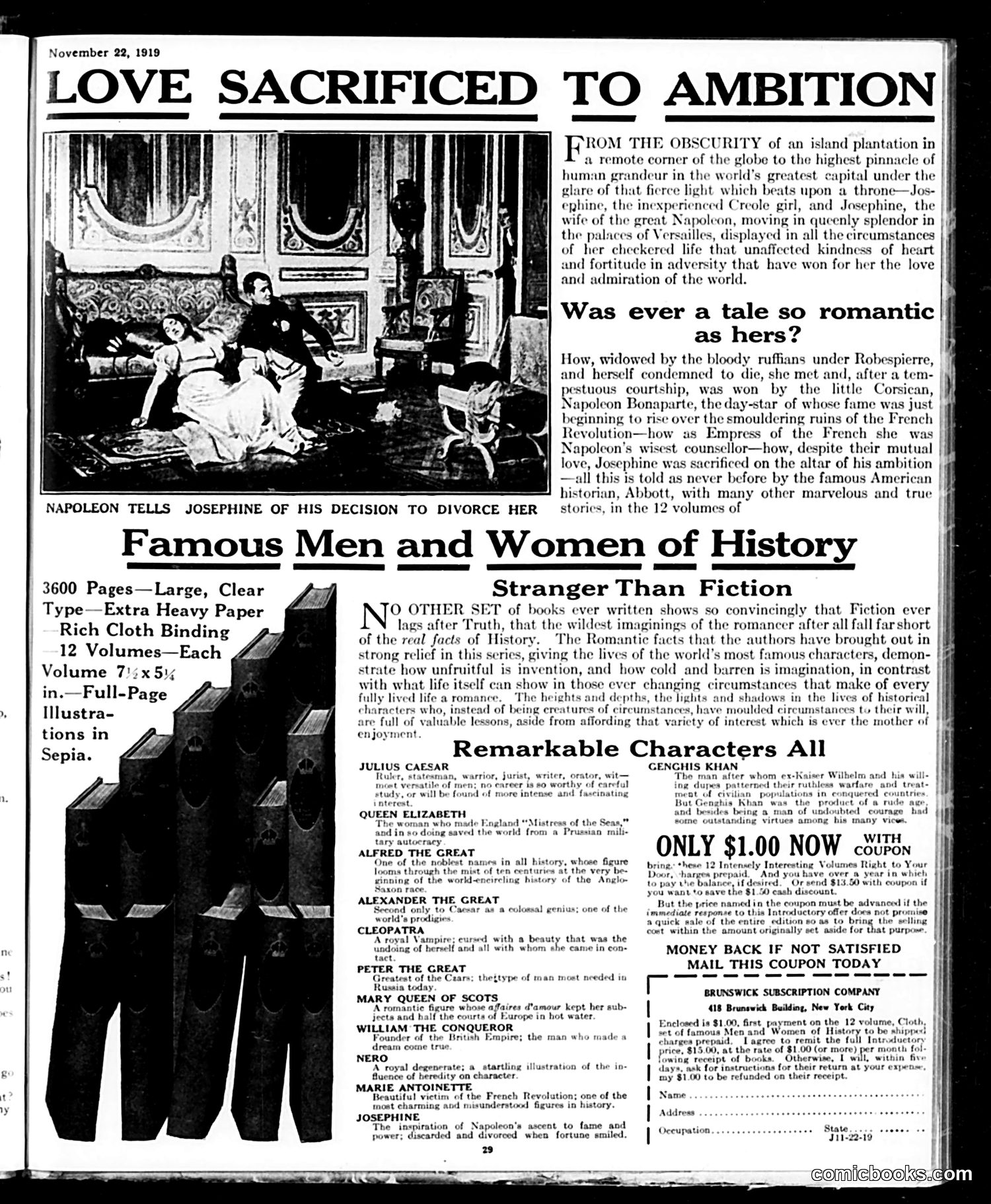
This page is primarily an **advertisement for a book series**, not political satire. The illustration depicts the historical moment when Napoleon divorced Josephine to pursue political ambitions—specifically, to marry an Austrian princess for dynastic advantage. The central image shows Napoleon informing Josephine of his decision in an opulent palace setting. The accompanying text romanticizes their story as presented in "Famous Men and Women of History," a 12-volume encyclopedia by historian Abbott. The framing is sentimental rather than satirical: it emphasizes Josephine's tragic sacrifice of personal love for Napoleon's career ambitions. The book series promises to present such historical figures' "real facts" in dramatic, engaging narratives—positioning itself as "Stranger Than Fiction." The "Remarkable Characters" list includes Julius Caesar, Cleopatra, Peter the Great, and others, all marketed as fascinating historical personalities. This is essentially a mail-order book advertisement exploiting public appetite for biographical drama.
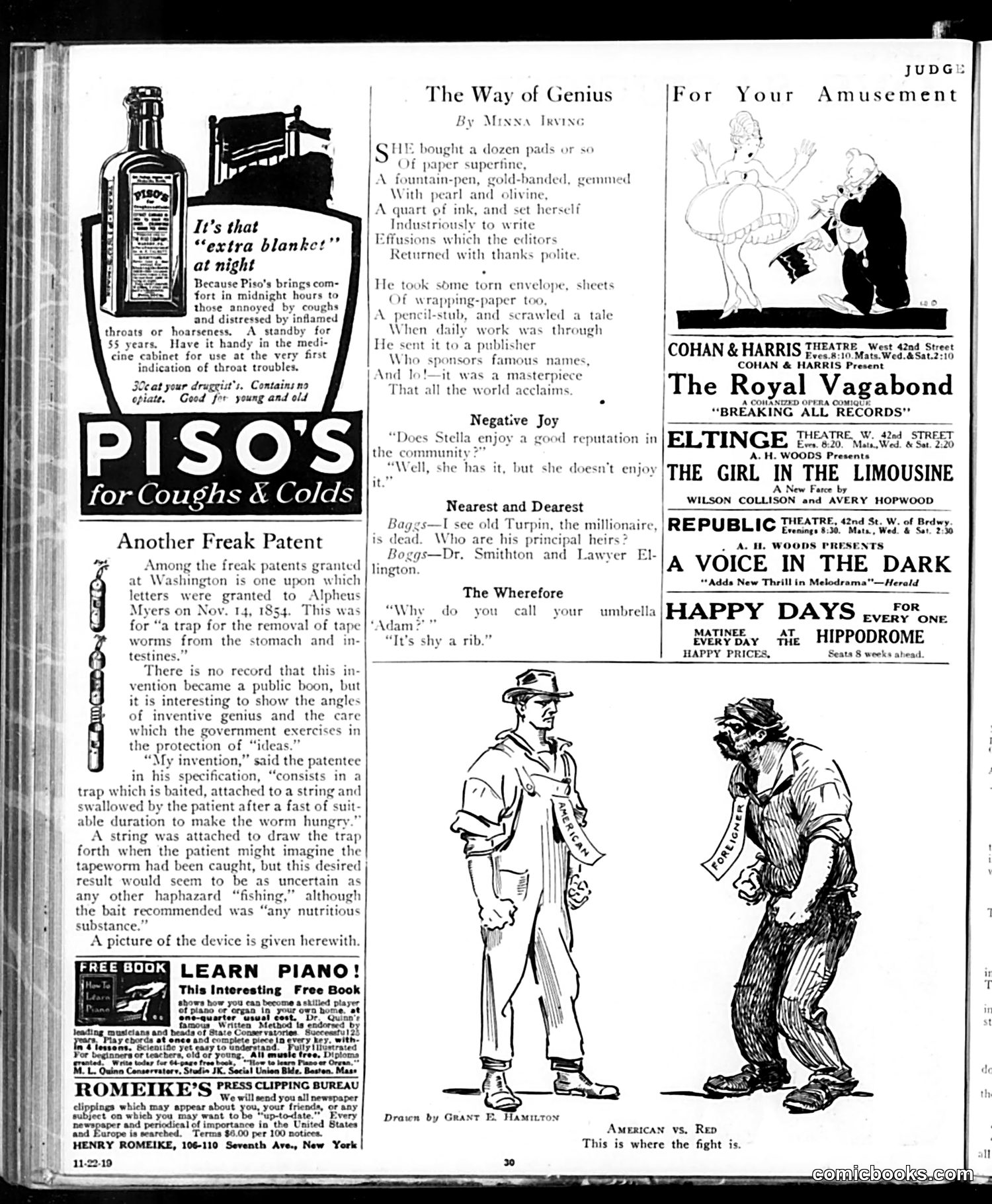
This page is primarily **advertising and theater listings** with minimal satirical content. The substantive pieces include: **"The Way of Genius"** (Minna Irvine): A light verse mocking aspiring writers. It depicts a woman buying expensive writing supplies and composing what she imagines is a masterpiece, only to have publishers reject it with polite form letters. The satire targets both the delusion of amateur writers and the publishing industry's dismissal of unsolicited work. **"Another Freak Patent"**: This describes an absurd 1854 patent for a tapeworm trap—a baited device swallowed on a string to "fish" for intestinal parasites. The piece ridicules the government's patent protection of obviously impractical inventions, highlighting the gap between theoretical innovation and practical utility. The remaining content consists of period advertisements (Piso's cough medicine, piano lessons) and theater listings for Broadway productions, reflecting Judge's commercial function alongside satire.
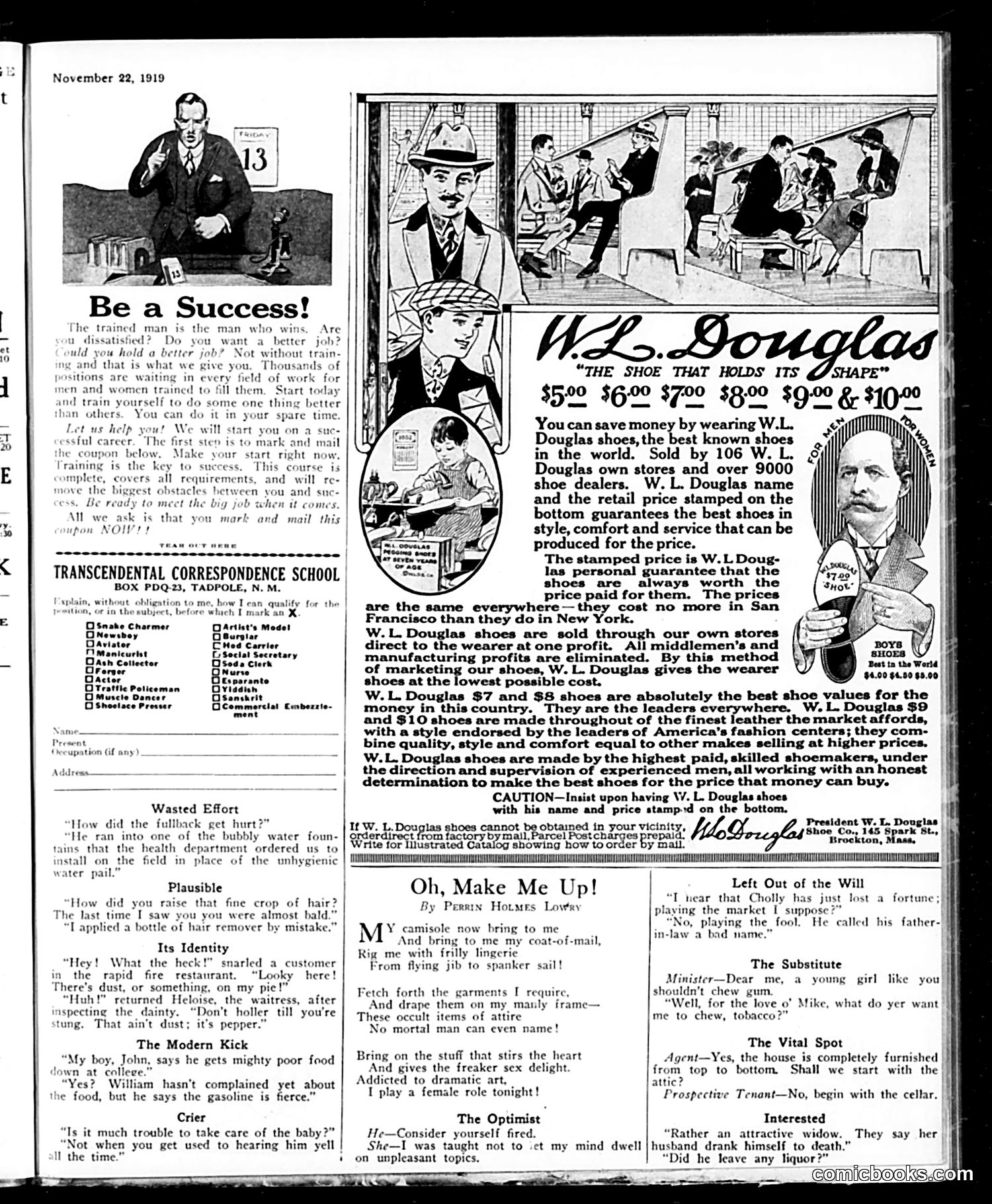
This page combines advertising with satirical humor pieces typical of Judge magazine. **The Main Advertisement** is a large W.L. Douglas shoe ad, showing the company's direct-to-consumer sales model and price guarantees—a business practice that was notable in 1919. **The Satirical Sections** consist of short joke vignettes: - **"Be a Success!"** satirizes correspondence school advertising (like the Transcendental Correspondence School featured below)—a common scam targeting working people promising career advancement through mail-based training. - **Brief humor pieces** ("Wasted Effort," "The Modern Kick," "Crier") mock everyday absurdities: students complaining about college food quality, parents' concerns about childcare, and restaurant dining experiences. The page reflects post-WWI American concerns: economic opportunity, education accessibility, consumer fraud, and working-class anxieties. The correspondence school satire specifically targets the desperation of people seeking self-improvement during economic uncertainty.

This page from Judge magazine contains mostly advertisements and brief humorous anecdotes rather than political cartoons. The content reflects early 20th-century domestic humor and gender stereotypes. The jokes satirize contemporary social attitudes: "Why are telephone operators all women?" answers that women work faithfully because they enjoy talking—a sexist jab at female chatiness. "Strategy" mocks marital dynamics, with a husband buying his wife diamond earrings to stop her wearing her hair over her ears. "A Mean Man" jokes that someone named his motorboat after his wife because it's "hard to manage"—equating wives with difficult vessels. The one illustration shows a chaotic street scene with automobiles and pedestrians, captioned about "Forcing Practice for Football Players," using traffic chaos as crude comedy. The advertisements (Brooks' Rupture Appliance, Cuticura skin treatment, Gorges Cigars) dominate the layout. Overall, this represents Judge's formula of light domestic satire aimed at middle-class readers, with humor based on marriage troubles, telephone operators, and consumer products rather than political commentary.
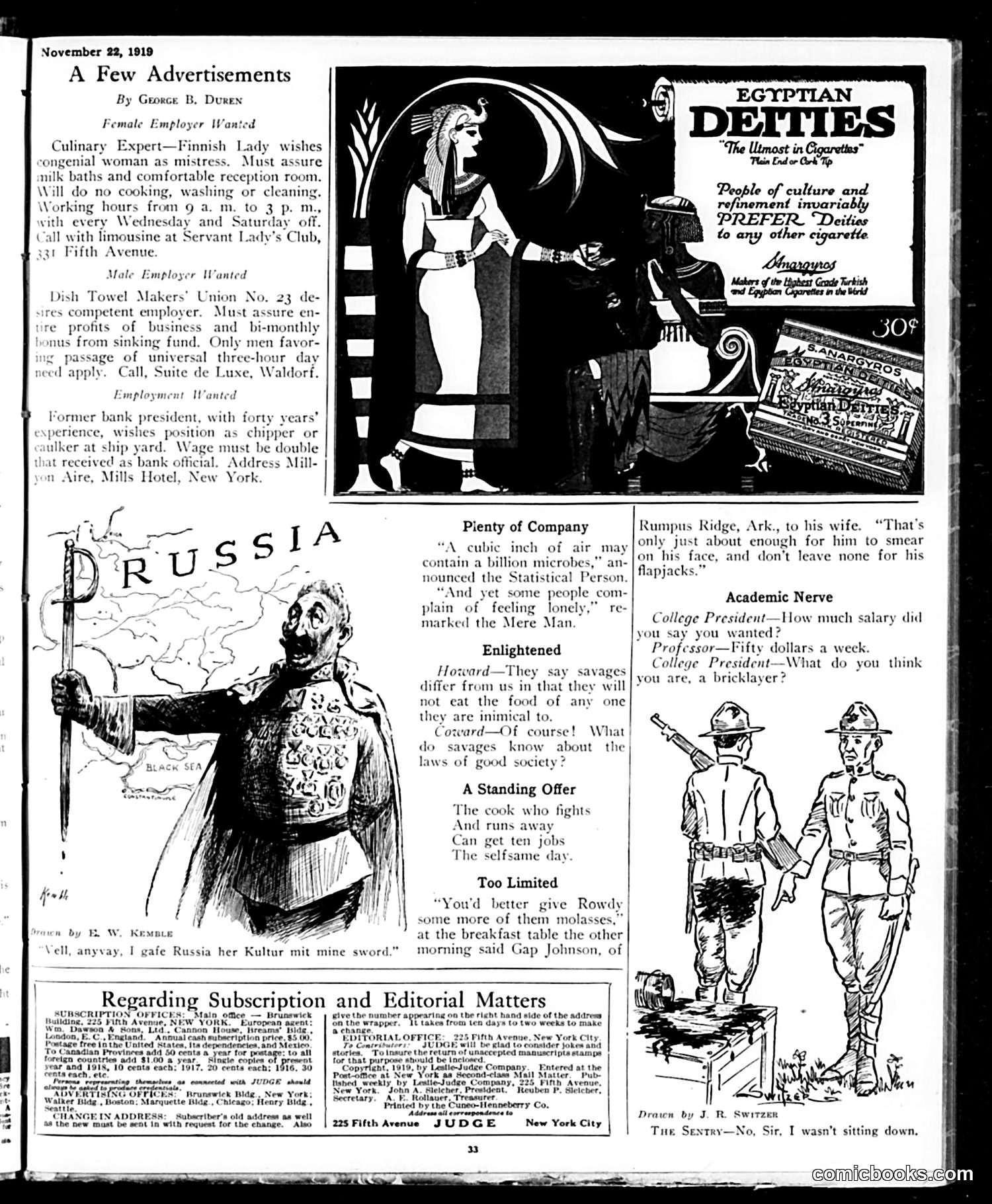
**The Russia Cartoon** (left): depicts a militaristic Russian figure holding a sword and flag, representing post-Bolshevik Russia. The caption "Well, anyway, I gave Russia her Kultur mit mine sword" mocks German militarism and its role in Russian upheaval. Published shortly after the 1917 Revolution, this satirizes how European powers destabilized Russia through warfare. **Job Advertisements Section**: These mock labor market absurdities of 1919. A Finnish employer demands servants who won't actually work; union workers demand employers guarantee profits; a former bank president needs double wages for manual labor. The satire targets post-WWI economic chaos, labor unrest, and inverted class expectations where traditional hierarchies crumble. **Short Jokes**: Poke fun at social pretension ("savages" understanding etiquette), labor mobility (cooks quitting freely), and salary disputes—reflecting widespread post-war labor disputes and changing employment dynamics. The overall theme: 1919 America's economic upheaval and social disorder following World War I and the Russian Revolution.
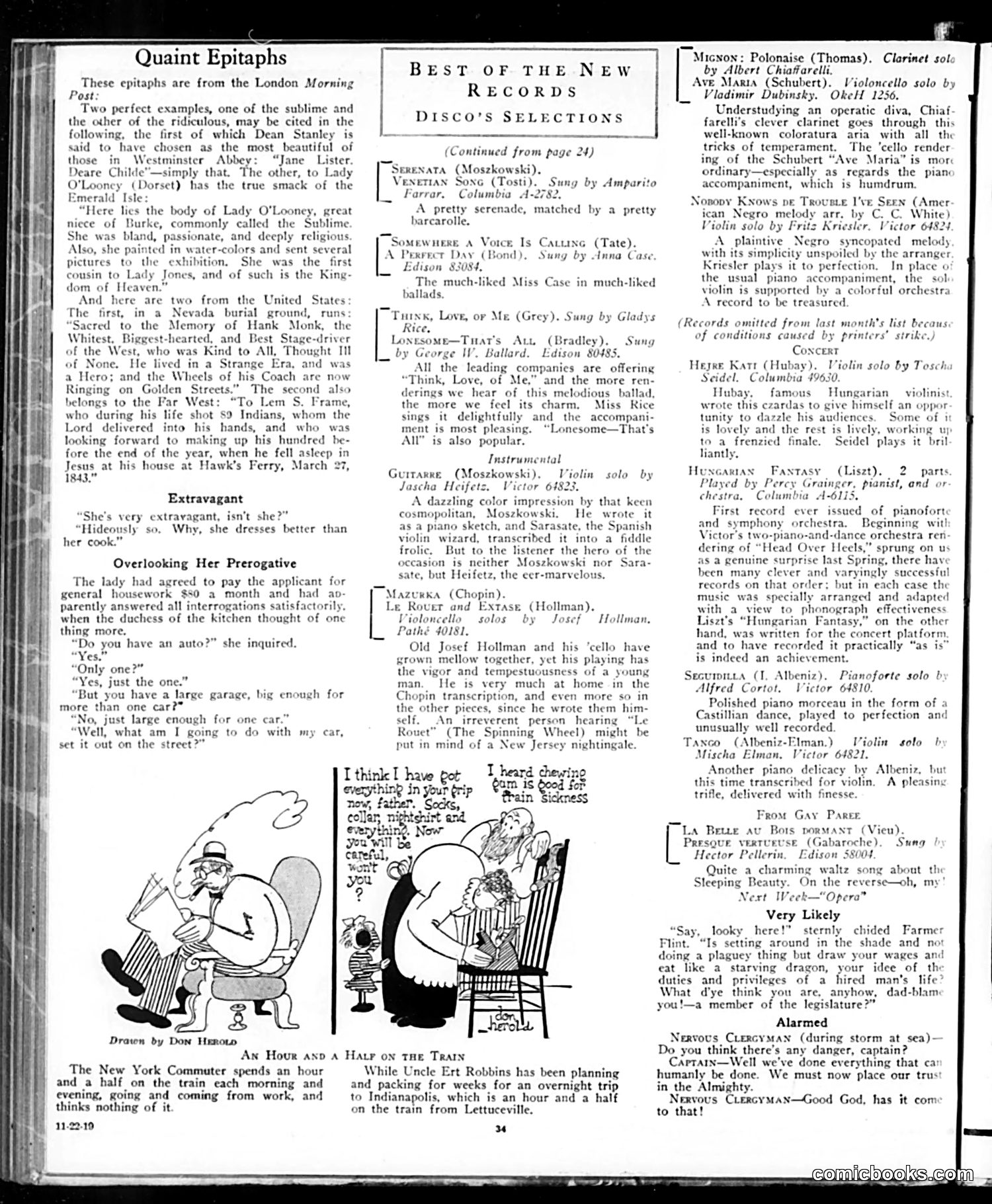
This cartoon satirizes the emerging class tensions of the early 20th century regarding domestic servants and automobiles. A prospective housemaid negotiates her employment terms with a lady employer. The maid initially accepts modest wages ($80/month), but then demands to know where she'll park her own car—apparently expecting the employer to provide garage space for the servant's personal automobile. The humor targets two social anxieties: first, the "uppity" servant class adopting middle-class pretensions (car ownership); second, the inversion of employer-employee hierarchy, where the maid presumes to make demands rather than accept terms. The employer's exasperated response—"set it out on the street?"—captures the absurdity of a domestic worker expecting such accommodation. This reflects genuine anxiety about automobile democratization and shifting servant expectations during the 1910s-20s, when cars became more affordable and workers increasingly demanded modern conveniences previously reserved for employers.

This is primarily a **music advertisement**, not political satire. It promotes Columbia Records' November releases, featuring popular vocal and jazz recordings of the era. The page advertises several tenor duets and jazz recordings, including the "Ted Lewis Jazz Band" making its first record. The text mentions performances from New York's Greenwich Village Follies and Keith's Palace Theatre, establishing these as contemporary entertainment venues. The illustrated figures on the right appear to be **promotional artwork** depicting performers or stylized representations of the recording artists—typical advertising imagery for the period. The Columbia Graphophone Company logo and grafonola phonograph image (lower left) identify this as a major record label's promotional material. The prices listed (85 cents) and catalog numbers indicate these were commercial releases distributed through Columbia dealers. This represents early 1920s popular music marketing, before radio dominated entertainment.
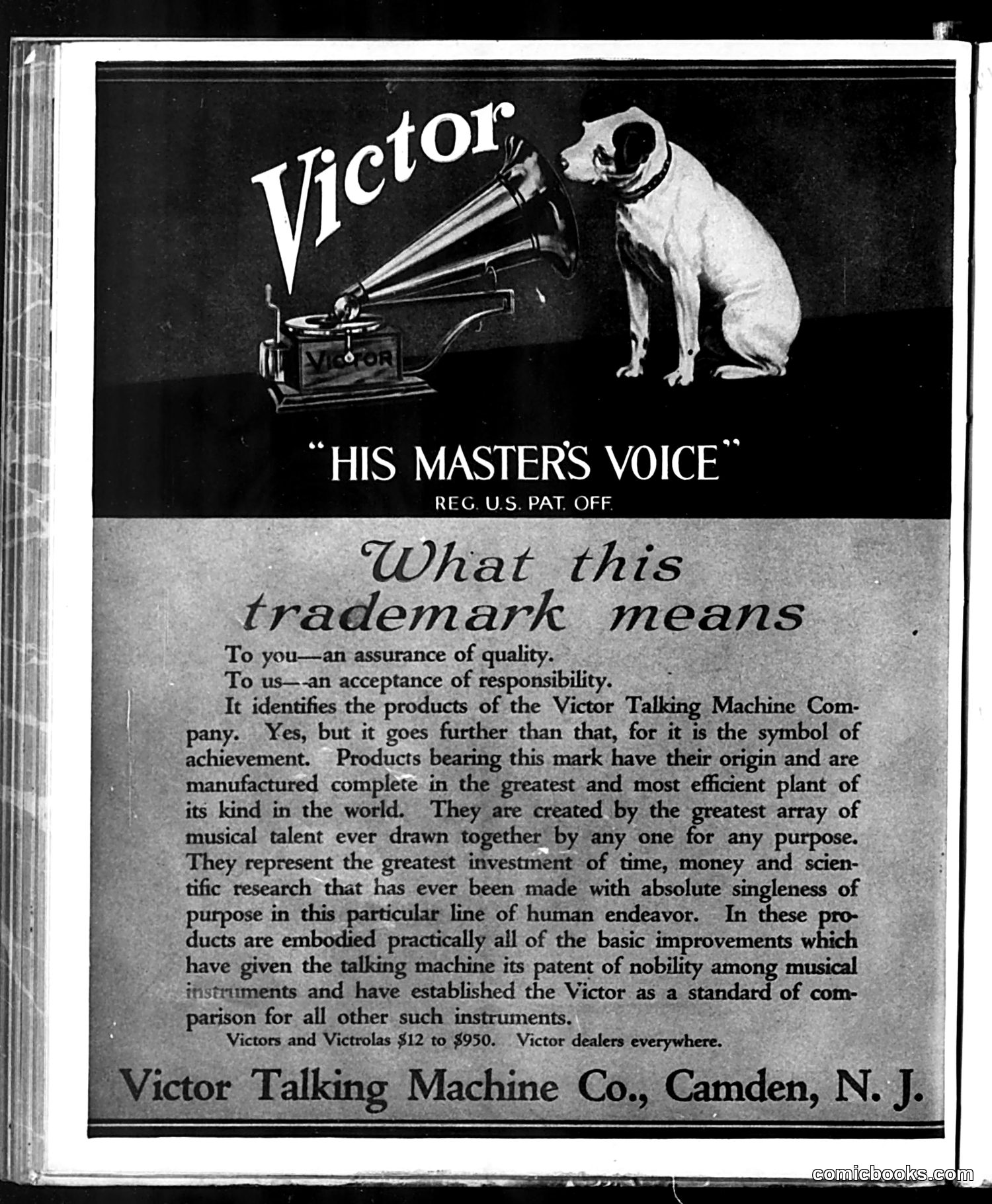
This is a full-page advertisement, not political satire. It promotes Victor brand phonographs ("talking machines") and their famous trademark: a dog listening to a gramophone horn, captioned "His Master's Voice." The ad explains the trademark's meaning to consumers and the company—assuring quality while accepting responsibility. It claims Victor products represent the pinnacle of manufacturing, employing the "greatest array of musical talent" and embodying all major phonograph improvements. The famous dog mascot (Nipper) was already an established Victor brand symbol by this era. The advertisement positions Victor phonographs as luxury items ($12–$950), emphasizing their technological superiority and cultural significance as a "standard of comparison." This appears in *Judge* magazine, suggesting it was a paid advertisement rather than editorial content.