
Judge, 1919-11-22 · page 24 of 36
Judge — November 22, 1919 — page 24: what you’re looking at
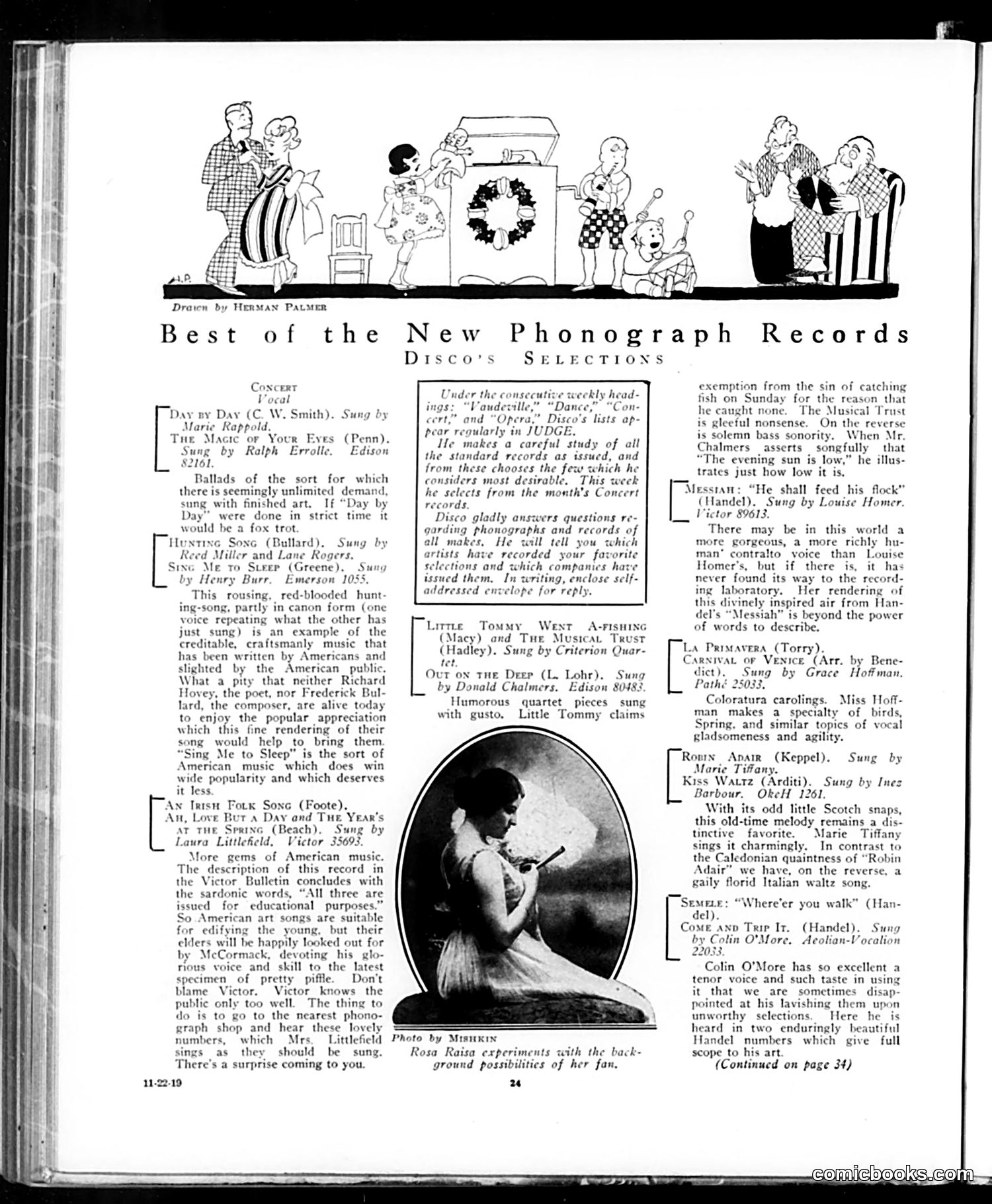
What you’re looking at
This is a **record review column**, not political satire. The page features Herman Palmer's illustration of a family with a phonograph and discusses newly released classical and popular vocal recordings. The reviews are **critical commentary on American musical taste**. The author (signing as "Disco") repeatedly expresses frustration that Americans neglect serious art songs by native composers (Hovey, Bullard, Foote) in favor of popular entertainment. He sarcastically notes that educational recordings are marketed to "edify the young," implying the public prefers lighter fare. **Key figures reviewed**: vocalists Rosa Raisa, Louise Homer, and Colin O'More perform selections ranging from Handel's *Messiah* to folk songs and operatic arias on various labels (Victor, Edison, Pathé). The underlying social critique is that **American audiences and record companies prioritize commercial popularity over artistic merit**—a common modernist-era complaint about mass culture prioritizing profit over culture.
📄 Transcribed text from this page (OCR, searchable)
Machine-transcribed from the original scan — historical spelling and the odd misread are preserved.
Drawn by Herman Pacater the New Phonograph Records Disco's SELECTIONS Best of Concert al Day ny Day (C. W. Smith). Sung by Marie Rappold. Tue M our Eves (Penn) Sung by Ralph Errolle. Edis: of the sort for which there is seemingly unlimited > sung with finished art. If Day” were done in strict time it would be a fox trot. Huntine Sone (Bullard), Sung by t rand Lane Rogers. » Steep (Greene). Sung Burr. Emerson 1033, This rousing, red-blooded hunt ing-song, partly in canon form (one voice repeating what the other has just sung) is an example of the creditable, craftsmanly music that has been written by Americans and slighted by the American publi What a pity that neither Richard Hovey, the poet, nor Freder 3ul- lard, the composer, are alive today to enjoy the popular appreciation which this fine rendering of their song would help to bring them. “Sing Me to Sleep” is the sort of which does win wide popularity and which deserves it less, An Irtsu Fotx Sonc (Foote). An, Love But a Day and Tue Y AT THE 5 (Beach). Laura Littlefield, Victor 35693. More gems of American music. The description of this record in the Victor Bulletin concludes with the sardonic words, “All three are issued for educational purposes.” So American art songs are suitable for edifying the young. but their elders will be happily looked out for by McCormack, ting his glo- rious voice and skill to the latest specimen of pretty piffle. Don't blame Victor. Victor knows the public only too well. The thing to do is to go to the nearest phi graph shop and hear these kc numbers, which Mrs. Little sings as they should be sung. There's a surprise coming to you. 11-22-19 “Vaude ” and “Opera,” Dis pear regularly in JUDGE. He makes a careful study the standard records as issu from these choo. the fi rnside rs most desirable, cts from the month's Con records Disco gladly answers questions re- ling phonographs and records of He will tell you which ¢ recorded your fa: selections and which compani In writing, encl slope for reply. address Lite Tommy Went A-FIsHING (Macy) and Tue Musicat Trust (Hadley). Sung by Criterion Quar- tet Ovt on tHe Deep (L. Lohr). Sung by Donald Chalmers, Edison 80483. Humorous quartet pieces sung with gusto. Little Tommy claims Photo by Misux Rosa Raisa experiments with the back- ground possibilities of her fan, -“ yMesstan: exemption from the sin of catching The Musica ab Trust is gleeful nonsense, On the reverse is solemn bass sonorit, When Mr. Chalmers asserts songfully that he evening sun is low,” he illus- trates just how low it is, “He shall feed his flock” (Handel). Sung by Louise Homer. Victor 89613. There may be in this world a more gorgeous, a more richly hu- man’ contralto’ voice than Louise Homer's, but if there is, it h never found its way to the recore ing laborate Her rendering « this divinely inspired air from Han- del’s “Messiah” is beyond the power of words to describe. La Pristavera (Torry). Carsivat or Venice (Arr. by Bene- dict). Sung by Grace Hoffman. Pathé Coloratura carolings. Miss 11 man makes a specialty of bird Spring, and similar topics of vocal gladsomeness and agility. Rows Anan (Keppel). Sung by Marie Tiffany. Kiss Watrz (Arditi). road by Inez Barbour. OkeH 126 With its odd Hitt Scotch snaps, this old-time melody remains a dis- tinctive favorite. Marie Tiffany sings it charmingly, In contrast to the Caledonian quaintness of “Robin Adair” we have, on the reverse, a gaily florid Italian waltz song. “Where'er you walk" (Han- p Trip It. (Handel Sung by Colin O'More, Aeolian-Vocalion Colin O’More has so excellent a tenor voice and such taste in using it that we are sometimes = pointed at his lavishing them up unworthy selections. Here he heard in two enduringly atiful Handel numbers which give full scope to his art. (Continued on page 34)