
Judge, 1919-11-22 · page 26 of 36
Judge — November 22, 1919 — page 26: what you’re looking at
What you’re looking at
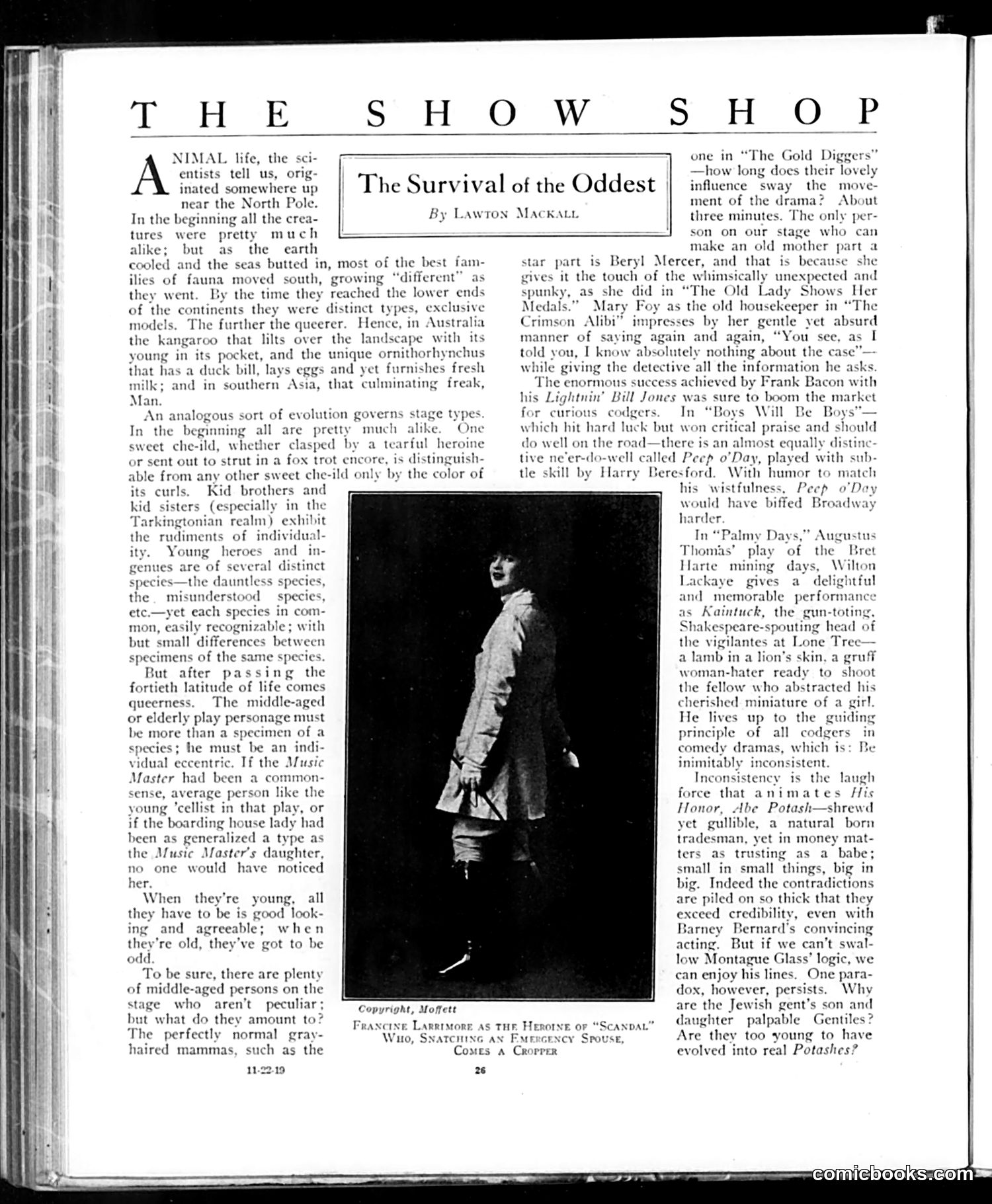
This theater column by Lawton Mackall discusses character types in stage plays. The accompanying photograph shows actress Francine Larrimore in a dramatic role. Mackall uses evolutionary biology as a metaphor for theatrical character development: just as animals become more "different" and specialized moving away from the North Pole, stage characters must evolve from generic "sweet child" types when young to eccentric, individualized personalities when middle-aged or elderly to remain interesting to audiences. The column praises specific actors—Beryl Mercer, Frank Bacon, and Harry Beresford—for bringing quirky, memorable eccentricity to older roles rather than playing generic "normal" types. The central point: successful theater requires aging characters to be oddly specific individuals, not bland generalized types. This oddness is what makes them compelling to audiences.
📄 Transcribed text from this page (OCR, searchable)
Machine-transcribed from the original scan — historical spelling and the odd misread are preserved.
S H O W S H O P NIMAL life, the sci- entists tell us, orig- inated somewhere up near the North Pole In the beginning all the cr tures were pretty much The Survival of the Oddest By Lawron Mack att one in “The Gold Diggers” —how long does their lovely influence sway the move- ment of the drama? About three minutes. The only per- son on our stage who can alike; but as the earth cooled and the seas butted in, most of the best fam- ilies of fauna moved south, growing “different” as they went. By the time they reached the lower ends of the continents they were distinct types, exclusive models. The further the queerer. Hence, in Australia the kangaroo that lilts over the landscape with its young in its pocket, and the unique ornithorhynchus a duck bill, lays eggs and yet furnishes fresh : and in southern Asia, that culminating freak, An ana us sort of evolution governs stage types In the beginning all are pretty much One sweet che-ild, whether clasped by a tearf or sent out to strut in a fox trot encore, is distinguish- able from any other sweet che-ild only the color of its curls. Kid brothers and kid sisters (especially in. the Tarkingtonian realm) exhibit the rudiments of individual Young heroes and in- s are of several distinct heroine species—the dauntless species, the. misunderstood — species, ete.—yet each species in com- mon, ea gnizable; with but small differences between specimens of the same spec But after passing the fortieth latitude of life comes queerness. The middle-aged or elderly play personage must be more than a specimen of a species; he must be an indi- vidual eccentric. If the Music Master had been a common- sense, average person like the young ‘cellist in that play, or if the boarding house lady had been as generalized a type as the Music Master's daughter, no one would have noticed her. When they're young, all they have to be is good look- ing and a when they're old, they've got to be odd To be sure, there are plenty of middle-aged persons on the stage who aren't peculiar; it what do they amount to? The perfectly normal gray- haired mammas, such as the pyright, Moffett Wuo, Syatcnis 11-22-19 26 Francine Larrtaore as THE Her AN EMrrcex Comes a Crorr make an old mother part a star part is Beryl Mercer, and that is because she gives it the touch of the whimsically unexpected and spunky, as she did in “The Old Lady Shows Her Medals.” Mary Foy as the old housekeeper in “The Crimson Alibi” impresses by her gentle yet absurd manner of saying again and again, “You see, as told you, I know absolutely nothing about the case’’— le giving the detective all the information he asks. The enormous success achieved by Frank Bacon with nu’ Bill Jones was sure to boom the market codgers. In “Boys Will Be Boys"— which hit hard luck but won critical praise and should do well on the road—there is an almost equally distine- 1e’er-do-well called Peep o’Day, played with sub- tle skill by Harry Beresford. With humor to match his wistfulness, Peep o'Dey would have biffed Broadw: harder . ‘Palmy Days,” Augustus Thomas’ play of the. Bret Harte mining days, Wilton Lackaye gives a delightf and memorable performance as Kaintuck, the gun-totin: Shakespeare-spouting head of the vigilantes at Lone Tree— a lamb in a lion’s skin, a gruff woman-hater ready to shoot the fellow who abstracted his cherished miniature of a girl He lives up to the principle of all codgers comedy dramas, which is inimitably inconsistent. Inconsistency is the force that animates Honor, Abe Potash—shrewd yet gullible, a natural born tradesman, yet in money mat- ters as trusting as bab small in small things, big in big. Indeed the contradictions are piled on so thick that they exceed credibility, even with Barney Bernard's convincing acting. But if we can’t swal- low Montague Glass’ logic, we can enjoy his lines. One para- dox, however, persists. Why are the Jewish gent’s son and daughter palpable Gentiles? Are they too young to have evolved into real Potashes? 77