
Judge, 1919-11-22 · page 9 of 36
Judge — November 22, 1919 — page 9: what you’re looking at
What you’re looking at
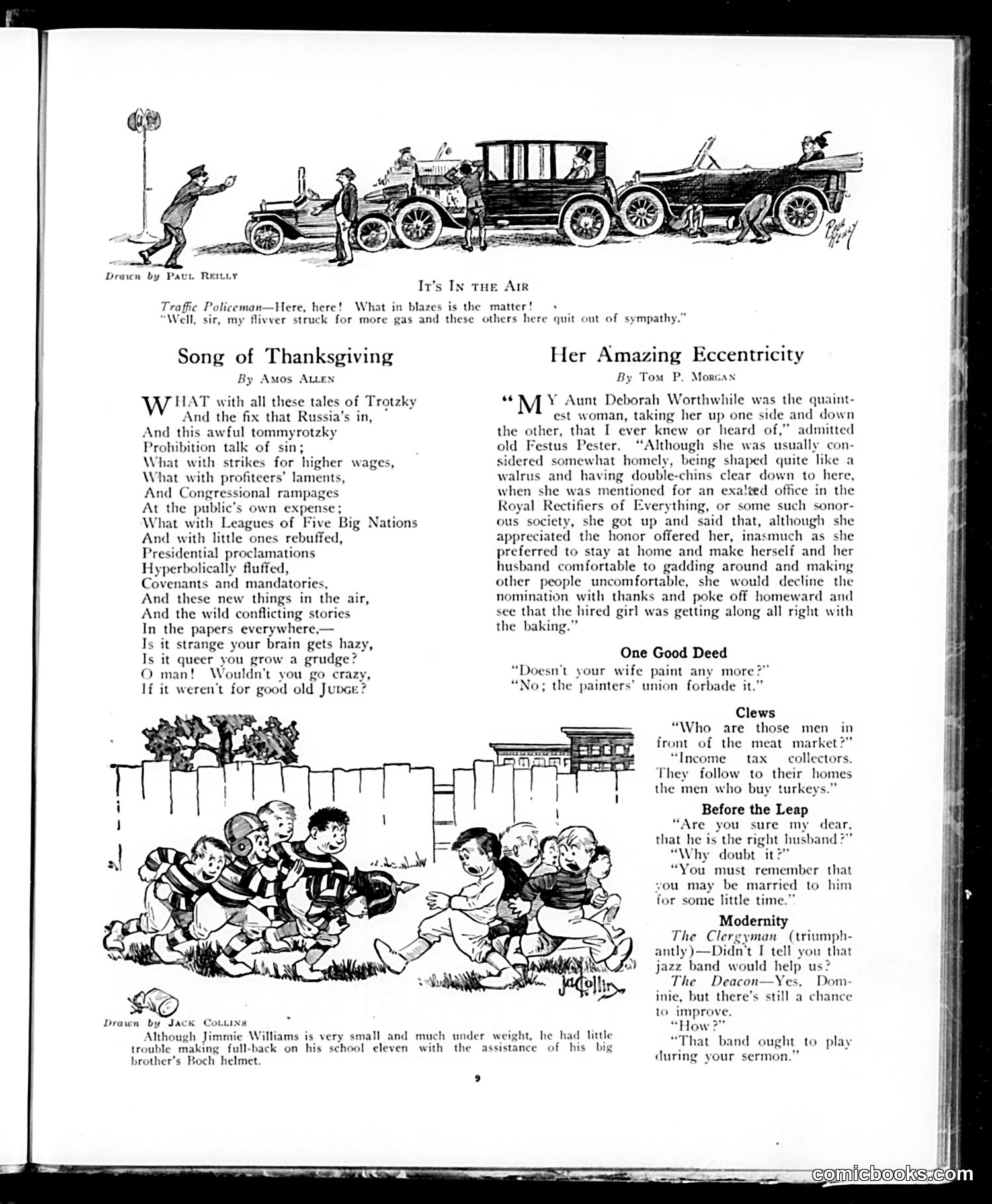
**"It's in the Air"** cartoon depicts a traffic policeman confronting drivers whose vehicles have stalled in sympathy with a striking "flivver" (Model T Ford). This satirizes labor unrest of the 1920s—workers striking for higher wages and sympathetic work stoppages that disrupted commerce and daily life. **"Song of Thanksgiving"** by Amos Allen catalogs post-WWI anxieties: Prohibition, labor strikes, war profiteering, Congressional corruption, and failed international diplomacy (the League of Nations). The poem's refrain suggests readers would "go crazy" without humor to cope—Judge itself provides this relief. **Other pieces** include humorous domestic sketches ("Her Amazing Eccentricity," "Modernity") and brief jokes about income tax and marriage, typical of the magazine's lighthearted social commentary. The page reflects early 1920s American frustrations: economic instability, political cynicism, and social upheaval following World War I.
📄 Transcribed text from this page (OCR, searchable)
Machine-transcribed from the original scan — historical spelling and the odd misread are preserved.
Drain by Paut Rey Traffic Policeman—Here, here! What in blazes is the It’s IN tHe Arr matter! + Well, sir, my flivver struck for more gas and these others here quit out of sympathy.” Song of Thanksgiving By Amos Auex HAT with all these tal And the fix that Ru And this awful tommyrotzky Prohibition talk of sin; What with strikes for higher wages, What with profiteers’ laments, And Congressional rampages At the public’s own expense ; What with Leagues of Five Big Nations And with little ones rebuffed, Presidential proclamations Hyperbolically fluffed, Covenants and mandatories, And these new things in the air, And the wild conflicting stories In the papers everywhere, Is it strange your brain gets ha Is it queer you grow a grudge O man! Wouldn't you go crazy, If it weren't for good old Jupcr? s of Trotzky in, Drawn by Jack © Althou trouble brothe h Jimmie Williams is ver. ing full-back on his school eleven Boch helmet. with small and much under wet the Her Amazing Eccentricity By Tom P. “ M Y Aunt Deborah Worthwhile was the quaint- est woman, taking her up one side and down the other, that I ever knew or heard of,” admitted old Festus Pester. ‘Although she was usually con- sidered somewhat homely, being shaped quite like a walrus and having double-chins clear down to here, when she was mentioned for an exalted office in the Royal Rectifiers of Everything, or some such sonor- ous society, she got up and said that, although she appreciated the honor offered her, inasmuch as she preferred to stay at home and make herself and her husband comfortable to gadding around and making other people uncomfortable, she would decline the nomination with thanks and poke off homeward and see that the hired girl was getting along all right with the baking. Morcan One Good Deed “Doesn't your wife paint any more ; the painters’ union forbade it. Clews “Who are those front of the meat market?” “Income tax collectors. They follow to their homes the men who buy turkeys.” Before the Leap “Are you sure my dea that he is the right husband “Why doubt it?” “You must remember that you may be married to him for some little time.” Modernity The Clergyman (triumph- antly )—Didn’t I tell you that jazz band would help us? The Deaco ves, Dom inie, but there’s still a chance >» improve. How during men in ht, he had little his big band ought to play assistance of ra your sermon