
A complete issue · 36 pages · 1919
Judge — October 4, 1919
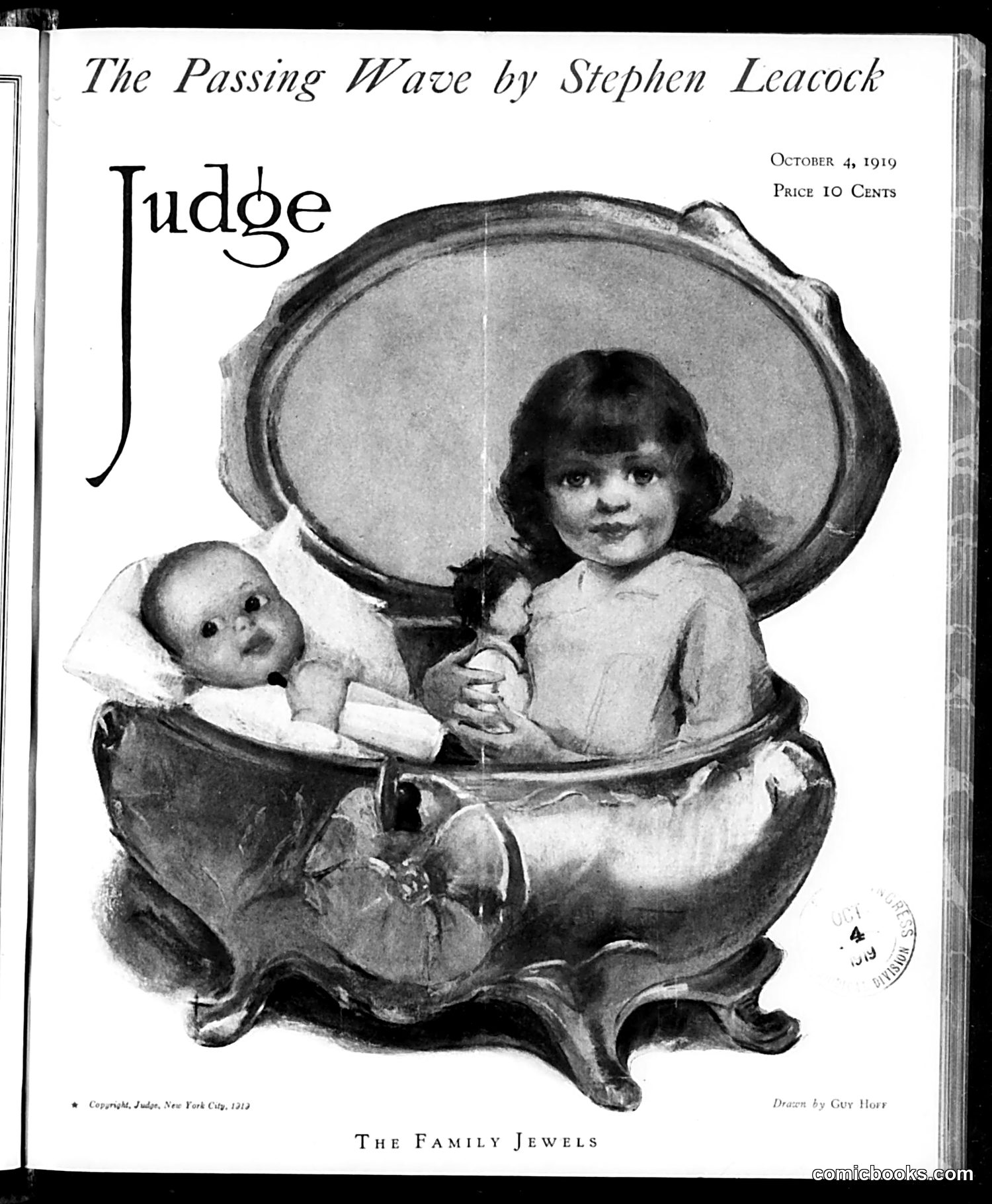
This cartoon by Guy Hoff depicts a toddler holding a doll inside an ornate jewelry box or casket. The title "The Family Jewels" is a satirical reference—playing on the phrase meaning one's most precious possessions or children. The specific meaning remains unclear without additional context from the 1919 issue. It likely comments on post-WWI American family life, parenting attitudes, or possibly social class and materialism. The oversized, elaborate container suggests either mockery of treating children as precious objects to be displayed, or commentary on how families regard their offspring. The drawing style and composition are characteristic of Judge's genteel satirical approach to social observation during this period.
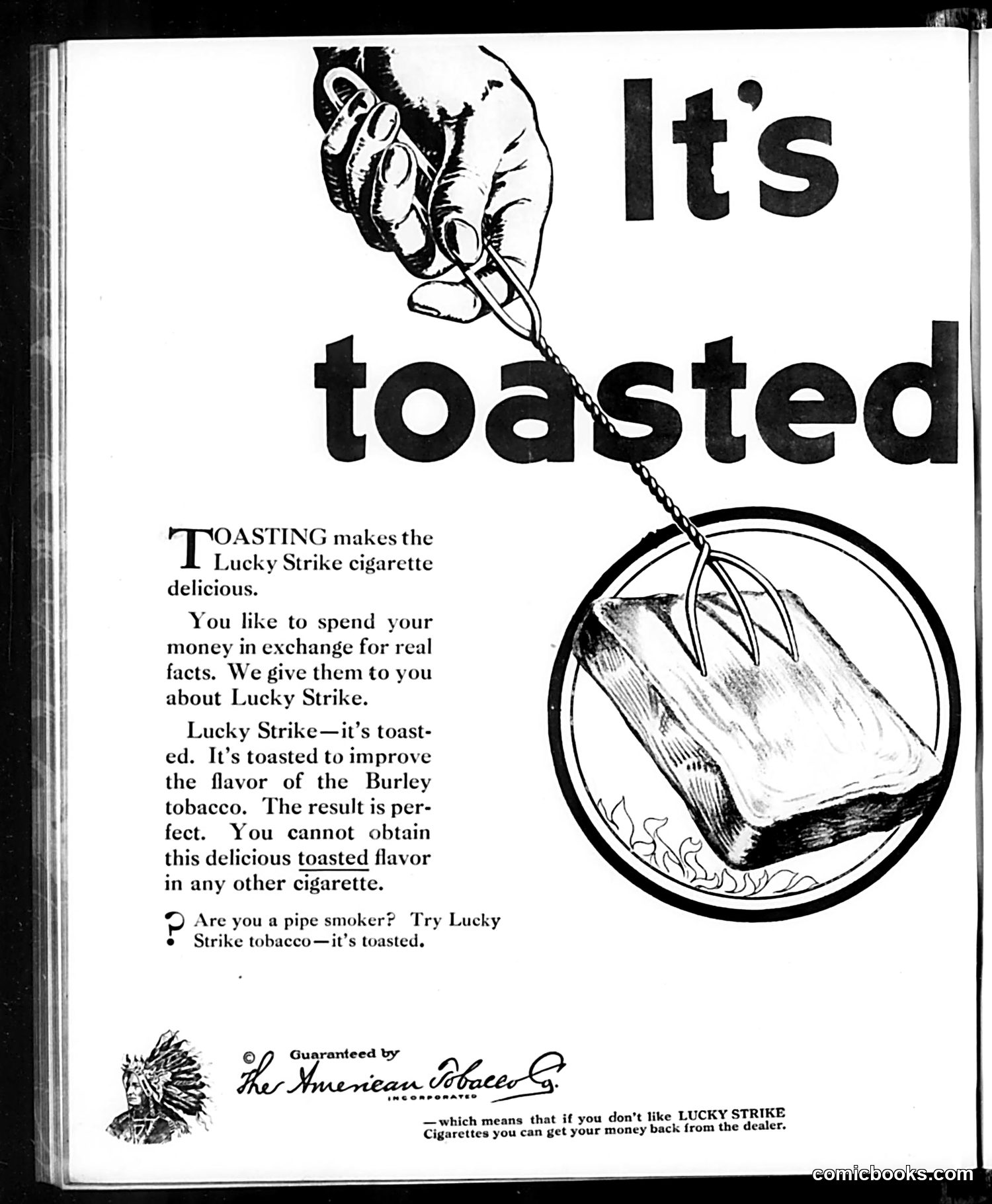
This is primarily a **Lucky Strike cigarette advertisement**, not political satire. The page promotes Lucky Strike's "toasted" tobacco process as a distinctive selling point. The visual metaphor shows a hand toasting tobacco over flame in a circular diagram, emphasizing the heating process claimed to improve flavor. The accompanying text argues that toasting the Burley tobacco creates a unique taste unavailable in competing cigarettes. The ad includes a money-back guarantee from the American Tobacco Company and suggests the product appeals to both cigarette and pipe smokers. This represents early 20th-century advertising strategy: claiming scientific/manufacturing superiority to justify brand preference. The "toasting" claim became Lucky Strike's signature marketing message during this era.
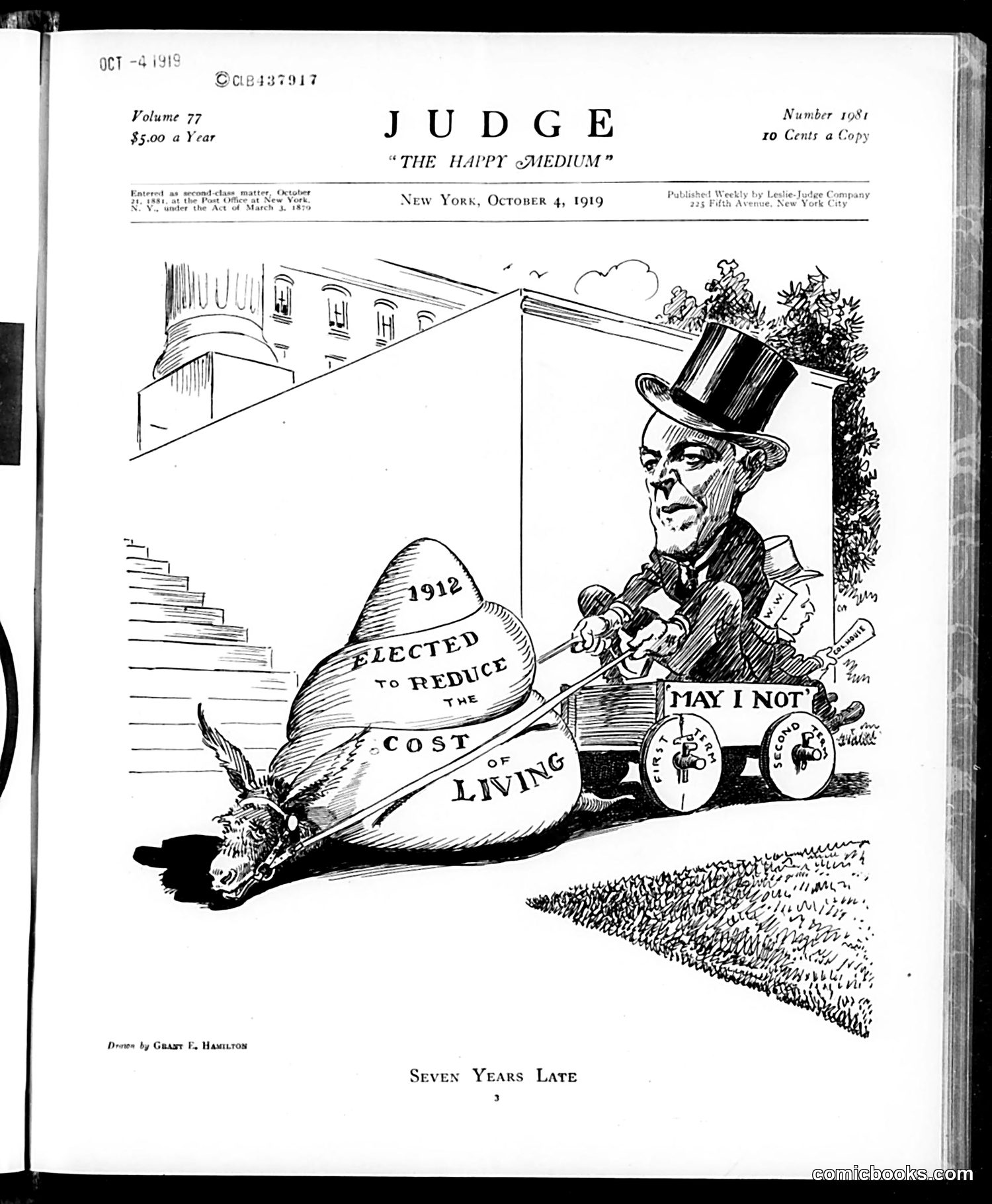
This political cartoon by Grant E. Hamilton satirizes failure to reduce the cost of living. A thin, exhausted donkey (representing the Democratic Party) struggles to pull a cart labeled "MAY I NOT" while dragging an enormous boulder inscribed "1912 ELECTED TO REDUCE THE COST OF LIVING." The caricatured figure in the top hat appears to be a Democratic politician or leader, depicted as impotent despite his promises. The "seven years late" caption refers to Democrats being elected in 1912 on a platform to lower living costs, but failing to deliver by 1919. The cartoon criticizes the party for broken campaign promises regarding economic issues—a major concern during post-WWI inflation.
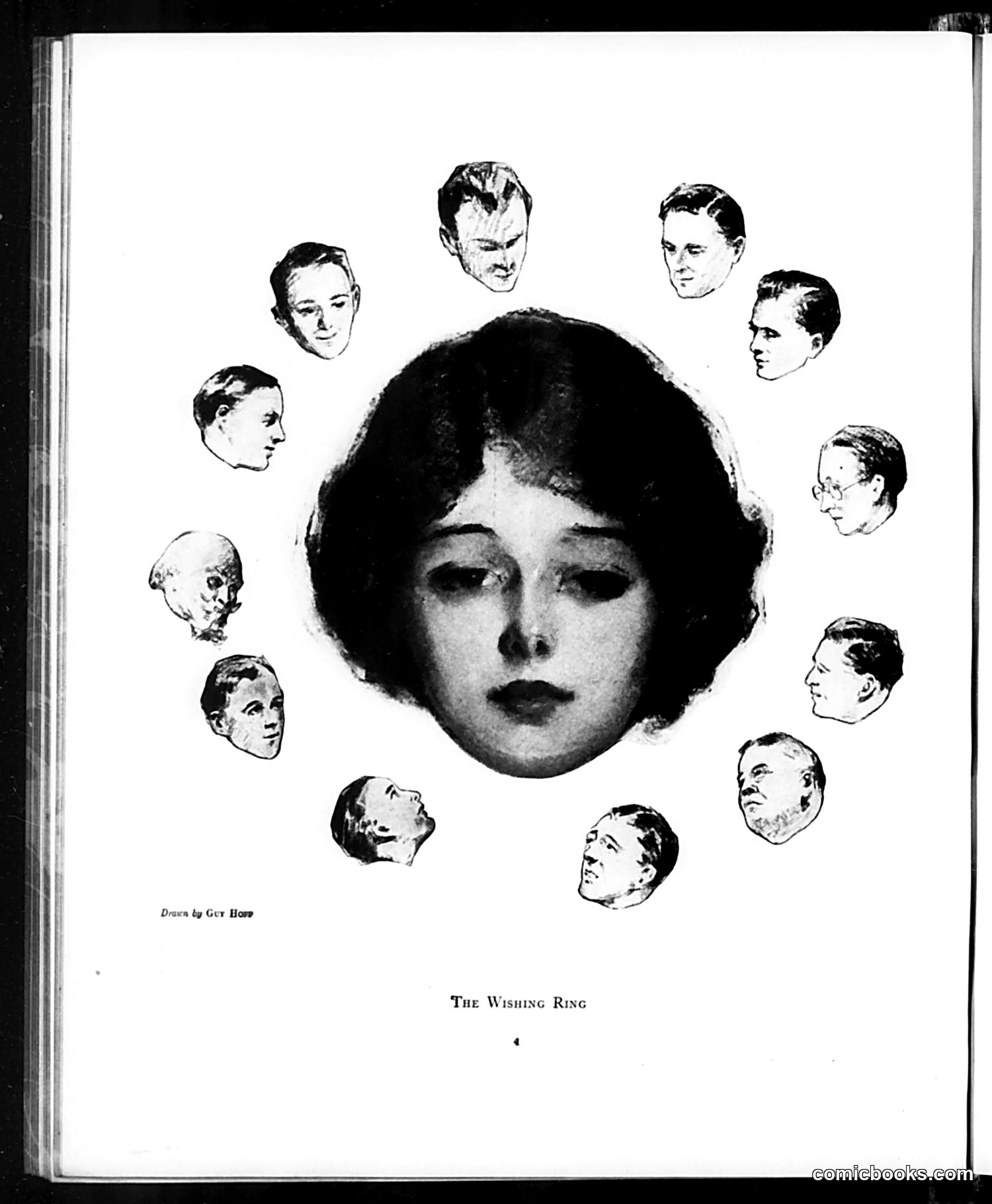
This illustration by Guy Howe depicts a woman's face surrounded by twelve male heads in a circular arrangement, titled "The Wishing Ring." The image appears to reference a romantic or matrimonial fantasy—the "wishing ring" likely alludes to the folklore concept of wishes coming true. The central female face suggests a woman surrounded by potential suitors or romantic options, typical of Judge magazine's satirical commentary on courtship and marriage customs of the early 20th century. The varying expressions and head angles of the surrounding men suggest different "types" or prospects. The satire likely mocks either women's romantic aspirations, the abundance of available men vying for attention, or contemporary courtship conventions. Without additional context about whether these represent specific public figures or simply generic "types," the precise satirical target remains unclear, though the overall theme addresses gender relations and romance.
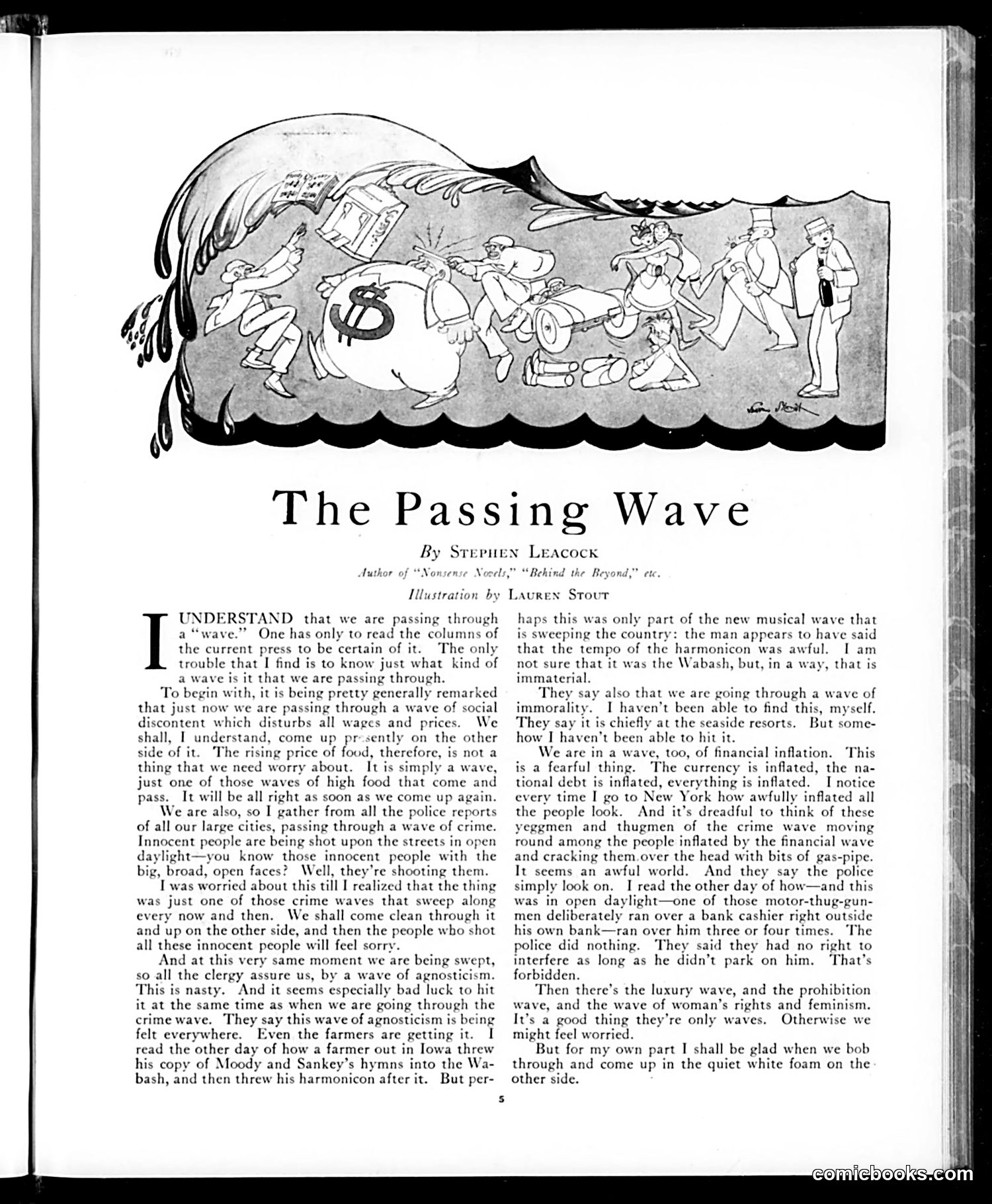
This satirical essay uses the metaphor of successive "waves" sweeping through society to critique multiple contemporary concerns. The author identifies several waves affecting America: crime waves (with innocent people shot in streets), waves of financial inflation and national debt, a luxury wave, prohibition, and women's rights/feminism. The illustration depicts these various social upheavals as literal waves, with figures being swept along. Leacock's tone is resigned and darkly humorous—suggesting these are inevitable social phenomena that come and go, each disruptive in its own way. He portrays the public as helplessly caught between them, noting that people simply "look on" passively while chaos occurs around them. The essay reflects early 20th-century anxieties about rapid social and economic change.
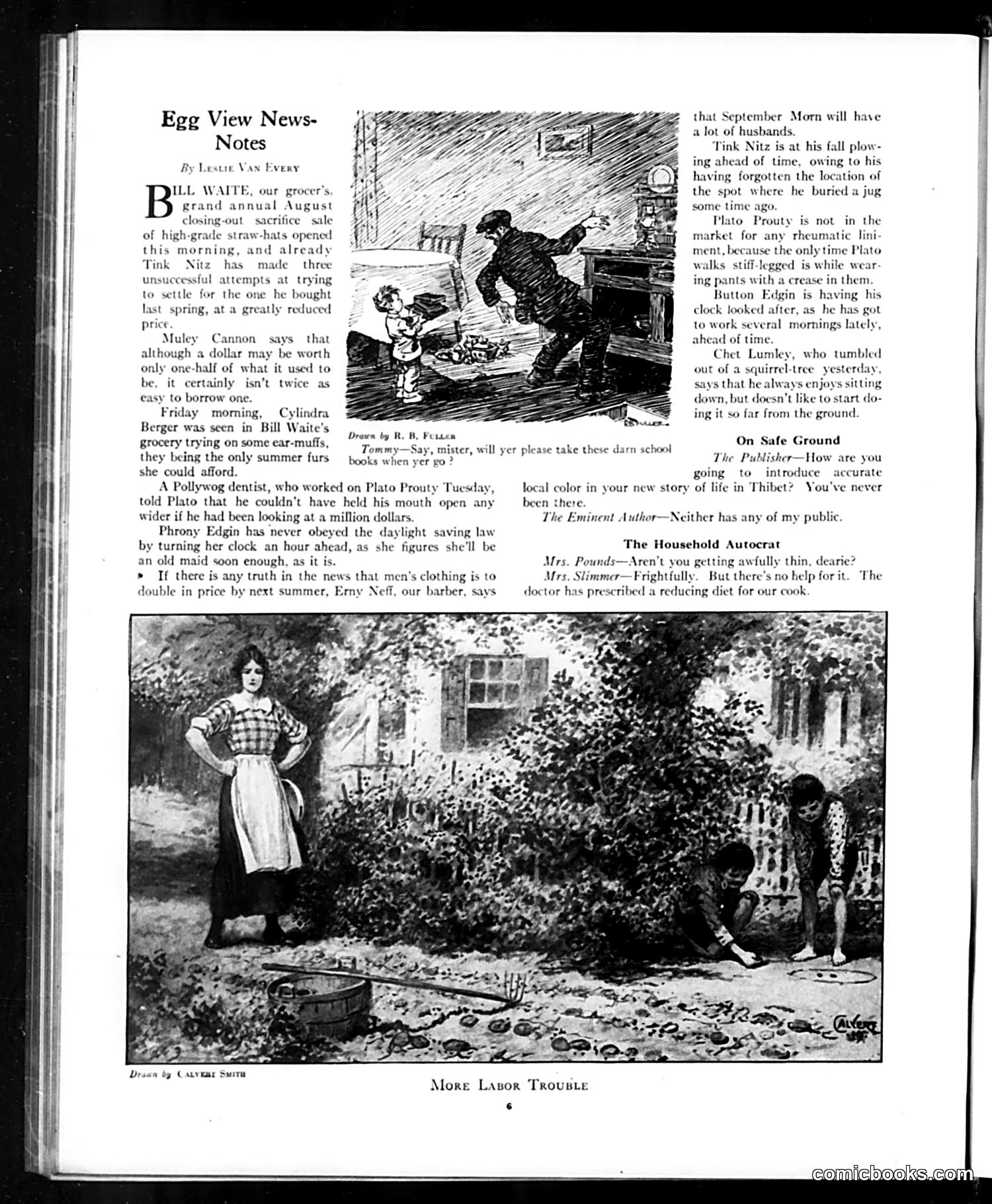
This page contains two distinct sections: **"Egg View News-Notes"** (top): A gossip column by Leslie Van Every about local Egg View personalities—Tink Nitz, Muley Cannon, Cylindra Berger, and others. It's small-town chitchat about straw-hat sales, dental work, and summer fur storage. No political content. **"More Labor Trouble"** (bottom cartoon): Drawn by Clarence Smith, shows a woman supervising children working in a garden, harvesting vegetables. The title suggests satire about labor disputes and child labor—likely mocking either labor complaints or the domestic "labor" of household management. The humor appears to hinge on redefining children's garden work as "labor trouble," trivializing actual labor concerns through domestic analogy. The page is primarily social humor with light satire rather than political commentary.
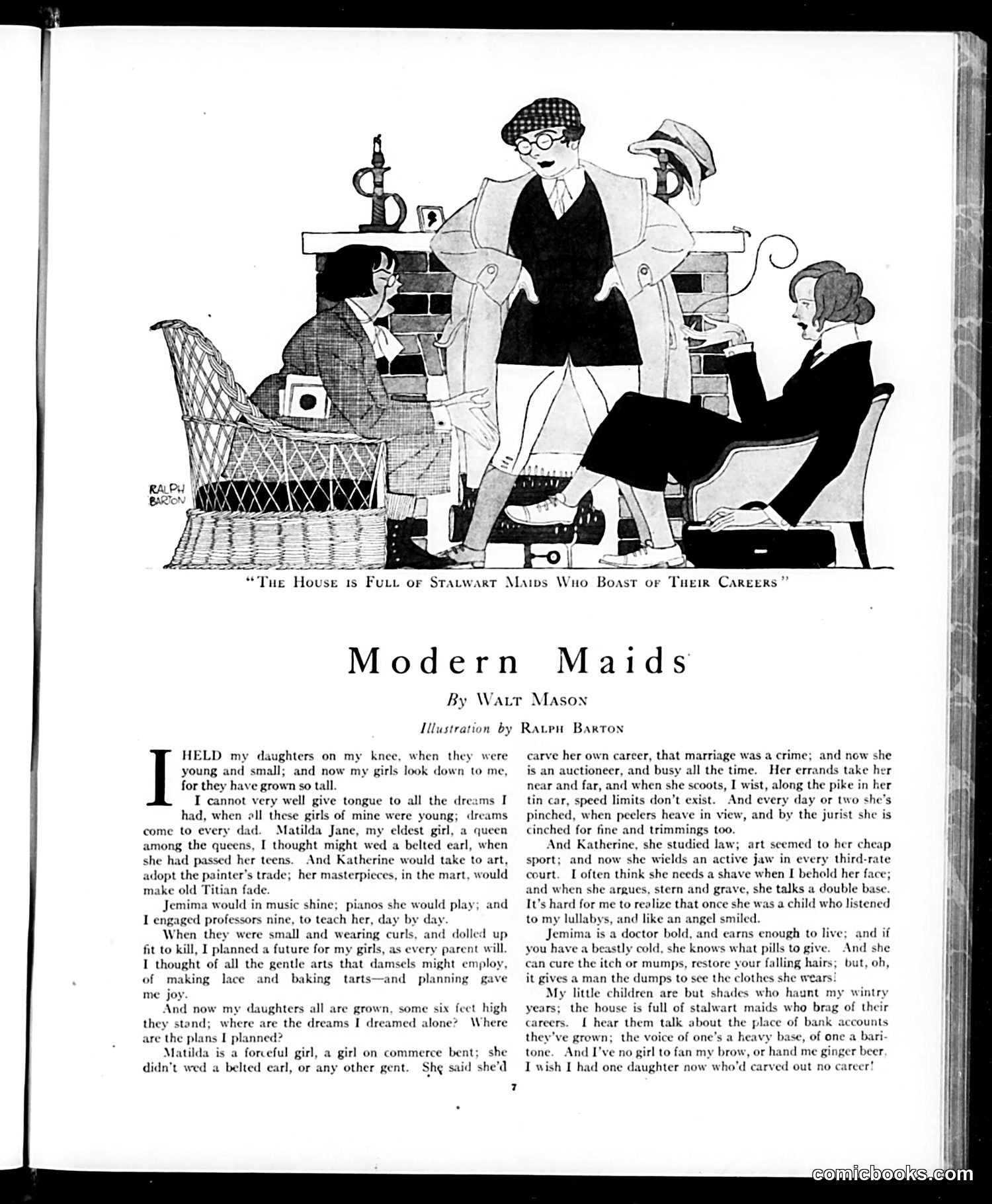
This 1920s-era satirical piece lambastes the "New Woman" phenomenon. The narrator, a nostalgic father, mourns his daughters' rejection of traditional domesticity. Instead of marrying well or becoming refined artists, they've pursued careers: Matilda is an aggressive auctioneer who speeds in a car and gets arrested; Katherine studies law and argues in court (the joke implies she's mannish); Jemima, a doctor, wears unfeminine clothing. The satire mocks both the daughters' independence and the father's outdated expectations. The irony: he once dreamed his daughters would excel—but only in "feminine" arts (music, painting, needlework). Now that they've achieved genuine professional success and self-sufficiency, he's dismayed they won't fan his brow or serve him. The cartoon lampoons anxieties about female emancipation while simultaneously exposing how limited—and servile—previous generations' "dreams" for women truly were.
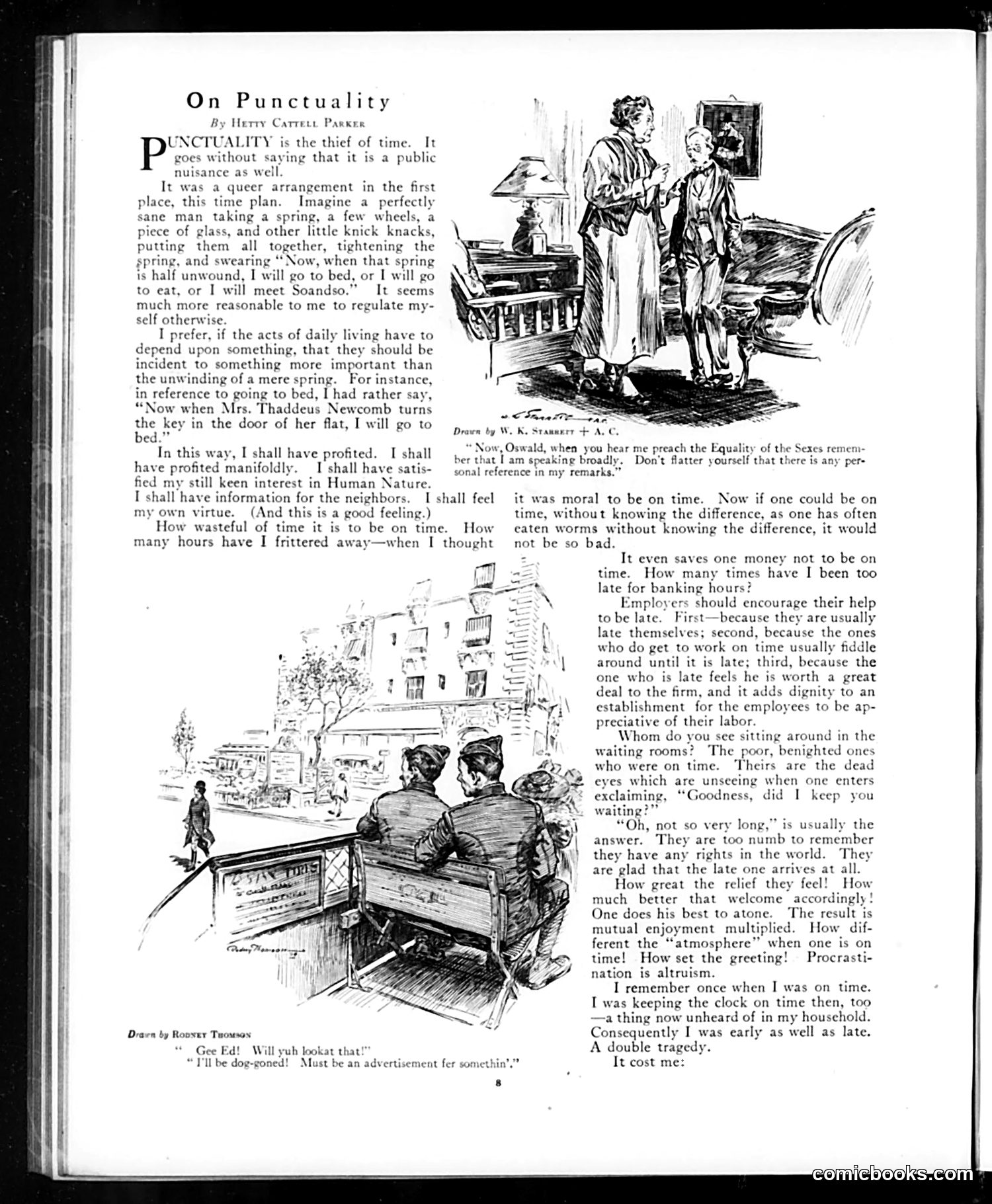
This is a humorous essay satirizing the obsession with punctuality in modern society. Parker argues provocatively that **being late is actually virtuous and beneficial**, inverting conventional wisdom about timeliness. The satire works by: 1. **Mocking the absurdity of clock-based living**: Parker ridicules the idea that a mechanical spring should dictate human behavior—a critique of industrialization's regimentation of daily life. 2. **Social commentary on class and power dynamics**: The cartoon showing waiting-room occupants illustrates Parker's point that only the poor and powerless arrive on time; the wealthy arrive late and are still warmly welcomed, suggesting punctuality demands reflect class hierarchies. 3. **Praising procrastination as altruism**: The essay's paradoxical conclusion—that lateness shows consideration and builds better relationships—is obviously tongue-in-cheek mockery of justifications people use to excuse tardiness. The accompanying illustrations by Robert Thomson show typical scenes of punctuality's supposed victims: the punctual waiting anxiously, and the late arrival being joyfully greeted.
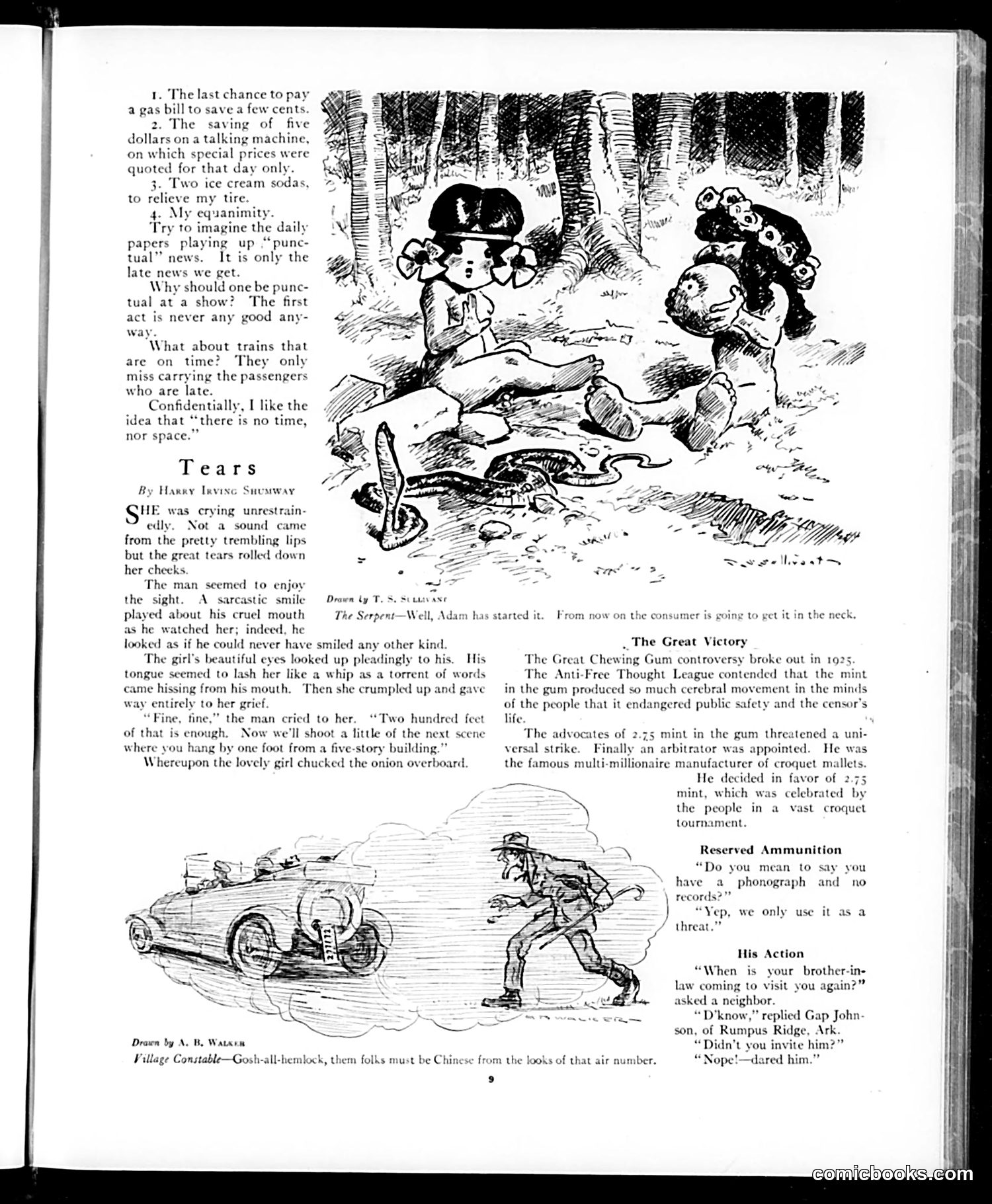
This page contains satirical humor typical of 1920s Judge magazine: **Top section** ("numbered list"): Cynical observations about modern life—people rushing to save pennies on bills, chasing sales, and losing peace of mind. The joke critiques American consumer anxiety. **"Tears" story with illustration**: A film director manipulating an actress's genuine emotional breakdown for a scene, then casually demanding she continue. It satirizes Hollywood's callous exploitation of performers. **"The Great Victory"**: A mock-serious account of a 1925 controversy over mint gum allegedly causing "too much cerebral movement," settled by a croquet-mallet manufacturer. This appears to mock both moral panic about consumer products and absurd arbitration. **Bottom illustrations and brief jokes**: Standard period humor about phonographs as status symbols, rural characters, and family dynamics. The overall tone reflects Jazz Age skepticism toward progress, commercialism, and authority—characteristic of Judge's satirical approach to contemporary American society.
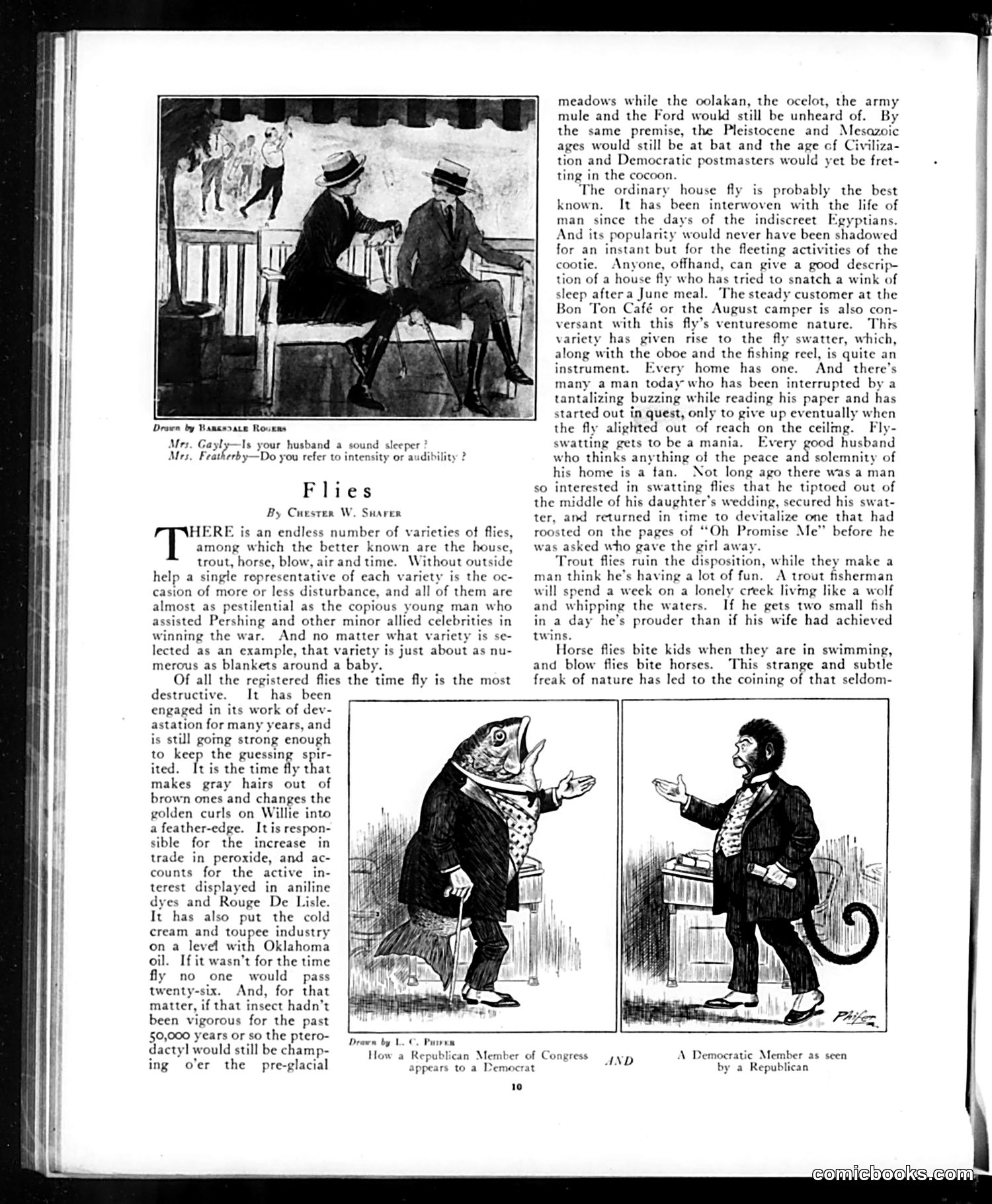
This article by Chester W. Shaver is a humorous essay on flies, using them as vehicles for social commentary. The page contains two distinct political cartoons at the bottom. **The cartoons:** Both drawings depict exaggerated caricatures of congressmen from opposing parties. The left cartoon shows "How a Republican Member of Congress appears to a Democrat"—depicting the Republican as fish-like and grotesque. The right shows "A Democratic Member as seen by a Republican"—portraying the Democrat as simian and crude. These are partisan attack cartoons using crude physical caricature, typical of *Judge* magazine's satirical approach to politics. **The essay's point:** Shaver uses different fly varieties as metaphors. The "time fly" (the passage of time) humorously explains aging, vanity, and human preoccupation with appearance. References to "Pershing" (General John Pershing, WWI commander) and complaints about "Democratic postmasters" indicate this is post-WWI political content, likely from the early 1920s. The overall effect is lighthearted social satire wrapped in entomology.
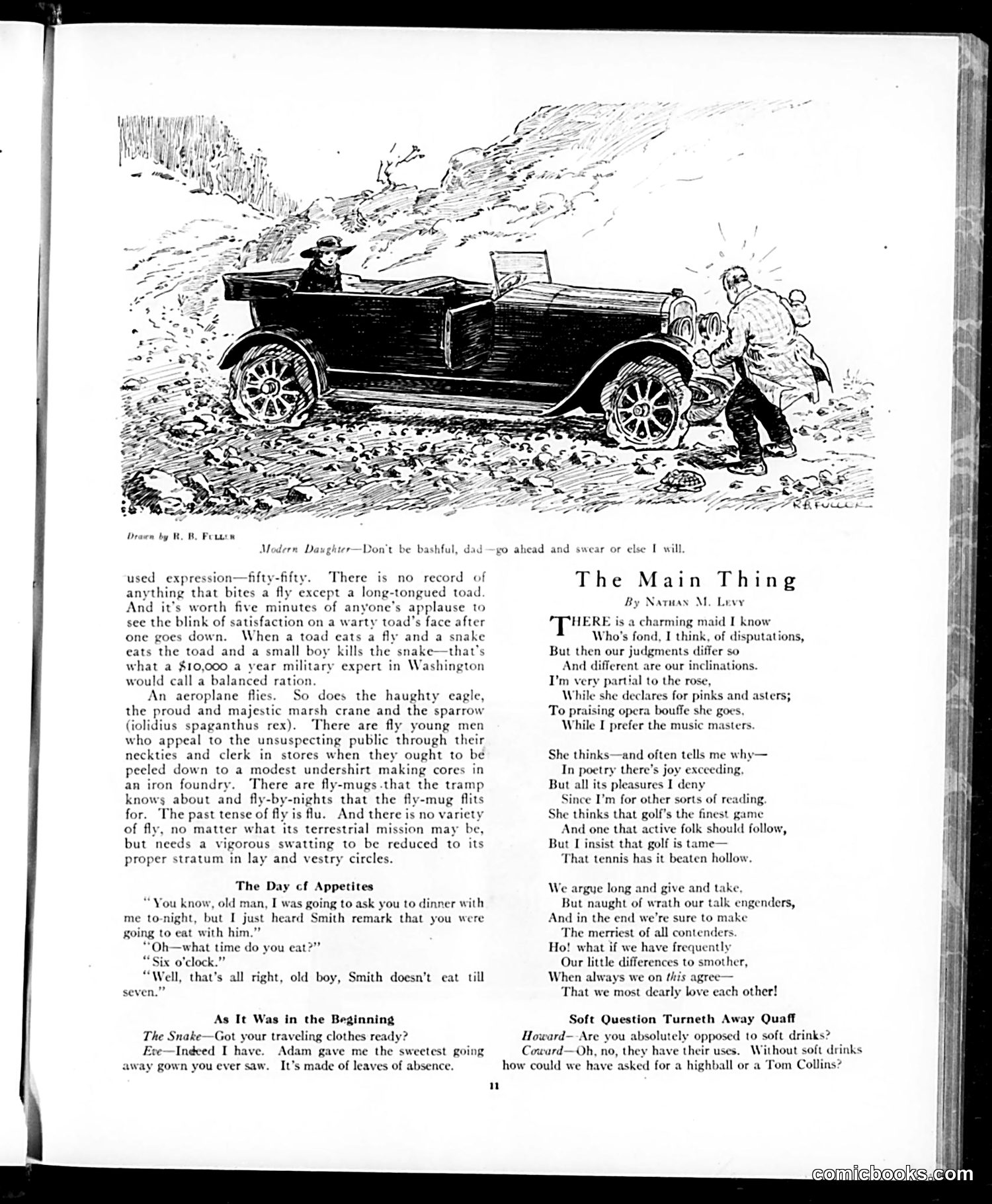
**The Cartoon:** The illustration depicts a car stuck on a muddy mountain road with a driver and two men pushing. The caption reads: "Modern Daughter—Don't be bashful, dad—go ahead and swear or else I will." This is satirizing the "modern woman" of the early 20th century—specifically, a daughter challenging her father's authority and traditional gender roles by threatening to use profanity herself if he doesn't. The joke targets changing social mores where younger women were rejecting Victorian propriety. **The Text:** The page contains three humorous dialogues and a poem mocking contemporary social attitudes: - "The Day of Appetites" jokes about social climbing - "As It Was in the Beginning" makes a biblical pun about Eve's departure with "leaves of absence" - "Soft Question Turneth Away Quaff" puns on temperance debates by suggesting soft drinks are merely pretexts for ordering cocktails Overall, the page satirizes modern social conventions, generational conflict, and changing attitudes toward propriety and consumption.
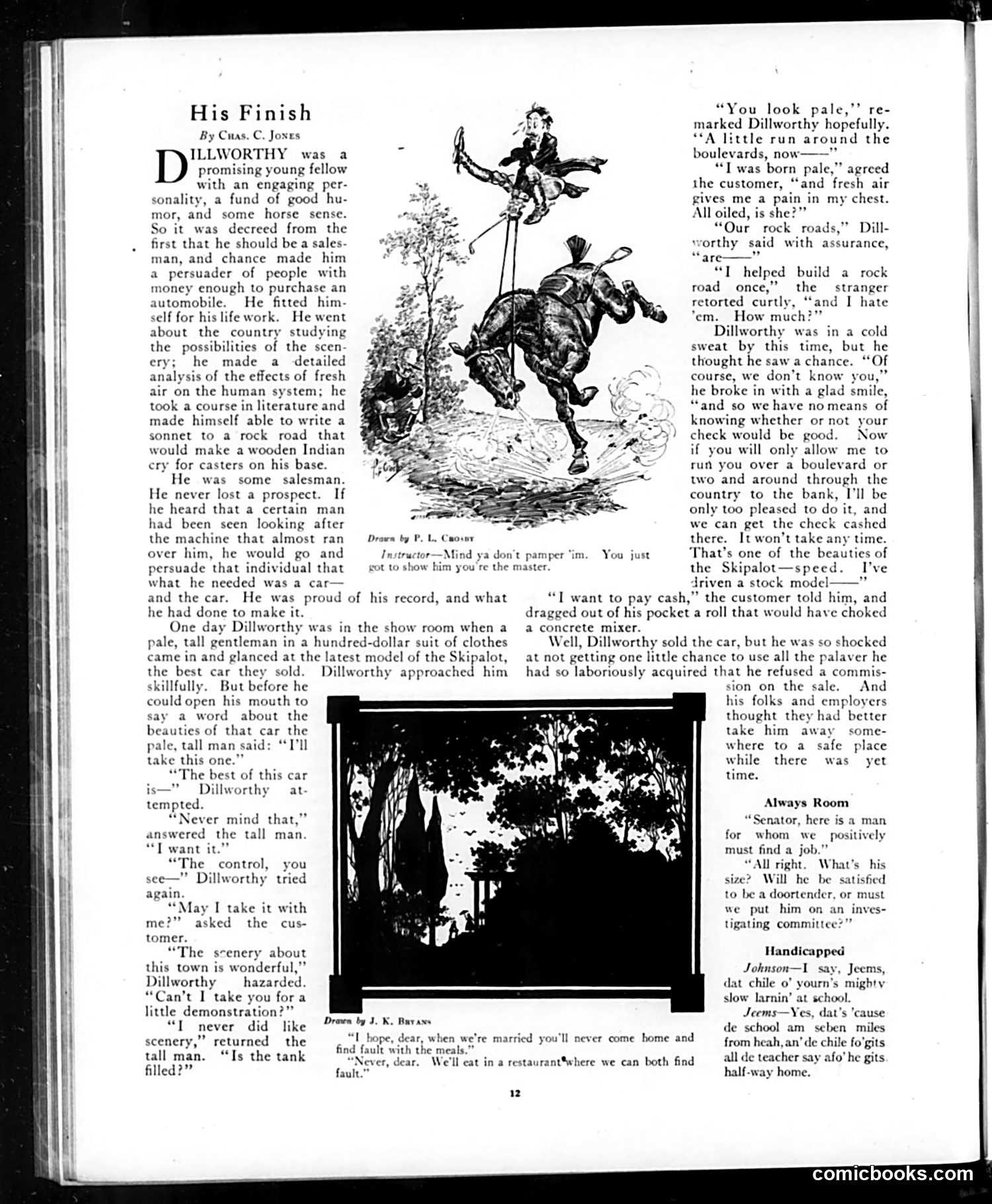
This story satirizes an overeager automobile salesman named Dillworthy who has perfected the art of persuasion through prepared pitches about scenery, fresh air, and road conditions. His comeuppance arrives when a wealthy customer simply walks in, declares "I'll take this one," and wants to buy immediately—with cash. Dillworthy is devastated. He's prepared elaborate sales techniques about rock roads, boulevards, and automotive features, but this customer wants none of it. The customer refuses every attempted demonstration, won't listen to benefits, and just wants the car. Dillworthy is so shocked at being denied his chance to deploy his carefully-honed verbal skills that he refuses his commission. The satire mocks salesmen who become so invested in their own rhetorical performance that they lose sight of the actual goal—closing the sale. The irony: Dillworthy "never lost a prospect," yet loses his composure when a prospect makes his job effortless.
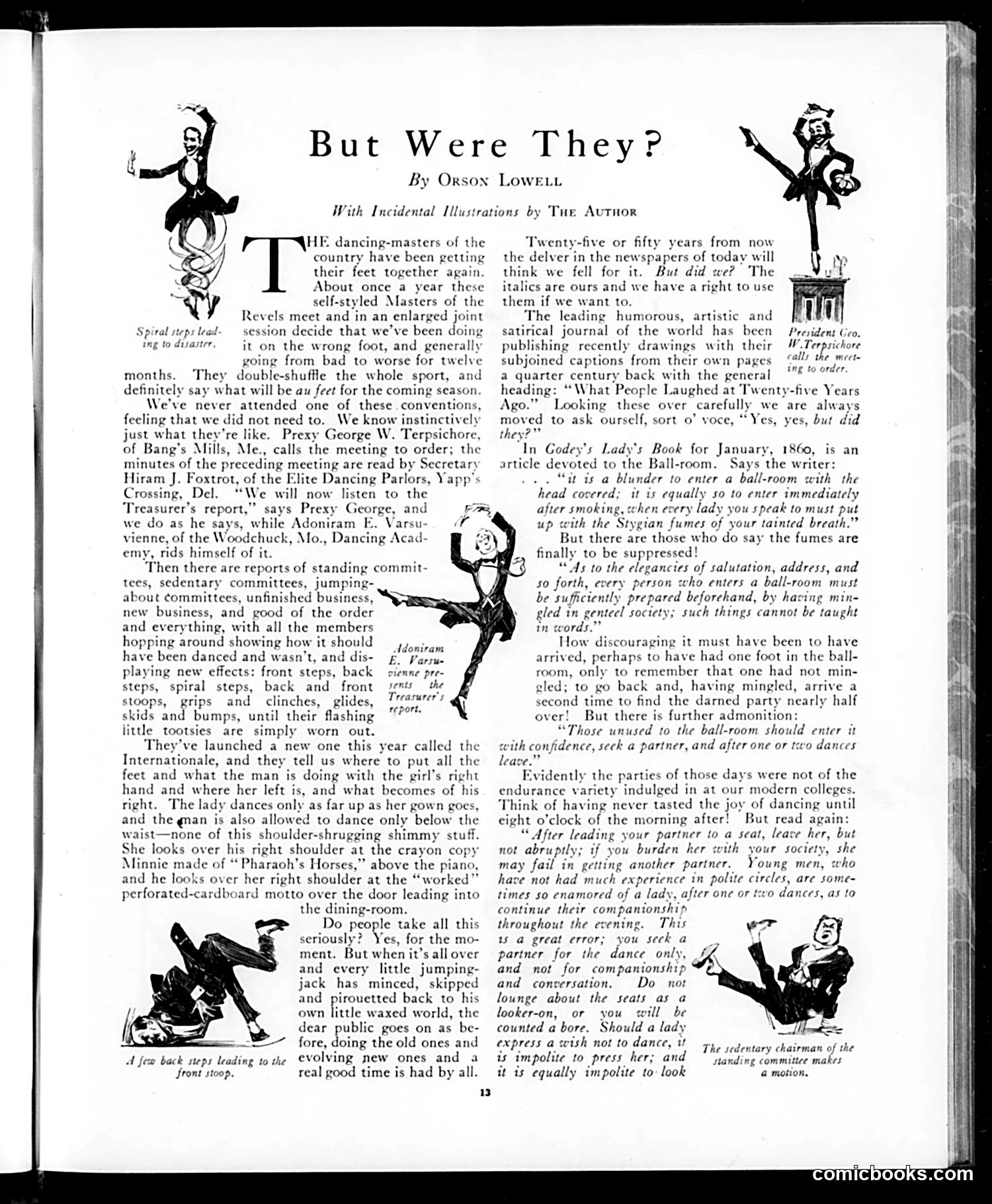
This article satirizes dancing masters and their annual conventions. Lowell mocks the pretentious ritualism of professional dance instructors who meet yearly to decree what dance steps will be "au feet" (fashionable) for the coming season—complete with absurdly formal procedures, committee reports, and demonstrations of new steps like "the Internationale." The satire's central joke: these conventions are taken seriously *during* the moment, but afterward the general public ignores the prescribed rules and simply dances as it always has, "doing the old ones and evolving new ones." Lowell questions whether people ever truly followed these mandates, using earlier historical references (Godey's Lady's Book from 1860) to suggest that past generations likely ignored such etiquette pronouncements just as contemporary readers do. The illustrations show dancing masters performing various exaggerated steps and maneuvers, emphasizing the physical comedy of their solemnity.
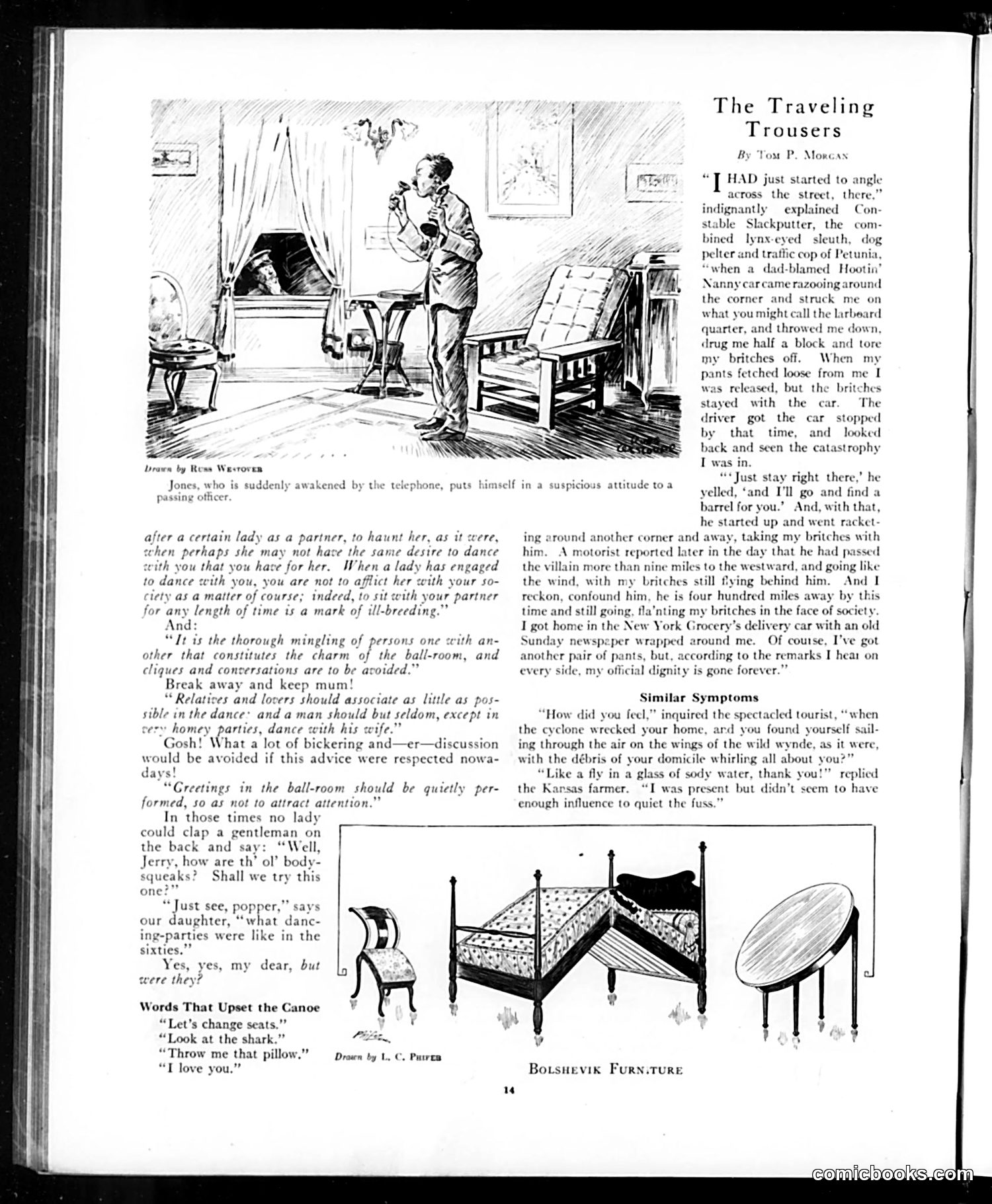
This page from *Judge* contains two distinct humor pieces: **"The Traveling Trousers"** (main story): A humorous anecdote by Yost P. Morgan about a pedestrian struck by a car driven recklessly by someone called "Hootin' Nanny." The impact tears off his pants, which remain in the speeding vehicle as it vanishes nine miles away. The joke satirizes early automobile culture—the recklessness of drivers, the absurdity of losing one's dignity literally to modern technology, and small-town gossip about the incident destroying the narrator's official standing. **Etiquette excerpt and commentary**: The page also mocks outdated Victorian ballroom rules (partners shouldn't sit together, relatives shouldn't dance together, greetings must be quiet) by noting how much "bickering" modern society would avoid if such advice were followed—implying contemporary manners are chaotic by comparison. **"Bolshevik Furniture" cartoon**: Crude drawings of unstable, collapsing furniture with the caption suggesting Russian (Bolshevik) manufacture is poor quality—Cold War-era anti-communist satire mocking Soviet products. The overall tone ridicules modern life's chaos, outdated propriety, and communist manufacturing.
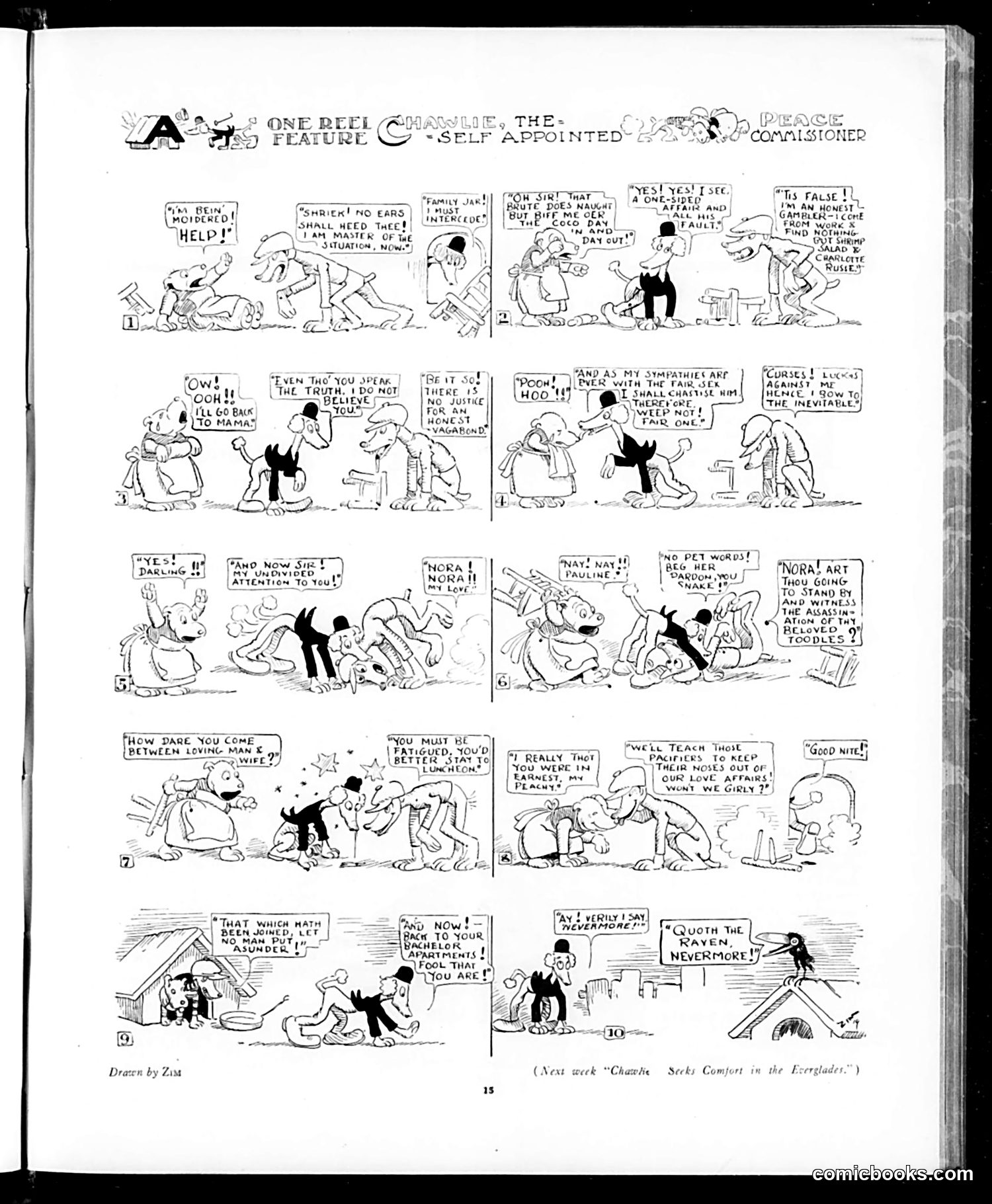
This comic strip satirizes marital conflict resolution and domestic interference. The narrative follows a "self-appointed peace commissioner" (a busybody character) attempting to mediate between a quarreling couple. The satire mocks: 1. **Naive intervention**: The commissioner pompously declares himself "master of the situation" while everything spirals into chaos. 2. **Contradictory advice**: He offers platitudes ("speak the truth," "be fair") that backfire when the couple actually takes him seriously, escalating their conflict. 3. **Domestic authority**: The joke hinges on the irony that an outsider confidently presumes to govern private marital disputes, citing fake legal/moral authority ("Quoth the Raven, Nevermore!"). 4. **Social meddling**: The final panel suggests the commissioner's interference has made things worse—the wife has taken a lover, and he watches the "assassination" of the marriage unfold. The humor targets overconfident busybodies who insert themselves into others' private affairs while possessing no actual wisdom or standing. The Poe reference reinforces the absurd pretension of the "commissioner."
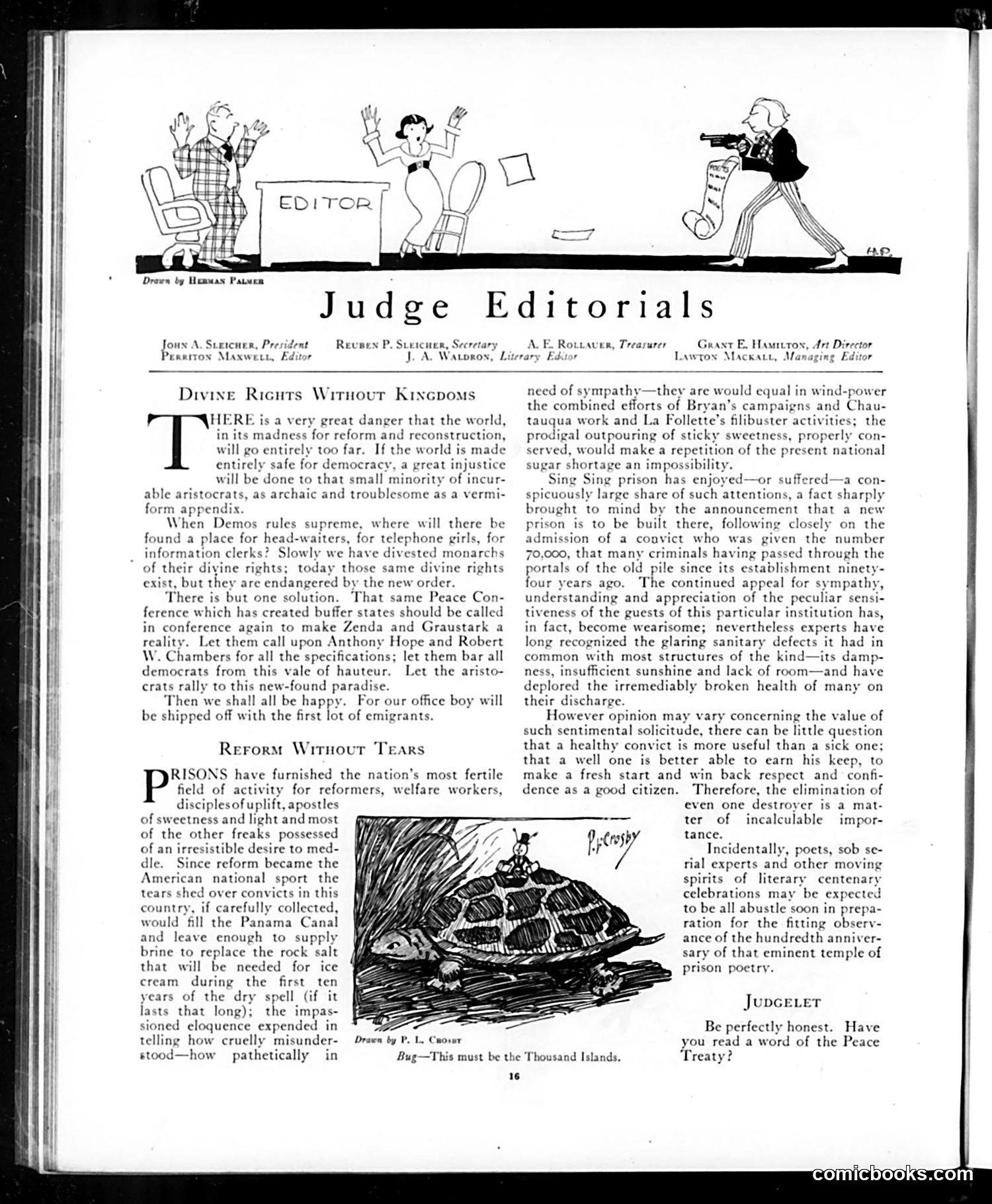
This page contains two satirical editorials with accompanying cartoons: **"Divine Rights Without Kingdoms"** mocks progressive reform movements. The editorial sarcastically argues that democratization threatens a "small minority of incurable aristocrats" (head-waiters, telephone girls) who need "divine rights." It suggests creating fictional aristocratic kingdoms like those from Anthony Hope novels as refuge. The satire targets both elites clinging to hierarchical privilege and perhaps overzealous reformers. **"Reform Without Tears"** critiques prison reform advocacy. It ridicules the emotional appeals made by welfare workers and "uplift" activists who sympathize with convicts, sardonically claiming their collective tears could fill the Panama Canal. However, the editorial concedes that actual prison conditions (poor sanitation, dampness, cramped quarters) genuinely harm inmates' health and rehabilitation—so reform has practical merit despite reformers' sentimental rhetoric. The page's top cartoon shows an editor being "shot" with papers, depicting chaotic editorial work. The bug cartoon illustrates the "Thousand Islands" salad dressing, likely a contemporary reference.
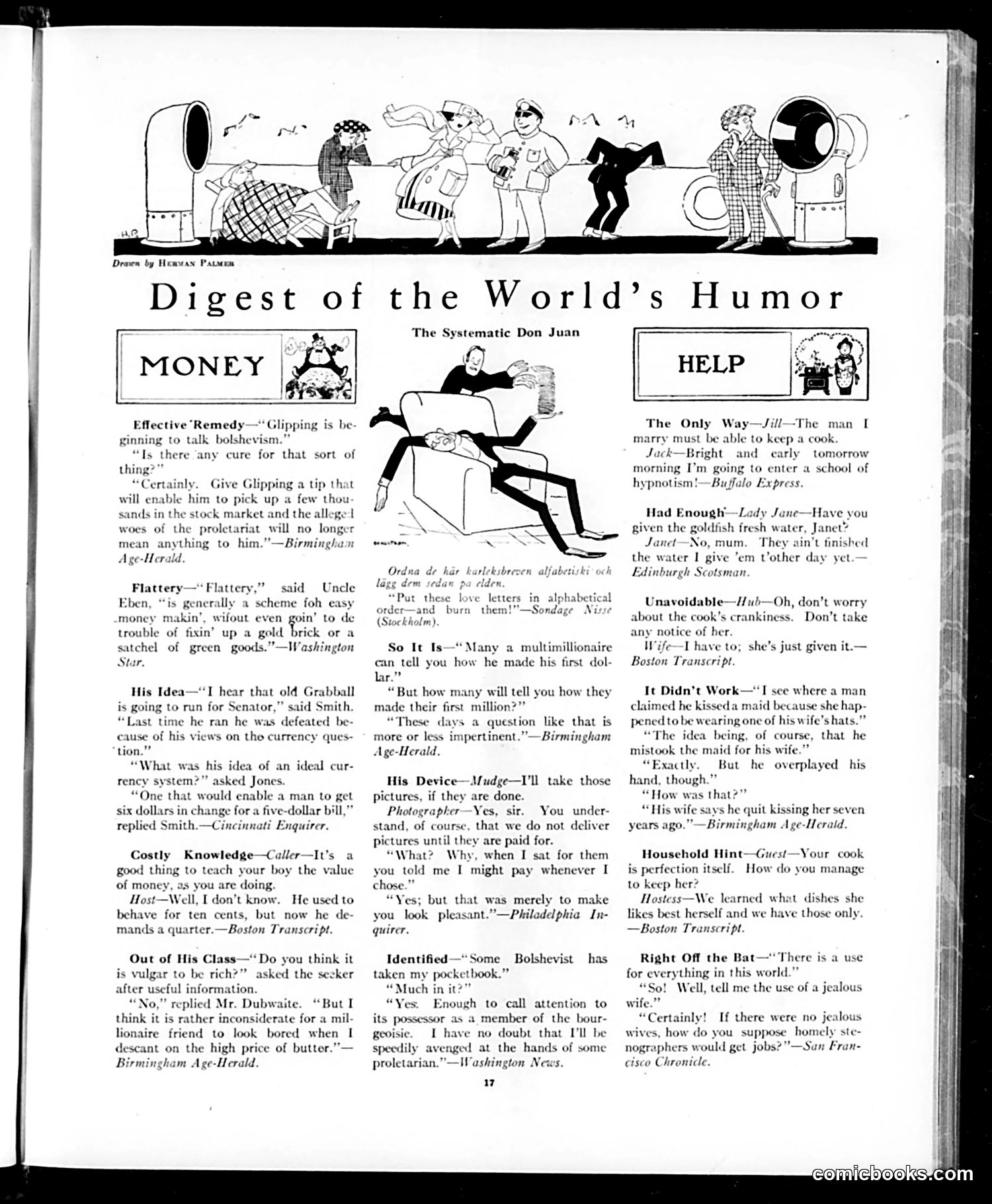
This page collects brief satirical jokes organized by topic (Money, Help, etc.), drawn by Herman Palmer. The humor targets early 20th-century social anxieties: **Money section** mocks wealth and greed: a "cure" for Bolshevism is stock-market profits; a politician's ideal currency lets you profit through fraud; inflation means children now demand quarters instead of dimes for good behavior. **Help section** uses domestic humor: wives complaining about cooks and servants; a man caught kissing a maid (his wife's hat) overplays his excuse; a "systematic Don Juan" organizing seduction efforts alphabetically. **Notable references**: "Bolshevism" appears twice, reflecting post-WWI anti-communist anxiety. The humor assumes readers recognize class anxieties (millionaires, servants, stenographers) and marital discord as relatable comedy. The top illustration shows vaudeville-style characters, reflecting Judge's entertainment-focused audience. Overall, this represents genteel, middle-class satire aimed at readers concerned with propriety, wealth, and domestic management.
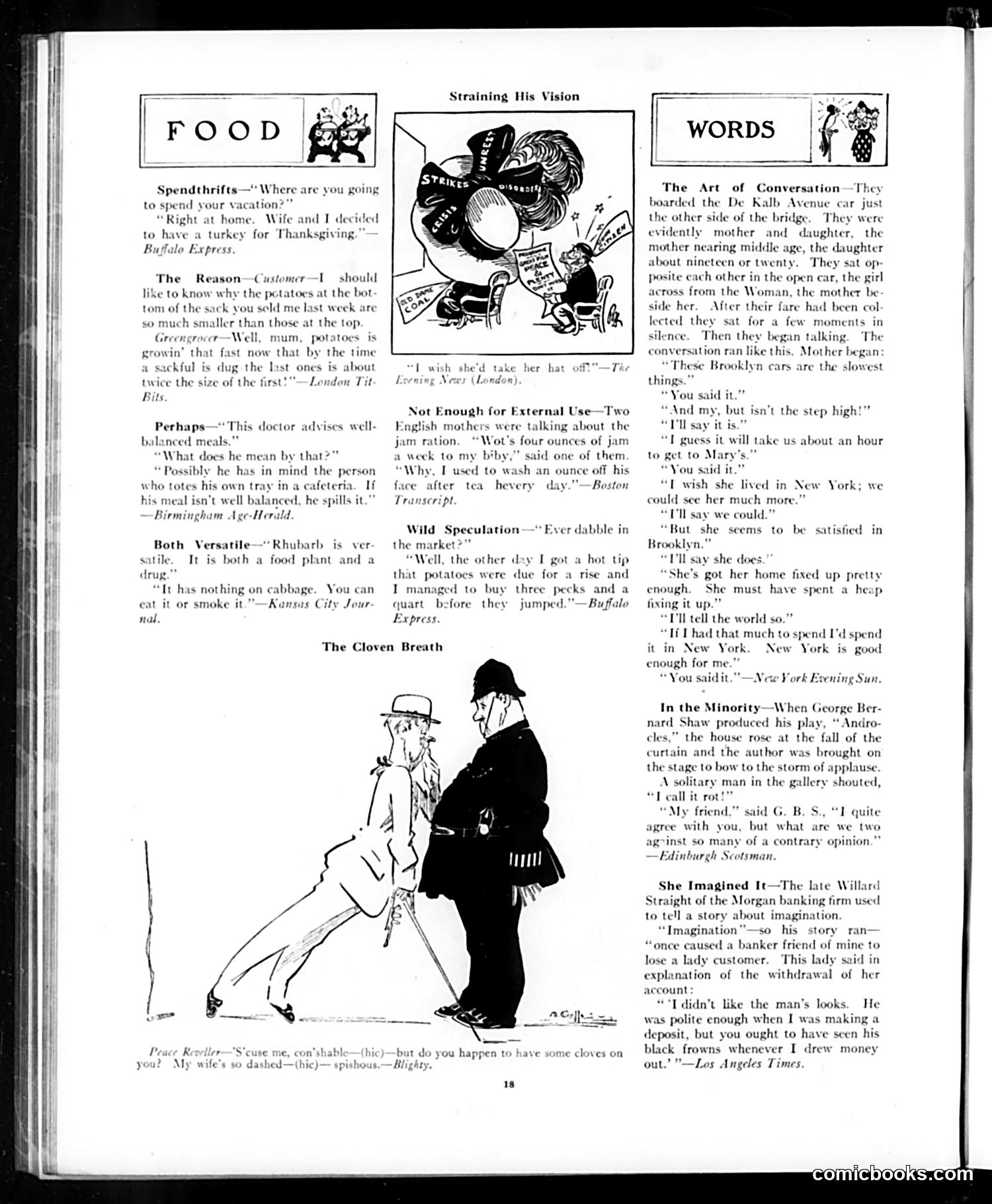
This page contains satirical commentary on wartime rationing and social observations, likely from WWI era (suggested by British rationing references). **The Food Section** mocks wartime shortages and profiteering through anecdotes—a grocer explaining potatoes shrink during harvest, a doctor's balanced meal advice, and British mothers discussing jam rations so meager they formerly used it for washing. **"Straining His Vision"** (center cartoon) depicts a man squinting, likely commentary on eyestrain or difficulty seeing clearly—possibly metaphorical for wartime confusion. **The Cloven Breath** shows two men, one clearly intoxicated ("hic"), joking about cloves masking alcohol breath—a prohibition-era joke about hiding drinking. **The Words Section** collects anecdotes about conversation, Bernard Shaw's theatrical success despite one heckler, and a banking story about a woman's unfair judgment based on a banker's appearance. The overall tone: gently mocking wartime scarcity, class observations, and human foibles during economic constraint.
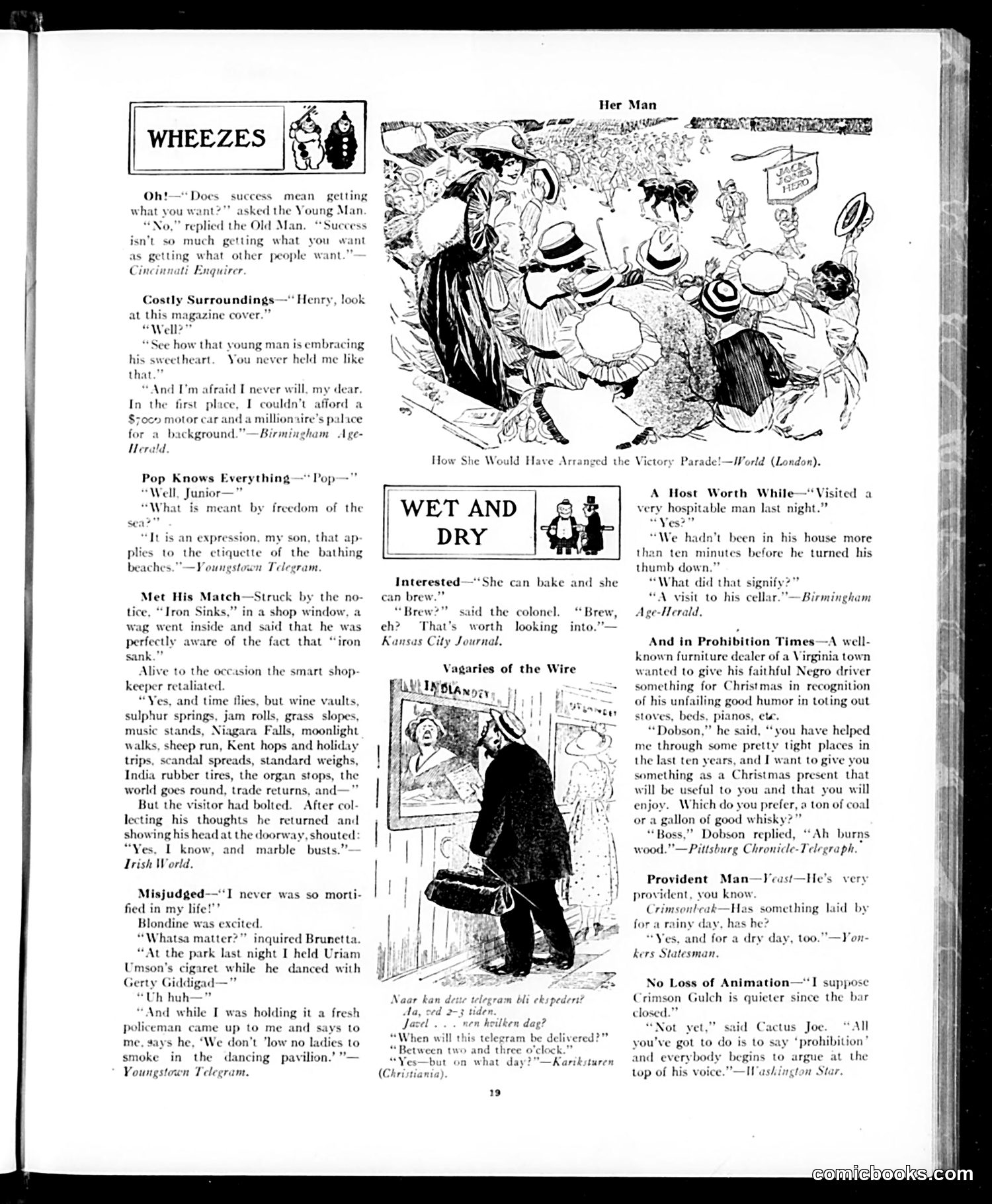
This page collects brief humorous anecdotes ("Wheezes") reflecting early 20th-century American social attitudes. **Key satirical points:** - **"Costly Surroundings"**: Mocks consumerism and social climbing—a man cannot afford romantic gestures without a "$700 motor car" and mansion as props. - **"Met His Match"**: Plays on literal interpretation; a shopkeeper's sign advertising "Iron Sinks" attracts a customer looking for actual sinks. - **"Wet and Dry"**: References Prohibition-era tensions. A colonel finds "brewing" interesting (legal home fermentation was debated), while dialogue about visiting a cellar carries double meaning regarding hidden alcohol. - **"Prohibition Times"**: Directly addresses Prohibition enforcement; a white employer offers his Black servant either coal or whisky as a Christmas gift—the servant chooses whisky, satirizing both the absurdity of Prohibition and racial dynamics of the era. - **"No Loss of Animation"**: Suggests Prohibition's failure; despite bar closures, people still argue passionately about "prohibition" itself. The humor reflects Jazz Age anxieties about changing morality, class aspiration, and Prohibition's unpopular enforcement.
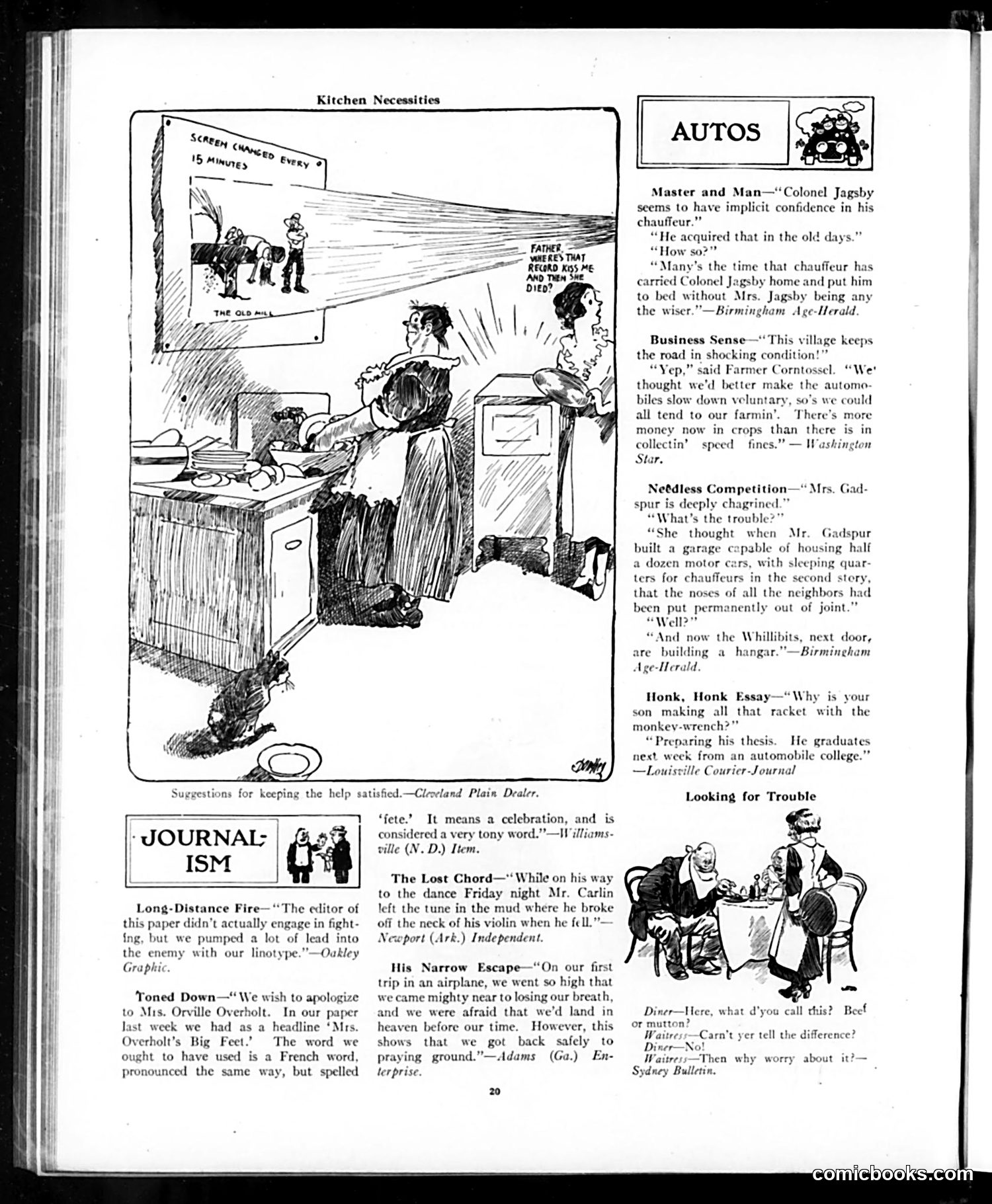
This page contains satirical commentary on early automobile culture and newspaper humor. The main cartoon depicts a kitchen scene where a woman manages domestic help, captioned with advice on "keeping the help satisfied"—satirizing the tension between employers and servants during this era. The "AUTOS" section collects brief jokes about automobiles and their social impact. Key themes include: chauffeurs as long-suffering servants (the Colonel Jagsby anecdote), farmers viewing cars as road hazards disrupting agriculture, and wealthy neighbors competing over garage size. The "automobile college" joke mocks the new vocational training emerging around cars. The "JOURNALISM" section ridicules newspaper errors and exaggerations—editors boasting about using weapons as metaphors, apologizing for insulting headlines through French euphemism, and reporting absurdly embellished stories. The final "Looking for Trouble" cartoon is a simple diner joke about indistinguishable meat quality, unrelated to automobiles. The overall tone reflects early 1900s anxieties about automobiles disrupting rural life and social hierarchies.
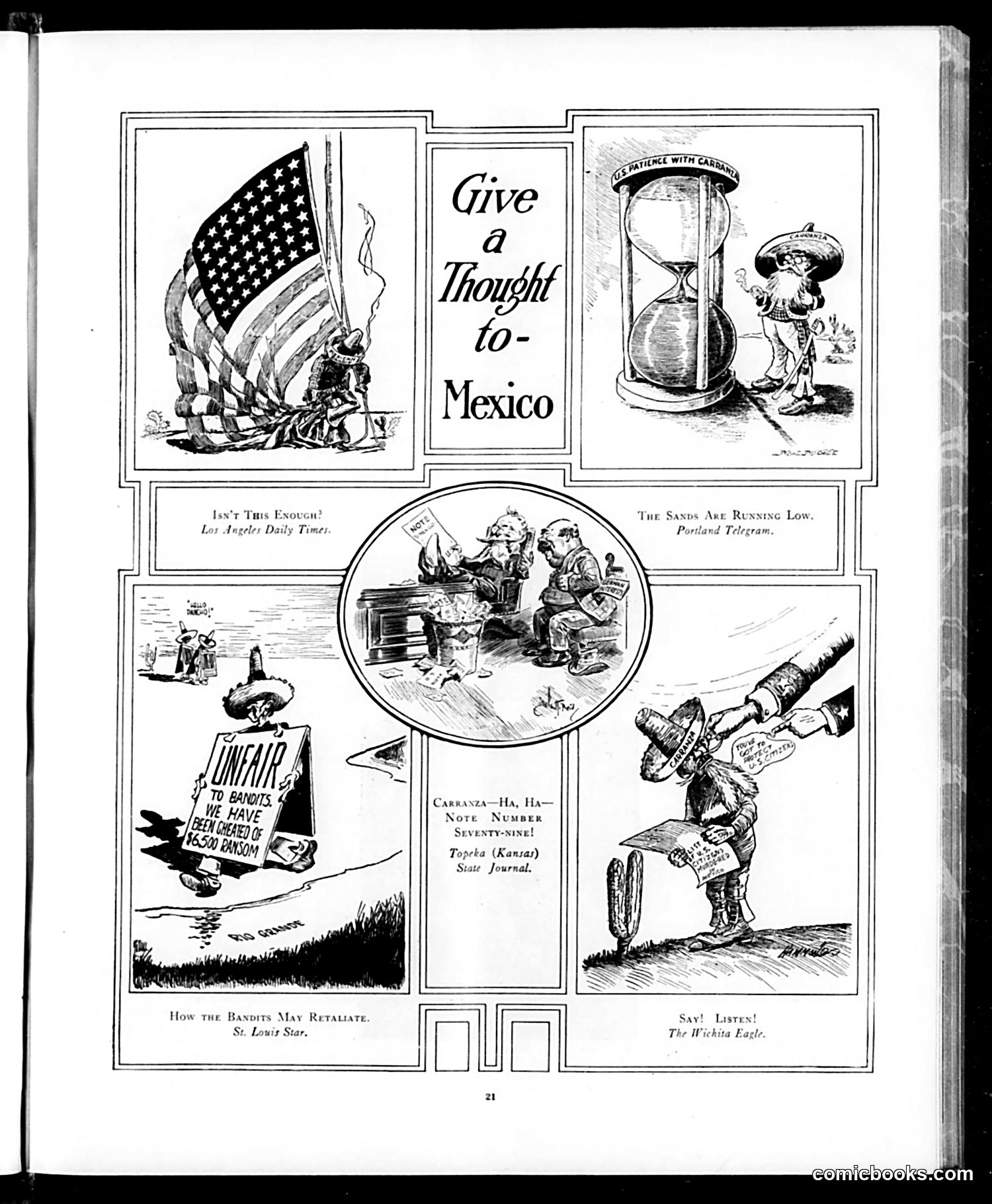
This page from *Judge* magazine addresses the Mexican Revolution and U.S. border security concerns, likely from around 1910-1920. **Main themes:** - **Top center**: "Give a Thought to Mexico"—urging American consideration of instability south of the border - **Hourglass image** (top right): References time running out, suggesting urgency - **Pancho Villa/bandits references**: The cartoons depict Mexican revolutionary figures (likely Carranza, mentioned in the central circular panel marked "Note Number Seventy-nine") as threats - **Kidnapping/ransom cartoon** (left): Shows bandits threatening American interests with "$500 RANSOM" demands - **Right panel**: A Mexican figure wielding weapons, labeled "Say! Listen!"—depicting Mexicans as violent threats **The satire's point**: These cartoons present Mexican revolutionaries as dangerous bandits threatening American citizens and property, appealing to American anxiety about border security and intervention debates of the era. The multiple newspaper attributions suggest this was widely syndicated commentary shaping public opinion against Mexican instability.
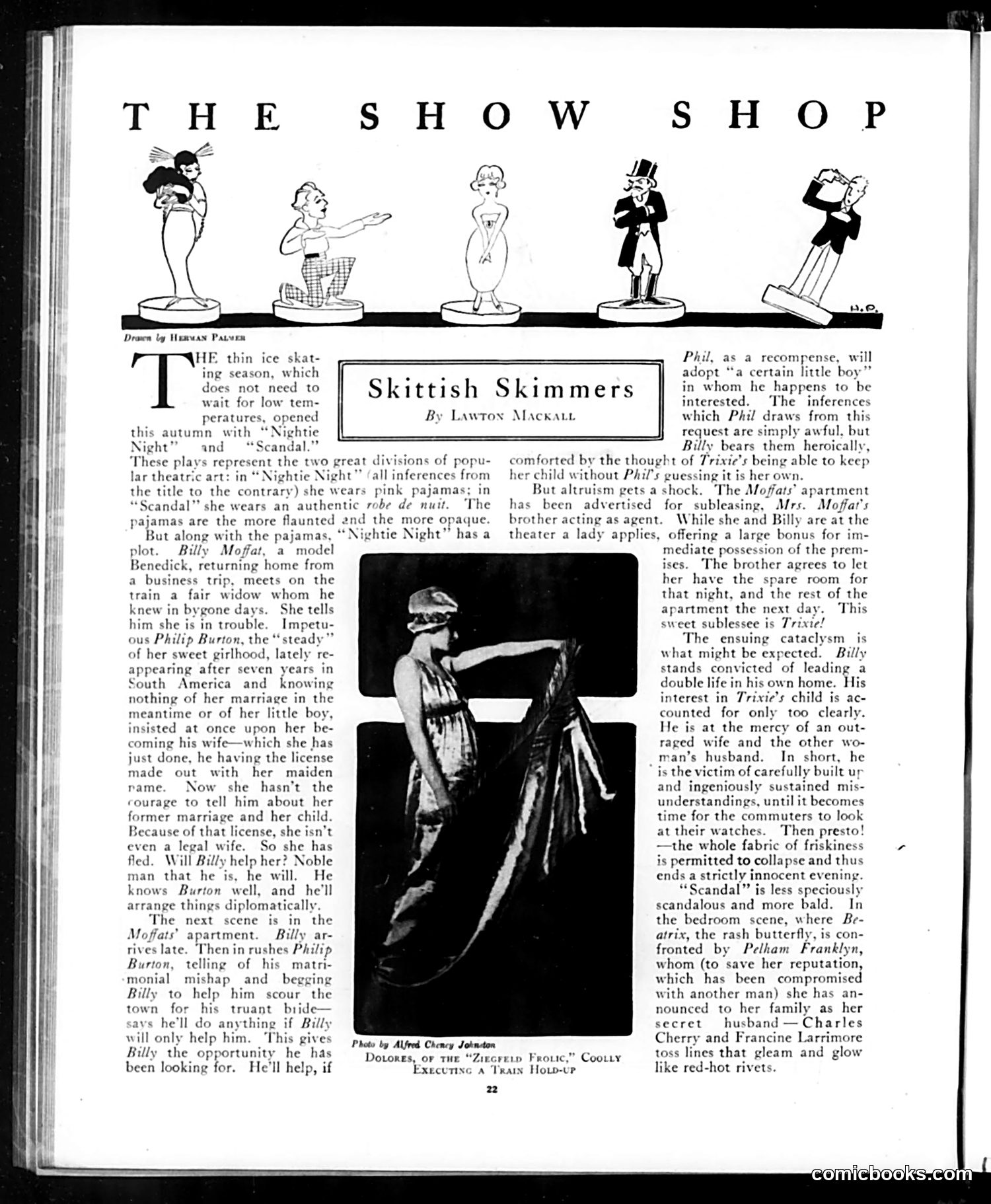
This page reviews two contemporary Broadway plays that exemplify popular theater's two genres: the bedroom farce ("Nightie Night") and the scandal melodrama ("Scandal"). **"Nightie Night"** centers on Billy Moffat, who helps a former flame (now remarried to Philip Burton) keep her illegitimate child secret. When Billy adopts the boy, misunderstandings spiral: Burton and Billy's wife assume Billy maintains a double life. The plot relies on escalating comedic confusion until the evening conveniently "ends strictly innocent." **"Scandal"** is more overtly risqué—a woman caught in a compromising situation with one man announces another man (Pelham Franklyn) as her secret husband to preserve her reputation. Both plays exploit the era's theatrical conventions: suggestive costumes (pink pajamas versus "authentic robe de nuit"), carefully orchestrated misunderstandings, and last-minute resolutions. The review gently mocks this "thin ice skating season"—implying these productions offer titillation masquerading as sophisticated comedy, relying on audience complicity in overlooking transparent moral contradictions.
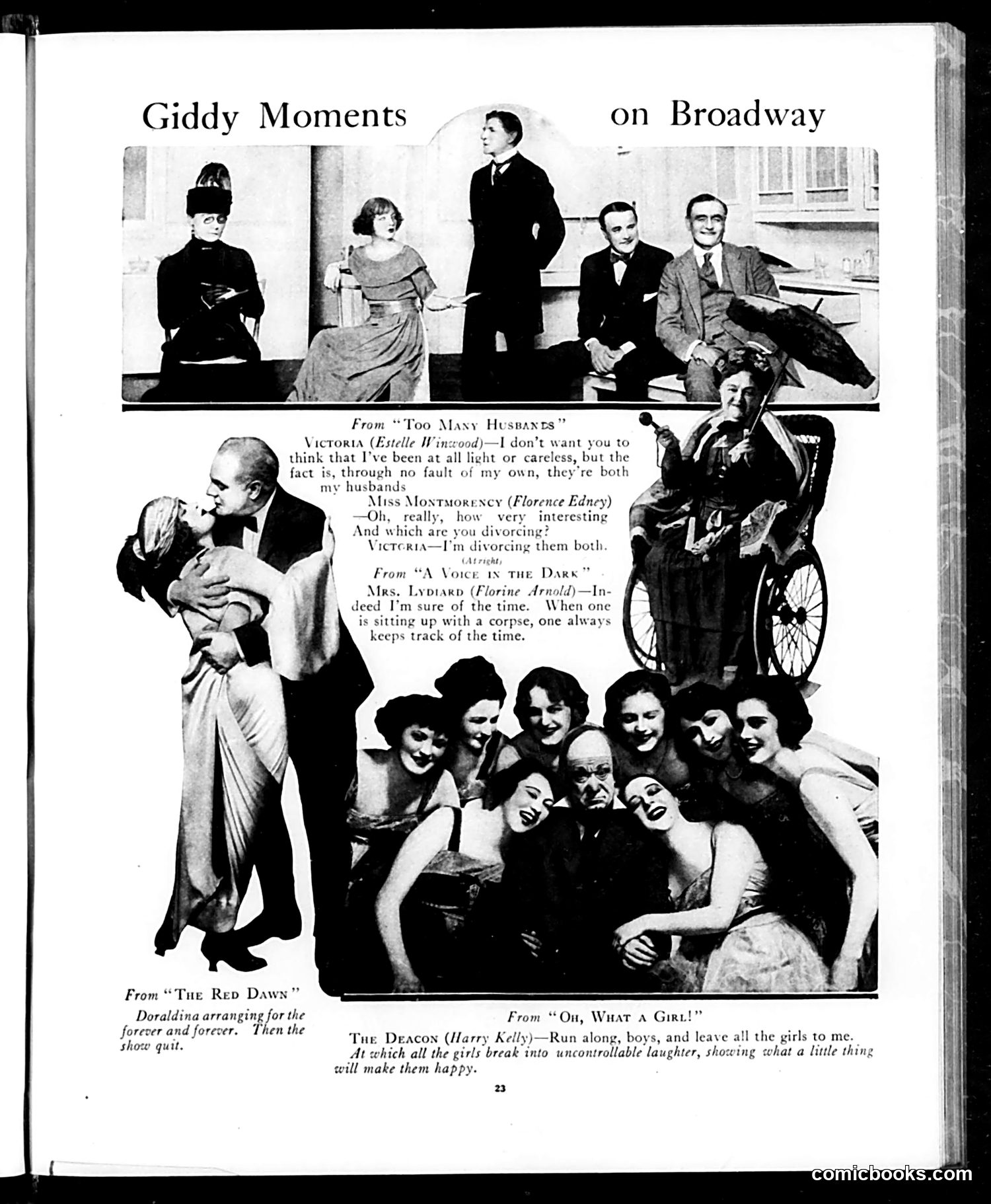
This page showcases humorous scenes from four Broadway plays, highlighting comedic dialogue and situations popular with early 20th-century theater audiences. The top section features cast members from various productions. The satirical humor focuses on marital and romantic entanglements typical of the era's comedies: a woman claiming two simultaneous husbands and planning to divorce both; dark comic timing about corpses; and a deacon's flirtation with multiple young women who find his advances hilarious. The satire reflects period attitudes—particularly the casual treatment of divorce (scandalous at the time), morbid humor about death, and patronizing views of women's easily-pleased nature. The "giddy" title suggests the page mocks both the frivolous plots and the presumed shallow entertainment tastes of Broadway audiences. This appears to be entertainment coverage rather than political satire, documenting theatrical trends and social attitudes of the era.
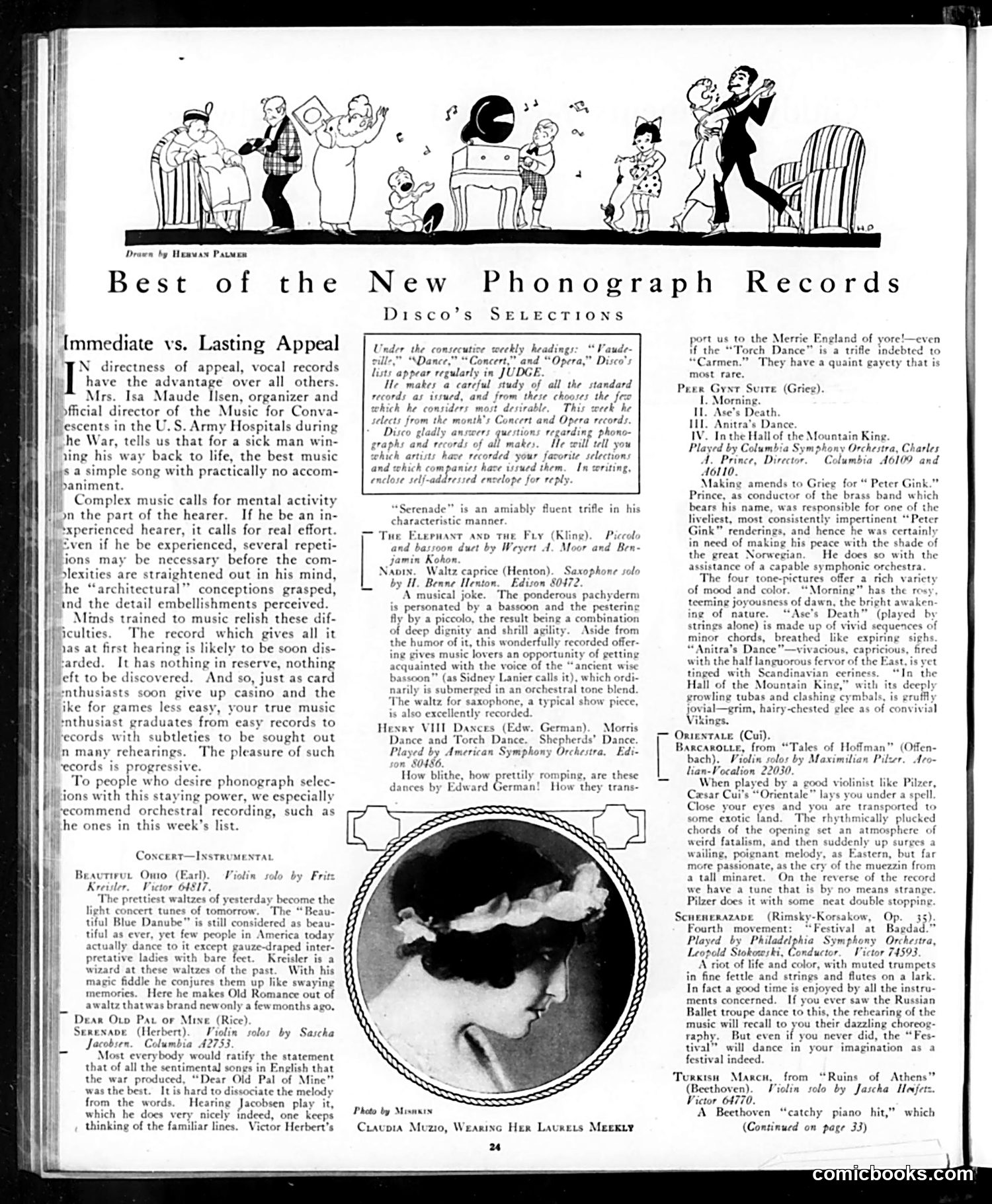
This page is primarily **music criticism and record recommendations**, not political satire. The masthead illustration by Heavan Palmer depicts a family enjoying music together—establishing the domestic leisure theme. The text discusses phonograph record selections for different audiences. Mrs. Isa Maude Ilsen, who organized music programs for recuperating WWI soldiers, advises that simple songs aid recovery better than complex compositions requiring mental effort. The criticism recommends orchestral recordings for serious music enthusiasts, arguing they offer "progressive" pleasure through repeated listening—contrasting with disposable popular records that reveal everything immediately. Specific records reviewed include waltzes by Kreisler, Herbert's sentimental wartime ballad "Dear Old Pal of Mine," and novelty pieces like "The Elephant and the Fly" featuring bassoon and piccolo. The circular photograph shows **Claudia Muzzo wearing her Laurels Meekly**—likely a recording artist featured in the reviews. This is **advertising/music journalism masquerading as editorial content**, typical of Judge's era.
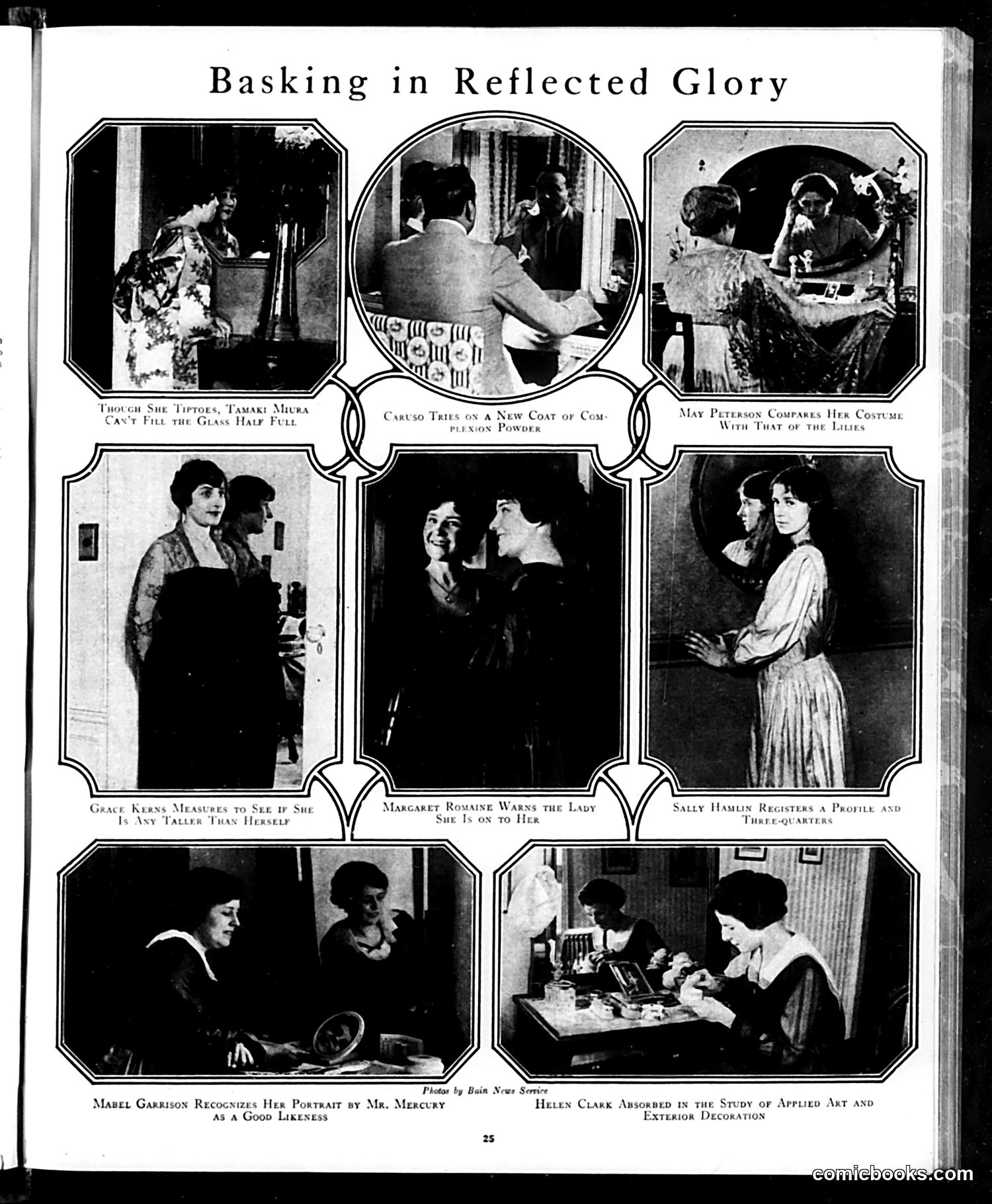
This page documents eight photographs of women apparently associated with a theatrical production or social event. The title suggests the humor: these women are "basking in reflected glory"—gaining status through association with someone famous or prestigious. The captions reference specific actresses (Tamaki Miura, Caruso, May Peterson, Margaret Romaine, Sally Hamlin, Helen Clark, Mabel Garrison) and their activities—trying on costumes, comparing outfits, measuring themselves against others, studying art and decoration. The satire appears to mock social climbing and vanity: women positioning themselves near celebrities or engaging in conspicuous consumption and self-display to elevate their social standing. The "reflected glory" they bask in suggests their importance derives entirely from proximity to famous names rather than their own merit. This reflects early 20th-century attitudes about women, celebrity culture, and social pretension.
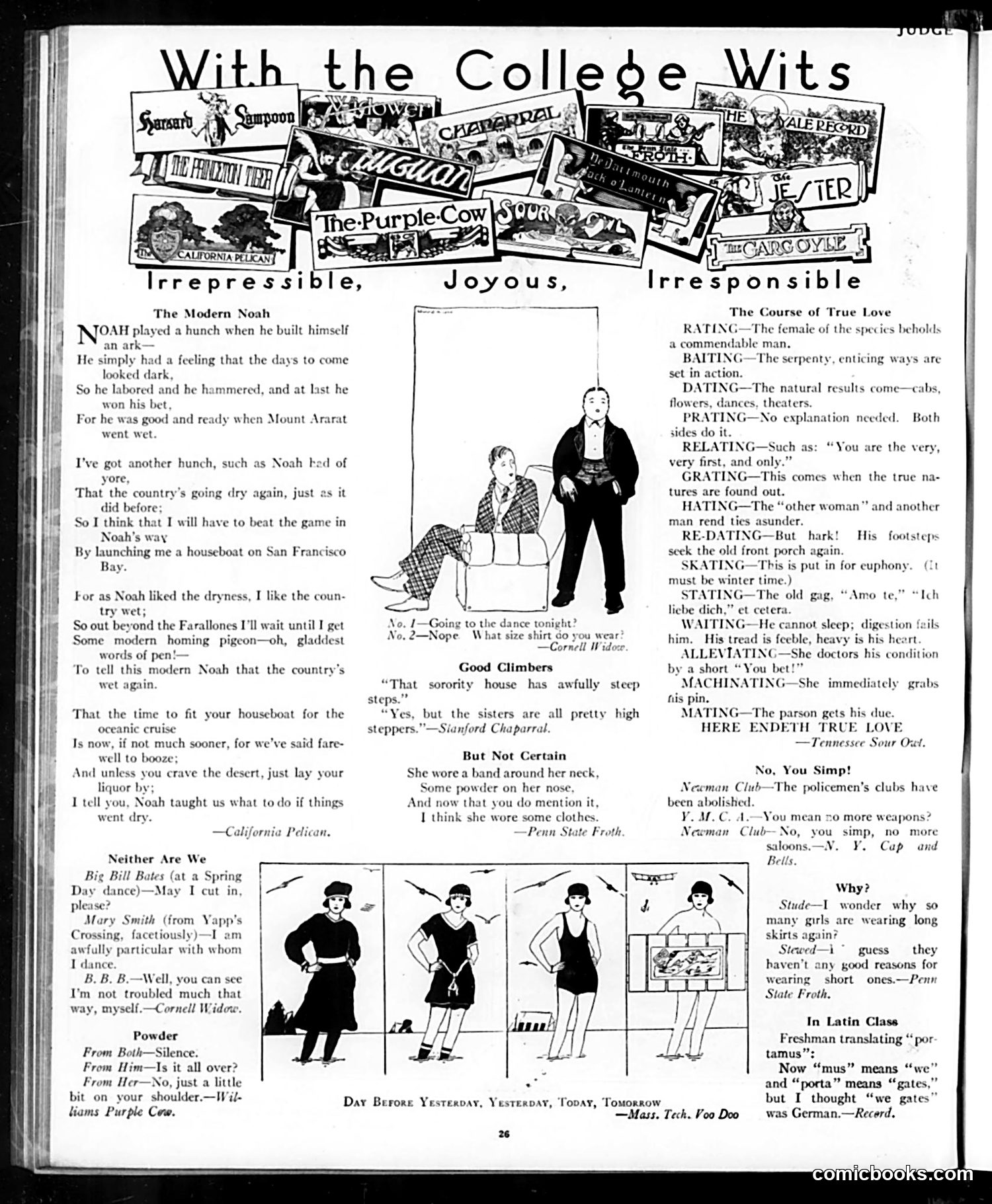
This page collects humorous verses and jokes from various college publications, satirizing student life and contemporary social issues. **Main Content:** The prominent piece, "The Modern Noah," uses biblical allegory to mock Prohibition. The poet draws parallels between Noah preparing for a flood and preparing for the country "going dry" (losing alcohol access). The joke: he'll launch a houseboat and wait for liquor to return, treating Prohibition as a temporary disaster like a flood. This reflects pre-Prohibition anxiety about the impending 18th Amendment. **Other jokes** address college romance ("The Course of True Love"), fashion trends (girls wearing long skirts again), and student mishaps (Latin translation confusion, dance etiquette). The small illustrated panels show women in different dress styles, likely commenting on hemline debates of the era. **Context:** This represents how American satirical magazines used college humor to discuss current events—here, Prohibition was so controversial that even college publications made it their target.
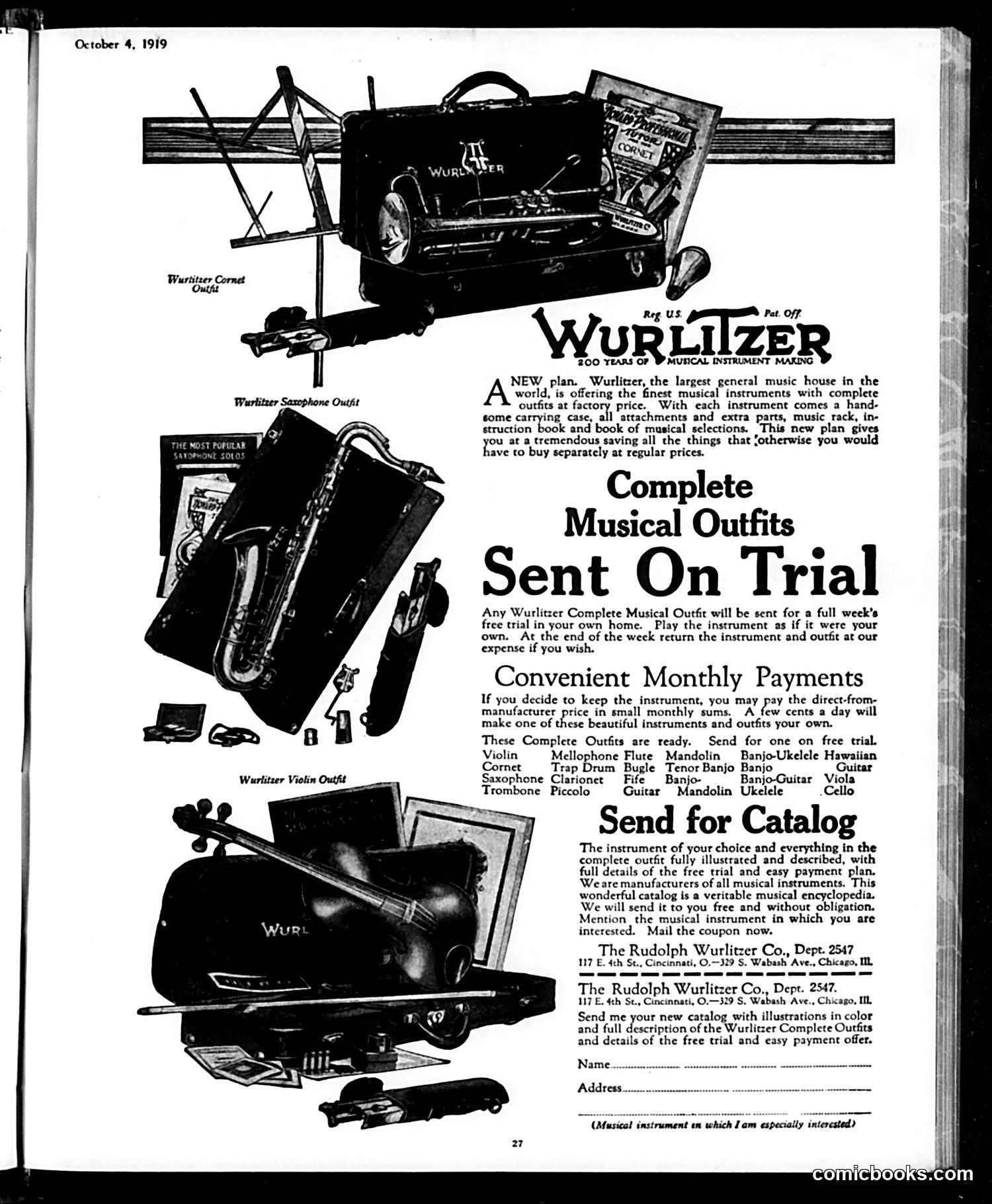
This page is **entirely a Wurlitzer musical instrument company advertisement**, not political satire or editorial cartooning. The ad showcases various instruments (violin, saxophone, cornet, drums, banjo, etc.) displayed with carrying cases and accessories. The marketing pitch emphasizes: - **Free trial periods** ("play the instrument as if it were your own") - **Affordable monthly payments** ("a few cents a day") - **Complete bundled outfits** with instruction books and music selections - **Factory-direct pricing**, positioning this as democratizing access to musical instruments The visual metaphor—instruments loaded onto a car like cargo—suggests mobility, accessibility, and modern consumer convenience. This reflects 1919 American optimism about making luxury goods (quality instruments) available to middle-class families through installment purchasing. There is **no political cartoon or satire** on this page. It's a straightforward commercial advertisement from Judge magazine's advertising section.
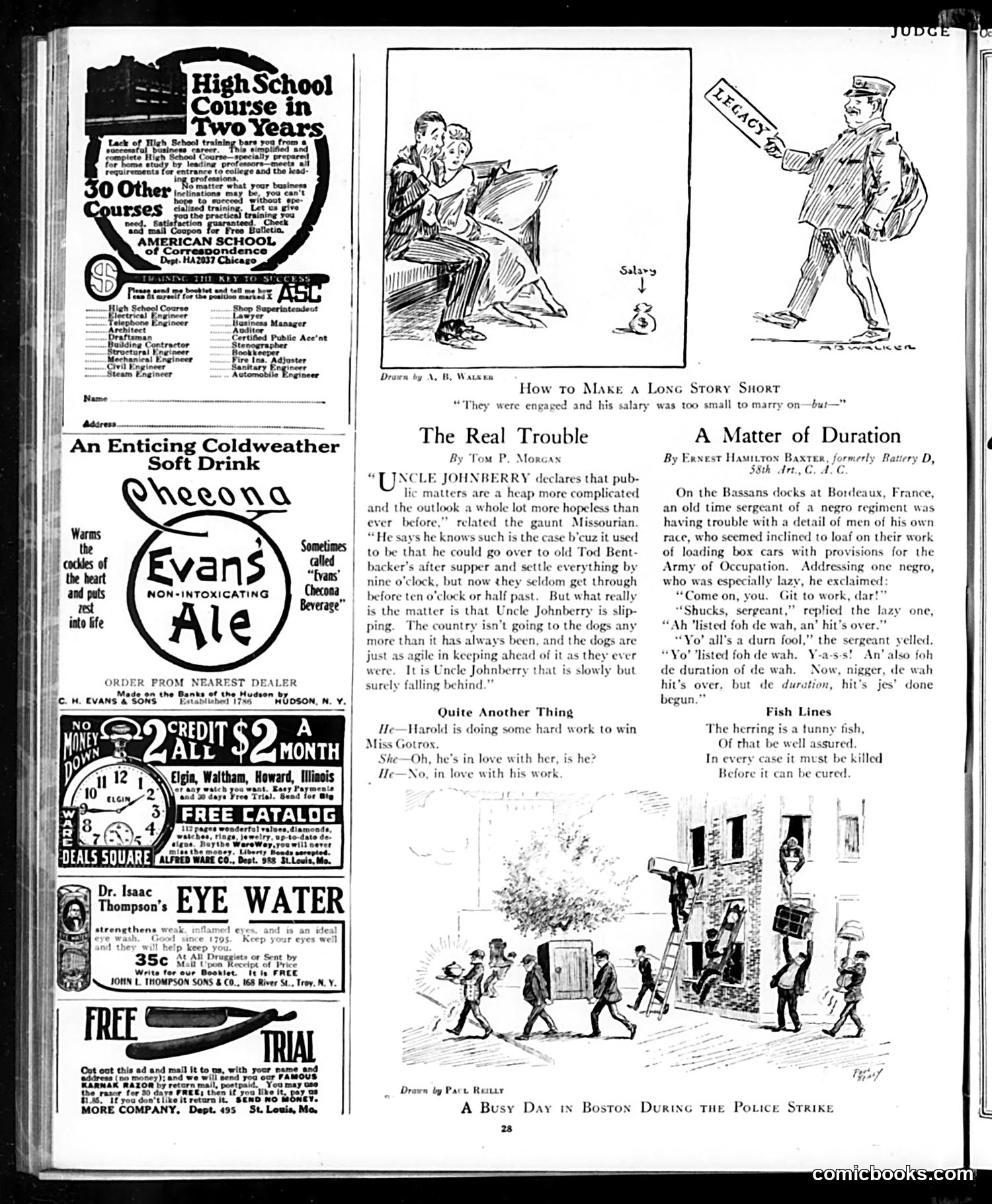
This page contains multiple satirical pieces typical of Judge magazine's editorial content: **"The Real Trouble"** mocks rural political commentary. Uncle Johnberry, a backwoods character, complains that public matters have grown too complicated to discuss over supper like they used to. The satire suggests old-fashioned thinkers blame modern complexity for their own declining relevance—they're "slipping" while the country moves forward. **"A Matter of Duration"** presents dialect humor involving a Black Army sergeant during WWI's occupation of France. The joke hinges on a soldier mishearing "duration of the war" as "dah-ration," creating confusion. This reflects period attitudes toward Black soldiers and uses stereotypical dialect for comedic effect. **"A Busy Day in Boston During the Police Strike"** (illustration) depicts chaos, likely referencing the 1919 Boston Police Strike—a major national event involving looting and disorder when police walked out. The page otherwise consists of period advertisements for correspondence courses, patent medicines, and consumer goods, typical of Judge's revenue model.
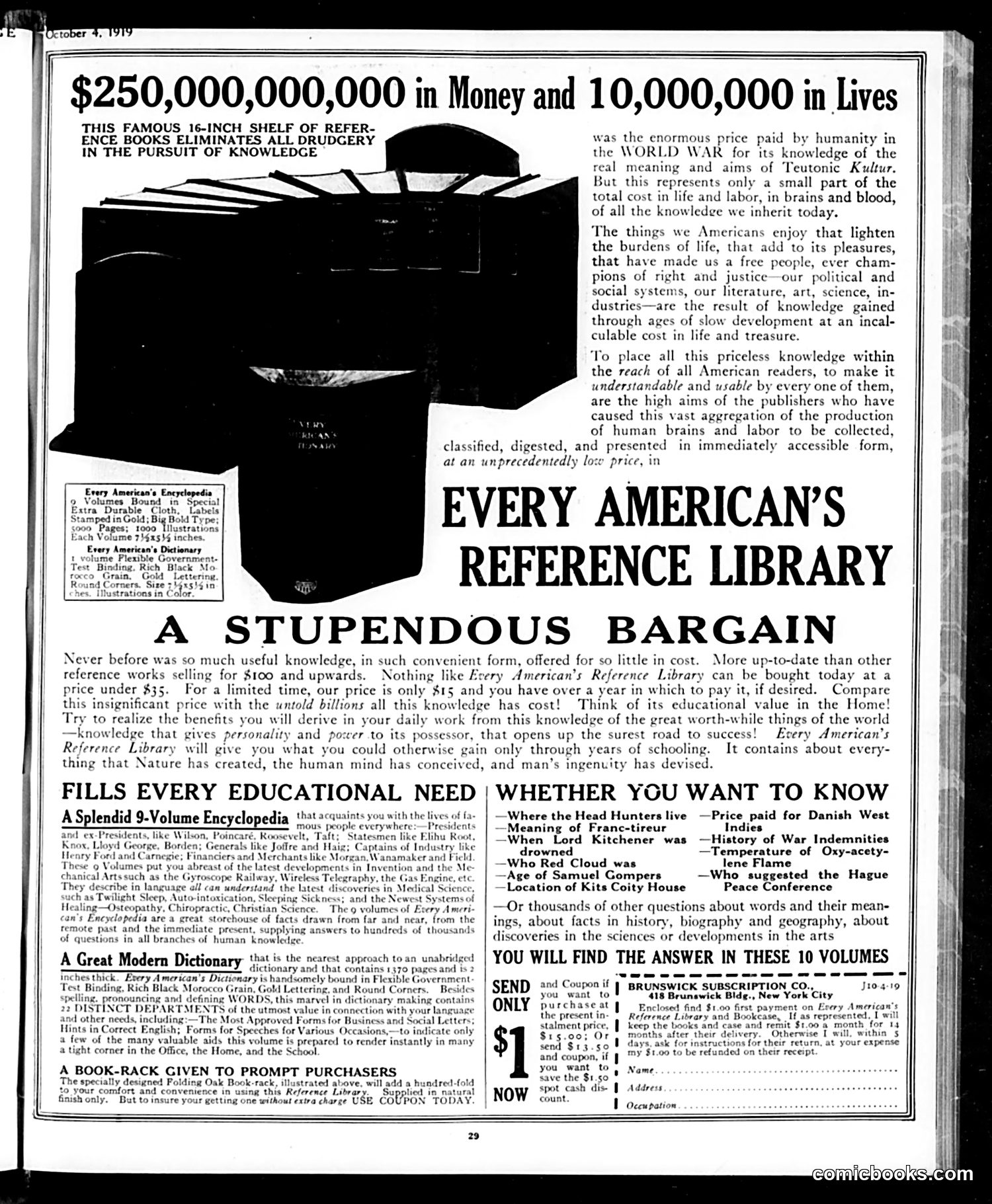
This page is primarily a **full-page advertisement** for "Every American's Reference Library," a mail-order encyclopedia set. However, it opens with pointed propaganda tying the product to World War I. The opening headline—**"$250,000,000,000 in Money and 10,000,000 in Lives"**—references the staggering costs of WWI (which ended November 1918). The advertisement argues that all human knowledge and progress historically cost immense sacrifice, so purchasing this affordable reference set ($15, payable over a year) represents good value compared to that heritage. The satire is **implicit rather than explicit**: the ad uses patriotic and educational language to sell a commercial product by invoking the fresh trauma of the war. It's essentially saying: "Millions died for civilization—now you can access that knowledge cheaply at home." The juxtaposition of battlefield casualties with a mail-order catalog is darkly clever, typical of Judge's sardonic approach. The page contains no caricatures or named figures—it's a straightforward (if emotionally manipulative) sales pitch disguised as cultural commentary.
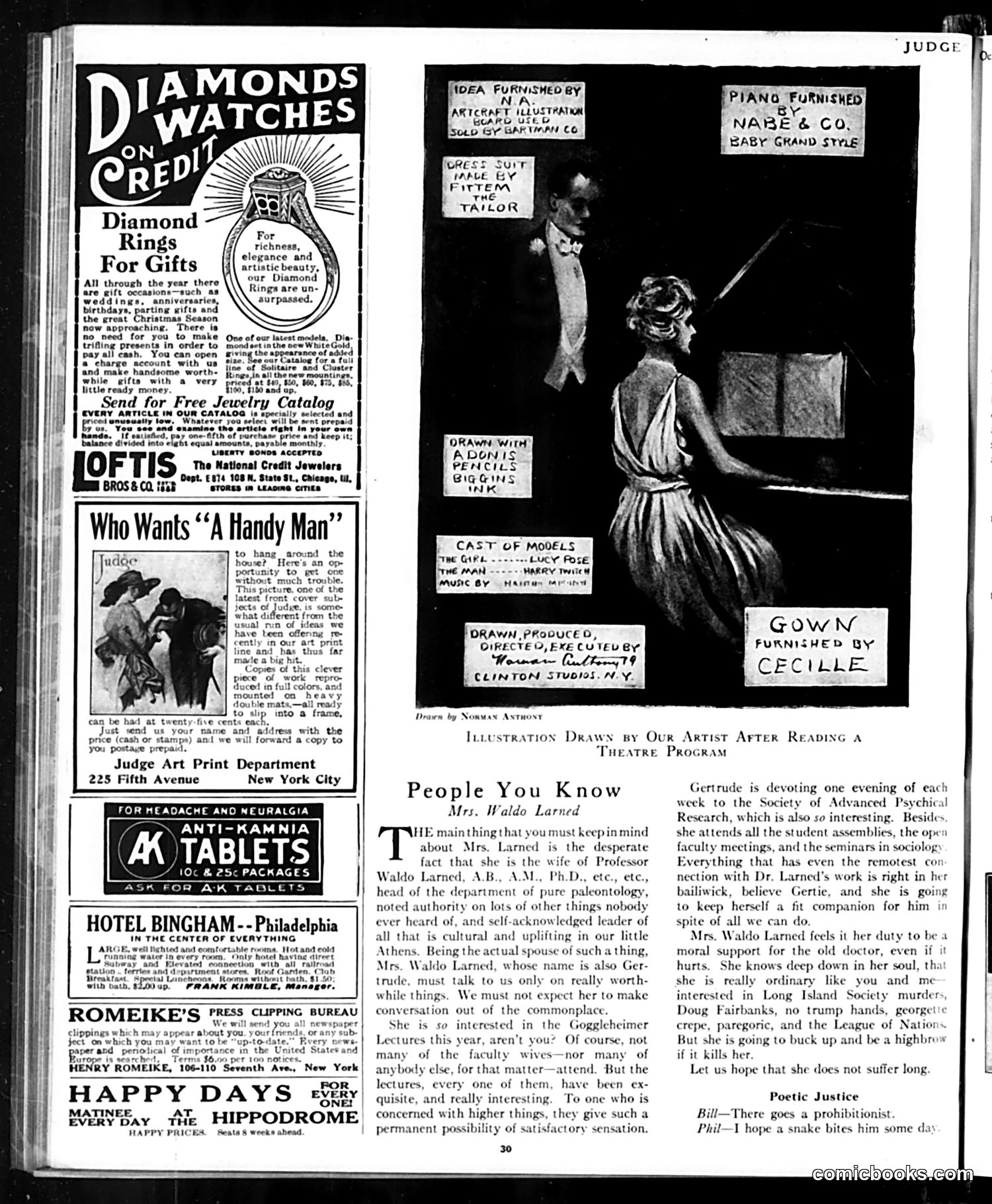
This page is primarily **advertising and society content** rather than political satire. The main illustrated section shows a woman at a piano, labeled as an "illustration drawn by our artist after reading a theatre program." The accompanying article "People You Know" discusses **Mrs. Waldo Larned**, wife of a prominent paleontology professor. The piece humorously notes her devotion to the Advanced Psychical Research Society and her role supporting her accomplished husband, characterizing her as an ordinary woman despite her husband's renown. The left side contains various **commercial advertisements** for watches, jewelry, tablets, and hotels typical of early 20th-century Judge magazine. The page lacks overt political commentary, instead offering light social humor about academic wives and domestic life.
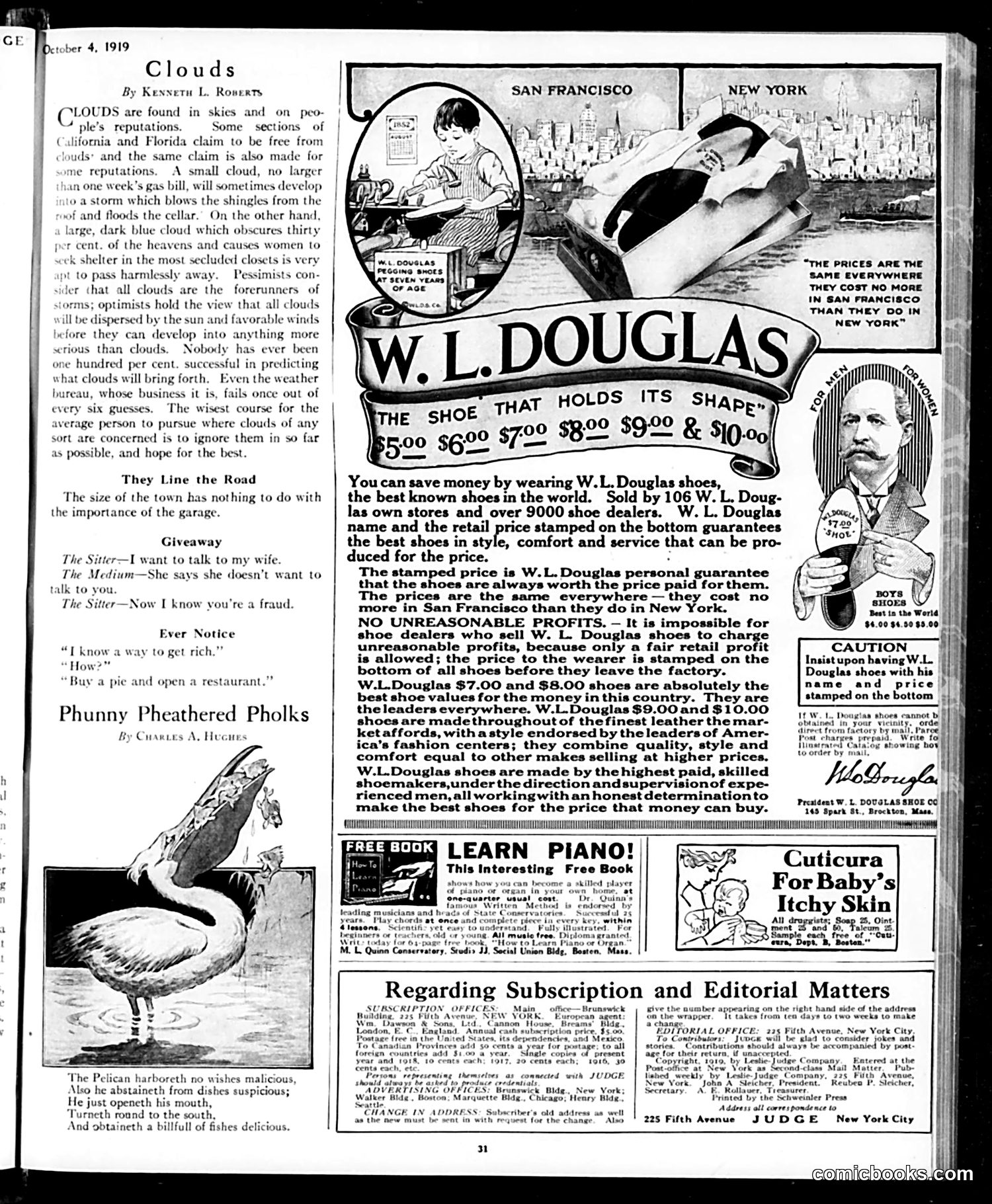
This page from *Judge* (October 4, 1919) is dominated by a **W.L. Douglas shoe advertisement**, not political satire. The ad emphasizes that shoe prices are identical across America—San Francisco and New York cost the same—and highlights Douglas's practice of stamping retail prices directly on shoe bottoms to prevent dealer markup. The smaller content includes: - **"Clouds"** by Kenneth Roberts: a humorous essay comparing clouds in sky to clouds on people's reputations - **"Phunny Pheathered Pholks"**: a cartoon about a pelican that simply opens its mouth to catch fish—a mild visual joke - Various brief satirical snippets ("The Sitter," "Ever Notice") The pelican cartoon and short humor pieces are gentle, whimsical rather than politically pointed. The page reflects *Judge's* typical mix of light humor and substantial advertising, with the shoe ad clearly the dominant commercial message of the day.
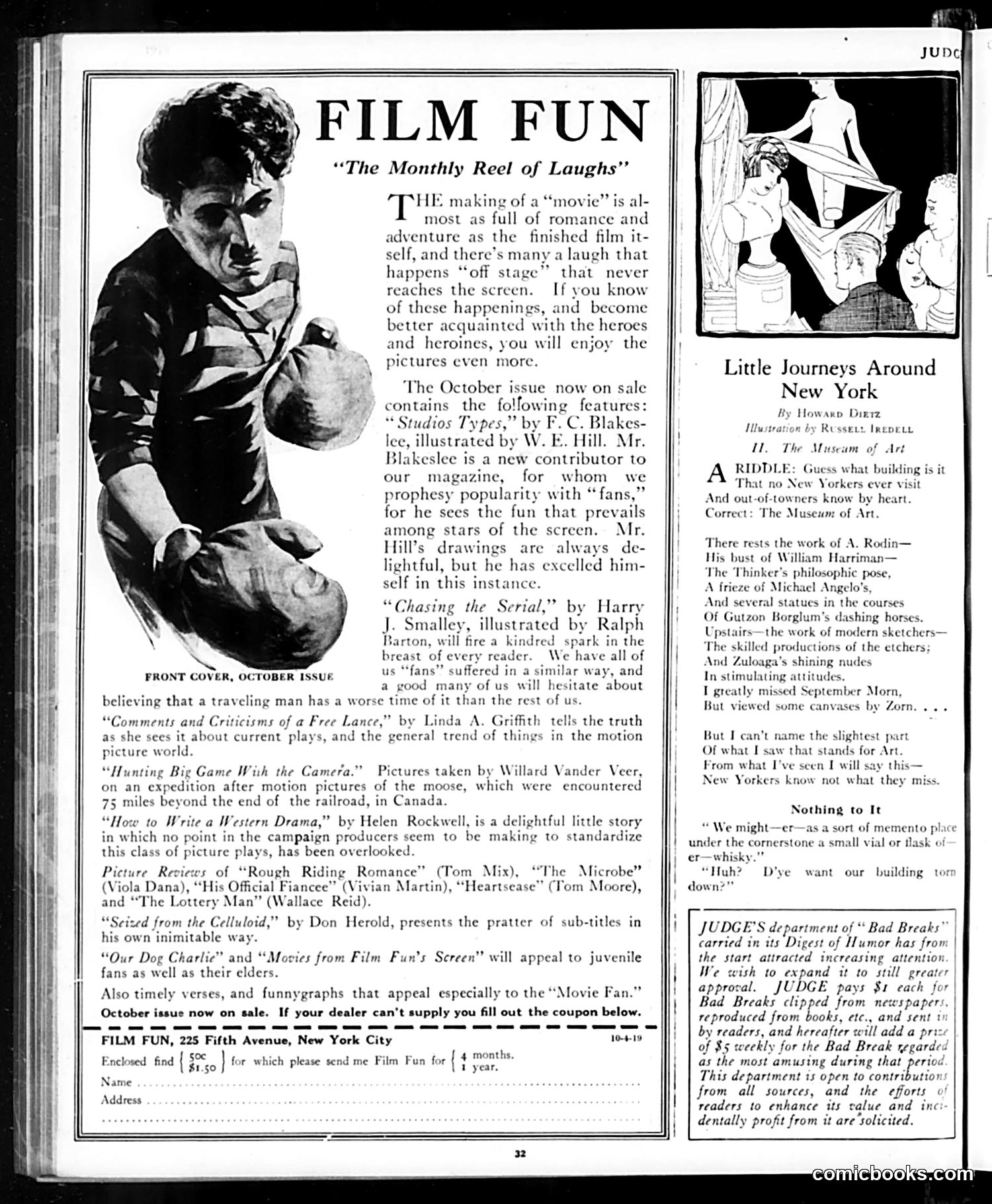
This page is primarily **advertising and promotional content** for two publications rather than political satire. The main feature advertises **"Film Fun" magazine**, promoting its October issue. The left column lists articles about early cinema production, including pieces on studio types, serial films, and how to write Westerns. The front-cover image shows what appears to be a slapstick comedian (likely from silent film era). The right column contains a lighthearted poem titled **"Little Journeys Around New York"** by Howard Dietz, illustrated by Russell Iredell. It humorously notes that New Yorkers never visit the Museum of Art while tourists know it well. The poem catalogs artworks there (Rodin, Michelangelo, etc.), ending with a joke that the author can't identify most art—a gentle jab at art appreciation pretension. Below that is a brief cartoon joke about placing whisky in a building's cornerstone. **Context for modern readers**: This reflects early-1920s culture's fascination with cinema as new entertainment, plus era-typical social commentary about cultural institutions and philistinism. The page is promotional rather than satirical.
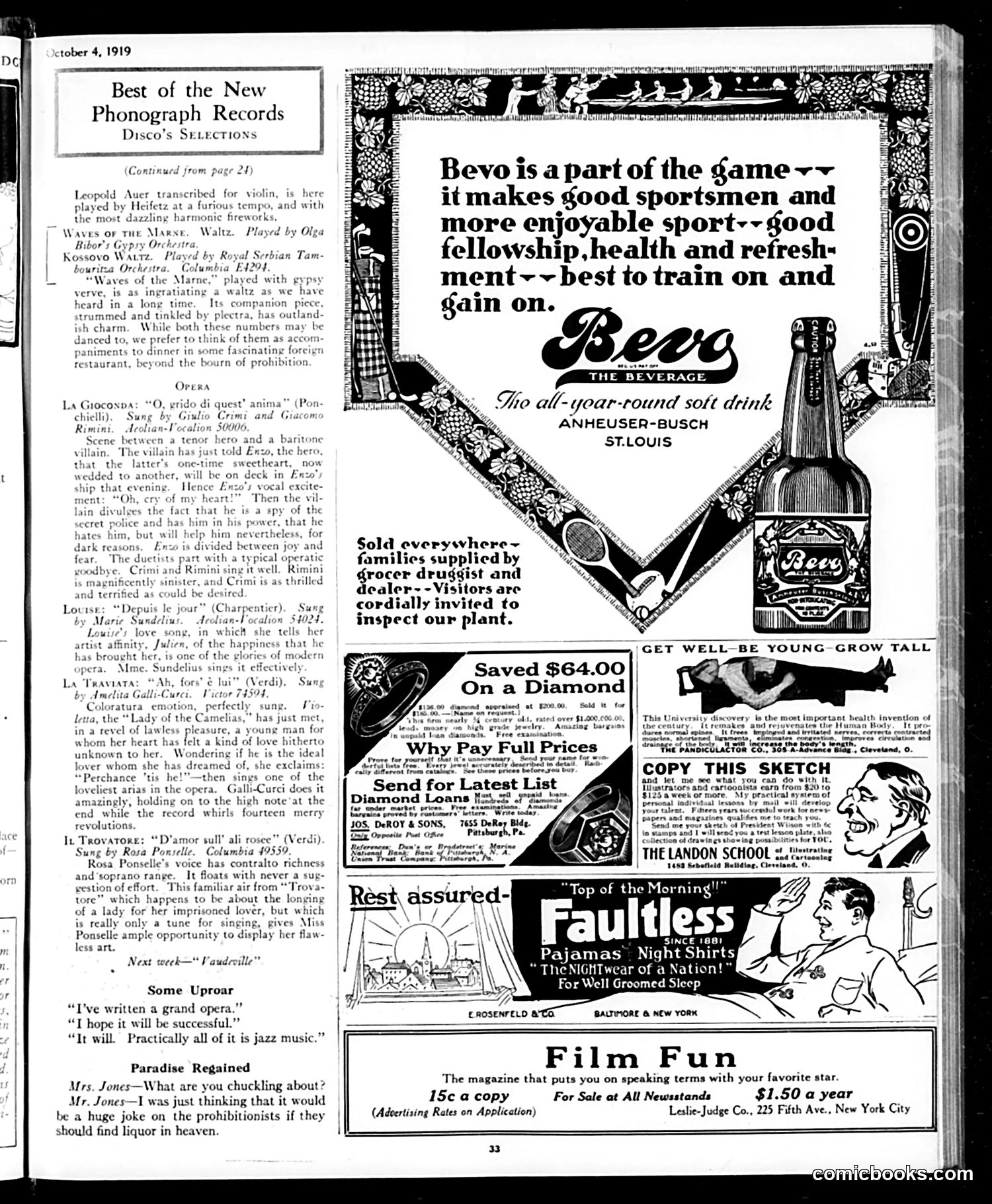
This page is primarily **advertising**, not political satire. It contains: 1. **Phonograph Records Section** (left): Reviews of classical opera recordings and musical pieces—standard entertainment content for 1919. 2. **Main Advertisement (center-right)**: **Bevo** soft drink by Anheuser-Busch, promoting their non-alcoholic beverage. This is significant context: the U.S. was in Prohibition (1920-1933), so breweries pivoted to selling "soft drinks." The ad claims Bevo makes "good sportsmen" and is "best to train on"—marketing it as a healthy alternative to alcohol. 3. **Minor Humor Items** (bottom-left): Brief jokes about opera and prohibitionists finding liquor in heaven—topical Prohibition-era humor. 4. **Miscellaneous Ads**: Diamond sales, pajamas, and "Film Fun" magazine. The page reflects 1919 American consumer culture during Prohibition's anticipation, with breweries advertising their pivot away from beer.
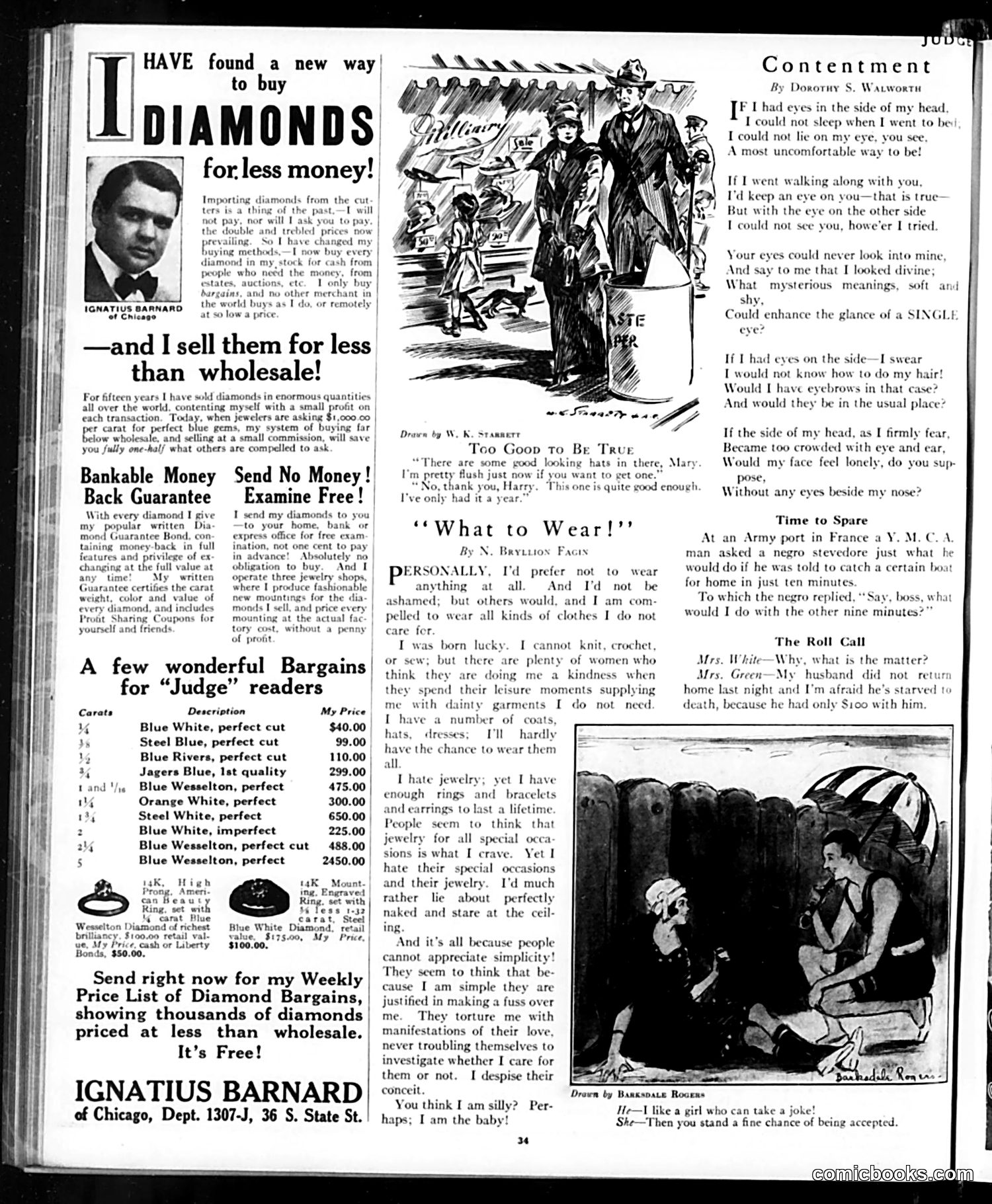
This page is primarily **advertising** featuring Ignatius Barnard of Chicago, a diamond merchant claiming to sell gems "for less than wholesale" through direct importing. The pitch emphasizes "bankable money back guarantee" and "send no money" examination—common mail-order sales tactics of the early 20th century. This type of ad was typical for Judge's readers (affluent men who could afford diamonds). The accompanying cartoons and literary pieces are lighter filler content: - **"Too Good to Be True"** depicts a sarcastic exchange about buying hats - **"What to Wear"** presents a privileged woman's complaint about being forced to wear jewelry and clothes she doesn't want—social satire about wealthy women's constraints - **"The Roll Call"** shows a widow's dark humor about her husband's death - **"Contentment"** is whimsical verse about hypothetically having side-facing eyes The overall page reflects Judge's target audience: upper-class readers interested in luxury goods, social commentary, and genteel humor.
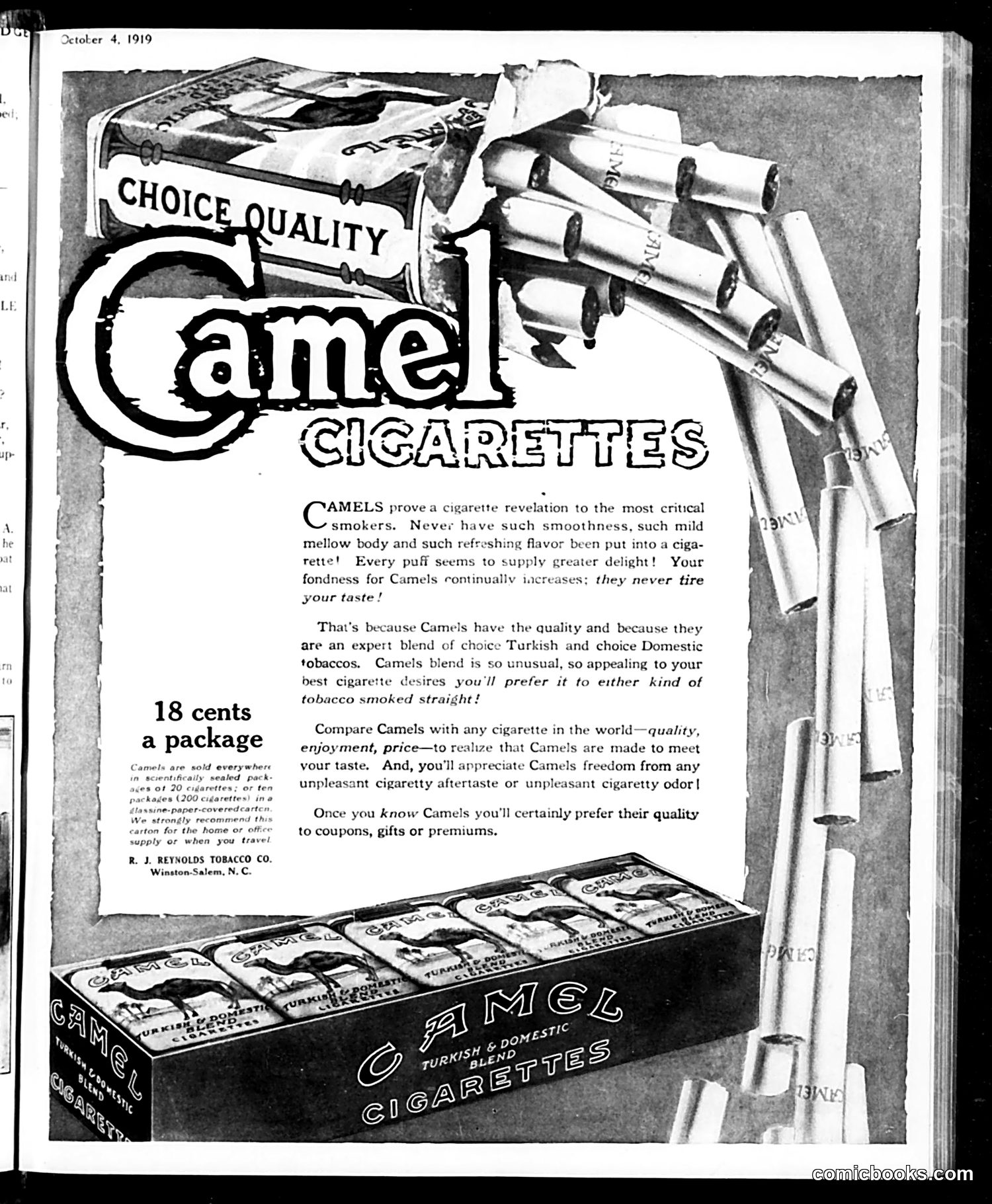
This page is **not a cartoon or satire**—it is a straightforward cigarette advertisement from *Judge* magazine. The R.J. Reynolds Tobacco Company promotes Camel cigarettes at 18 cents per package, emphasizing quality over competitor incentives. The ad's key claims include: superior "smoothness" and "mild mellow body" from blending Turkish and domestic tobacco; freedom from "unpleasant cigaretty aftertaste or odor"; and superiority to rival brands offering coupons and premiums. The visual shows an open cigarette package and fanned cigarettes. For modern readers: this represents pre-regulation tobacco advertising, before health warnings, FTC restrictions, or acknowledgment of addiction. The rhetoric about "quality" and "taste" was standard marketing unchallenged by health science at the time. The dismissal of competitor giveaways suggests competitive market positioning among major cigarette brands in this era.
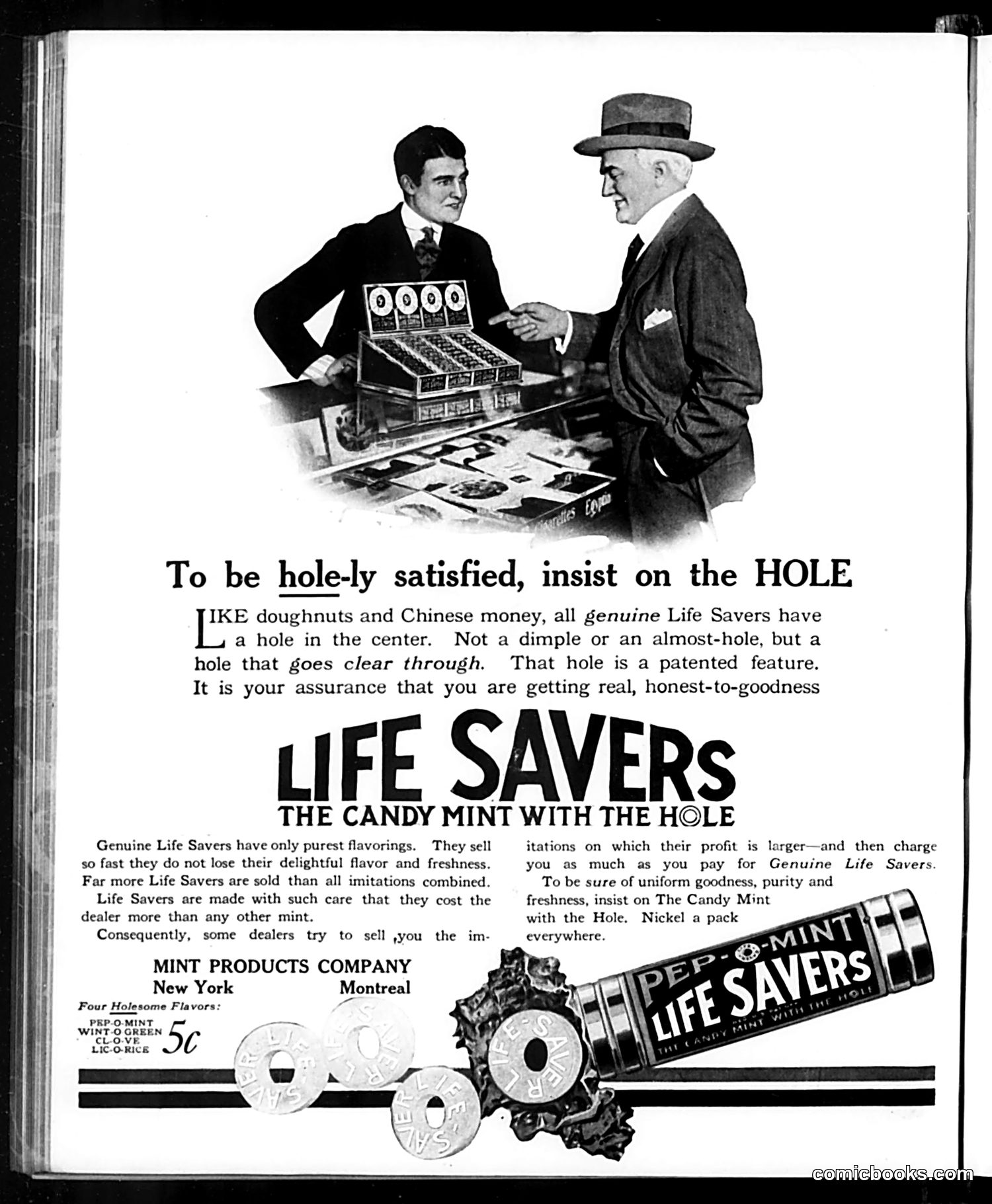
This is primarily a **Life Savers candy advertisement**, not political satire. The page uses a playful pun—"hole-ly satisfied"—to promote the candy's distinguishing feature: its central hole. The two men shown appear to be a **salesman and customer** examining a Life Savers display. The advertisement compares Life Savers' hole to features of doughnuts and Chinese coins, using humor to explain why the hole is a mark of authenticity. The real message: counterfeit imitations exist, and dealers sometimes try selling cheaper knockoffs. The hole is positioned as a **patented guarantee of genuine product**—assurance against fraud. This reflects early 20th-century consumer concerns about product authenticity and counterfeiting. The four flavors listed (Pep-O-Mint, Wint-O-Green, Clove, Licorice) suggest this is vintage advertising, likely 1910s-1920s, when Life Savers were establishing market dominance against competitors.