
Judge, 1919-10-04 · page 13 of 36
Judge — October 4, 1919 — page 13: what you’re looking at
What you’re looking at
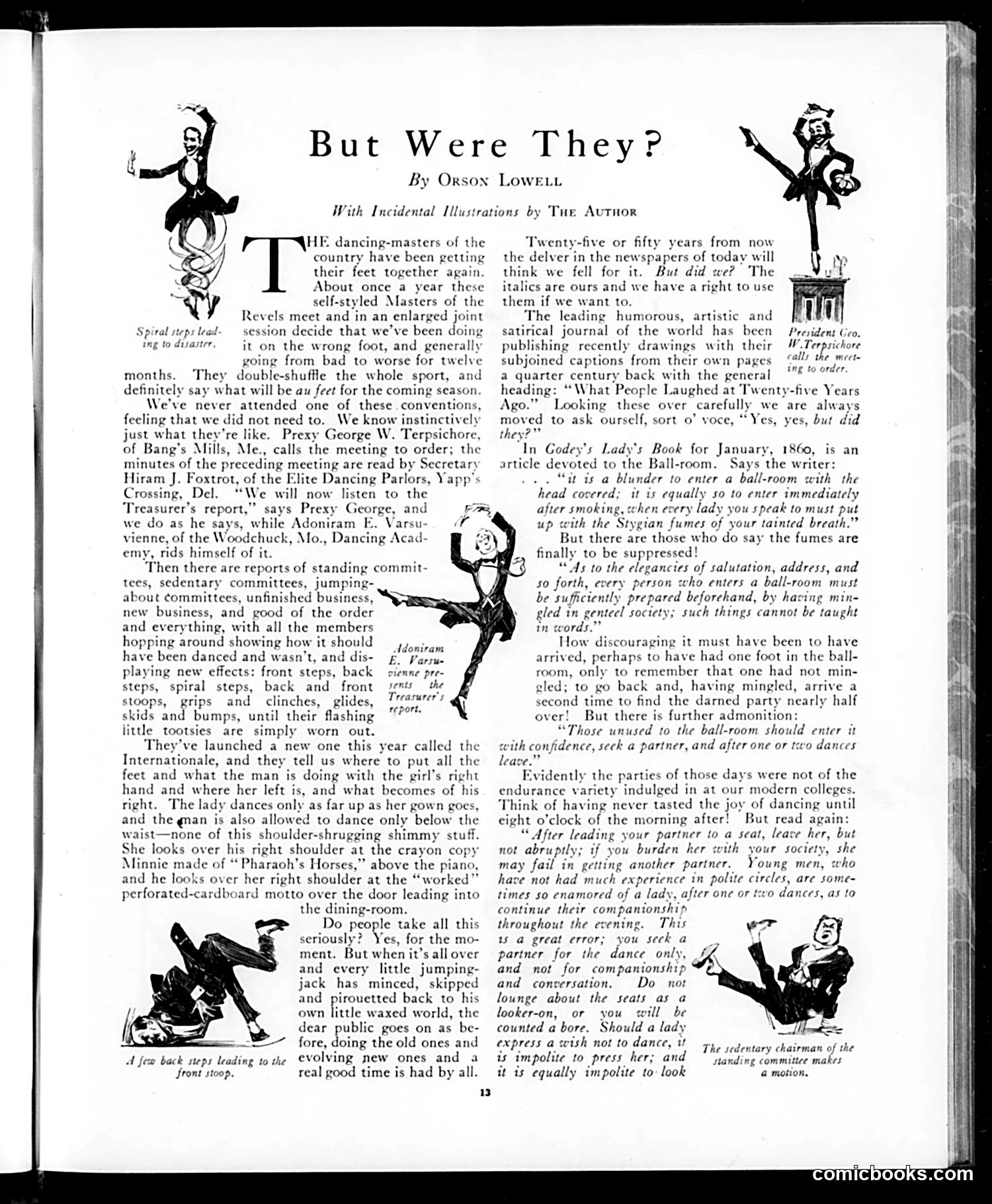
This article satirizes dancing masters and their annual conventions. Lowell mocks the pretentious ritualism of professional dance instructors who meet yearly to decree what dance steps will be "au feet" (fashionable) for the coming season—complete with absurdly formal procedures, committee reports, and demonstrations of new steps like "the Internationale." The satire's central joke: these conventions are taken seriously *during* the moment, but afterward the general public ignores the prescribed rules and simply dances as it always has, "doing the old ones and evolving new ones." Lowell questions whether people ever truly followed these mandates, using earlier historical references (Godey's Lady's Book from 1860) to suggest that past generations likely ignored such etiquette pronouncements just as contemporary readers do. The illustrations show dancing masters performing various exaggerated steps and maneuvers, emphasizing the physical comedy of their solemnity.
📄 Transcribed text from this page (OCR, searchable)
Machine-transcribed from the original scan — historical spelling and the odd misread are preserved.
| | HE. dancing-masters of the country have been getting their feet together again. About once a year these If-styled Masters of the Revels meet and in an enlarged joint session decide that we've been doing it on the wrong foot, and generally going from bad to worse for twelve months. They double-shuffle the whole sport, and definitely say what will be au feet for the coming season. We've never attended one of these conventions, feeling that we did not need to. We know instinctively just what they’re like. Prexy George W. Terpsichore, of Bang’s Mills, Me., calls the meeting to order; the minutes of the preceding meeting are read by Secretary Hiram J. Foxtrot, of the Elite Dancing Parlors, Yapp’s Crossing, Del. “We will now listen to the Treasurer's report,” says Prexy George, and we do as he says, while Adoniram E. Varsu- vienne, of the Woodchuck, Mo., Dancing Acad- emy, rids himself of it. Then there are reports of standing commit- tees, sedentary committees, jumping- about committees, unfinished business, new business, and good of the order and everything, with all the members hopping around showing how it should have been danced and wasn’t, and dis- playing new effects: front steps, back steps, spiral steps, back and front stoops, grips and clinches, glides, skids and bumps, until their flashing little tootsies are simply worn out. They’ve launched a new one this year called the Internationale, and they tell us where to put all the feet and what the man is doing with the girl’s right hand and where her left is, and what becomes of his right. The lady dances only as far up as her gown goes, and the qnan is also allowed to dance only below the waist—none of this shoulder-shrugging shimmy stuff. She looks over his right shoulder at the crayon copy Minnie made of “ Pharaoh’s Horses,” above the piano, and he looks over her right shoulder at the “worked” perforated-cardboard motto over the door leading into the dining-room. Do people take all this seriously? Yes, for the mo- ment. But when it’s all over and every little jumping- jack has minced, skipped and pirouetted back to his own little waxed world, the dear public goes on as be- fore, doing the old ones and evolving new ones and a real good time is had by all. Spiral in steps leau fo disaster. idoniram Varsu- penne pre- sents the Treasurer's report. 1 few back steps leading to the Sront stoop. pm, But Were They By Orson LowE.tu With Incidental Illustrations by 13 Tue Autnor Twenty-five or fifty years from now the delver in the newspapers of today will think we fell for it. But did we? The italics are ours and we have a right to use them if we want to. The leading humorous, artistic satirical journal of the world has been publishing recently drawings with their subjoined captions from their own pages a quarter century back with the general heading: “‘What People Laughed at Twenty-five Years Ago.” Looking these over carefully we are always moved to ask ourself, sort 0’ voce, “Yes, yes, but did they?” In Godey’s Lady's Book for article devoted to the Ball-room. Says the writer: “it is a blunder to enter a ball-room with the head covered; it is equally so to enter immediately after smoking, when every lady you speak to must put up with the Stygian fumes of your tainted breath.” But there are those who do say the fumes are finally to be suppressed! “As to the elegancies of salutation, address, and 50 forth, every person who enters a ball-room must be ‘sufficiently prepared beforehand, by having min- gled tn genteel society; such things cannot be taught tn words.” How discouraging it must have been to have arrived, perhaps to have had one foot in the ball- room, only to remember that one had not min- gled; to go back and, having mingled, arrive a second time to find the darned party nearly half over! But there is further admonitior “Those unused to the ball-room should enter it ceith confidence, seck a partner, and after one or tro dances and President Geo. W.Terpsichore calls the mect- ing to order. January, 1860, is an Evidently the parties of those days were not of the endurance variety indulged in at our modern colleges. Think of having never tasted the joy of dancing until eight o'clock of the morning after! But read again: “After leading your partner to a seat, leave her, but not abruptly; if you burden her swith your society, she may fail in getting another partner. Young men, who have not had much experience in polite circles, are some- times so enamored of a lady, after one or tvo dances, as to continue their companionship co throughout the evening. hs 15 @ great error; you seck a partner for the dance oie and not for companionship and conversation. Do not lounge about the seats as a looker-on, or you will be counted a bore. Should a lady express a wish not to dance, it is impolite to press her; and it is equally impolite to: look The sedentary chairman of the standing commitice makes @ motion. Ccomicbooks.com