
Judge, 1919-10-04 · page 8 of 36
Judge — October 4, 1919 — page 8: what you’re looking at
What you’re looking at
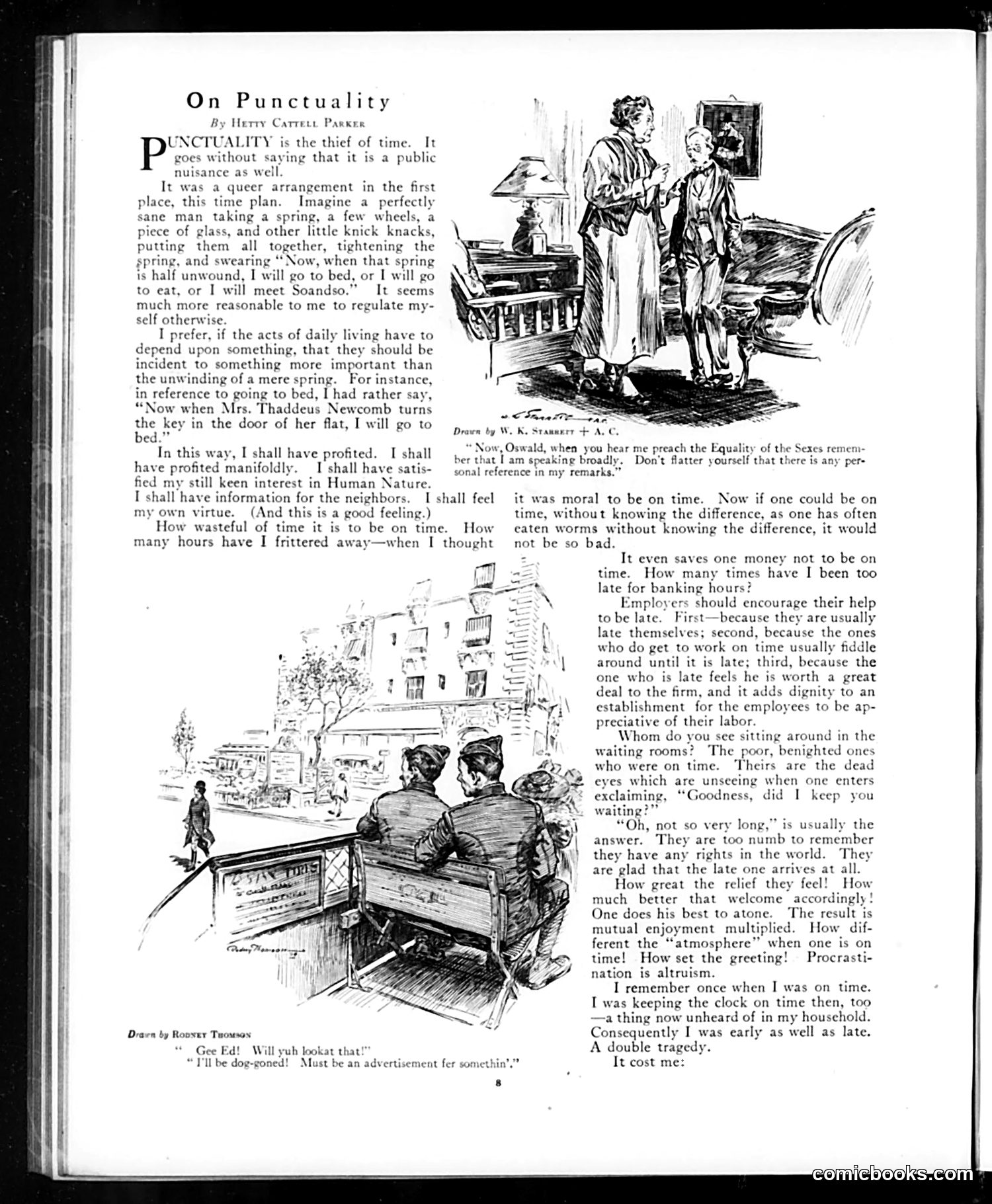
This is a humorous essay satirizing the obsession with punctuality in modern society. Parker argues provocatively that **being late is actually virtuous and beneficial**, inverting conventional wisdom about timeliness. The satire works by: 1. **Mocking the absurdity of clock-based living**: Parker ridicules the idea that a mechanical spring should dictate human behavior—a critique of industrialization's regimentation of daily life. 2. **Social commentary on class and power dynamics**: The cartoon showing waiting-room occupants illustrates Parker's point that only the poor and powerless arrive on time; the wealthy arrive late and are still warmly welcomed, suggesting punctuality demands reflect class hierarchies. 3. **Praising procrastination as altruism**: The essay's paradoxical conclusion—that lateness shows consideration and builds better relationships—is obviously tongue-in-cheek mockery of justifications people use to excuse tardiness. The accompanying illustrations by Robert Thomson show typical scenes of punctuality's supposed victims: the punctual waiting anxiously, and the late arrival being joyfully greeted.
📄 Transcribed text from this page (OCR, searchable)
Machine-transcribed from the original scan — historical spelling and the odd misread are preserved.
| On Punctuality By Herry Carrece Parxer UNCTUALITY is the thief of time. It goes without saying that it is a public nuisance as well. It was a queer arrangement in the first place, this time plan. Imagine a_ perfectly sane man taking a spring, a few wheels, a piece of glass, and other little knick knacks, putting them all together, tightening the spring, and swearing ‘‘ Now, when that spring is half unwound, I will go to bed, or I will go to eat, or I will meet Soandso.” It seems much more reasonable to me to regulate my- self otherwise. I prefer, if the acts of daily living have to depend upon something, that they should be incident to something more important than the unwinding of a mere spring. For instance, in reference to going to bed, I had rather say, “Now when Mrs. Thaddeus Newcomb turns the key in the door of her flat, I will go to bed ad In this way, I shall have profited. I shall have profited manifoldly. I shall have satis- fied my still keen interest in Human Nature. I shall have information for the neighbors. I shall feel my own virtue. (And this is a good feeling.) How wasteful of time it is to be on time. many hours have I frittered away—when I thought Drawn by Rooxer Tuowsox Gee Ei “ T'll be dog-goned! Will yuh fookat that!” w, Oswald, when you hear me ber that 1 am speaking broadly ence in my remarks, Must be an advertisement fer some preach the Equality of the Sexes remem- Don't flatter yourself that there is any per it was moral to be on time. Now if one could be on time, without knowing the difference, as one has often caten worms without knowing the difference, it would not be so bad. It even saves one money not to be on time. How many times have I been too late for banking hours? Employers should encourage their help to be late. First—because they are usually late themselves; second, because the ones who do get to work on time usually fiddle around until it is late; third, because the one who is late feels he is worth a great deal to the firm, and it adds dignity to an establishment for the employees to be ap- preciative of their labor. Whom do you see sitting around in the waiting rooms? The poor, benighted ones who were on time. Theirs are the dead eyes which are unseeing when one enters exclaiming, ‘Goodness, did I keep you waiting?” “Oh, not so very long,” is usually the answer. They are too numb to remember they have any rights in the world. They are glad that the late one arrives at all. How great the relief they feel! How much better that welcome ordingly ! One does his best to atone. The result is mutual enjoyment multiplied. How dif- ferent the “atmosphere” when one is on time! How set the greeting! Procrasti- nation is altruism. I remember once when I was on time. I was keeping the clock on time then, too —a thing now unheard of in my household. Consequently I was early as well as late. A double tragedy. It cost me: icomicbooks-com