
Judge, 1919-10-04 · page 20 of 36
Judge — October 4, 1919 — page 20: what you’re looking at
What you’re looking at
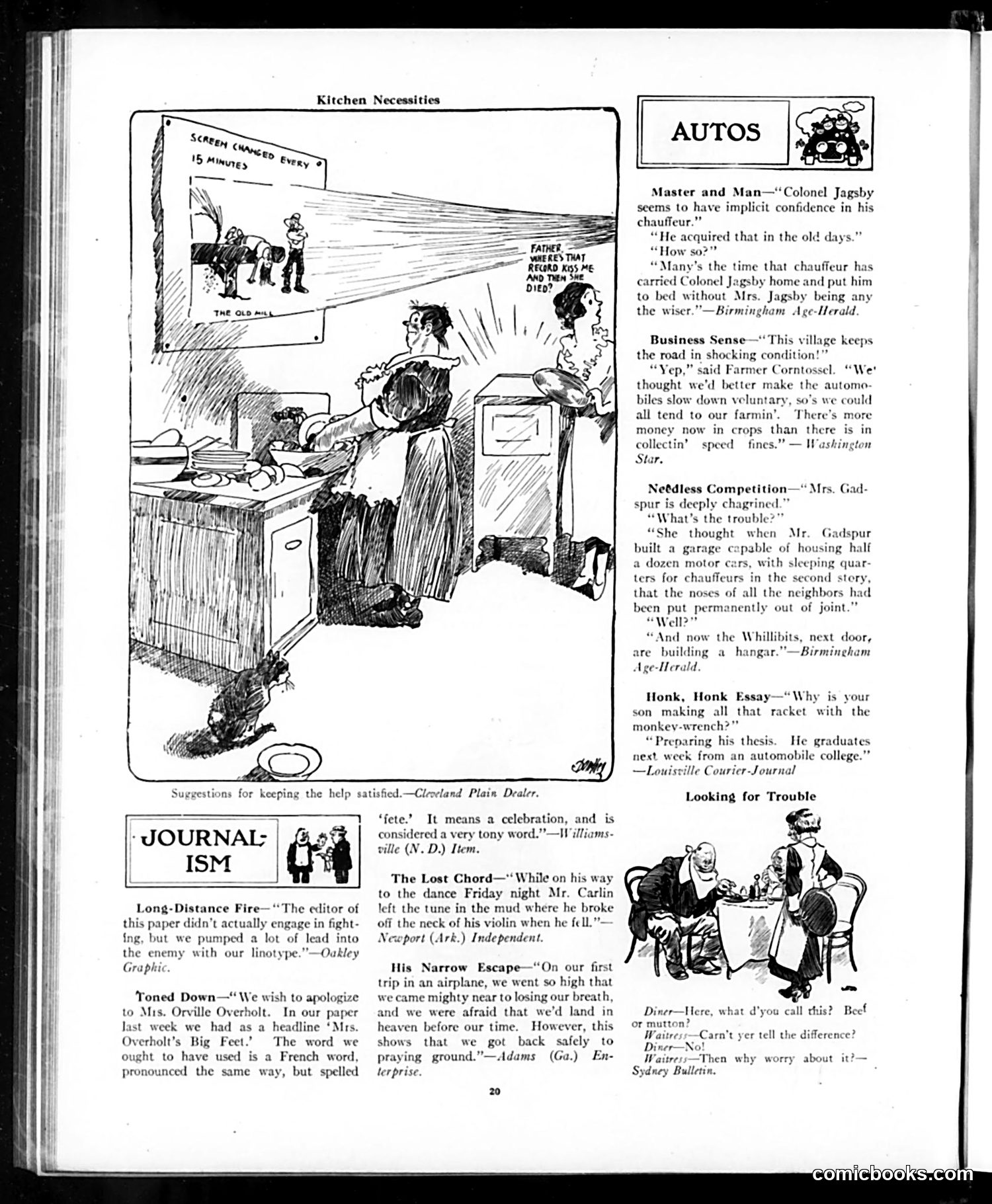
This page contains satirical commentary on early automobile culture and newspaper humor. The main cartoon depicts a kitchen scene where a woman manages domestic help, captioned with advice on "keeping the help satisfied"—satirizing the tension between employers and servants during this era. The "AUTOS" section collects brief jokes about automobiles and their social impact. Key themes include: chauffeurs as long-suffering servants (the Colonel Jagsby anecdote), farmers viewing cars as road hazards disrupting agriculture, and wealthy neighbors competing over garage size. The "automobile college" joke mocks the new vocational training emerging around cars. The "JOURNALISM" section ridicules newspaper errors and exaggerations—editors boasting about using weapons as metaphors, apologizing for insulting headlines through French euphemism, and reporting absurdly embellished stories. The final "Looking for Trouble" cartoon is a simple diner joke about indistinguishable meat quality, unrelated to automobiles. The overall tone reflects early 1900s anxieties about automobiles disrupting rural life and social hierarchies.
📄 Transcribed text from this page (OCR, searchable)
Machine-transcribed from the original scan — historical spelling and the odd misread are preserved.
Kitchen Necessities Suggestions for keeping the help satisfied.—Cleveland Plain Dealer. - JOURNAL | ISM Long-Dis ice Fire—‘The editor of this paper didn’t actually engage in fight- {ng, but we pumped a lot of lead into the enemy with our linotype.”—Oukley Graphic Toned Down—“ We wish to apologize to Mis. Orville Overholt. In our paper Jast week we had as a headline ‘Mrs. Overholt’s Big Feet.’ The word we ought to have used is a French word, pronounced the same way, but spelled ‘fete.’ It means a celebration, and is considered a very tony word.””—Williams- ville (N. D.) Item. The Lost Chord—“ While on his way to the dance Friday night Mr. Carlin left the tune in the mud where he broke off the neck of his violin when he fell.”- Newport (Ark.) Independent. His Narrow Escape—“On our first trip in an airplane, we went so high that we came mighty near to losing our breath, and we were afraid that we'd land in heaven before our time. However, this shows that we got back safely to praying ground.”—Adams (Ga.) En- ter prise. 20 Master and Man—‘“Colonel Jagsby seems to have implicit confidence in his chauffeur.” “He acquired that in the old days.” “How so?” “Many’s the time that chauffeur has carried Colonel Jagsby home and put him to bed without Mrs. Jagsby being any the wiser.”—Birmingham Age-Herald. Business Sense—‘ This the road in shocking condition!” “Yep,” said Farmer Corntossel. “Wet thought we'd better make the automo- biles slow down velun so’s we could all tend to our farmi There’s more money now in crops than there is in collectin’ speed fines.” — Washington Star. ¢ keeps Netdless Competition—* Mrs. Gad- spur is deeply chagrined.” “What's the trouble?” “She thought when Mr. Gadspur built a garage capable of housing half a dozen motor cars, with sleeping quar- ters for chauffeurs in the second stery, that the noses of all the neighbors had been put permanently out of joint.” “Well?” “And now the Whillibits, next door, are building a hangar."—Birmingham Age-Herald. Honk, Honk Essay—“Why is your son making all that racket with the monkey-wrench?” “Preparing his thesis. He graduates next week from an automobile college.” —Loui: ¢ Courier-Journal Looking for Trouble Beef Diner—Here, what d’you call this? or mutton? Waitress—Carn't yer tell the difference? Diner—No! Waitress—Then why worry about it?— Sydney Bulletin.