
Judge, 1919-10-04 · page 16 of 36
Judge — October 4, 1919 — page 16: what you’re looking at
What you’re looking at
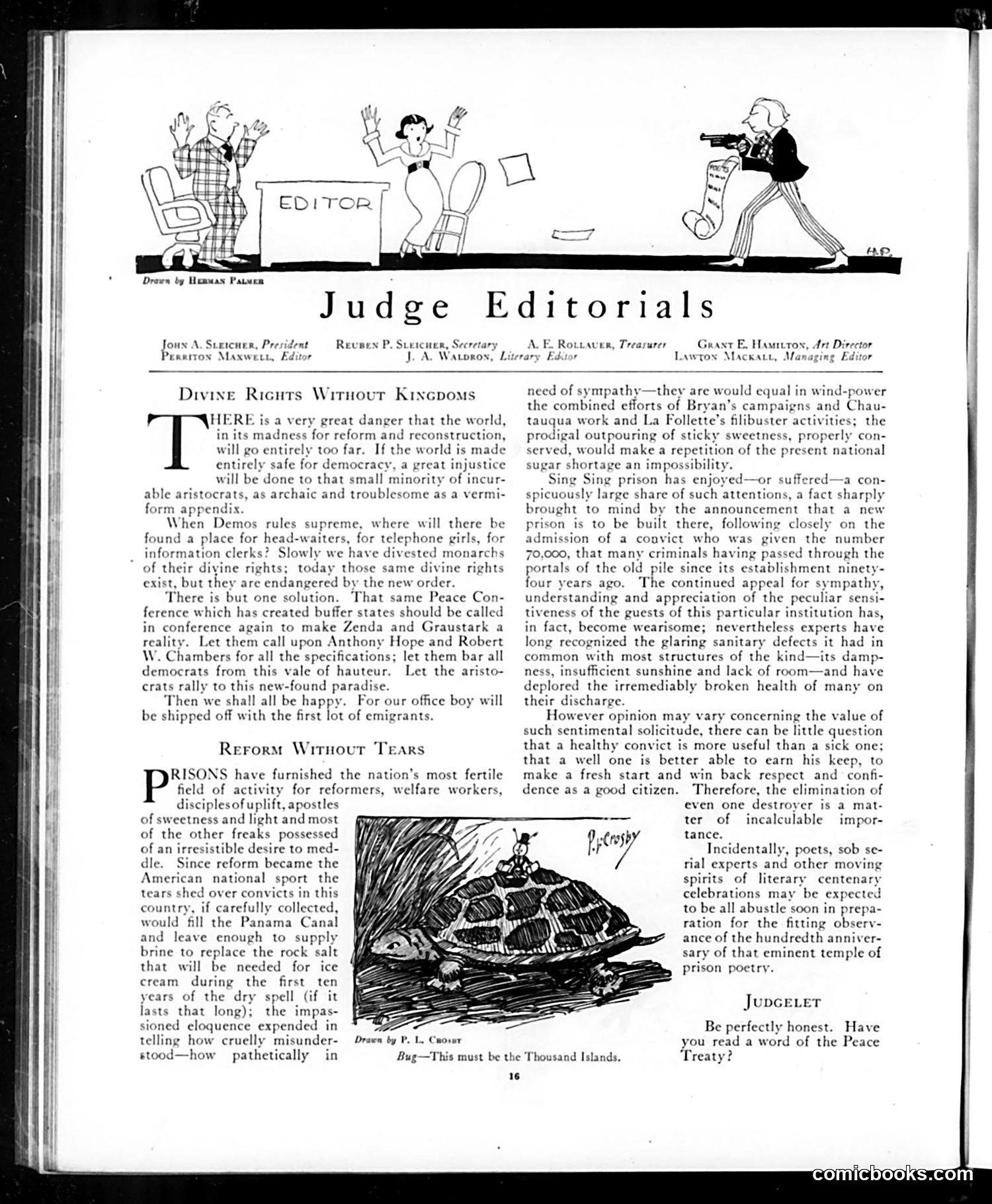
This page contains two satirical editorials with accompanying cartoons: **"Divine Rights Without Kingdoms"** mocks progressive reform movements. The editorial sarcastically argues that democratization threatens a "small minority of incurable aristocrats" (head-waiters, telephone girls) who need "divine rights." It suggests creating fictional aristocratic kingdoms like those from Anthony Hope novels as refuge. The satire targets both elites clinging to hierarchical privilege and perhaps overzealous reformers. **"Reform Without Tears"** critiques prison reform advocacy. It ridicules the emotional appeals made by welfare workers and "uplift" activists who sympathize with convicts, sardonically claiming their collective tears could fill the Panama Canal. However, the editorial concedes that actual prison conditions (poor sanitation, dampness, cramped quarters) genuinely harm inmates' health and rehabilitation—so reform has practical merit despite reformers' sentimental rhetoric. The page's top cartoon shows an editor being "shot" with papers, depicting chaotic editorial work. The bug cartoon illustrates the "Thousand Islands" salad dressing, likely a contemporary reference.
📄 Transcribed text from this page (OCR, searchable)
Machine-transcribed from the original scan — historical spelling and the odd misread are preserved.
Drown by Hemwas Paiwen Judge Editorials Revsen P. Srescuer, Secretar Joun A. Stercuer, President A. Wavprox, Peretton Maxwett, Editor J rary Edstor Grant E. Hast, Art Director Lawton Mackatt, Managing Editor Rottaver, Treasurer AF Divine Ricuts Wirnout Kixcpoms HERE is a very great danger that the world, in its madness for reform and reconstruction, will go entirely too far. If the world is made entirely safe for democracy, a great injustice will be done to that small minority of incur- able aristocrats, as archaic and troublesome as a vermi- form appendix. When Demos rules supreme, where will there be found a place for head-waiters, for telephone girls, for information clerks? Slowly we have divested monarchs of their divine rights; today those same divine rights exist, but they are endangered by the new order. There is but one solution. That same Peace Con- ference which has created buffer states should be called in conference again to make Zenda and Graustark a reality. Let them call upon Anthony Hope and Robert W. Chambers for all the specifications; let them bar all democrats from this vale of hauteur. Let the aristo- crats rally to this new-found paradise. Then we shall all be happy. For our office boy will be shipped off with the first lot of emigrants. Rerorm Wirnout Tears RISONS have furnished the nation’s most fertile field of activity for reformers, welfare workers, disciplesof uplift, apostles of sweetness and light and most of the other freaks possessed of an irresistible desire to med- dle. Since reform became the American national sport the tears shed over convicts in this country, if carefully collected, would fill the Panama Canal and leave enough to supply brine to replace the rock salt that will be needed for ice cream during the first ten years of the dry spell (if it lasts that long); the impas- sioned eloquence expended in telling how cruelly misunder- stood—how pathetically in Crosur Bug—This must be the Thousand Islands. need of sympathy—they are would equal in wind-power the combined efforts of Bryan’s campaigns and Chau- tauqua work and La Follette’s filibuster activities; the prodigal outpouring of sticky sweetness, properly con- served, would make a repetition of the present national sugar shortage an impossibility Sing Sing prison has enjoyed—or suffered—a con- spicuously large share of such attentions, a fact sharpl brought to mind by the announcement that a new prison is to be built there, following closely on the admission of a convict who was given the number 70,000, that many criminals having passed through the portals of the old pile since its establishment ninety- four years ago. The continued appeal for sympath understanding and appreciation of the peculiar sensi- tiveness of the guests of this particular institution has, in fact, become wearisome; nevertheless experts have long recognized the glaring sanitary defects it had in common with most structures of the kind—its damp- ness, insufficient sunshine and lack of room—and have deplored the irremediably broken health of many on their discharge. However opinion may vary concerning the value of such sentimental solicitude, there can be little question that a healthy convict is more useful than a sick one; that a well one is better able to earn his keep, to make a fresh start and win back respect and con dence as a good citizen. Therefore, the elimination of even one destroyer is a mat- ter of incalculable impor- tance. Incidentally, poets, sob se- rial experts and other moving spirits of literary centenary celebrations may be expected to be all abustle soon in prepa- ration for the fitting observ- ance of the hundredth anniver- sary of that eminent temple of prison poetry. JupceLet Be perfectly honest. Have you read a word of the Peace Treaty?