
Judge, 1919-10-04 · page 24 of 36
Judge — October 4, 1919 — page 24: what you’re looking at
What you’re looking at
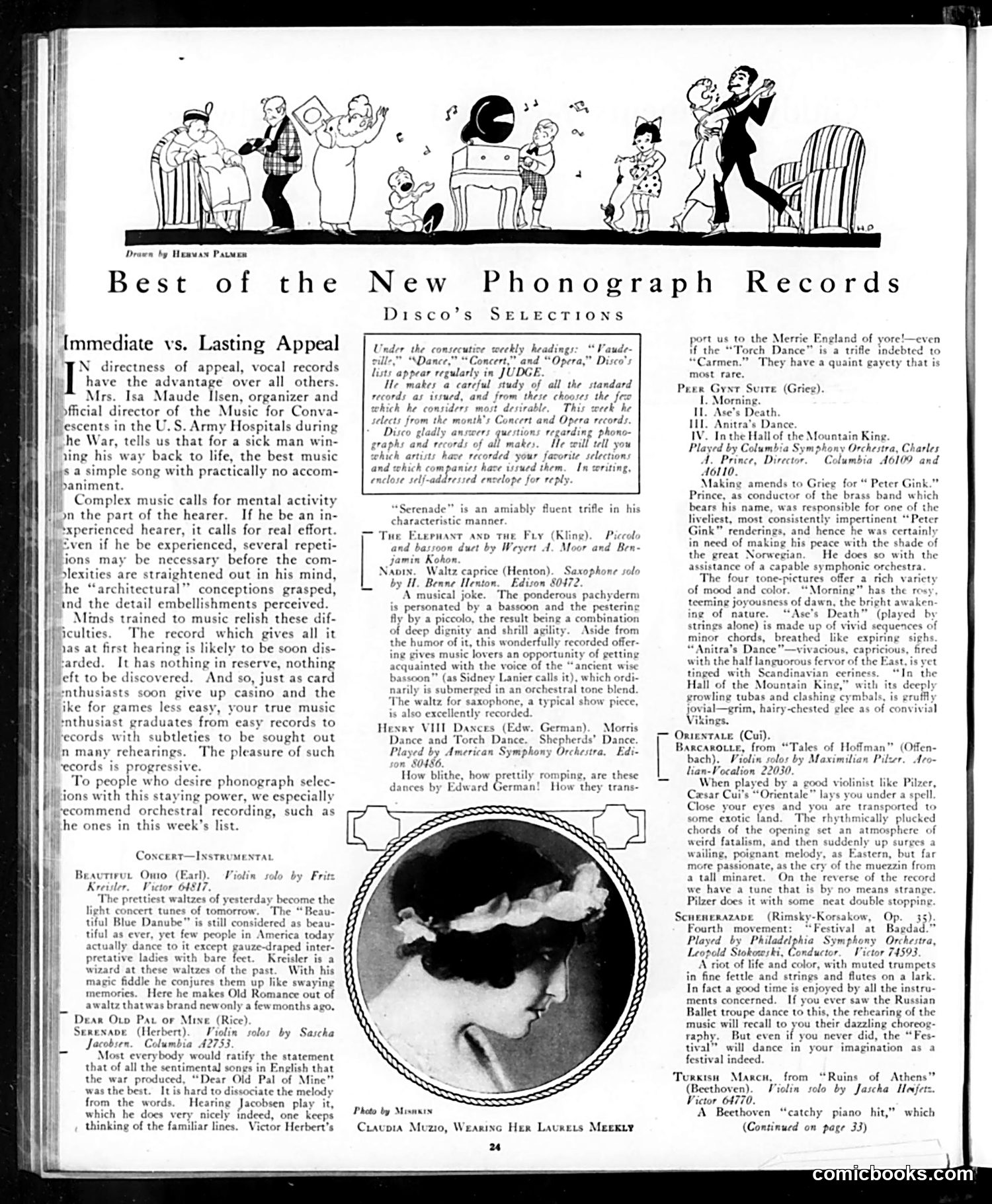
This page is primarily **music criticism and record recommendations**, not political satire. The masthead illustration by Heavan Palmer depicts a family enjoying music together—establishing the domestic leisure theme. The text discusses phonograph record selections for different audiences. Mrs. Isa Maude Ilsen, who organized music programs for recuperating WWI soldiers, advises that simple songs aid recovery better than complex compositions requiring mental effort. The criticism recommends orchestral recordings for serious music enthusiasts, arguing they offer "progressive" pleasure through repeated listening—contrasting with disposable popular records that reveal everything immediately. Specific records reviewed include waltzes by Kreisler, Herbert's sentimental wartime ballad "Dear Old Pal of Mine," and novelty pieces like "The Elephant and the Fly" featuring bassoon and piccolo. The circular photograph shows **Claudia Muzzo wearing her Laurels Meekly**—likely a recording artist featured in the reviews. This is **advertising/music journalism masquerading as editorial content**, typical of Judge's era.
📄 Transcribed text from this page (OCR, searchable)
Machine-transcribed from the original scan — historical spelling and the odd misread are preserved.
Drown by Heawax Patwen Best of the Immediate vs. Lasting Appeal N directness of appeal, vocal records have the advantage over all others. { Mrs. Isa Maude Ilsen, organizer and ficial director of the Music for Conva- escents in the U.S. Army Hospitals during he War, tells us that for a sick man win- ning his way back to life, the best music s a simple song with practically no accom- animent. Complex music calls for mental activity on the part of the hearer. If he be an in- *xperienced hearer, it calls for real effort. Zven if he be experienced, several repeti- ions may be necessary before the com- dlexities are straightened out in his mind, he “architectural” conceptions grasped, ind the detail embellishments perceived. Minds trained to music relish these dif- Wiculties. The record which gives all it jas at first hearing is likely to be soon di rarded. It has nothing in reserve, nothing eft to be discovered. And so, just as card snthusiasts soon give up casino and the ike for games less easy, your true music |:nthusiast graduates from easy records to ecords with subtleties to be sought out n many rehearings. The pleasure of such ‘ecords is progressive. To people who desire phonograph selec- ions with this staying power, we especially ommend orchestral recording, such as he ones in this week’s list. Coxcert—INstrumentat Beautirut Onto (Earl). Violin solo by Frits Victor 64817. prettiest waltzes of yesterday become the light concert tunes of tomorrow. The “Beau- tiful Blue Danube” is still considered as beau- tiful as ever, yet few people in America today actually dance to it except gauze-draped inter- pretative ladies with bare feet. Kreisler is a wizard at these waltzes of the past. With his magic fiddle he conjures them up like swaying memories. Here he makes Old Romance out of ____ awaltz thatwas brand newonly a fewmonths ago. Dear Ovo Pat or Mixe. (Rice). Serexave (Herbert). Violin solos by Sascha Jacobsen. Columbia 42753. Most everybody would ratify the statement that of all the sentimental sones in English that the war produced, “Dear Old Pal of Mine” was the best. It is hard to dissociate the melody from the words. Hearing Jacobsen play i which he docs very nicely indeed, one keeps thinking of the familiar lines. Victor Herbert's New Phonograph Records Disco’s SELECTIONS Under the consecutive weekly headings: “ Vaude- cille,” “Dance,” “Concert,” and “Opera,” Disco’ lists appear regularly in JUDGE. He mates a careful study of all the standard records as issued, and from these chooses “oncert and Opera records all makes. He will tell you hace recorded your f selectio m panies have issued them. In ceriting, enclose self-addressed envelope for reply “Serenade” is an amiably fluent trifle in his racteristic manner. [> Tue Evernaxt ano tue Puy (Kling). Picc and bas duct by Weyert A. Moor and Be jamin Kohon Napix. Waltz caprice (Henton). Saxophone solo by H. Benne He Edison 80472 A musical joke. The ponderous pachyderm is personated by a bassoon and the pestering fly by a piccolo, the result being a combination snity and shrill agility. Aside from he humor of it, this wonderfully recorded offer ing gives music lovers an opportunity of gettin acquainted with the voice of the “ancient wise bassoon” (as Sidney Lanier calls it), which ordi- narily is submerged in an orchestral tone blend. 7 he waltz for saxophone, a typical show piece, s also excellently recorded. Hexny VII Daxces (Edw. German). Morris Dance and Torch Dance. Shepherds’ Dance. Played by American Symphony Orchestra, Edi- on SOSSO. How blithe, how prettily romping, are these dances by Edward German! How they tran Photo by Mi Craupia Muzio, Weaninc Hex Lavrers Meexry port us to the Merrie England of yore!—even if the rch Dance” is a trifle indebted to “Carmen.” They have a quaint gayety that is most rare. Peer Gynt Surre (Grieg). 1. Morning. IL. Ase’s Death ut Anitra’s Dance. In the Hall of the Mountain King. elt by Columbia Symphony Orchestra, Charles 1. Prince, Director. | Columbia 40109 and 46110. Making amends to Grieg for “ Peter Gink.” Prince, as conductor of the brass band which bears his name, was responsible for one of the liveliest, most consistently impertinent “Peter Gink” renderings, and hence he was certainly in need of making his peace with the shade of the great Norwegian. He does so with the assistance of a capable symphonic orchestra. The four tone-pictures offer a rich v of mood and color. “Morning” has the r teeming joyousness of dawn, the bright awaken- ing of nature. “Ase’s Death” (played by strings alone) is made up of vivid seque minor chords, breathed like expiring sighs “Anitra’s Dance” —vivac capricious, fired the half languorous fervor c East, is yet with § f the Mounta' growling tubas and clashing cym' jovial—grim, hairy-chested glee as of cc Vikings. 77 Ortestare (Cui). Barcaroute, fi bach). Violin solos by Maximilia lian-Vocalion 22030, When played by a good violinist like Pilzer, Caesar Cui's “Orientale” lays you under a spell Close your eyes and you are transported to some exotic land. The rhythmically plucked chords of the ope set_an atmosphere weird fatalism, and th ddenly up surges a wailing, poignant melody, as Eastern, but far more passionate, as the cry of the muezzin from a tall minaret. On the reverse of the record we have a tune that is by no means strange. Pilzer does it with some neat double stopping. mazave (Rimsk: akow, Op. 35 Fourth movement: Festival at Bagdad. Played by Philadelp: ymphony Orchestra, Leopold Stokowski, Conductor. Victor 74593. A riot of life and color, with muted trumpets in fine fettle and strings and flutes on a lark. In fact a good time is enjoyed by all the instru- ments concerned. If you ever saw the Russian Ballet troupe dance to this, the rehearing of the music will recall to you their dazzling choreo) raphy. But even if you never did, the tival” will dance in your imagination as a festival indeed. Turxisu Mancu, from “Ruins of Athens” (Beethoven). Violin solo by Jascha Hevfetz. Victor 64770. A Beethoven “catchy piano hit,” which (Continued on page 33)