
Judge, 1919-10-04 · page 12 of 36
Judge — October 4, 1919 — page 12: what you’re looking at
What you’re looking at
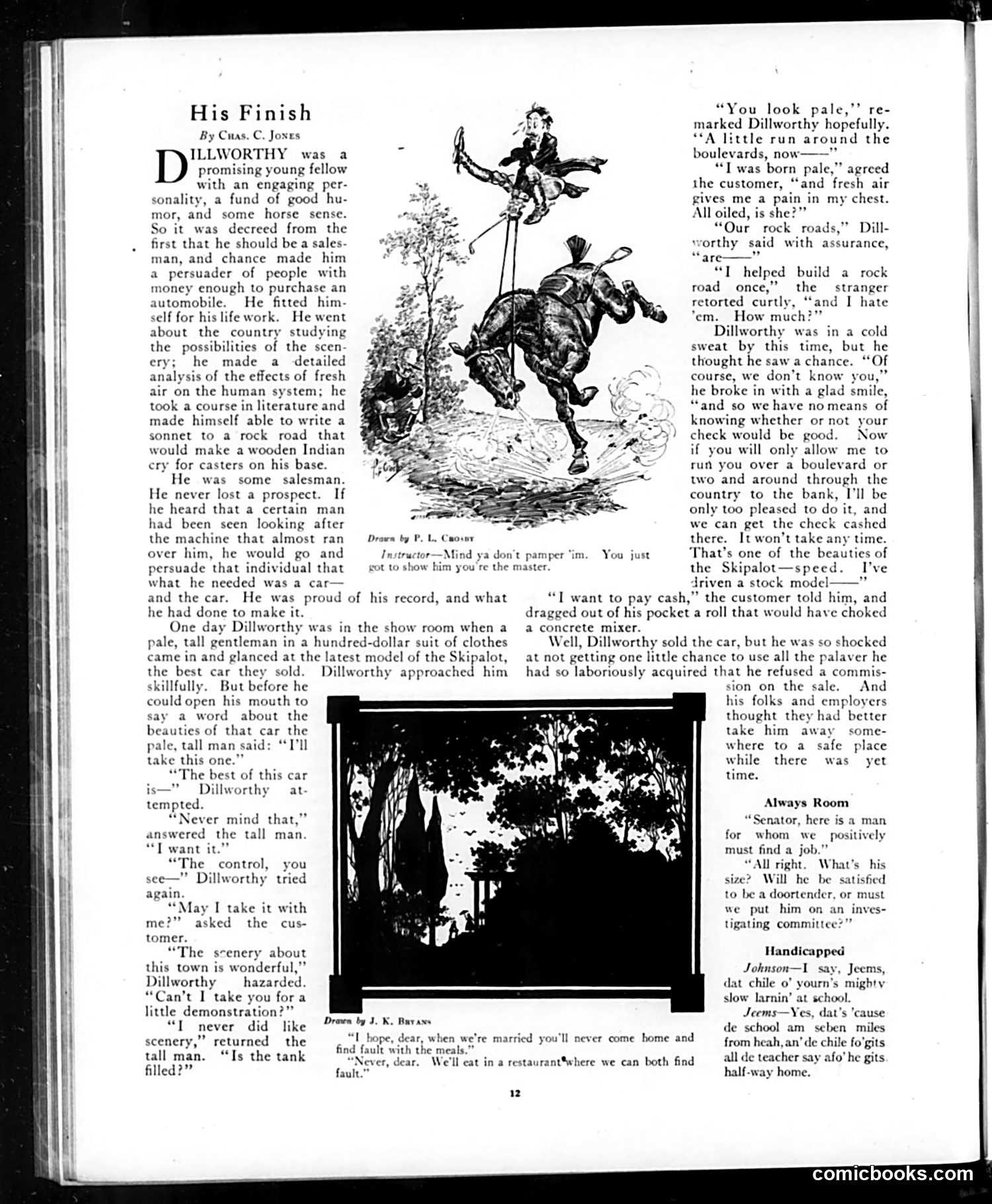
This story satirizes an overeager automobile salesman named Dillworthy who has perfected the art of persuasion through prepared pitches about scenery, fresh air, and road conditions. His comeuppance arrives when a wealthy customer simply walks in, declares "I'll take this one," and wants to buy immediately—with cash. Dillworthy is devastated. He's prepared elaborate sales techniques about rock roads, boulevards, and automotive features, but this customer wants none of it. The customer refuses every attempted demonstration, won't listen to benefits, and just wants the car. Dillworthy is so shocked at being denied his chance to deploy his carefully-honed verbal skills that he refuses his commission. The satire mocks salesmen who become so invested in their own rhetorical performance that they lose sight of the actual goal—closing the sale. The irony: Dillworthy "never lost a prospect," yet loses his composure when a prospect makes his job effortless.
📄 Transcribed text from this page (OCR, searchable)
Machine-transcribed from the original scan — historical spelling and the odd misread are preserved.
His Finish By Cuas. C. Jones ILLWORTHY was a promising young fellow with an engaging per- sonality, a fund of good hu- mor, and some horse sense. So it was decreed from the first that he should be a sales- man, and chance made him a persuader of people with money enough to purchase an automobile. He fitted him self for his life work. He went about the country studying the possibilities of the scen ery; he made a_ detailed analysis of the effects of fresh air on the human system; he took a course in literature and made himself able to write a sonnet to a rock road that would make a wooden Indian cry for casters on his base. He was some salesman. He never lost a prospect. If he heard that a certain man had been seen looking after the machine that almost ran over him, he would go and persuade that individual that what he needed was a car— Drown by P. L Instructor got to show h -M m you're the master and the car. He was proud of his record, and what he had done to make it. One day Dillworthy was in the show room when a “You look pale,’’ re- marked Dillworthy hopefully. “*A little run around the boulevards, now——” “T was born pale,” agreed the customer, ‘and fresh air gives me a pain in my chest. All oiled, is she?” “Our rock roads,” Dill- worthy said with assurance, “are te “T helped build a rock road once,” the — stranger retorted curtly, ‘“‘and I hate ‘em. How much?” Dillworthy was in a cold sweat by this time, but he thought he saw a cchance. “Of course, we don’t know you,” he broke in with a glad smile, “and so we have nomeans of knowing whether or not your check would be good. Now if you will only allow me to run you over a boulevard or two and around through the country to the bank, I'll be only too pleased to do it, and we can get the check cashed there. It won’t take any time. That’s one of the beauties of the Skipalot—speed. I've driven a stock model ” “T want to pay cash,” the customer told him, and dragged out of his pocket a roll that would have choked pale, tall gentleman in a hundred-dollar suit of clothes came in and glanced at the latest model of the Skipalot, the best car they sold. Dillworthy approached him skillfully. But before he could open his mouth to say a word about the beauties of that car the pale, tall man said: “I'll take this one.” he best of this car Dillworthy at- tempted. “Never mind that,” answered the tall man. “T want it.” “The control, you see—"” Dillworthy tried again. “May I take it with me?” asked the cus- tomer. “The scenery about this town is wonderful,” Dillworthy — hazarded. “Can't I take you fora little demonstration? “T never did like 2" scenery,” returned the tall man. “Is the tank filled?” fault.” is— J. K. Buy ars “I hope, dear, when we're married you'll never come home and find fault with the meals. “Never, dear. We'll cat in a restaurant®where we can both find 12 a concrete mixer. Well, Dillworthy sold the car, but he was so shocked at not getting one little chance to use all the palaver he had so laboriously acquired that he refused a commis- sion on the sale. And his folks and employers thought they had better take him away some- where to a safe place while there was yet time. Always Room “Senator, here is a man for whom we positively must find a job.”” “AM right. What's his size? Will he be satisfied to be a doortender, or m we put him on an inves- tigating committee?” Handicapped Johnson—I say, Jeems, dat chile 0’ yourn’s mighty slow larnin’ at schoo! Jeems—Yes, dat’s ‘cause de school am seben miles from heah, an’ de chile fo’gits all de teacher say afo’ he gits half-way home. comicbooks.com