
A complete issue · 36 pages · 1919
Judge — September 6, 1919
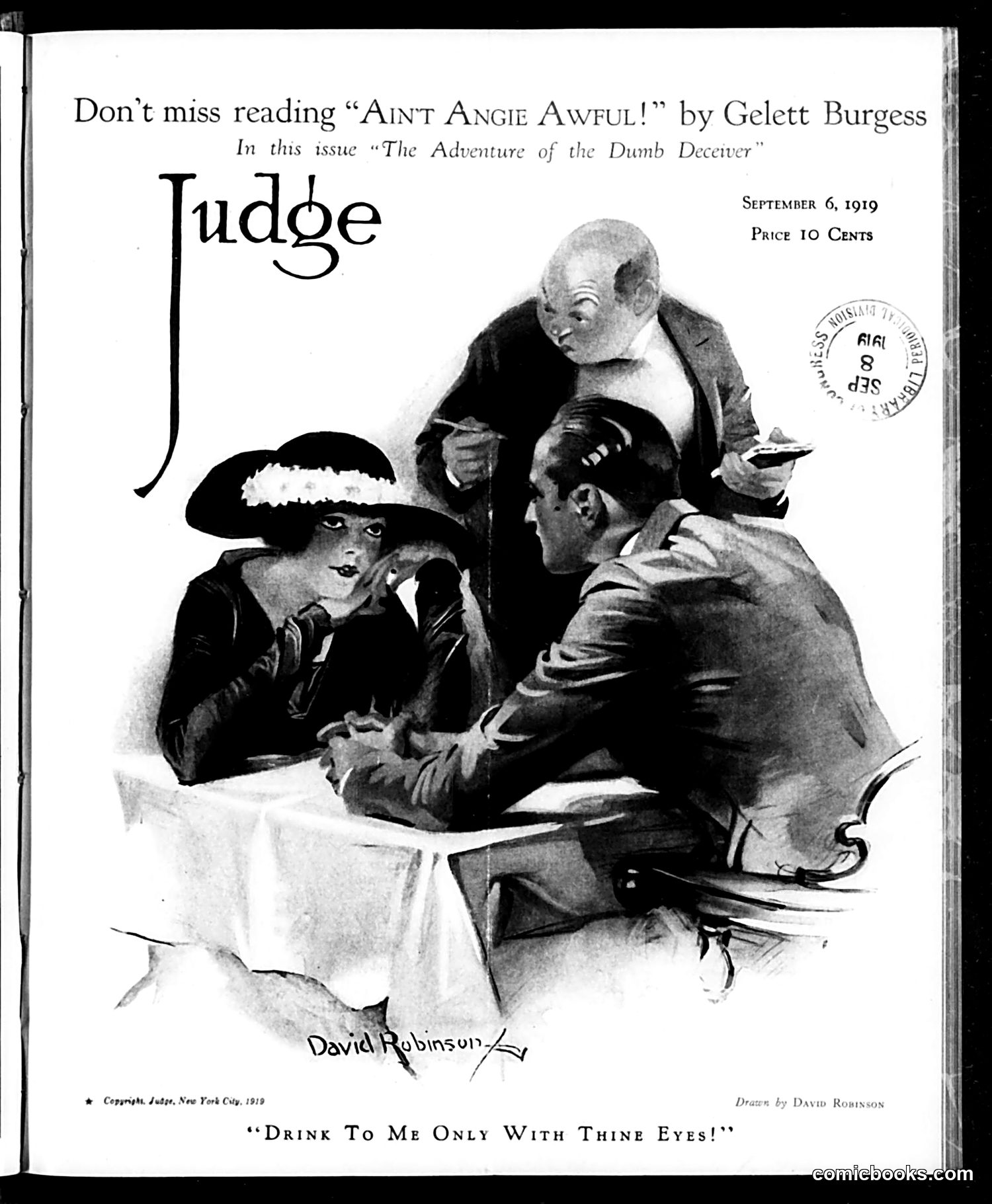
This cover illustration by David Robinson depicts a courtroom scene titled "Drink To Me Only With Thine Eyes!" The cartoon shows a judge presiding over what appears to be a legal proceeding involving three other figures seated at a table. Given the 1919 date, this likely satirizes Prohibition-era enforcement or court cases related to alcohol. The title's reference to drinking "with thine eyes" (a famous poem/song) suggests ironic commentary on the new alcohol ban—implying people must now merely look at drinks rather than consume them. The judge's stern expression and the formal courtroom setting parody the serious legal machinery being deployed against alcohol use during early Prohibition enforcement.

This page is primarily **advertising**, not satirical editorial content. It promotes "The World's Best Stories," a multi-volume collection of 1,260+ humorous and philosophical anecdotes marketed for business and social situations. The advertisement features a photograph of two men in business attire at a desk—likely meant to represent a salesman closing a deal through skillful storytelling. The pitch emphasizes that good stories are effective business tools, referencing Abraham Lincoln's famous use of humor in persuasion. The text describes various story categories (Irish, Scotch, Italian, Hebrew anecdotes) and highlights 81 prize-winning stories from a contest. The collection is framed as practical and economical for early 20th-century readers seeking conversational material. This reflects period attitudes valuing storytelling as a valued social and professional skill.
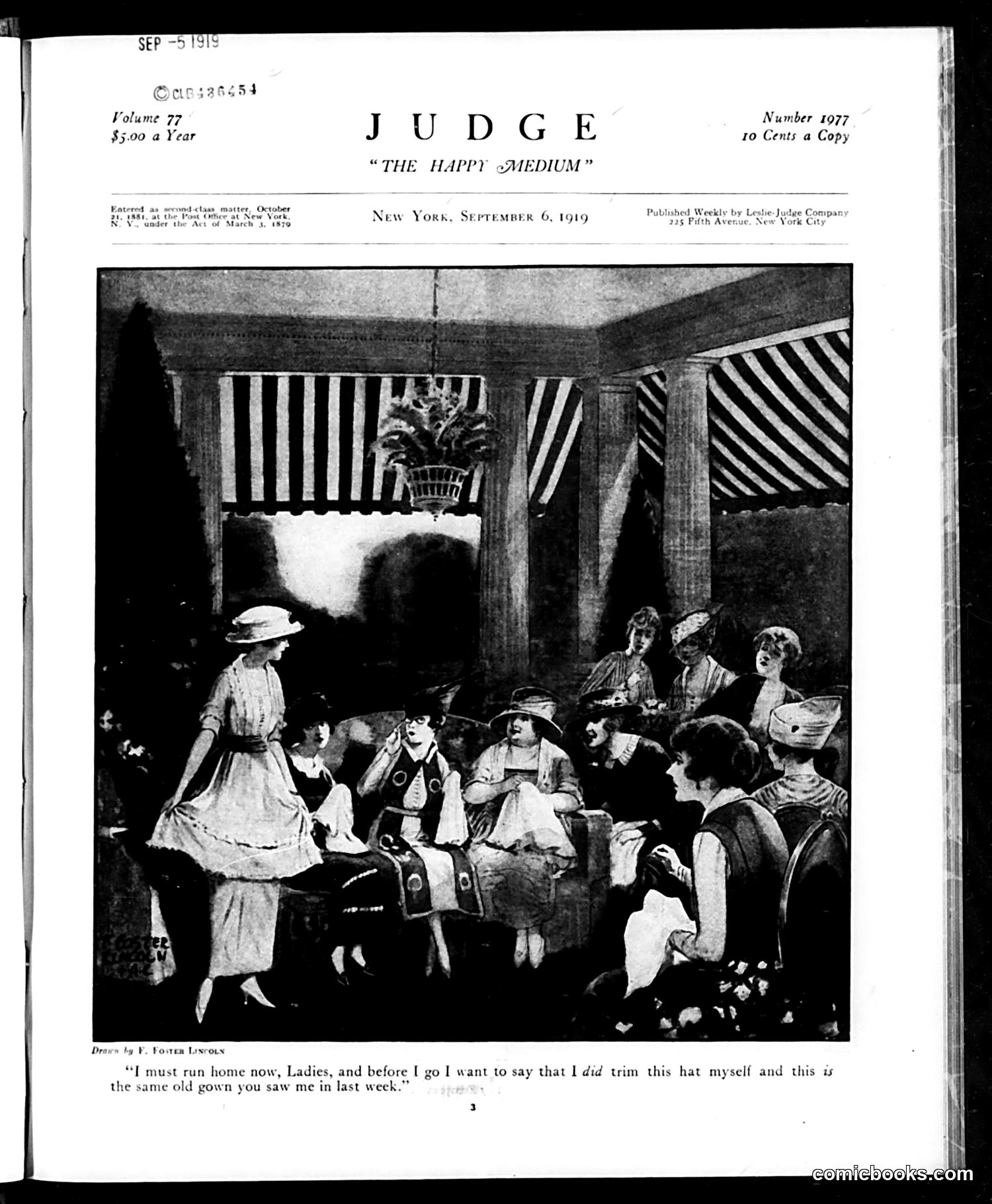
This page from *Judge* magazine (September 6, 1919) shows a theatrical or social scene with women in a drawing room setting, with one woman standing and addressing seated ladies. The caption quotes a woman saying she trimmed her hat herself and it's "the same old gown you saw me in last week." This appears to be gentle satire about **post-WWI fashion economy** — women making do with existing garments by altering accessories rather than buying new clothes. The striped awnings visible in the background and the domestic interior suggest a leisured, upper-class setting, making the self-trimming of hats somewhat ironic for that social class. The joke likely mocks either women's fashion consciousness during economic constraints or their attempts to appear fashionable through minor modifications. The overall tone is light rather than biting social criticism.
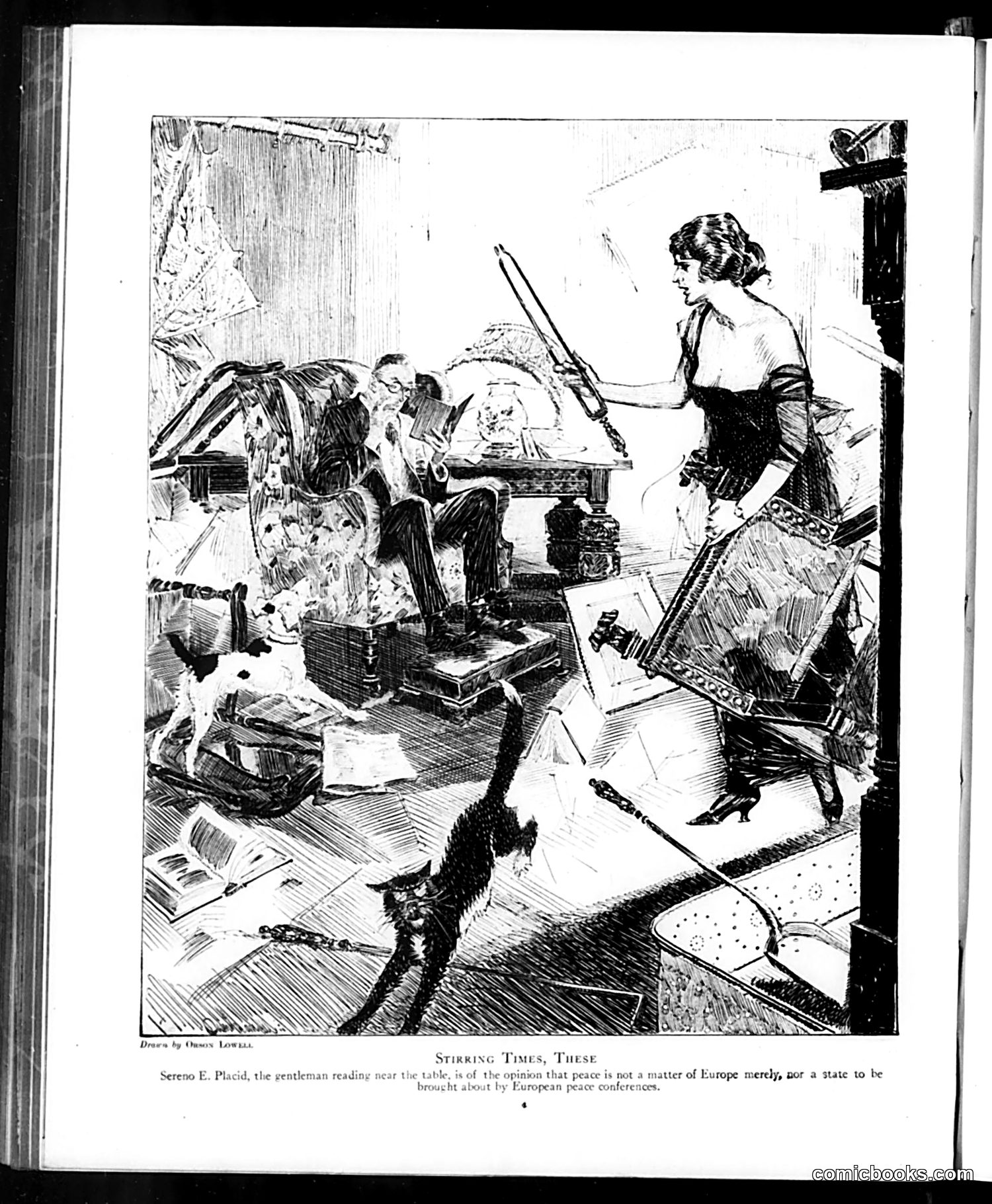
This political cartoon depicts a domestic scene where a woman gestures forcefully with a broom at a seated man reading near a table, while dogs play on the floor. The caption identifies the man as "Sereno E. Placid," who holds the opinion that "peace is not a matter of Europe merely, nor a state to be brought about by European peace conferences." The satire appears to target complacency about international peace efforts, likely referencing post-WWI peace negotiations. The joke contrasts Placid's detached, philosophical musings about European peace with the immediate domestic turbulence around him—suggesting that peace cannot be achieved through distant diplomatic conferences when chaos exists at home. The woman's aggressive stance with the broom implies domestic discord makes such lofty ideals laughable.
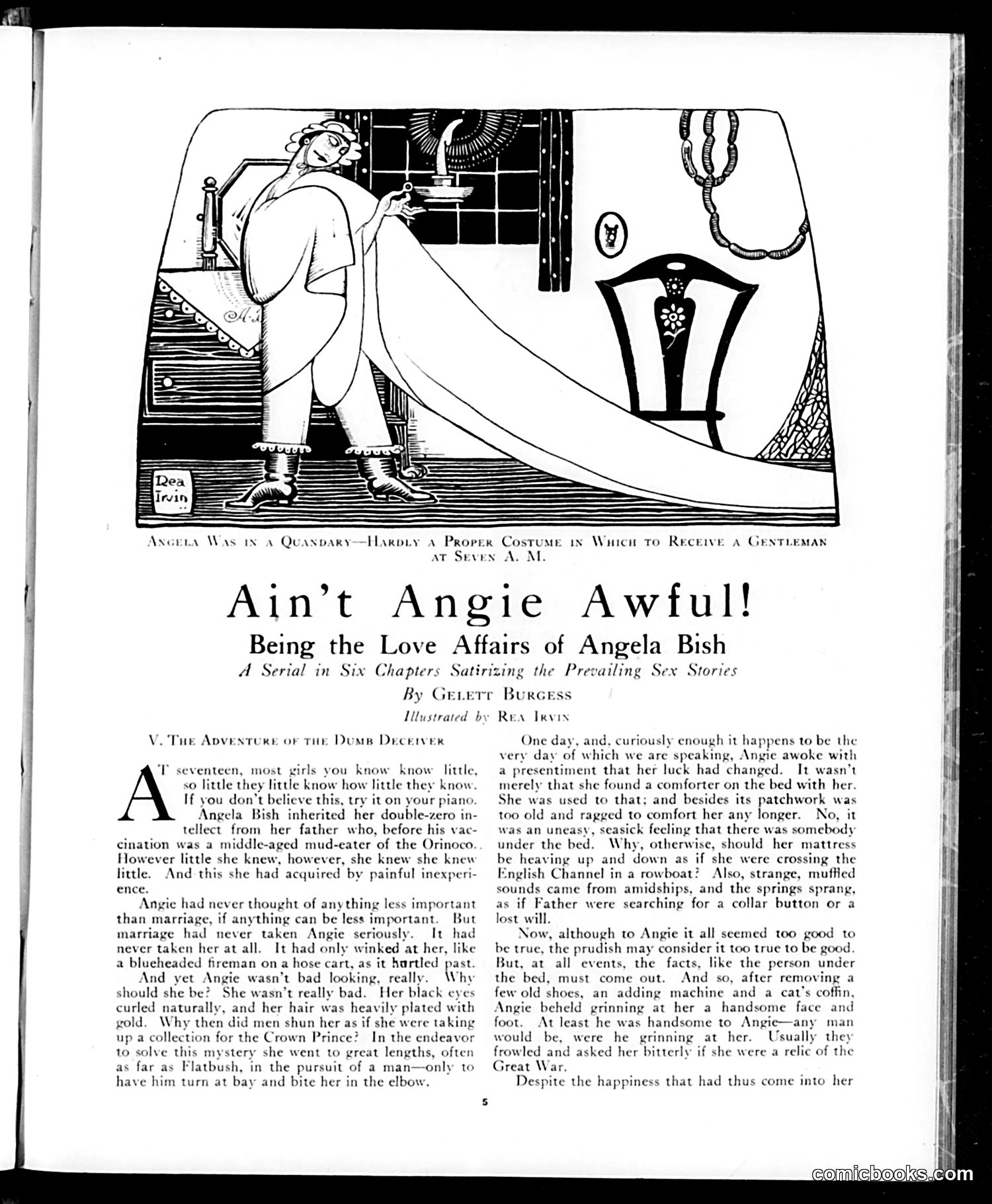
This is a serialized humor piece satirizing a character named Angela Bish through exaggerated romantic misadventures. The illustration shows Angela in a nightgown receiving a gentleman caller at 7 A.M.—an improper hour suggesting scandal or poor judgment. The satire targets young women's behavior and romantic pursuits in the early 20th century. Angela is portrayed as incompetent at courtship despite her interest in marriage. The text emphasizes her inherited lack of intelligence ("double-zero intellect") and describes comic domestic mishaps—a comforter under the bed, strange sounds from the English Channel. The humor relies on period attitudes mocking women's intelligence and romantic aspirations, presenting Angela's failures as inherently amusing rather than sympathetic.
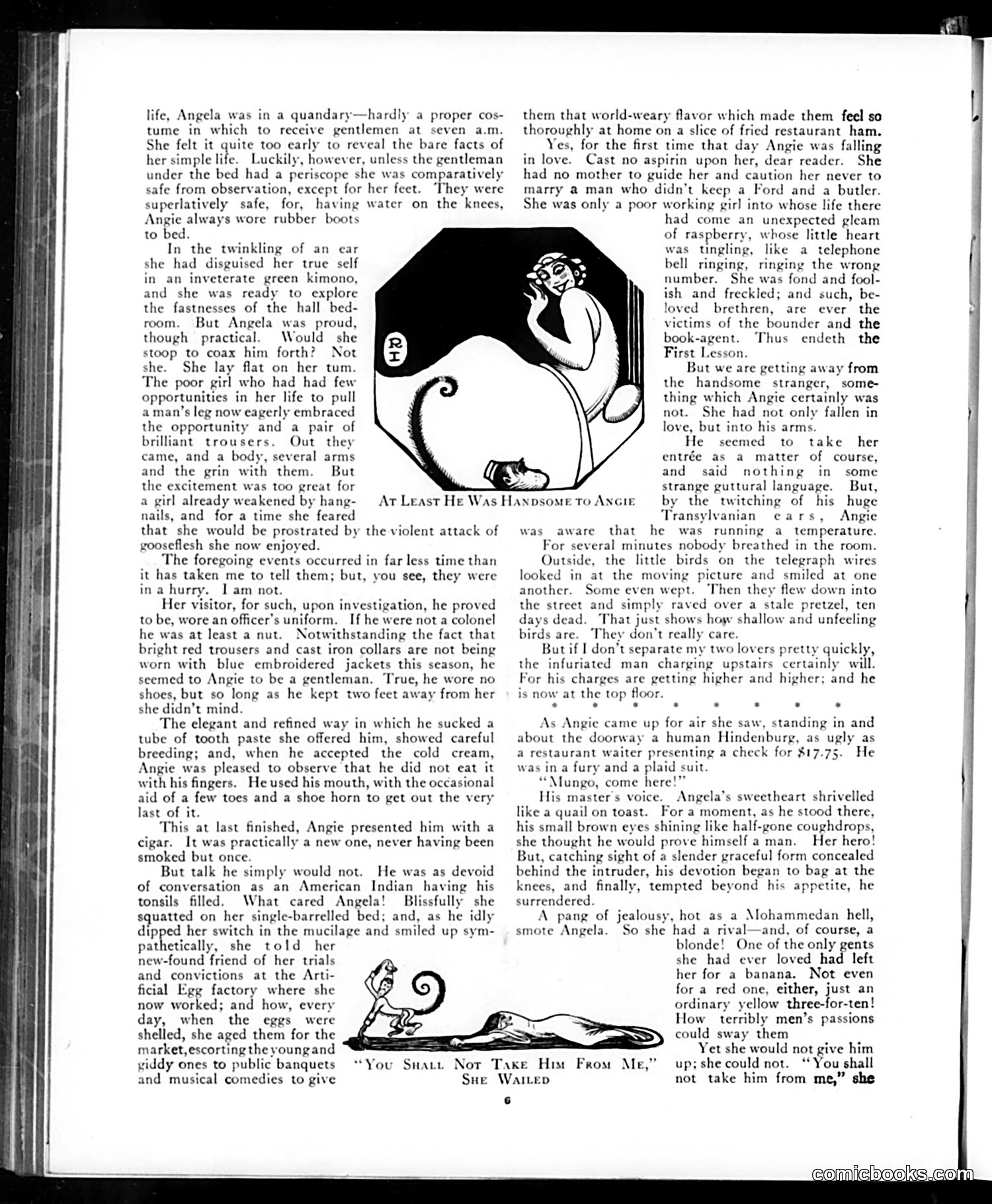
This page contains a serialized romance story titled "The First Lesson" with two illustrations. The narrative follows a young woman named Angie who falls in love with an officer in a military uniform—described as having "bright red trousers and cast iron collars." The illustrations depict romantic scenes: one shows the couple in an intimate moment ("At Least He Was Handsome to Angie"), and another shows a woman in distress with the caption "You Shall Not Take Him From Me," She Wailed." This is not political satire but rather sentimental fiction typical of Judge magazine's era. The story explores themes of class difference and romantic rivalry common to early 20th-century popular literature. The military uniform suggests the story may have been published around WWI, though the exact date isn't specified.
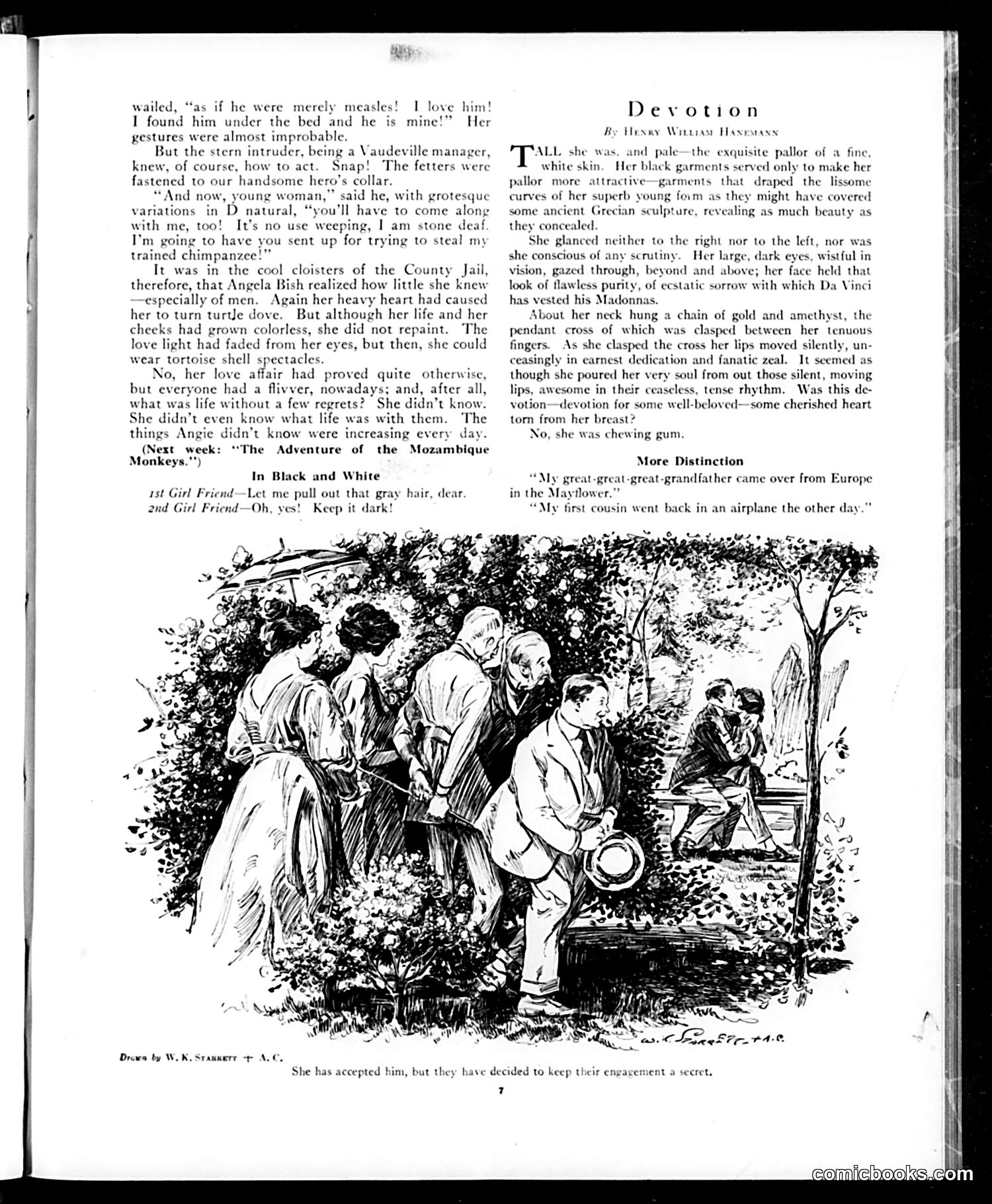
This page contains three distinct pieces of satirical content: **"Angela Bish" Serial Story**: A comedic narrative about a woman who falls in love with what she believes is a man but is actually a trained chimpanzee belonging to a vaudeville manager. She's arrested for theft. The satire mocks romantic naivety and female sentimentality—the joke being that she can't distinguish between human and animal, suggesting women's poor judgment in matters of love. **"In Black and White" Dialogue**: Two women discuss keeping gray hair dark. This is mild satire on vanity and women's concern with appearance. **"Devotion" Story with Illustration**: Describes a pale, ethereal woman appearing deeply spiritual—clutching a cross, lips moving in apparent prayer. The punchline: she's chewing gum. This satirizes the performative nature of female piety and the gap between outward religious devotion and actual inner life. **The Illustration**: Shows a group in a garden setting with the caption about a secret engagement—typical romantic comedy fodder for the era. Overall, the page reflects early 20th-century satirical attitudes toward women as silly, vain, and hypocritical.
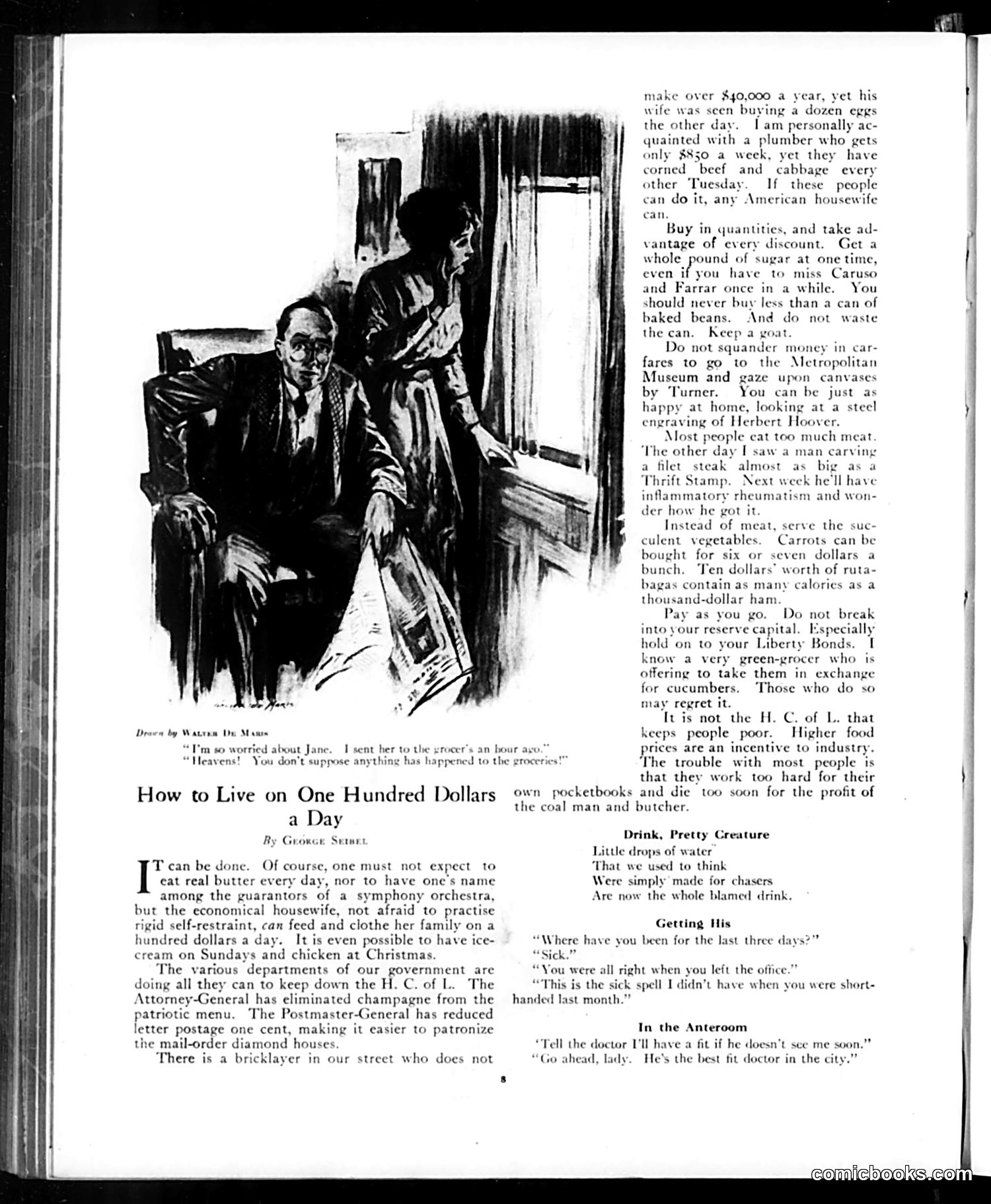
This is satirical advice on wartime economy, likely from WWI era (references to Liberty Bonds, Thrift Stamps). The author George Street mocks both wealthy people claiming poverty and working-class people who somehow manage on pittances—exposing the hypocrisy of the era's "cost of living" (H.C. of L.) crisis. The illustration shows a worried man and woman, captioned about sending "Jane" to the grocer with implied disaster. Street's "advice" drips with irony: skip opera tickets, buy vegetables instead of expensive meat, don't visit museums, embrace strict rationing. The recurring joke is that the wealthy complain while the poor actually achieve what they claim is impossible. The subheadings ("Drink, Pretty Creature," "Getting His," "In the Anteroom") contain brief, darkly comic vignettes about drinking, workplace illness, and medical visits—satirizing contemporary social problems alongside economic pretense.
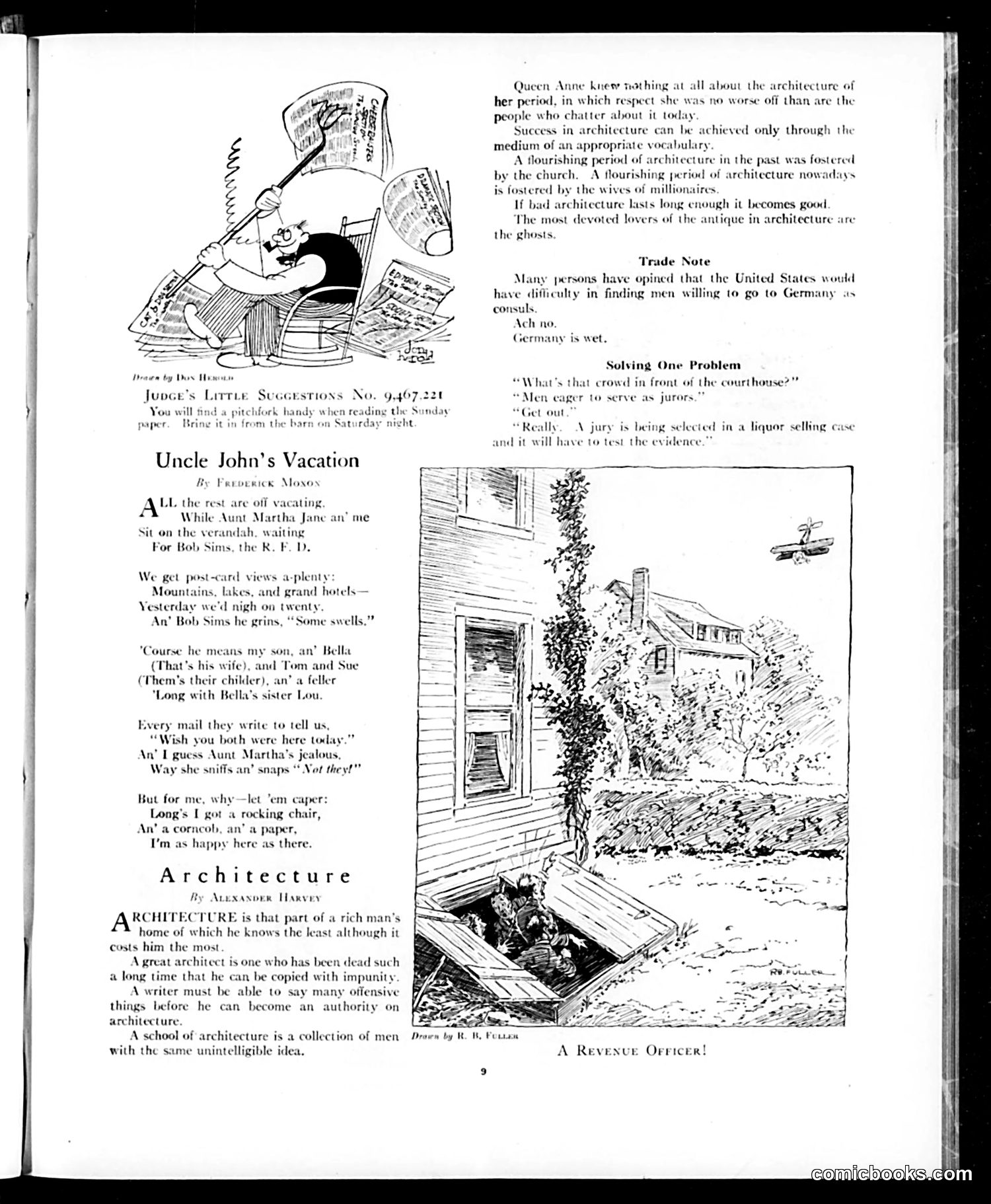
This page contains three satirical pieces typical of early-20th-century American humor: **"Uncle John's Vacation"** is a humorous poem about a rural couple staying home while relatives vacation at fancy resorts. The R.F.D. (Rural Free Delivery) mailman brings postcards of mountains and hotels. Uncle John, content with his rocking chair and corncob pipe, remains unbothered by their boasting—gentle satire of class aspiration and rural contentment. **"Architecture"** by Alexander Harvey offers sardonic one-liners mocking architectural pretension: that rich owners know nothing about their homes' design, dead architects are copied without penalty, and "bad architecture lasts long enough it becomes good." It satirizes both architectural snobbery and the wealthy wives of millionaires as architecture's modern patrons (replacing the Church). **"Solving One Problem"** is a brief joke about jury selection in a liquor-selling case, where men eagerly volunteer as jurors—likely satirizing Prohibition-era hypocrisy regarding alcohol enforcement. The cartoons use accessible humor targeting upper-class affectation and social contradictions.
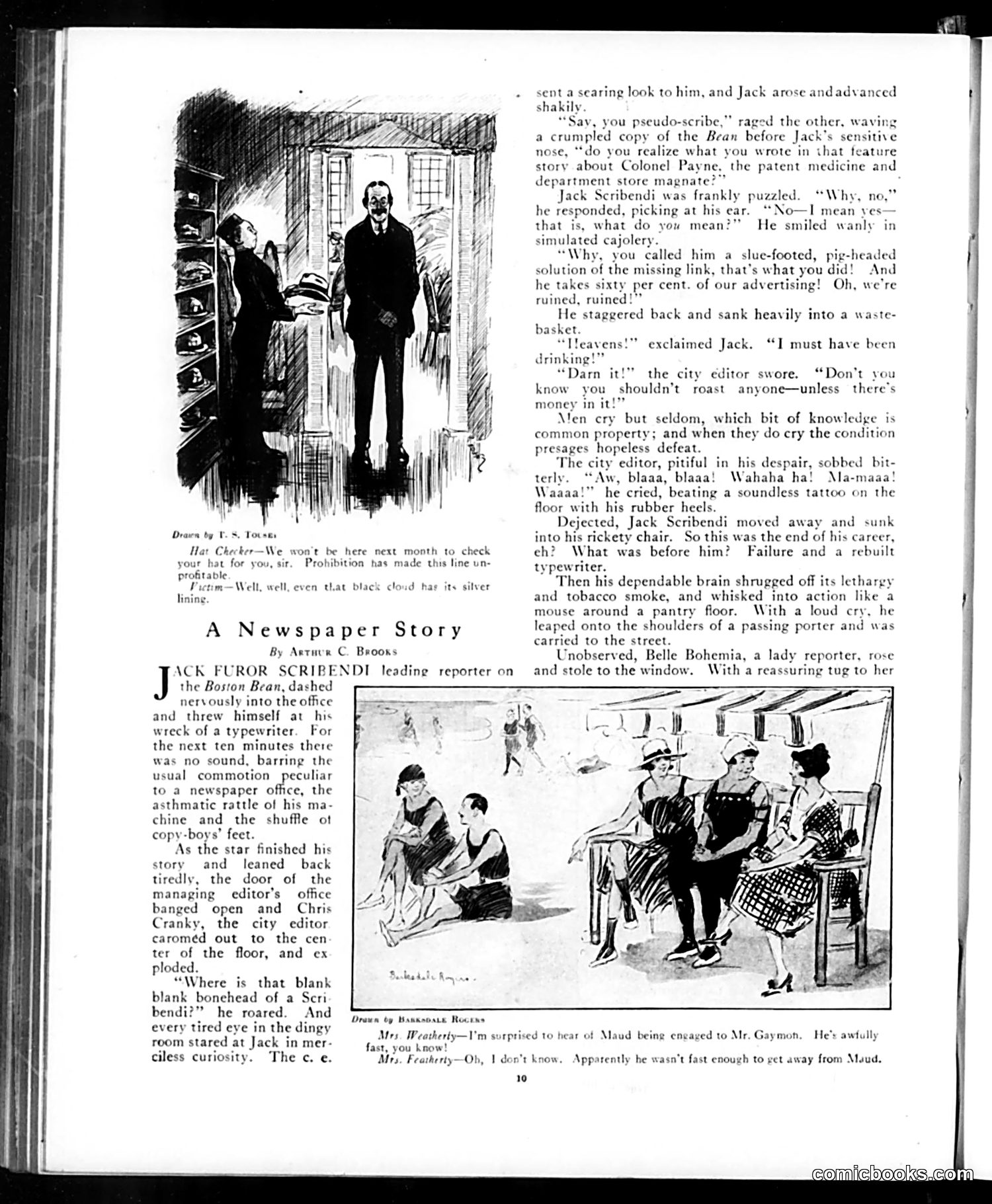
This humorous story satirizes early 20th-century newspaper culture and advertising corruption. Jack Scribendi, a reporter for the *Boston Bean*, writes a scathing feature story about Colonel Payne, a patent medicine and department store magnate—calling him a "slue-footed, pig-headed solution of the missing link." The joke: The city editor Chris Cranky doesn't care about journalistic integrity. He's furious because Payne spends 60% of their advertising revenue there. The editor prioritizes profits over truth, famously declaring "Don't you know you shouldn't roast anyone—unless there's money in it!" The satire targets the hypocrisy of newspapers claiming editorial independence while actually serving advertisers' interests. It reflects Progressive Era concerns about corporate influence on press freedom. The editor's melodramatic breakdown (crying "blaaa, blaaa!") exaggerates this moral collapse for comedic effect.
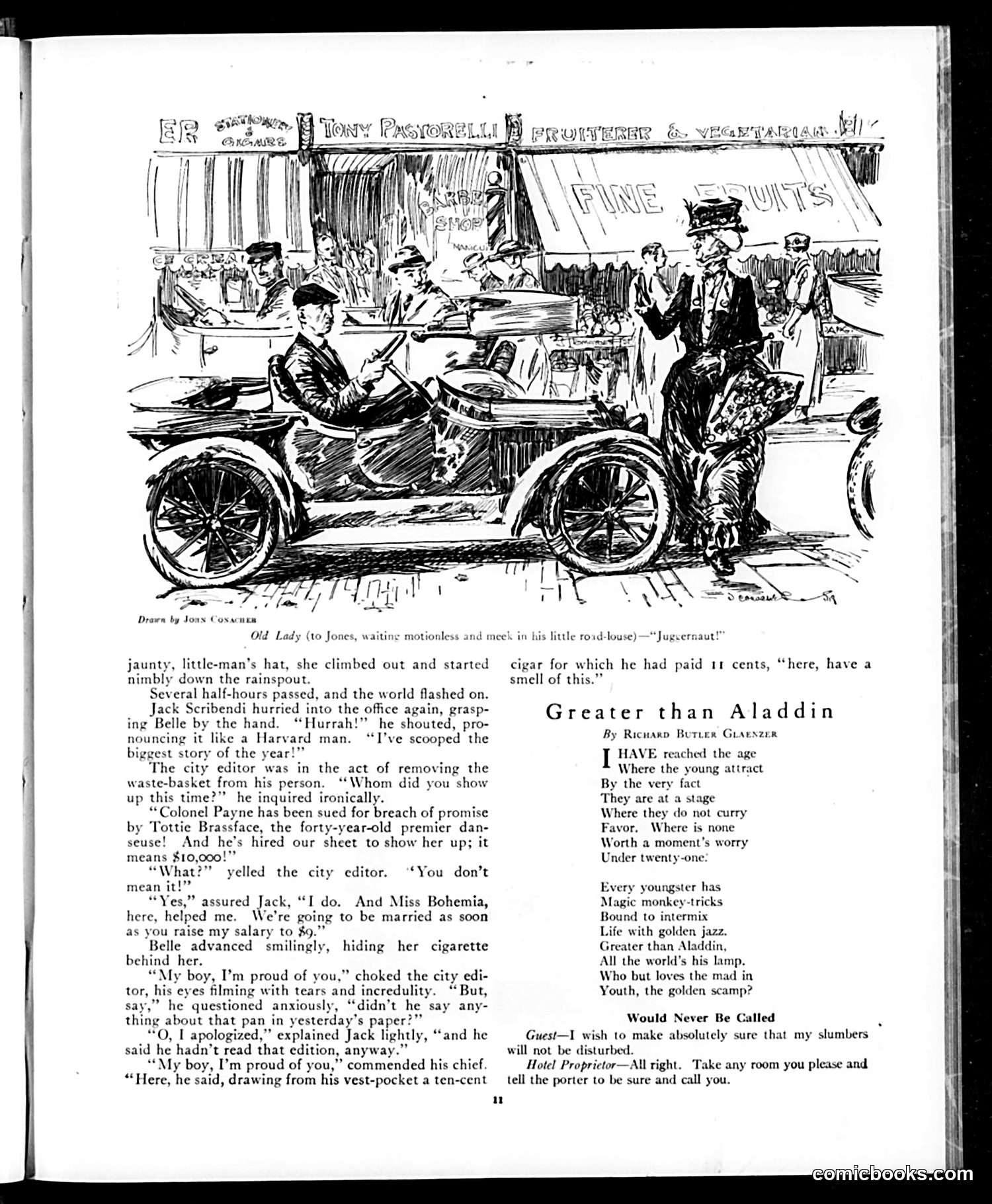
The top illustration depicts a humorous newspaper office scene. A young reporter named Jack Scribendi excitedly tells his city editor that he's secured a major scandal story: Colonel Payne is being sued for breach of promise by "Tottie Brassface, the forty-year-old premier danseuse" (dancer). The joke satirizes sensationalist journalism—Jack has essentially bribed or manipulated a subject into providing a scandalous story, paying $10,000 to the newspaper. The editor's emotional response and his reward of a cheap cigar (paid 11 cents, offered as if valuable) mocks both the editor's easily-manipulated sentimentality and the ethics of yellow journalism. The bottom section contains poetry ("Greater than Aladdin") celebrating youth's magical appeal, and a brief hotel joke playing on miscommunication about "calling" guests—the guest fears disturbance while the proprietor assumes "call" means wake-up service. The cartoons appear to mock journalistic corruption and sensationalism prevalent in early 20th-century American newspapers.
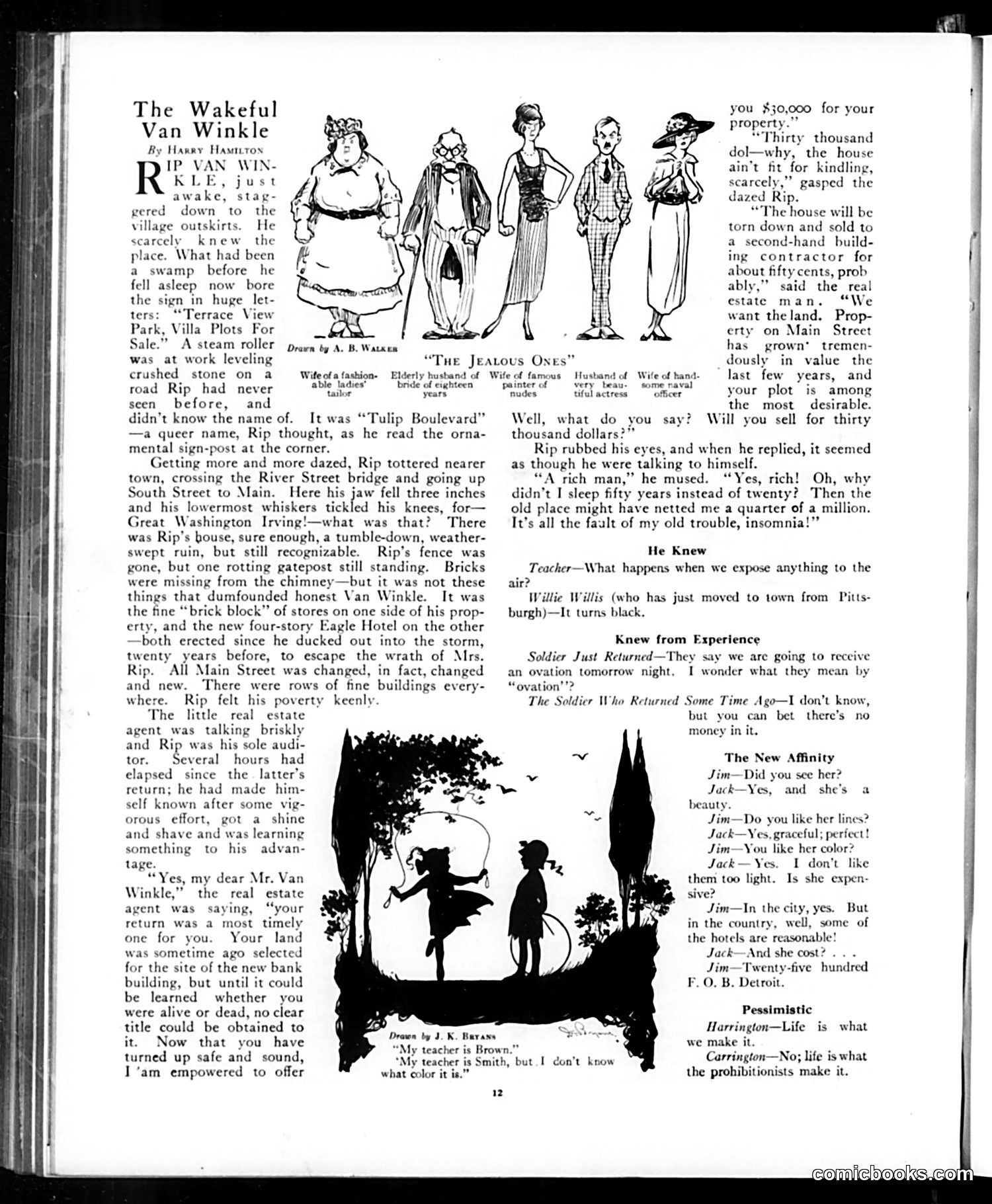
This story parodies Washington Irving's "Rip Van Winkle," updating it to satirize early-20th-century American urban sprawl and real estate speculation. Rip awakens to find his rural village transformed: swampland converted to "Terrace View Park," his family home surrounded by commercial development (a brick block of stores, a new Eagle Hotel), and Main Street lined with fine buildings. The satire's target: rapid, speculative development that enriches landowners while destroying the old character of communities. The real estate agent offers Rip $30,000 for his worthless property—a fortune. Rip's bitter joke captures the irony: he slept through twenty years of growth and missed becoming wealthy through passive land ownership, had he only stayed awake and patient. The accompanying cartoons and quips about teachers, soldiers, and social types fill the remaining space—typical Judge magazine filler humor requiring less historical context to understand the simple gags.
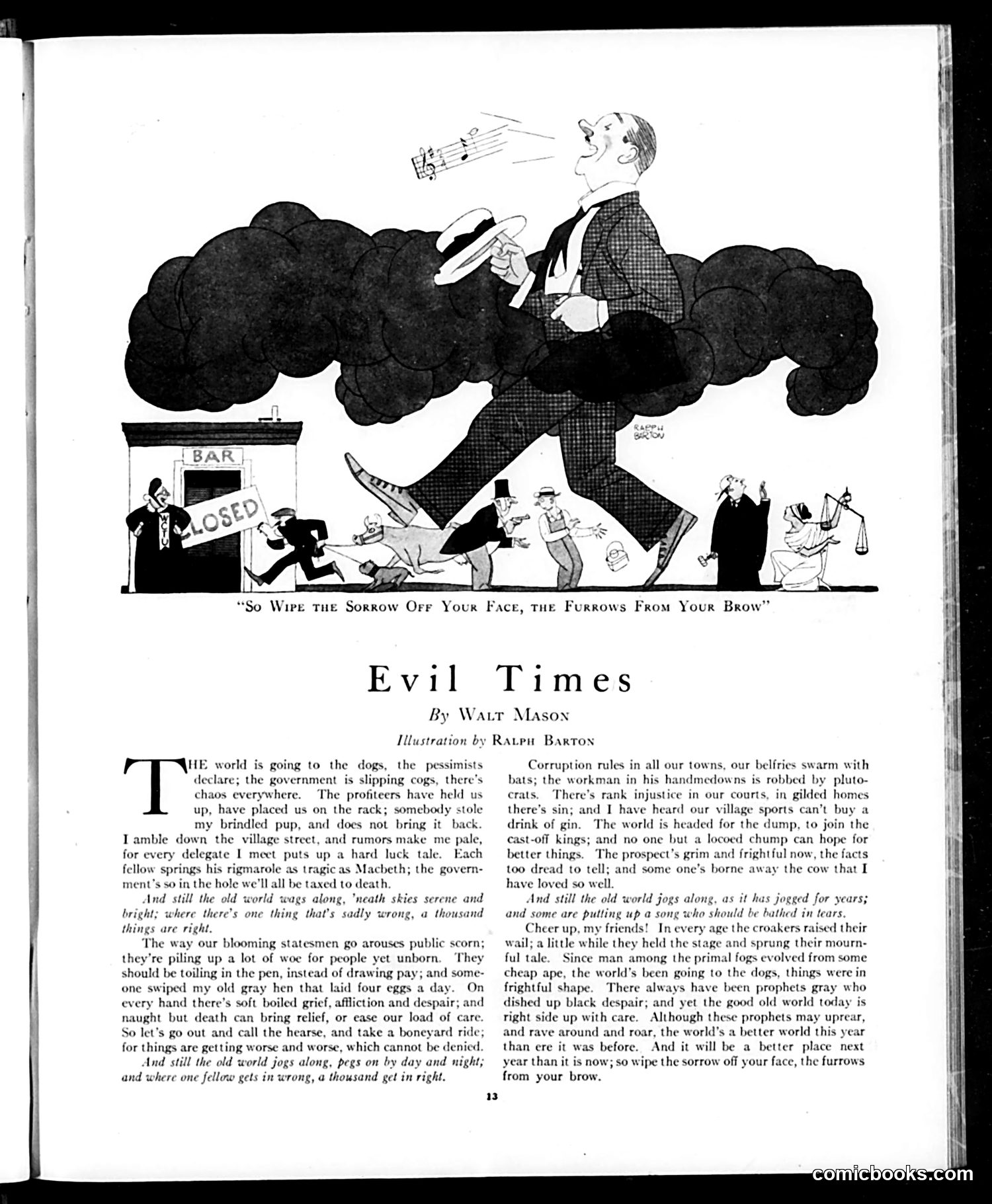
This is a satirical poem with Ralph Barton's accompanying illustration mocking pessimism during what appears to be a period of post-WWI economic turbulence and Prohibition (the "CLOSED" bar sign is visible). **The Satire's Point:** Mason criticizes chronic complainers and "prophets of doom" who obsess over genuine social problems—corruption, injustice, profiteering, government incompetence—while ignoring that the world fundamentally persists and improves. The refrain "the world still jogs along" undercuts apocalyptic doom-saying. **The Cartoon:** Shows a well-dressed man striding confidently through chaos: a closed bar, distressed figures, spilled bottles, and financial disorder. He's singing cheerfully despite the surrounding "evil times." Musical notes stream from his mouth—visualizing Mason's ironic message that optimism, not justified grievance, should prevail. **For Modern Readers:** This reflects a recurring American rhetorical move: dismissing legitimate complaints about systemic problems as mere negativity. The cartoon's central figure embodies willful obliviousness to documented corruption and suffering.
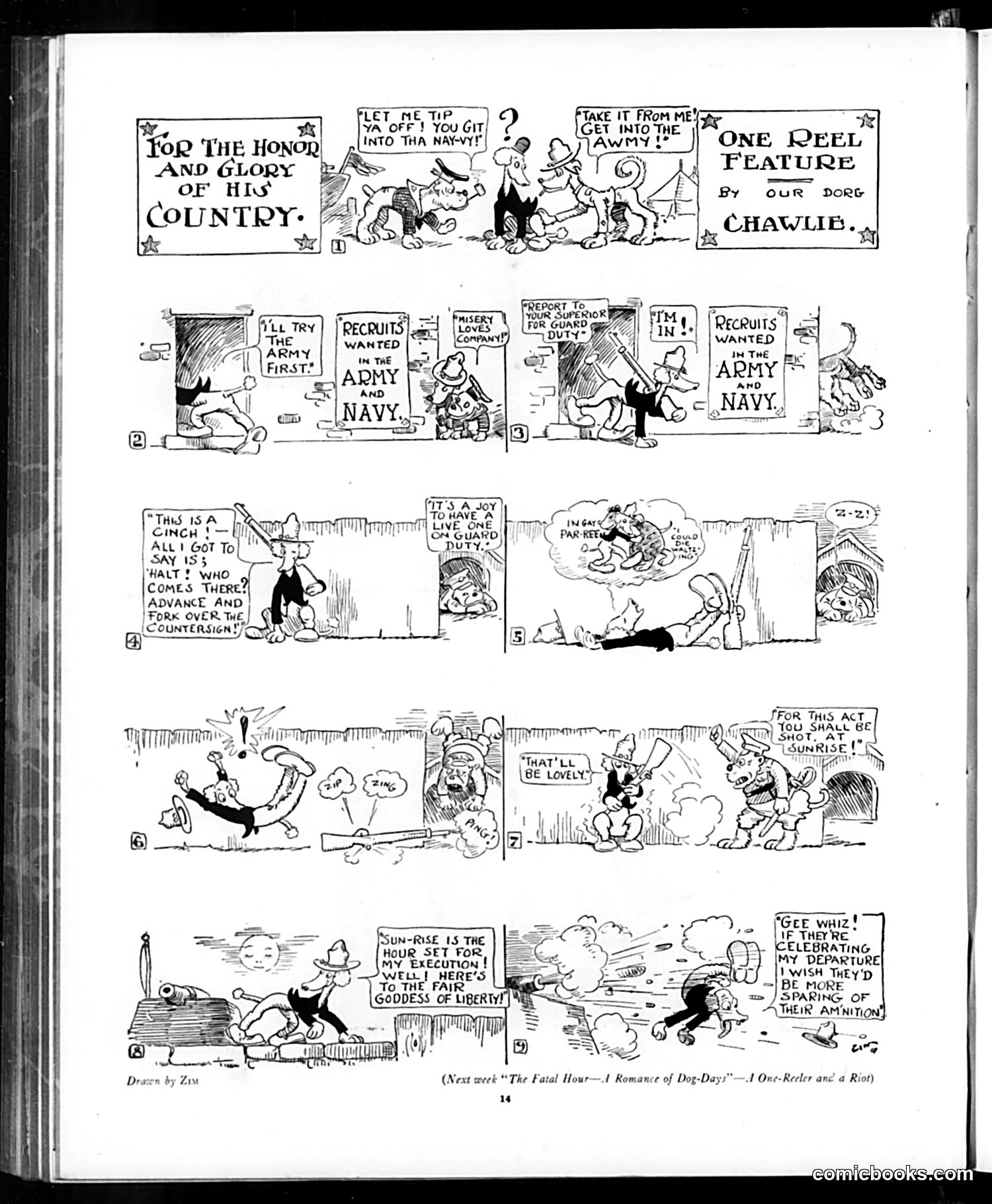
This is a humorous comic strip satirizing World War I recruitment and military life through the eyes of a dog character named "Chawlie." The narrative follows the dog's patriotic enlistment ("try the army first"), his encounter with recruitment posters, and his subsequent military experiences. The satire targets several aspects of WWI-era America: the aggressive recruitment campaigns promising honor and glory, the gap between recruitment promises and harsh battlefield reality (depicted through the dog's increasingly chaotic experiences), and the waste of ammunition in combat. The dog's dialect ("nay-vee," "awny," "dorg") appears to mock urban speech patterns, possibly reflecting contemporary ethnic stereotypes. The final panel's complaint about excessive ammunition expenditure likely references real debates about military resource allocation during the war. The comic uses slapstick physical humor and an anthropomorphic protagonist—common in Judge magazine's style—to make social commentary about patriotic propaganda versus military reality.
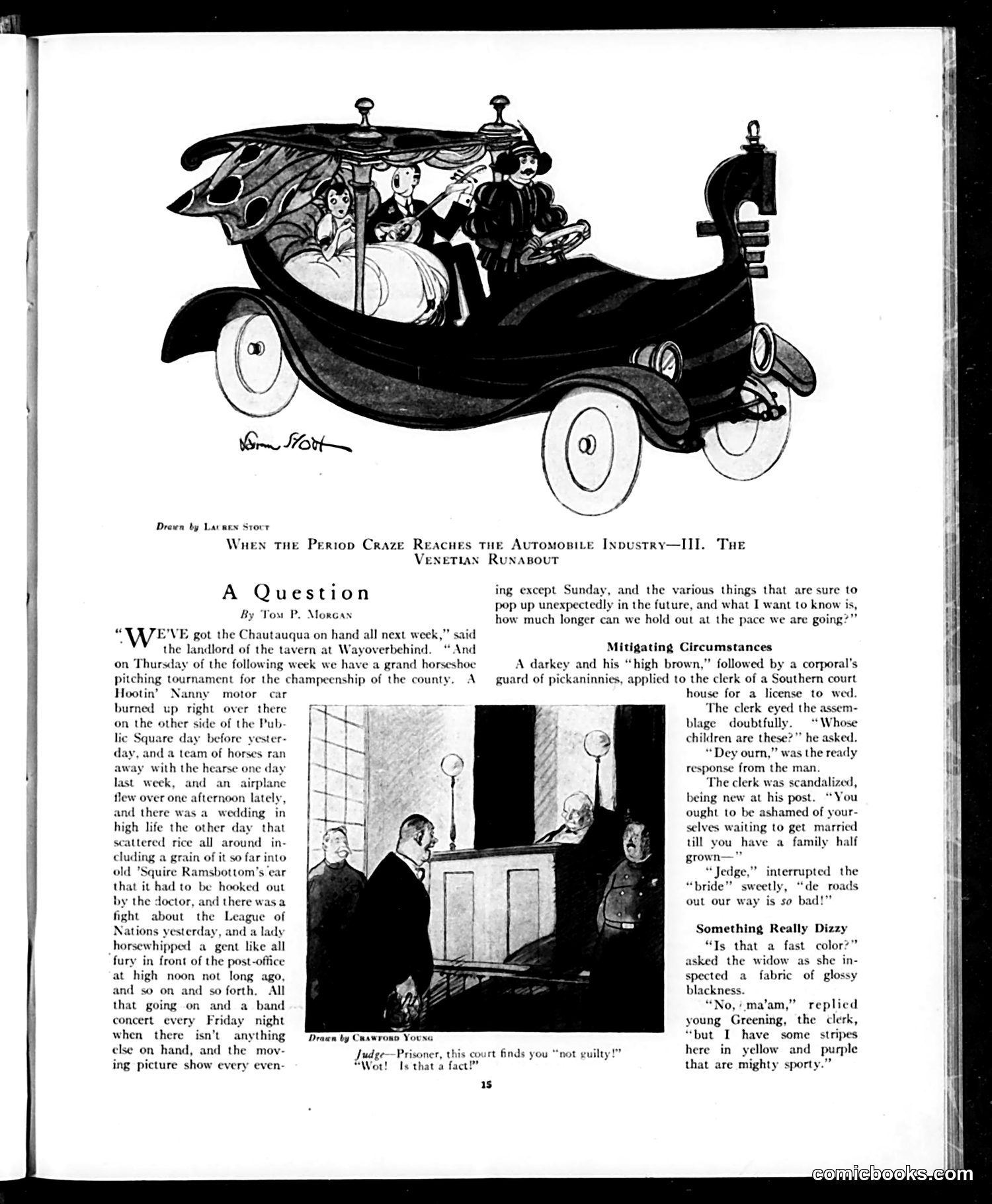
**Top Illustration**: "The Venetian Runabout" satirizes the automobile industry's adoption of ornate, impractical design trends. The car's exaggerated gondola-like canopy with elaborate drapery mocks period crazes for decorative excess applied to motorcars—a running Judge series theme about fashion fads reaching manufacturing. **"A Question"** (left): A rambling rural anecdote about small-town chaos—competing events (Chautauqua, horseshoe tournament, burning cars, plane flights, weddings, League of Nations debates) create constant disruption. The satire critiques modern life's overwhelming pace and simultaneous triviality. **Court Scene** (center): Uses racist stereotypes common to period Judge humor. A Black couple seeking marriage licenses confuses a new clerk who objects to their children being born outside wedlock. The "humor" relies on racist caricature and dialect. **"Something Really Dizzy"** (right): A widow asks if a fabric's color fades. The clerk's joke—that it has garish yellow and purple stripes ("sporty" but not fast-dyed)—is mild wordplay. The page reflects 1920s-era concerns about rapid social change and contains now-offensive racial content typical of the era.
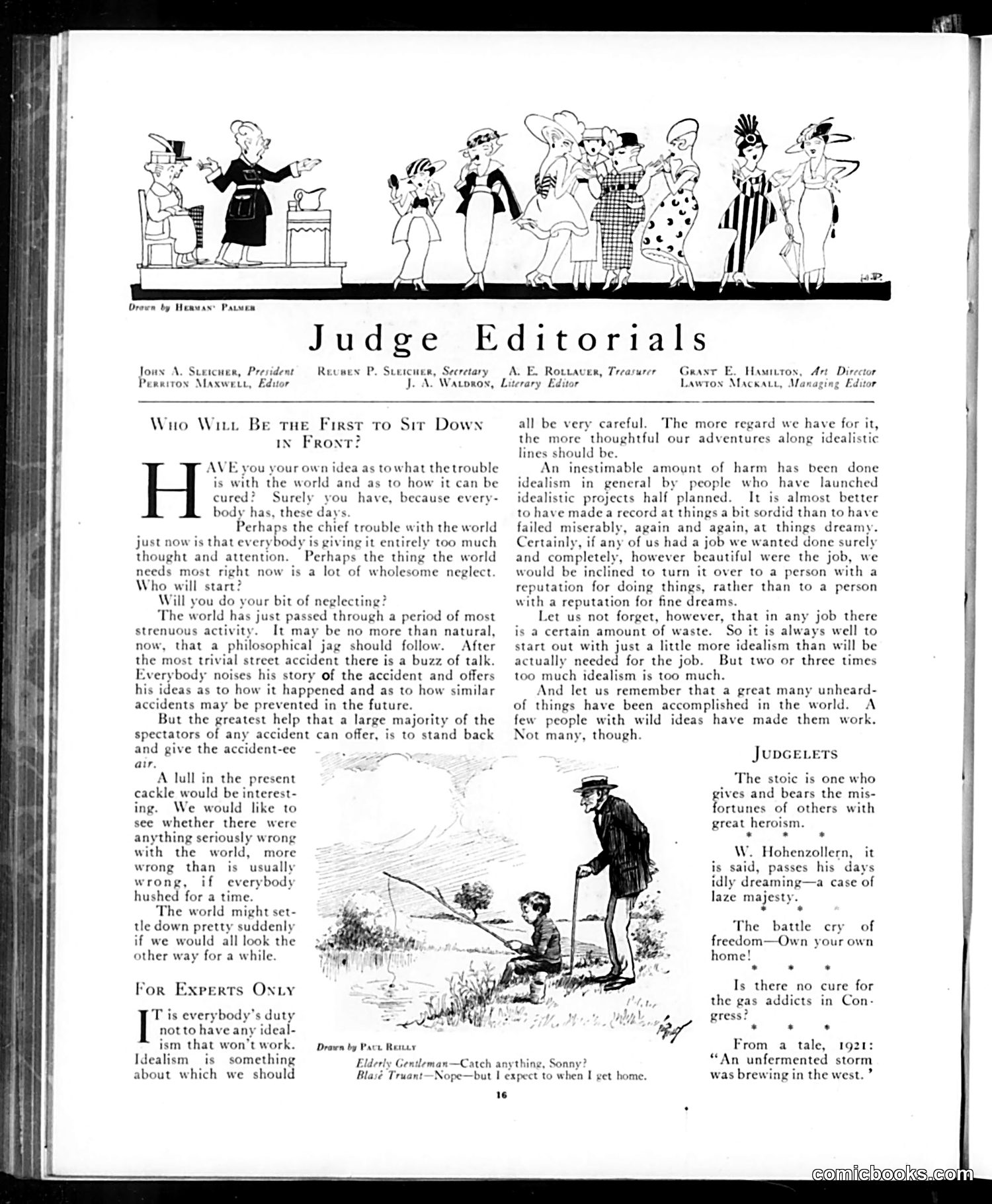
This is a Judge magazine editorial page addressing post-World War I American society's obsession with solving social problems through idealism. ## Main Editorial: "Who Will Be the First to Sit Down in Front?" The editors argue that the world suffers not from apathy but from *excessive* idealistic fervor. After WWI's "strenuous activity," they advocate for "wholesome neglect"—a deliberate pause in constant problem-solving and theorizing. The point: well-intentioned but poorly-planned idealistic projects cause more damage than modest, practical work. They warn against starting ventures with "too much idealism" and note that few idealists actually accomplish their goals. ## "Judgelets" (Sidebar Jokes) Quick satirical jabs at: - **W. Hohenzollern** (Kaiser Wilhelm II): Depicted as idly dreaming away in exile—mocking his powerlessness post-WWI - Generic social commentary on homeownership, gas addiction, and an unspecified 1921 storm ## Context This reflects post-WWI American skepticism toward progressive reformers and their grandiose schemes, favoring pragmatism over idealistic zeal.
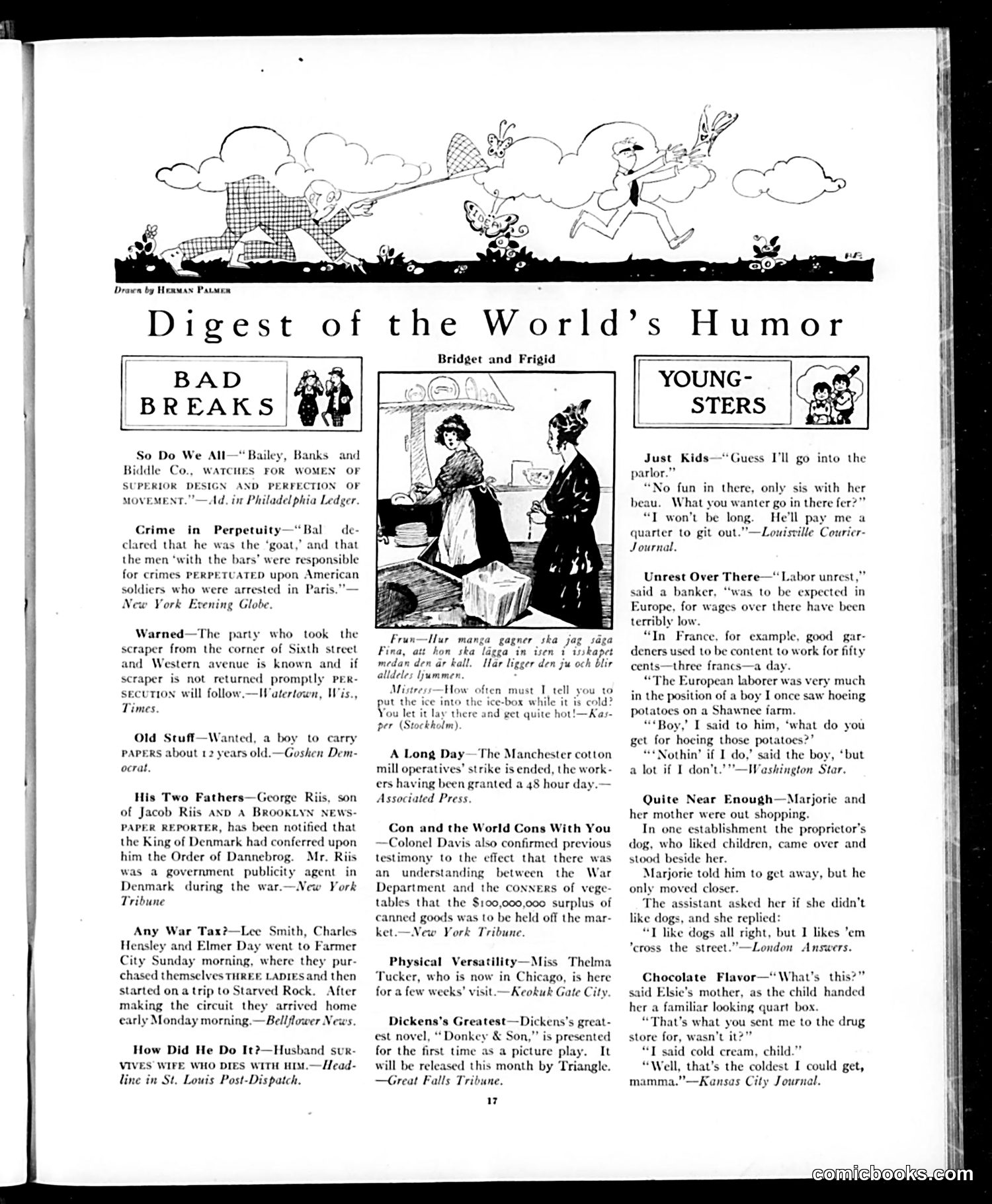
This is primarily a humor digest—short jokes and anecdotes rather than political cartoons. The top illustration (by Herman Palmer) depicts a playful scene of adults and children in clouds, setting a whimsical tone. The "Digest of the World's Humor" collects brief, humorous newspaper clippings and anecdotes organized by comedic premise. Examples include: - **"His Two Fathers"**: Satire on government publicity work—the son of famous reformer Jacob Riis receives a Danish honor despite his father's actual achievements. - **"Bridget and Frigid"**: A domestic comedy about a Swedish housewife; the humor relies on dialect and the wife's forgetfulness about storing ice properly. - **"Con and the World Cons With You"**: References post-WWI food surplus scandal, implying government conspiracy to artificially suppress vegetable prices. - **"Just Kids" and "Quite Near Enough"**: Standard domestic humor about children's naive logic and their bargaining with parents. The overall tone is light, observational American humor circa early 1920s, without apparent heavy political messaging.
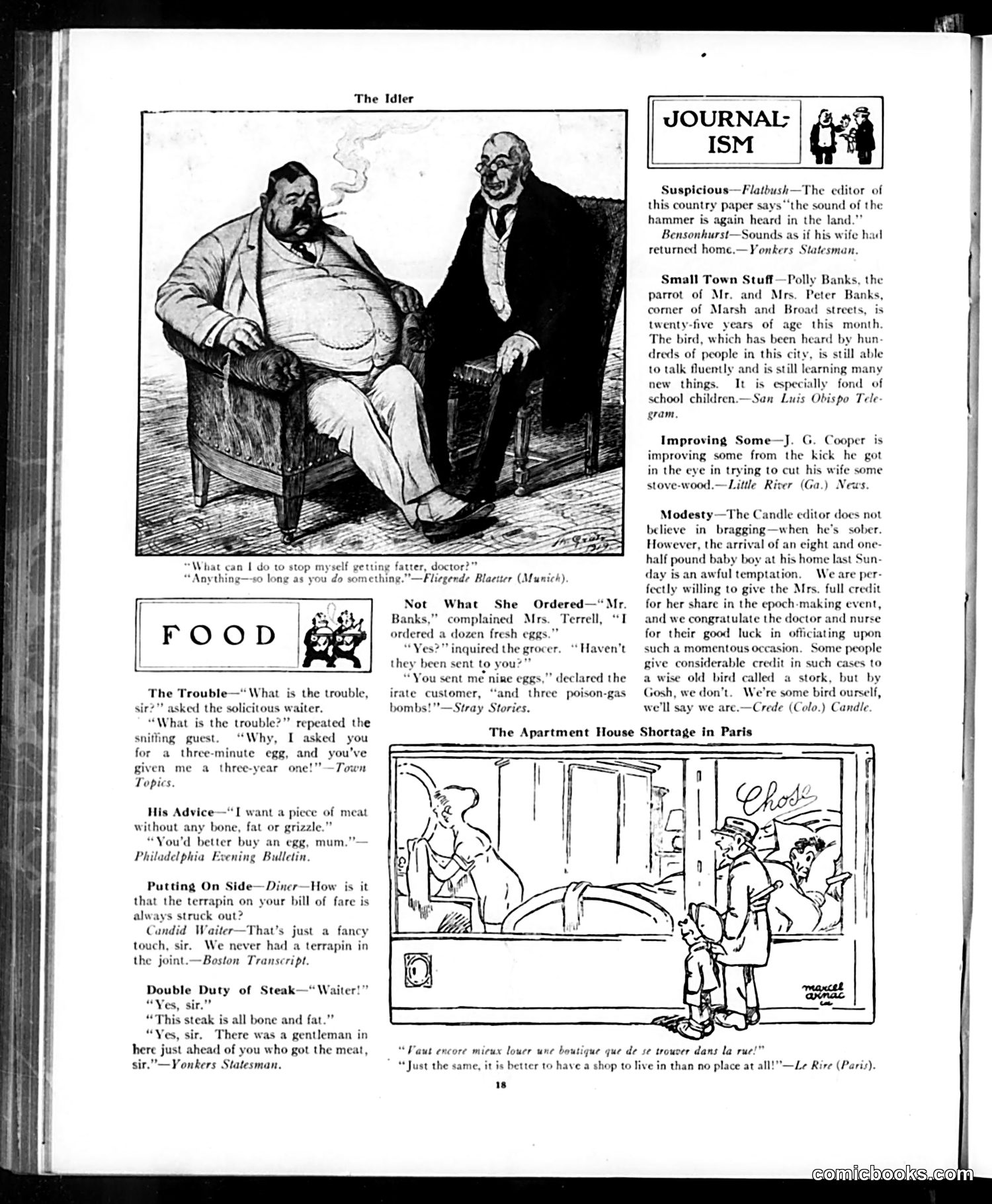
This Judge magazine page is a collection of humorous anecdotes about restaurant dining and domestic life, circa early 20th century. **Main cartoon (top):** Shows two men—one obese and smoking, one thin—discussing the overweight man's weight gain. The caption "What can I do to stop myself getting fatter, doctor?" with the response "Anything—so long as you do something" satirizes both the man's overeating and doctors' vague health advice. **"JOURNALISMS" section (right):** Brief satirical newspaper items mocking small-town journalism and domestic mishaps—a wife returning home making "hammer sounds," a 25-year-old parrot, a man injured while cutting firewood for his wife. **Restaurant jokes (left):** Multiple quips about food service: waiters serving overcooked eggs, fake menu items (terrapin never actually served), steaks that are mostly bone and fat, and "poison-gas bombs" instead of eggs. **Paris cartoon (bottom):** French caption about preferring to rent a shop to live in rather than having no shelter—commenting on post-WWI Parisian housing shortage. The page satirizes American dining pretensions, incompetent service, and domestic absurdities.
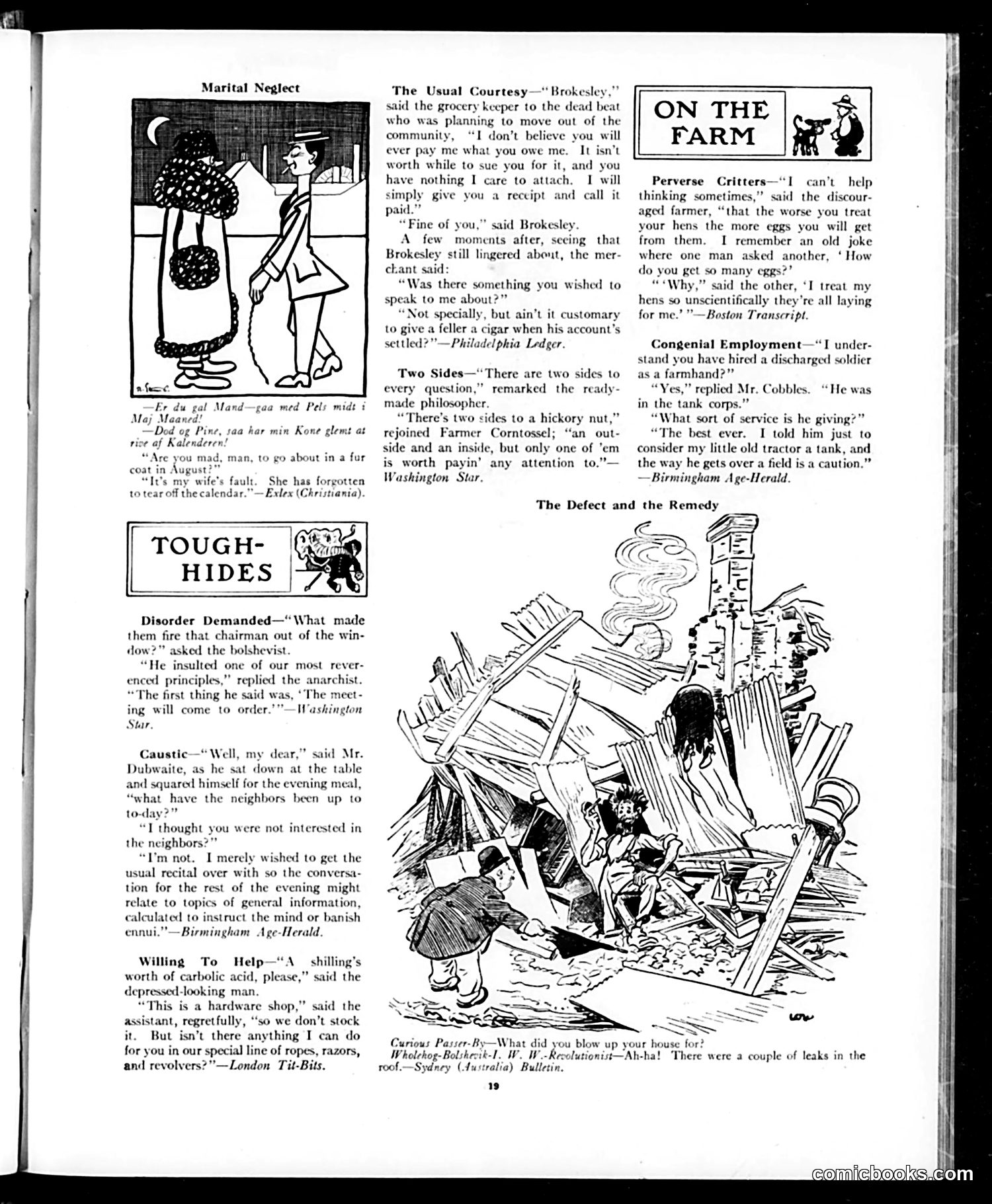
This page contains several brief humorous anecdotes typical of early 20th-century American satirical magazines, organized into sections like "Marital Neglect," "Tough-Hides," and "On the Farm." The cartoons mock domestic life, labor disputes, and rural stereotypes. Notable satirical content includes: - **Political references**: A joke about anarchists/Bolshevists demanding "disorder" and objecting to orderly meetings reflects post-WWI American anxieties about radical ideology. - **Class humor**: Multiple jokes about deadbeats, discharged soldiers seeking employment, and working-class characters suggest Depression-era or post-war economic struggles. - **The final cartoon** appears to reference revolutionary violence ("blow up your house"), with a punchline about "leaks in the roof"—likely satirizing radical political movements through crude wordplay. The overall tone is conservative and mocking toward labor radicalism, bohemian philosophy, and social disorder. The humor relies on stereotypes and wordplay rather than sophisticated satire.
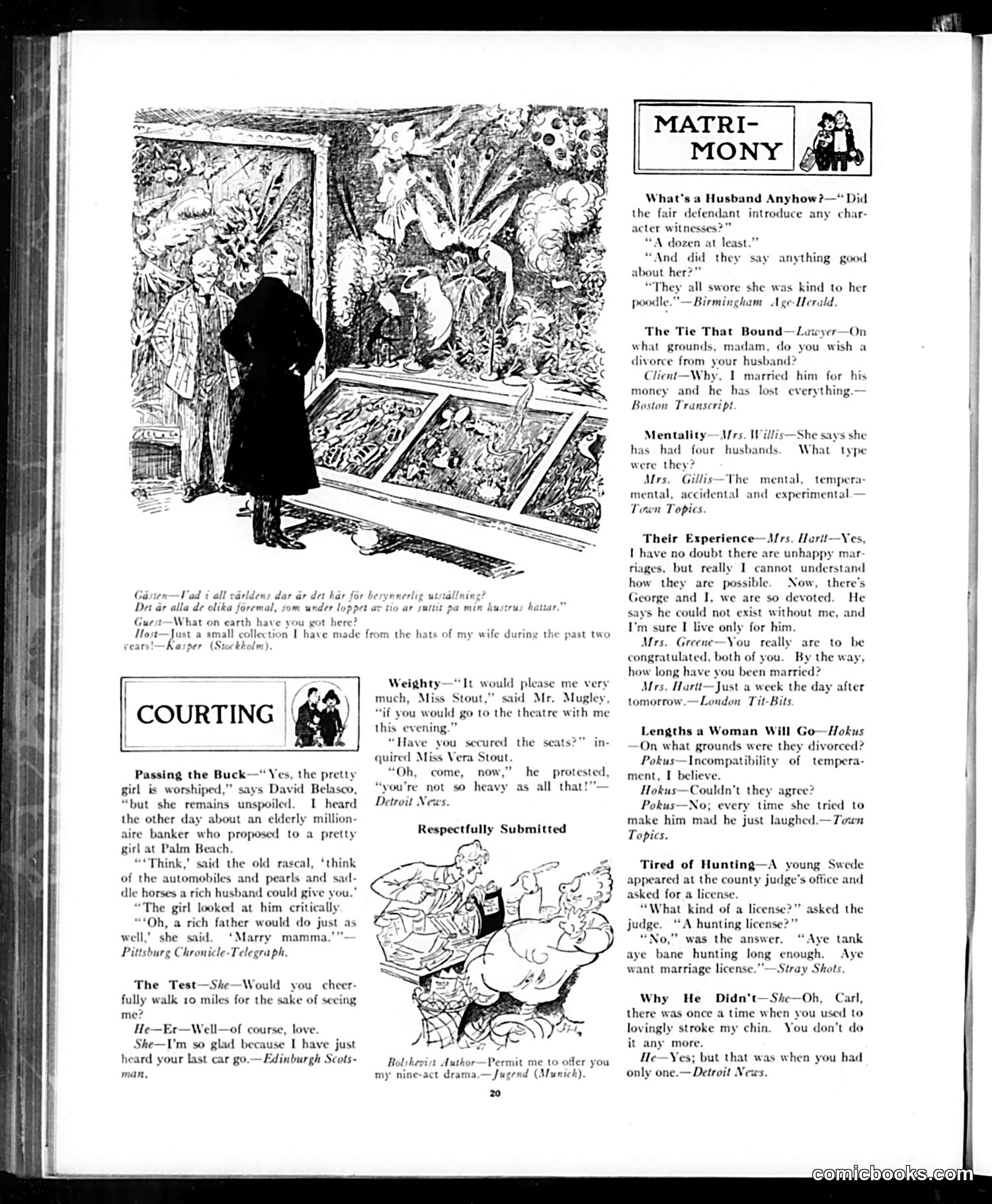
This is a humor page from *Judge* magazine featuring multiple short jokes and comic vignettes about marriage and courtship, reflecting early 20th-century American attitudes toward relationships. The main cartoon shows a silhouetted woman viewing what appears to be decorative panels or artwork in a gallery-like setting, illustrating a Swedish anecdote about a man's collection of objects made from his wife's hats over two years—mocking both female fashion excess and marital frustration. The surrounding jokes use stock satirical tropes: women marrying for money then divorcing when husbands go broke; pretty girls rejecting wealthy suitors' material promises in favor of targeting their fathers instead; gender-based physical humor (a woman gaining weight, aging chin); and ethnic humor (a Swedish immigrant's broken English about preferring marriage "hunting" to actual hunting). The humor assumes middle-class male readership and reinforces period stereotypes about women as materialistic, vain, and physically changing with age, while men are portrayed as tolerant but exasperated.
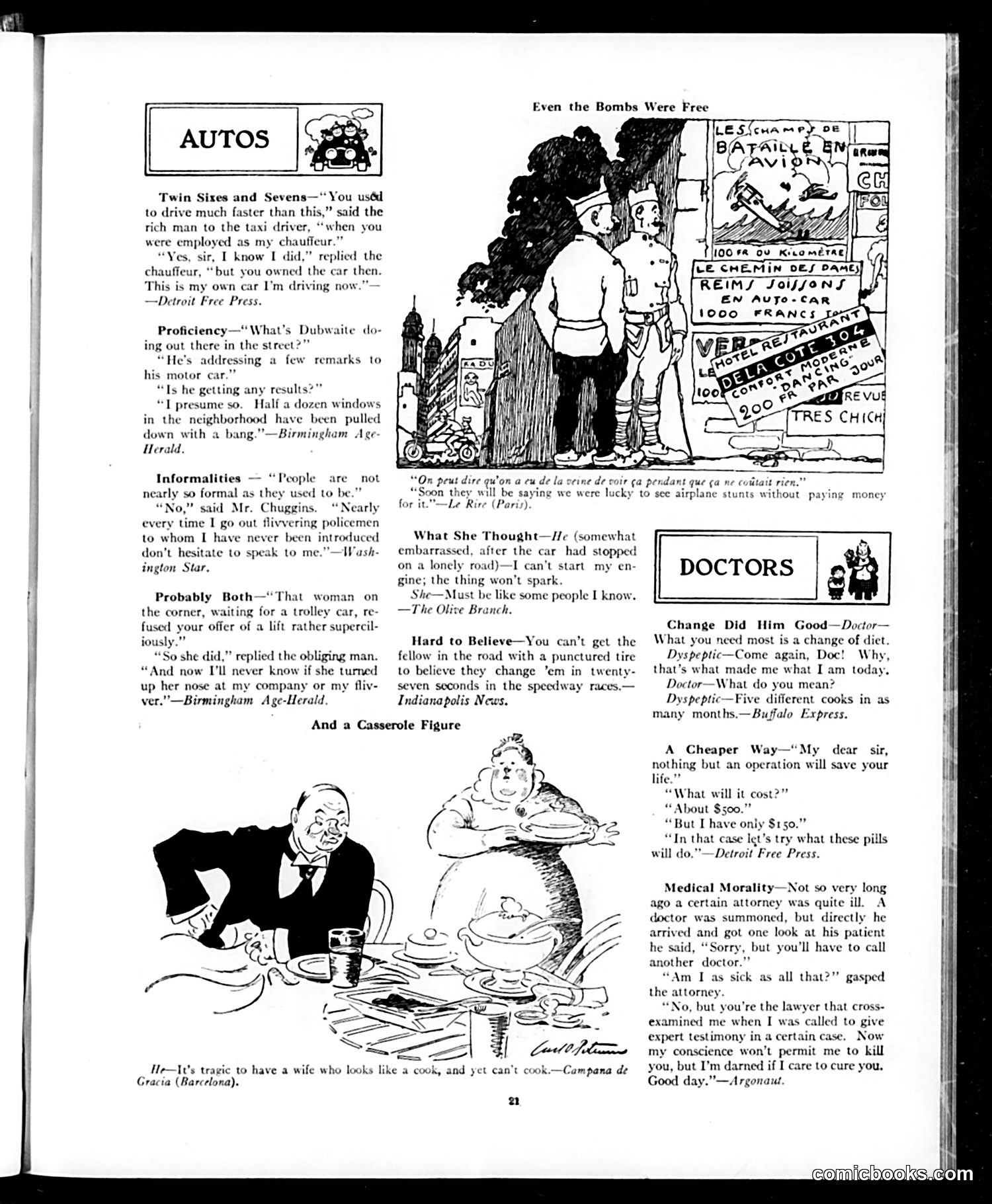
This page from Judge magazine contains early 20th-century humor about automobiles and doctors. **The "Autos" section** features short jokes about the then-novel automobile culture. The humor relies on the contrast between wealthy car owners and their chauffeurs, as well as the frustrations of early motorists—cars that won't start, addressing remarks to malfunctioning vehicles, and the social awkwardness cars create. One joke references "flivvering" (driving a cheap car like a Ford Model T), suggesting this was already slang. **The cartoon with the casserole figure** depicts a domestic tragedy: a wife who *looks* like a good cook but cannot cook—a common complaint about marriages in this era. **The "Doctors" section** uses similar satirical structure: jokes about medical incompetence (doctors suggesting expensive treatments they won't actually perform), dietary advice causing more problems, and a cynical punchline about a doctor refusing to treat someone he testified against in court for moral/ethical reasons. The overall tone is genteel satirical humor targeting professional incompetence and social pretensions.
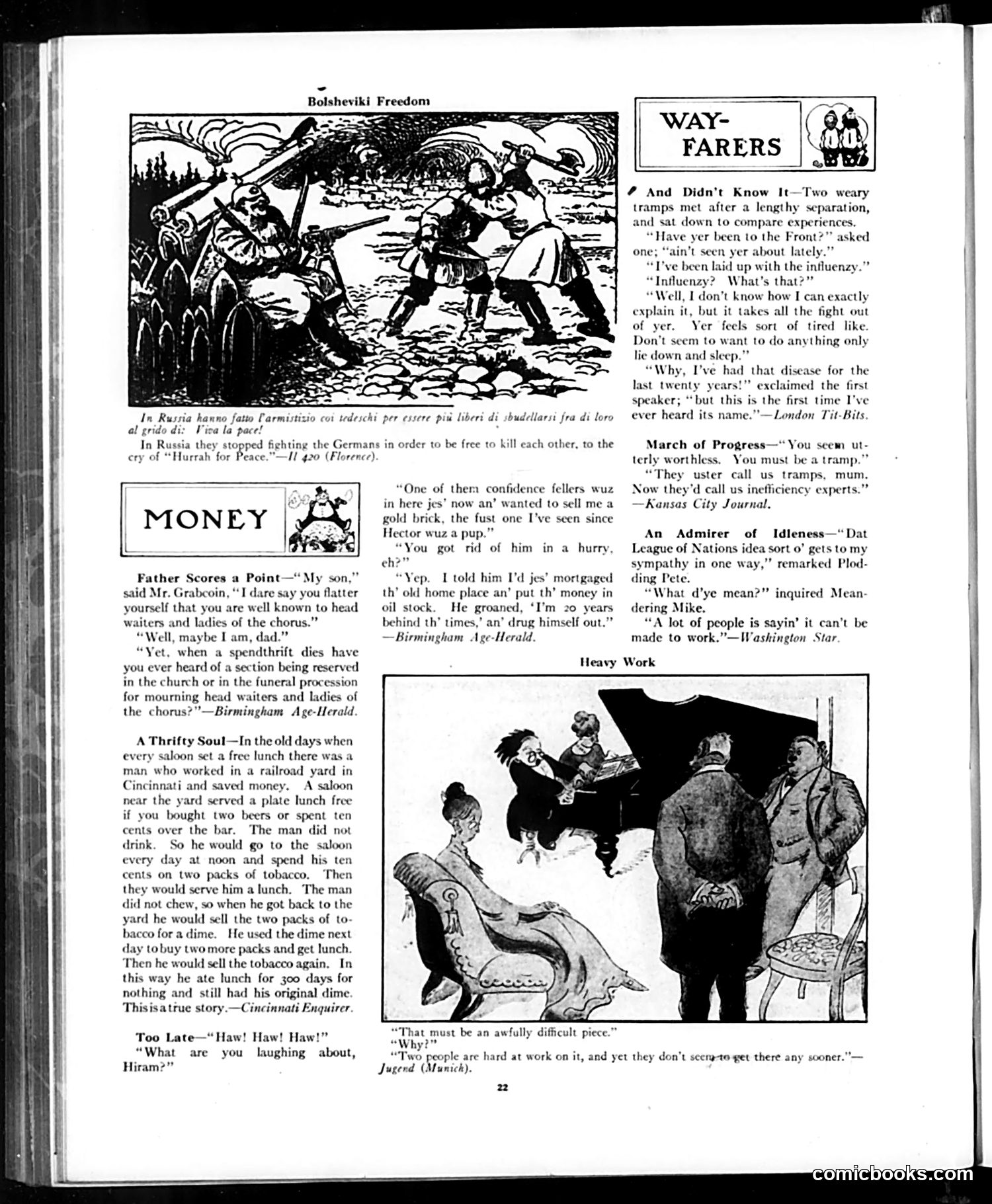
**Top Section - "Bolsheviki Freedom":** This large woodcut depicts violence and chaos, referencing the Russian Revolution. The Italian caption translates roughly to Russians stopping "with the cry of 'peace!'" The satire suggests the Bolsheviks promised peace but delivered only bloodshed—a common Western criticism of the 1917 revolution. **Remaining Content:** The page consists of brief humorous anecdotes and jokes rather than political cartoons: - "Father Scores a Point" mocks social climbers - "A Thrifty Soul" celebrates Depression-era ingenuity - Other items joke about con men, influenza, and tramps - The "Heavy Work" cartoon (bottom) appears to reference post-WWI reconstruction efforts **Context:** Published during the Red Scare era (post-1917), when American media depicted Bolshevism as violent chaos. The other jokes reflect 1920s American concerns: economic hardship, the recent flu pandemic, and social mobility anxieties.
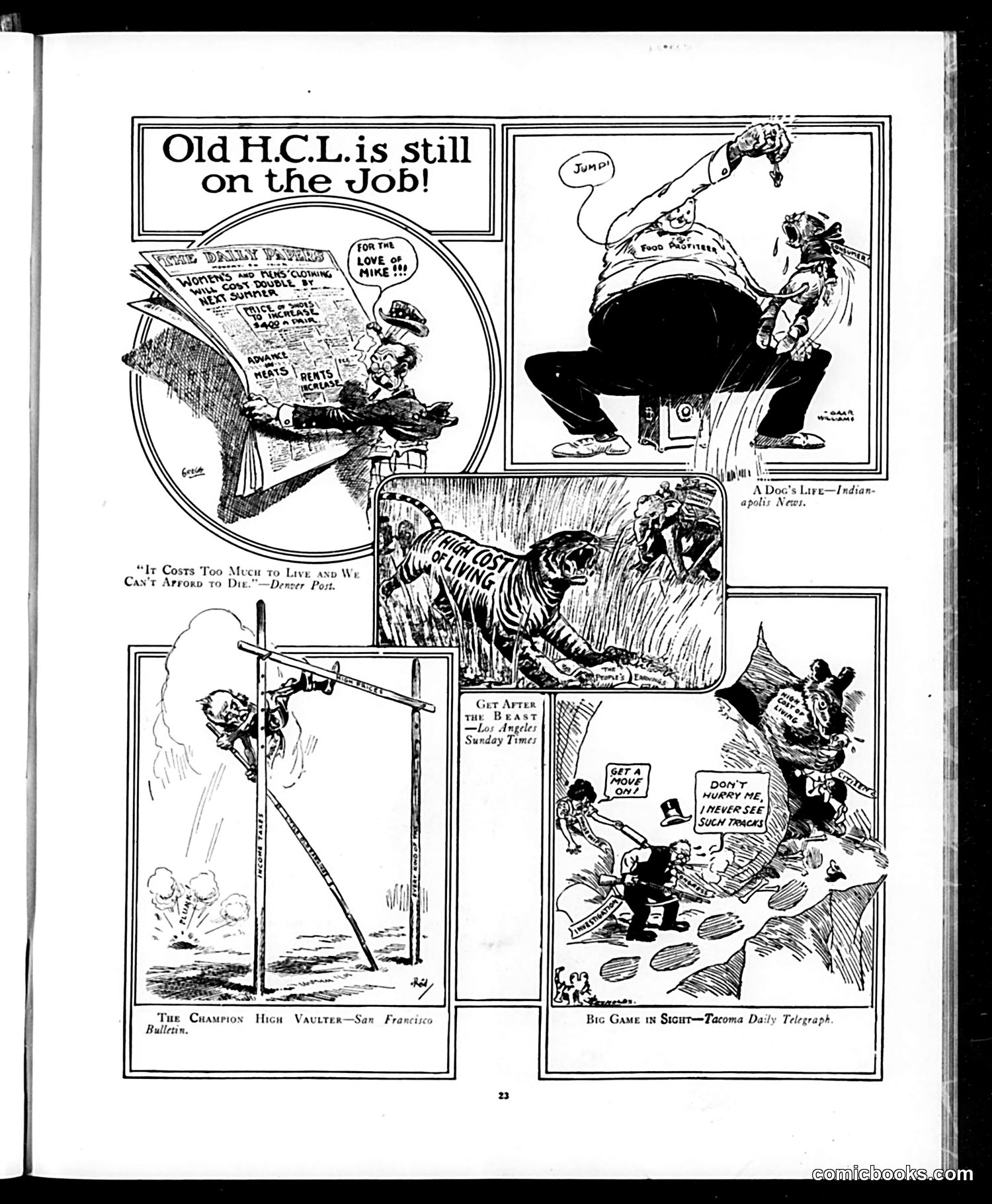
This page satirizes the ongoing cost-of-living crisis (H.C.L. = "High Cost of Living"). The headline announces that inflation remains a persistent problem despite efforts to address it. The cartoon vignettes show H.C.L. personified as a character creating havoc across American life: someone can't afford groceries, a man jumps from a building, a tiger (symbolizing the beast of rising costs) prowls menacingly, and people struggle with expenses. The captions reference real newspaper headlines from major cities (San Francisco, Los Angeles, Tacoma), suggesting this was a widespread national concern. The satire mocks the failure of authorities to control inflation, presenting the cost-of-living as an unstoppable force destroying ordinary Americans' finances and—darkly—driving some to desperation. The cartoon reflects post-WWI economic anxieties.
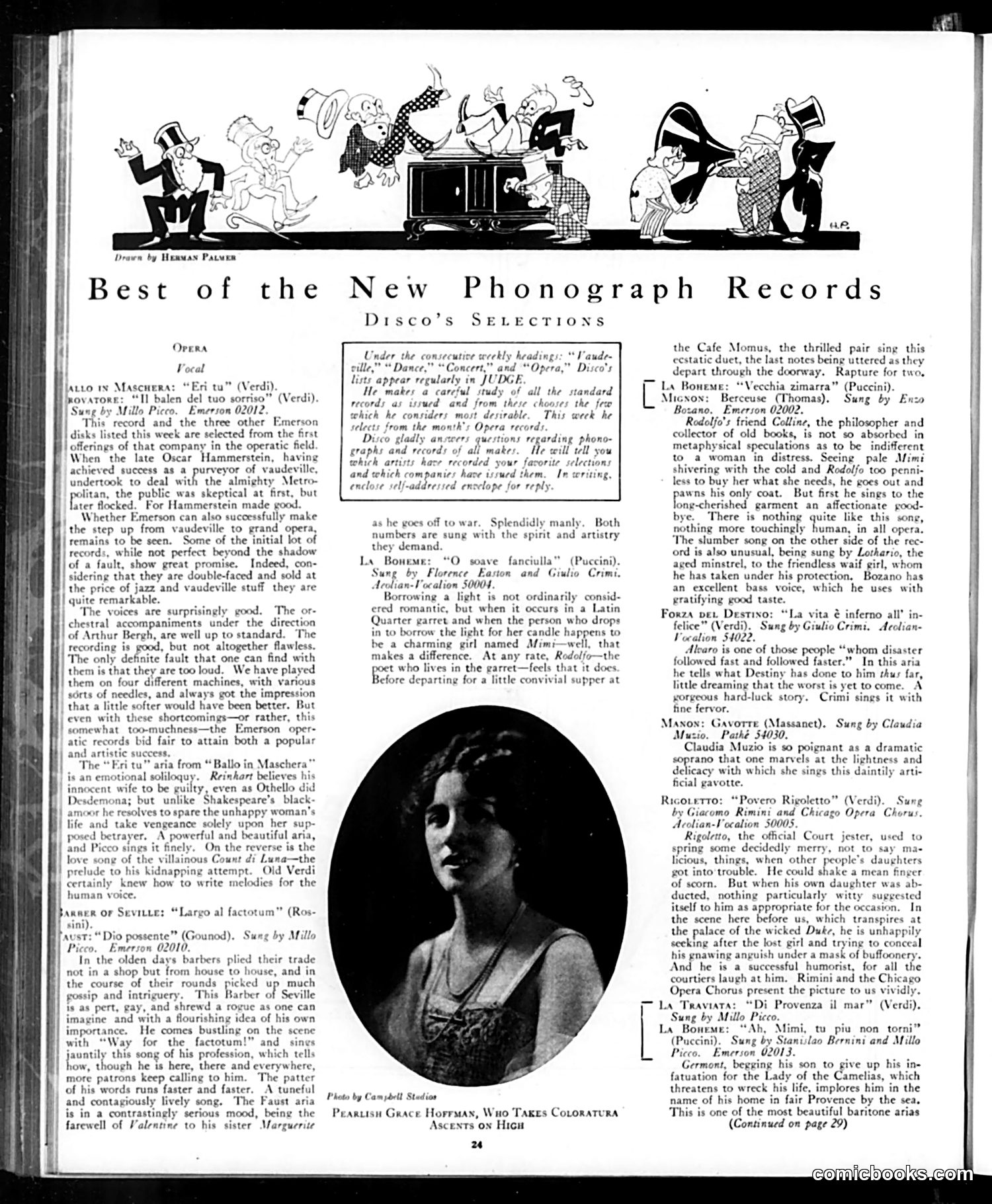
This page is primarily a **record review column**, not political satire. The cartoon at the top—drawn by Herman Palmer—shows stylized figures dancing and celebrating around a phonograph, illustrating the entertainment value of recorded music. The content reviews newly released operatic phonograph records from the Emerson company, including arias from *Ballo in Maschera*, *The Barber of Seville*, *La Bohème*, and *Faust*. The reviewer discusses vocal quality, orchestral accompaniment, and recording fidelity, noting that while Emerson's operatic venture shows promise, the recordings play too loudly. **Social context**: This reflects the early 1920s entertainment industry, when phonograph records were transitioning from popular/vaudeville material to serious opera—a marker of cultural aspiration and respectability. The mention of Oscar Hammerstein's success bringing opera to mass audiences suggests democratization of "high" culture through technology and commercial enterprise. This is **not satirical commentary** but rather cultural criticism evaluating a commercial product.
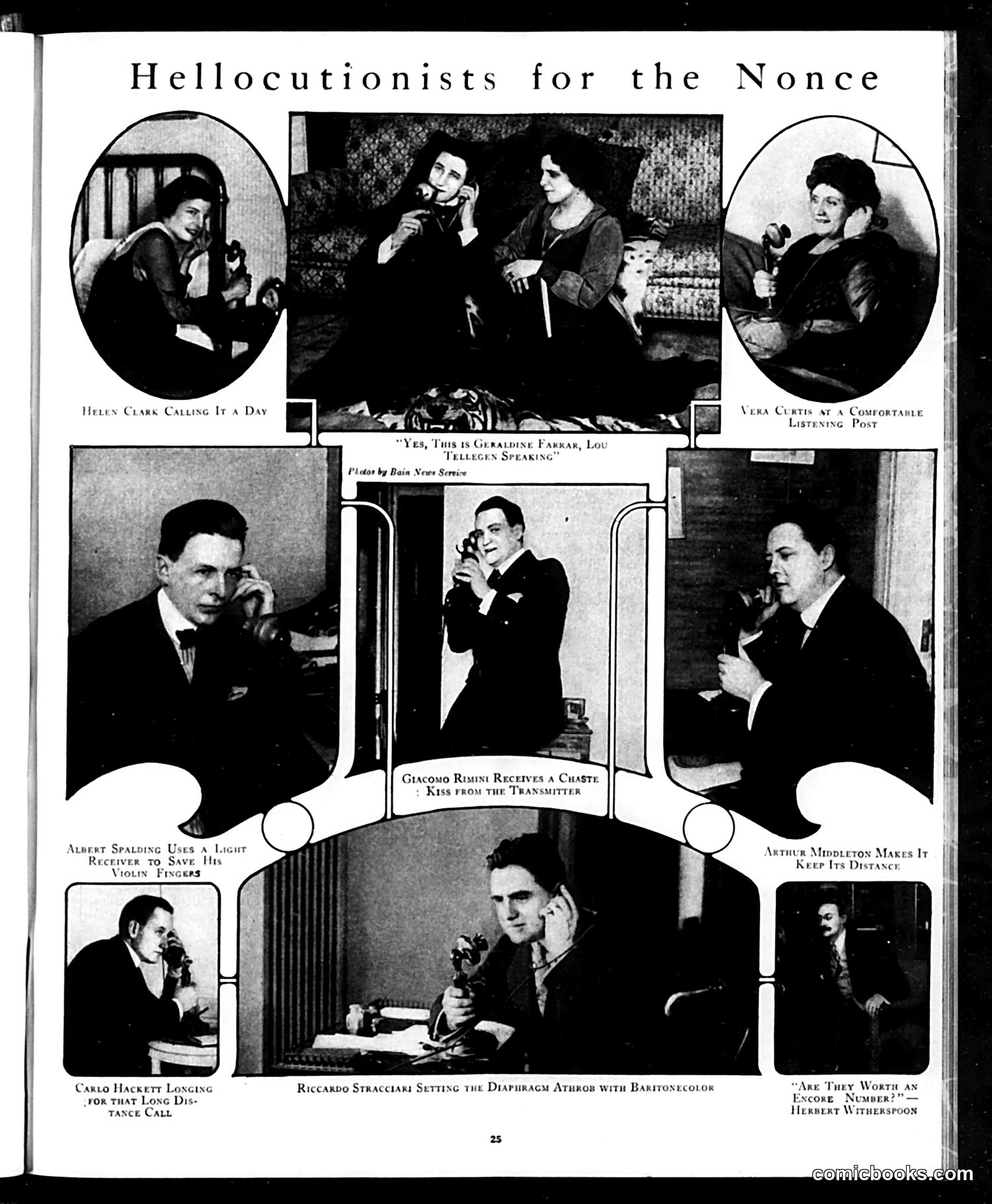
This page satirizes the novelty and social fascination with long-distance telephone communication. The title "Hellocutionists" humorously names people engaged with this new technology. The photographs show various celebrities and public figures using early telephone receivers in exaggerated or theatrical poses—holding handsets to their ears, appearing emotionally affected by distant conversations. The captions identify them as famous performers (Helen Clark, Vera Curtis, Albert Spalding, Arthur Middleton, Giacomo Rimini, Carlo Hackett, Riccardo Stracciari, and Herbert Witherspoon), treating mundane phone calls as dramatic performances worthy of documentation. The satire mocks both the technology's novelty appeal and the vanity of celebrities eager to be photographed using it. The humorous framing suggests that long-distance telephony was still exotic enough to warrant special notice and public interest during this era.
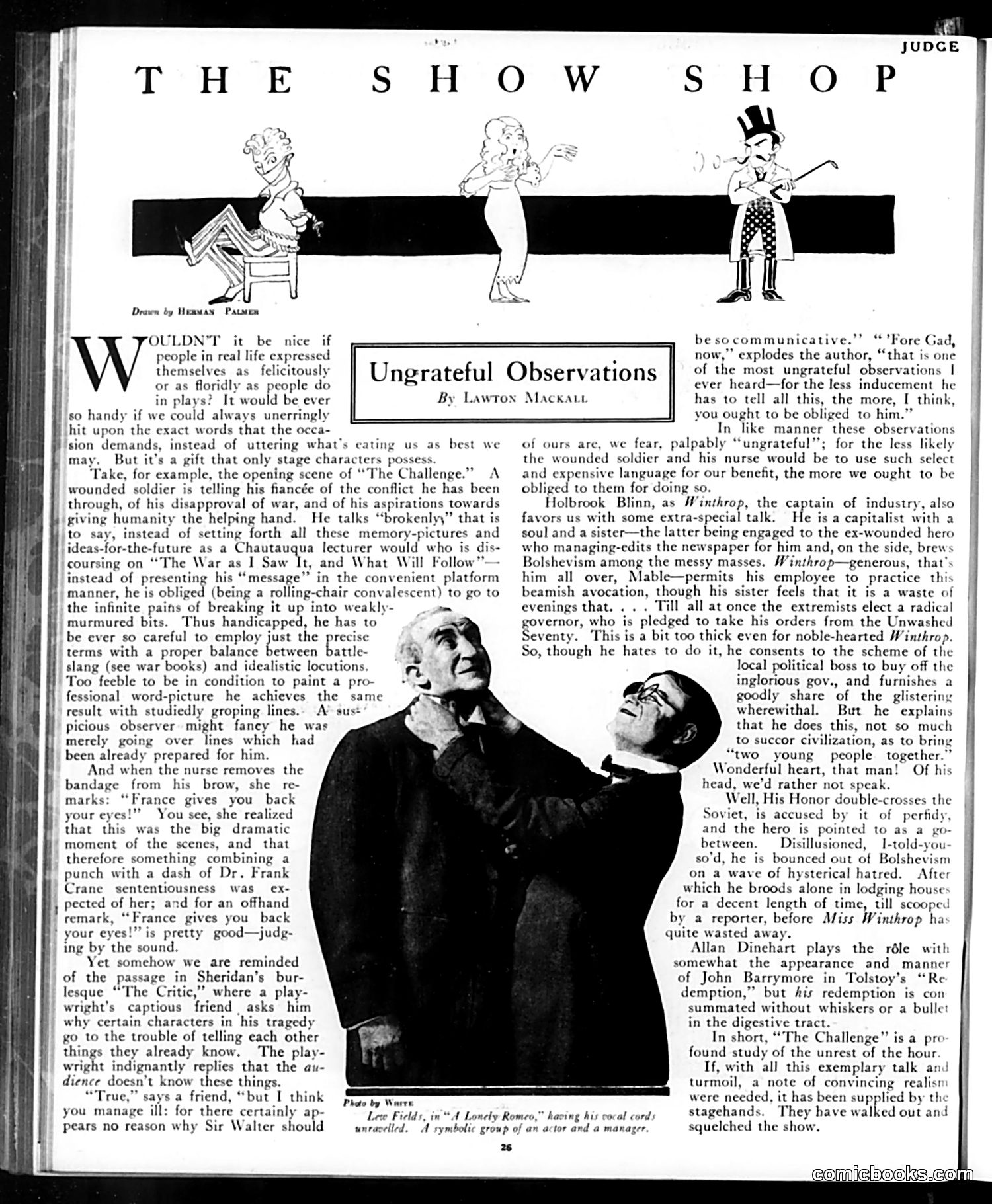
This page critiques theatrical dialogue in "The Challenge," a contemporary play. The author contrasts realistic speech with stage convention: a wounded soldier speaks in carefully balanced "broken" sentences combining military slang and idealistic language—language no real injured person would naturally use. When a nurse removes his bandage, she delivers an equally artificial line: "France gives you back your eyes!" The satire references Sheridan's play "The Critic," where a playwright defends unrealistic dialogue by arguing the *audience* needs information characters already know. Judge inverts this: the *less* realistic the dialogue should be, the *more* obliged audiences should feel to accept it. The page also discusses Holbrook Blinn in "Winthrop," a capitalist character who speaks in flowery language while employing a Bolshevik-sympathizing newspaper editor—a topical reference to 1920s Red Scare anxieties. The satire mocks both theatrical artificiality and contemporary political tensions.
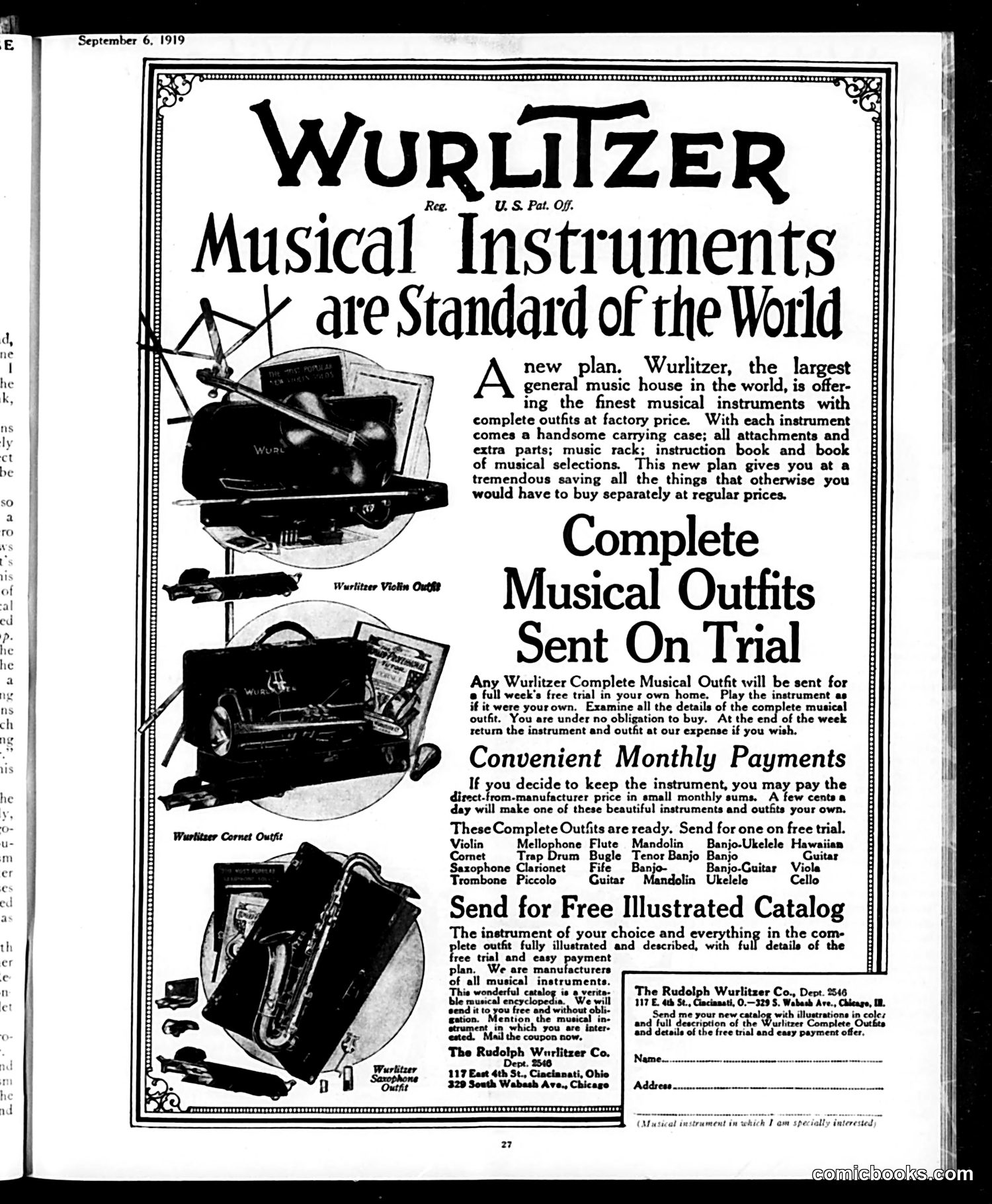
This is a **full-page advertisement**, not a political cartoon. It promotes Wurlitzer, described as "the largest general music house in the world," offering complete musical instrument outfits at factory prices. The advertisement emphasizes a then-novel sales strategy: **free home trial for one week** with no purchase obligation, followed by **convenient monthly payments** if the customer decides to keep the instrument. This approach was innovative for 1919, allowing working-class customers to afford quality instruments without large upfront costs. The page displays three illustrated musical outfits (violin, cornet, and saxophone) with their carrying cases and accessories. A coupon at bottom invites readers to request a free illustrated catalog. There is **no satire or political commentary** visible—this is straightforward commercial marketing in a magazine context, appealing to aspirational consumers interested in home music-making during the early 20th century.
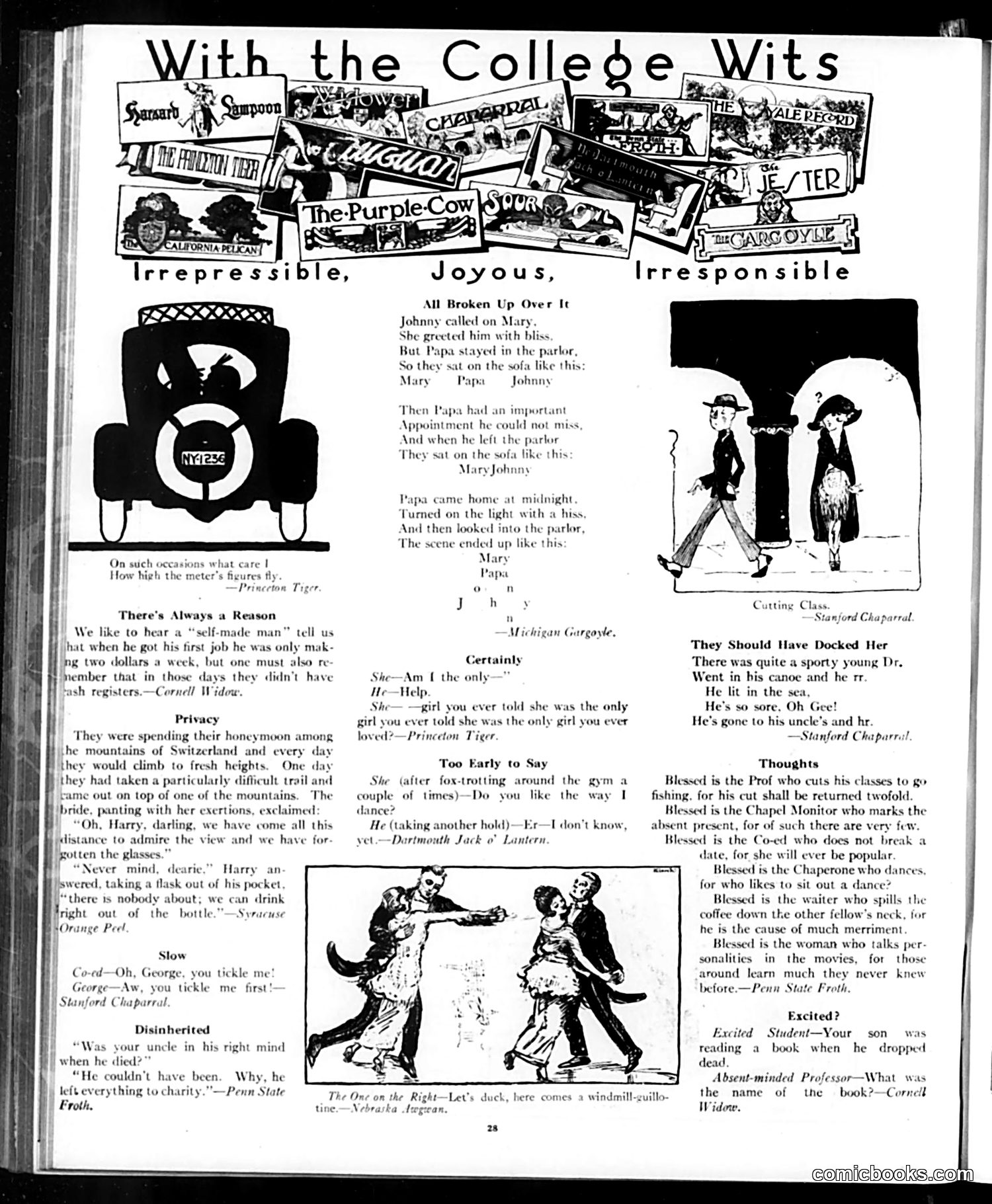
This is a **humor compilation page** from Judge magazine featuring jokes and comic sketches about college life, primarily targeting young romantic situations and student behavior. **Main content includes:** - **"All Broken Up Over It"**: A three-panel narrative joke about a young couple (Johnny and Mary) courting on a sofa while her father supervises, then leaves—with the punchline showing the father's angry reaction upon returning at midnight. - **Short quips** on dating, honeymoons, and social etiquette—typical college humor of the era mocking awkward romantic moments and parental supervision. - **"Thoughts"** section: Satirical "blessings" mimicking religious language to mock college types (professors who skip class, gossipy women at movies, clumsy waiters). The satire targets **early 20th-century college social conventions**: chaperoned dating, parental control, and the pretensions of academic life. The humor is gentle, focusing on relatable situations rather than sharp political commentary.
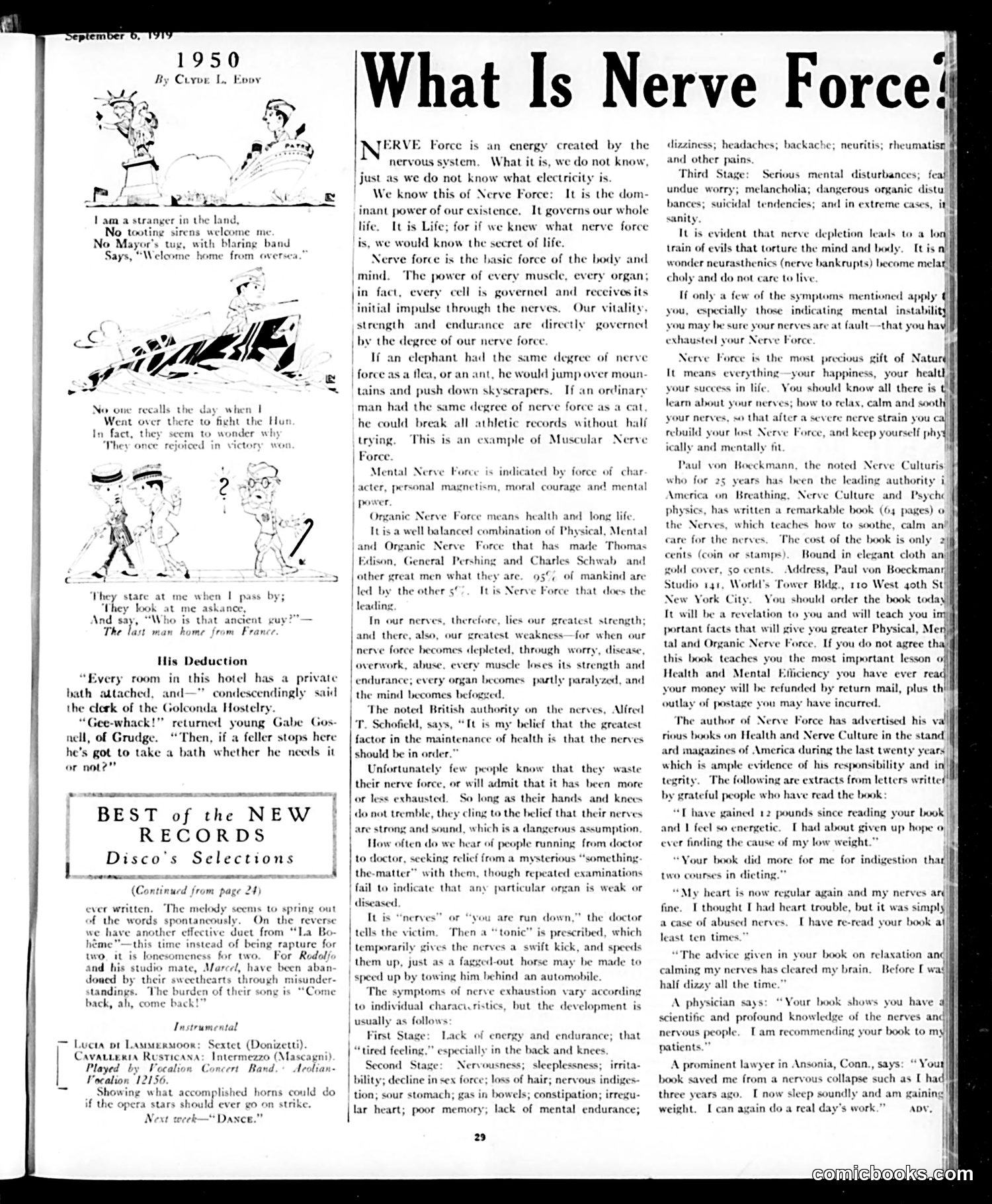
The top cartoon depicts a returning WWI veteran who feels unwelcome in his own country. The soldier contrasts his overseas experience ("Went over there to fight the Hun") with his cold reception at home—no welcoming parades, suspicious glances from civilians ("They stare at me when I pass by / They look at me askance"). The satire critiques American ingratitude toward soldiers. Despite the soldier's sacrifice fighting in World War I (concluded 1918), he receives no hero's welcome or recognition. Citizens regard him with wariness rather than gratitude. The final panel's ambiguous line "Who is that ancient guy?" suggests aging, displacement, or that the soldier has become a forgotten figure. This reflects a genuine post-WWI social problem: veterans struggled reintegrating into American society and often faced public indifference despite their service. The remainder of the page contains unrelated content: jokes about hotel amenities and music reviews.
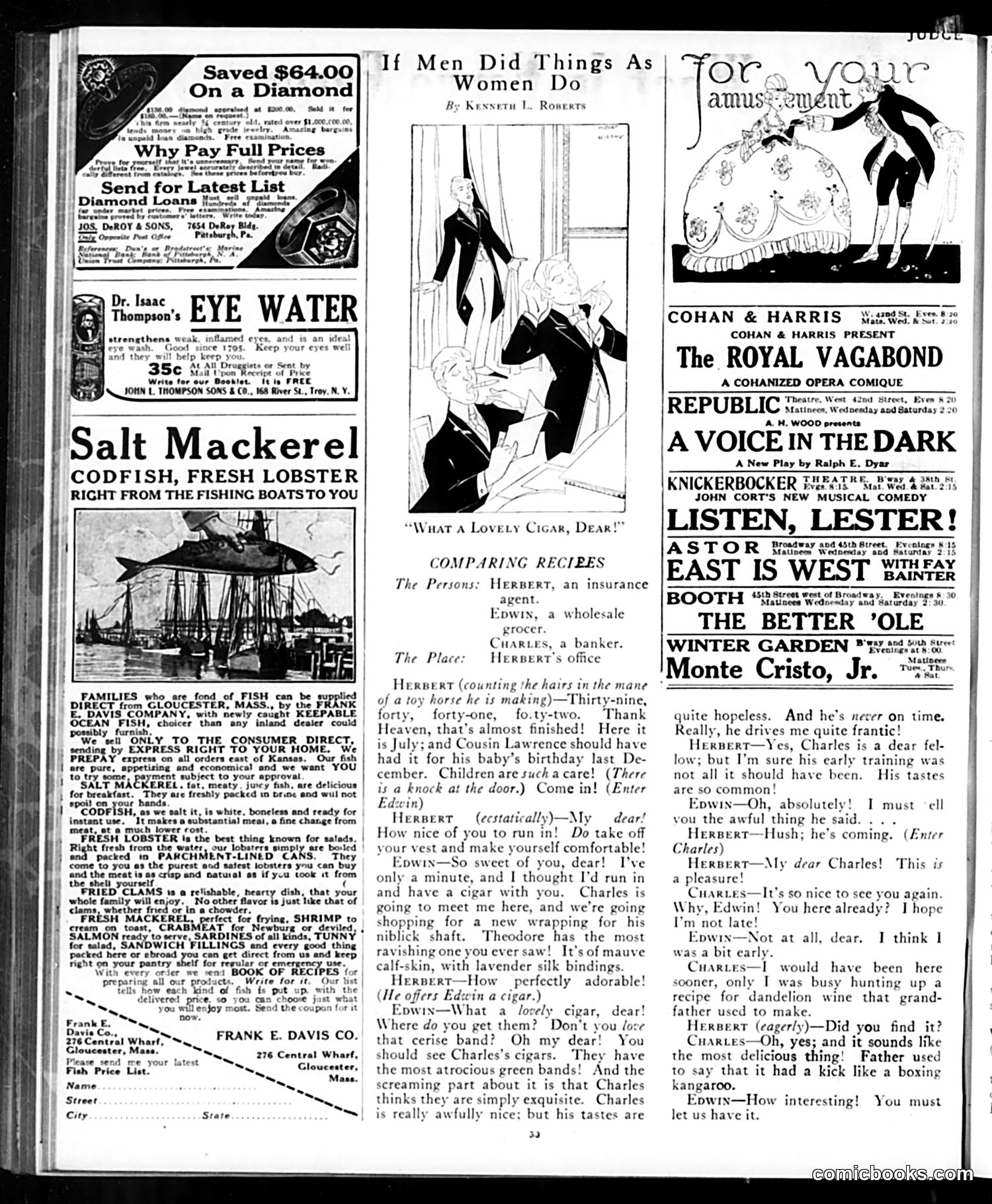
This page combines advertisements with satirical humor typical of Judge magazine's social commentary. **The Main Cartoon**: "If Men Did Things As Women Do" by Kenneth L. Roberts satirizes gender roles through role reversal. Three businessmen (Herbert, Edwin, and Charles) discuss cigars, wrapping paper, and gift ribbons with the obsessive attention to aesthetic detail—color coordination, decorative finishes—that contemporary stereotypes attributed to women. The joke mocks both rigid gender expectations and male ignorance of "feminine" concerns; by having men fret over lavender silk bindings and cerise bands on cigar wrappings, Roberts humorously suggests men would be hopelessly impractical if they adopted women's supposed preoccupations with appearance and decoration. **Context**: This reflects 1910s-era gender anxieties—the piece gently ridicules narrow assumptions about what occupies women's minds while simultaneously implying men would be ridiculous if they shared such concerns. The page also features period advertisements for seafood, diamonds, eye water, and theatrical productions (typical Judge content).
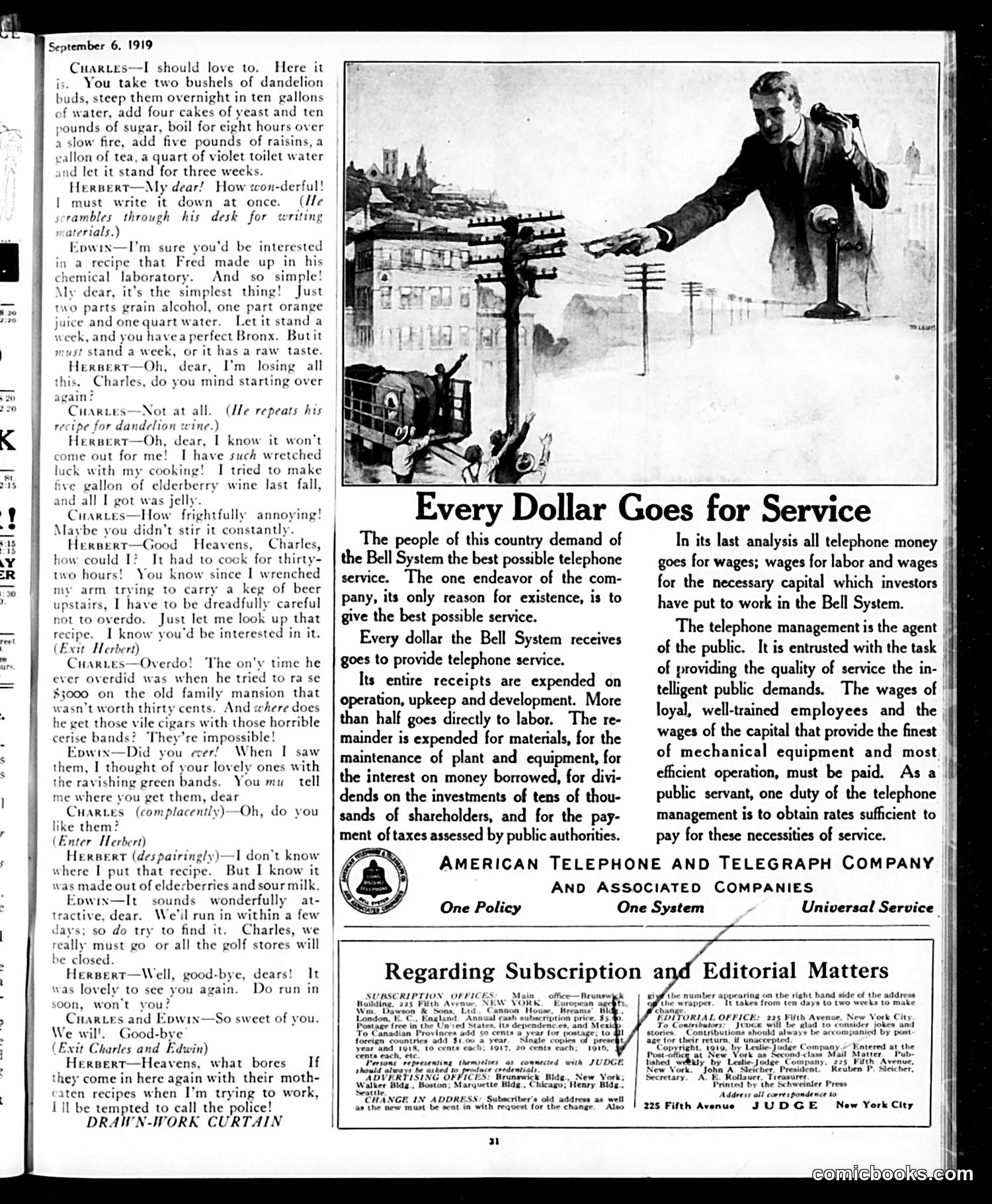
**The Comic Sketch ("Drawn-Work Curtain"):** A conversation between three characters—Charles, Herbert, and Edwin—satirizes Prohibition-era home alcohol production. The men exchange elaborate "recipes" for dandelion wine and a "Bronx" cocktail (grain alcohol, orange juice, water), disguising illegal liquor-making as domestic culinary hobby. Herbert's bumbling attempts and convenient "wrenched arm" excuse mock both the absurdity of Prohibition enforcement and middle-class men's sudden domesticity. The joke: sophisticated gentlemen are reduced to swapping bootleg formulas like housewives sharing recipes. **The Advertisement:** Immediately below, AT&T's corporate messaging asserts that "every dollar goes for service"—wages, labor, maintenance, and shareholder dividends. The juxtaposition is likely unintentional but pointed: while ordinary citizens risk legal consequences making homemade alcohol, large monopolies like Bell justify their profits as serving the "public good." **Context:** This reflects 1919 America during Prohibition's implementation (ratified January 1919, effective January 1920).
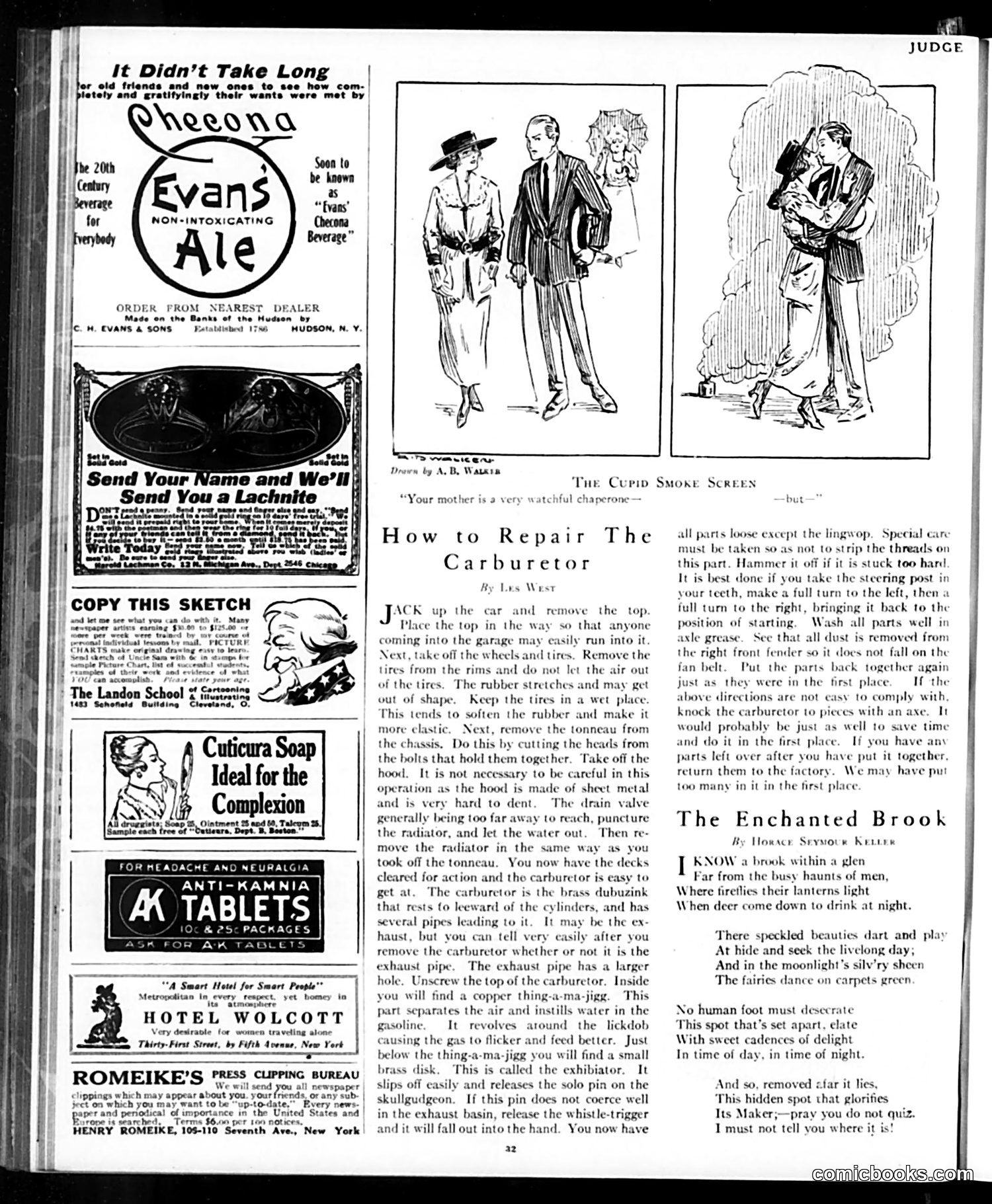
This page features a romantic comedy cartoon titled "The Cupid Smoke Screen," drawn by A.B. Waxlar. The cartoon depicts a young couple embracing in a doorway while an older woman (the girl's mother, described as "very watchful") peers at them through curtains from another room. The joke plays on the phrase "smoke screen"—the couple is using the curtains/drapes as literal cover to hide their romantic moment from parental supervision. The humor derives from the tension between young love and Victorian-era parental oversight, particularly mothers' vigilance over daughters' romantic behavior. The cartoon satirizes both the young couple's attempts at discretion and the mother's protective watchfulness, presenting a familiar domestic comedy scenario of the period where courtship required careful navigation around chaperons and family members. The reference reflects early 20th-century social norms around supervised courtship.
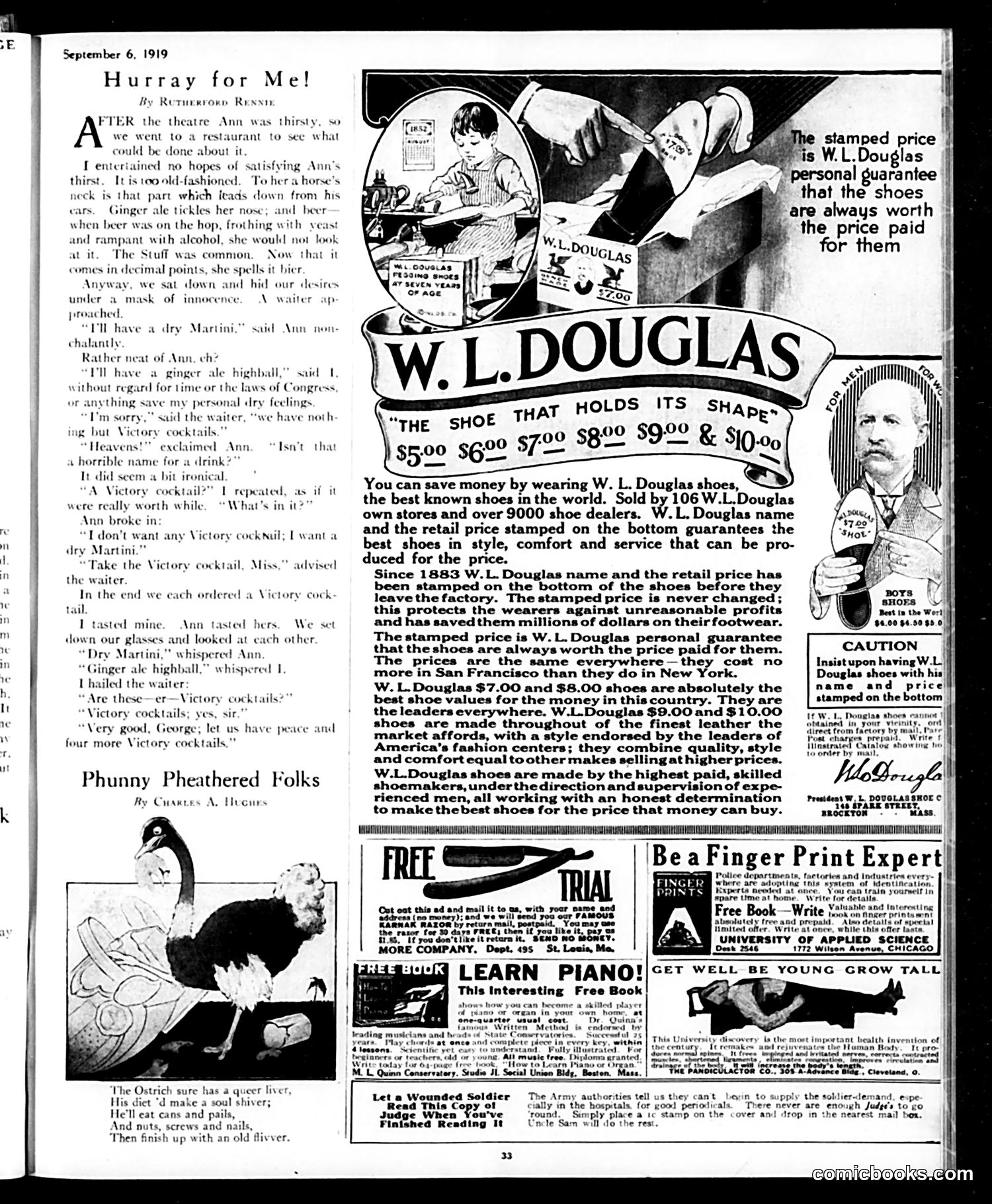
This page contains a satirical short story titled "Hurray for Me!" by Rutherford Reuss, mocking Prohibition's effects on American drinking culture. **The Satire:** After Prohibition became law (January 1919), alcohol was banned but restaurants offered legal substitutes called "Victory cocktails"—apparently non-alcoholic drinks. The humor centers on the absurdity: the narrator and his companion Ann try ordering traditional pre-Prohibition drinks (dry Martini, ginger ale highball), only to be told only "Victory cocktails" are available. They reluctantly accept these beverages, taste them, and realize they're disappointing substitutes for real alcohol. **The Point:** The story mocks both Prohibition's enforcement and Americans' frustration with it. The ironic name "Victory cocktail" (suggesting triumph) highlights how citizens viewed the law as a loss, not a victory. The couple's resigned acceptance ("let us have peace and four more Victory cocktails") suggests weary capitulation to an unpopular federal mandate. The page also contains W.L. Douglas shoe advertising and other period classifieds, typical of Judge's mixed content.
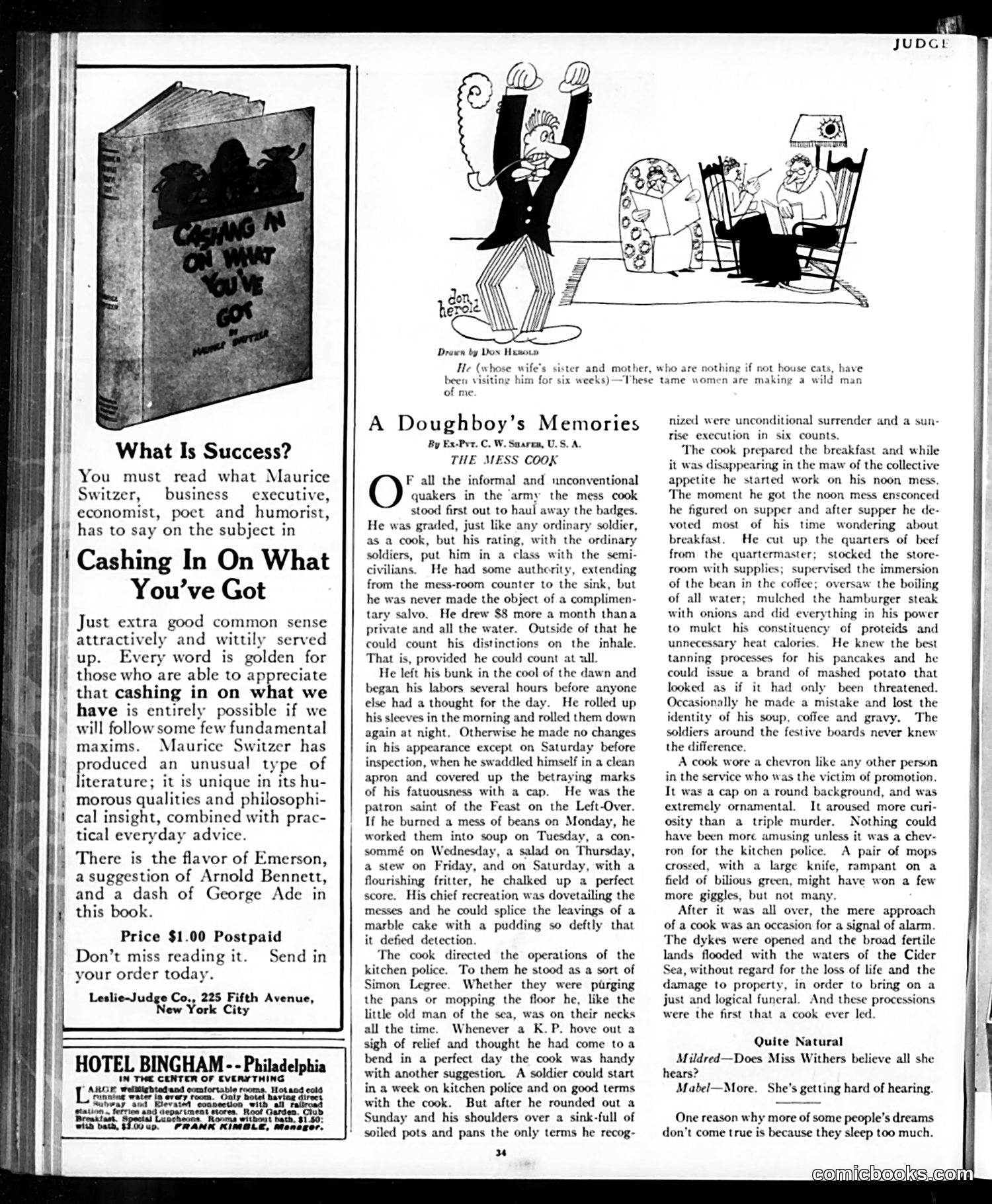
This page contains **advertising and satirical content** typical of Judge magazine's format. The top cartoon, drawn by Don Herold, depicts a husband with arms raised in exasperation while his wife's visiting female relatives (her mother and sister) sit comfortably at home. The caption notes these women are "making a wild man" of him during their six-week visit, playing on the domestic stereotype that visiting in-laws—particularly female relatives—create household chaos and emasculate the male householder. Below is an advertisement for Maurice Switzer's self-help book *"Cashing In On What You've Got,"* promoting common-sense business philosophy. The main feature, "A Doughboy's Memories," satirizes **WWI army mess cooks**—their low status despite supervisory duties, their grueling pre-dawn schedules, and their tyrannical treatment of kitchen police (K.P.) workers. The cook holds absolute power over subordinates while remaining unappreciated, working endless hours transforming leftover food into successive meals. The satire critiques military hierarchy's absurdities and the thankless nature of service positions.
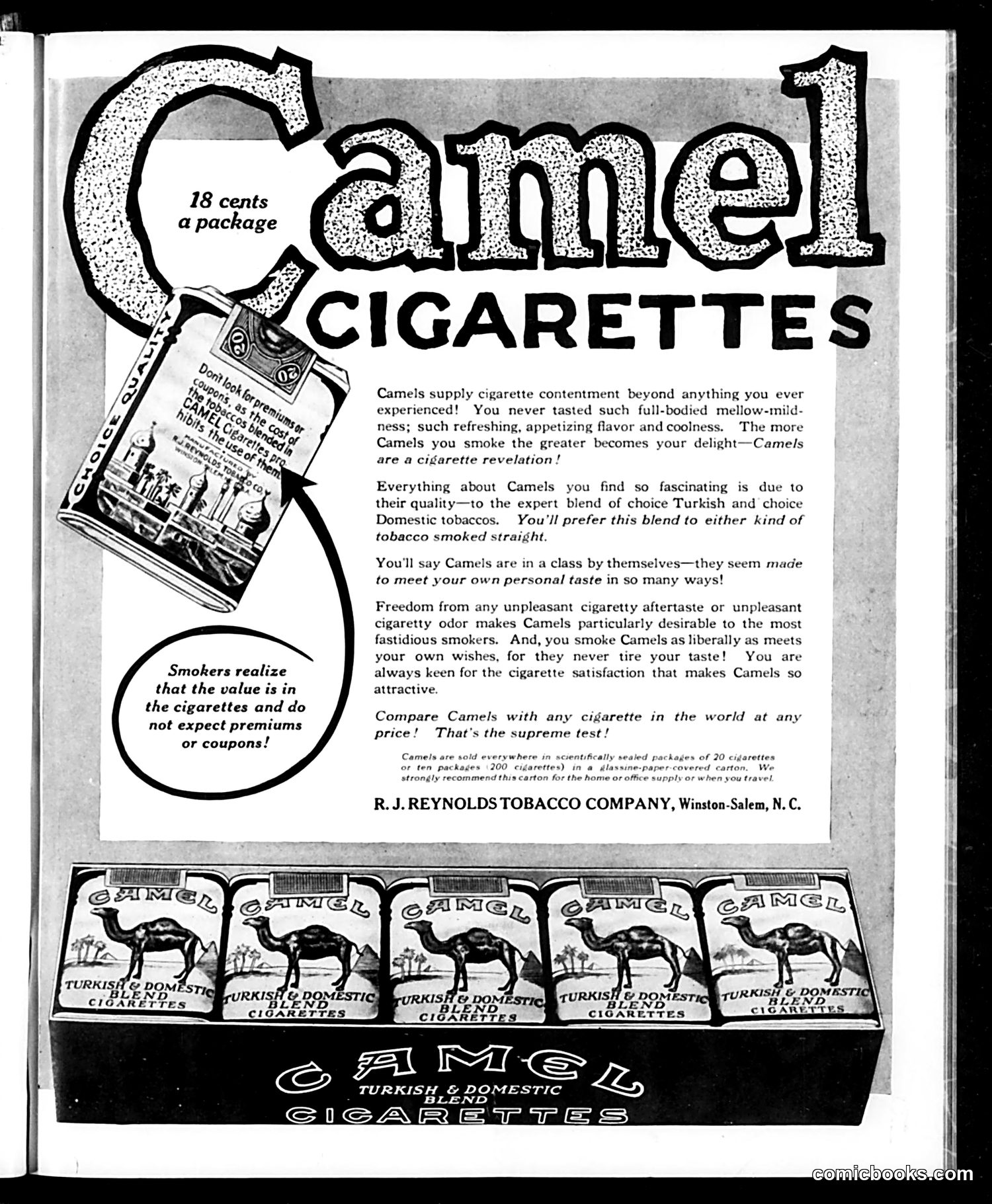
This page is **entirely a cigarette advertisement**, not satire or editorial content. It's a Camel cigarettes ad from the R.J. Reynolds Tobacco Company, priced at 18 cents per package. The ad uses several persuasive techniques common in early 20th-century marketing: claims about tobacco "quality" (Turkish and domestic blend), appeals to personal taste and sophistication, and reassurances about lack of aftertaste or odor. The memorable circular callout—"Smokers realize that the value is in the cigarettes and do not expect premiums or coupons!"—attempts to position Camels as premium goods needing no gimmicks. By modern standards, the health claims and overall pitch would be shocking: the ad promises "mellow-mildness" and encourages liberal smoking. The Camel mascot appears prominently on the product packaging shown below. This represents pre-regulation tobacco advertising, before cigarette health warnings were required.
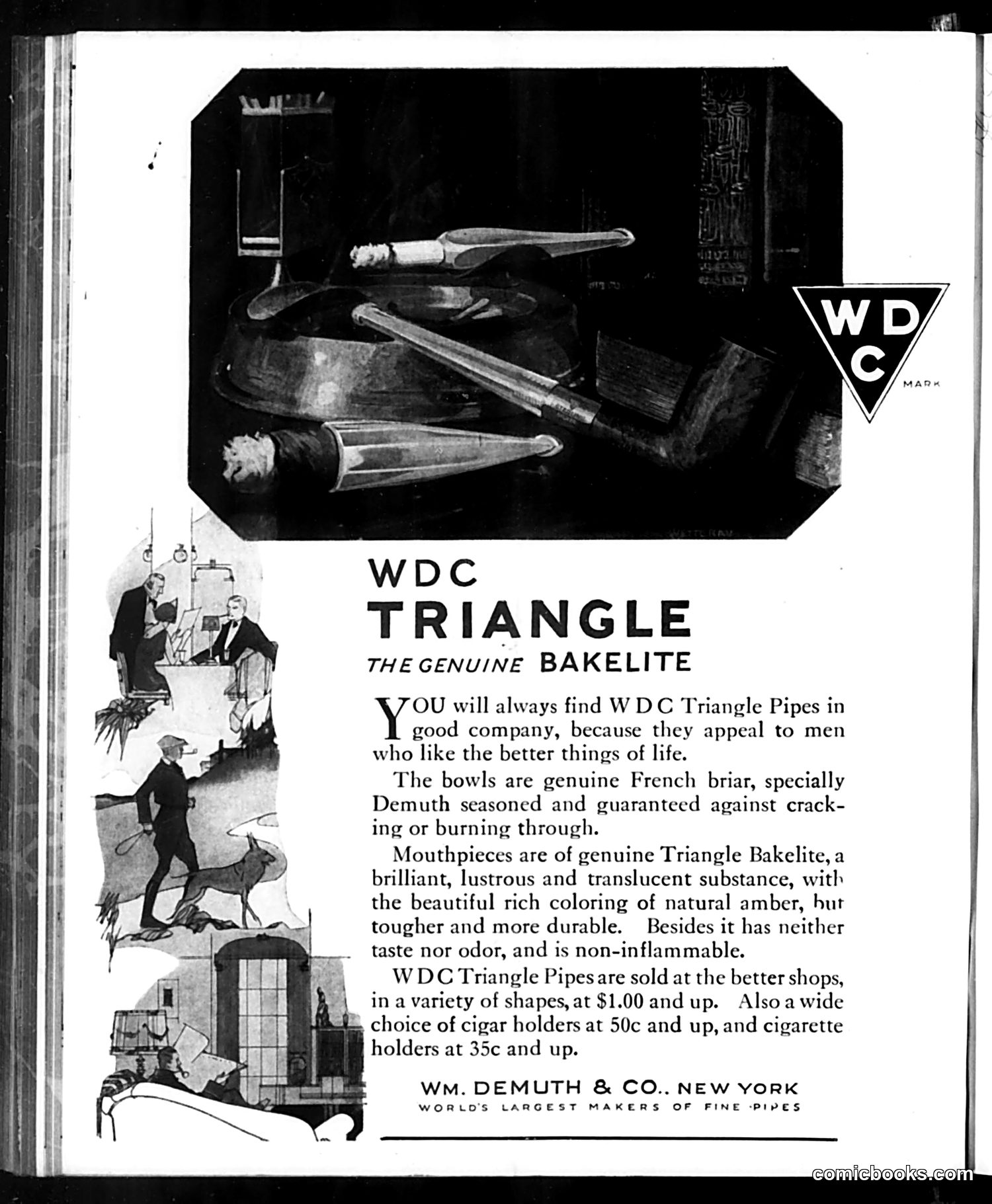
This is primarily a **product advertisement**, not political satire. The page promotes WDC Triangle Pipes made by William Demuth & Co. of New York. The advertisement emphasizes luxury and sophistication, targeting affluent male consumers ("men who like the better things of life"). It highlights the pipes' quality materials: genuine French briar bowls and Bakelite mouthpieces—a then-modern synthetic material that mimicked amber's appearance while offering superior durability. The decorative illustrations on the left show well-dressed gentlemen in leisure settings (socializing, hunting), reinforcing the aspirational lifestyle the product promises. The upper photograph displays various pipe styles and accessories. Pricing ($1.00 and up) positions these as premium goods. This represents typical Judge magazine advertising from the early 20th century, when such publications subsidized editorial content through upscale product placements targeting their educated, wealthy readership.