
Judge, 1919-09-06 · page 34 of 36
Judge — September 6, 1919 — page 34: what you’re looking at
What you’re looking at
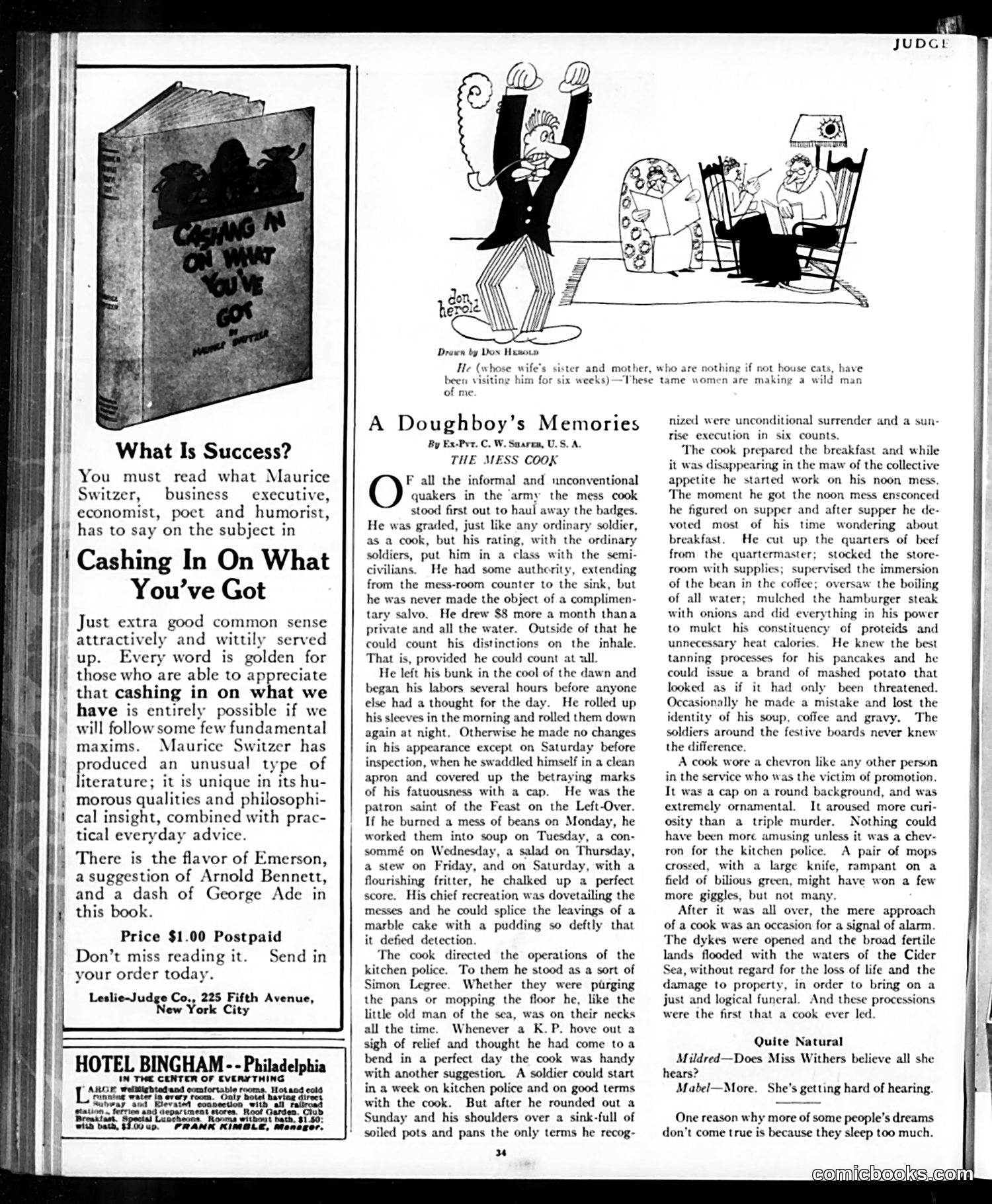
This page contains **advertising and satirical content** typical of Judge magazine's format. The top cartoon, drawn by Don Herold, depicts a husband with arms raised in exasperation while his wife's visiting female relatives (her mother and sister) sit comfortably at home. The caption notes these women are "making a wild man" of him during their six-week visit, playing on the domestic stereotype that visiting in-laws—particularly female relatives—create household chaos and emasculate the male householder. Below is an advertisement for Maurice Switzer's self-help book *"Cashing In On What You've Got,"* promoting common-sense business philosophy. The main feature, "A Doughboy's Memories," satirizes **WWI army mess cooks**—their low status despite supervisory duties, their grueling pre-dawn schedules, and their tyrannical treatment of kitchen police (K.P.) workers. The cook holds absolute power over subordinates while remaining unappreciated, working endless hours transforming leftover food into successive meals. The satire critiques military hierarchy's absurdities and the thankless nature of service positions.
📄 Transcribed text from this page (OCR, searchable)
Machine-transcribed from the original scan — historical spelling and the odd misread are preserved.
SEE EEE What Is Success? You must read what Maurice Switzer, business executive, economist, poet and humorist, ' has to say on the subject in | Cashing In On What HI You’ve Got ) Just extra good common sense attractively and wittily served up. Every word is golden for those who are able to appreciate that cashing in on what we , have is entirely possible if we will follow some few fundamental maxims. Maurice Switzer has produced an unusual type of literature; it is unique in its hu- morous qualities and philosophi- cal insight, combined with prac- tical everyday advice. There is the flavor of Emerson, a suggestion of Arnold Bennett, and a dash of George Ade in this book. Price $1.00 Postpaid Don’t miss reading it. Send in your order today. Leslie-Judge Co., 225 Fifth Avenue, jew York City HOTEL BINGHAM -- Philadelphia iM THE CENTER OF EVERYTHING ‘eheons. Rooms without hath. 'si30: Dou. FRANK KIMBLE, Manager. Drawn by Dox Hino He (whose wife's sister and mother, who are nothing if not house cats, have him for six weeks) A Doughboy’ s Memories F all the informal and unconventional O quakers in the ‘army the mess cook stood first out to haul away the badges. He was graded, just like any ordinary soldier, as a cook, but his rating, with the ordinary soldiers, put him in a class with the semi- civilians. He had some autherity, extending from the mess-room counter to the sink, but he was never made the object of a complimen- tary salvo. He drew $8 more a month thana private and all the water. Outside of that he could count his distinctions on the inhale. That is, provided he could count at ull. He left his bunk in the cool of the dawn and began his labors several hours before anyone else had a thought for the day. He rolled up his sleeves in the morning and rolled them down again at night. Otherwise he made no changes in his appearance except on Saturday before inspection, when he swaddled himself in a clean apron and covered up the betraying marks of his fatuousness with a cap. He was the patron saint of the Feast on the Left-Over. If he burned a mess of beans on Monday, he worked them into soup on Tuesday, a con- sommé on Wednesday, a salad on Thursday, a stew on Friday, and on Saturday, with a flourishing fritter, he chalked up a perfect score. His chief recreation was dovetailing the messes and he could splice the leavings of a marble cake with a pudding so deftly that it defied detection. The cook directed the operations of the kitchen police. To them he stood as a sort of Simon Legree. Whether they were purging the pans or mopping the floor he, like the little old man of the sea, was on their necks all the time. Whenever a K.P. hove out a sigh of relief and thought he had come toa bend in a perfect day the cook was handy with another suggestion. A soldier could start in a week on kitchen police and on good terms with the cook. But after he rounded out a Sunday and his shoulders over a sink-full of soiled pots and pans the only terms he recog- uM “These tame women are making a wild man nized were unconditional surrender and a sun- rise execution in six counts. The cook prepared the breakfast and while it was disappearing in the maw of the collective appetite he started work on his noon mess. The moment he got the noon mess ensconced he figured on supper and after supper he de- voted most of his time wondering about breakfast. He cut up the quarters of beef from the quartermaster; stocked the store- room with supplies; supervised the immersion of the bean in the coffee; oversaw the boiling of all water; mulched the hamburger steak with onions and did everything in his power to mulct his constituency of proteids and unnecessary heat calories. He knew the best tanning processes for his pancakes and he could issue a brand of mashed potato that looked as if it had only been threatened. Occasionally he made a mistake and lost the identity of his soup, cofice and gravy. The soldiers around the festive boards never knew the difference. A cook wore a chevron like any other person in the service who was the victim of promotion. It was a cap on a round background, and was extremely ornamental. It aroused more curi- osity than a triple murder. Nothing could have been more amusing unless it was a chev- ron for the kitchen police. A pair of mops crossed, with a large knife, rampant on a field of bilious green, might have won a few more giggles, but not many. After it was all over, the mere approach of a cook was an occasion for a signal of alarm. The dykes were opened and the broad fertile lands flooded with the waters of the Cider Sea, without regard for the loss of life and the damage to property, in order to bring on a just and logical funeral. And these processions were the first that a cook ever led. Quite Natural Mildred—Does Miss Withers believe all she hears? Mabel—More. She's getting hard of hearing. One reason why more of some people’s dreams don’t come true is because they sleep too much.