
Judge, 1919-09-06 · page 26 of 36
Judge — September 6, 1919 — page 26: what you’re looking at
What you’re looking at
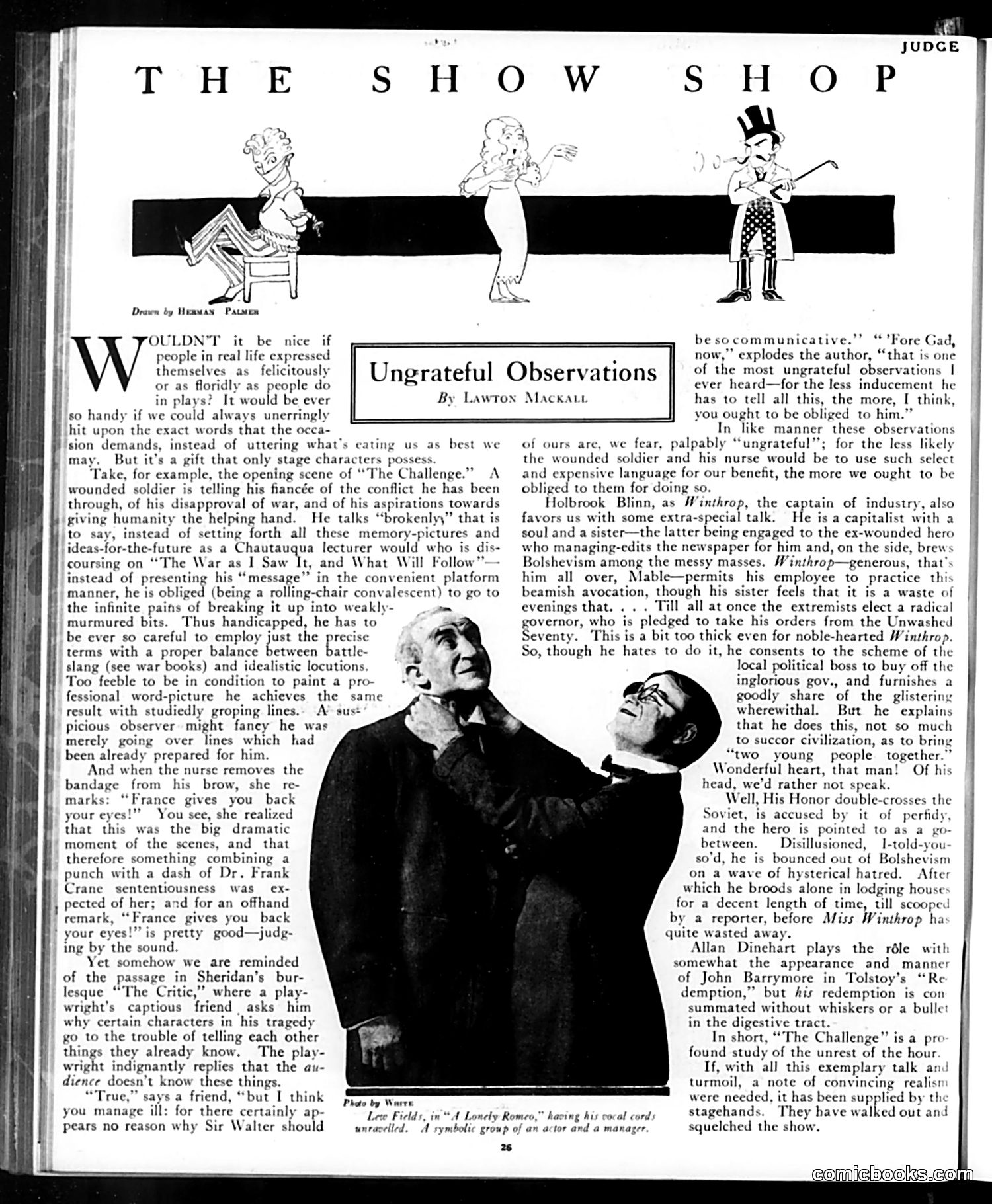
This page critiques theatrical dialogue in "The Challenge," a contemporary play. The author contrasts realistic speech with stage convention: a wounded soldier speaks in carefully balanced "broken" sentences combining military slang and idealistic language—language no real injured person would naturally use. When a nurse removes his bandage, she delivers an equally artificial line: "France gives you back your eyes!" The satire references Sheridan's play "The Critic," where a playwright defends unrealistic dialogue by arguing the *audience* needs information characters already know. Judge inverts this: the *less* realistic the dialogue should be, the *more* obliged audiences should feel to accept it. The page also discusses Holbrook Blinn in "Winthrop," a capitalist character who speaks in flowery language while employing a Bolshevik-sympathizing newspaper editor—a topical reference to 1920s Red Scare anxieties. The satire mocks both theatrical artificiality and contemporary political tensions.
📄 Transcribed text from this page (OCR, searchable)
Machine-transcribed from the original scan — historical spelling and the odd misread are preserved.
Drawn by Heaway Pauren OULDN’T it be nice if people in real life expressed themselves as felicitously or as floridly as people do in plays? It would be ever so handy if we could always unerring! hit upon the exact words that the occa- sion demands, instead of uttering what's cating us as best we But it’s a gift that only stage characters possess. ‘ake, for example, the opening scene of “The Challenge.” A wounded soldier is telling his fiancée of the conflict he has been through, of his disapproval of war, and of his aspirations towards giving humanity the helping hand. He talks “brokenlyy” that is to say, instead of setting forth all these memory-pictures and ideas-for-the-future as a Chautauqua lecturer would who is dis- coursing on “The War as I Saw It, and What Will Follow” instead of presenting his “message” in the convenient platform manner, he is obliged (being a rolling-chair convalescent) to go to the infinite pains of breaking it up into weakly- _ murmured bits. Thus handicapped, he has to be ever so careful to employ just the precise . a ) terms with a proper balance between battle- % slang (see war books) and idealistic locutions. n ¢ Too feeble to be in condition to paint a pro- y fessional word-picture he achieves the same result with studiedly groping lines.- A’ sus+ picious observer might fancy he was merely going over lines which had been already prepared for him And when the nurse removes the bandage from his brow, she re- marks: “France gives you back your ey You see, she realized that this v the big dramatic moment of the scenes, and that therefore something combining a punch with a dash of Dr. Frank Crane sententiousness was ex- pected of her; and for an offhand remark, “France gives you back * your eyes!” is pretty good—judg- ing by the sound. Yet somehow we are reminded of the passage in Sheridan’s bur- lesque “The Critic,” where a play- wright’s captious friend asks him why certain characters in his tragedy go to the trouble of telling each other things they already know. The play- wright indignantly replies that the au- dience doesn’t know these things. “True,” a friend, “but I think you manage ill: for there certainly ap- pears no reason why Sir Walter should Lawton By may, Photo by Warre unracelled. Ungrateful Observations Lew Fields, in“ A Lonely Romeo,” having his 1 symbolic group of an actor and a besocommunicative.”’ “’Fore Gad, now,” explodes the author, “that is one of the most ungrateful observations | ever heard—for the less inducement he has to tell all this, the more, I think, you ought to be obliged to him.” In like manner these observations of ours are, we fear, palpably “ungrateful”; for the less likely the wounded soldier and his nurse would be to use such select and expensive language for our benefit, the more we ought to be obliged to them for doing so. Holbrook Blinn, as Winthrop, the captain of industry, also favors us with some extra-special talk. He is a capitalist with a soul and a sister—the latter being engaged to the ex-wounded hero who managing-edits the newspaper for him and, on the side, brews Bolshevism among the messy masses. Winthrop—generous, that's him all over, Mable—permits his employee to practice this beamish avocation, though his sister feels that it is a waste of evenings that. . . . Till all at once the extremists elect a radical governor, who is pledged to take his orders from the Unwashed Seventy. This is a bit too thick even for noble-hearted Winthrop. So, though he hates to do it, he consents to the scheme of the local political boss to buy off the inglorious gov., and furnishes a goodly share of the glistering wherewithal. But he explains that he does this, not so much to succor civilization, as to bring “two young people together.” Wonderful heart, that man! Of his head, we'd rather not speak. Well, His Honor double-crosses the Soviet, is accused by it of perfidy, and the hero is pointed to as a go- between. —_ Disillusioned, _1-told-you- so'd, he is bounced out of Bolshevism on a wave of hysterical hatred. After which he broods alone in lodging houses for a decent length of time, till scooped y a reporter, before Miss Winthrop has quite wasted away, Allan Dinehart plays the réle with somewhat the appearance and manner of John Barrymore in Tolstoy’s “Re demption,” but Ais redemption is con summated without whiskers or a bullet in the digestive tract. In short, “The Challenge” is a pro found study of the unrest of the hour If, with all this exemplary talk and turmoil, a note of convincing realist were needed, it has been supplied by th stagehands. They have walked out and squelched the show. Mackane vocal cords manag