
Judge, 1919-09-06 · page 24 of 36
Judge — September 6, 1919 — page 24: what you’re looking at
What you’re looking at
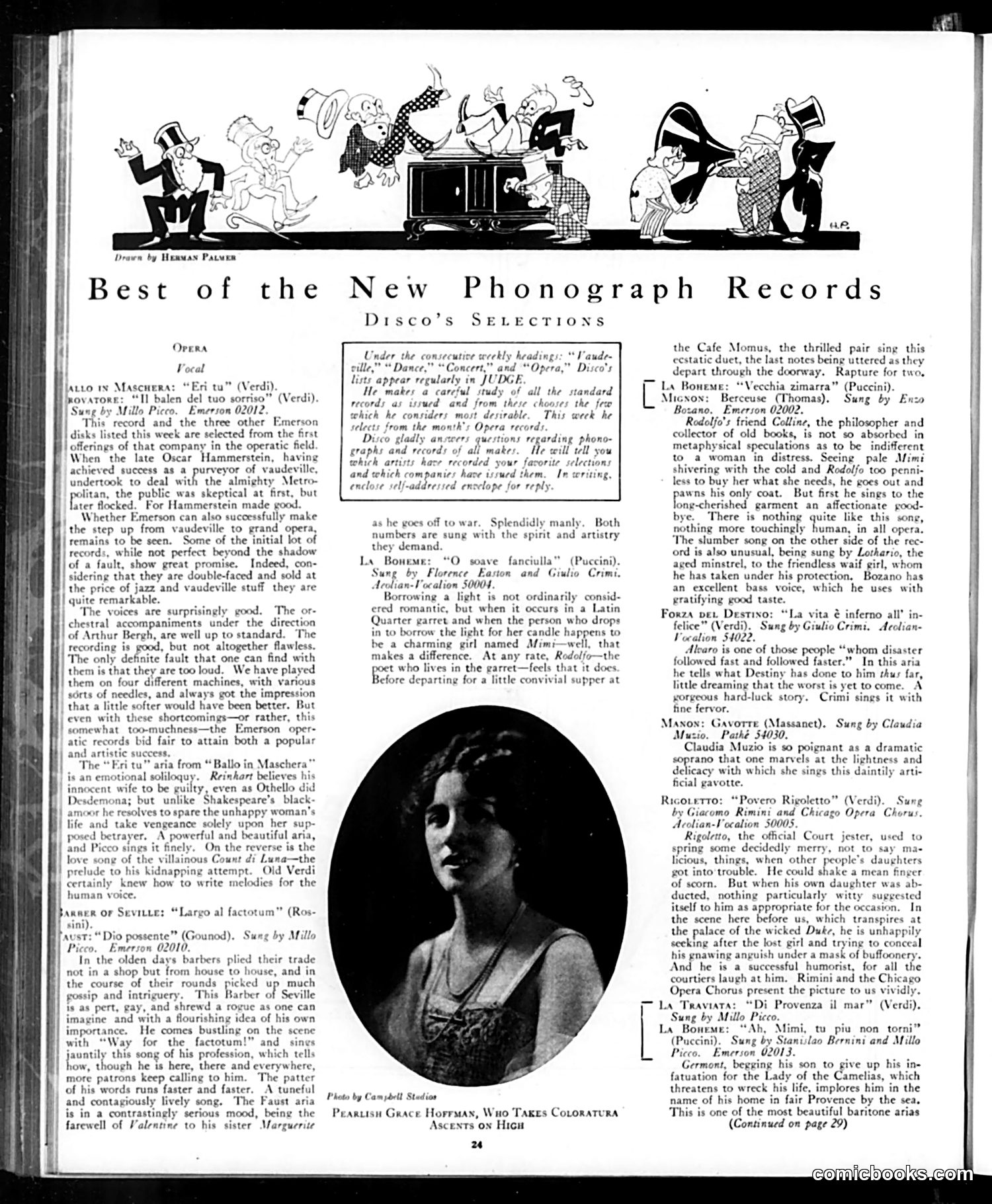
This page is primarily a **record review column**, not political satire. The cartoon at the top—drawn by Herman Palmer—shows stylized figures dancing and celebrating around a phonograph, illustrating the entertainment value of recorded music. The content reviews newly released operatic phonograph records from the Emerson company, including arias from *Ballo in Maschera*, *The Barber of Seville*, *La Bohème*, and *Faust*. The reviewer discusses vocal quality, orchestral accompaniment, and recording fidelity, noting that while Emerson's operatic venture shows promise, the recordings play too loudly. **Social context**: This reflects the early 1920s entertainment industry, when phonograph records were transitioning from popular/vaudeville material to serious opera—a marker of cultural aspiration and respectability. The mention of Oscar Hammerstein's success bringing opera to mass audiences suggests democratization of "high" culture through technology and commercial enterprise. This is **not satirical commentary** but rather cultural criticism evaluating a commercial product.
📄 Transcribed text from this page (OCR, searchable)
Machine-transcribed from the original scan — historical spelling and the odd misread are preserved.
Drown by Heawas Patwen Best of Overs Vocal auto ww Mascuera: “Eri tu” (Verdi) movators: “II balen del tuo sorriso” (Verdi) Millo Picco. Emerson 02012 d and the three other Emerson | disks listed this week are selected from the first ferings of that company in the operatic field When the late Oscar Hammerstein, having achieved success as a purveyor of vaudeville, undertook to deal with the almighty Metro- politan, the public was skeptical at first, but [iter flocked. For Hammerstein made good. Whether Emerson can also successfully make the step up from vaudeville to grand opera, remains to be seen. Some of the initial lot of records, while not perfect beyond the shadow of a fault, show great promise. Indeed, con- sidering that they are double-faced and sold at the price of jazz and vaudeville stuff they are quite remarkable. ne voices are surprisingly good. The or- | chestral accompaniments under the dir of Arthur Bergh, are well up to standard. recording is good, but not altogether flawless. The only definite fault that one can find with them is that they are too loud. We have playe them on four different mac! sorts of needles, and alway’ got the impression that a little softer would have been better. Bi even with these shortcomings—or rather, mewhat too-muchness—the Emerson oper- atic records bid fair to attain both a popular and artistic succe: ‘The “Eri tu” aria from “Ballo in Masche is an emotional soliloquy. Reinhart believes hi innocent wife to be guilty, even as Othello did but unlike Shakespeare’s black- jolves to spare the unhappy woman's and take vengeance solely upon her sup- J betrayer. A powerful and cco sings it finely. On song of the villainous C c Jude to his kidna Old Verdi certainly knew how to write melodies for the hur Sanner or Sevitte: “Largo al factotum” (Ros- | sini). haust: “Dio possente” (G . Sung by Millo ». Emerson 02010. In the olden days barbers plied their trade | not in a shop but from house to house, and in | the course of the ands picked up much sssip and i This Barber of Seville is as pert, gay, rewd a rogue as one can imagine and with a flourishing idea of his own importance. He comes bustling on the scene | with “Way for the factotum!” and sines jauntily this song of his profession, which tells how, though he is here, there and ¢ more patrons keep calling to him. 1 of his words runs faster and faster. A tuneful and contagiously lively song. The Faust aria is in a contrastingly serious mood, being the farewell of Valentine to his sister | Marguerite the New ists appe Disco’s SELECTIONS Under the consecutive weekly headings: “ Vaude~ lle,” Dance,” “Concert,” and “Opera,” Disco's egularly in JUDGE He ‘makes a careful itudy of all the standard records as issued and from these chooses the few which he considers most desirable. This week he elects from the month's Opera reco Disco gladly or ali makes hare recorded yc and which companies ha goes off to war. Splendidly manly. Both umbers are sung with the spirit and artistry they demand. La Boneme: Sung by Florence East 4teolian-Vocalion 50004. Borrowing a light is not ordinarily consid- ered romantic, but when it occurs in a Latin Quarter garret and when the person who drops in to borrow the light for her candle happens to be a charming girl named Mimi—well, that makes a difference. At any rate, Rodolfo—th oct who lives in the garret—feels that it docs Before departing for a little convivial supper at “O soave fanciulla™ (Puccini). and Giulio Crimi, Photo by Campbell Stadion Peartisn Grace Horrmax, Wao Takes CoLoratura Ascents on Hicn “4 j_ La Bonese: 77 La Traviata: Phonograph Records the Cafe Momus, the thrilled pair sing this ecstatic duet, the last notes being uttered as they depart through the doorway, Rapture for two, “Vecchia zimarra” (Puccini). Micron: Berceuse (Thomas). Sung by Enzo Bozano. Emerson 02002. Rodoljo’s friend Colline, the philosopher and collector of old books, is not so absorbed in metaphysical speculations as to be indiffer to. a woman in distress. Seeing pale Mf shivering with the cold and Rodolfo too penni less to buy her what she needs, he goes out and awns his only coat. But first he sings to the cherished garment an affectionate pood- There is nothing quite like this so: nothing more touchingly human, in all opera. ‘The slumber song on the other side of the rec- ord is also unusual, being sung by Lothario, the aged minstrel, to the friendless waif girl, whom he has taken under his protection, Bozano has an excellent bass voice, which he uses with gratifying good taste. Forza vet Destixo: “La vita é inferno all’ in- felice” (Verdi). Sung by Giulio Crimi. Acc Vocalion 54022. Alcaro is one of those people “whom disaster followed fast and followed faster.” In this aria he tells what Destiny has done to him thus far, little dreaming that the worst is yet to come. A gorgeous hard-luck story. Crimi sings it with fine fervor. Gavorre (Massanet). Sung by Claudia Pathé 54030, Claudia Muzio is so poignant as a dramatic soprano that one marvels at the lightness and delicacy with which she sings this daintily arti- ficial gavotte. ° Ricoretto: “Povero Rigoletto” (Verdi) by Giacomo Rimini and Chicago Opera C Acolian-Vecalion 50005. , the official Court jester, used to fe decidedly merry, not to say ma- licious, things, when other people's daughters got into trouble. He could shake a mean fi of scorn. But when his own daughter was ab- ducted, nothing particularly witty suggested itself to him as appropriate for the occasion. In the scene here before us, which transpires at the palace of the wicked Duke, he is unhappily seeking after the lost girl and trying to concea his gnawing anguish under a mask of buffoonery. And he is a successful humorist, for all the courtiers laugh at him. Rimini and the Chicago Opera Chorus present the picture to us vividly. “Di Provenza il mar” (Verdi). Sung by Millo Picco. La Boweae: “Ah, Mimi, tu piu non torni” (Puccini). Sung by Stanislao Bernini and Millo Picco. Emerson 02013. Germont, begging his son to give up his in. fatuation for the Lady of the Camelias, which threatens to wreck his life, implores him in the name of his home in fair Provence by the sea. This is one of the most beautiful baritone arias (Continued on page 29)