
Judge, 1919-09-06 · page 12 of 36
Judge — September 6, 1919 — page 12: what you’re looking at
What you’re looking at
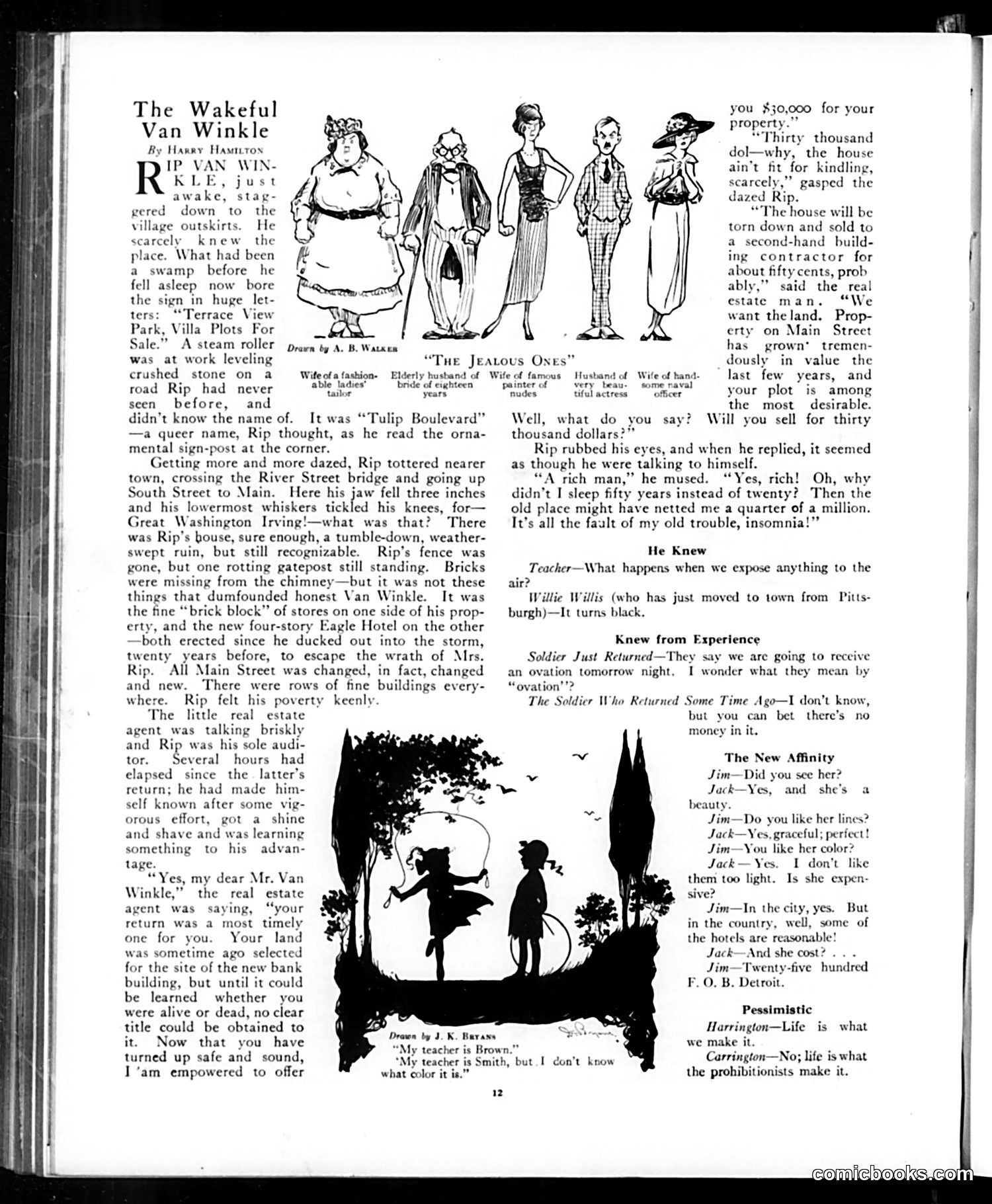
This story parodies Washington Irving's "Rip Van Winkle," updating it to satirize early-20th-century American urban sprawl and real estate speculation. Rip awakens to find his rural village transformed: swampland converted to "Terrace View Park," his family home surrounded by commercial development (a brick block of stores, a new Eagle Hotel), and Main Street lined with fine buildings. The satire's target: rapid, speculative development that enriches landowners while destroying the old character of communities. The real estate agent offers Rip $30,000 for his worthless property—a fortune. Rip's bitter joke captures the irony: he slept through twenty years of growth and missed becoming wealthy through passive land ownership, had he only stayed awake and patient. The accompanying cartoons and quips about teachers, soldiers, and social types fill the remaining space—typical Judge magazine filler humor requiring less historical context to understand the simple gags.
📄 Transcribed text from this page (OCR, searchable)
Machine-transcribed from the original scan — historical spelling and the odd misread are preserved.
The Wakeful Van Winkle By Haney Hasttrros IP VAN WIN- KLE, just awake, stag- gered down to the village outskirts. He scarcely knew the place. What had been a swamp before he fell asleep now bore the sign in huge let- ters: “Terrace View Park, Villa Plots For Sale.” A steam roller was at work leveling crushed stone on a road Rip had never seen before, and didn’t know the name of. It was “Tulip Boulevard” —a queer name, Rip thought, as he read the orna- mental sign-post at the corner. Getting more and more dazed, Rip tottered nearer town, crossing the River Street bridge and going up South Street to Main. Here his jaw fell three inches and his lowermost whiskers tickled his knees, for— Great Washington Irving!—what was that? There was Rip’s house, sure enough, a tumble-down, weather- swept ruin, but still recognizable. Rip’s fence was gone, but one rotting gatepost still standing. Bricks were missing from the chimney—but it was not these things that dumfounded honest Van Winkle. It was the fine “brick block” of stores on one side of his prop- erty, and the new four-story Eagle Hotel on the other both erected since he ducked out into the storm, twenty years before, to escape the wrath of Mrs. Rip. All Main Street was changed, in fact, changed and new. There were rows of fine buildings every- where. Rip felt his poverty keenly. The little real estate agent was talking briskl and Rip was his sole audi- tor. Several hours had elapsed since the. latter’s return; he had made him- self known after some v orous effort, got a shine and shave and was learning something to his advan- tage. “Yes, my dear Mr. Van Winkle,” the real estate agent was saying, “your return was a most timely one for you. Your land was sometime ago selected for the site of the new bank building, but until it could be learned whether you were alive or dead, no clear title could be obtained to it. Now that you have turned up safe and sound, I’am empowered to offer Drawn by A. B.Watxen Wite of a fashion- able ladies’ tailor bride of eighteen years Drawn by 3. KE what color it is.” “Tue Jeatous Ones’ lerly husband of Wife of famous a teacher is Brown.” teacher is Smith, but.I don’t know you $30,000 for your hirty thousand dol—why, the house ain’t fit for kindling, scarcely,” gasped the dazed Rip. “The house will be torn down and sold to a second-hand build- ing contractor for about fifty cents, prob ably,” said the real estate man. “We want theland. Prop- erty on Main Street has grown’ tremen- dously in value the Husband of Wife of hand. last few years, and waaay RET your plot is among the most desirable. Will you sell for thirty painter of nudes Well, what do you say? thousand dollars?” Rip rubbed his eyes, and when he replied, it seemed as though he were talking to himself. “A rich man,” he mused. “Yes, rich! Oh, why didn’t I sleep fifty years instead of twenty? Then the old place might have netted me a quarter of a million. It’s all the fault of my old trouble, insomnia!” He Knew Teacher—What happens when we expose anything to the Willie Willis (who has just moved to town from Pitts- burgh)—It turns black. Knew from Experience Soldier Just Returned—They say we are going to receive an ovation tomorrow night. I wonder what they mean by “ovation’’? The Soldier Who Returned Some Time Ago—1 don’t know, but you can bet there’s no money in it. The New Affinity Jim—Did you see her? Jack—Yes, and she's ty. Jim—Do you like her lines? Jack—Ves, graceful; perfect! Jim—Y ou like her color? Jack—Yes. 1 don’t like them too light. Is she expen- sive? Jim—In the city, yes. But in the country, well, some of the hotels are reasonable! Jack—And she cost? . . . Jim—Twenty-five hundred F. O, B. Detro a bea Pessimistic Harrington—Life is what we make Carrington—No; life is what the prohibitionists make it.