
A complete issue · 32 pages · 1918
Judge — December 21, 1918
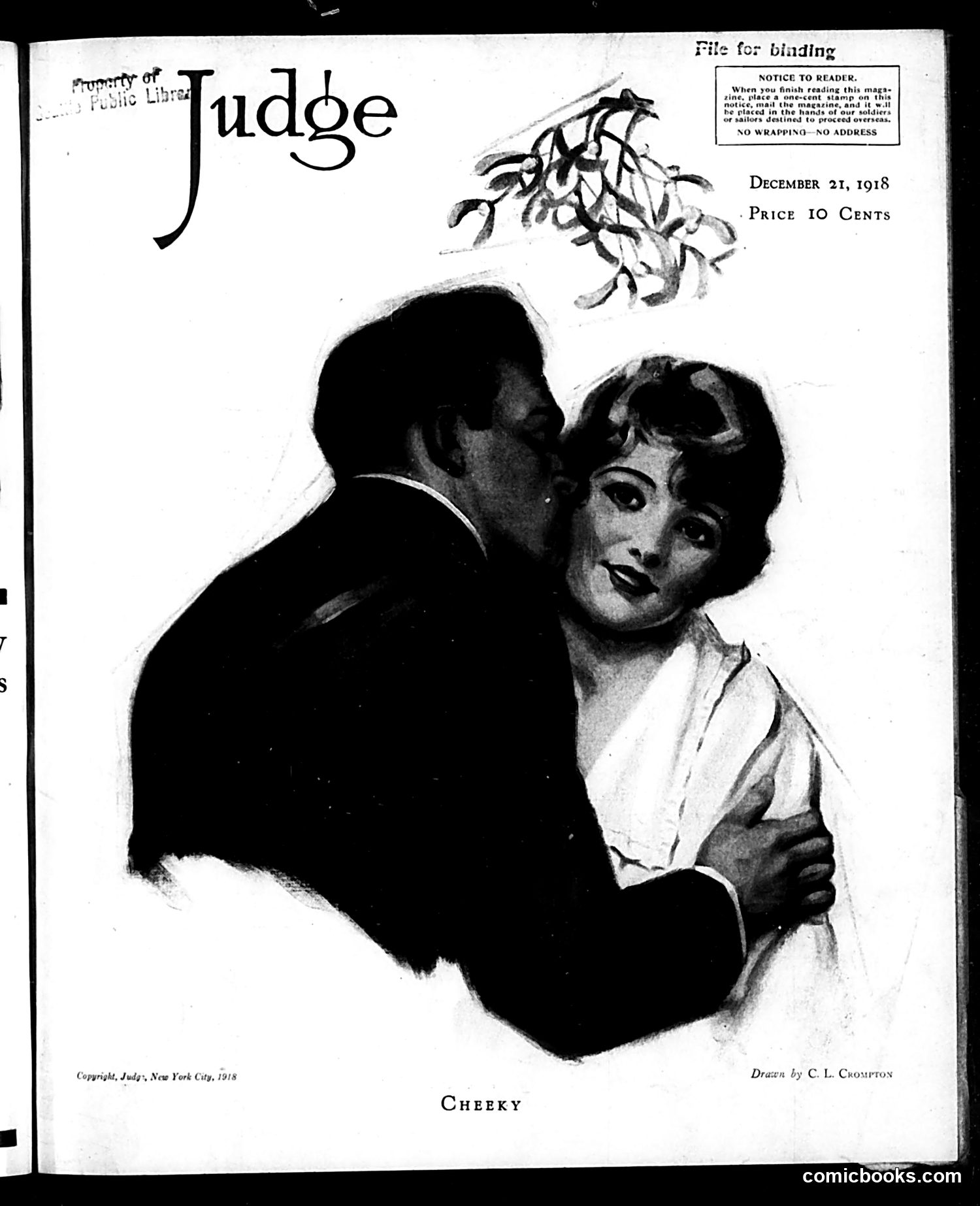
This illustration by C.L. Crouton depicts a romantic/flirtatious scene where a man in dark formal wear kisses or whispers to a smiling woman in light clothing, with mistletoe hanging above them. The title "Cheeky" suggests playful boldness or impudence. Published just after World War I ended (November 1918), this appears to be lighthearted holiday humor about romantic behavior during the festive season—specifically the tradition of kissing under mistletoe at Christmas. The cartoon requires no deeper political context; it's simply satirizing the somewhat forward, socially-daring flirtation that mistletoe supposedly permits between the sexes during holiday celebrations. The woman's knowing expression suggests she's complicit in this "cheeky" moment.
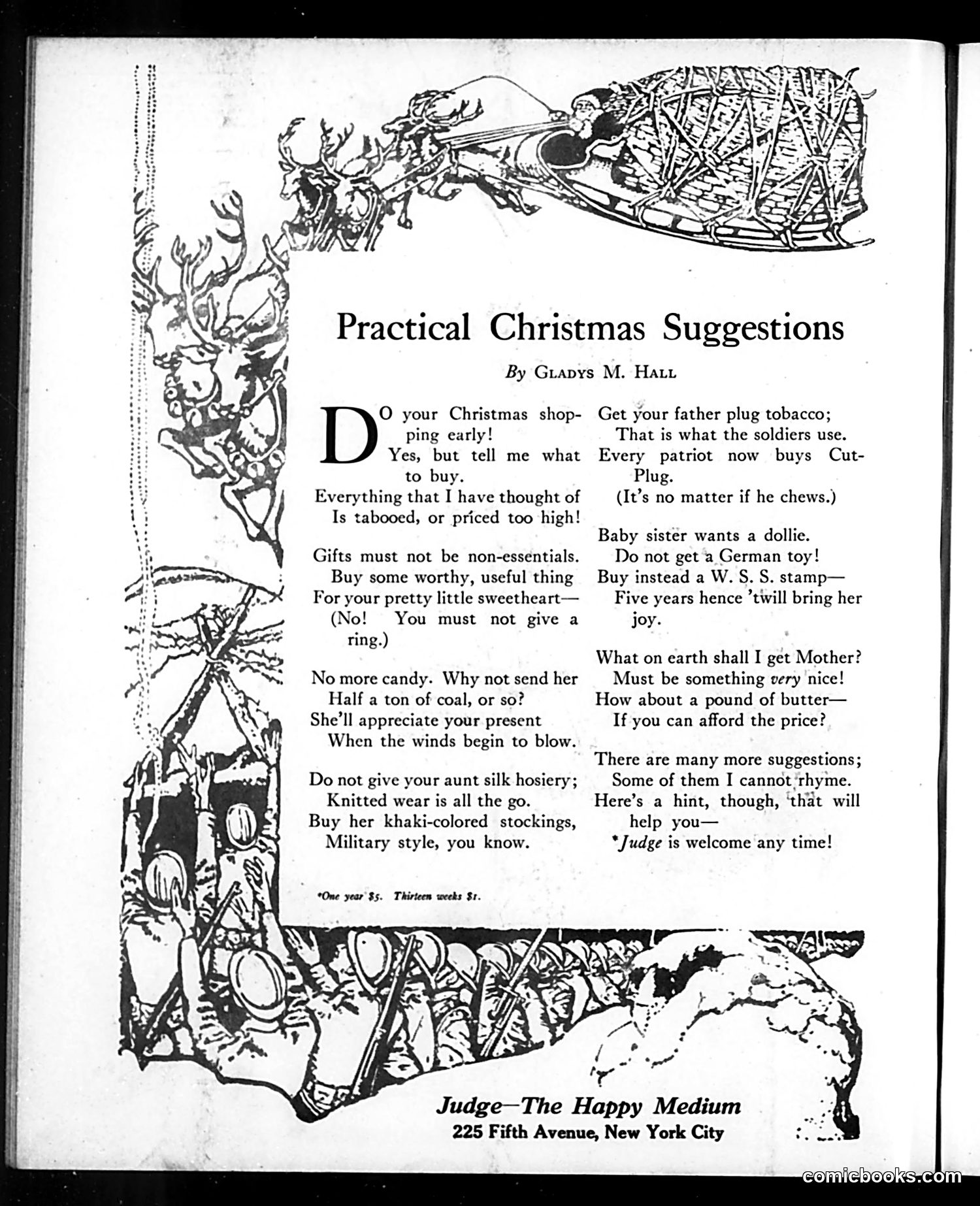
This satirical poem addresses Christmas gift-giving during wartime (likely WWI, given references to soldiers). The humor relies on patriotic guilt and rationing consciousness: - **Father's plug tobacco**: Framed as patriotic—"what the soldiers use" - **Baby's doll**: Must be American (U.S. stamp), not German - **Aunt's stockings**: "Khaki-colored, Military style"—fashionable sacrifice - **Mother's butter**: Luxuries are questioned; coal is suggested instead - **No candy/rings**: Non-essentials criticized as unpatriotic The satire mocks how wartime messaging pressures civilians into "practical" gifts by wrapping deprivation in patriotic language. What should be joyful giving becomes duty-driven austerity. The poem's tone—slightly exasperated—suggests Hall found these suggestions absurdly restrictive, yet socially inescapable.
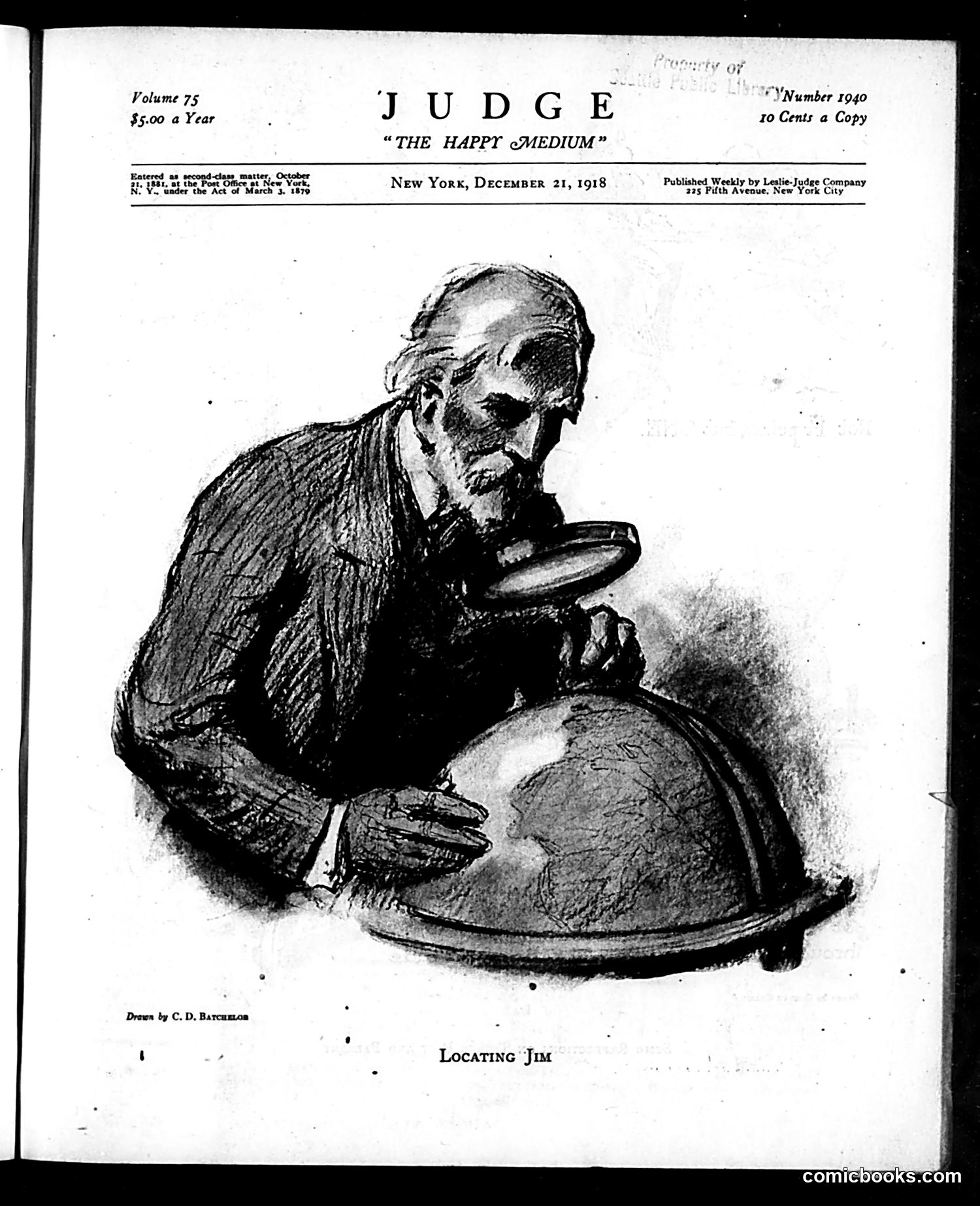
This cartoon, drawn by C.D. Batchelor, depicts a man using a magnifying glass to examine a dome-shaped object. The title "Locating Jim" suggests a search or investigation. Given the December 1918 date—immediately following WWI's November armistice—this likely references Jim (possibly a political figure or public personality of that era), though the specific identity is unclear from the image alone. The magnifying glass suggests difficulty finding or identifying the subject, implying the person has become obscured, hidden, or hard to locate. Without additional context about who "Jim" represents in 1918 politics or popular culture, the precise satirical target cannot be stated with certainty. The cartoon appears to mock someone's elusiveness or obscurity.
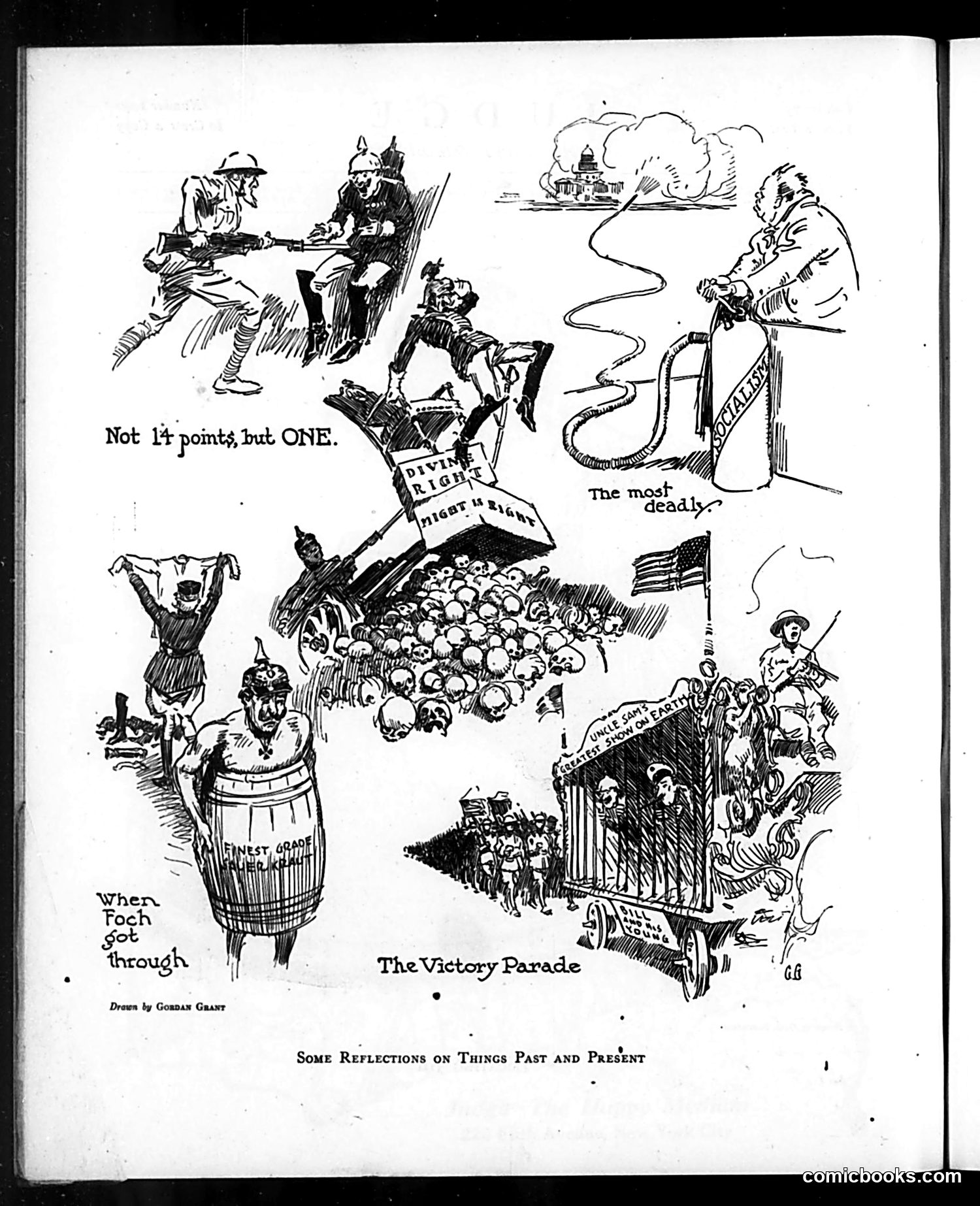
This satirical page by Gordon Grant compares WWI military strategy with domestic American outcomes: **Top panels**: "Not 14 points, but ONE" depicts military officers with a soldier, contrasting President Wilson's famous 14 Points peace proposal with battlefield reality. "The most deadly" shows a cannon pointed at civilians, criticizing civilian casualties. **Bottom left**: "When Food got through" shows a barrel labeled "Finest Grade" being hoisted—likely mocking food rationing or profiteering during wartime. **"The Victory Parade"**: depicts American soldiers parading past Uncle Sam's hat and a building, suggesting hollow celebration amid actual suffering. The overall message critiques the gap between wartime promises and actual results—both military casualties and domestic hardship—using dark humor typical of Judge's political commentary.
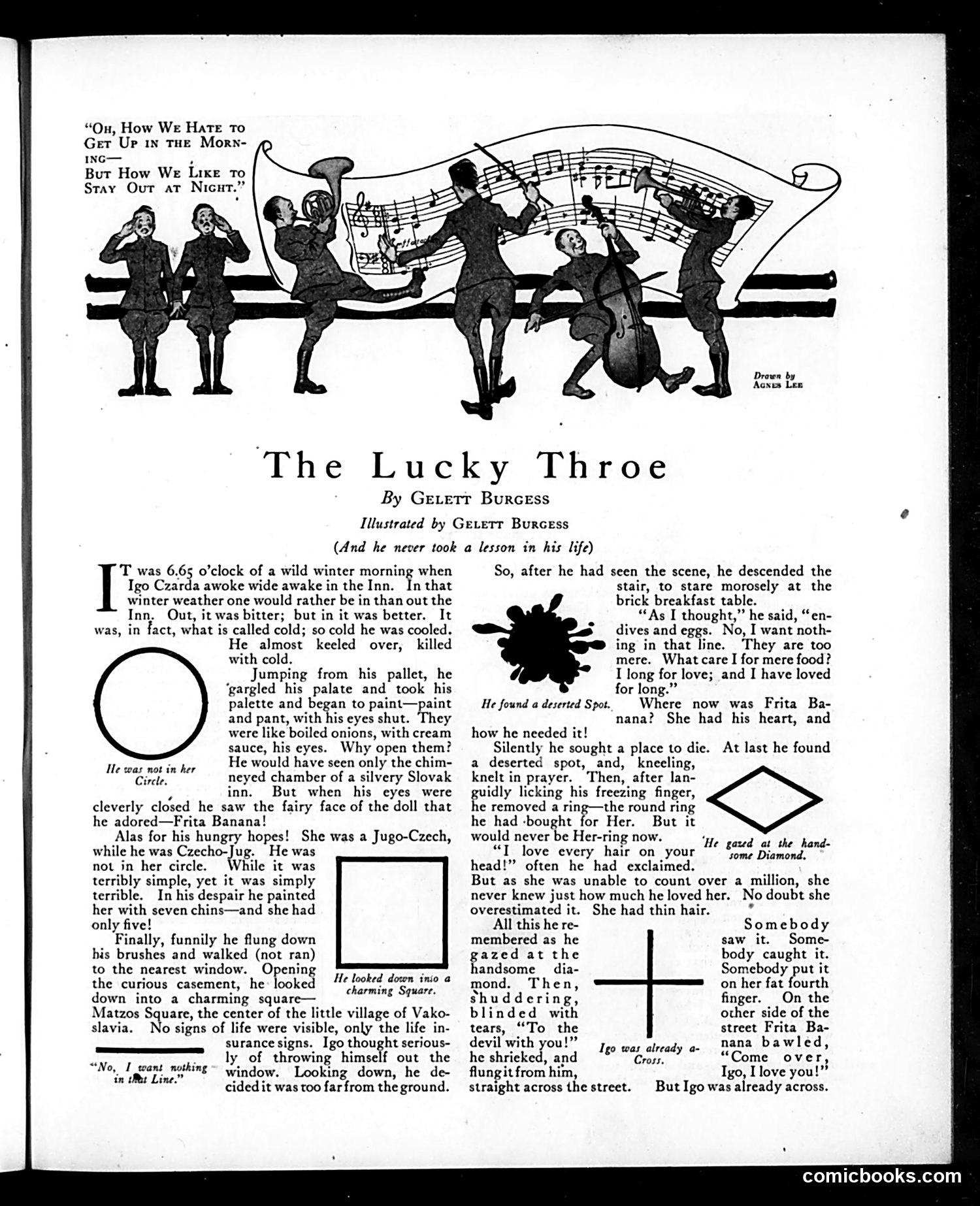
This is a short story illustration rather than political satire. It depicts a romantic tale set in a Slovak inn during winter, following a character named Igo Czarda who awakens lovesick and depressed. The narrative centers on his longing for Frita Banana, a Jugo-Czech woman he adores but who is unaware of his feelings. The story's "lucky three" apparently refers to elements of fortune—Igo eventually removes a ring he'd purchased for her and places it on a deserted spot, hoping to reunite with her. The illustrated vignettes show key story moments: his melancholy breakfast, his discovery of a diamond, and his emotional realization of love. This appears to be entertainment fiction rather than topical commentary.
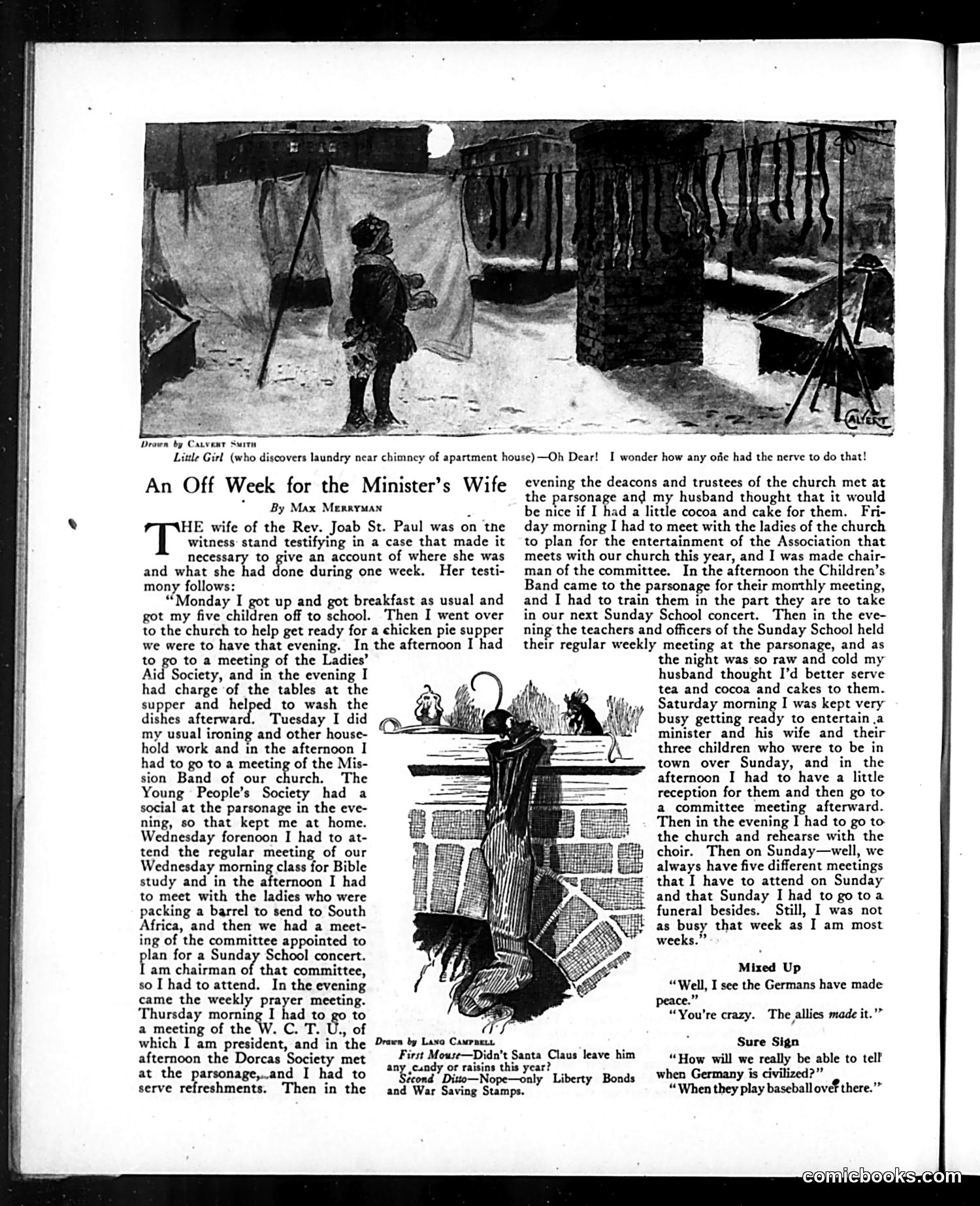
The main article, "An Off Week for the Minister's Wife" by Max Merryman, is a humorous domestic narrative rather than political satire. It describes a clergyman's wife overwhelmed by church obligations—Bible studies, Ladies' Aid Society meetings, missionary planning, concerts, and social events—that consume her entire week. The small cartoon illustrations scattered throughout appear to be visual gags supporting the text. The illustration labeled "First Messy—Didn't Santa Claus leave him any candy or raising this year?" references wartime rationing (Liberty Bonds and War Saving Stamps are mentioned), suggesting this was published during WWI when civilian goods were restricted. The page is primarily domestic humor rather than political commentary, reflecting American home-front life during wartime.
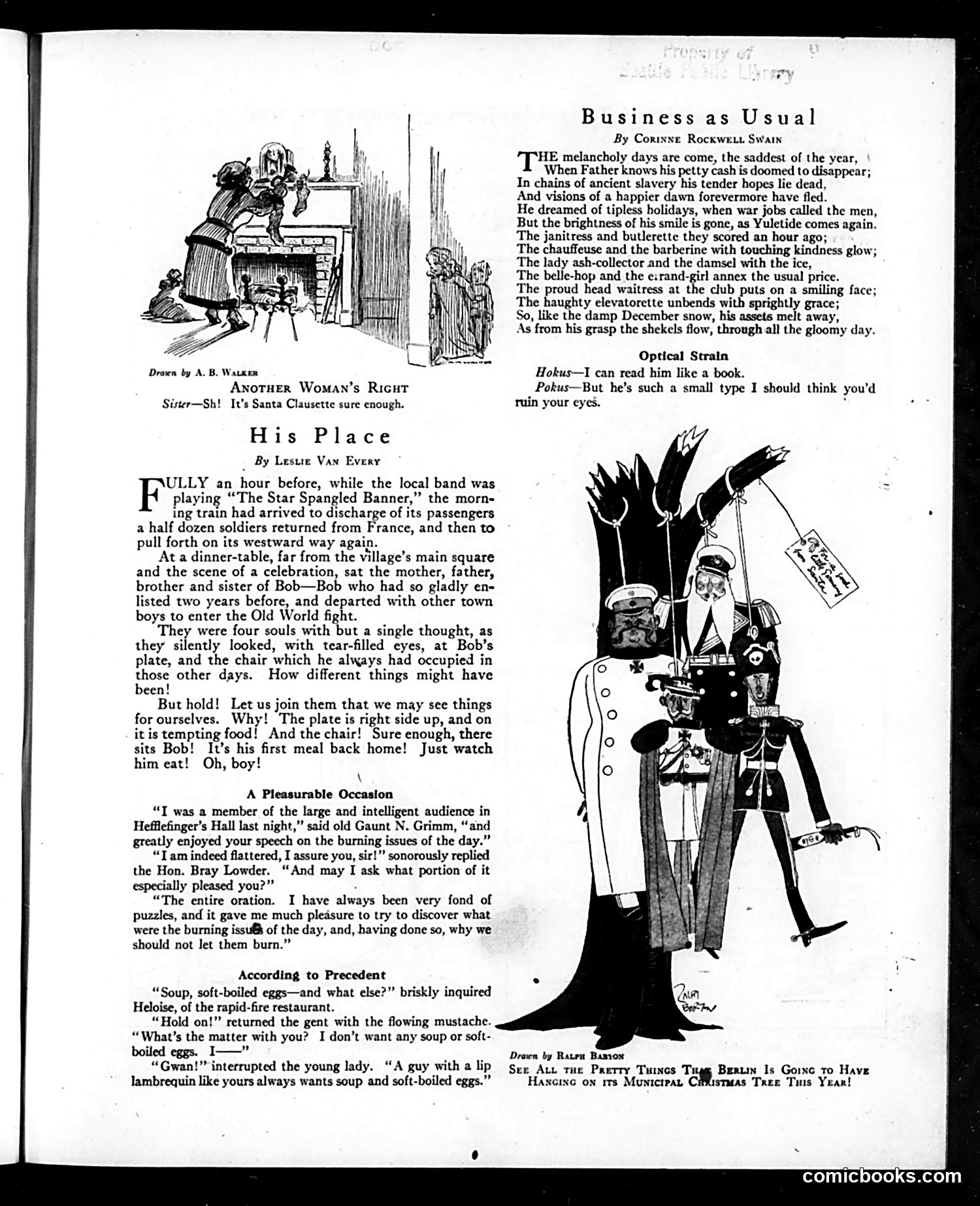
This page contains three satirical pieces from the post-WWI era (likely early 1920s): **"His Place"** depicts a soldier returning home from France to his family's dinner table. The satire centers on the empty chair left during his absence—revealing the relief and joy that he survived and returned safely. **"Business as Usual"** mocks the post-war economic squeeze on middle-class fathers. Despite soldiers returning and wartime "tip jobs" ending, service workers (janitors, butlers, chauffeurs, waiters, elevator operators) continue extracting gratuities, draining the father's holiday budget. It satirizes how working-class demands for tips persist regardless of economic conditions. **The two brief jokes** are wordplay: one mocks female Santa impersonators ("Clausette"), and another ridicules a pompous political speaker whose vague oration leaves listeners unable to identify what issues he actually addressed. The cartoons reflect post-war American anxieties: soldiers' homecoming, economic strain, and growing frustration with tipping culture—issues that resonate today.
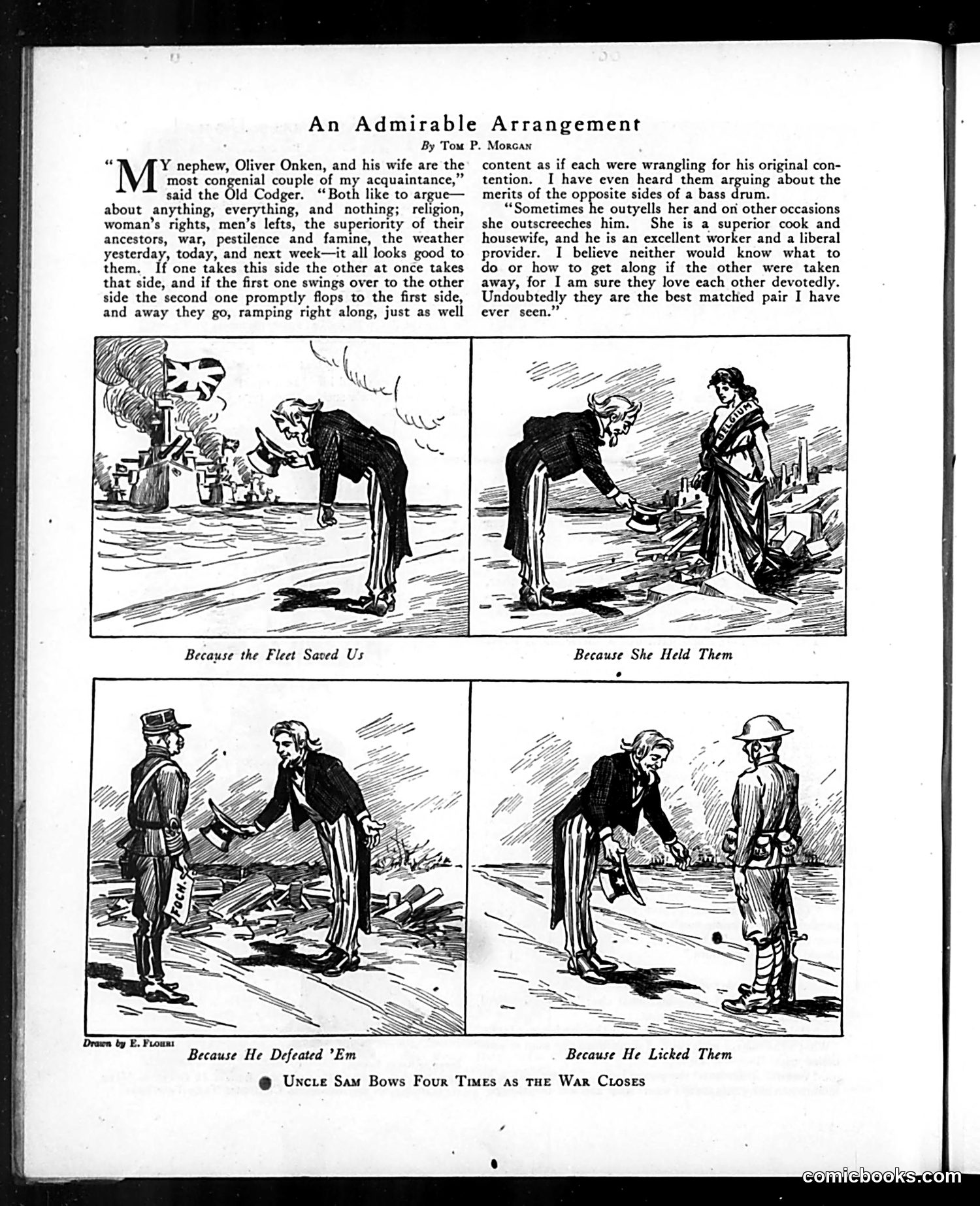
This satirical piece by Tom P. Morgan depicts a married couple, Oliver Onken and his wife, who constantly argue about everything—religion, politics, weather—yet remain devoted to each other. The humor lies in the paradox: they're perfectly matched *because* they fight. The four comic panels show Uncle Sam bowing at different points during wartime, with captions explaining his deference: "Because the Fleet Saved Us," "Because She Held Them," "Because He Defeated 'Em," and "Because He Licked Them." The final line states "Uncle Sam Bows Four Times as the War Closes." This appears to be WWI-era commentary using the Onken couple as a metaphor for how America's allies (likely Britain and France, represented as bickering partners) actually strengthen each other through their disagreements. The Uncle Sam panels suggest his respect grows as the allied nations "defeat" enemies together—their constant conflict ironically makes them stronger partners.
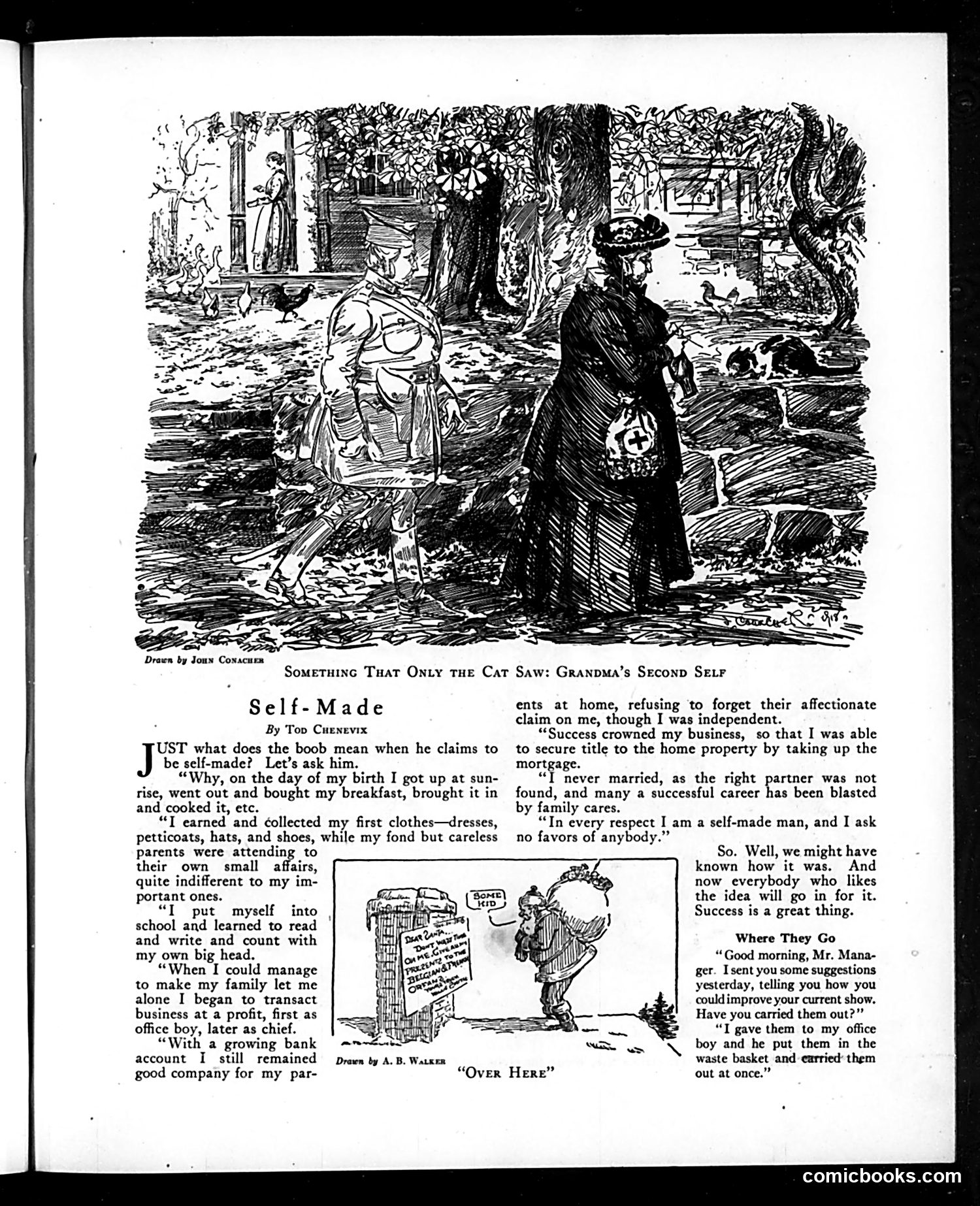
This two-part satirical piece mocks the American "self-made man" concept. The main article by Too Chenevix presents a boastful man claiming complete independence—he fed and clothed himself as an infant, educated himself, and built his business alone—while conveniently omitting that his parents fed, housed, and raised him. The satire is razor-sharp: the man contradicts himself by describing parental support he claims to have rejected. The accompanying cartoon "Over Here" (by A.B. Walker) reinforces the joke: a manager dismisses helpful suggestions by tossing them in the waste basket. This suggests that self-made "success" often involves ignoring outside input, further mocking the hubris of those claiming sole credit for their achievements. Judge's target: wealthy businessmen who celebrated their independence while benefiting from inherited advantages, family connections, and luck—yet credited only themselves.
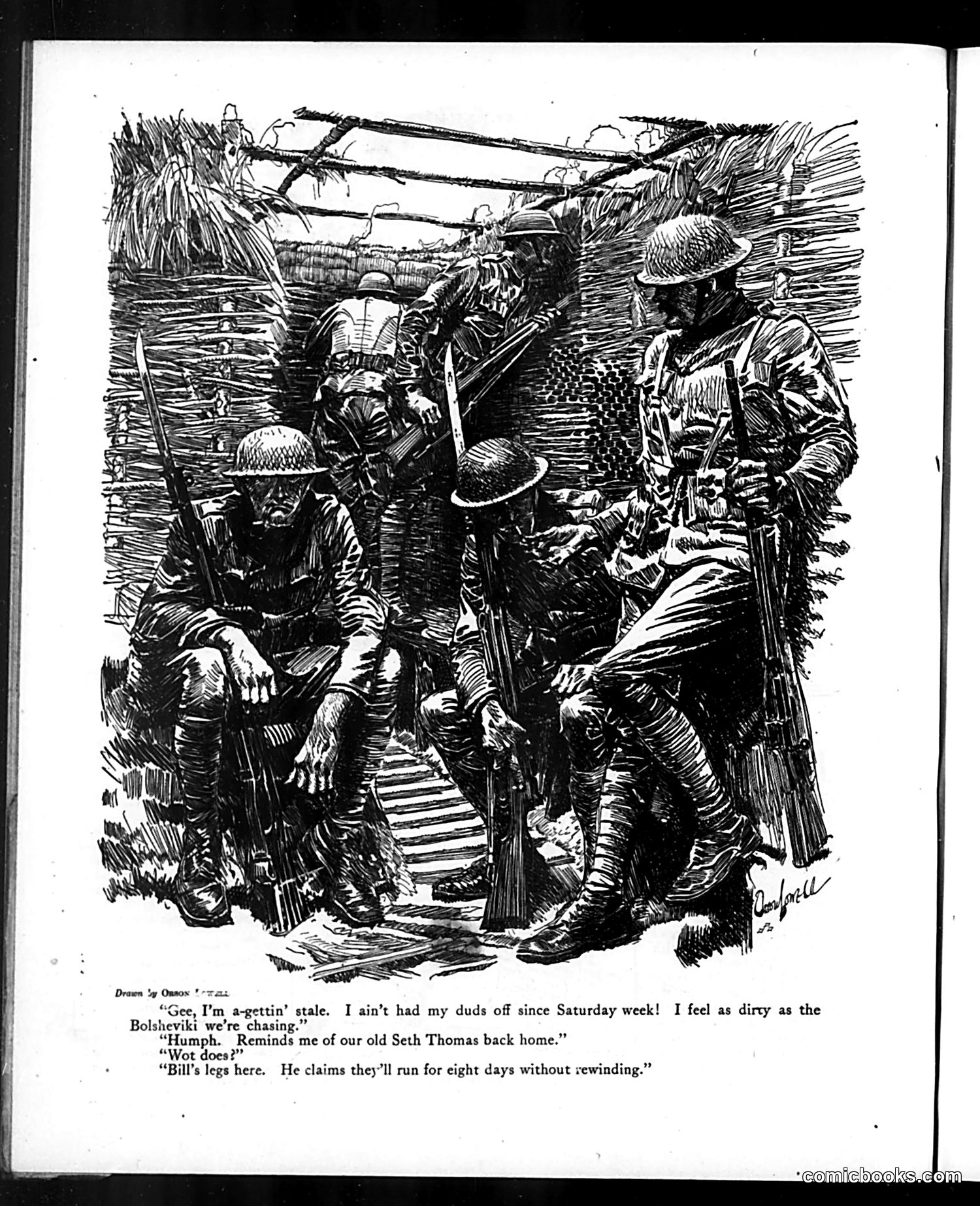
This WWI-era cartoon depicts soldiers in a trench discussing their exhaustion and filthy conditions. One soldier complains he hasn't changed clothes in a week and feels "as dirty as the Bolsheviki we're chasing"—a reference to Russian communist forces, used here as a crude insult suggesting extreme dirtiness. Another soldier jokes that their comrade Bill's legs resemble an old "Seth Thomas" clock (a real American clock brand), claiming they'll "run for eight days without rewinding"—a dark humor joke suggesting Bill's legs are mechanical or will keep going despite fatigue. The satire mocks both soldier exhaustion during the war and uses anti-communist rhetoric casually as wartime slang.
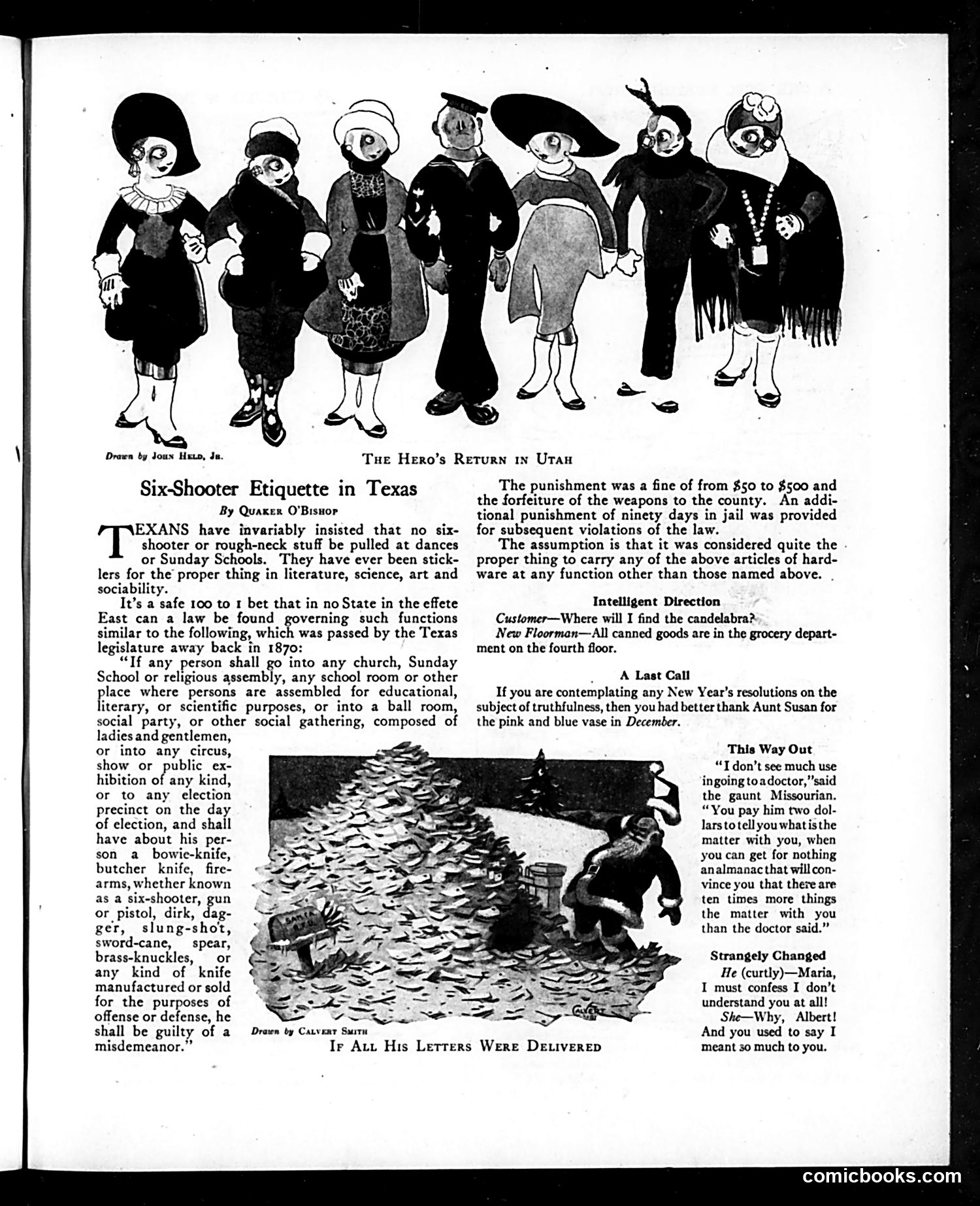
This satirical article mocks Texas's reputation for frontier violence by presenting an 1870 Texas law prohibiting weapons at civilized gatherings—churches, schools, social events, elections. The joke is the *irony*: that Texans needed such a law suggests they were so prone to armed violence that legislators had to explicitly forbid guns at Sunday schools and dances. The accompanying cartoon shows seven women in fancy hats and dresses, likely satirizing how even "proper society" gatherings in Texas apparently required weapons restrictions. The article's sardonic tone suggests the "effete East" (refined Eastern states) didn't need such laws because they were naturally civilized, whereas Texas—despite its inhabitants' claims to propriety—required legal enforcement to prevent gunfights at social functions. The accompanying short humor pieces are unrelated filler typical of Judge magazine.
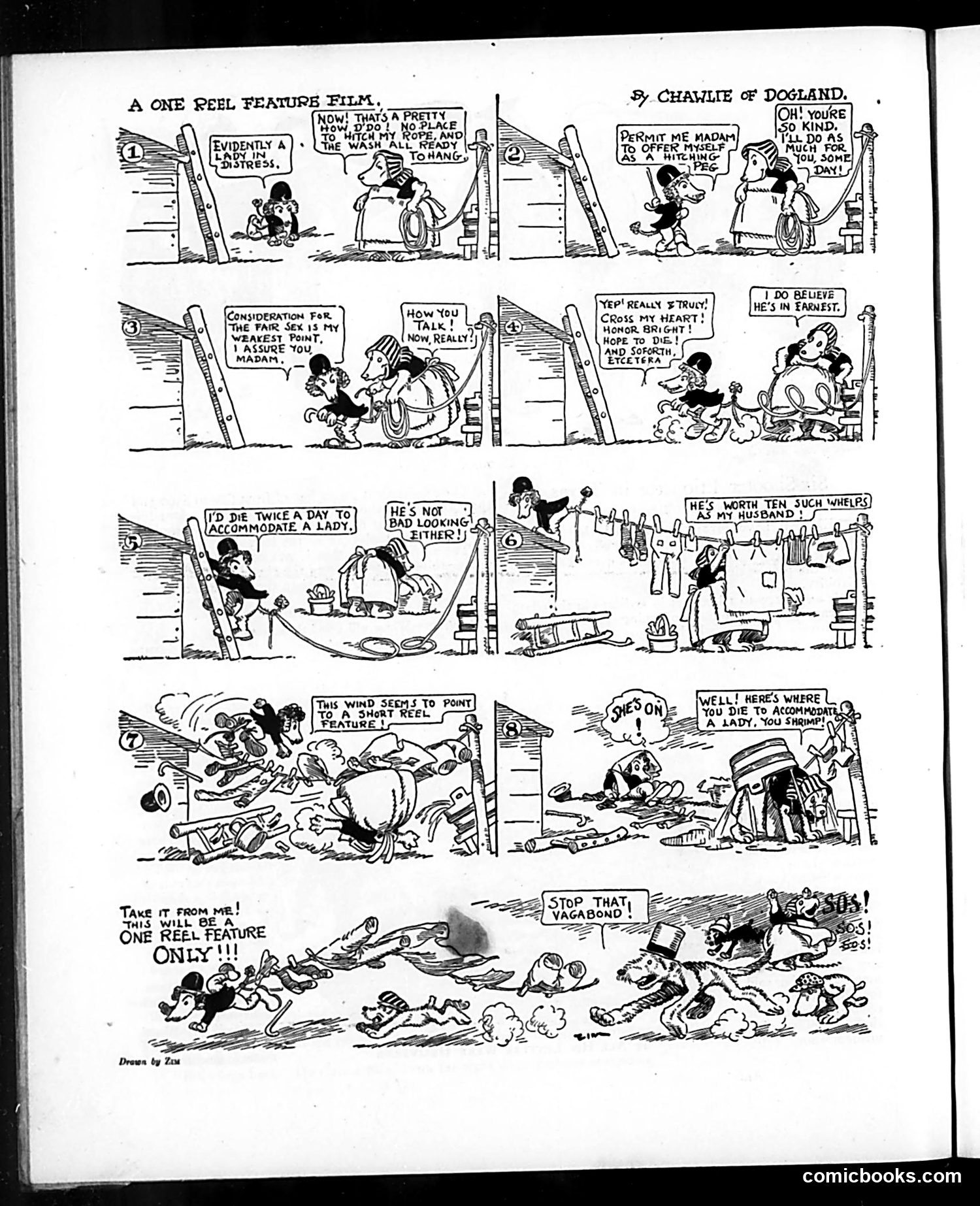
This is a humorous comic strip featuring anthropomorphic dogs in slapstick situations. The narrative follows a small dog character attempting to court or impress a female dog, using exaggerated romantic gestures and declarations. The satire references early silent film conventions—specifically the "one reel feature" format popular in the 1910s-1920s. The repeated phrase "one reel feature" is a running joke about how the dog's romantic misadventures escalate from minor complications to complete physical chaos, mirroring the escalating disasters typical of silent comedies. The final panel shows the characters literally tangled and scattered after a windstorm, with someone declaring "this will be a one reel feature only"—the ultimate comedic destruction. The strip mocks both melodramatic courtship behavior and the predictable formula of early cinema slapstick, where elaborate setups inevitably end in total mayhem.
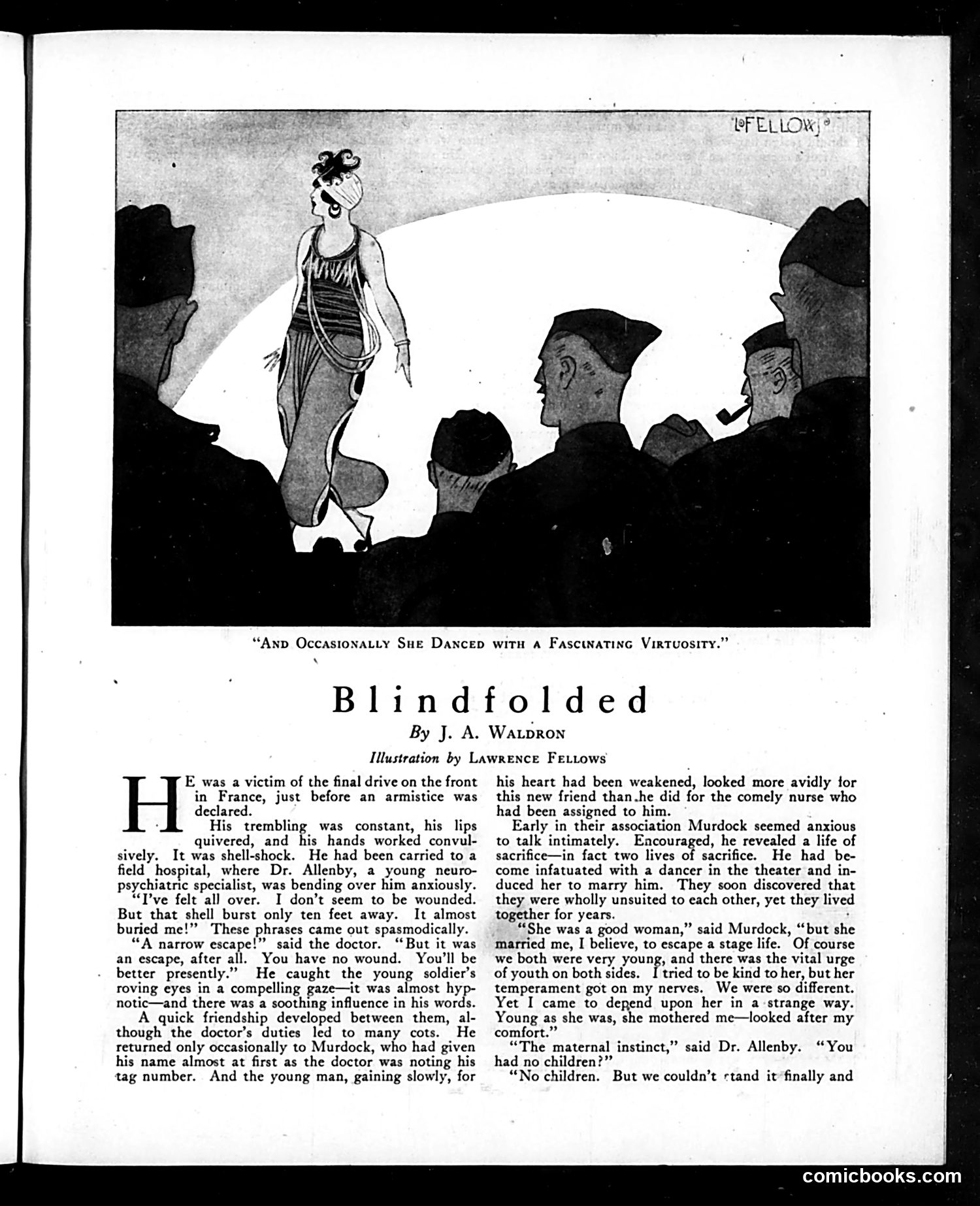
This is a short story, not a political cartoon. "Blindfolded" by J.A. Waldron tells of a WWI shell-shock victim named Murdock recovering in a field hospital under Dr. Allenby's care. The narrative explores psychological trauma and emotional dependency. Murdock, weakened physically and mentally from combat, becomes emotionally reliant on the doctor while confessing details of his failed marriage to a theater dancer. The story examines themes of sacrifice, incompatibility, and the "maternal instinct" in relationships. The illustration shows Murdock (center) before silhouetted military officers, depicting his vulnerable position. The caption references a dancer with "fascinating virtuosity"—likely the ex-wife he's describing. This appears to be serialized fiction exploring post-war psychological and domestic themes rather than satire or political commentary. The "blindfolded" title likely refers to emotional blindness in relationships.
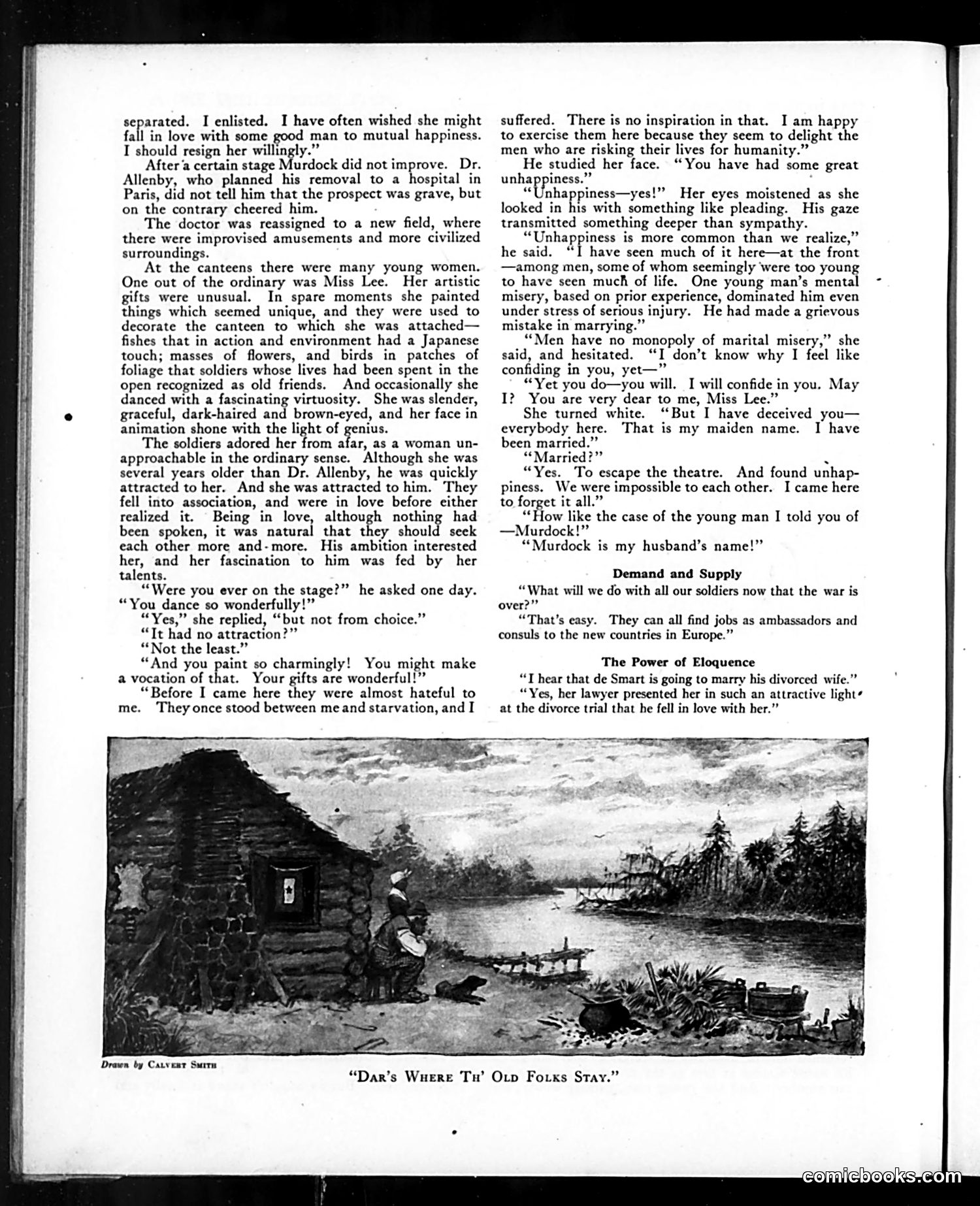
This page contains a serialized romantic story about Dr. Allenby and Miss Lee, two people who fall in love while working at a WWI military canteen. The narrative's twist reveals Miss Lee was previously married to a soldier named Murdock—a patient Allenby had treated, creating an ironic connection between the characters. Below the main story are three brief satirical jokes typical of Judge magazine's humor: 1. **"Demand and Supply"** jokes about post-WWI employment, suggesting soldiers could become ambassadors and consuls to newly independent European nations—satirizing both the proliferation of new countries after the war and optimistic employment prospects. 2. **"The Power of Eloquence"** mocks divorce proceedings, suggesting a lawyer's persuasive courtroom presentation made a man fall back in love with his ex-wife—a commentary on rhetoric's manipulative power and marital absurdity. The illustration depicts a riverside scene, likely illustrating the story's setting.
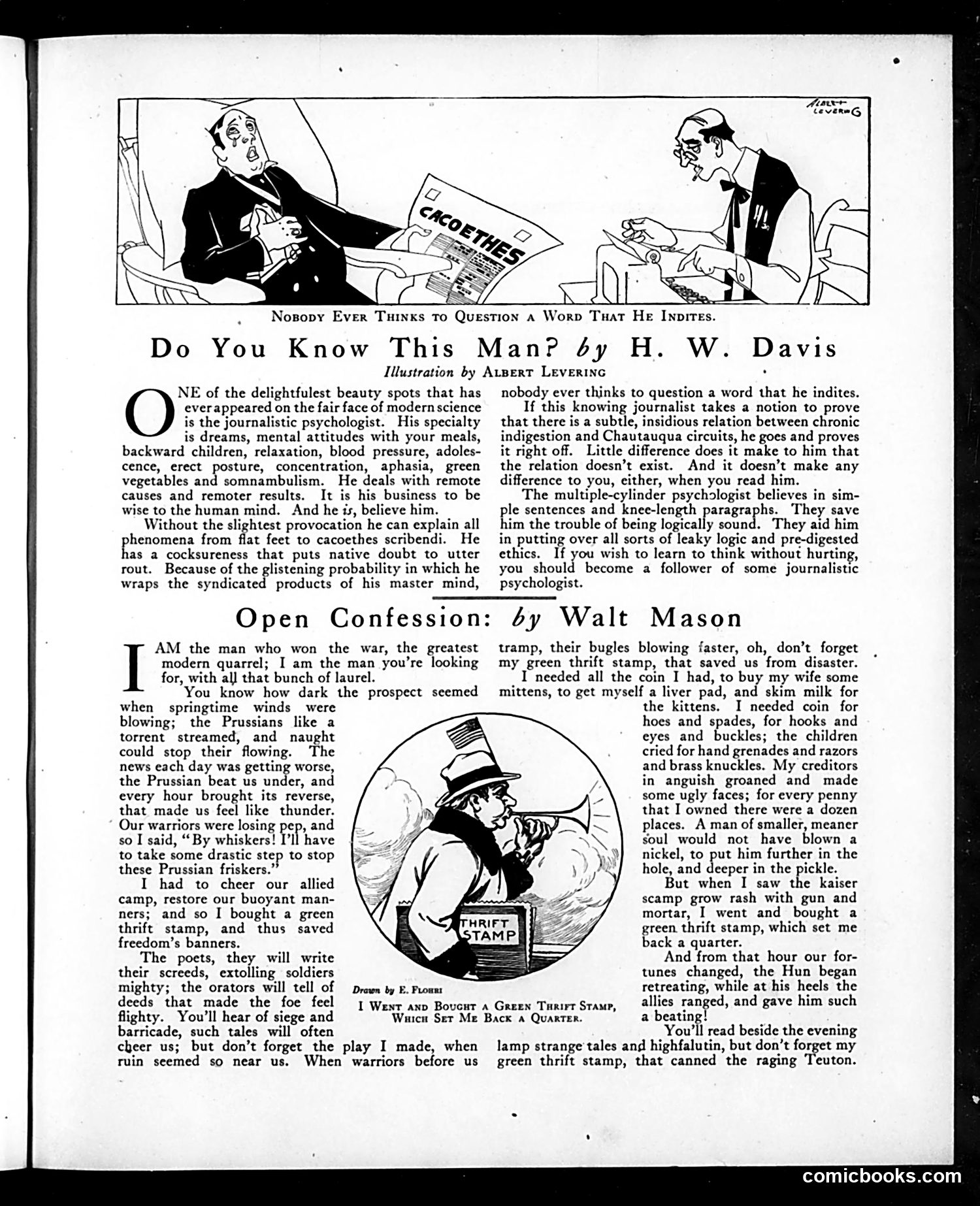
This page from *Judge* magazine contains two distinct pieces of satirical content, likely from World War I era (references to "the Hun," Prussians, and thrift stamps): **Top cartoon ("Do You Know This Man?"):** Satirizes the "journalistic psychologist"—a newspaper columnist who confidently explains complex human behavior (dreams, posture, digestion) through pseudo-scientific armchair psychology. The satire's point: readers never question such writers' dubious claims because they're presented with glib certainty and simple, persuasive language. It's mocking both the charlatan experts and the credulous public that accepts their nonsense. **Bottom piece ("Open Confession"):** A humorous poem claiming the narrator won WWI by purchasing a war bond ("green thrift stamp"). The joke is absurdly inflating personal contribution—he bought one stamp for 25 cents, which somehow turned the tide against Germany. It's patriotic satire promoting war bonds while gently mocking the propaganda that claimed such purchases were war-winning.
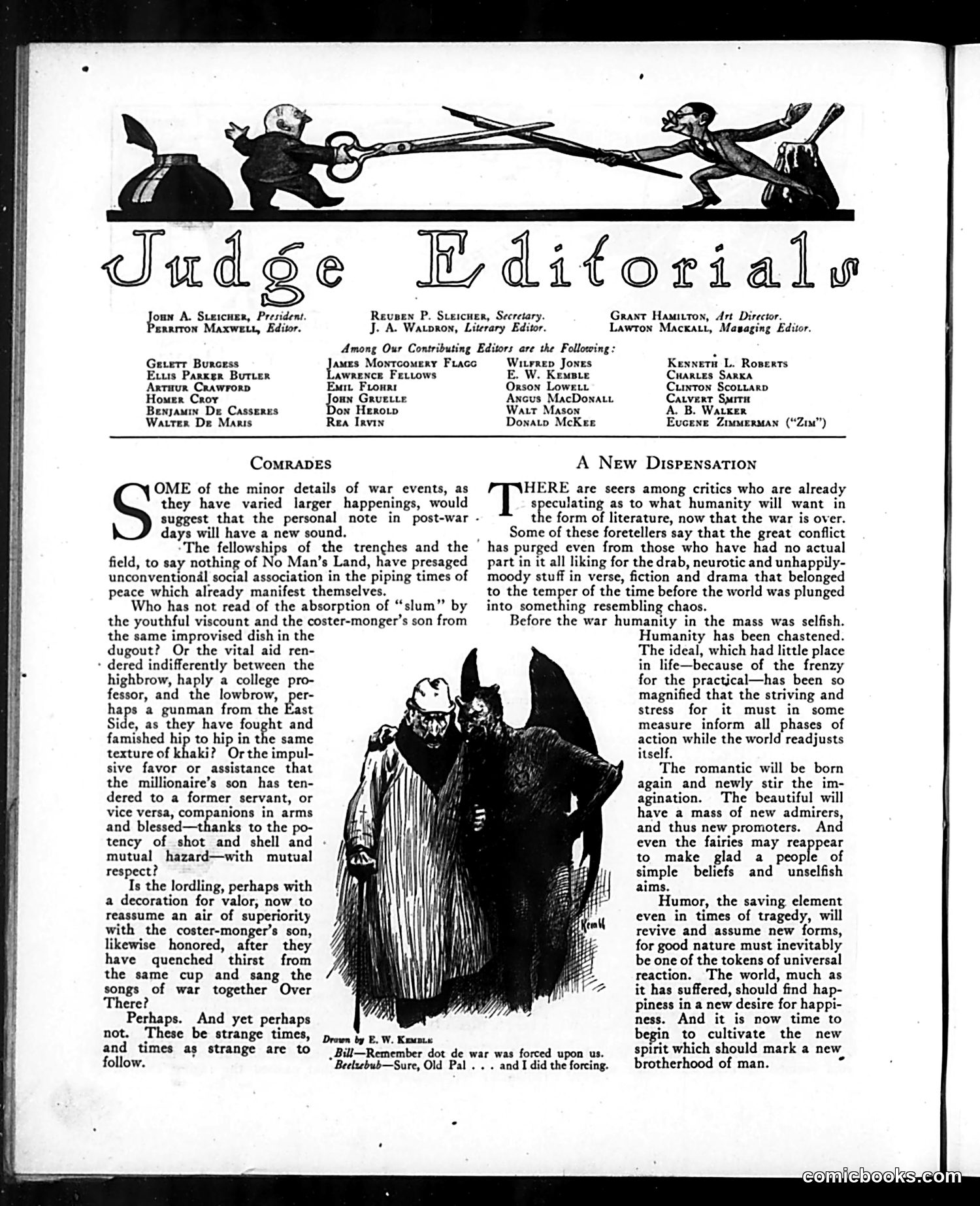
This is a **title/editorial page** from Judge magazine, likely published shortly after World War I ended (1918-1919). The page contains two editorial essays: **"Comrades"** discusses how trench warfare dissolved class barriers—aristocrats and working-class soldiers shared foxholes, food, and danger equally. The editor questions whether this newfound mutual respect will survive peace, or if the lordling with a military decoration will resume his former superiority over his former working-class companion. **"A New Dispensation"** is more hopeful, arguing that the war's sacrifices have "chastened" humanity and purged selfish pre-war attitudes. The author predicts literature and culture will shift from "drab, neurotic" realism toward romance, beauty, and humor—reflecting humanity's moral elevation through shared suffering. The cartoon by E.W. Kemble (captioned "Bill—Remember dot de war was forced upon us / Beelzebub—Sure, Old Pal... and I did the forcing") appears to satirize this optimism, suggesting darker forces manipulated the conflict. Both pieces reflect post-WWI anxieties about whether war's social disruptions would create lasting change.
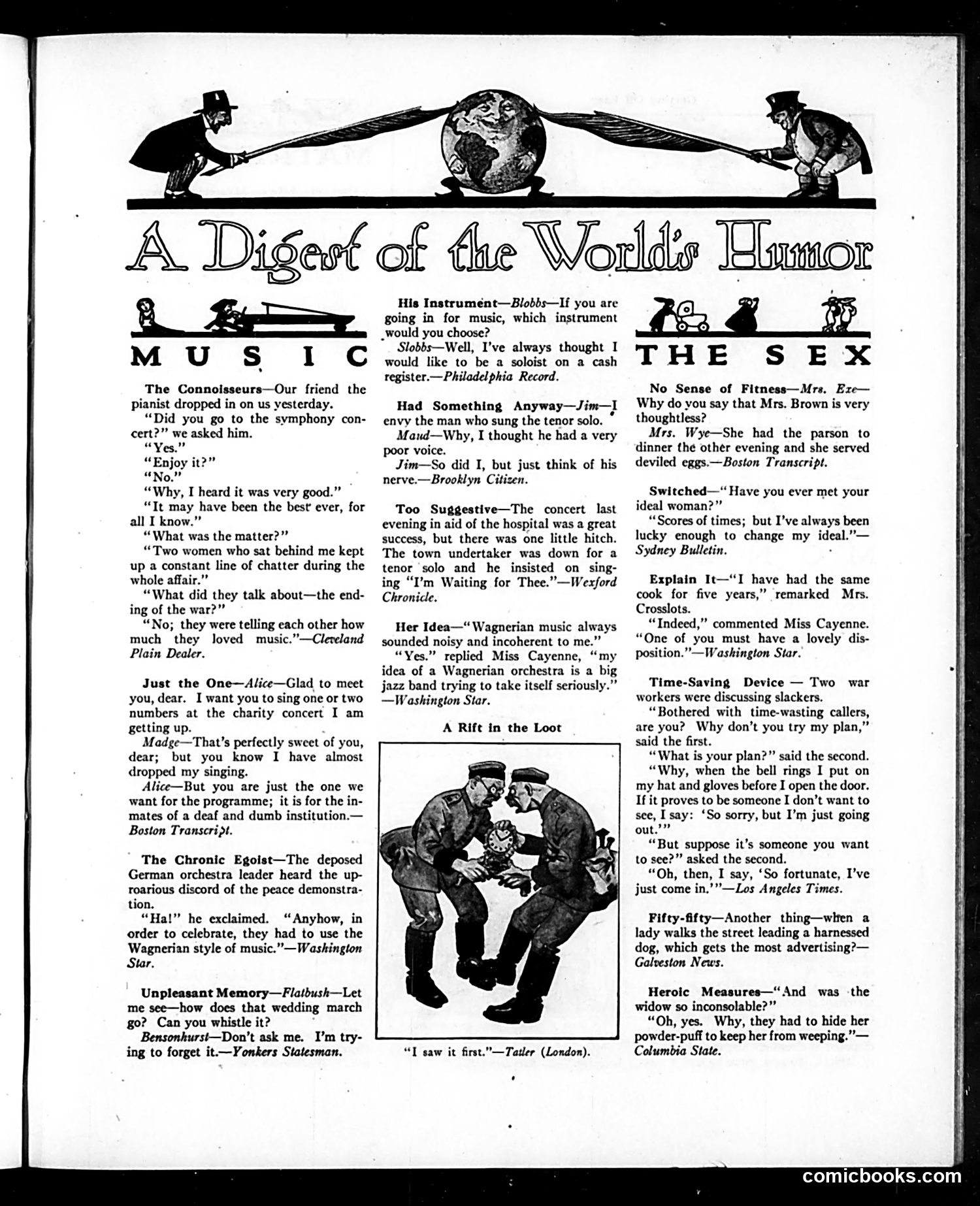
This page collects brief humorous anecdotes organized by topic (Music, The Sex, A Rift in the Loot). The jokes reflect early 20th-century social attitudes: **Music section** satirizes concert etiquette and performers—chatty women disrupting symphonies, a tone-deaf undertaker insisting on singing, musicians with poor voices but "nerve." **The Sex section** mocks women and domestic life: a thoughtless hostess serving "deviled eggs" to clergy, men changing romantic ideals, a woman's remarkable ability to keep the same cook (implying either she or the cook has saintly patience), and a woman's vanity (prioritizing powder-puff over grief). **"A Rift in the Loot"** cartoon depicts two men fighting over found money—the caption "I saw it first" suggests disputed claims to discovered wealth. References to "war workers" and "slackers" indicate WWI-era publication. The humor is genteel, relying on wordplay and social observation rather than visual comedy, reflecting Judge's audience of educated readers.
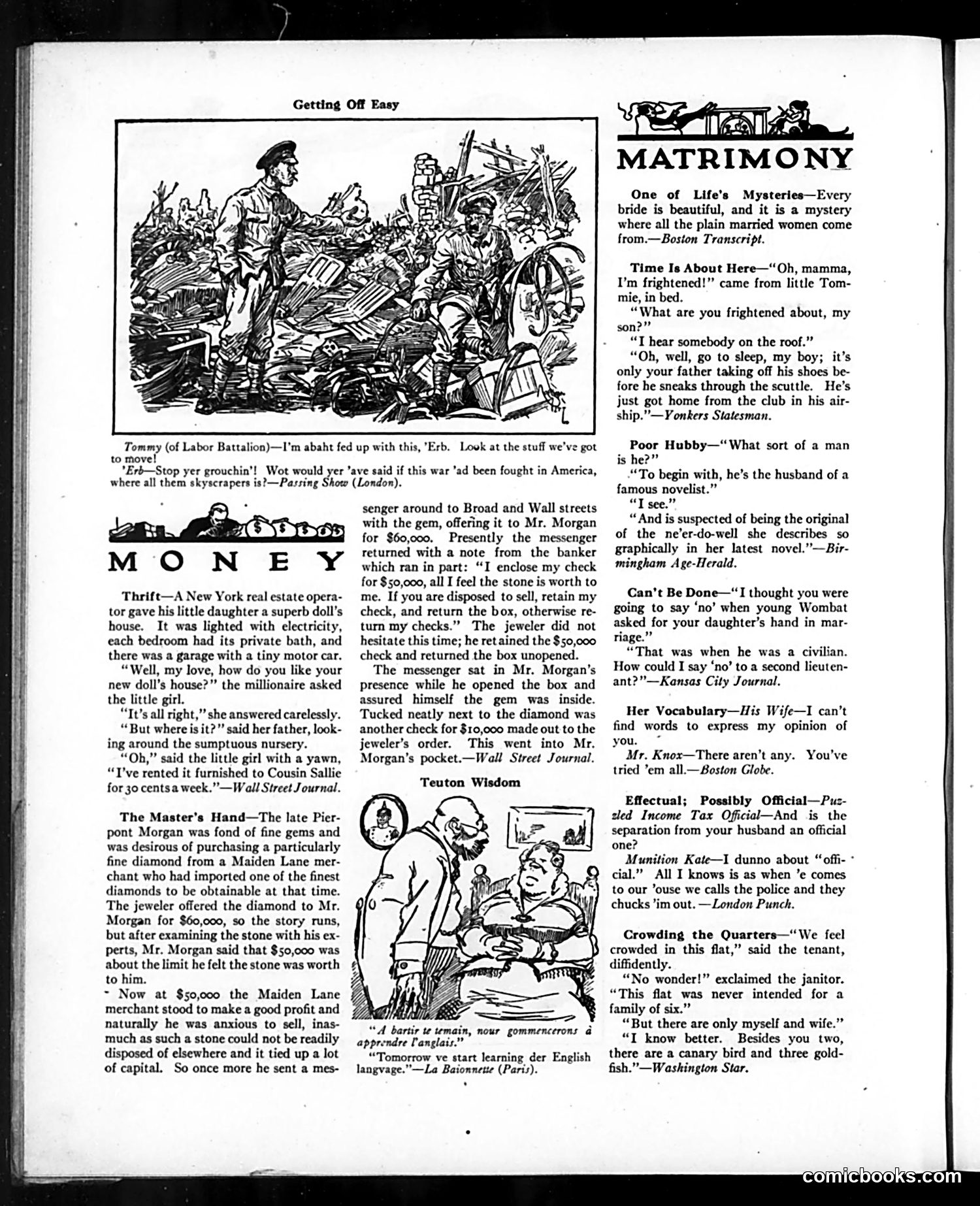
This page from Judge magazine contains several satirical sections mocking wealth, marriage, and wartime attitudes: **"Money" section**: The stories ridicule the ultra-wealthy. One jokes that a millionaire's daughter rents out her elaborate doll's house for income. Another describes J.P. Morgan (the famous banker/collector) negotiating a diamond purchase—he offers less than asked, the jeweler accepts, then finds Morgan has secretly added a $10,000 bonus check. The satire suggests even the richest men play games and expect profit margins in all dealings. **"Matrimony" section**: These brief jokes mock marriage stereotypes—brides are attractive but become plain wives; modern husbands arrive home drunk via "air-ship" (suggesting futuristic excess); wives of famous novelists are unhappy; and wives lack vocabulary beyond insults. **"Teuton Wisdom"**: A cartoon captioned in German-accented English about teaching English to prisoners, likely referencing WWI attitudes toward Germans. The page satirizes American wealth, consumerism, and gender relations of the era.
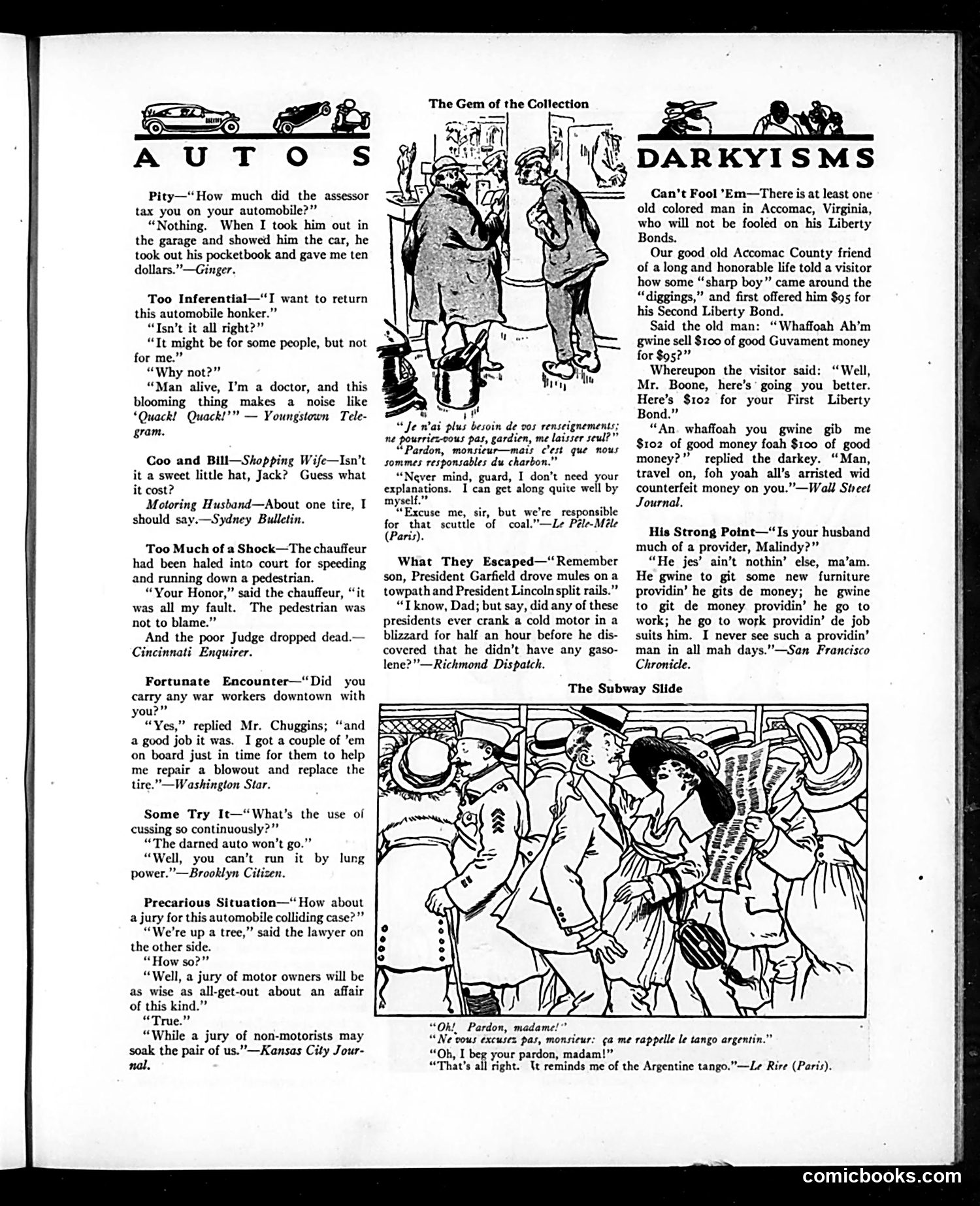
This page contains automobile-themed humor and ethnic comedy typical of early 20th-century American satire. **The "Autos" section** comprises short jokes about car ownership and early motoring culture—assessors being bribed, automobile horns sounding like "quacks" (offensive to doctors), wives' expensive hats costing "one tire" in value, and the absurdity of juries composed entirely of motorists or non-motorists judging automobile collision cases. These reflect widespread anxiety about automobiles as new, disruptive technology. **"Darkyisms"** represents the page's most dated and offensive content. This section uses racist dialect to present Black characters as shrewd regarding Liberty Bonds (WWI-era government bonds) and marital provision—stereotypical "comic" observations rendered in caricatured speech patterns. This was standard in early-20th-century magazines but is now recognized as racist. **"The Subway Slide"** depicts a man accidentally bumping into a woman; the French caption compares it to the Argentine tango, playing on contemporary dance crazes. The page exemplifies how period humor often combined genuine social observation (automobile culture's growing pains) with deeply offensive racial stereotyping now considered unacceptable.
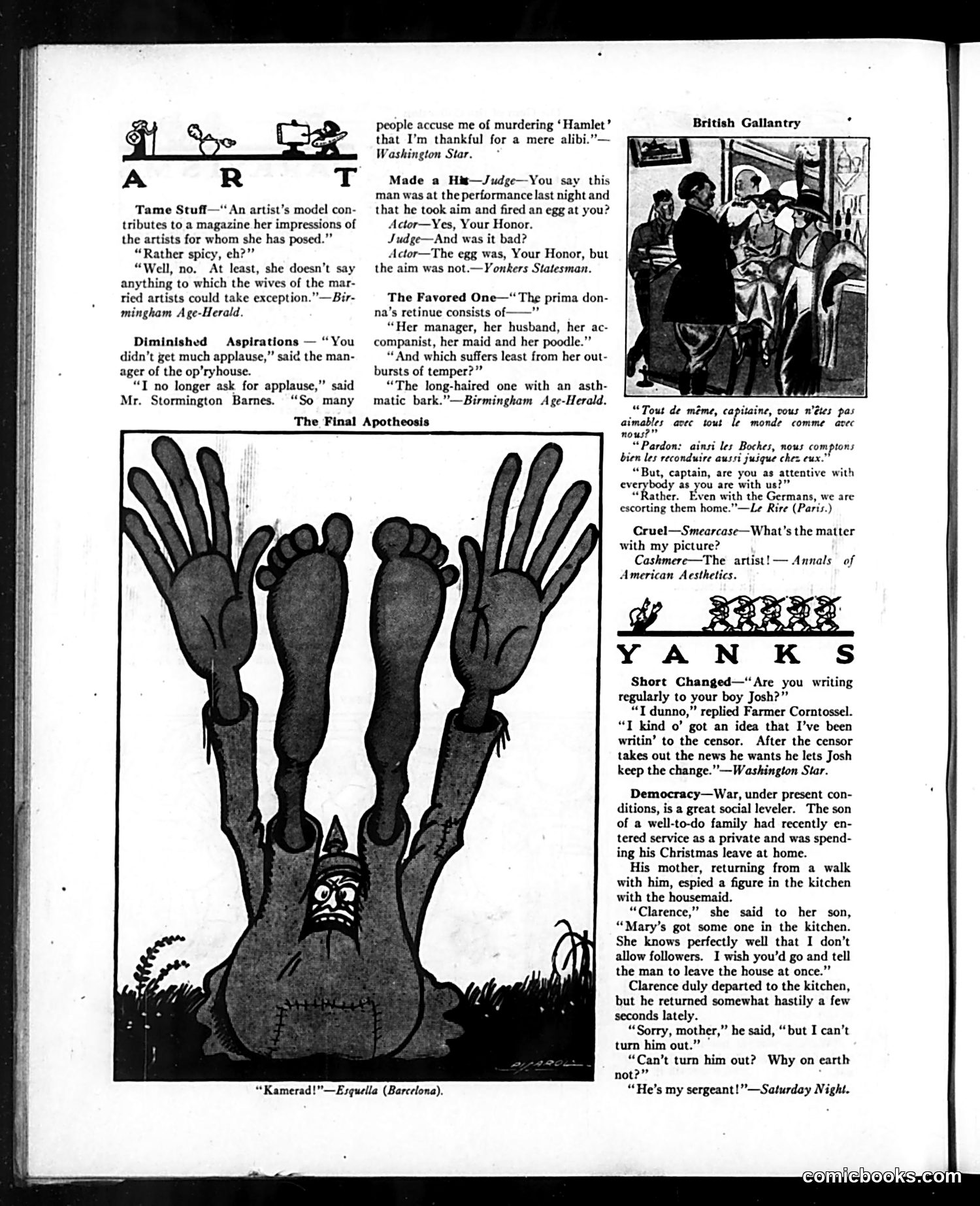
This WWI-era satirical cartoon depicts a grotesque hand emerging from the ground—likely representing a German soldier or "the enemy"—with a ghoulish face at the wrist. The image is titled "Kamerad!" (German for "comrade"), a term German soldiers used when surrendering. The satire critiques the dehumanization of warfare: the enemy is reduced to a dismembered, monstrous appendage rather than a human being. The hand's distorted fingers and skeletal appearance emphasize the brutality and death of mechanized trench warfare. The accompanying "British Gallantry" anecdote reinforces this: a French captain explains that British soldiers are "attentive" to all soldiers equally—"even with the Germans, we are escorting them home." This sardonic joke about courtesy masks the grim reality of mass casualties and the industrial-scale killing of the war. Together, these pieces satirize both the dehumanization of enemies in wartime propaganda and the hollow civility surrounding mass death.
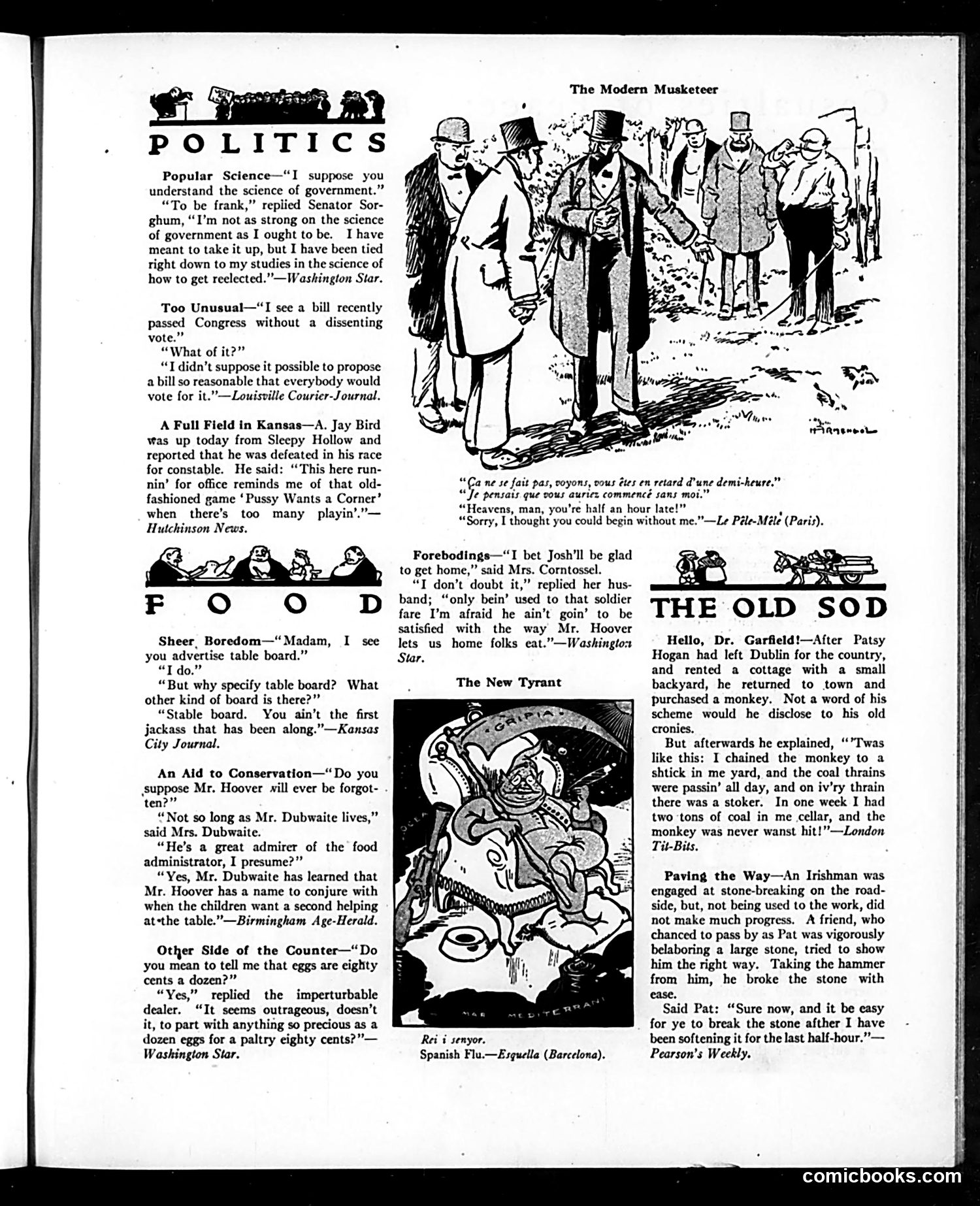
This page contains several short satirical pieces typical of Judge's political humor circa WWI era. **"Politics" section**: Mocks Senator Sorghum for prioritizing reelection strategy over actual governance knowledge. Another joke ridicules Congress for passing a bill unanimously—implying reasonable legislation is so rare it's suspicious. The Kansas constable race references the children's game "Pussy Wants a Corner," suggesting too many candidates chasing the same office. **"Food" section**: Jokes about food rationing and prices during WWI. Herbert Hoover served as Food Administrator, and his name became synonymous with conservation measures. One anecdote uses "Hoover" as a threat to discourage children from demanding seconds—satirizing how his policies affected home meals. **"The Modern Musketeer" cartoon**: A Parisian cartoon showing late arrival at what appears to be a social gathering, with French dialogue joking about punctuality. **"The New Tyrant" cartoon**: Depicts the Spanish Flu (pandemic of 1918-19) as a menacing tyrant figure, reflecting contemporary fear of the disease. **"The Old Sod"**: Irish humor about an immigrant using a chained monkey to collect coal dust from passing trains—cleverly exploiting a situation.
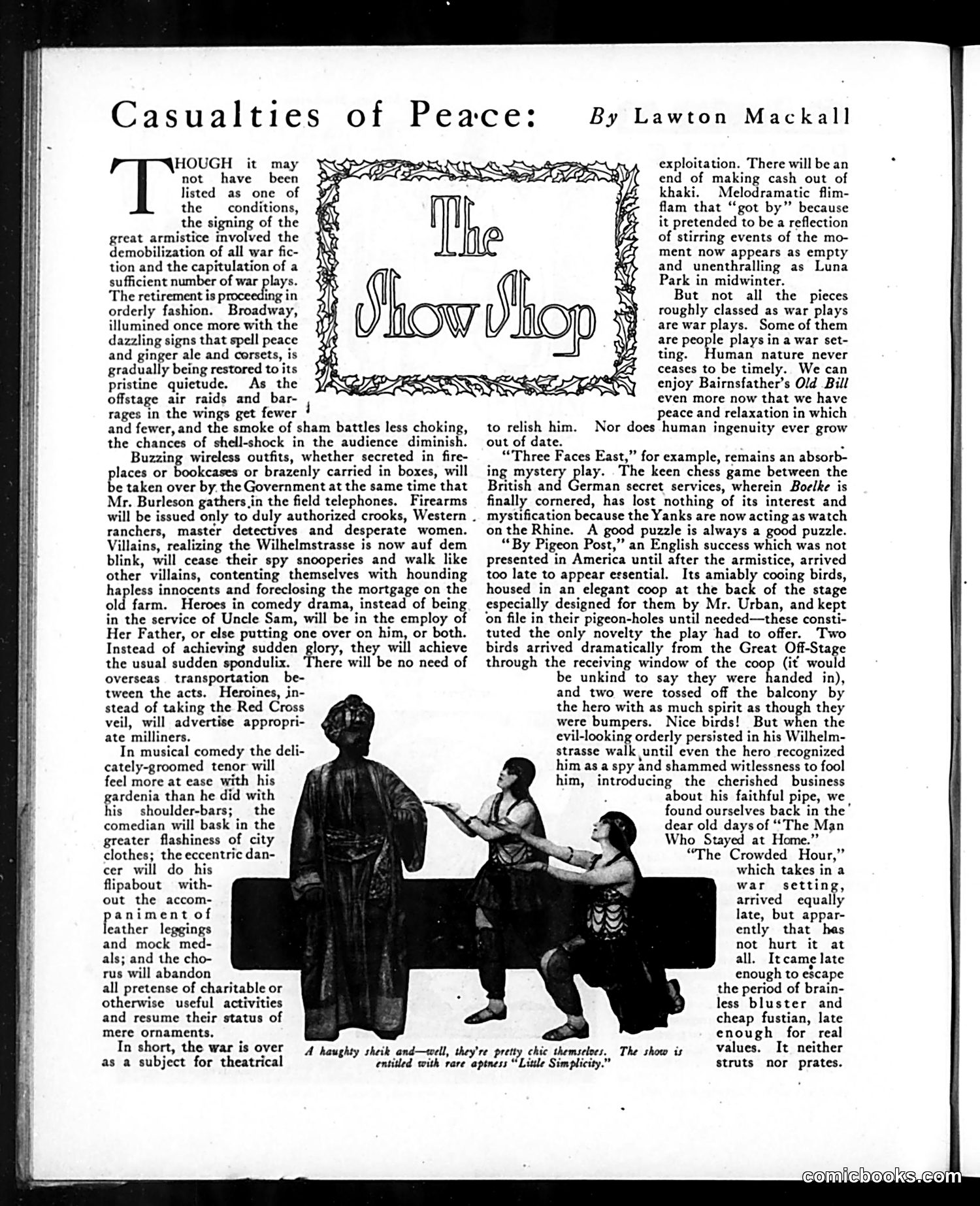
This article satirizes how Broadway theatre must adapt after WWI's armistice. The author argues that war-themed plays—which exploited patriotic fervor with spy plots, soldiers, and melodrama—now seem hollow and commercially unviable. Mackall mocks the theatrical absurdities that wartime audiences tolerated: wireless devices hidden in fireplaces, sham battles, heroes in uniform. Post-war, he predicts, villains will stop spying, comedians will abandon mock medals, and choruses will resume being "mere ornaments" rather than pretending patriotic purpose. However, he argues that plays about timeless human nature—like *Old Bill* or the spy thriller *Three Faces East*—retain value because they transcend the war setting. The illustration shows a "haughty sheik" in what appears to be an exotic melodrama, representing the kind of theatre that survives peace. The satire targets both wartime theatrical exploitation and post-war audiences' fickleness, suggesting entertainment's moral bankruptcy when profit depends on current events.
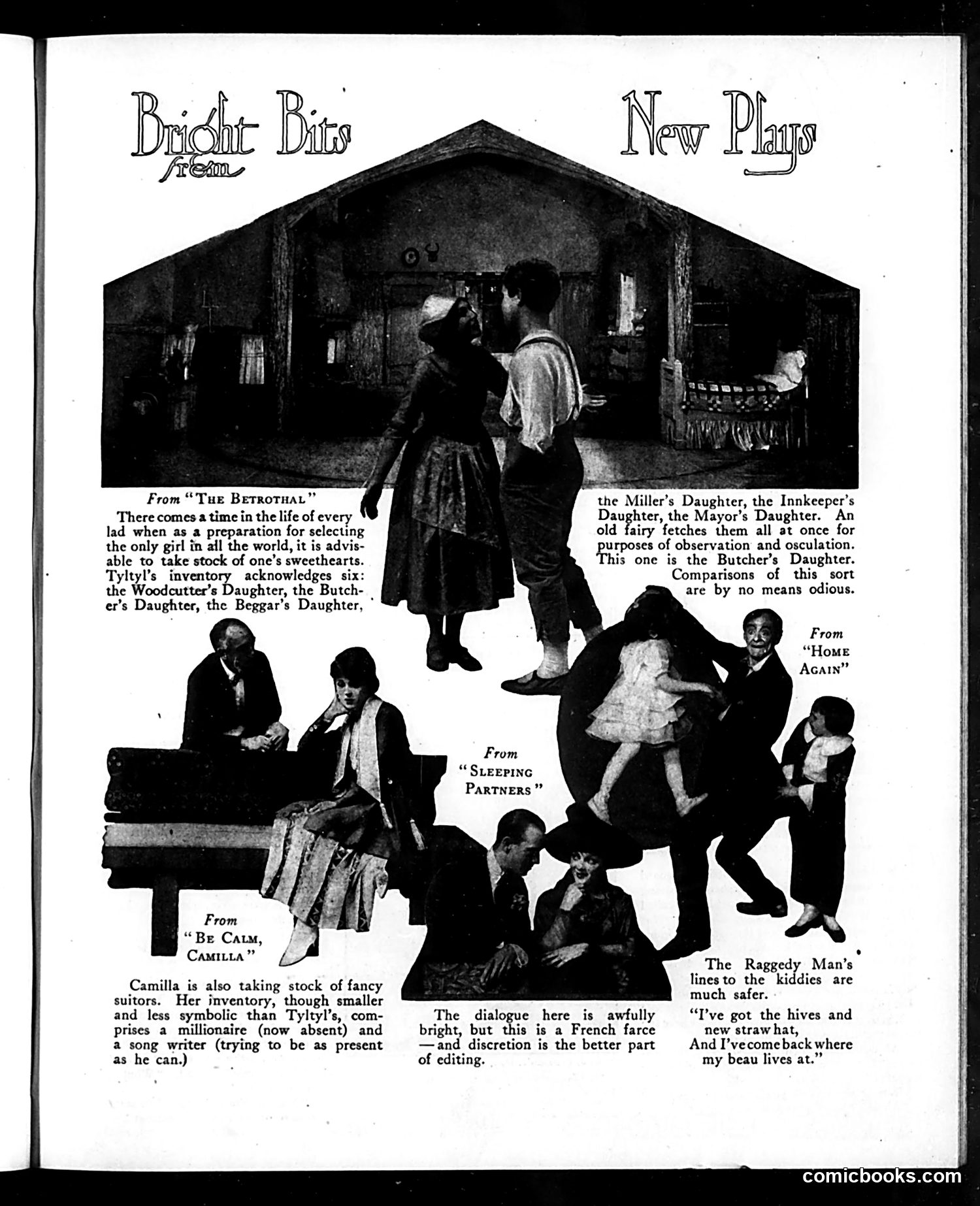
This page reviews theatrical productions—specifically new stage plays being performed. "Bright Bits from New Plays" showcases scenes and dialogue from four productions: *The Betrothal*, *Sleeping Partners*, *Be Calm, Camilla*, and *Home Again*. The commentary is theater criticism in a humorous vein. For example, *The Betrothal* depicts a young man (Tyltyl) inventorying potential romantic partners—six daughters from different social classes (miller, butcher, beggar, etc.)—before choosing a bride. The critic notes this inventory-taking is "by no means odious," suggesting the play handles this premise tactfully. Similarly, *Be Calm, Camilla* presents a woman evaluating suitors, including a millionaire and songwriter. The other scenes show domestic or romantic comedies typical of early 20th-century theater. The final quote—"I've got the hives and new straw hat, / And I've come back where my beau lives at"—appears to be safe, family-friendly dialogue from *The Raggedy Man*, contrasted with potentially risqué French farce material that required editorial discretion.
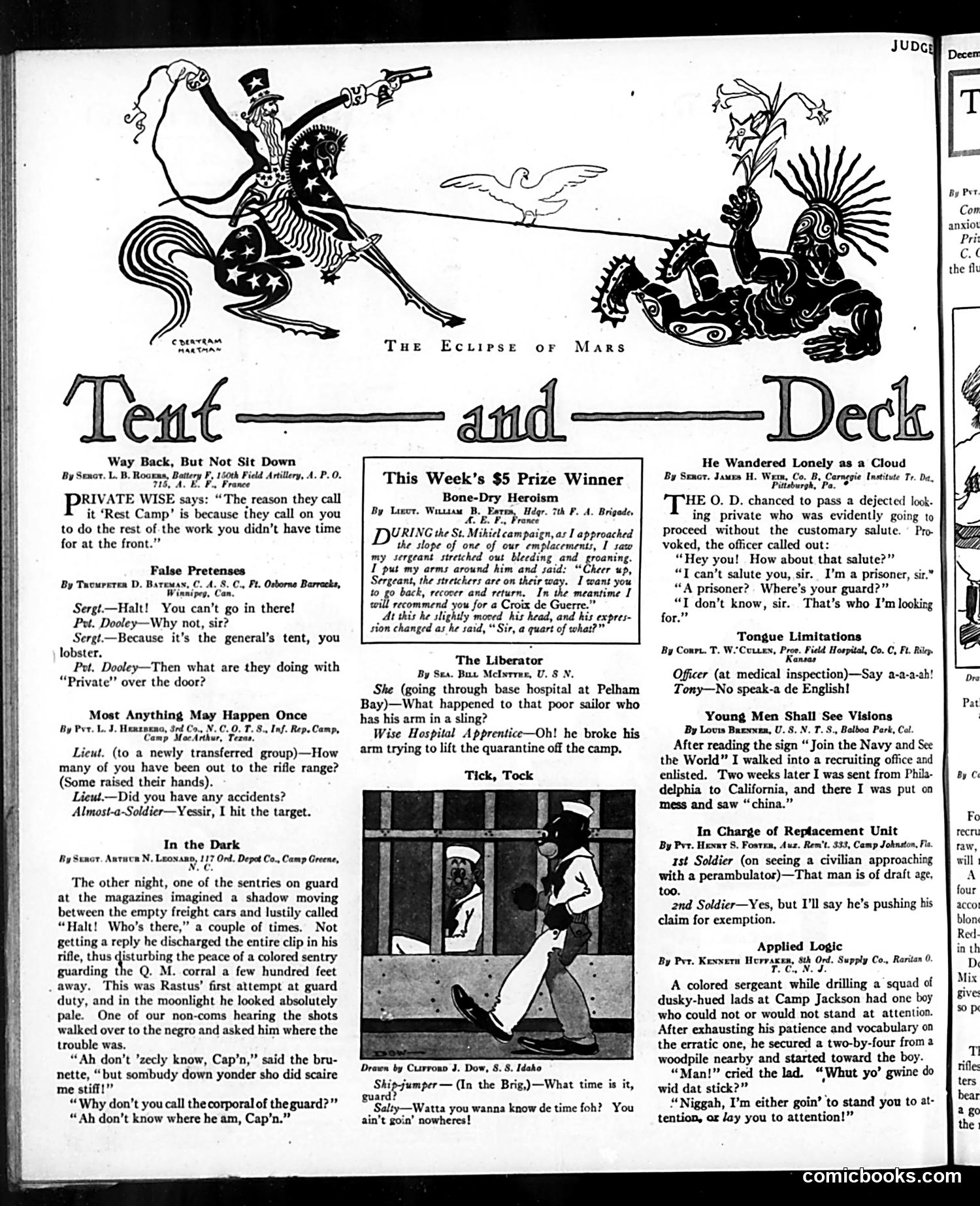
This Judge page collects soldier-submitted jokes mocking military life during World War I. The cartoons and anecdotes satirize common frustrations: officers' hypocrisy (a general's tent labeled "Private"), bureaucratic absurdity (a soldier told to "stand at attention" while pushing a baby carriage), and false promises (recruits enlisted to "see the world" but got kitchen duty instead). One sketch depicts a panicked Black sentry firing at shadows—playing on period racial stereotypes while also mocking incompetent guard training. Another jokes that a wounded sergeant's priority is whiskey, not medals. The humor targets military inefficiency, deceptive recruitment, and the gap between soldiers' expectations and grim reality. The "Eclipse of Mars" header cartoon shows Mars disarmed by Cupid—suggesting romance as respite from war.
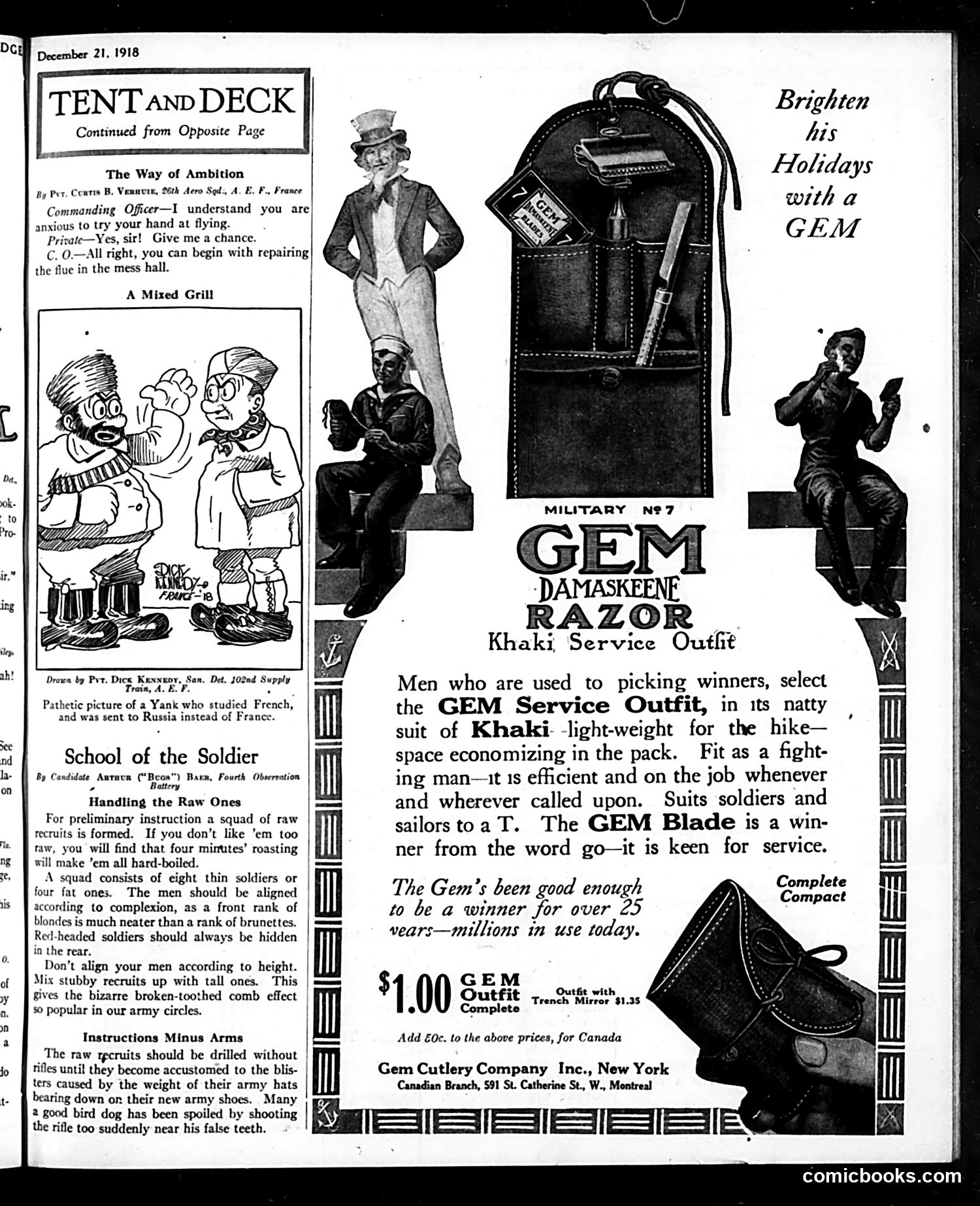
This page mixes military humor with advertising, all aimed at WWI soldiers. **"The Way of Ambition"** satirizes military bureaucracy: a soldier eager to learn flying is deflated when ordered to repair a mess hall flue—a joke about how ambition meets mundane reality in the Army. **"A Mixed Grill"** cartoon (by Pvt. Dick Kenney) mocks an American soldier who studied French but was sent to Russia instead of France—poking fun at military logistics and the soldier's wasted preparation. **"School of the Soldier"** offers absurdist "training advice"—mixing recruits by hair color for "neatness," avoiding height uniformity for a "bizarre broken-toothed comb effect"—satirizing the ad-hoc nature of raw troop instruction. The bulk of the page advertises the **Gem Damascene Razor**, marketed specifically to soldiers as a compact "Service Outfit" in khaki. This is straightforward wartime advertising targeting the military market during the final weeks of WWI.
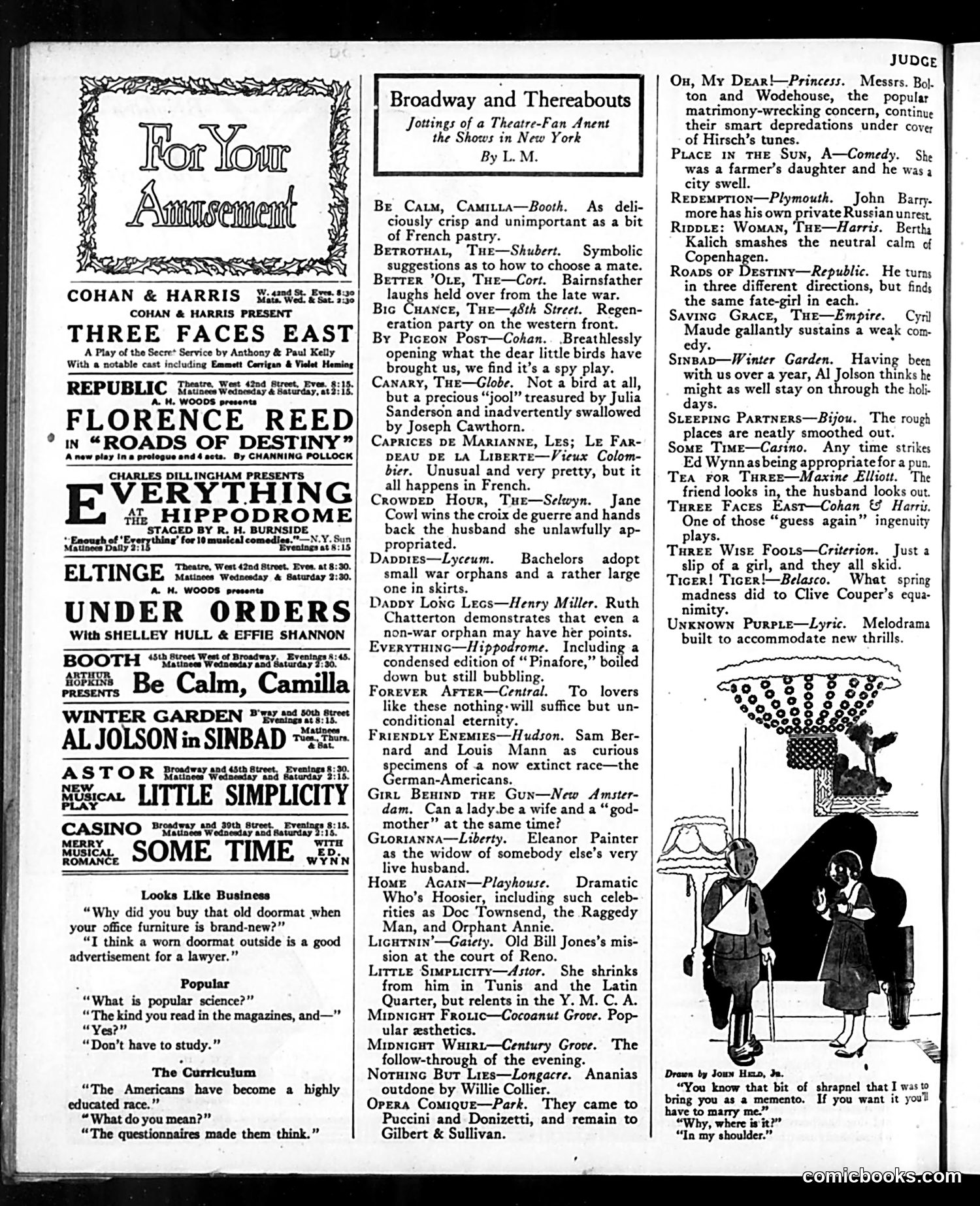
This is primarily a **Broadway theater listing and review page** from Judge magazine, circa early 1920s (post-WWI references appear throughout). The left side advertises current theatrical productions with cast names and theater locations. The center column provides brief, witty reviews of shows—using satirical one-liners to describe plots. Notable: several reviews reference World War I ("croix de guerre," "late war," "war orphans"), indicating this is from the immediate post-war period when audiences were seeing plays about recent combat. The small cartoons and jokes on the right (including a illustration by John Held Jr.) are unrelated humor—typical Judge filler content about doormat advertisements and popular science. The reviews themselves are satirical theater criticism: dismissing plots as formulaic ("nothing-will suffice but unconditional eternity") while praising performances. This reflects how Broadway catered to popular tastes, which Judge's educated readership found amusing to mock gently.
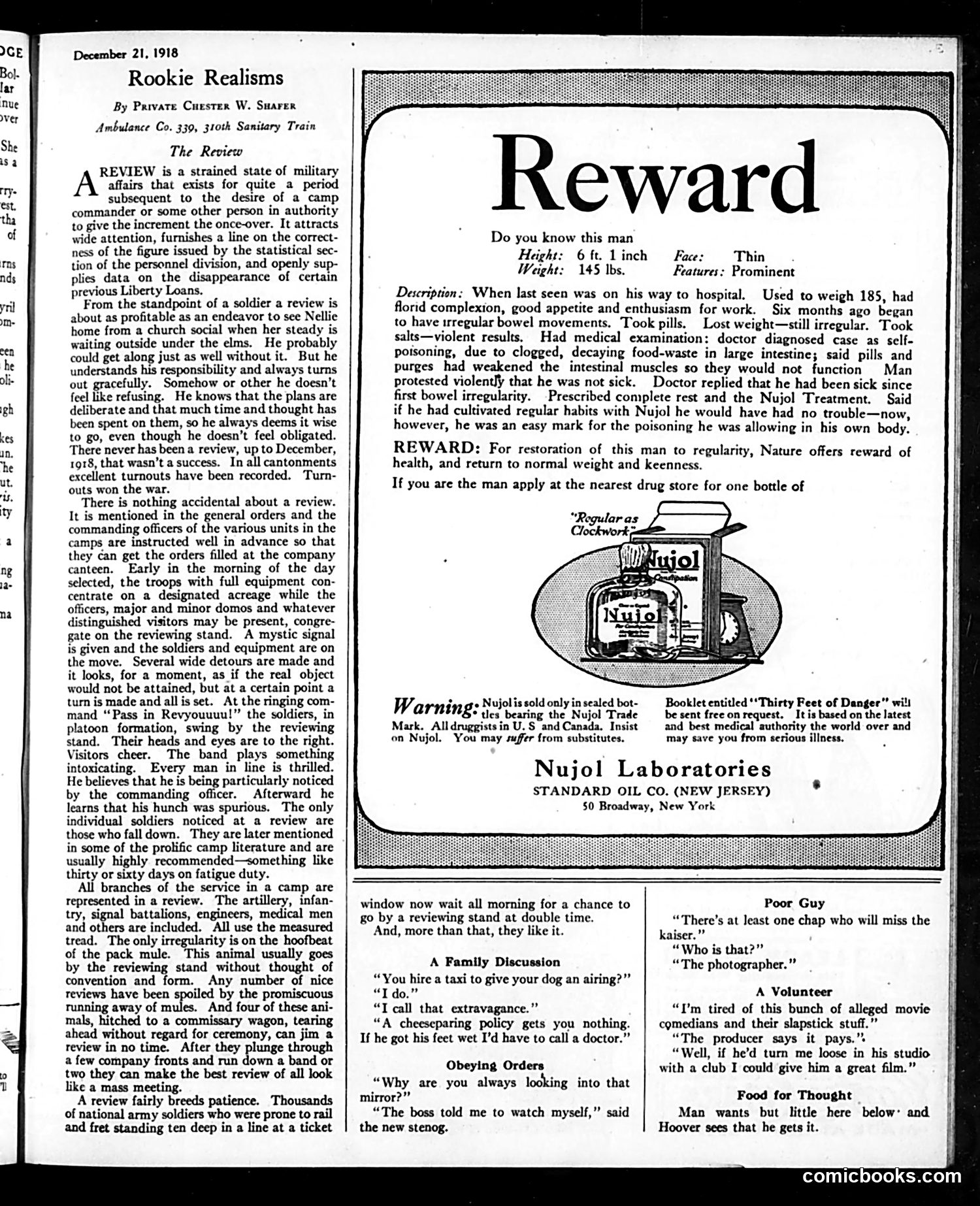
This page contains satirical military commentary by a soldier author, plus a satirical advertisement disguised as a "missing person" reward notice. **The Main Article**: A humorous essay about military "reviews" (formal troop inspections). The author, writing as a WWI Army recruit, explains these mandatory formations with wry humor—soldiers understand they're pointless but participate dutifully. The satire mocks the elaborate theater of military inspections, their unpredictability (especially mules disrupting formations), and how only soldiers who visibly fail are remembered. **The "Reward" Advertisement**: Satirically formatted as a genuine missing-person notice, it advertises Nujol laxative by describing a soldier suffering from severe intestinal problems. The joke: the "reward" for finding this afflicted man is to give him Nujol, implying this was a common complaint among troops. Published just after WWI's November 1918 armistice, it humorously addresses real soldier health issues while promoting patent medicine—a typical early-20th-century advertising approach. Both pieces reflect the post-war moment when soldiers were returning home and military experience was being processed through humor.
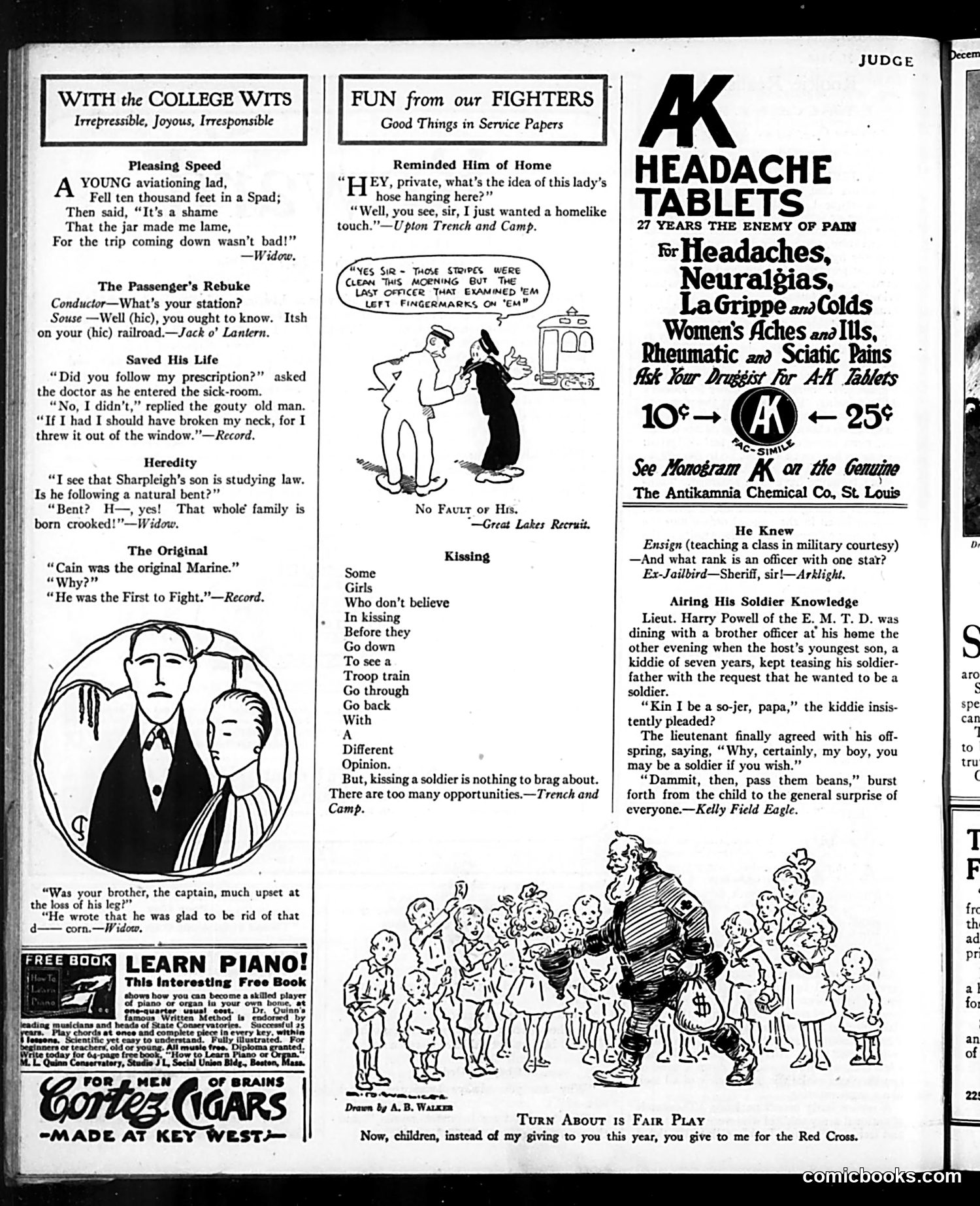
This Judge magazine page contains humor aimed at WWI-era audiences, mixing college jokes, military anecdotes, and advertisements. **The College Wits section** offers irreverent humor about young men—an aviator crashing a plane, a drunk conductor, a doctor's patient, and jokes about heredity and Marines. These reflect Jazz Age collegiate attitudes. **"Fun from our Fighters"** presents military service humor, apparently sourced from soldier newspapers. The jokes mock army life: a soldier recreating "home" with a woman's stockings, complaints about fingerprints on uniforms, and observations about kissing soldiers (implied as common wartime behavior). **Notable content**: The "Airing His Soldier Knowledge" anecdote shows a child mimicking military profanity, played for comedic shock value. The final cartoon urges Red Cross donations during wartime, shifting from humor to patriotic duty. **Advertisements** (AK Headache Tablets, piano lessons, Cortez Cigars) represent typical period marketing. The overall tone reflects American homefront attitudes toward WWI soldiers—affectionate mockery mixed with patriotic sentiment.
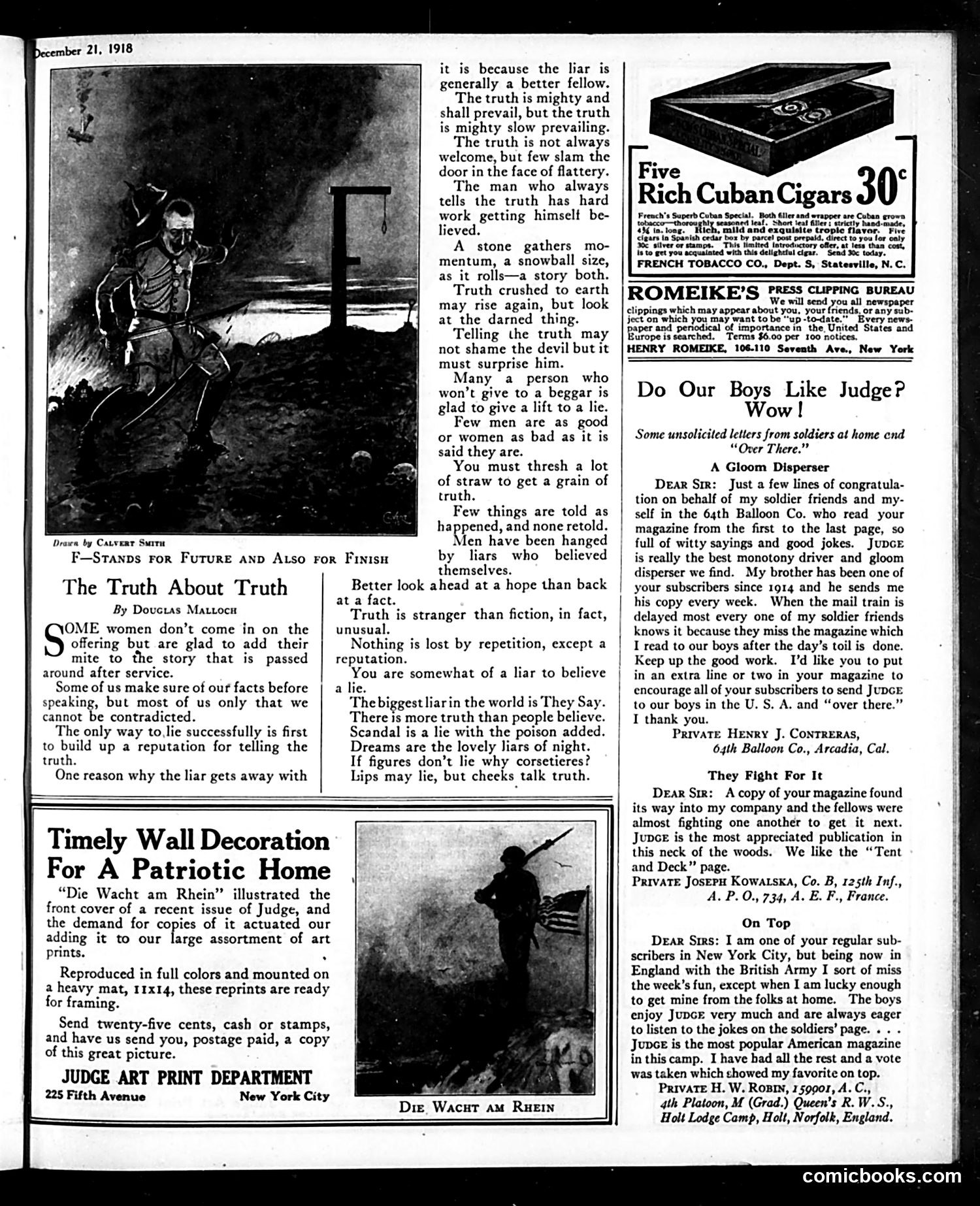
This page features a philosophical essay by Douglas Mallock examining paradoxes of truthfulness. Published just after WWI's end, it addresses how liars often succeed socially because they maintain reputations for honesty, while truth-tellers struggle for credibility. The piece uses aphorisms ("A stone gathers momentum, a snowball size, as it rolls—a story both") to suggest that lies, like snowballs, accumulate power through repetition. The accompanying illustration shows a figure in shadow near a window, suggesting introspection or moral reckoning—apt for 1918, when Americans were reassessing wartime propaganda and rhetoric. The page also includes advertisements and soldiers' letters praising Judge magazine for morale-building humor "over there" in Europe, reflecting the publication's patriotic role during the war's final months.
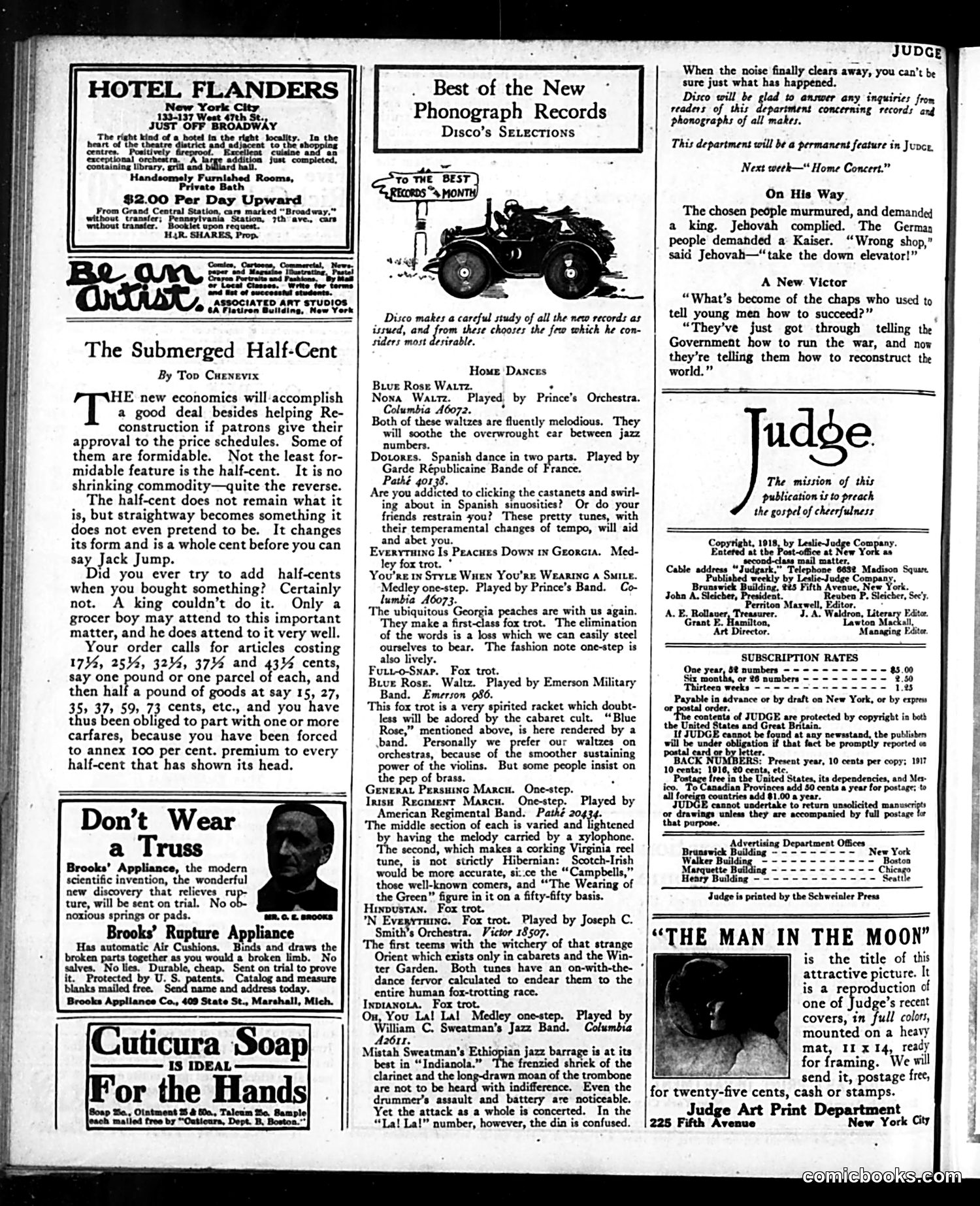
This page is primarily **advertising and record reviews**, not political satire. The main content includes: **"The Submerged Half-Cent"** — a humorous essay by "Too Chenevix" satirizing post-WWI economic inflation and pricing confusion. The joke: grocers couldn't calculate half-cent increments, forcing customers to pay full cents—essentially a 100% markup on fractional amounts. This reflects genuine inflation anxieties after World War I reconstruction. **"Best of the New Phonograph Records"** — Disco's music reviews covering dance music (waltzes, fox trots, one-steps) popular in 1918-1919. References to "Everything Is Peaches Down in Georgia" and Irish marches reflect period entertainment. The page also advertises the Hotel Flanders, Brooks' Rupture Appliance (a medical device), and Cuticura Soap—typical contemporary advertisements. No clear political cartoons appear on this page; the satire is economic/social rather than partisan.
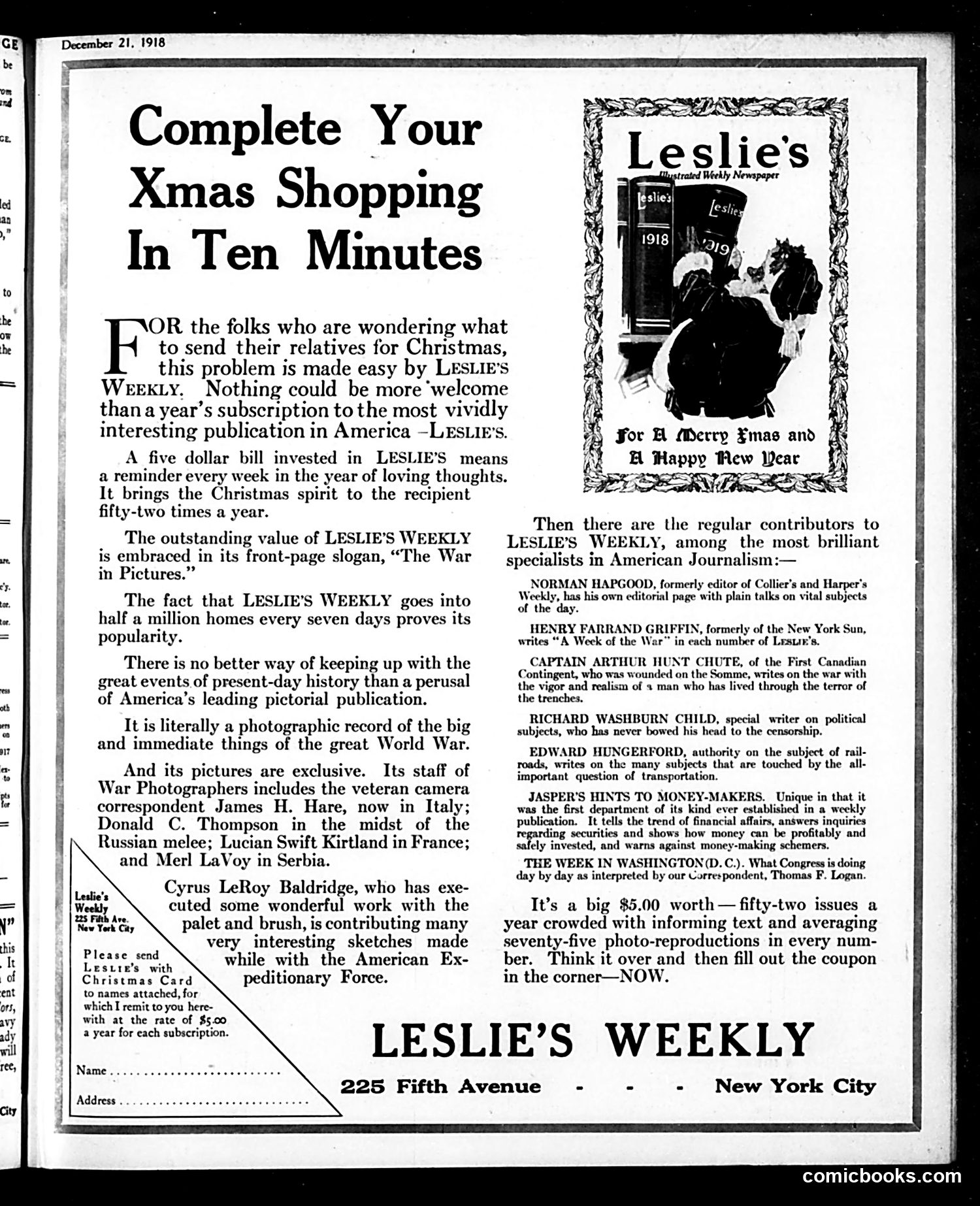
This is primarily a **Christmas gift advertisement** for Leslie's Weekly magazine, not political satire. It appeared just weeks after World War I ended (November 1918). The page promotes Leslie's as an ideal holiday gift by emphasizing its value as "The War in Pictures"—a pictorial record of WWI. It lists staff war photographers and correspondents (James H. Hare, Donald C. Thompson, Lucian Swift Kirtland) positioned in active theaters: Italy, Russia, France, and Serbia. Artist Cyrus LeRoy Baldridge's sketches from the American Expeditionary Force are highlighted. The magazine also advertises prominent political/editorial contributors like Norman Hapgood and Richard Washburn Child, positioning it as serious journalism covering current events. At $5 for a year's subscription (52 issues), it's marketed as an economical Christmas present that delivers "loving thoughts" fifty-two times yearly. The coupon at bottom-left enables gift subscriptions. This reflects post-WWI American media celebrating photojournalism and positioning illustrated weeklies as essential for staying informed on "great events of present-day history."
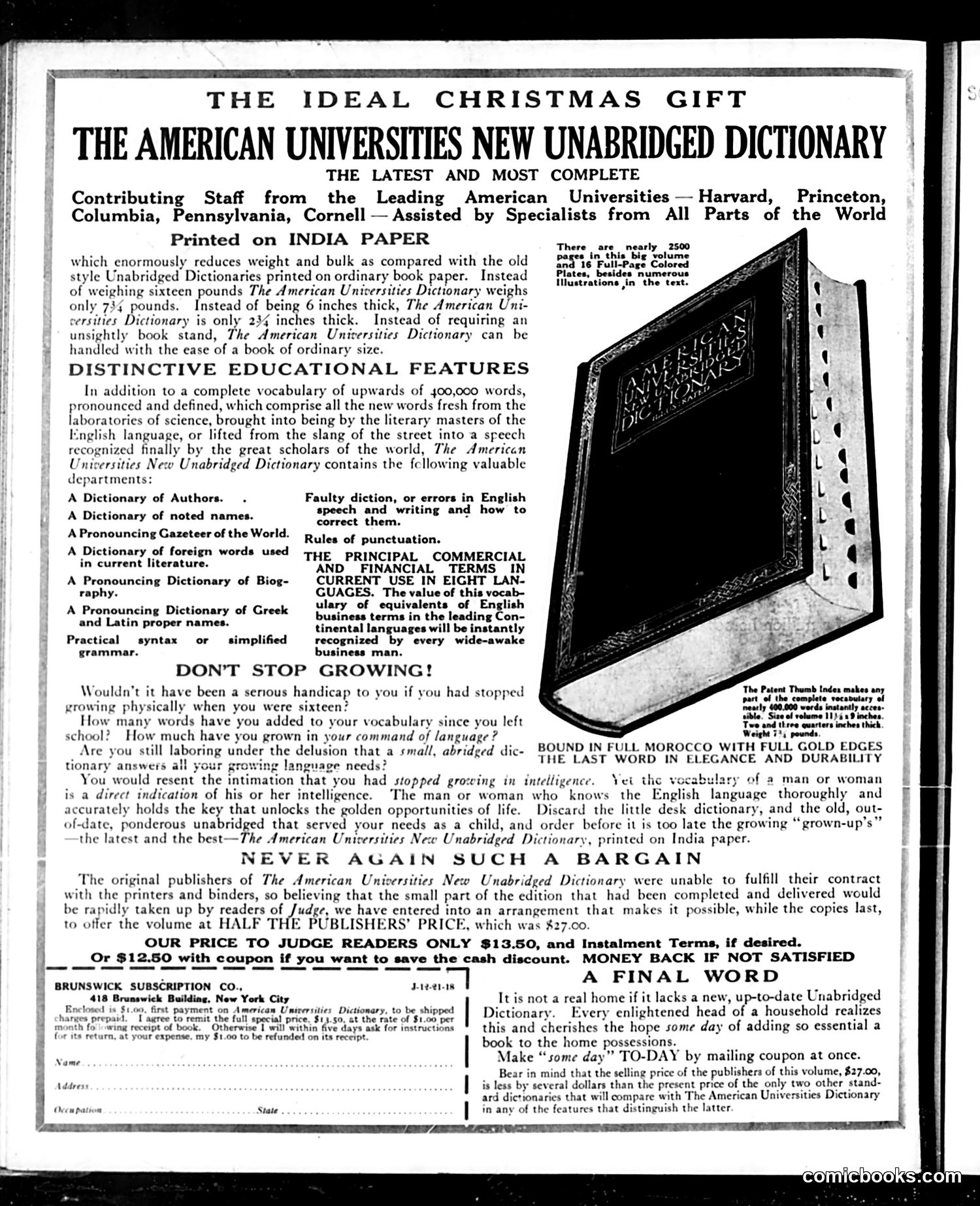
This is primarily a **full-page advertisement**, not a cartoon or satirical piece. It promotes *The American Universities New Unabridged Dictionary* as a Christmas gift. The ad employs motivational messaging pitched at self-improvement aspirations typical of early 20th-century American culture. The "Don't Stop Growing!" section uses implicit shame—equating vocabulary size with intelligence and suggesting that failure to expand one's language skills represents intellectual stagnation. This appeals to anxieties about social mobility and professional competitiveness. The framing suggests the dictionary as essential for the "wide-awake business man" and anyone seeking "golden opportunities of life," reflecting period anxieties about keeping pace in an increasingly complex, commerce-driven society. The advertiser emphasizes the book's practical advantages: printed on lightweight India paper, it weighs only 7¾ pounds rather than sixteen, and includes specialized features (business terminology in eight languages, biographical references). The "bargain" angle—selling at half the publisher's price—capitalizes on Depression-era cost consciousness, though the original $27 price point indicates this targeted middle-to-upper-class readers.