
Judge, 1918-12-21 · page 20 of 32
Judge — December 21, 1918 — page 20: what you’re looking at
What you’re looking at
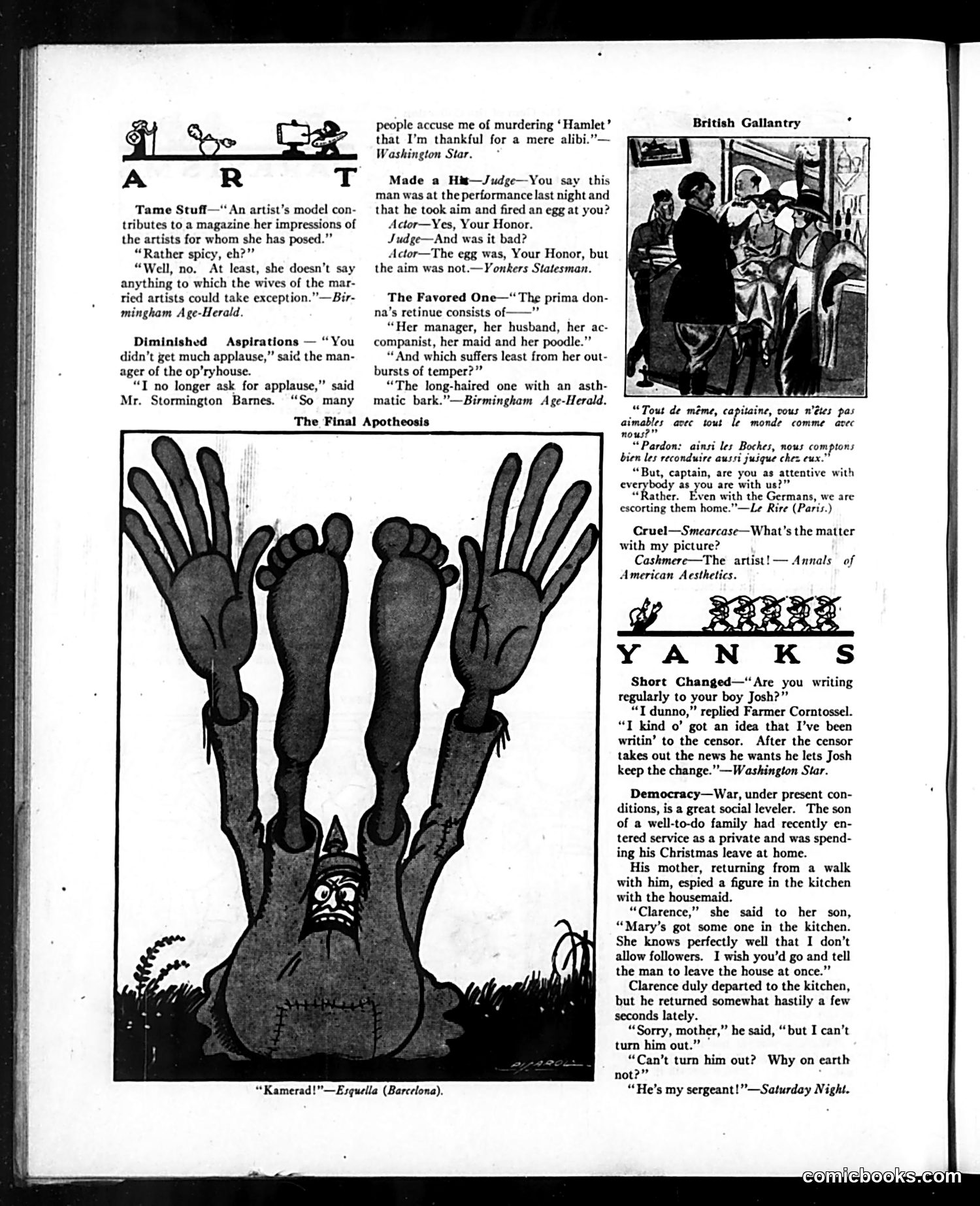
This WWI-era satirical cartoon depicts a grotesque hand emerging from the ground—likely representing a German soldier or "the enemy"—with a ghoulish face at the wrist. The image is titled "Kamerad!" (German for "comrade"), a term German soldiers used when surrendering. The satire critiques the dehumanization of warfare: the enemy is reduced to a dismembered, monstrous appendage rather than a human being. The hand's distorted fingers and skeletal appearance emphasize the brutality and death of mechanized trench warfare. The accompanying "British Gallantry" anecdote reinforces this: a French captain explains that British soldiers are "attentive" to all soldiers equally—"even with the Germans, we are escorting them home." This sardonic joke about courtesy masks the grim reality of mass casualties and the industrial-scale killing of the war. Together, these pieces satirize both the dehumanization of enemies in wartime propaganda and the hollow civility surrounding mass death.
📄 Transcribed text from this page (OCR, searchable)
Machine-transcribed from the original scan — historical spelling and the odd misread are preserved.
R T Tame Stuff—“ An artist's model con- tributes to a magazine her impressions of the artists for whom she has posed.” “Rather spicy, eh?” “Well, no. At least, she doesn’t say anything to which the wives of the mar- ried artists could take exception.”—Bir- mingham Age-Herald. Diminished Aspirations — “You didn’t get much applause,” said the man- ager of the op’ryhouse. “I no longer ask for applause,” said Mr. Stormington Barnes. “So many people accuse me of murdering ‘Hamlet’ that I’m thankful for a mere alibi.”— Washington Star. Made a His—Judge—You say this man was at the performance last night and that he took aim and fired an egg at you? Actor—Yes, Your Honor. Judge—And was it bad? Actor—The egg was, Your Honor, but the aim was not.—Yonkers Statesman. The Favored One—“ The prima don- na’s retinue consists of —" “Her manager, her husband, her ac- companist, her maid and her poodle.” “And which suffers least from her out- bursts of temper?” “The long-haired one with an asth- matic bark.”—Birmingham A ge-Herald. The Final Apotheosis merad!"—Esquella (Barcelona). British Gallantry ine, vous n’étes pas “Tout de méme, on monde comme avec aimables avec tous nous?” “Pardon: ainsi les Bockes, nous comptons bien les reconduire aussi juique chez eux.” “But, captain, are you as attentive with everybody as you are with us?” “Rather. Even with the Germans, we are escorting them home.”—Le Rire (Paris.) Cruel—Smearcase—What's the matter with my picture? Cashmere—The artist! — Annals of American Aesthetics. YAN K S Short Changed—“Are you writing regularly to your boy Josh?” “I dunno,” replied Farmer Corntossel. kind o’ got an idea that I’ve been writin’ to the censor. After the censor takes out the news he wants he lets Josh keep the change.” —Washington Star. Democracy—War, under present con- ditions, is a great social leveler. The son of a well-to-do family had recently en- tered service as a private and was spend- ing his Christmas leave at home. His mother, returning from a walk with him, espied a figure in the kitchen with the housemaid. “Clarence,” she said to her son, “Mary’s got some one in the kitchen. She knows perfectly well that I don’t allow followers. I wish you’d go and tell the man to leave the house at once.” Clarence duly departed to the kitchen, but he returned somewhat hastily a few seconds lately. “Sorry, mother,” he said, “but I can’t turn him out.” ” “Can’t turn him out? Why on earth not?” : “He’s my sergeant!” —Saturday Night.