
Judge, 1918-12-21 · page 22 of 32
Judge — December 21, 1918 — page 22: what you’re looking at
What you’re looking at
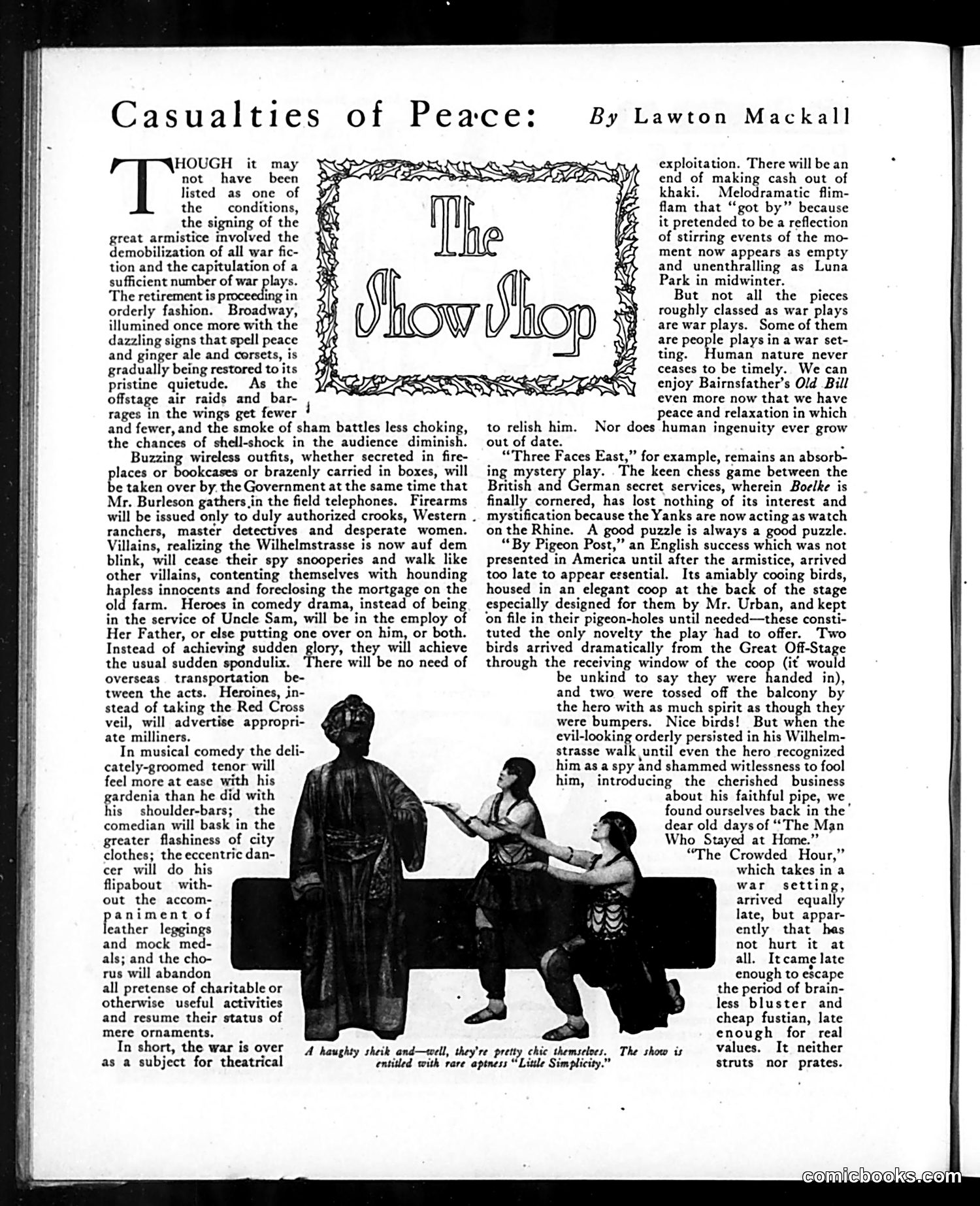
This article satirizes how Broadway theatre must adapt after WWI's armistice. The author argues that war-themed plays—which exploited patriotic fervor with spy plots, soldiers, and melodrama—now seem hollow and commercially unviable. Mackall mocks the theatrical absurdities that wartime audiences tolerated: wireless devices hidden in fireplaces, sham battles, heroes in uniform. Post-war, he predicts, villains will stop spying, comedians will abandon mock medals, and choruses will resume being "mere ornaments" rather than pretending patriotic purpose. However, he argues that plays about timeless human nature—like *Old Bill* or the spy thriller *Three Faces East*—retain value because they transcend the war setting. The illustration shows a "haughty sheik" in what appears to be an exotic melodrama, representing the kind of theatre that survives peace. The satire targets both wartime theatrical exploitation and post-war audiences' fickleness, suggesting entertainment's moral bankruptcy when profit depends on current events.
📄 Transcribed text from this page (OCR, searchable)
Machine-transcribed from the original scan — historical spelling and the odd misread are preserved.
Casualties of Peace: HOUGH it may not have been listed as one of the conditions, the signing of the great armistice involved the demobilization of all war fic- tion and the capitulation of a sufficient number of war plays. The retirement is proceeding in orderly fashion. Broadway, illumined once more with the dazzling signs that spell peace and ginger ale and corsets, is gradually being restored to its pristine quietude. As the offstage air raids and bar- rages in the wings get fewer i and fewer, and the smoke of sham battles less choking, the chances of shell-shock in the audience diminish. Buzzing wireless outfits, whether secreted in fire- laces or bookcases or brazenly carried in boxes, will be taken over by. the Government at the same time that Mr. Burleson gathers.in the field telephones. Firearms will be issued only to duly authorized crooks, Western . ranchers, master detectives and desperate women. Villains, realizing the Wilhelmstrasse is now auf dem blink, will cease their spy snooperies and walk like other villains, contenting themselves with hounding hapless innocents and foreclosing the mortgage on the old farm. Heroes in comedy drama, instead of being in the service of Uncle Sam, will be in the employ of Her Father, or else putting one over on him, or both. Instead of achieving sudden glory, they will achieve the usual sudden spondulix. There will be no need of overseas transportation be- tween the acts. Heroines, in- stead of taking the Red Cross veil, will advertise appropri- ate milliners. In musical comedy the deli- cately-groomed tenor will feel more at ease with his gardenia than he did with his shoulder-bars; the comedian will bask in the greater flashiness of city clothes; the eccentric dan- cer will do his flipabout with- out the accom- animent of eather leggings and mock med- als; and the cho- rus will abandon all pretense of charitable or otherwise useful activities and resume their status of mere ornaments, In short, the war is over as a subject for theatrical A haughty sheik and—ell, they're pretty chic themsclses. The show is par cy en Ava ncn eed By Lawton Mackall exploitation. There will be an end of making cash out of khaki. Melodramatic flim- flam that “got by” because it pretended to be a reflection of stirring events of the mo- ment now appears as empty and unenthralling as Luna Park in midwinter. But not all the pieces roughly classed as war plays are war plays. Some of them are people plays in a war set- ting. Human nature never ceases to be timely. We can enjoy Bairnsfather’s Old Bill even more now that we have peace and relaxation in which to relish him. Nor does human ingenuity ever grow out of date. : “Three Faces East,” for example, remains an absorb- ing mystery play. The keen chess game between the British and German secret services, wherein Boelke is finally cornered, has lost nothing of its interest and mystification because the Yanks are now acting as watch onthe Rhine. A good puzzle is always a good puzzle. “By Pigeon Post,” an English success which was not presented in America until after the armistice, arrived too late to appear essential. Its amiably cooing birds, housed in an elegant coop at the back of the stage especially designed for them by Mr. Urban, and kept ‘on file in their pigeon-holes until needed—these consti- tuted the only novelty the play had to offer. Two birds arrived dramatically from the Great Off-Stage through the receiving window of the coop (it would be unkind to say they were handed in), and two were tossed off the balcony by the hero with as much spirit as though they were bumpers. Nice birds! But a the evil-looking orderly persisted in his Wilhelm- strasse walk until even the hero recognized him as a spy and shammed witlessness to fool him, introducing the cherished business about his faithful pipe, we found ourselves back in the’ dear old days of ‘The Man Who Stayed at Home.” “The Crowded Hour,” which takes in a war setting, arrived equally late, but appar- ently that has not hurt it at all. Itcame late enough to escape the period of brain- less bluster and cheap fustian, late enough for real values. It neither struts nor prates.