
Judge, 1918-12-21 · page 14 of 32
Judge — December 21, 1918 — page 14: what you’re looking at
What you’re looking at
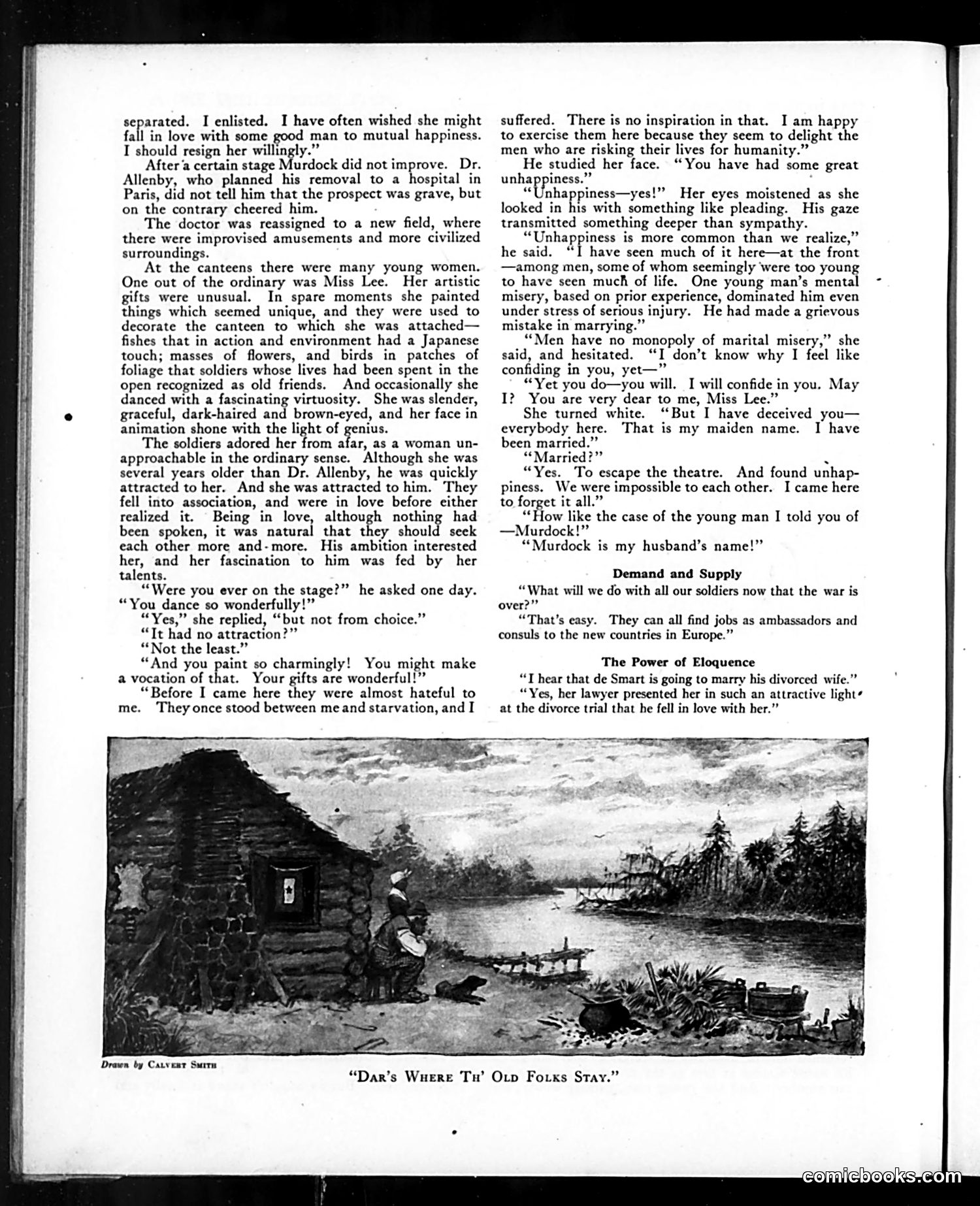
This page contains a serialized romantic story about Dr. Allenby and Miss Lee, two people who fall in love while working at a WWI military canteen. The narrative's twist reveals Miss Lee was previously married to a soldier named Murdock—a patient Allenby had treated, creating an ironic connection between the characters. Below the main story are three brief satirical jokes typical of Judge magazine's humor: 1. **"Demand and Supply"** jokes about post-WWI employment, suggesting soldiers could become ambassadors and consuls to newly independent European nations—satirizing both the proliferation of new countries after the war and optimistic employment prospects. 2. **"The Power of Eloquence"** mocks divorce proceedings, suggesting a lawyer's persuasive courtroom presentation made a man fall back in love with his ex-wife—a commentary on rhetoric's manipulative power and marital absurdity. The illustration depicts a riverside scene, likely illustrating the story's setting.
📄 Transcribed text from this page (OCR, searchable)
Machine-transcribed from the original scan — historical spelling and the odd misread are preserved.
separated. I enlisted. I have often wished she might fall in love with some good man to mutual happiness. I should resign her willingly.” After‘a certain stage Murdock did not improve. Dr. Allenby, who planned his removal to a hospital in Paris, did not tell him that the prospect was grave, but on the contrary cheered him. The doctor was reassigned to a new field, where there were improvised amusements and more civilized surroundings. At the canteens there were many young women. One out of the ordinary was Miss Lee. Her artistic gifts were unusual. In spare moments she painted things which seemed unique, and they were used to decorate the canteen to which she was attached— fishes that in action and environment had a Japanese touch; masses of flowers, and birds in patches of foliage that soldiers whose lives had been spent in the open recognized as old friends. And occasionally she danced with a fascinating virtuosity. She was slender, graceful, dark-haired and brown-eyed, and her face in animation shone with the light of genius. The soldiers adored her from afar, as a woman un- approachable in the ordinary sense. Although she was several years older than Dr. Allenby, he was quickly attracted to her. And she was attracted to him. They fell into association, and were in love before either realized it. Being in love, although nothing had been spoken, it was natural that they should seek each other more and-more. His ambition interested her, and her fascination to him was fed by her talents. “Were you ever on the stage?” he asked one day. “You dance so wonderfully!” “Yes,” she replied, “but not from choice.” “Tt had no attraction?” “Not the least.” “And you paint so charmingly! You might make a vocation of that. Your gifts are wonderful!” “Before I came here they were almost hateful to me. They once stood between me and starvation, and I suffered. There is no inspiration in that. I am happy to exercise them here because they seem to delight the men who are risking their lives for humanity.” He studied her face. ‘You have had some great unhappiness.” 5s - mlappiness yest Her eyes moistened as she looked in his with something like pleading. His gaze transmitted something deeper than sympathy. “Unhappiness is more common than we realize,” he said. “I have seen much of it here—at the front —among men, some of whom seemingly were too young to have seen much of life. One young man’s mental misery, based on prior experience, dominated him even under stress of serious injury. He had made a grievous mistake in marrying.” “Men have no monopoly of marital misery,” she said, and hesitated. “I don’t know why I feel like confiding in you, yet—” “Yet you do—you will. I will confide in you. May I? You are very dear to me, Miss Lee.” She turned white. “But I have deceived you— everybody here. That is my maiden name. I have been married.” “Married?” . “Yes. To escape the theatre. And found unhap- piness. We were impossible to each other. I came here to forget it all.” “How like the case of the young man I told you of —Murdock!” “Murdock is my husband’s name!” Demand and Supply “What will we do with all our soldiers now that the war is over?” “That's easy. They can all find jobs as ambassadors and consuls to the new countries in Europe.” The Power of Eloquence “T hear that de Smart is going to marry his divorced wife.” “Yes, her lawyer presented her in such an attractive light’ at the divorce trial that he fell in love with her.” = a “ Are Ls 4 “Dar’s Wuere Tu’ Otp Forks Stay.”