
Judge, 1918-12-21 · page 16 of 32
Judge — December 21, 1918 — page 16: what you’re looking at
What you’re looking at
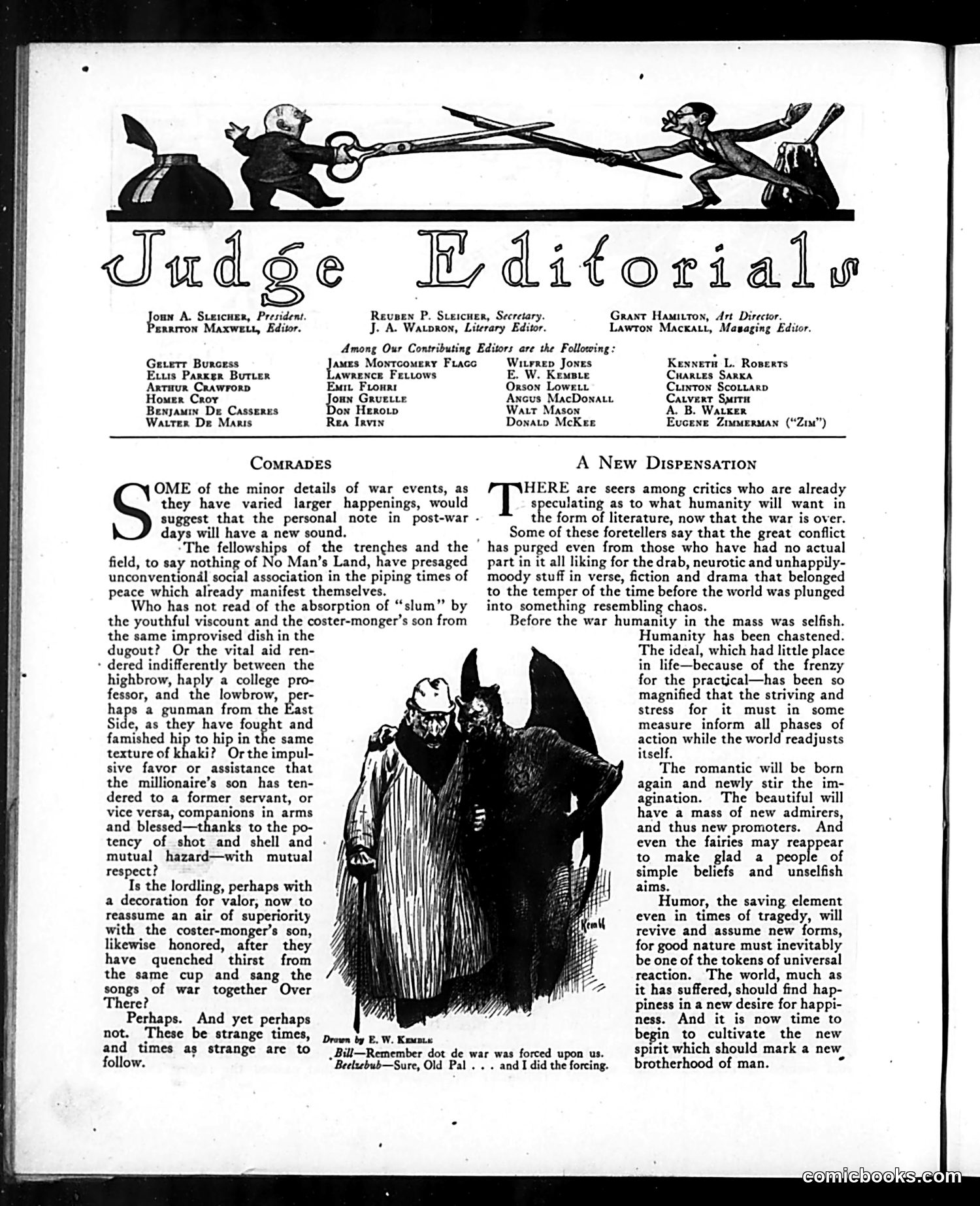
This is a **title/editorial page** from Judge magazine, likely published shortly after World War I ended (1918-1919). The page contains two editorial essays: **"Comrades"** discusses how trench warfare dissolved class barriers—aristocrats and working-class soldiers shared foxholes, food, and danger equally. The editor questions whether this newfound mutual respect will survive peace, or if the lordling with a military decoration will resume his former superiority over his former working-class companion. **"A New Dispensation"** is more hopeful, arguing that the war's sacrifices have "chastened" humanity and purged selfish pre-war attitudes. The author predicts literature and culture will shift from "drab, neurotic" realism toward romance, beauty, and humor—reflecting humanity's moral elevation through shared suffering. The cartoon by E.W. Kemble (captioned "Bill—Remember dot de war was forced upon us / Beelzebub—Sure, Old Pal... and I did the forcing") appears to satirize this optimism, suggesting darker forces manipulated the conflict. Both pieces reflect post-WWI anxieties about whether war's social disruptions would create lasting change.
📄 Transcribed text from this page (OCR, searchable)
Machine-transcribed from the original scan — historical spelling and the odd misread are preserved.
Judge if diforials yom A. Steicuer, eran ‘erriton Maxwett, Ke jamzs Montcomery Fiacc Etus Parxgr Butter AWRENCE FELtows Axraur Crawrorp Eur Fronar Homer Cro fons Gruetie Benjamin De Casseres lon Heroin Water De Maris Rea Irvin Gexetr Burcess ComRADES OME of the minor details of war events, as they have varied larger happenings, would suggest that the personal note in post-war - days will have a new sound. The fellowships of the trenches and the field, to say nothing of No Man’s Land, have presaged unconventional social association in the’ piping times of peace which already manifest themselves. Who has not read of the absorption of “slum” by the youthful viscount and the coster-monger’s son from the same improvised dish in the dugout? Or the vital aid ren- » dered indifferently between the highbrow, haply a college pro- fessor, and the lowbrow, per- cape a gunman from the East as they have fought and fitaned hip to hip in the same texture of khaki? Or the impul- sive favor or assistance that the millionaire’s son has ten- dered to a former servant, or vice versa, companions in arms and blessed—thanks to the po- tency of shot and shell and - mutual hazard—with mutual respect? Is the lordling, perhaps with a decoration for valor, now to reassume an air of superiority with the coster-monger’s son, likewise honored, ates they have quenched thirst from the same cup and sang the songs of war together Over There? Perhaps. And yet perhaps not. These be strange times, pyum by E,W. Keunue and times as strange are to follow. * Beeluebub—Sure, Old Pal . aa P. Sreicner, Secretary. |. A. Watpron, Literary Editor. dunce Our Contributing Editors are the Following: .Bill—Remember dot de war was forced upon us. Grant Hamitox, drt Director. Lawton Macxatt, Masaging Editor. Kennetu L. Roserts Cuares Sara Curwton Scottarp Catvert Suita A. B. Warker Evcene Znoerman (“Zr”) Witrrep Jones E. W. Kesare Orson Lowett Ancus MacDonatt Watt Mason Donato McKee A New DispensaTION HERE are seers among critics who are already speculating as to what humanity will want in form of literature, now that the war is over. Some of these foretellers say that the great conflict "has purged even from those who have had no actual part in it all liking for the drab, neurotic and unhappily- moody stuff in verse, fiction and drama that belonged to the temper of the time before the world was plunged into something resembling chaos. Before the war humanity in the mass was selfish. Humanity has been chastened. The ideal, which had little place in life—because of the frenzy for the practical—has been so magnified that the striving and stress for it must in some measure inform all phases of action while the world readjusts itself. The romantic will be born again and newly stir the im- agination. The beautiful will have a mass of new admirers, and thus new promoters. And even the fairies may reappear to make glad a people of simple beliefs and unselfish aims. Humor, the saving element even in times of tragedy, will revive and assume new forms, for good nature must inevitably be one of the tokens of universal reaction. The world, much as it has suffered, should find hap- piness in a new desire for happi- ness. And it is now time to begin to cultivate the new spirit which should mark a new . and I did the forcing. | brotherhood of man.