
Judge, 1918-12-21 · page 13 of 32
Judge — December 21, 1918 — page 13: what you’re looking at
What you’re looking at
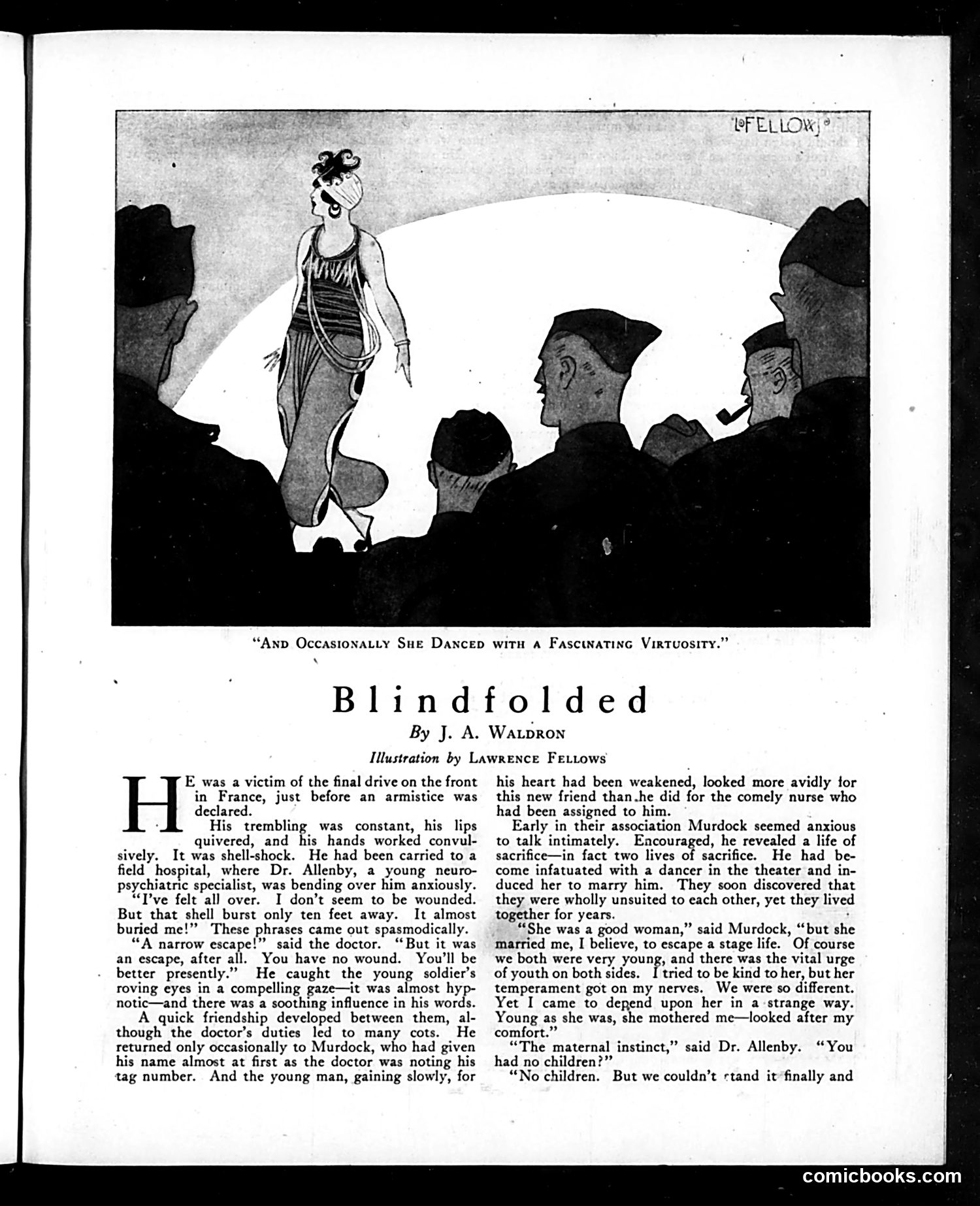
This is a short story, not a political cartoon. "Blindfolded" by J.A. Waldron tells of a WWI shell-shock victim named Murdock recovering in a field hospital under Dr. Allenby's care. The narrative explores psychological trauma and emotional dependency. Murdock, weakened physically and mentally from combat, becomes emotionally reliant on the doctor while confessing details of his failed marriage to a theater dancer. The story examines themes of sacrifice, incompatibility, and the "maternal instinct" in relationships. The illustration shows Murdock (center) before silhouetted military officers, depicting his vulnerable position. The caption references a dancer with "fascinating virtuosity"—likely the ex-wife he's describing. This appears to be serialized fiction exploring post-war psychological and domestic themes rather than satire or political commentary. The "blindfolded" title likely refers to emotional blindness in relationships.
📄 Transcribed text from this page (OCR, searchable)
Machine-transcribed from the original scan — historical spelling and the odd misread are preserved.
FELLON)® “Anp Occasionatty Sue Dancep witu A Fascwnatinc Virtuosity.” Blindfolded By J. A. Watpron Illustration by Lawrence Fettows E was a victim of the final drive on the front in France, just before an armistice was declared. His trembling was constant, his lips quivered, and his hands worked convul- sively. It was shell-shock. He had been carried to a field hospital, where Dr. Allenby, a young neuro- psychiatric specialist, was bending over him anxiously. “T’ve felt all over. I don’t seem to be wounded. But that shell burst only ten feet away. It almost buried me!” These phrases came out spasmodically. “A narrow escape!” said the doctor. “But it was an escape, after all. You have no wound. You'll be better presently.” He caught the young soldier’s roving eyes in a compelling gaze—it was almost hyp- notic—and there was a soothing influence in his words. A quick friendship developed between them, al- though the doctor’s duties led to many cots. He returned only occasionally to Murdock, who had given his name almost at first as the doctor was noting his tag number. And the young man, gaining slowly, for his heart had been weakened, looked more avidly tor this new friend than.he did for the comely nurse who had been assigned to him. Early in their association Murdock seemed anxious to talk intimately. Encouraged, he revealed a life of sacrifice—in fact two lives of sacrifice. He had be- come infatuated with a dancer in the theater and in- duced her to marry him. They soon discovered that they were wholly unsuited to each other, yet they lived together for years. “(She was a good woman,” said Murdock, “but Rie married me, I believe, to escape a stage life. Of course we both were very young, and there was the vital urge of youth on both sides. I tried to be kind to her, but her temperament got on my nerves. We were so different. Yet I came to depend upon her in a-strange way. Young as she was, she mothered me—looked after my comfort.” “The maternal instinct,” said Dr. Allenby. “You had no children?” “No children. But we couldn’t ctand it’finally and comicbooks.com