
A complete issue · 32 pages · 1918
Judge — October 5, 1918
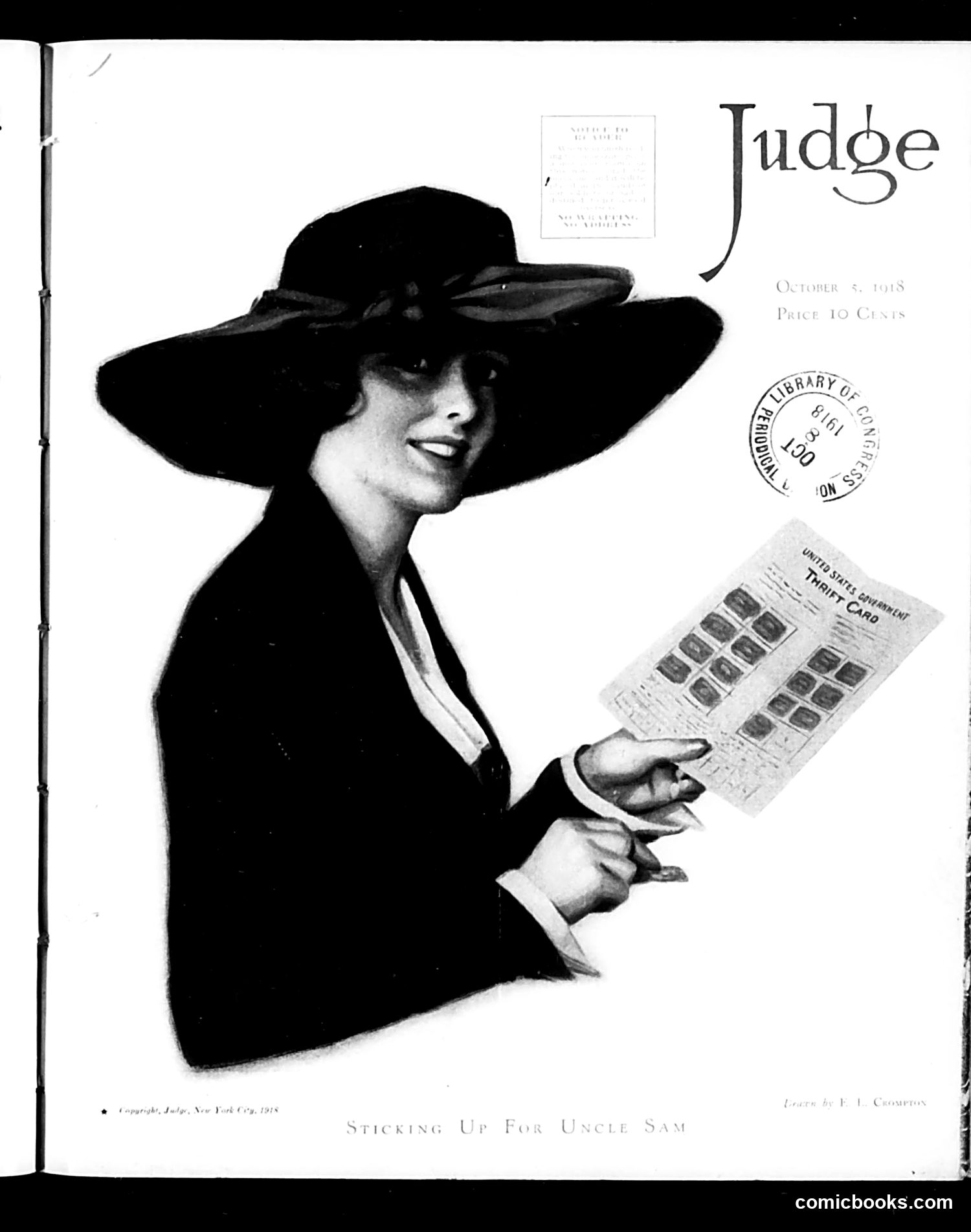
This Judge magazine cover from October 5, 1918, depicts a fashionable woman holding what appears to be a Thrift Card—a government savings program used to fund World War I. The woman's elegant appearance (wide-brimmed hat, jewelry) contrasts with her patriotic duty. The title "Sticking Up for Uncle Sam" uses a double meaning: literally "supporting" Uncle Sam (the U.S. government) through financial contribution, while "sticking up" also suggests forcefully advocating for the war effort. The satire likely mocks how the government marketed war bonds and savings programs to the public, or possibly critiques how even wealthy citizens were being asked—or pressured—to contribute financially to the war effort. The fashionable woman represents those targeted by this patriotic appeal.
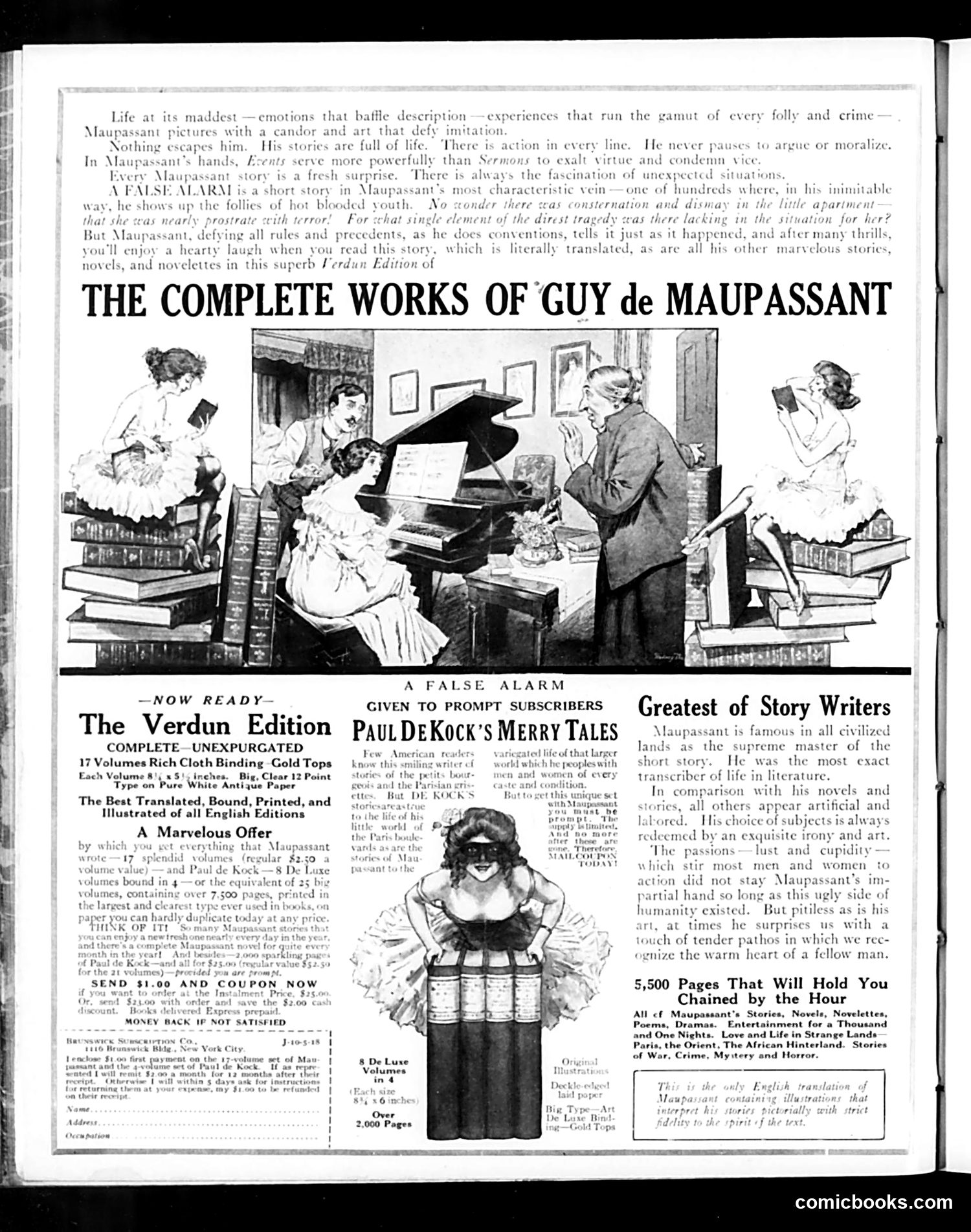
This page is primarily **advertising for a deluxe edition of Guy de Maupassant's collected works**, not political satire. The top contains promotional text praising Maupassant as a master short-story writer known for capturing life's follies without moralizing. The central illustration labeled "A False Alarm" depicts a domestic scene—a woman at a piano with men reacting with apparent surprise or concern, likely illustrating one of Maupassant's stories about social embarrassment or misunderstanding. The left side advertises "The Verdun Edition"—a 17-volume set with gold tops and cloth binding. The right side emphasizes Maupassant's literary reputation and mentions the collection contains 5,500 pages of stories, novels, and other works. This is **primarily a commercial advertisement** rather than political or social commentary. No political figures or satire are evident.
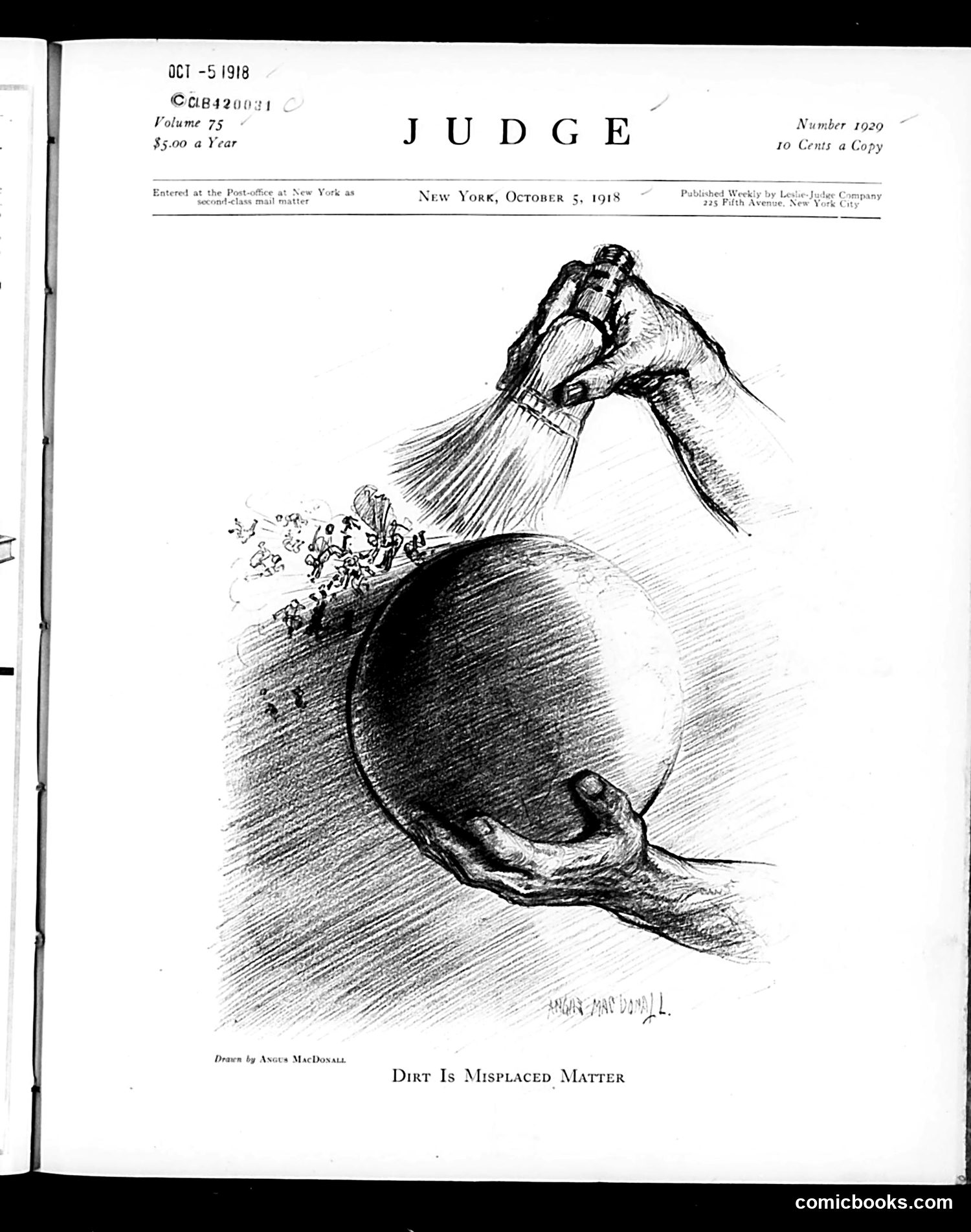
This October 1918 Judge cartoon by Angus MacDonald uses visual metaphor to criticize mismanagement during World War I's final months. A giant hand pours dirt from a shovel onto a globe, while tiny figures cling to the sphere's surface. The caption "Dirt Is Misplaced Matter" suggests that resources, manpower, or effort are being wasted or directed ineffectively. Given the timing—just weeks before the Armistice—the cartoon likely critiques how the war effort has squandered American lives and resources. The figures on the globe appear helpless against this downpour, emphasizing civilians' vulnerability to wasteful military or governmental decisions. The satire indicts those in power for carelessly dumping "dirt" (wasted effort, lives, money) onto the world.
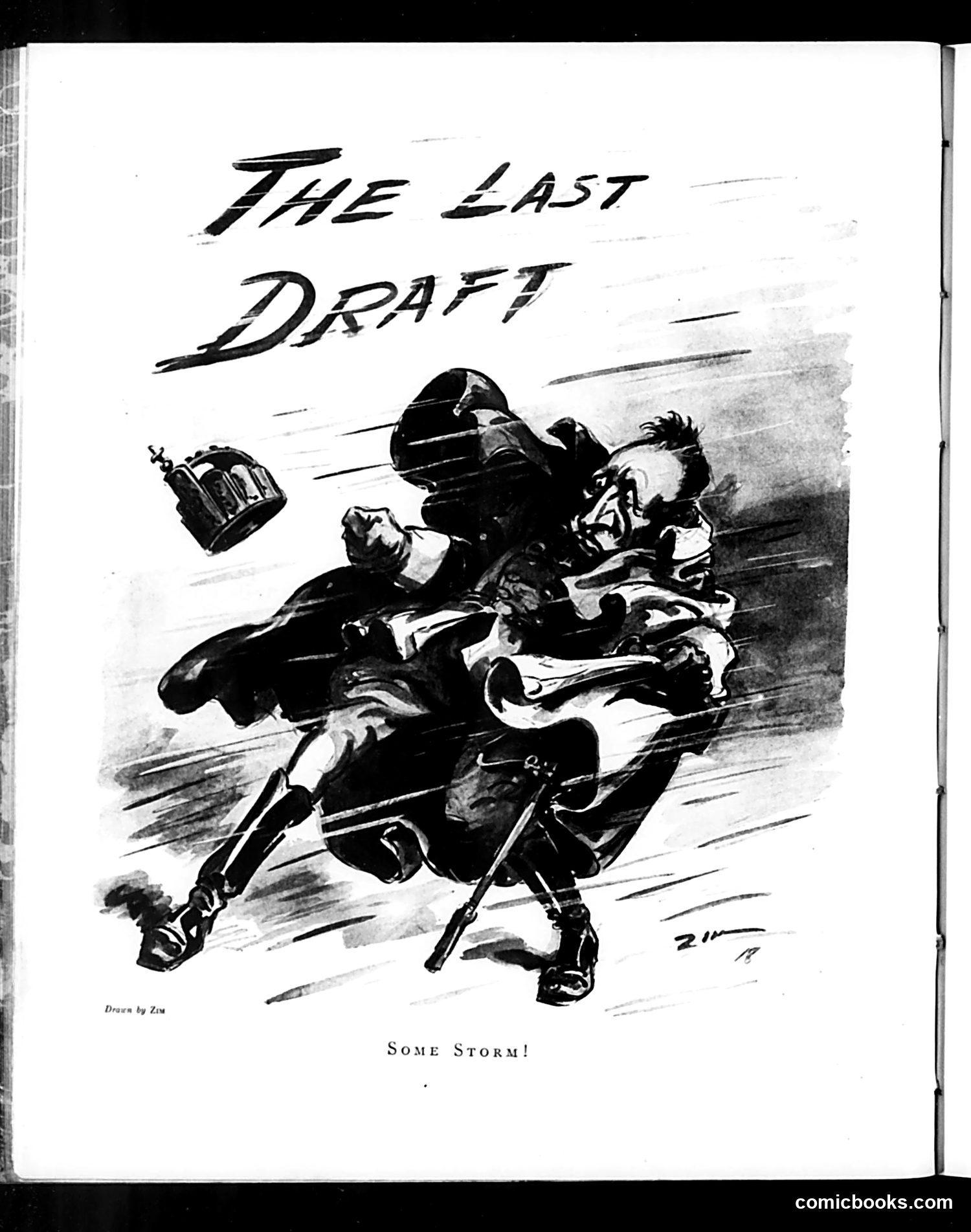
This Judge magazine cartoon satirizes military conscription during what appears to be a wartime period (likely WWI or WWII, based on the style). The title "The Last Draft" combined with the subtitle "Some Storm!" suggests criticism of a final round of draft calls. The illustration shows military figures being violently swept up or blown away in chaotic motion, with a crown or military insignia flying loose. The dynamic, turbulent imagery conveys the disruption and upheaval caused by the draft. The satire appears to mock either the chaos of implementing mass conscription, the desperation of calling up remaining eligible men, or the political storm surrounding draft policy. The "last draft" likely implies this represents an extreme or final measure in military recruitment.
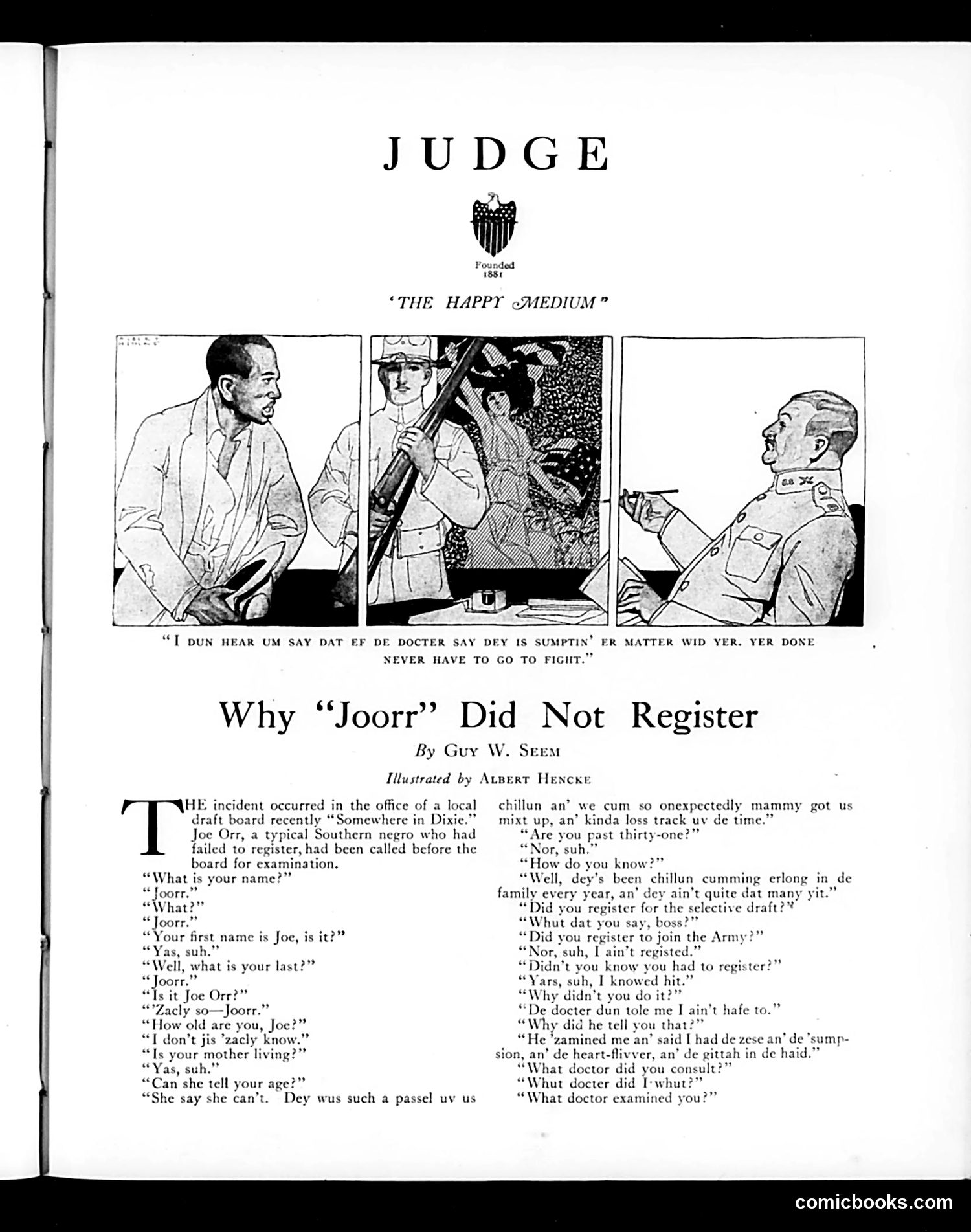
This Judge magazine piece satirizes draft evasion during a military conscription period (likely WWI era, given the "draft board" reference). The three-panel cartoon shows a military official interrogating "Joe Orr," a Black Southern man who claims he didn't register for the draft. The satire works through dialect humor and the man's implausible excuses: he blames a doctor for saying he shouldn't fight, claims his mother is dead (so she can't confirm his age), and feigns ignorance about registration requirements. The dialogue mocks both the evasion attempt and, through heavy dialect representation, perpetuates racial stereotypes common to the era's humor. The piece ridicules draft dodgers while simultaneously using racist caricature for comedic effect—typical of early 20th-century American satire.
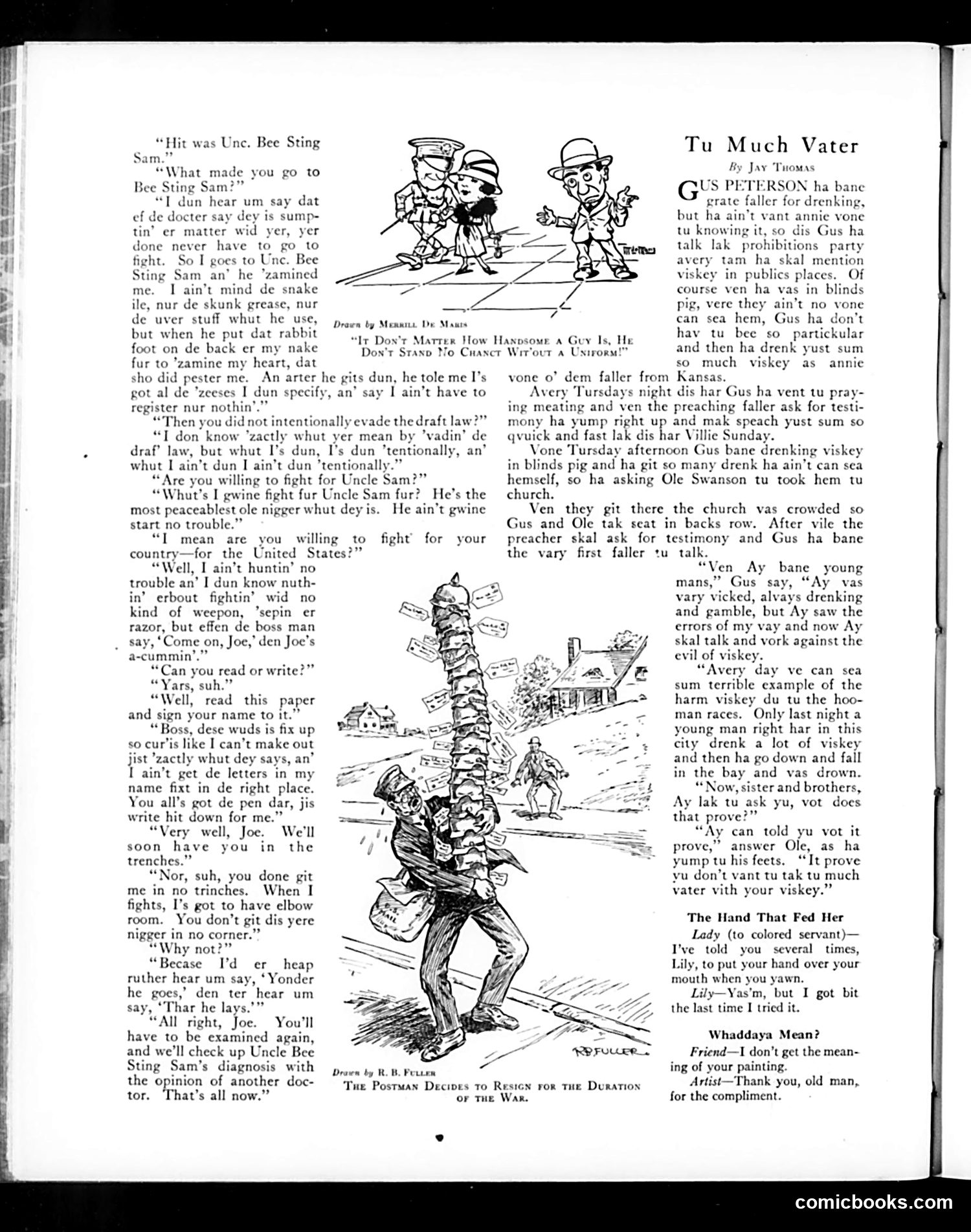
This page contains two main elements: **Left side:** A dialect-heavy story titled "His was Unc. Bee Sting Sam" depicting African American characters in vernacular speech, discussing draft evasion during what appears to be World War I. The dialogue suggests characters attempting to avoid military service through various excuses. **Right side:** A story titled "Tu Much Vater" by Jay Thomas, also using dialect to portray African American characters, focusing on excessive drinking and its moral dangers. A separate sketch titled "The Hand That Fed Her" presents a brief domestic interaction. **Center illustration:** "The Postman Decides to Resign for the Duration of the War"—showing a mail carrier overwhelmed with correspondence. The content reflects period stereotypes and dialect humor common to early 20th-century American magazines, addressing contemporary wartime concerns about draft compliance and social behaviors.
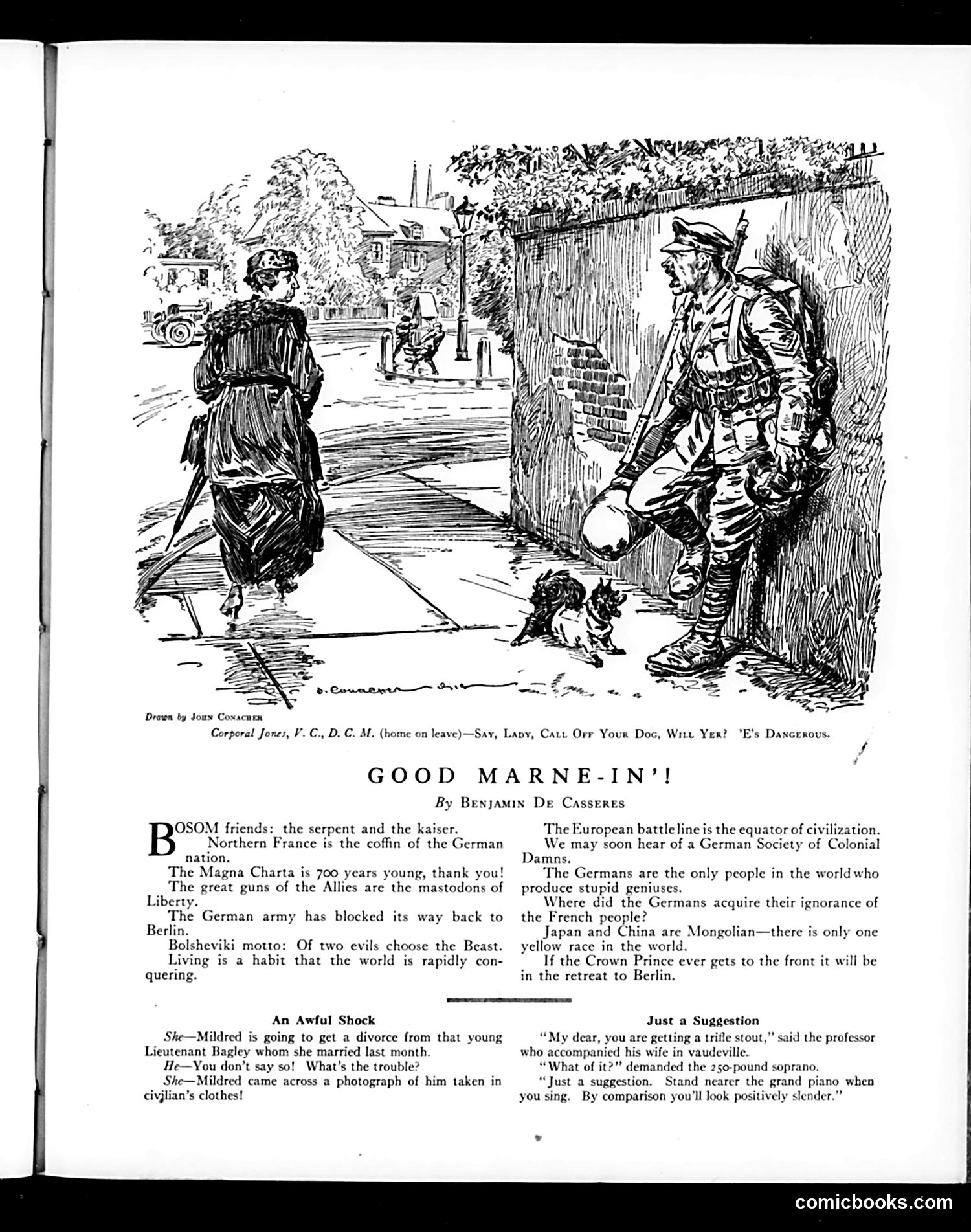
This page from *Judge* magazine contains WWI-era American satire, likely from 1914-1918. **Main Cartoon:** A British soldier (identified by uniform and "V.C., D.C.M." military decorations) on leave warns a lady to call off her dog, claiming he's "dangerous." The joke appears to mock British soldiers' reputations—possibly suggesting they're untrustworthy around civilians, or playing on stereotypes about soldiers' behavior while on leave. **"Good Marne-in!" Essay:** Benjamin De Casseres offers anti-German rhetoric typical of Allied propaganda. He uses poetic language to characterize Germany as doomed ("coffin of the German nation") and portrays Germans as intellectually inferior despite producing "stupid geniuses." References to "the kaiser" and the "Crown Prince" indicate this targets German leadership specifically. **Bottom Humor Pieces:** Two unrelated jokes about domestic life and vaudeville, typical filler content for magazines of this era. The page reflects American wartime sentiment and morale-boosting messaging common in satirical publications during the Great War.
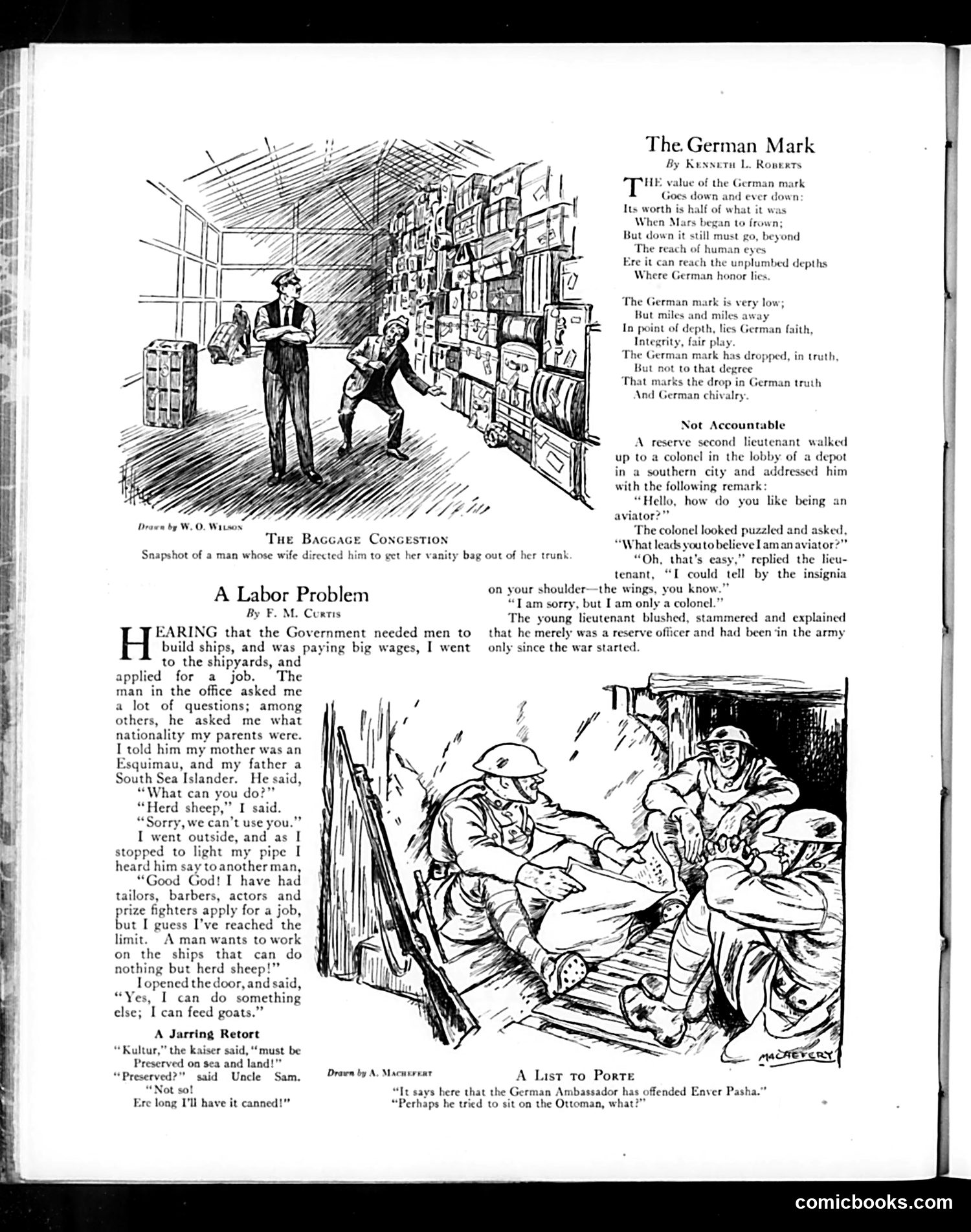
**"The Baggage Congestion"** depicts domestic humor: a husband reluctantly retrieving his wife's vanity bag from a trunk—satirizing the burden of spousal demands during wartime. **"A Labor Problem"** mocks shipyard hiring discrimination. A job applicant of mixed heritage (Esquimau and South Sea Islander parents) is rejected for sheep-herding, then offers goat-feeding instead—absurdist humor about arbitrary hiring practices and labor shortages during WWI ship construction. **"A Jarring Retort"** uses wordplay to mock German Kaiser Wilhelm II's emphasis on "Kultur" (culture/civilization): Uncle Sam promises to can-preserve German kultur, implying it will be destroyed/eliminated. **"The German Mark"** is a patriotic poem contrasting Germany's currency collapse with Americans' claim that German honor and integrity have fallen even further. **"Not Accountable"** jokes about military rank insignia confusion: a reserve officer mistakenly addresses a colonel as an aviator based on shoulder insignia, then awkwardly explains his recent enlistment. **"A List to Porte"** contains a pun: the German Ambassador offending Ottoman leader Enver Pasha, with wordplay on "ottoman" (furniture). All content reflects WWI-era American sentiment.
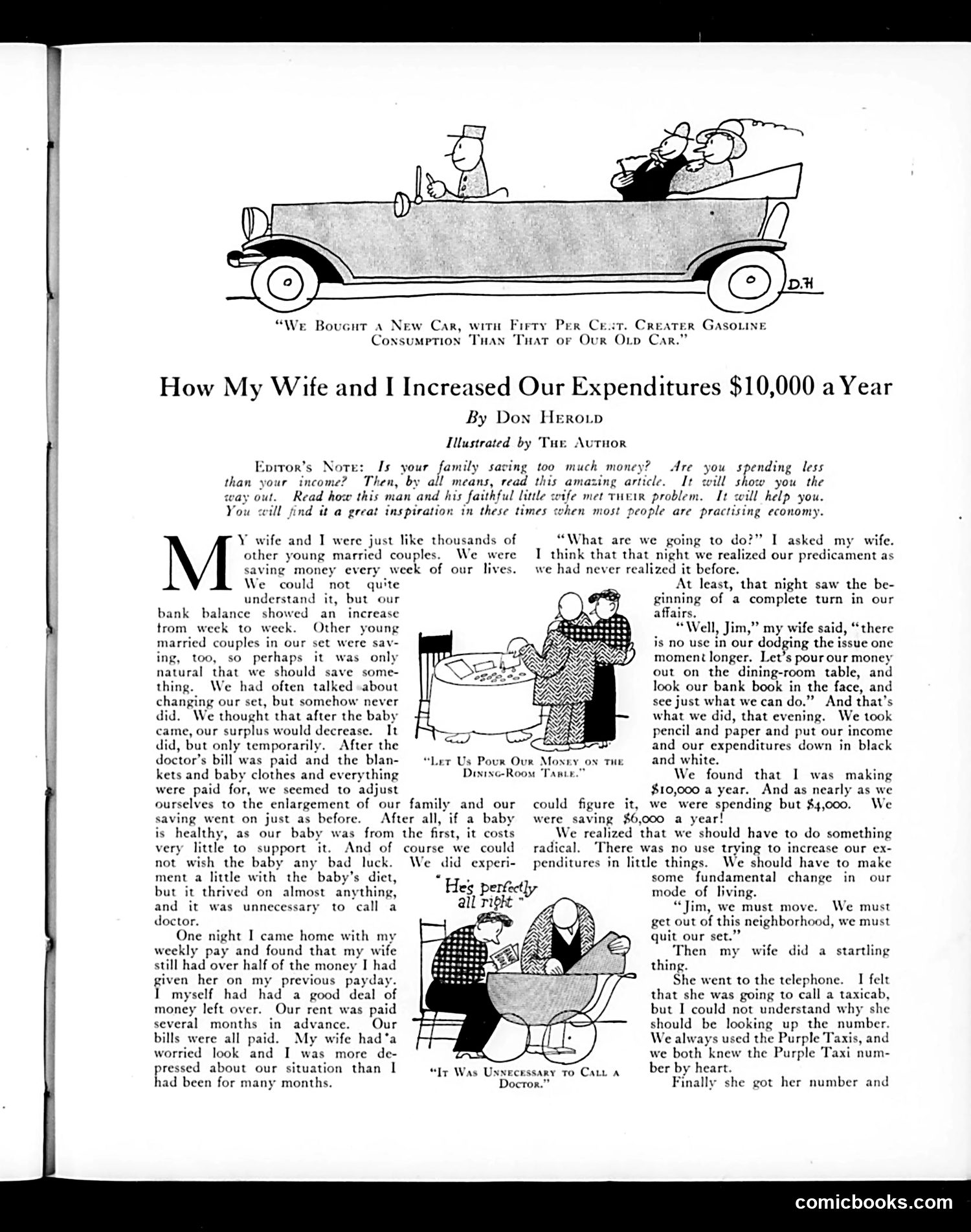
This 1920s satirical article mocks the irresponsibility of wealthy couples who overspend despite earning substantial incomes. The narrator and his wife earn $10,000 annually but, alarmed by their $6,000 yearly savings, decide they must spend more lavishly to avoid "hoarding" money. The cartoons illustrate their solution: they buy a gas-guzzling car (the opening cartoon shows a massive vehicle consuming 50% more fuel), move to a wealthier neighborhood, and adopt an extravagant lifestyle. The wife's phone call at the article's end hints she's arranging even more expensive indulgences. **The satire targets**: 1920s consumer culture and status anxiety among the upwardly mobile middle class, who equated visible spending with respectability and believed saving money was somehow unpatriotic or unbecoming. The Editor's note sardonically frames this as "inspiration" for economizing families—the opposite of its actual message—adding another layer of ironic commentary on excessive consumption during an era when most people practiced genuine thrift.
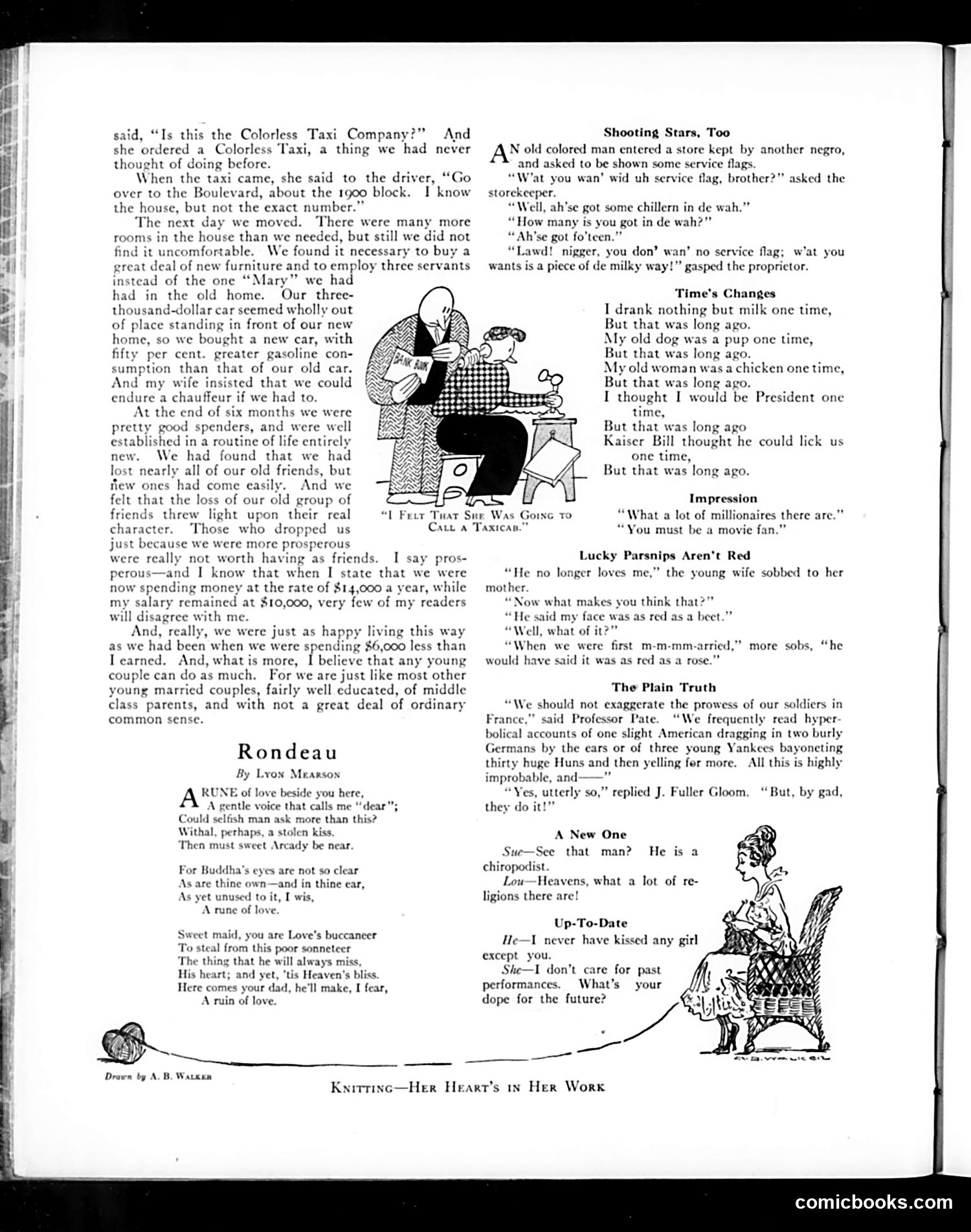
This page contains multiple brief satirical pieces typical of Judge's format: **Main narrative** (top left): A humorous story about a couple who move to an expensive neighborhood and spiral into debt—spending $14,000 annually on a $10,000 salary. The satire targets middle-class aspirational spending and the social pressure to maintain appearances through consumption. **"Rondeau"** (poem): A romantic verse with a dark twist—the narrator's father will "make a ruin of love," poking fun at courtship obstacles. **Small humor pieces** (right column): - "Shooting Stars, Too": A dialect joke about a Black man with fourteen children seeking a WWI service flag; the punchline relies on crude racial stereotypes common to the era. - "Time's Changes": Nostalgic observations (drinking milk, Kaiser Bill's defeat) referencing WWI's recent conclusion. - "Lucky Parsnips Aren't Red" & "The Plain Truth": Brief romantic/marital jokes. **Visual elements**: Pen-and-ink illustrations by A.B. Walker accompany pieces, including a couple and a woman knitting. The page reflects early 20th-century American middle-class anxieties and attitudes, including period-typical racist humor.
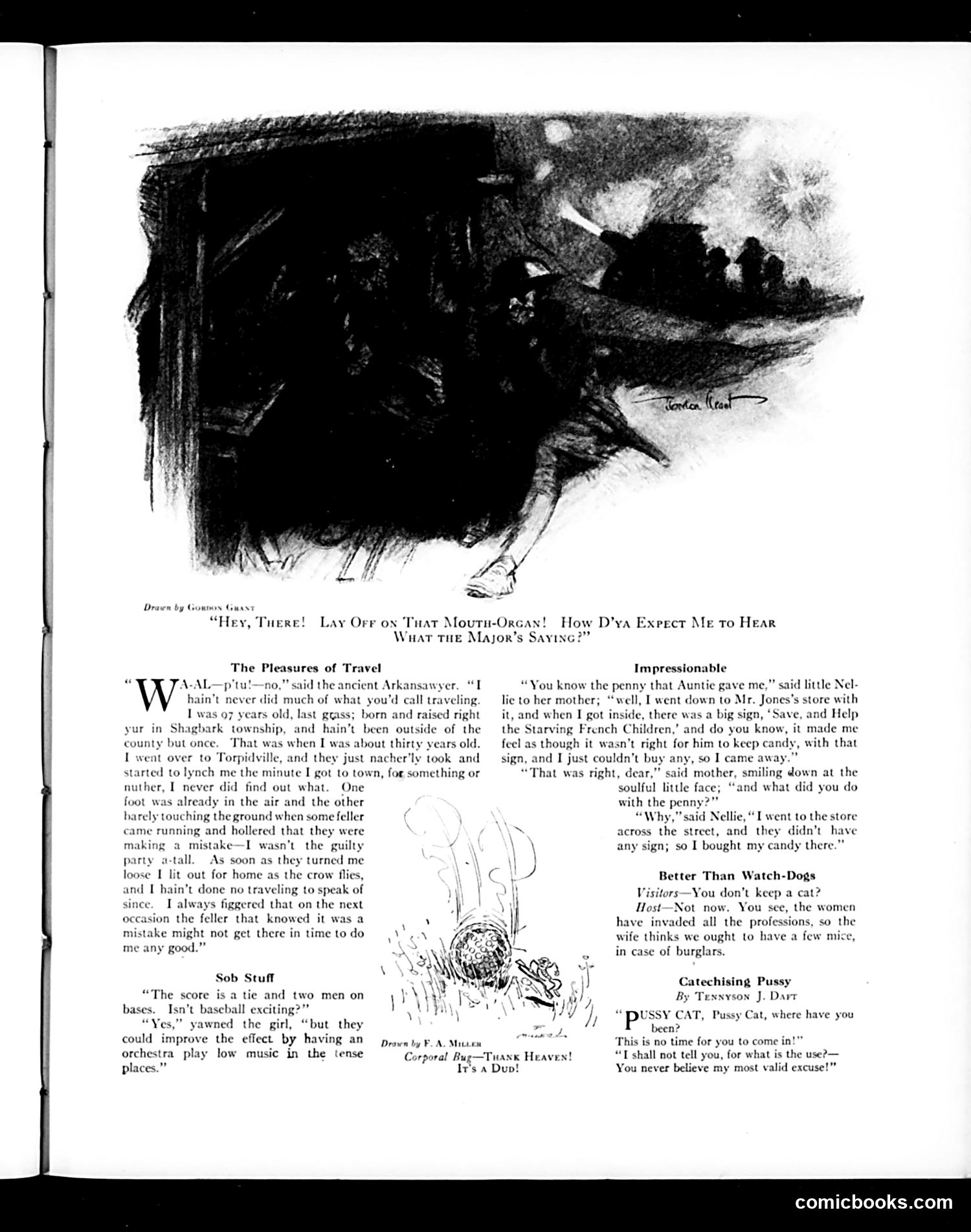
This page contains three separate humorous pieces satirizing early 20th-century American attitudes and social conventions. **"The Pleasures of Travel"** mocks rural, provincial Americans through an Arkansawyer character who's never left his county and recounts a near-lynching as his sole travel experience—suggesting backwoods ignorance and violence. **"Sob Stuff"** jokes about a girl's indifference to baseball, preferring orchestral accompaniment to "tense places"—likely satirizing either women's supposed lack of sports enthusiasm or the era's sentimental over-dramatization. **"Better Than Watch-Dogs"** makes a gender-equality joke: with women entering professions, the host humorously suggests keeping mice as burglary "insurance" since his wife now expects domestic dangers requiring female protection. **"Catechising Pussy"** personifies a cat deflecting questions about whereabouts, mirroring human evasiveness—mild humor about pet behavior. The cartoons reflect turn-of-century anxieties about women's expanding roles, rural versus urban divides, and sentimental Victorian culture.
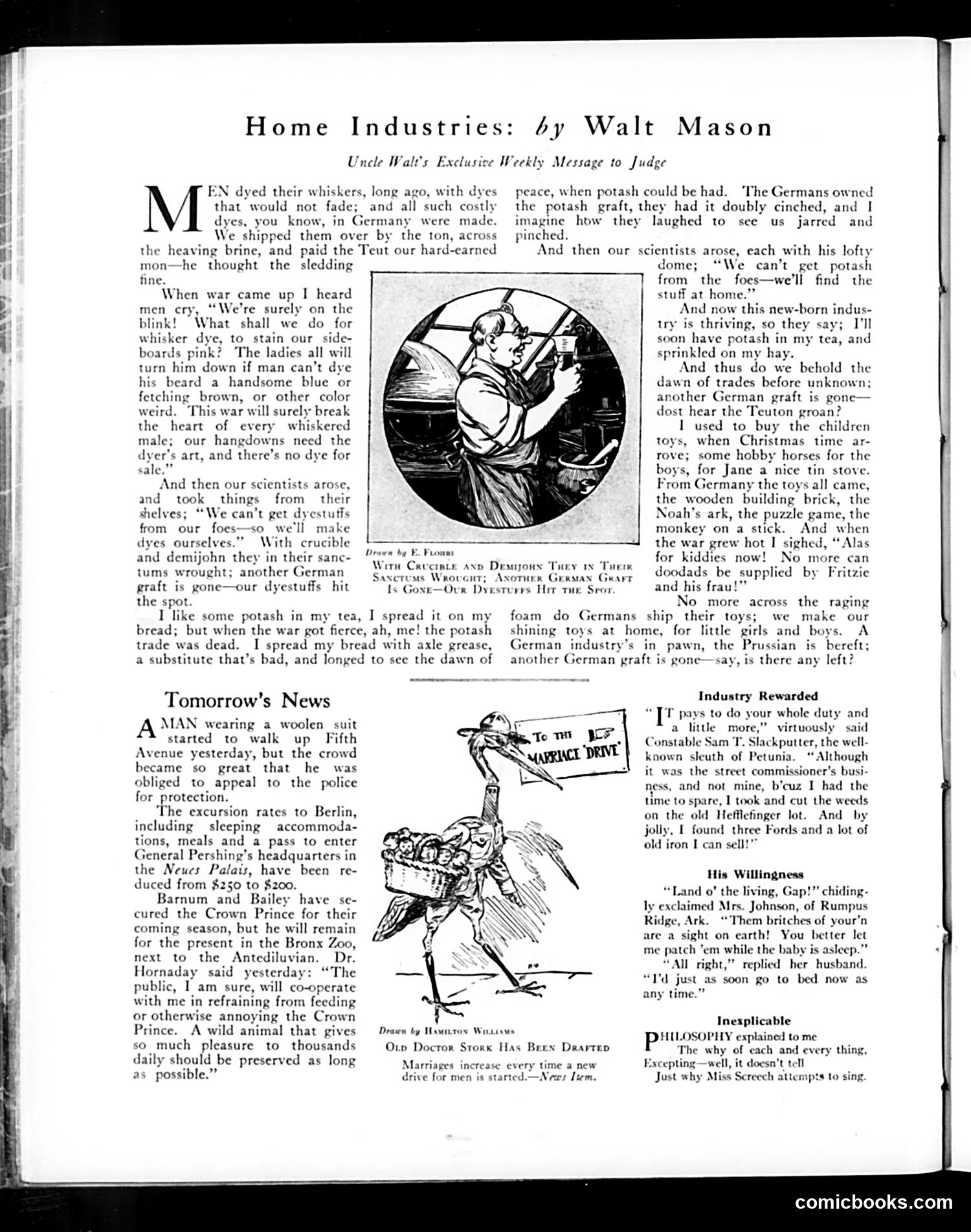
This WWI-era piece by Walt Mason celebrates American industrial self-sufficiency after the war cut off German imports. The main article mocks American dependence on Germany for everyday goods—whisker dyes, potash (for tea and hay), and children's toys. When war began, the cry went up: "What shall we do?"—but American scientists quickly developed domestic alternatives, turning potential crisis into triumph. The satirical "Tomorrow's News" section offers absurdist jokes about post-war conditions: a man in wool clothes draws crowds (suggesting shortages), Berlin excursion rates drop comically, and the Crown Prince is jokingly placed in the Bronx Zoo. The cartoons by Hamilton Williams mock German militarism ("Old Doctor Stork Has Been Drafted") and marital anxiety ("Marriage Drive"). The humor celebrates American innovation and independence while mocking both German dominance and American wartime anxiety—all wrapped in patriotic satisfaction that "German grafts are gone."
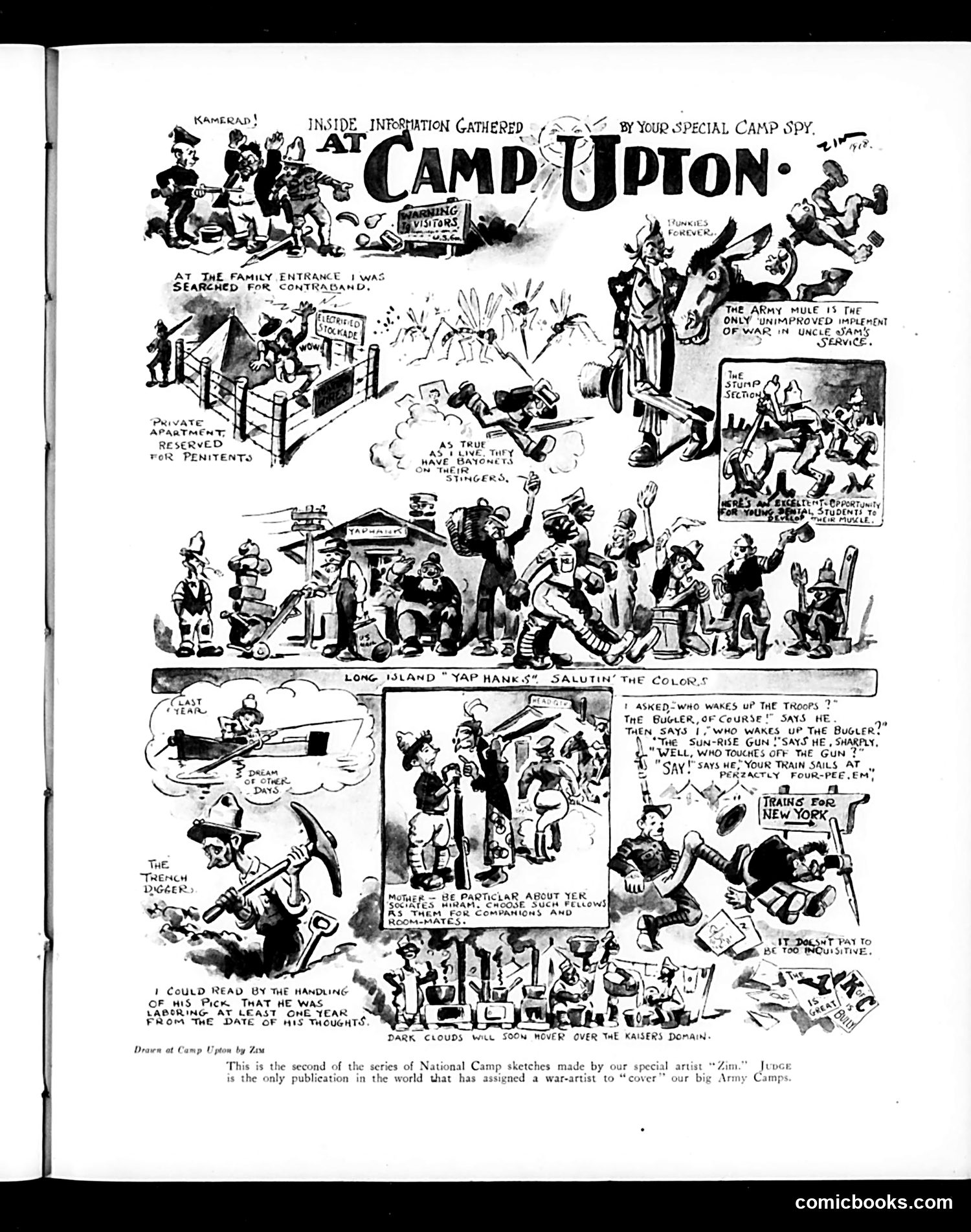
This is a humorous illustrated report on Camp Upton (a major WWI training facility on Long Island), presented as "inside information" gathered by Judge's war artist "Zim." The sketches mock various aspects of military camp life through exaggerated cartoon vignettes: soldiers being searched for contraband, the quirky hierarchy of who wakes up whom (bugler→sun-rise gun→soldier), officers giving advice to recruits about choosing trustworthy bunkmates, and general camp routines. The humor relies on the absurdity of military bureaucracy and the contrast between soldier expectations and reality. The final caption notes this is the second in a series—Judge claims to be the only publication with a dedicated war artist covering Army camps, positioning itself as providing unique wartime commentary. The underlying tone is patriotic but gently mocking of military inefficiency and camp life's ironies, typical of American satirical commentary during WWI mobilization.
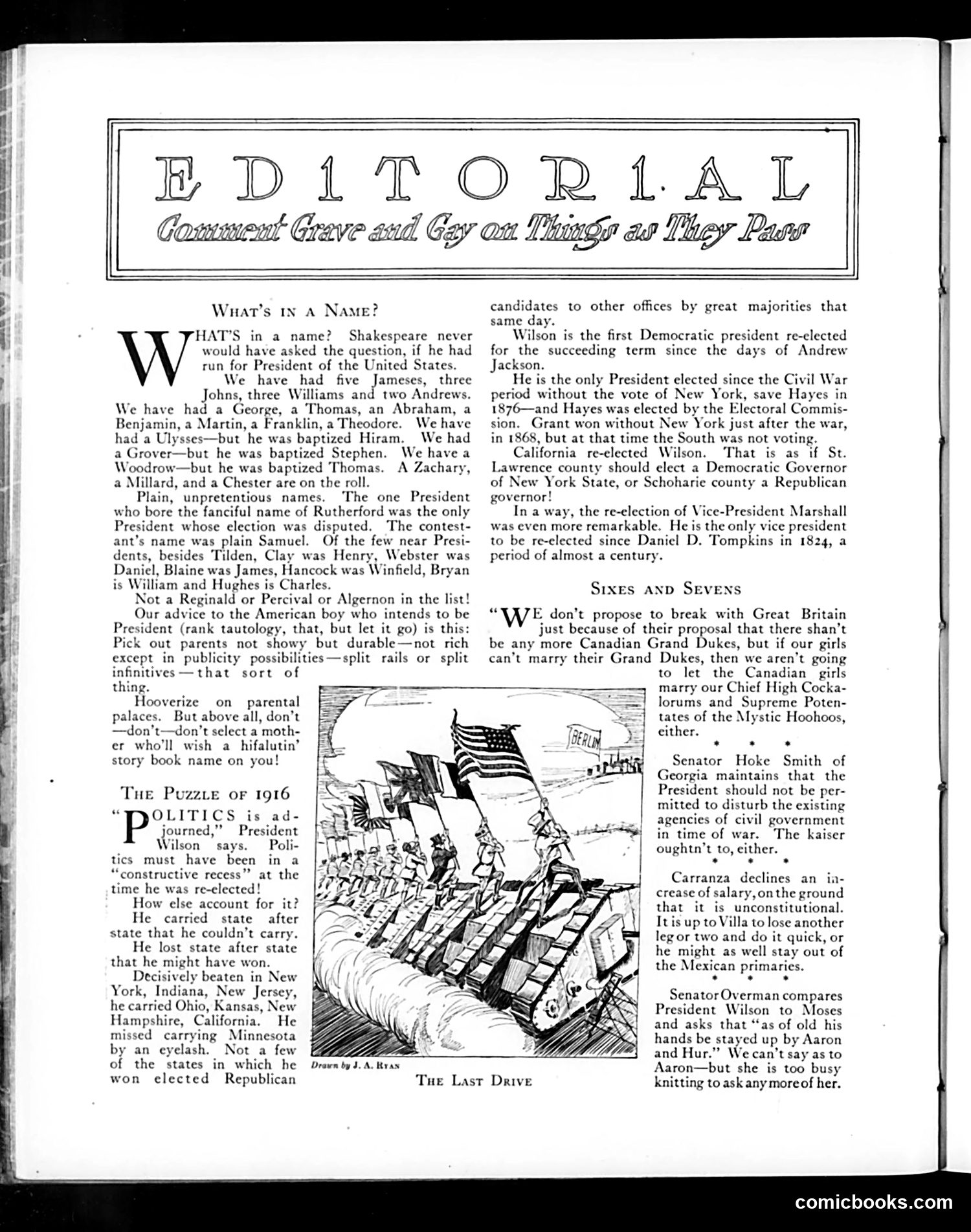
This editorial page from Judge (circa 1916) contains political commentary on President Woodrow Wilson's recent re-election. **Main Points:** The "Puzzle of 1916" section mocks Wilson's unexpected electoral victory. Despite losing major states like New York, Indiana, and New Jersey—states he'd previously carried—Wilson won California and other unlikely victories. The cartoonist finds this contradictory and absurd, comparing it to a Democratic governor being elected in a reliably Republican county. **The cartoon "The Last Drive"** (center) depicts soldiers/sailors advancing with American and German flags, referencing World War I, which was ongoing. This illustrates the editorial's broader context: America's debate over entering the European conflict. **"Sixes and Sevens"** section uses humorous jabs at various political figures—Senator Hoke Smith, Mexican General Villa, and Senator Overman—mixing serious policy critiques with mockery. The overall tone is skeptical of Wilson's political maneuvering and election results, presenting them as inexplicable given the electoral data presented.
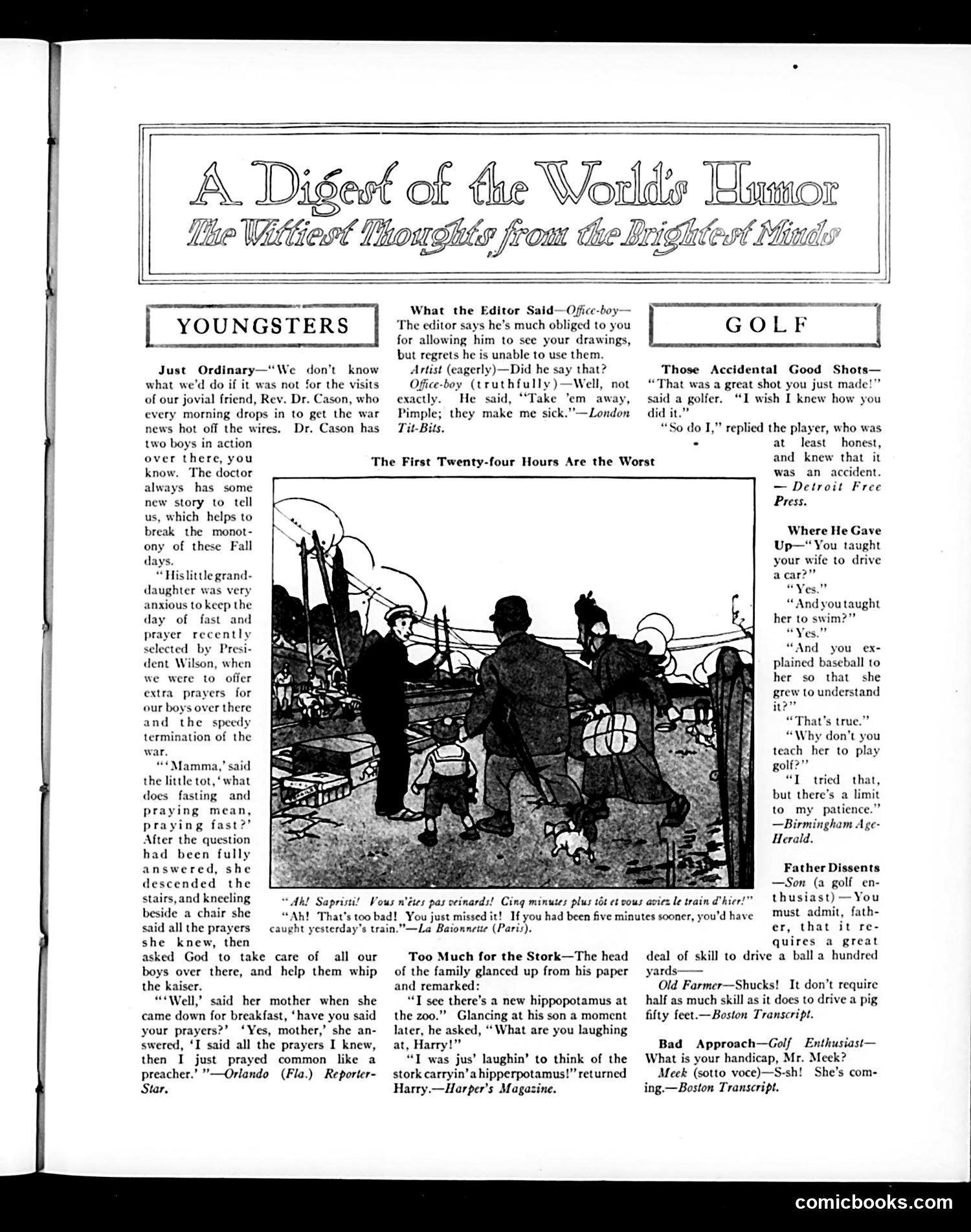
This page collects humorous anecdotes and jokes organized by topic (Youngsters, Golf, etc.), typical of Judge's editorial format. The central cartoon depicts a WWI scene: a man in formal attire has apparently missed a train, with French caption explaining he arrived five minutes too late. **Key references:** - **WWI context**: Multiple pieces reference the war—Dr. Cason visits for war news; a child prays for soldiers; the train cartoon is French, reflecting the European theater - **The train joke**: Satirizes the frustration of narrowly missing transportation, with French locale emphasizing the war's European scope - **Golf pieces**: Gentle domestic humor about golf's difficulty and marital dynamics - **Stork/hippopotamus joke**: A child's innocent misunderstanding of reproduction during wartime (when birth announcements were common) The page reflects 1910s-era American satire: patriotic but light-hearted, mixing wartime anxiety with everyday domestic comedy. The golf humor suggests affluent readership.
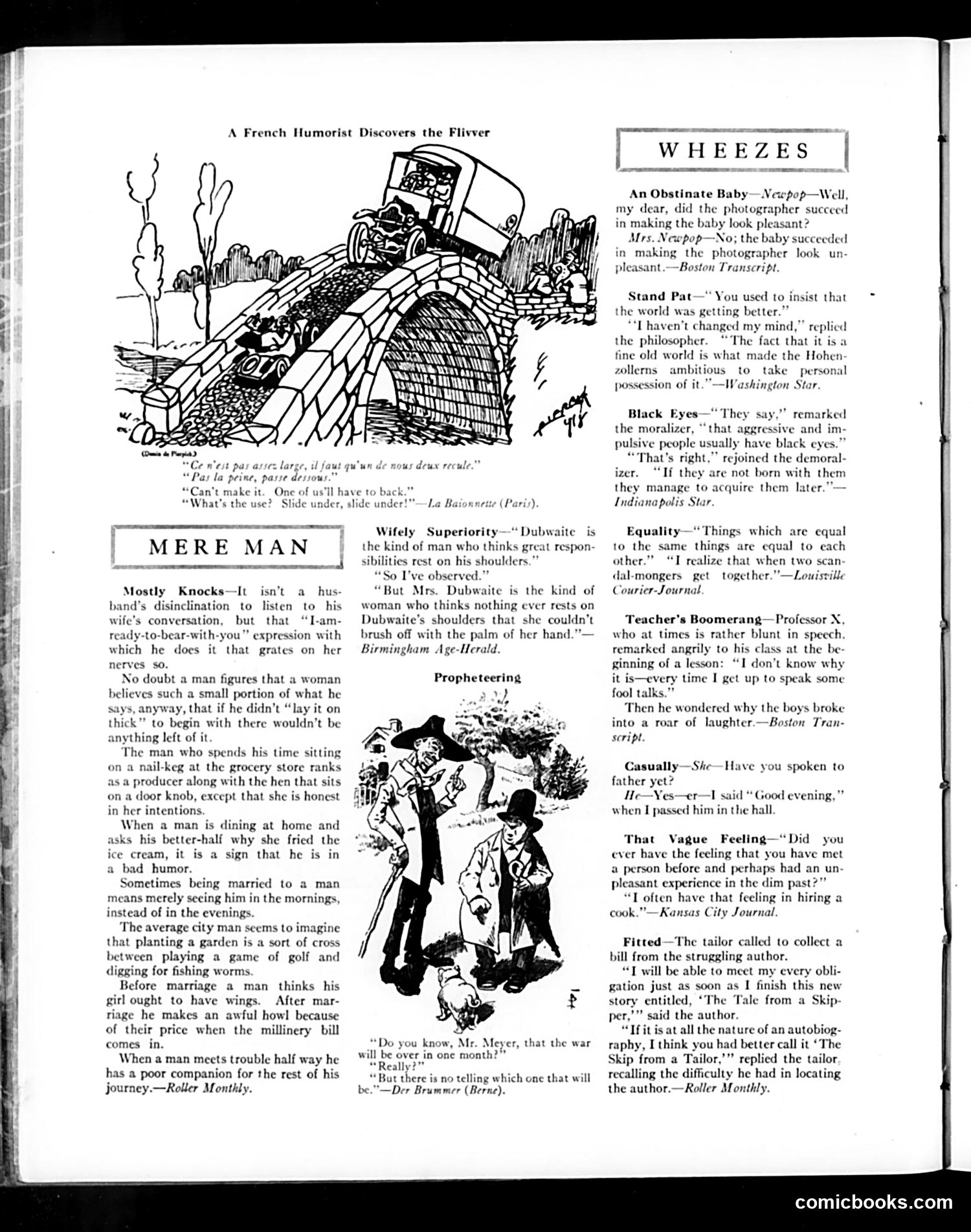
The top cartoon shows a French observer's reaction to the American automobile ("flivver"—slang for Model T Ford). A car precariously balanced on a steep bridge illustrates the caption's French dialogue about the vehicle's dubious safety and practicality. The satire mocks both American automotive enthusiasm and stereotypical French skepticism toward this new technology. The remainder consists of miscellaneous short humor pieces titled "Mere Man," "Wheezes," and "Propheteering." These are brief, unrelated jokes targeting domestic life, gender relations, and social pretension. Notably, several mock husbands' indifference toward wives' conversation and women's domestic authority. One joke references the Hohenzollern dynasty's imperial ambitions (likely WWI-era commentary). The humor reflects early 20th-century American attitudes about marriage, gender dynamics, and technological novelty, presented without sophisticated satire—mostly straightforward punchlines about wives, cooking, and social observation.
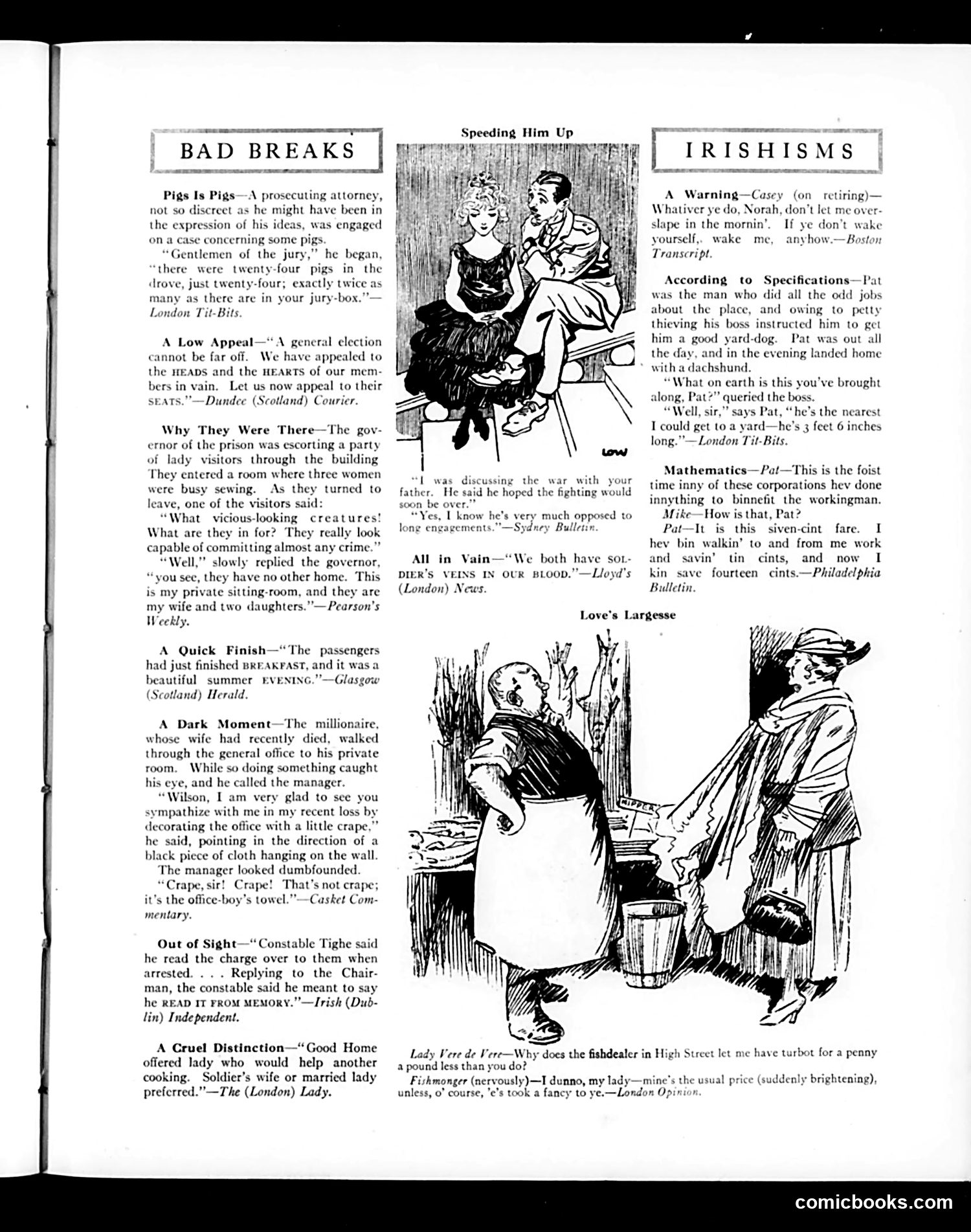
This page from Judge magazine contains brief satirical anecdotes and jokes organized into three sections: "Bad Breaks," "Irishisms," and "Love's Largesse." **"Bad Breaks"** collects humorous mishaps: a prosecutor accidentally insults jurors by comparing them to pigs; a prison governor is embarrassed when visitors mistake his wife and daughters for inmates; an office boy's dirty towel is mistaken for mourning crepe. **"Irishisms"** trades in ethnic stereotypes common to the era, featuring Irish characters (Casey, Pat, Mike) with exaggerated dialect and malapropisms—Pat brings home a dachshund as a "yard dog," misunderstanding specifications. **"Love's Largesse"** is a flirtation joke: a fishmonger undercuts competitors' prices because he's attracted to an upper-class customer ("Lady Vere de Vere"). The humor relies on wordplay, class differences, and period-specific references to WWI ("soldier's veins in our blood"). The ethnic stereotyping reflects casual prejudices of early 20th-century American publishing.
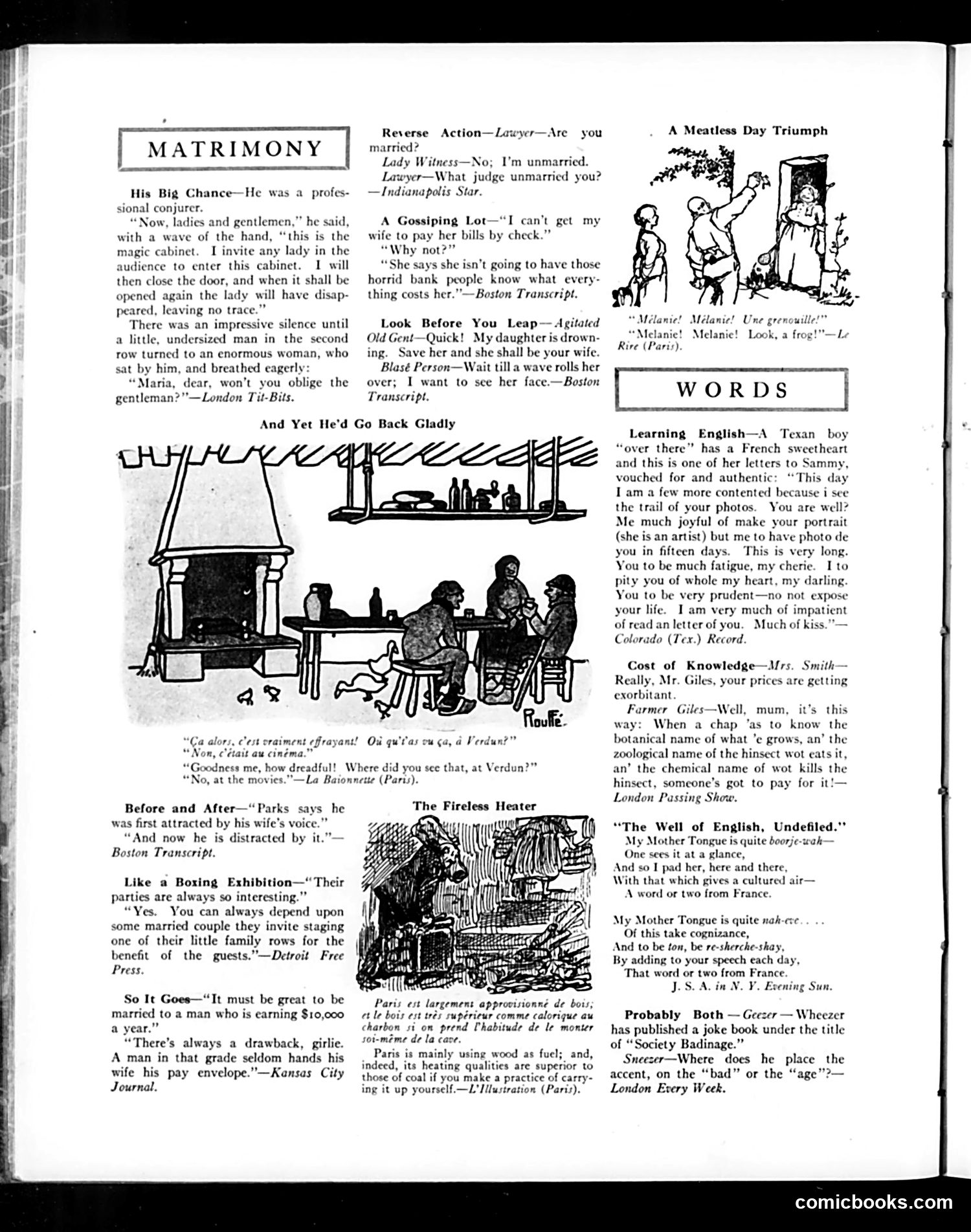
This page collects short humorous anecdotes about marriage, language, and wartime conditions, typical of Judge's satirical format. **Key content:** The "Matrimony" section mocks marriage through brief jokes: a magician's trick inviting his wife to disappear (the husband eagerly volunteers his enormous wife), a lawyer's confusion about unmarried witnesses, and complaints about wives' spending and communication styles. **Historical context:** References to "Verdun" and "over there" indicate World War I era (likely 1917-18). The "Meatless Day Triumph" cartoon references American wartime rationing efforts. The "Learning English" piece humorously presents fractured French from a French woman writing to an American soldier, satirizing language barriers between allies. **Social satire:** The jokes target married couples' domestic friction, wives' financial independence concerns (checking accounts revealing expenses), and the awkwardness of international wartime romance. The magazine assumes readers understand contemporary rationing, the Western Front, and American soldiers' French deployments.
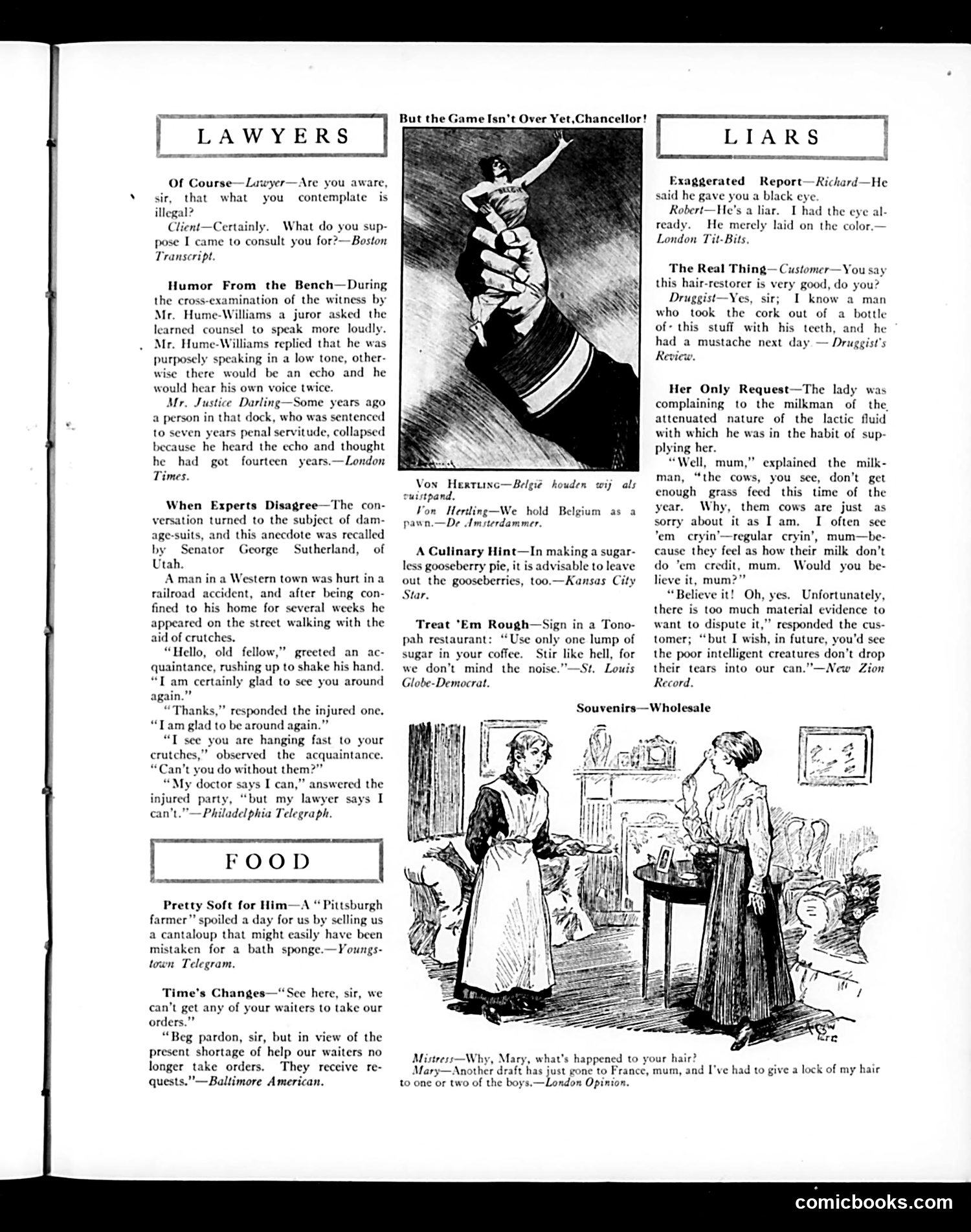
This page collects brief humorous anecdotes organized by topic (Lawyers, Liars, Food), typical of Judge's format. Most are apolitical jokes—lawyers joking about their fees, druggists exaggerating product claims, a milkman blaming cows for thin milk. However, **the central illustration and one anecdote reference World War I**: The cartoon shows a hand holding Belgium like a pawn, captioned with quotes from Belgian and German officials debating Belgium's status as a war "pawn" or "hostage." This reflects contemporary diplomatic tensions over Germany's occupation of Belgium. The "Souvenirs" cartoon below depicts a woman explaining she gave locks of her hair to soldiers departing for France—a poignant reference to soldiers leaving for WWI combat, and women's symbolic participation through such gestures. These items suggest the page was published during WWI, when such references would resonate with American readers following European conflicts before U.S. involvement (1914-1917).
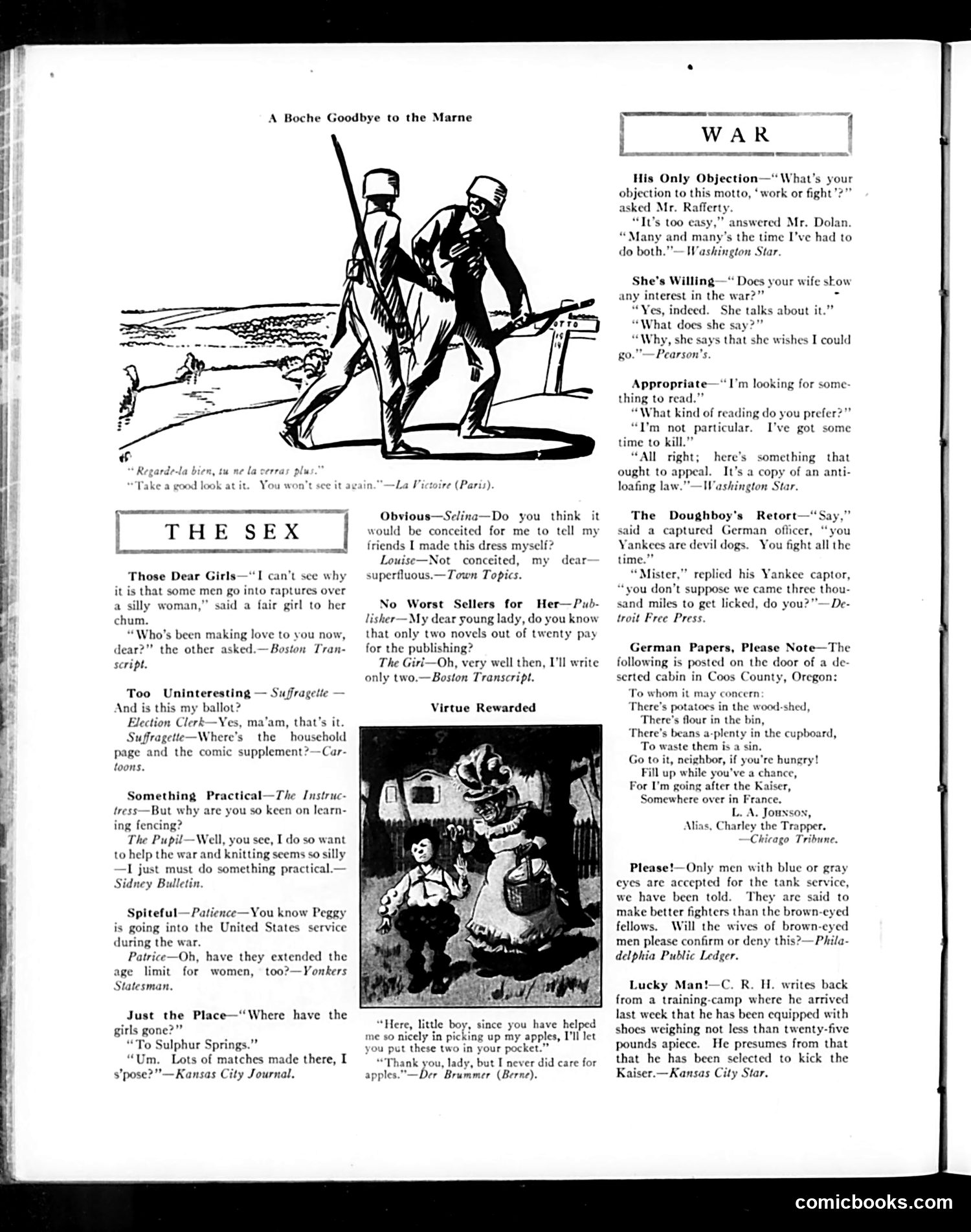
The main cartoon depicts two German soldiers (identified as "Boche"—a derogatory French term for Germans) being forced from the Marne River region during World War I. The image likely celebrates the Allied victory at the Second Battle of the Marne (July 1918), a major turning point against German forces. The surrounding jokes satirize American attitudes toward WWI participation. Several target women's suffrage advocates ("Suffragettes") who prioritize voting rights over war effort. Others mock civilian complaints about wartime restrictions and mock-heroic attitudes toward military service. The "German Papers" joke celebrates American patriotic spirit—an Oregon settler abandoning his homestead to fight "the Kaiser." The overall page reflects 1918 American confidence in the Allied cause and gently ridicules those seen as insufficiently committed to defeating Germany.
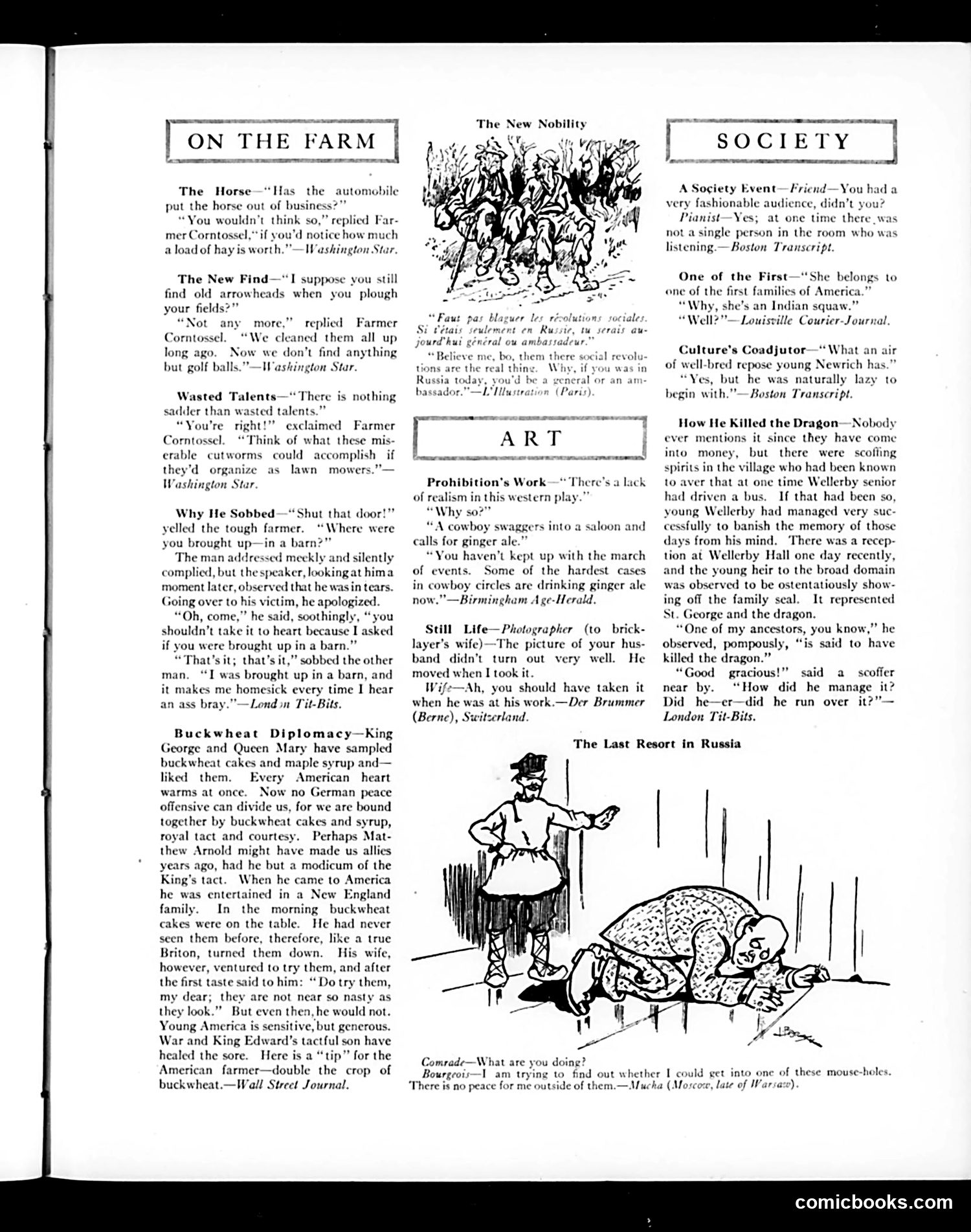
This page from Judge contains multiple satirical pieces targeting early 20th-century American life. **Farm Section**: Rural humor mocking farmers and changing times—automobiles replacing horses, golf balls replacing arrowheads on plowed fields, cutworms as potential "lawn mowers." One anecdote plays on the phrase "brought up in a barn" as insult, with ironic reversal when the victim admits nostalgia for barn life. **Society Section**: Sharp class satire. "One of the First Families" jokes that an Indian woman belongs to America's original families. "How He Killed the Dragon" satirizes social climbing—the nouveau riche Wellerby family suppresses embarrassing history (the father drove a bus) to appear aristocratic. "Culture's Coadjutor" mocks lazy wealth masquerading as refined taste. **Art/Mixed**: "Prohibition's Work" satirizes the absurdity of Western saloon scenes with ginger ale instead of alcohol (Prohibition-era commentary). "Still Life" is a mild domestic joke about a photographer's subject. **"Buckwheat Diplomacy"**: References King George V and Queen Mary's American visit, suggesting food diplomacy could unite nations better than Matthew Arnold's failed 19th-century visit.
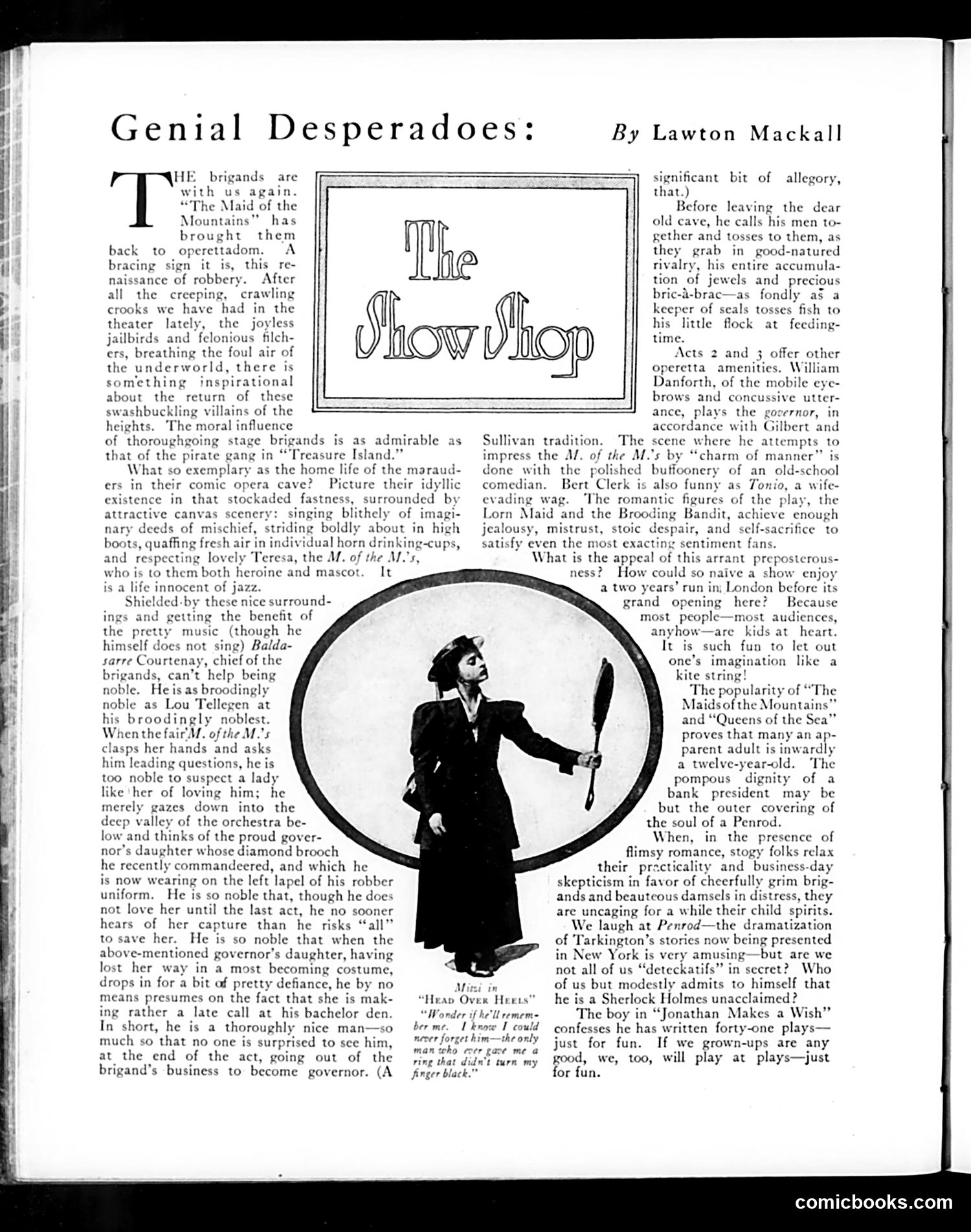
This is Lawton Mackall's review of an operetta called "The Maid of the Mountains," praising its return to cheerful, romantic villainy after recent theater offerings featuring grim, realistic criminals. **The satire's point:** Mackall argues that stage brigands—romanticized, noble bandits who sing prettily and respect women—are morally superior to the depressing, naturalistic "crooks" that have lately dominated American theater. The brigand chief Baldassarre Courtenay is so nobly virtuous he ultimately abandons crime to become governor. **The joke:** Mackall is gently mocking both the operetta's naive sentimentality *and* audiences who prefer escapist fantasy to serious drama. He acknowledges the show's appeal is fundamentally childish—letting imagination run free like a kite string—yet finds this charming rather than contemptible. The circular illustration shows a man in formal dress striking a theatrical pose, likely depicting a lead character.
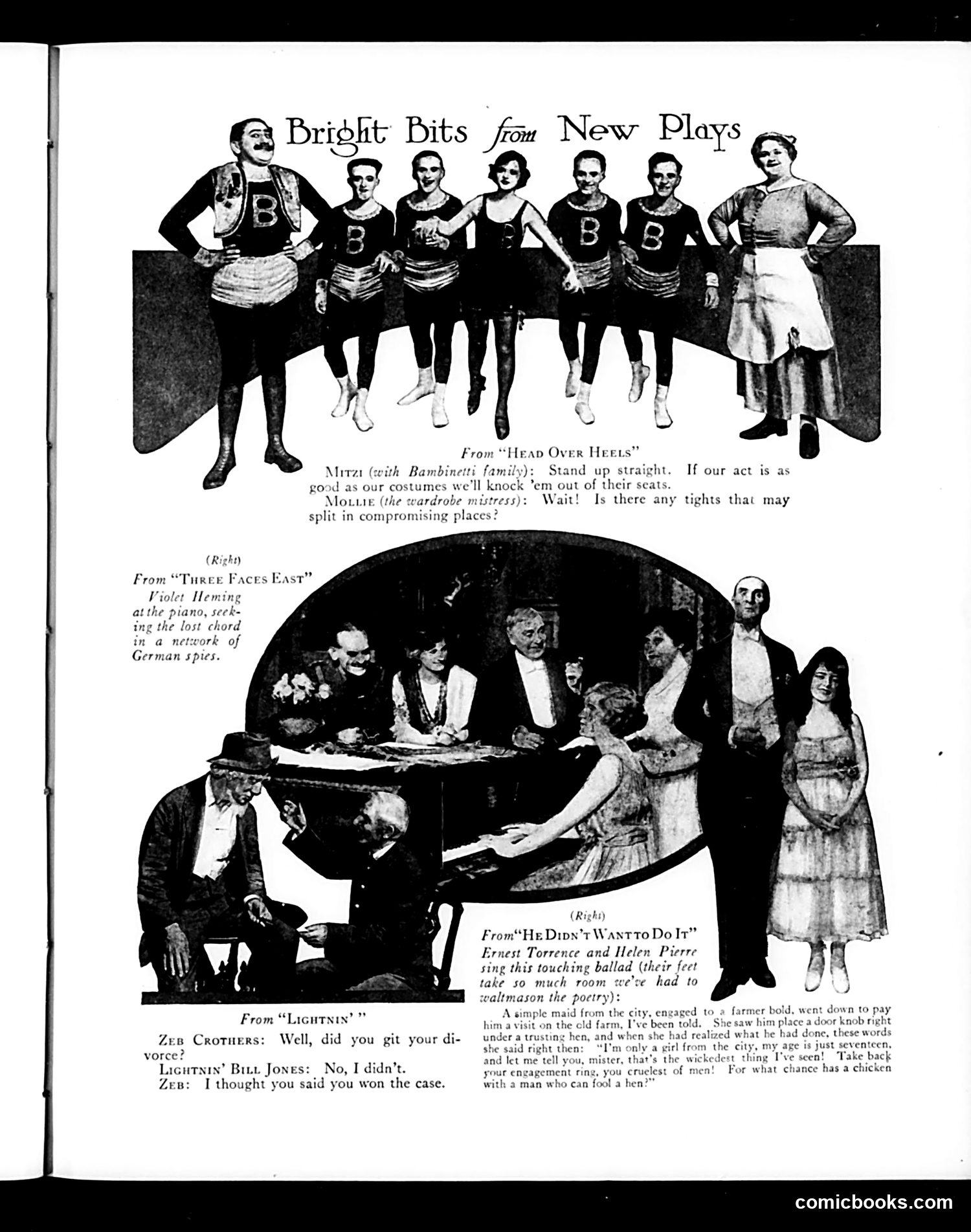
This page collects humorous excerpts from contemporary theatrical productions. The top section shows a chorus line from "Head Over Heels," with a wardrobe mistress concerned about costume malfunctions—satirizing both the physical demands of dance routines and the modest sensibilities of the era. "Three Faces East" features a pianist performing amid a melodramatic spy plot (German spies were a popular theatrical villains' motif, likely reflecting WWI-era anxieties). "He Didn't Want to Do It" jokes about two characters—Ernest Torrence and Helen Pierre—singing a sentimental ballad so energetically that their feet consume stage space, forcing the poetry to be abbreviated. The bottom excerpt shows a humorous dialogue between "Zeb Crothers" and "Lightnin' Bill Jones," playing on rural dialect comedy popular in vaudeville. The joke involves misunderstanding legal victory: one character won his case but lost his divorce anyway—a play on the absurdities of courtroom outcomes.
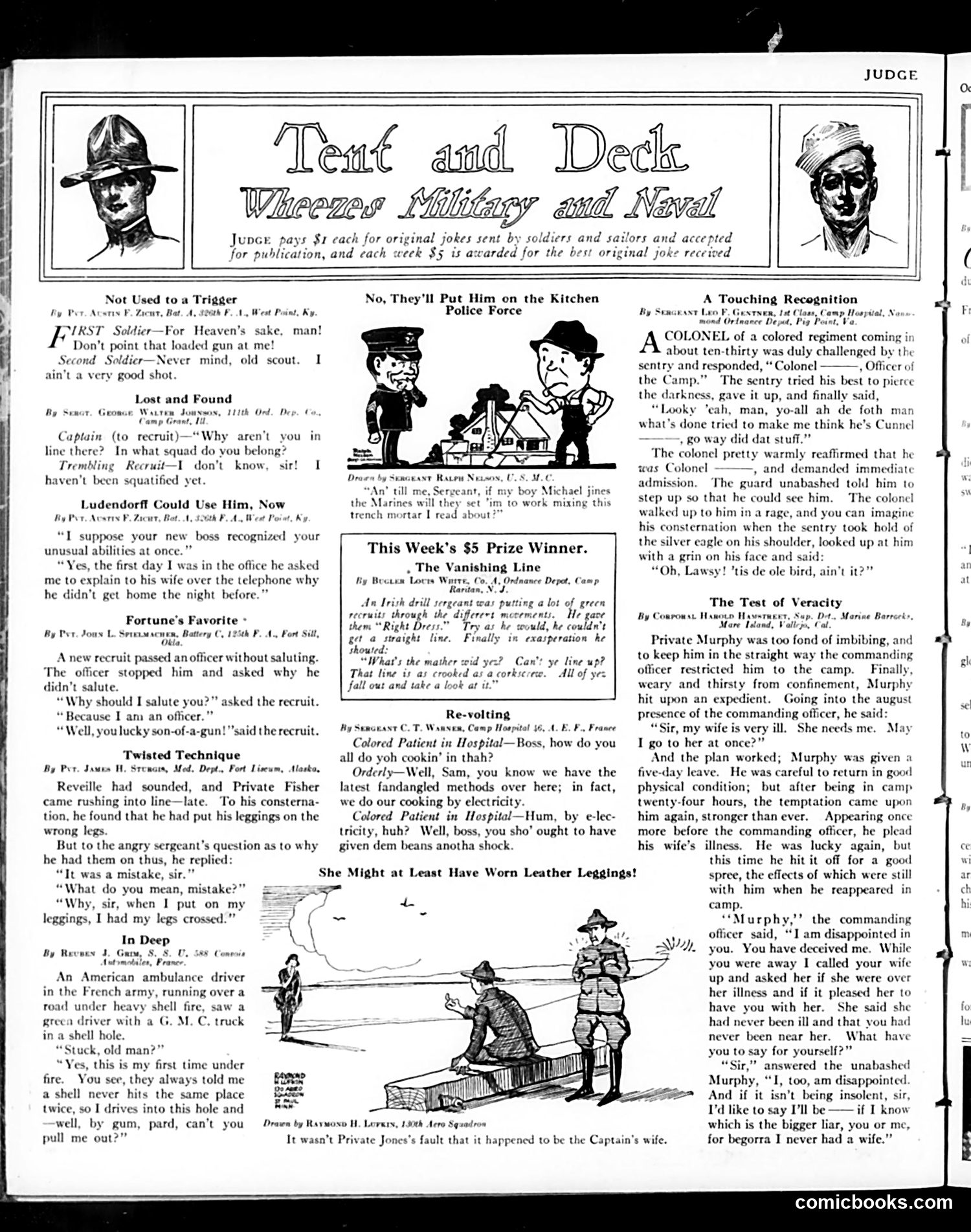
This is a humor page from Judge magazine featuring military jokes submitted by soldiers and sailors during World War I. The page collects brief anecdotes and cartoon illustrations meant to entertain service members. The jokes mock common military experiences: recruits unfamiliar with protocol ("squatified"), soldiers making dangerous mistakes with weapons, and the confusion of military hierarchy. One cartoon depicts a soldier stuck in a shell hole, having followed the old saying that shells never hit the same spot twice—a dark humor commentary on trench warfare. A recurring theme is racial humor typical of the 1910s-1920s, including a "Colored Patient in Hospital" joke that relies on dialect stereotypes. Another section titled "A Touching Recognition" references a colored regiment officer, appearing to treat the encounter as noteworthy. The page reflects WWI-era military culture: the hazards of trench warfare, rigid chain-of-command confusion, and the casual racism embedded in American military society at that time. Modern readers should recognize both the historical documentation value and the offensive racial stereotypes present.
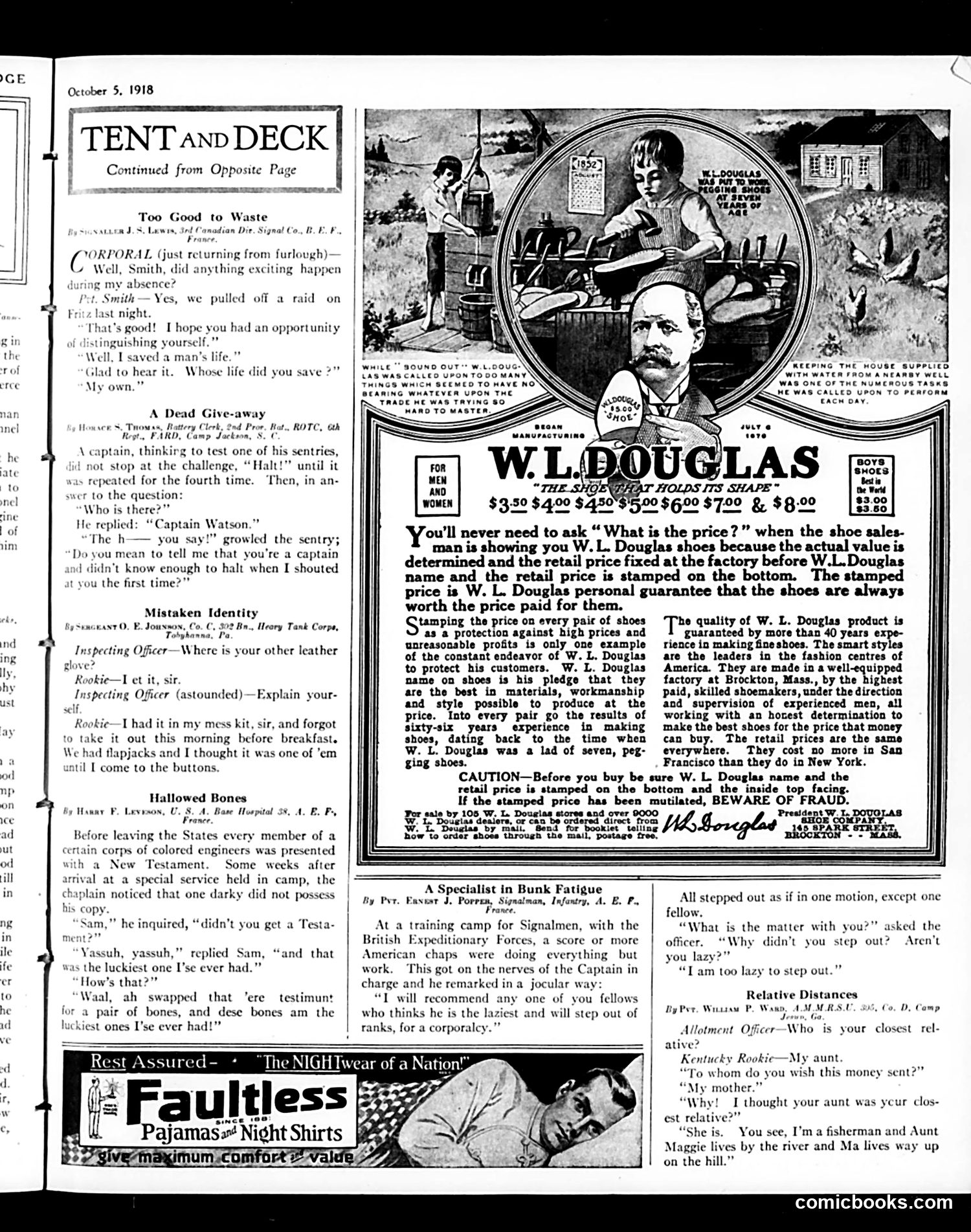
This page mixes **WWI military humor** with **commercial advertising**. The left column contains four brief comedic sketches about soldiers: 1. **"Too Good to Waste"** jokes about a corporal saving his own life during a raid—dark humor about wartime danger. 2. **"A Dead Give-away"** depicts a captain's identity exposed when challenged by a sentry, playing on military protocol. 3. **"Mistaken Identity"** shows a rookie who ate his leather glove thinking it was a pancake—slapstick humor about army camp confusion. 4. **"Hallowed Bones"** presents a racist caricature of a Black soldier who traded his Bible for dice bones—reflecting the period's deeply offensive depictions of African Americans. The **dominant feature** is a large **W.L. Douglas shoe advertisement** claiming factory-stamped prices guarantee fairness and prevent fraud—a consumer protection pitch during wartime inflation. The ad includes a circular inset photo of Douglas himself. Below runs a **"Faultless Pajamas"** advertisement. The content reflects 1918 America: wartime levity, consumer capitalism, and casual racial bigotry.
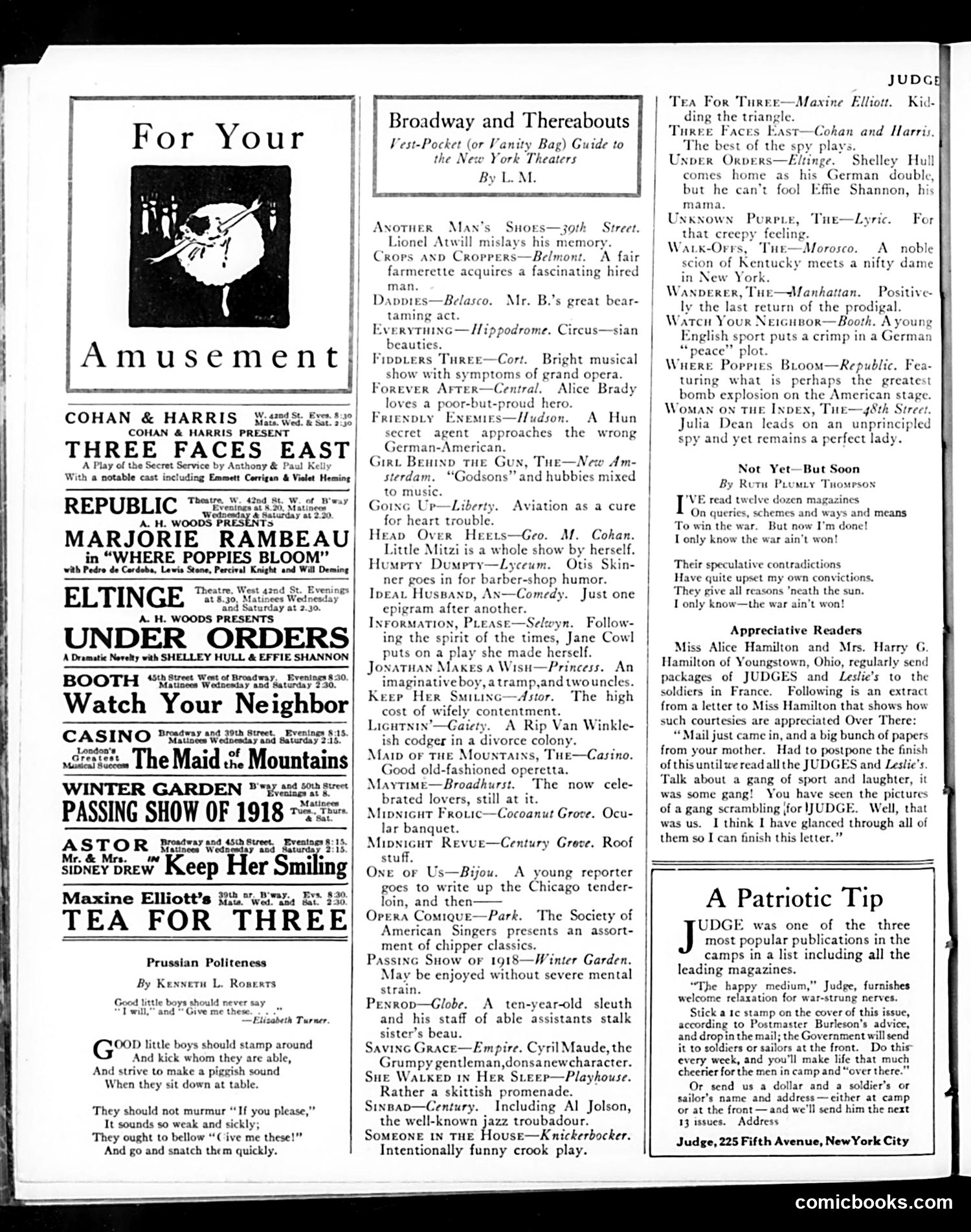
This is primarily a **theater advertising and review page** from Judge magazine, circa 1918. The left side features Broadway theater advertisements for plays like "Three Faces East" (a spy drama) and "The Passing Show of 1918" (a revue). The right side contains brief theater reviews and a poetry section. The single notable satirical content is **"Prussian Politeness"** by Kenneth L. Roberts—a short poem mocking German etiquette by inverting it. Written during WWI, it sarcastically advises American boys to adopt crude, aggressive behavior (yelling, snatching, stamping) instead of polite manners, implying this is how "Prussians" (Germans) behave. This reflects wartime American anti-German sentiment. The bottom section, **"A Patriotic Tip,"** notes that Judge magazine supports troops by encouraging readers to send stamps and letters to soldiers—typical WWI-era patriotic messaging. The page is mostly commercial and entertainment-focused rather than heavily satirical.
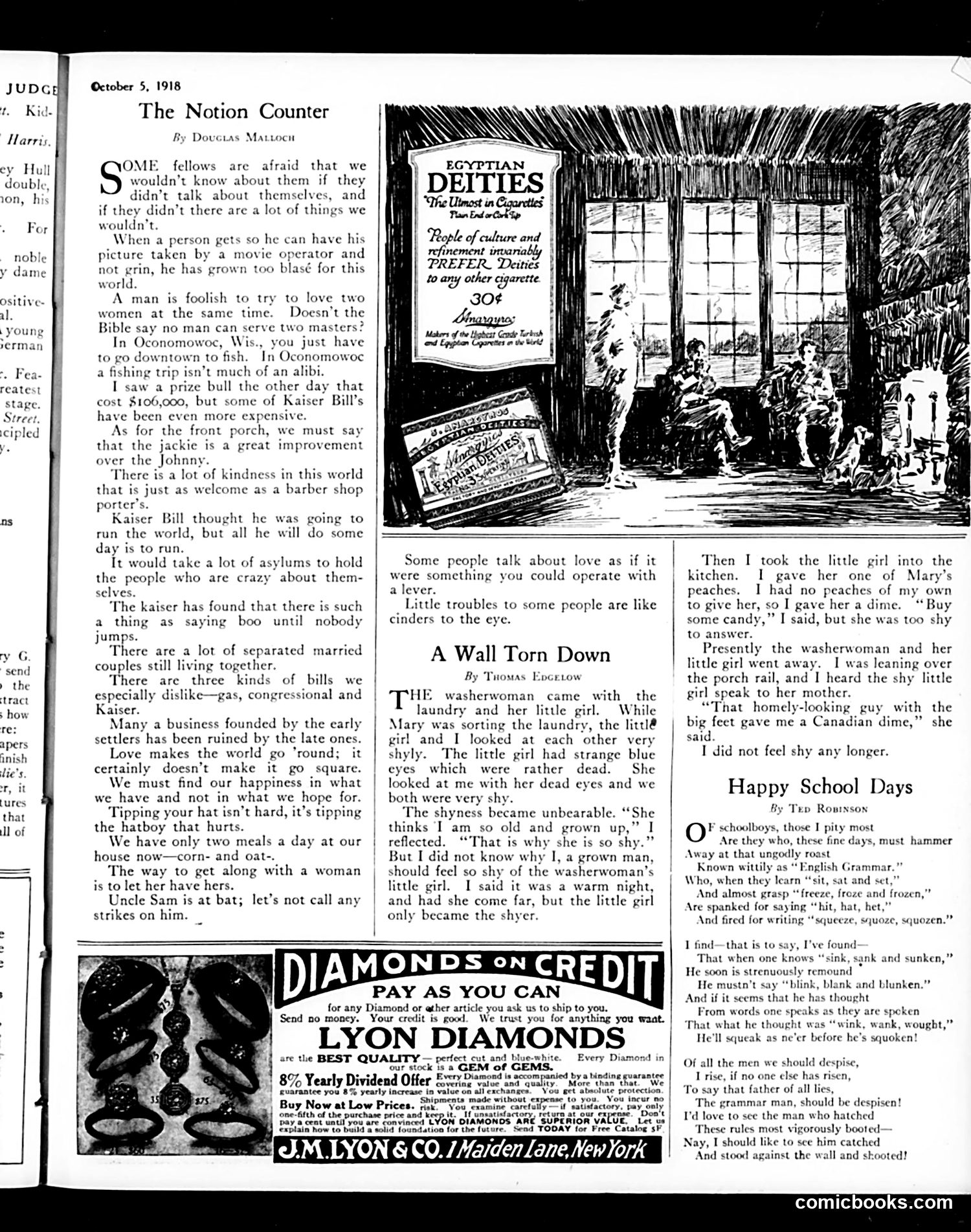
This page contains two distinct elements: **"The Notion Counter"** is a humorous column of brief satirical observations by Douglas Malloch. Notable references include: - A jab at **"Kaiser Bill"** (German Emperor Wilhelm II), whose expensive horses are mentioned mockingly—likely appealing to American readers in 1918, when the U.S. was actively fighting Germany in World War I. The column ends with "Uncle Sam is at bat; let's not call any strikes on him"—patriotic encouragement not to criticize American war efforts. - Social commentary on American foibles: excessive self-promotion, pretentiousness, failed marriages, and bad tipping practices. **"A Wall Torn Down"** is a sentimental short story about an awkward encounter between a narrator and a washerwoman's shy daughter, depicting a moment of human connection transcending class barriers. The page also features cigarette and diamond advertisements typical of early-20th-century magazines.
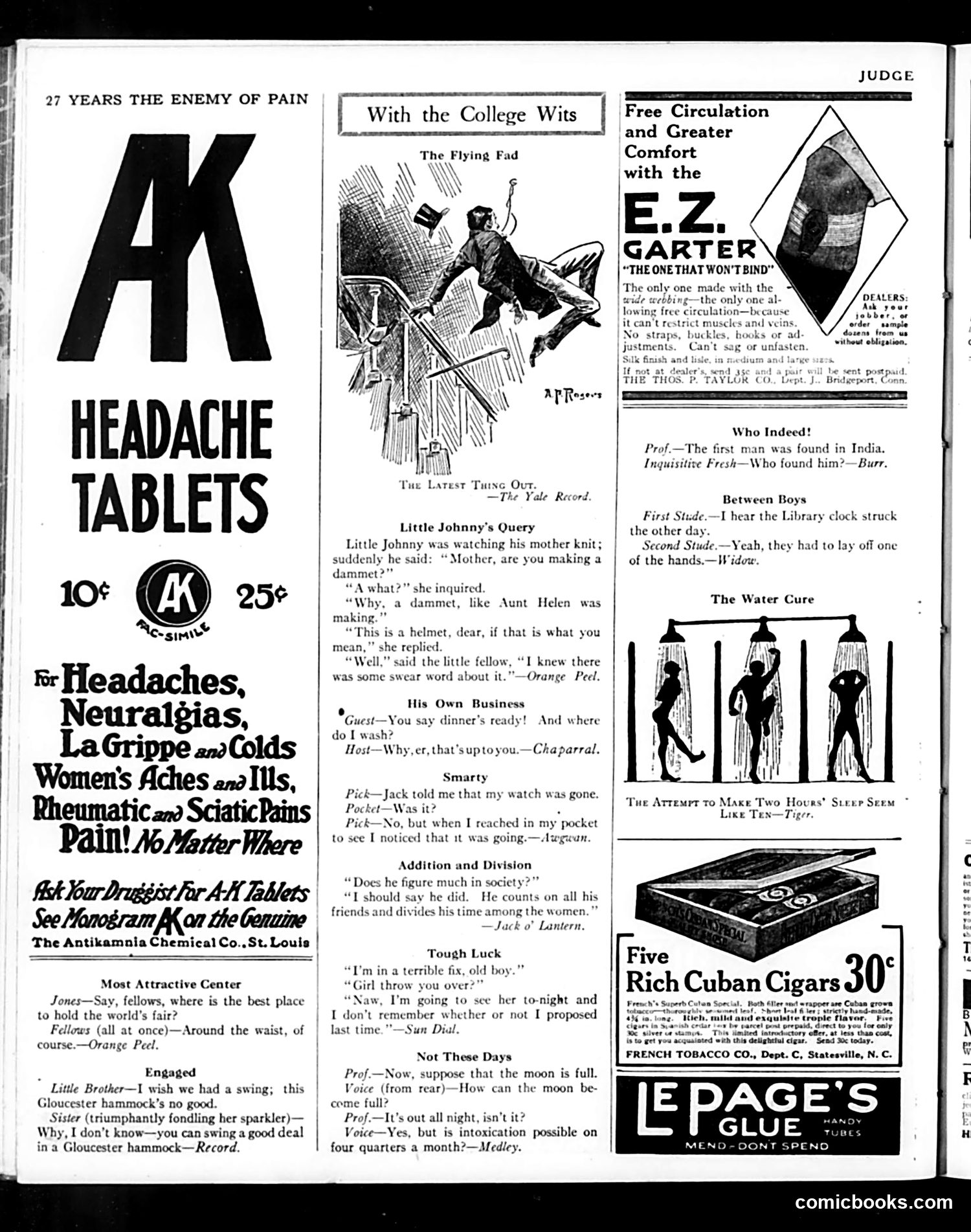
This is primarily an **advertising and humor page** from Judge, a satirical weekly magazine. The page contains: **Main Content:** - Large advertisement for "AK Headache Tablets" (left side) — a pain reliever marketed for headaches, neuralgia, colds, and rheumatic pain - Multiple brief college humor jokes ("With the College Wits") — typical early-20th-century campus jokes about students, romance, and wordplay - Advertisements for E.Z. Garter, Cuban cigars, and Page's Glue **The Cartoon:** "The Flying Fad" (top center) shows a student apparently flying/jumping with a bicycle, captioned as "The Latest Thing Out" from Yale Record — likely mocking a trendy college fad or dangerous stunt. **Humor Style:** The jokes rely on puns, misunderstandings, and innuendo typical of the era ("dammet" confusion, watch "going," moon intoxication). These would have amused college-educated readers familiar with campus culture. **Historical Context:** This reflects pre-1920s American consumer culture: patent medicines were heavily advertised, college humor was a recognized genre, and satirical magazines monetized through advertisements.
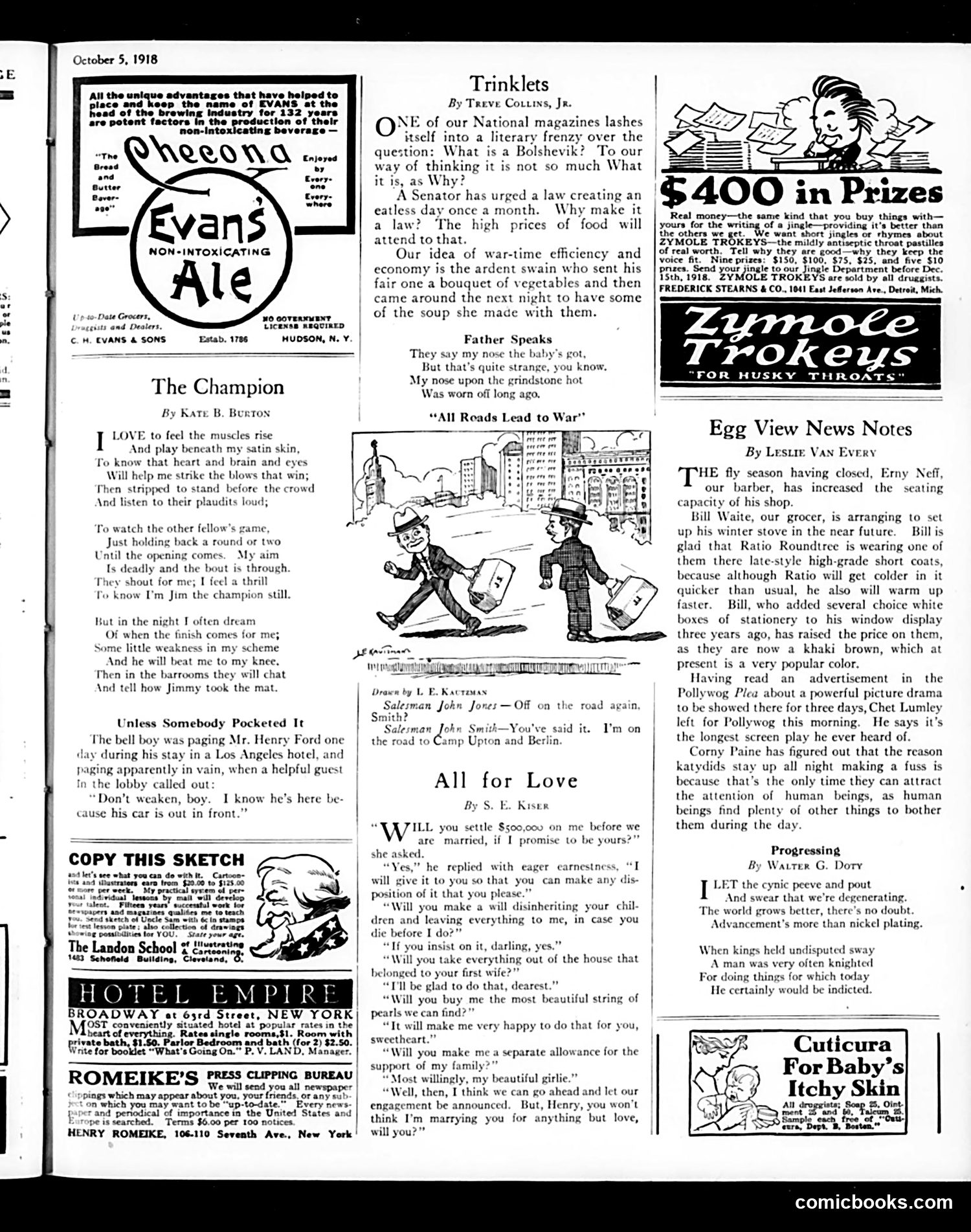
This page mixes advertisements with several short satirical pieces reflecting WWI-era concerns. **"Trinklets" column** satirizes government wartime measures: a senator's proposed "meatless day" law is mocked as unnecessary since high food prices already accomplish the goal. The piece also ridicules wartime romance—a suitor sending vegetables as a bouquet, then profiting from soup made from them. **"All Roads Lead to War"** is a brief comic dialogue about traveling salesmen, playing on the phrase "all roads lead to Rome" by substituting wartime destinations (Camp Upton and Berlin), reflecting America's active WWI involvement in 1918. **"All for Love"** presents a mercenary woman extracting increasingly absurd financial and legal concessions from her fiancé before agreeing to marry him—satirizing gold-diggers and prenuptial negotiations. The page is primarily filled with period advertisements (Evans Ale, Hotel Empire, Zymole throat lozenges) and includes unrelated content like poetry and etiquette columns typical of Judge's mixed format.
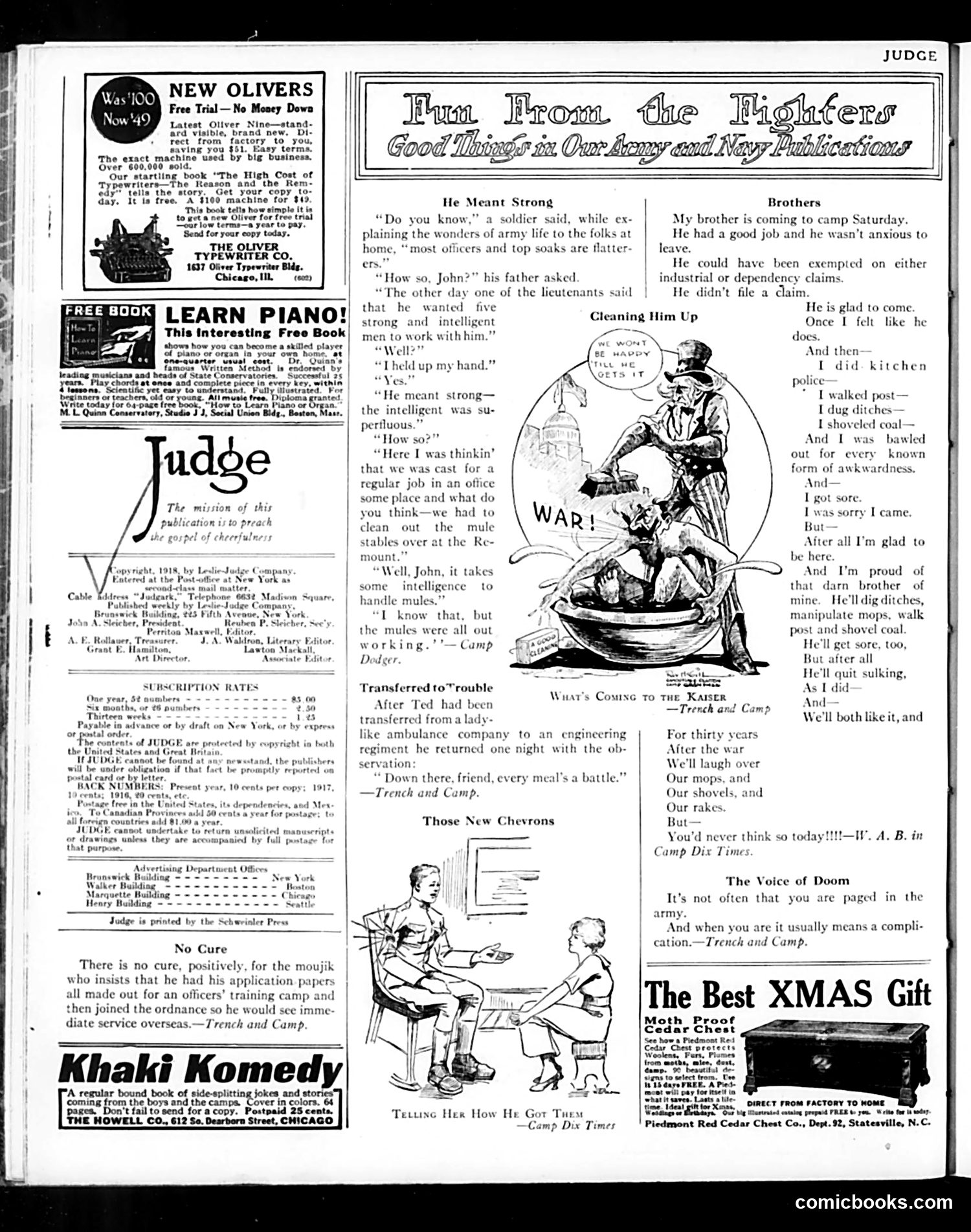
This page from *Judge* magazine combines **wartime humor and advertisements** from WWI-era America. The cartoons satirize soldiers' experiences through enlisted men's perspectives: **"He Meant Strong"** jokes that a soldier volunteered for what he thought was office work but was assigned to clean mule stables—the humor lies in the soldier's physical strength being useless without intelligence (the mules were already working elsewhere). **"Transferred to Trouble"** satirizes a soldier moved from an ambulance unit to engineering, where every meal felt like "a battle"—absurdist humor about wartime food conditions. **"Brothers"** presents a sentimental narrative: a soldier reflects on initially resenting military service (police duty, digging, shoveling, punishment for awkwardness) but ultimately becoming proud his brother volunteered despite having exemption options. It expresses patriotic acceptance of sacrifice. The page reflects how *Judge* mixed patriotic messaging with enlisted-perspective humor—validating common soldiers' complaints while encouraging acceptance of military hardship as honorable.
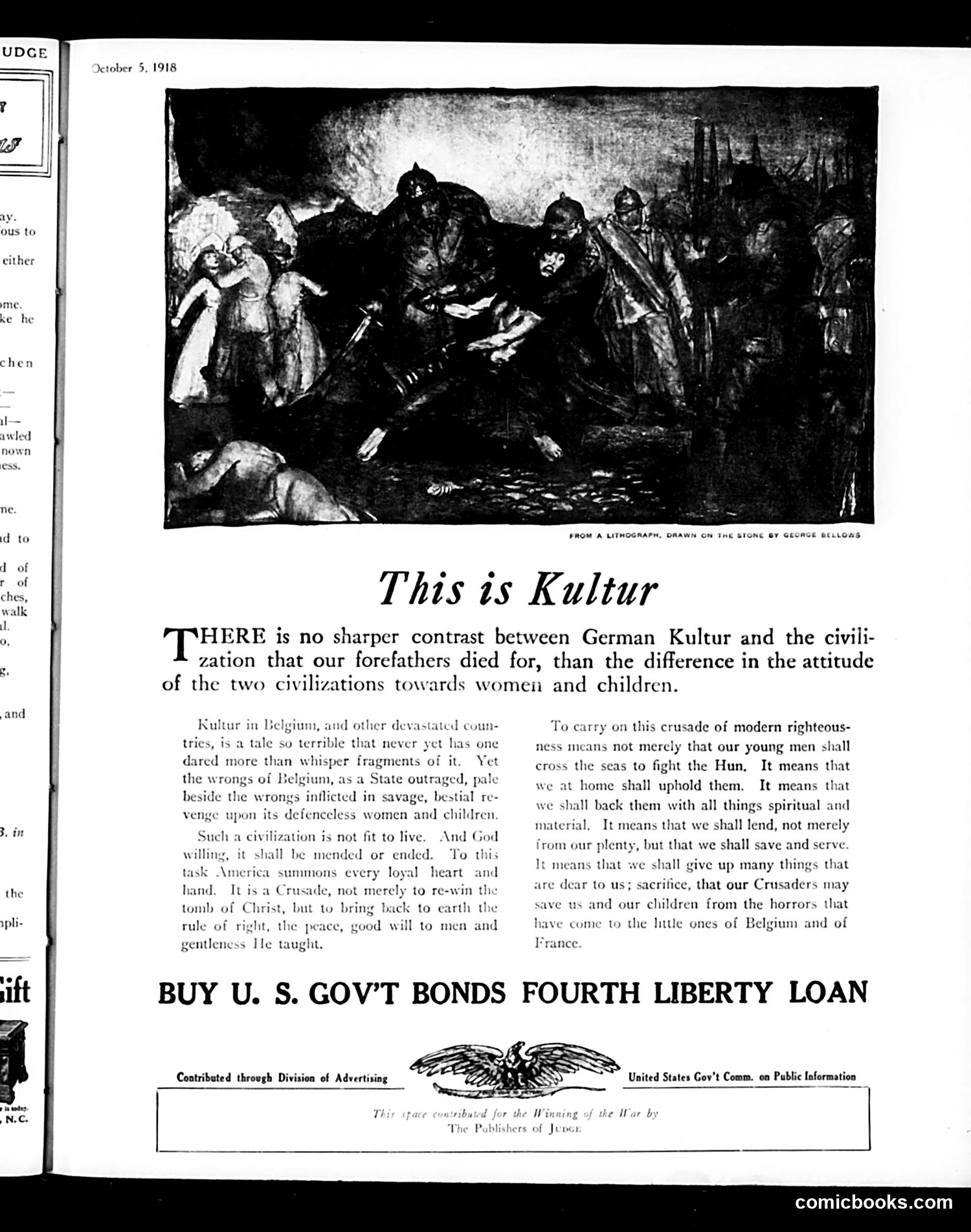
This is a WWI propaganda piece, not satire. The lithograph by George Bellows depicts German soldiers brutalizing Belgian civilians—women and children—during Germany's 1914 invasion of Belgium, an event that shocked the world and became a rallying cry for Allied support. The text contrasts "German Kultur" (presented as barbaric brutality toward the defenseless) with Western civilization's values. It frames American involvement as a righteous "Crusade" to restore "right, peace, and gentleness." The propaganda pushes readers to buy Fourth Liberty Loan bonds to fund the war effort, arguing that supporting soldiers abroad means sacrificing at home. The appeal conflates patriotic duty with financial investment in the war. For modern readers: this represents how American media demonized the enemy and mobilized civilian support through atrocity narratives and emotional appeals during the final year of WWI.
This page is primarily **advertising copy**, not satire or political commentary. It promotes the "Roth Memory Course," a commercial memory-improvement program marketed through Judge magazine. The text presents a testimonial from "Victor Jones" claiming he learned memory techniques in one evening from David M. Roth, then increased his business revenue by $100,000 within six months. The narrative includes supporting quotes from business figures (a publisher, a telephone company official, etc.) vouching for the course's effectiveness. At the bottom is a **free examination coupon** from "Independent Corporation," the publisher, inviting readers to request information about the memory course by mail. This represents early 20th-century **direct-response advertising**—using testimonials and urgency ("Free Examination") to sell self-improvement products. Judge magazine's satirical reputation makes its inclusion of such earnest commercial content somewhat ironic, though the ad itself contains no obvious satire or humor. It's straightforward mail-order marketing.